
What size supplement box do I need for bottles, jars and stick packs?
Short answer: Measure the widest point of your bottle or cap and add 1/16 to 1/8 inch on length, width and height. Standard 120 cc bottles fit 2.0 × 2.0 × 3.75 inch cartons, while 150 cc bottles use 2.25 × 2.25 × 4.25 inches. Order custom supplement boxes cut to any size.
On this page
- What are the standard supplement box sizes by bottle capacity and format
- How do I measure a round packer bottle and child-resistant cap for a box
- How do I size a box for 15 or 30 hydration, collagen or greens stick packs
- How much space do blister cards, leaflets and neck collars add
- Can I use one supplement box size across multiple bottle SKUs
- Common mistakes
- FAQs
Request a custom quoteFree dieline & 3D mockup
To find the exact inside size for a supplement box, measure your physical container at its widest horizontal point (either the bottle cylinder or the ribbed child-resistant cap) and its total vertical height from base to cap top, then add 1/16 inch (1.5 mm) of clearance on length and width and 1/8 inch (3 mm) on height. Standard 100 cc to 120 cc capsule packer bottles typically use a 2.0 × 2.0 × 3.75 inch inside carton, 150 cc to 175 cc bottles use a 2.25 × 2.25 × 4.25 inch carton, and 200 cc to 250 cc bottles use a 2.5 × 2.5 × 4.75 inch carton. For 15 to 30 single-serve hydration or collagen powder stick packs, a 3.5 × 2.5 × 5.5 inch vertical dispenser carton is the industry workhorse. When you order from CubitPack, every folding carton is cut to your exact inside dimensions from 1,000 units with no die fees.
What are the standard supplement box sizes by bottle capacity and format?
Supplement bottles are sold by internal volume in cubic centimeters (cc) rather than fluid ounces. A 150 cc bottle holds roughly 60 standard size-00 vegetable capsules, whereas a 200 cc bottle holds 90 to 120 capsules. However, two 150 cc bottles from different mold makers can vary by 2 to 4 mm in diameter depending on whether the profile is a tall slim cylinder or a squat wide-mouth jar, and whether it is molded in PET plastic or thick-walled amber glass. Use the reference table below to benchmark your starting carton size before measuring your physical sample. Every row lists the inside carton dimensions (length × width × height in inches) used for custom printed supplement cartons, including clearance for smooth hand or automated loading.
| Supplement container or format | Typical inside box size (L × W × H) | Recommended carton style |
|---|---|---|
| 75 cc - 100 cc small bottle (30 capsules) | 1.875 × 1.875 × 3.5 in | Straight or reverse tuck end |
| 120 cc standard packer bottle (60 capsules) | 2.0 × 2.0 × 3.75 in | Straight or reverse tuck end |
| 150 cc - 175 cc packer bottle (60-90 capsules) | 2.25 × 2.25 × 4.25 in | Straight tuck end or auto lock bottom |
| 200 cc - 250 cc packer bottle (90-120 capsules) | 2.5 × 2.5 × 4.75 in | Auto lock bottom (especially for glass) |
| 300 cc - 400 cc wide jar (60 gummies / softgels) | 2.875 × 2.875 × 5.25 in | Auto lock bottom |
| 15-count powder stick packs (single row) | 2.5 × 2.0 × 5.5 in | Straight tuck end or dispenser box |
| 30-count powder stick packs (two rows of 15) | 3.5 × 2.5 × 5.5 in | Perforated gravity dispenser box |
| 2 to 4 probiotic blister cards (30-60 count) | 4.25 × 1.5 × 5.25 in | Reverse tuck end or seal end |
How do I measure a round packer bottle and child-resistant cap for a box?
When sizing a square folding carton around a round cylindrical bottle, length (left-to-right front width) and width (front-to-back depth) are equal. The single biggest trap is measuring only the smooth bottom wall of the bottle while ignoring the cap and neck ring at the top. On 75 cc, 100 cc and 120 cc bottles fitted with a 38-400 child-resistant push-and-turn closure or a ribbed flip-top cap, the outer knurled diameter of the cap is often 1.5 to 2.5 mm wider than the bottle shoulder. If you size the carton to the narrower bottle body, the top of the box bulges outward around the cap and the top tuck flap refuses to stay closed. Always measure both the bottle diameter and the outer cap diameter with calipers, take the larger of the two numbers, and add 1/16 inch (1.5 mm) for a snug hand-packed fit or 3/32 inch (2.5 mm) for high-speed automated cartoning lines.
- Measure bottle body diameter across the base and check for any label seam or shrink-band bulge.
- Measure outer cap diameter across the widest ribs of a child-resistant or flip-top closure.
- Use the larger diameter + 1/16 in (1.5 mm) as both your inside carton Length (L) and inside Width (W).
- Measure total vertical height from the table surface to the top of the sealed cap, then add 1/8 in (3 mm) for inside Height (H).
- Add extra width or depth if you are slipping a folded consumer information leaflet alongside the bottle.
How do I size a box for 15 or 30 hydration, collagen or greens stick packs?
Single-serve powder stick packs (sachets) behave very differently from rigid bottles because powder settles toward the bottom of each flexible packet, making the lower half of the sachet plumper than the flat heat-sealed top fin. If you calculate box depth by multiplying the flat empty thickness of one foil wrapper by 30, the filled sachets will bow the front and back carton walls outward like a pillow. Instead, gather the exact number of filled stick packs that go into one retail unit (for example, 15 packets stacked in a single column, or 30 packets arranged in two side-by-side columns of 15). Stand the bundle upright on your desk and hold it together with light finger pressure: just enough to keep the packets neat without squeezing the powder flat. Measure the bundle width, front-to-back stack depth at the plumpest lower third, and stick height, then add 1/8 inch (3 mm) to each dimension so packets slide smoothly out of a custom dispenser box.
Know your size? Compare pricing across up to 3 quantities.
Request a Quote →How much space do blister cards, leaflets and neck collars add?
Probiotics, digestive enzymes and daily AM/PM vitamin regimens are frequently packed in foil-on-foil or PVC/foil thermoformed blister cards. Unlike round bottles, blister cards are flat rectangles with raised dome cavities. To size a carton for multiple blister cards, stack the cards the way they will be packed (either face-to-back or nested face-to-face) and measure the combined stack thickness across the raised domes, plus 1/16 inch for a folded paper leaflet and 1/16 inch of loading clearance. If you are packing a narrow-neck glass bottle, a small 30 ml dropper bottle, or a tall slim vial inside a wider square carton so you have more room for front-panel branding, include a custom cardboard insert or an extended top dust flap with a die-cut circular neck hole. A die-cut dust-flap collar costs almost nothing extra because it is cut from the existing top side flaps of the carton, yet it locks the bottle neck dead-center so the container cannot rattle.
- Folded package insert leaflet: add 1/16 in (1.5 mm) to carton depth so the paper slips in without catching on the bottle.
- Extended dust-flap neck collar: needs at least 0.5 in of vertical space between the bottle shoulder and the top of the cap.
- Separate corrugated or card partition: add 1/8 in (3 mm) per divider wall when bundling 2 or 3 bottles in one kit.
- Dosing scoop allowance: if packing a plastic scoop beside a pouch or jar, measure the scoop bowl depth and handle length.
Can I use one supplement box size across multiple bottle SKUs?
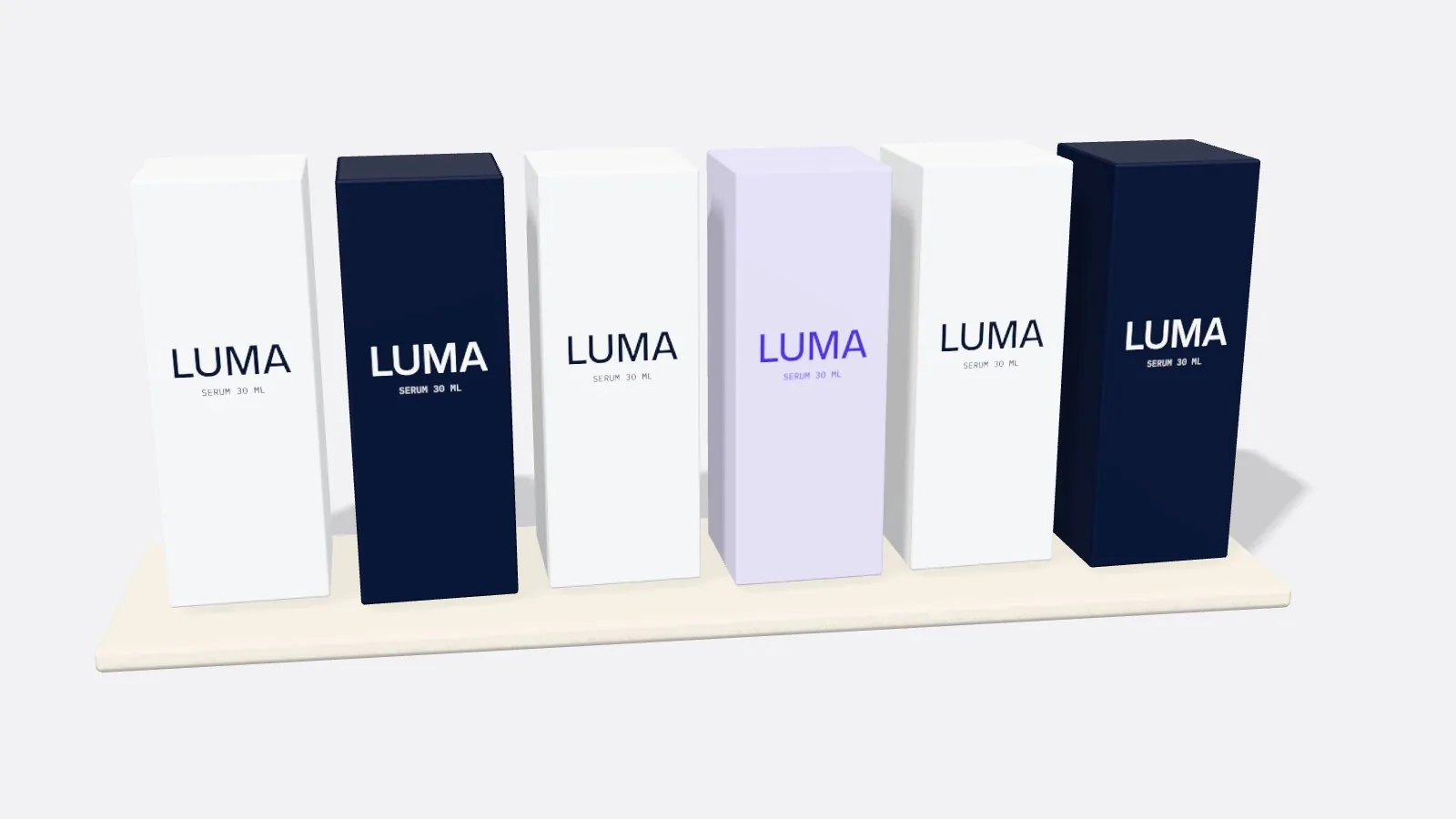
Many growing supplement brands carry four to six core products: a 60-capsule probiotic in a 120 cc bottle, a 90-capsule multivitamin in a 150 cc bottle, and a 60-capsule herbal adaptogen in a 150 cc bottle. Ordering one shared 2.25 × 2.25 × 4.25 inch carton size across all 120 cc and 150 cc products, and using an extended top dust-flap collar to hold the slightly shorter 120 cc bottle steady, lets you combine your order volume and simplify co-packer line changeovers. When all your bottle cartons share the exact same outside footprint, your contract packager does not need to re-adjust the rails on their cartoner or case-packer between flavor or formula runs, and your retail shelf display trays fit every SKU uniformly.
What are the most common supplement box sizing mistakes?
A carton that is 2 mm too tight slows down co-packer filling lines, while a carton that is 5 mm too loose arrives dented. Check these five sizing errors before approving your dieline
- Measuring the smooth bottle wall while ignoring a wider ribbed child-resistant cap that prevents the top flap from closing flat.
- Sizing a stick-pack dispenser box from flat empty foil wrappers instead of measuring the plump lower third of filled powder sachets.
- Ordering outside dimensions instead of inside dimensions, which leaves the interior cavity 1 to 2 mm too tight after board folding.
- Forgetting to add 1.5 mm of depth for a folded consumer leaflet or dosing tracker card tucked beside the bottle.
- Packing a heavy 250 cc amber glass bottle in a tall carton with zero top neck stabilization, letting the bottle slam against the top flap.
Find your size
Suggested inside size: 2.0 × 2.0 × 3.75 in
A starting point. Your account manager confirms the size with you before the proof.
Quote this size →Packaging for this
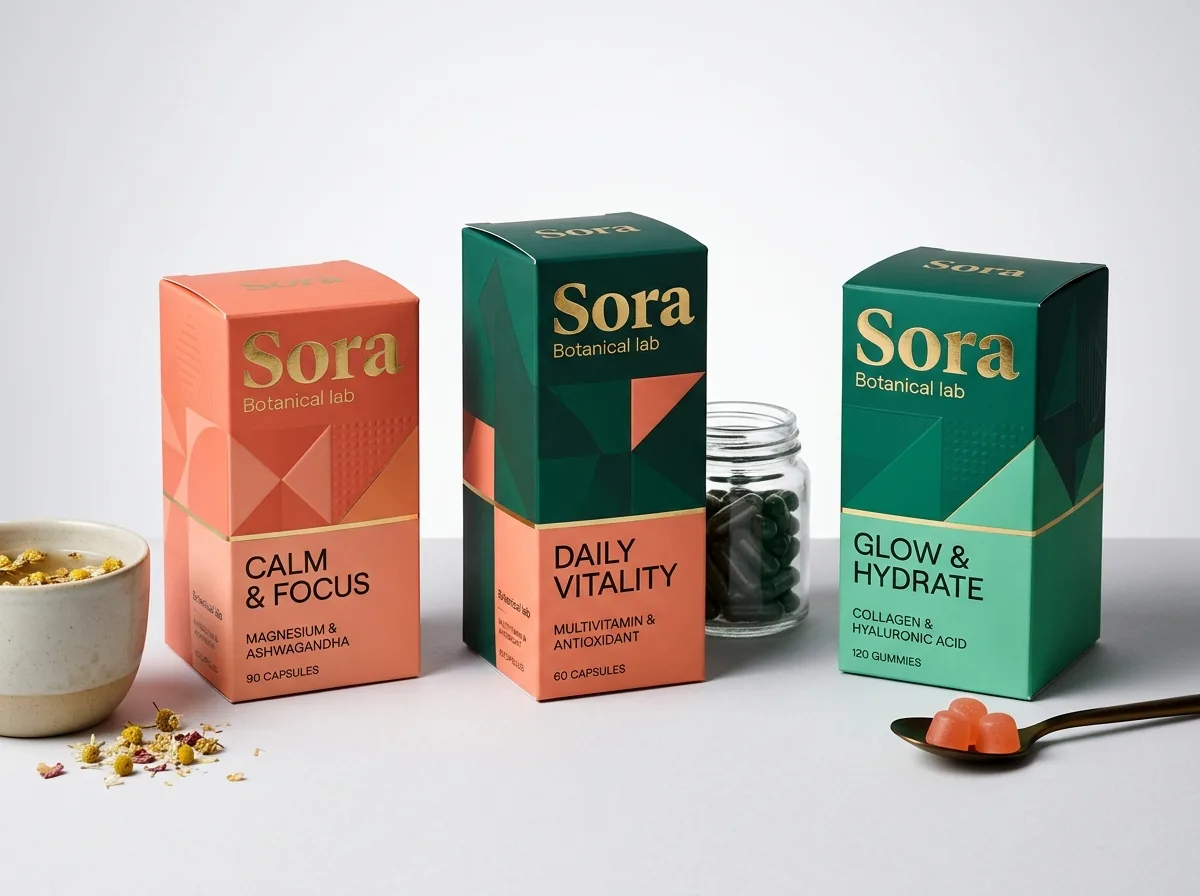
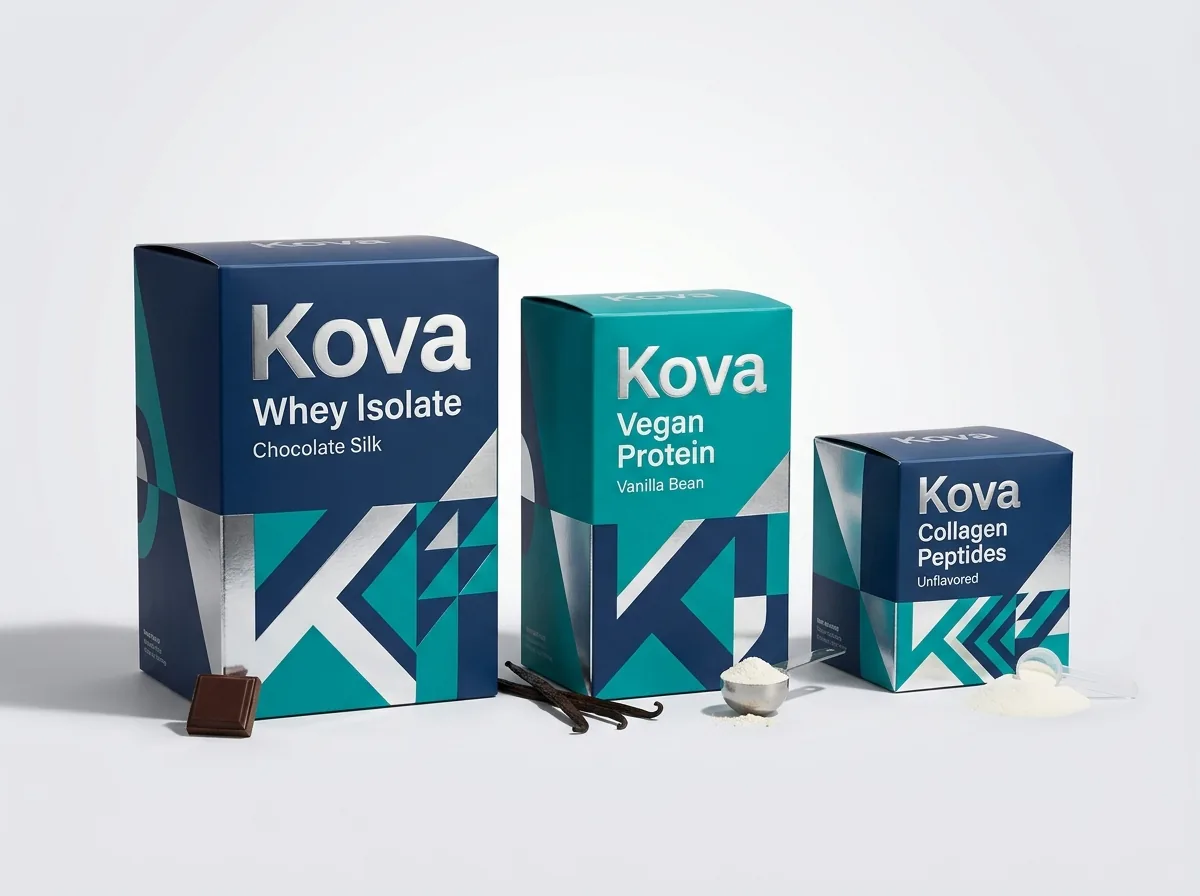
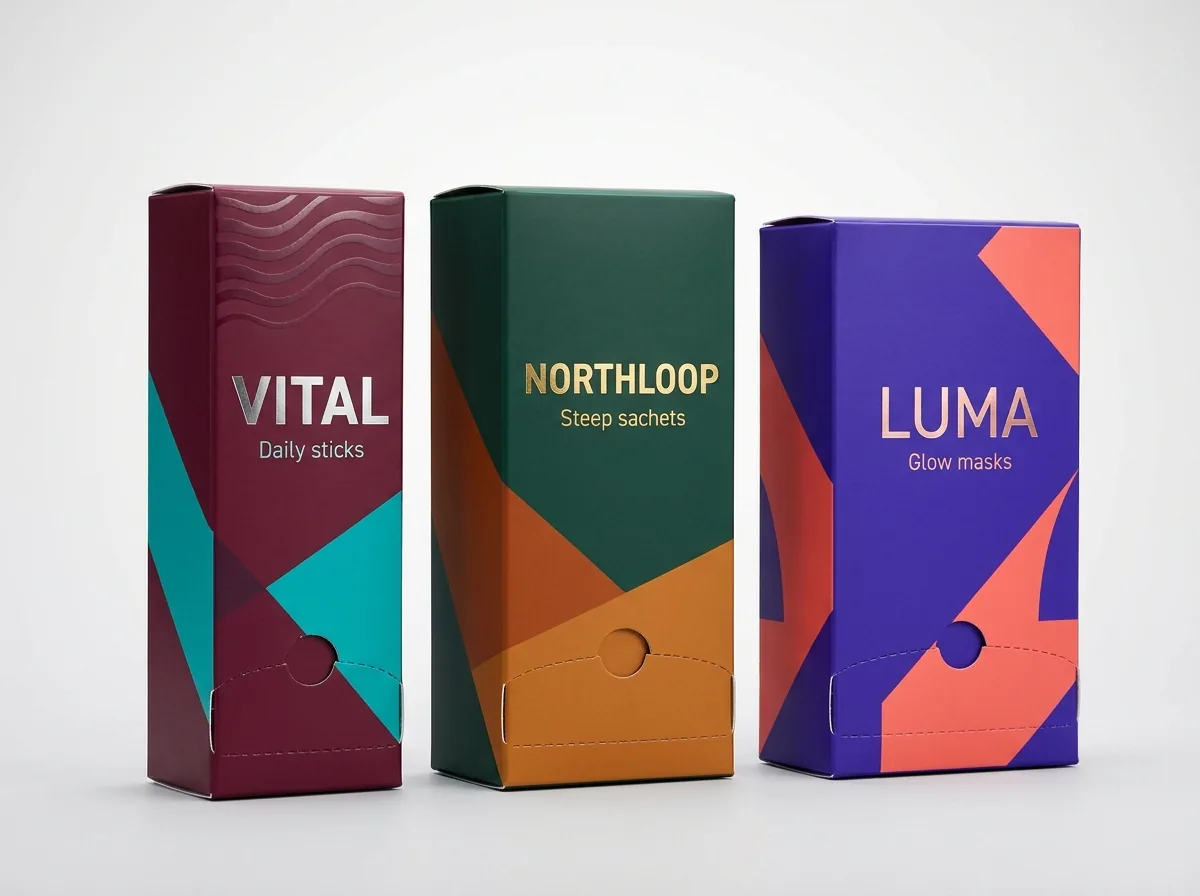
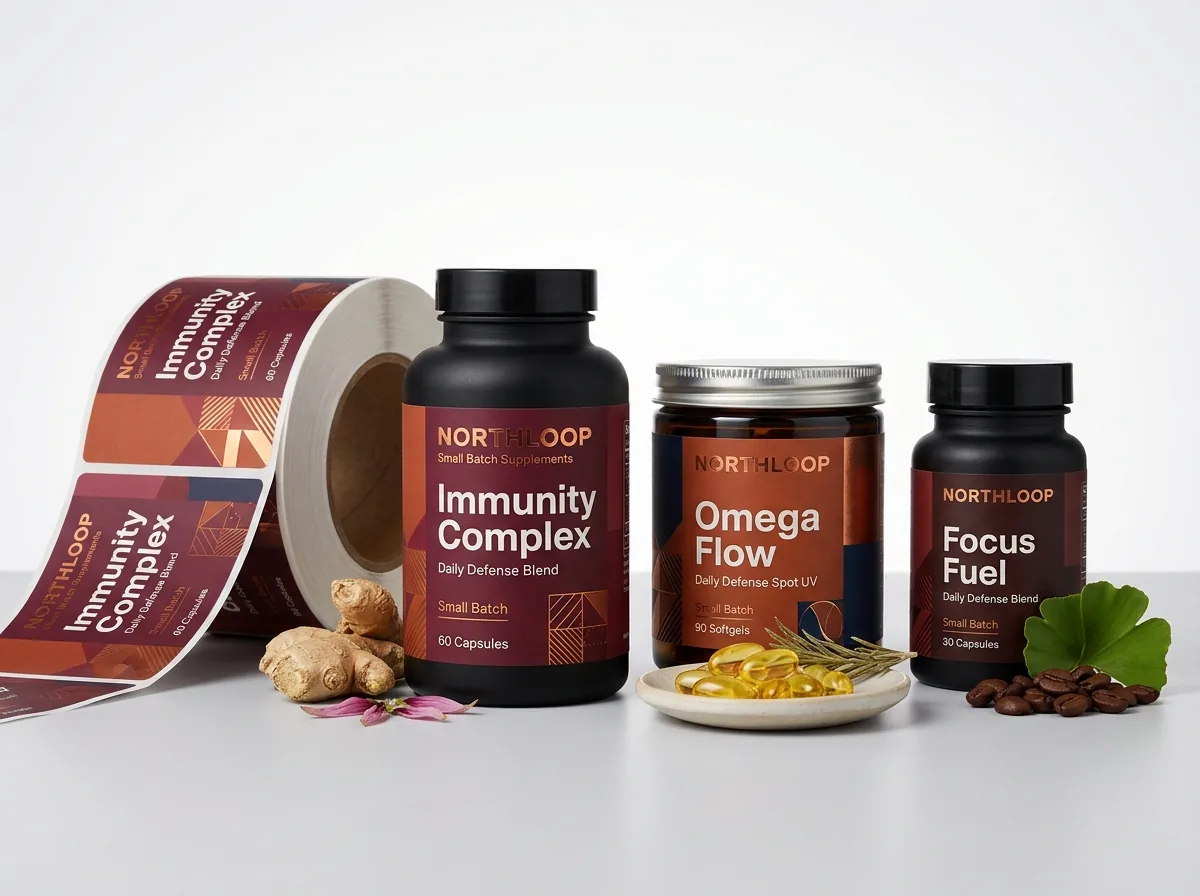
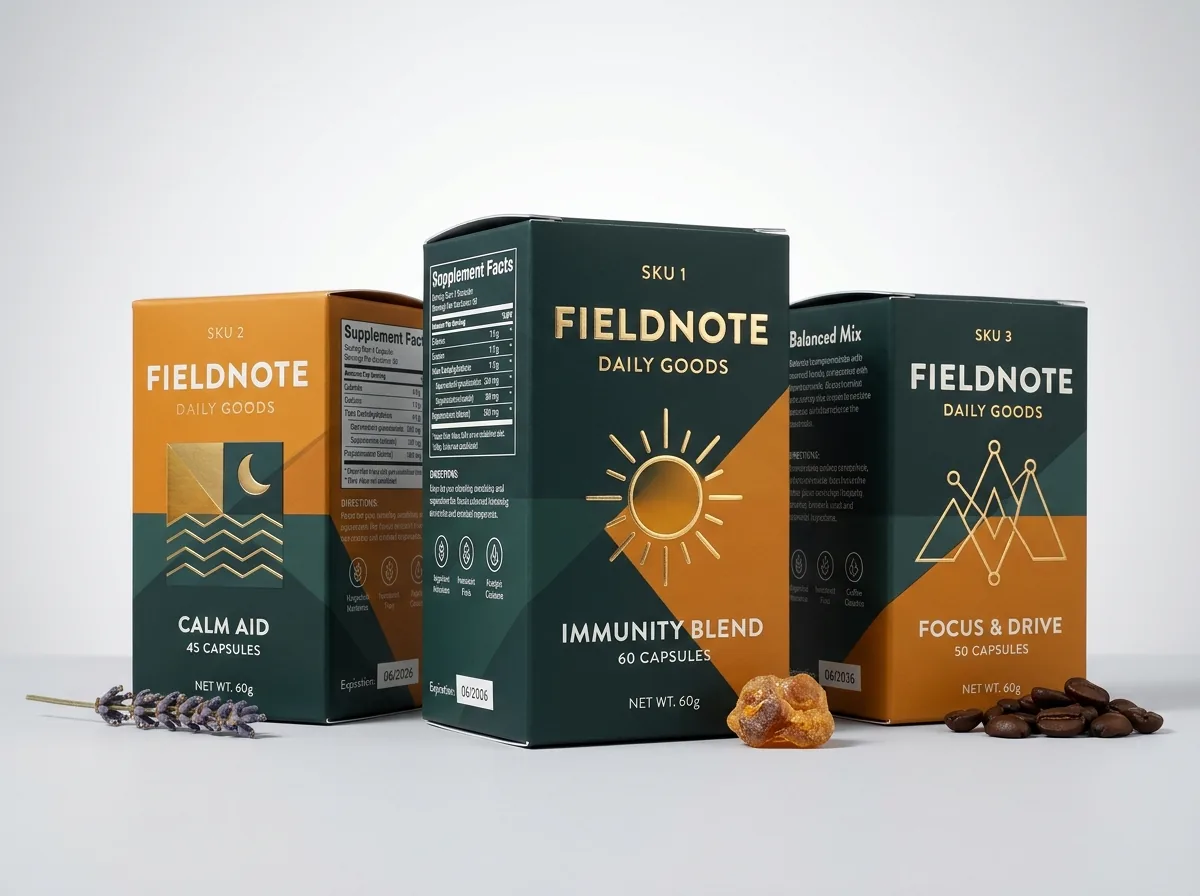
Ready to order supplement boxes? Compare up to 3 quantities with a free 3D mockup.
Request a Quote →Questions about supplement boxes
What size box fits a standard 60-count or 90-count capsule bottle?
Most 60-count capsule supplements use a 120 cc or 150 cc packer bottle, which fits a 2.0 × 2.0 × 3.75 inch or 2.25 × 2.25 × 4.25 inch inside carton. Most 90-count to 120-count formulas use a 200 cc bottle, which fits a 2.5 × 2.5 × 4.75 inch carton.
How much clearance should I add for automated co-packer cartoning machines?
While hand-packing works cleanly with 1/16 inch (1.5 mm) of clearance around the bottle width and depth, high-speed automated cartoning lines usually prefer 3/32 inch (2.5 mm) on width and depth and 1/8 inch (3 mm) on height so bottles slide in without jamming.
How high should the perforated opening be on a stick-pack dispenser box?
Set the bottom edge of the perforated dispenser window about 0.75 inch above the base of the carton, and make the window opening 1.25 to 1.5 inches tall. That retains the bottom sachet in the tray while giving fingers room to pinch and pull one packet out.
Do amber glass supplement bottles need a different box size than plastic bottles?
Yes. An amber glass packer bottle of the same cc volume (for example, 150 cc) has thicker glass walls and a heavier base than a PET or HDPE plastic bottle, making its outside diameter and height 3 to 5 mm larger. Always measure your exact glass bottle sample.
Can you build a custom dieline if I mail my bottle or stick packs to you?
Yes, or you can simply send us the caliper measurements or your bottle supplier's technical drawing. Our structural team creates your custom folding carton and neck-collar dieline for free, and you can test a physical sample before full production.
What is the minimum order for custom-sized supplement boxes?
CubitPack makes custom folding carton supplement boxes to any exact inside dimension starting at 1,000 boxes, with no die or plate charges and free shipping across all 50 US states.
Still have a question? Ask a packaging specialist.
Request a Quote →Request your supplement boxes quote
Tell us your size and quantities, and one dedicated account manager prepares pricing for each tier.
- Free design & AI-to-print studio + 3D mockup
- No die or plate charges · 4–5 day rush available
- Free shipping to all 50 states
- 10% off your first order
The packer bottle volume mappings, cap clearance rules and stick-pack bundle measurements in this guide are based on standard US nutraceutical bottle molds (75 cc to 400 cc) and contract-packaging line tolerances. A CubitPack packaging specialist verified every row. Spot an error? Tell us and we will fix it.
Sources
What changed
- October 22, 2026: First published.
- October 22, 2026: Updated specifications, terminology, and verified source links.
More guides
New packaging guides by email
Sizes, materials and design tips. Unsubscribe anytime.