
Tuck end vs auto-lock bottom supplement boxes: which should you choose?
Short answer: Choose a straight or reverse tuck end carton for lightweight PET/HDPE plastic bottles, blister packs and under-6-ounce units. Choose an auto-lock bottom carton for heavy amber glass bottles, 200 cc+ jars and fast hand-packing lines. Order custom supplement boxes in either style.
On this page
- How do reverse tuck, straight tuck, auto-lock and seal-end boxes compare
- Straight tuck end vs reverse tuck end: what is the difference on a retail shelf
- Why do amber glass bottles and 30-count stick packs need an auto-lock bottom
- How does box bottom style change co-packer hand-packing vs machine speed
- When should you upgrade to a perforated dispenser or glued seal-end carton
- Common mistakes
- FAQs
Request a custom quoteFree dieline & 3D mockup
Deciding between a tuck-end carton and an auto-lock bottom carton for your supplement line comes down to three real-world factors: the filled weight of your container, how your contract packager erects the boxes, and your target unit cost. Straight tuck end (STE) and reverse tuck end (RTE) cartons close at both top and bottom with folding friction flaps, making them the most economical choice for lightweight PET or HDPE capsule bottles, blister cards and single sachets under 6 ounces. An auto-lock bottom (crash-lock) carton arrives pre-glued at the base so the bottom flaps snap into a locked load-bearing floor the instant the flat carton is squeezed open. That pre-glued floor prevents heavy 150 cc to 300 cc amber glass bottles or 30-count stick-pack bundles from pushing through the base during parcel shipping or retail shelf handling, starting at 1,000 units.
How do reverse tuck, straight tuck, auto-lock and seal-end boxes compare?
Nutraceutical brands rely on four core folding carton closures depending on whether the primary container is a lightweight plastic bottle, a heavy amber glass jar, a blister pack or a bulk powder pouch. Compare the weight rating, front-panel appearance, assembly speed and board efficiency of each style in the table below. When reviewing your options for custom printed supplement boxes, ask your co-packer whether your run will be erected by hand or on an automated horizontal/vertical cartoner. Automated cartoners fold tuck flaps mechanically at high speed, whereas hand-packing teams work almost twice as fast with pre-glued auto-lock bases.
| Carton style | Safe container weight | Typical supplement use case | Assembly & cost notes |
|---|---|---|---|
| Reverse tuck end (RTE) | Up to 5 - 6 oz | 100-150 cc PET/HDPE bottles, blister cards | Lowest unit cost; nests tightly on press sheets |
| Straight tuck end (STE) | Up to 5 - 6 oz | Retail-facing skincare & daily capsule bottles | Cleanest front panel (both tuck flaps fold back) |
| Tuck end with slit lock | Up to 7 - 8 oz | Mid-weight plastic bottles & 15-count sachets | Adds two side notches that hook the bottom flap |
| Auto-lock bottom (ALB) | 8 oz to 2.5+ lbs | Amber glass bottles, 200-400 cc jars, 30 stick packs | Pre-glued crash-lock base pops open in 1 second |
| 1-2-3 snap lock bottom | 8 oz to 2.0 lbs | Shorter wide-base powder tubs & multi-bottle kits | Strong interlocking base without pre-gluing cost |
| Seal end carton | Up to 3+ lbs | Loose sachets, bulk pouches, tamper-evident packs | Glued shut on automated lines; tear-strip opening |
Straight tuck end vs reverse tuck end: what is the difference on a retail shelf?
If your supplement is packed in a lightweight HDPE or PET plastic bottle or foil blister strips, a tuck-end carton gives you the lowest per-box price. However, straight tuck end (STE) and reverse tuck end (RTE) fold in different directions, and that difference shows up right on the front panel of your box. On a custom straight tuck end box, both the top lid flap and the bottom base flap hinge off the front panel and tuck toward the rear panel. When the carton stands on a retail shelf at Whole Foods, Sprouts or a pharmacy counter, the shopper looks at a completely uninterrupted front panel from top crease to bottom crease, with no raw cut cardboard edge visible at the base. On a custom reverse tuck end box, the top flap tucks to the back while the bottom flap hinges off the back and tucks to the front. Why do high-volume brands use reverse tuck end? Because alternating the flaps allows adjacent flat cartons to interlock like puzzle pieces on the master press sheet, reducing paperboard waste by 8% to 12% on large runs.
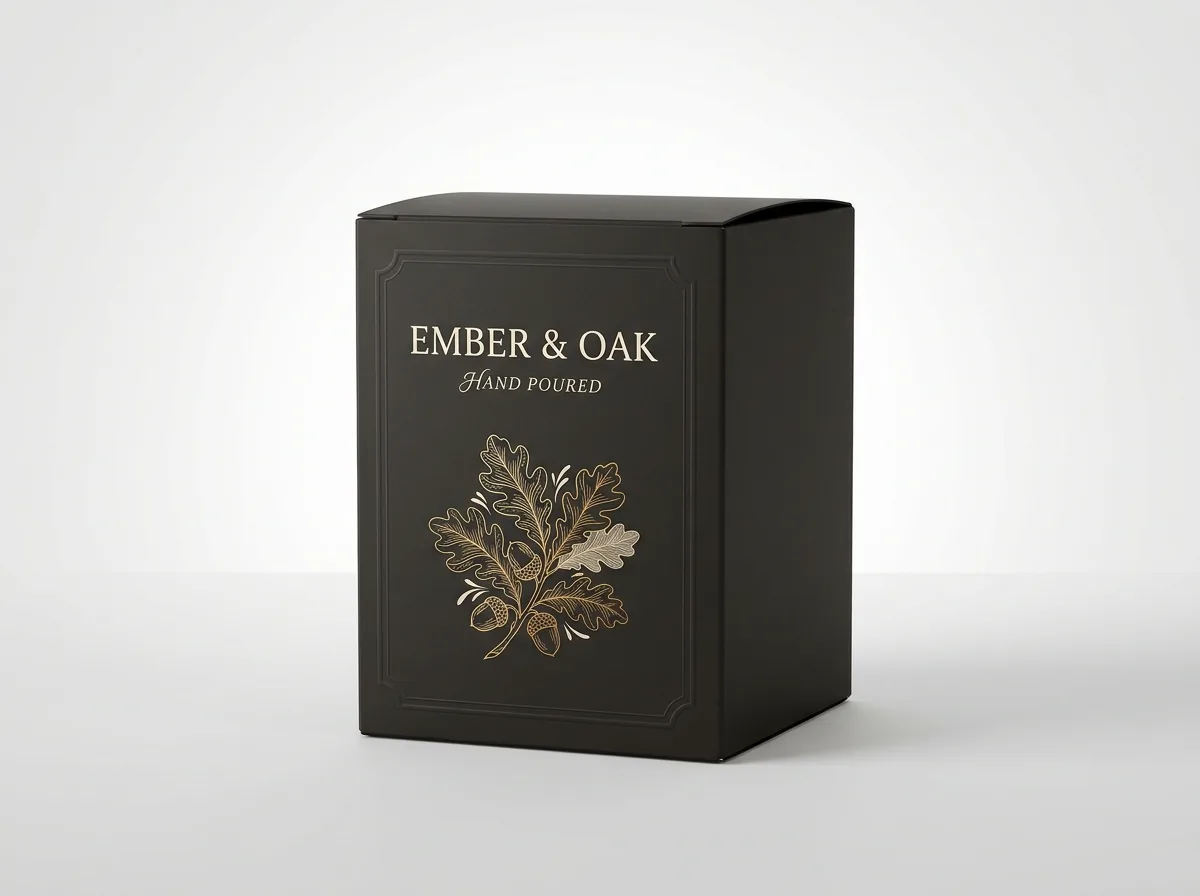
- Choose Straight Tuck End (STE) when front-panel visual polish on dark or foil-stamped cartons is your top priority.
- Choose Reverse Tuck End (RTE) when maximizing sheet yield on 5,000+ unit runs of white or kraft cartons.
- Add a friction slit-lock (cherry lock) to the bottom tuck flap of either style so the base cannot swing open when lifted.
- Specify dust-flap neck cutouts at the top of either style if your bottle has a narrower neck than body.
Why do amber glass bottles and 30-count stick packs need an auto-lock bottom?
An empty 150 cc or 200 cc amber glass packer bottle weighs four to five times more than an equivalent PET plastic bottle before a single capsule is added. Once filled with 90 softgels or 4 fl oz of herbal liquid and topped with a metal or phenolic cap, that glass bottle acts like a battering ram inside the carton whenever a parcel is dropped by a courier or lifted off a shelf by a shopper. On a standard tuck-end carton, downward bottle pressure pushes against a single folded paperboard tab held only by friction. Over a cross-country parcel shipment, vibration works that friction tab loose and the glass bottle drops right out the bottom. A custom auto-lock bottom box solves this by bonding the opposing bottom flaps with folding-carton glue during converting. When your fulfillment team squeezes the opposite corners of the flat box, four overlapping board layers lock together into a rigid load-bearing floor that cannot open unless the box itself is torn apart.
Know your size? Compare pricing across up to 3 quantities.
Request a Quote →How does box bottom style change co-packer hand-packing vs machine speed?
The price printed on your packaging quote is only half of your true packaging cost; the other half is what your contract manufacturer charges per unit to erect, fill and close the carton. If your launch batch of 1,000 to 5,000 supplement boxes is being packed by hand or semi-automatically, folding four separate bottom flaps on a tuck-end or 1-2-3 snap-lock box adds 4 to 6 seconds of labor to every single bottle. Across 2,500 boxes, 5 seconds of extra bottom-folding time equals nearly 3.5 hours of line labor. Because an auto-lock bottom carton pops square in a single 1-second squeeze and stands upright on the conveyor belt by itself while workers drop in the bottle and leaflet, the labor savings at the co-packer often outweigh the small difference in carton manufacturing cost. Conversely, if you are running 25,000+ units on a fully automated high-speed cartoner equipped with tuck-flap plows, a reverse tuck end carton runs at peak machine speed without paying for pre-glued auto-lock bases.
- Hand packing (1,000 - 5,000 units): auto-lock bottom saves 4 to 6 seconds per box on the assembly table.
- Automated cartoner (10,000+ units): ask your co-packer's line engineer whether their machine is set up for RTE, STE or hot-melt seal end.
- Stick-pack loading: an auto-lock base lets the empty dispenser box stand upright while two rows of 15 sachets are dropped in from the top.
- Flat storage: both tuck-end and auto-lock bottom cartons ship and store completely flat in bundled master cases.
When should you upgrade to a perforated dispenser or glued seal-end carton?
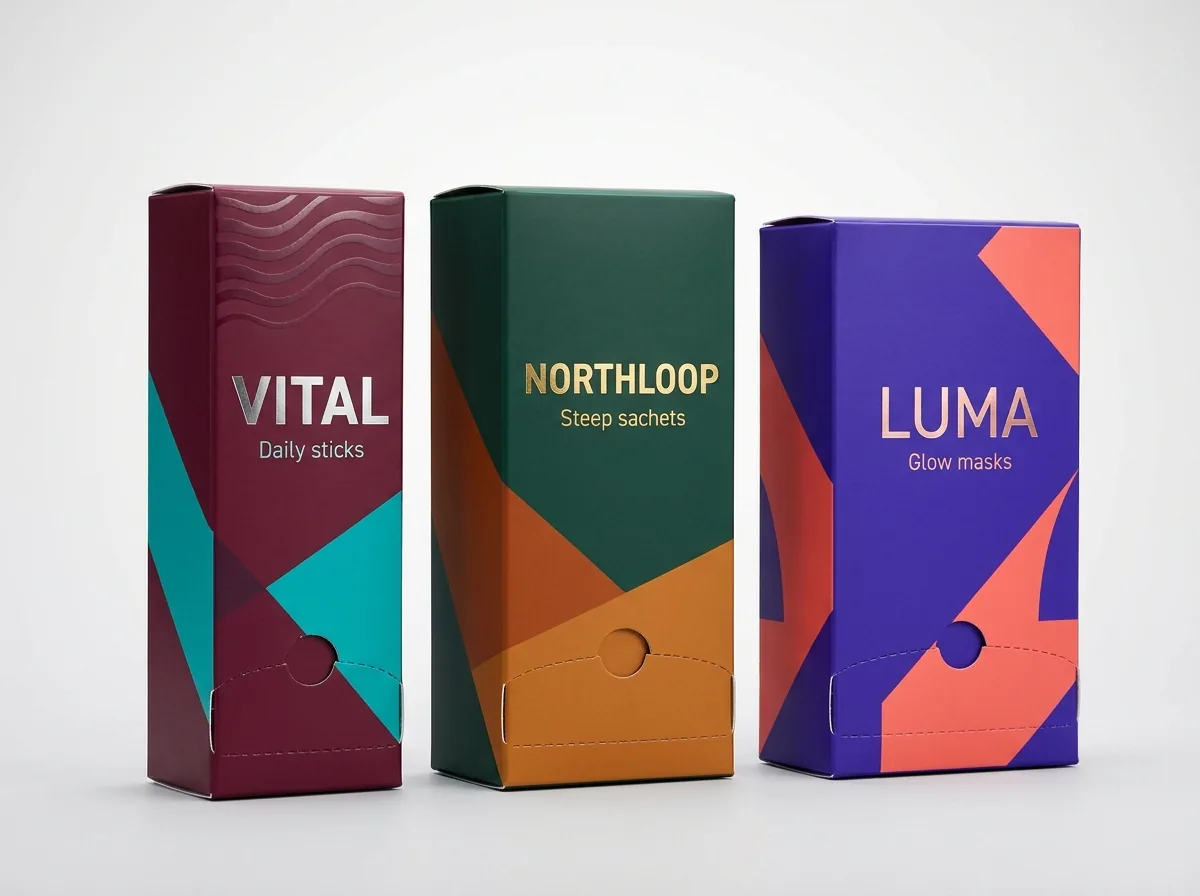
Two specialized supplement formats call for going beyond standard tuck and auto-lock bottoms. First, if you sell 15-count or 30-count powder stick packs (electrolytes, collagen peptides, greens or pre-workout), pair an auto-lock bottom with a zipper-perforated lower front panel to create a custom dispenser box. The auto-lock floor supports the weight of the vertical sachet column, while the perforated front panel folds down into a neat tray so packets feed downward by gravity. Second, if you sell retail blister packs or OTC-adjacent supplements in pharmacies that require visible tamper evidence on the outer carton itself, choose a custom seal end box or add wafer seal stickers over the top tuck flap. Either approach shows the shopper at a glance that the carton has never been opened.
What are the most common supplement box style mistakes?
Picking the wrong bottom closure can lead to crushed bases in transit or slow down your contract packager's line. Avoid these five mistakes
- Packing a heavy 150 cc or 200 cc amber glass bottle in an unglued reverse tuck end carton without a bottom slit lock, letting the bottle drop through the base.
- Choosing a reverse tuck end on a dark-colored luxury supplement carton where the white raw board edge of the bottom flap shows across the front face.
- Ordering a 1-2-3 snap-lock bottom for a 5,000-unit hand-packed run without accounting for the extra assembly time required to fold four interlocking bottom flaps.
- Designing a stick-pack dispenser perforation too close to the bottom crease, which weakens the front wall and causes packets to spill out.
- Sending cartons to an automated co-packer without confirming whether their cartoning machine requires straight tuck, reverse tuck or glue-seal flaps.
Find your size
Suggested inside size: 2.0 × 2.0 × 3.75 in
A starting point. Your account manager confirms the size with you before the proof.
Quote this size →Packaging for this
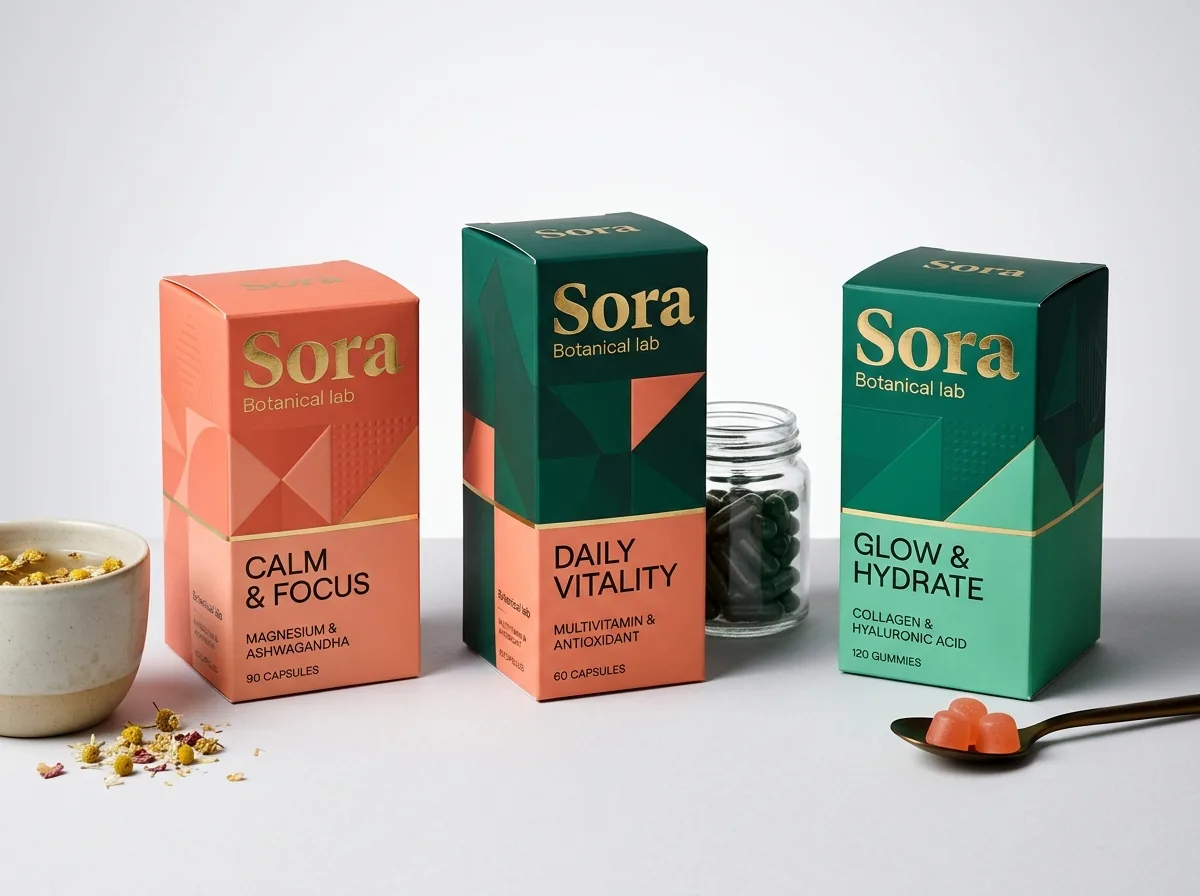
Ready to order supplement boxes? Compare up to 3 quantities with a free 3D mockup.
Request a Quote →Questions about supplement boxes
How much more does an auto-lock bottom supplement box cost than a tuck-end box?
An auto-lock bottom carton uses slightly more paperboard for the overlapping base flaps and includes a pre-gluing pass during converting. You can request a quote for both styles in the same dimensions from CubitPack to compare the exact unit difference at 1,000, 2,500 and 5,000 boxes.
Can a tuck-end box hold a 150 cc plastic bottle of 60 capsules safely?
Yes. A 150 cc PET or HDPE plastic bottle filled with 60 vegetable capsules typically weighs 3 to 4.5 ounces, which is well within the safe range for a straight or reverse tuck end carton, especially when we add a friction slit-lock tab to the bottom flap.
Does an auto-lock bottom carton still have a tuck-end top lid?
Yes. On an auto-lock bottom supplement box, the bottom base is pre-glued for strength while the top closure remains a standard reclosable tuck flap (often with a slit lock or tamper seal) so the customer can open and close the box easily.
Do auto-lock bottom supplement boxes ship flat to my co-packer?
Yes. Even though the bottom flaps are pre-glued, auto-lock bottom cartons fold completely flat along diagonal score lines and ship in compact strapped bundles inside master corrugated cases, taking up almost the same warehouse space as tuck-end cartons.
Which box style suits 30-count hydration stick packs?
An auto-lock bottom carton with a tuck top and a zipper-perforated lower front dispenser panel is the top choice for 30-count stick packs. The auto-lock base keeps the box standing solidly on a counter while customers pull packets from the front tray.
Can I test both a tuck-end and an auto-lock bottom sample with my bottle?
Yes. Every order includes a free digital proof and 3D mockup before payment, and you can also order our $50 sample kit or a custom printed prototype cut to your bottle dimensions, with the prototype cost credited to your order.
Still have a question? Ask a packaging specialist.
Request a Quote →Request your supplement boxes quote
Tell us your size and quantities, and one dedicated account manager prepares pricing for each tier.
- Free design & AI-to-print studio + 3D mockup
- No die or plate charges · 4–5 day rush available
- Free shipping to all 50 states
- 10% off your first order
This comparison is based on folding carton structural load ratings, contract-packaging cartoner specifications, and glass vs plastic packer bottle weights across CubitPack supplement orders. A packaging specialist checked every recommendation. Spot something wrong? Let us know and we will fix it.
Sources
What changed
- October 22, 2026: First published.
- October 22, 2026: Updated specifications, terminology, and verified source links.
More guides
New packaging guides by email
Sizes, materials and design tips. Unsubscribe anytime.