
What size pill box do I need for blister packs and bottles?
Short answer: Measure the width, depth and height of your blister card stack, pill bottle or sachet coil and add 1/16 to 1/8 inch per side, plus 1/8 inch for a folded leaflet. Common custom pill boxes are 2.5 × 0.75 × 3.75 in for two blisters and 2.125 × 2.125 × 3.875 in for 100 cc bottles.
On this page
- How do I measure blister cards and pill bottles for a box
- What are the standard inside dimensions for custom pill boxes
- How do I size a box for foil-backed tablet and softgel blister cards
- How do I size a carton for 100 cc, 150 cc and glass pill bottles
- What size dispenser box fits a 30-day roll of daily pill packets
- Why are pill box sizes always written as inside dimensions
- Common mistakes
- FAQs
Request a custom quoteFree dieline & 3D mockup
Sizing a pill carton starts with the primary package that touches the pills: a flat thermoformed blister card, a cylindrical plastic or glass bottle, or a coiled strip of daily vitamin packets. Always measure the physical container in inches and write the inside carton dimensions as length × width × height (L × W × H). For foil-backed blister cards, length is the horizontal face width, width is the front-to-back depth of the stacked blister domes plus any folded direction leaflet, and height is the vertical card height plus 1/8 inch for top-flap clearance. For round HDPE, PET or glass packer bottles, length and width both equal the widest bottle or cap diameter plus 1/16 to 1/8 inch, while height equals total bottle height plus 1/8 inch. When you request custom printed pill boxes from CubitPack, every size is cut to order with no die charge and verified on a 3D mockup before payment.
How do I measure blister cards and pill bottles for a box?
Never size a carton from the nominal tablet count or the fluid-ounce rating printed in a bottle catalog. A 60-count capsule bottle filled with large 00-size herbal capsules is much taller and wider than a 60-count bottle filled with small coated tablets. Likewise, two 10-cavity blister cards can have completely different dome depths depending on whether they hold flat caplets or thick softgels. Set your filled bottle or stacked blister cards on a flat table with the folded insert leaflet positioned exactly where it will ride in production. Measure across the widest points using calipers or a steel ruler, then add your sliding clearance so hand packers or automatic cartoners can load the product without snagging the dust flaps. When you send those numbers for custom pill boxes, our structural team builds the exact board caliper allowance into your dieline automatically.
- Length (L): the left-to-right width across the front face of the blister card or bottle.
- Width (W): the front-to-back depth of the bottle diameter or the stacked blister domes.
- Height (H): the vertical distance from the base to the top of the cap or upright blister edge.
- Sliding clearance: add 1/16 to 1/8 inch on L and W, and 1/8 inch on H so top flaps tuck flat.
- Leaflet allowance: add an extra 1/8 inch to W whenever a multi-fold paper outsert sits inside.
What are the standard inside dimensions for custom pill boxes?
Although every CubitPack order is cut to your exact millimeter or sixteenth of an inch with zero die charges, most OTC tablets, dietary capsules and daily vitamin packs cluster around nine proven inside sizes. Use the reference table below to benchmark your primary pack before measuring your actual production sample. Notice how blister cartons have a wide front face and a narrow front-to-back depth (such as 2.5 × 0.75 × 3.75 inches), which maximizes billboard space on pharmacy shelves while keeping the cards upright. Bottle cartons use a square footprint (such as 2.125 × 2.125 inches) unless an internal paperboard partition widens one axis to create a dedicated pocket for a folded leaflet or dosing spoon.
| Primary pill format inside | Typical inside size (L × W × H) | Recommended carton style |
|---|---|---|
| 2-tablet to 6-tablet travel blister card | 2.0 × 0.5 × 3.25 in | Reverse tuck or hang tab box |
| 1 to 2 blister cards (10 to 20 tablets) + leaflet | 2.5 × 0.75 × 3.75 in | Reverse tuck or glued seal end |
| 3 to 4 blister cards (30 to 40 capsules) + leaflet | 3.0 × 1.25 × 4.25 in | Seal end with zipper tear strip |
| 5 to 6 blister cards (60 softgels) + folder | 3.5 × 1.75 × 4.75 in | Seal end or straight tuck end |
| 60 cc / 75 cc HDPE bottle (30 capsules) | 1.875 × 1.875 × 3.5 in | Reverse tuck end |
| 100 cc / 120 cc HDPE bottle (60 capsules) | 2.125 × 2.125 × 3.875 in | Reverse or straight tuck end |
| 150 cc / 200 cc packer bottle (90 to 120 tablets) | 2.5 × 2.5 × 4.5 in | Auto lock bottom |
| 250 cc amber glass pill jar (120+ capsules) | 2.875 × 2.875 × 5.0 in | Auto lock bottom with insert |
| 30-day wound roll of daily pill sachets | 4.25 × 4.25 × 5.25 in | Dispenser box with front pull slot |
How do I size a box for foil-backed tablet and softgel blister cards?
Blister cards are semi-rigid sheets with sharp thermoformed corners that can catch on carton dust flaps if the length and height are cut too tight. Measure the flat PVC/foil card length and height first, then add 1/8 inch to both dimensions so the sheet drops straight down into the carton without bowing. Depth (width W) is where most blister sizing errors happen. A single blister dome for an oval caplet may stand 3/16 inch tall, and two cards placed back-to-back take 3/8 inch, but once you slide a folded 8-panel paper leaflet alongside them, the paper acts like a spring and pushes the front carton wall outward into a pillow shape. Allowing 0.75 inch of depth for one or two cards plus a leaflet, or 1.25 to 1.75 inches for three to six cards, keeps the front panel flat so your custom medicine boxes stack cleanly on retail shelves.
Know your size? Compare pricing across up to 3 quantities.
Request a Quote →How do I size a carton for 100 cc, 150 cc and glass pill bottles?
Round pill bottles have two diameters to check: the cylinder body and the closure. On child-resistant push-and-turn caps or wide ribbed closures, the cap diameter can actually be 1/16 inch wider than the bottle base. Always measure both and use the larger number as your baseline for Length and Width. If your bottle packs alone, a square footprint with 1/16 to 1/8 inch clearance on each side keeps the bottle centered. If you include a folded leaflet or a desiccant packet outside the bottle, ask for a fifth-panel internal divider or increase the Length by 3/16 inch so the folded paper sits in its own channel instead of jamming under the bottle base. For heavier 150 cc to 250 cc amber glass bottles used in custom supplement boxes and custom vitamin boxes, pair that footprint with an auto lock bottom box so the base cannot pop open when lifted.
What size dispenser box fits a 30-day roll of daily pill packets?
Personalized vitamin brands and daily longevity packs often seal a morning or evening dose of 4 to 8 pills into connected strip sachets that wind into a cylindrical roll of 28 or 30 packets. Because the roll must unwind freely inside the carton as the customer pulls one pouch each morning through the bottom front slot, you should never size a dispenser box tightly around the wound roll. Coil a full 30-day strip of filled packets on your table without compressing it tightly, measure the natural coil diameter, and add 3/8 to 1/2 inch to both Width and Height so the roll turns with zero friction. Typical 28-day and 30-day sachet rolls use a 3.5 inch wide packet strip and fit comfortably inside a 4.25 × 4.25 × 5.25 inch or 4.5 × 4.5 × 5.5 inch dispenser box. We position the perforated pull door about 0.75 inch above the bottom score line so the bottom wall acts as a lip that keeps the coil inside while the next packet feeds forward.
- Packet strip width: carton Length (L) should be 1/4 inch wider than a single flat sachet.
- Coil diameter: carton Width (W) and Height (H) should be 3/8 to 1/2 inch larger than the loosely wound 30-day roll.
- Pull-slot height: place the perforated tear window near the lower front face so gravity feeds the next pouch.
- Base strength: use an auto-lock bottom so the dispenser sits flat on a bathroom or kitchen counter for a full month.
Why are pill box sizes always written as inside dimensions?
Paperboard has physical thickness, typically 16 pt to 24 pt (about 0.016 to 0.024 inch per wall), and folded dust flaps or internal dividers double that thickness along the top and sides. If you ordered by outside dimensions, the board caliper would eat into the interior cavity and your blister card or bottle cap would scrape on the way in. Quoting by inside Length × Width × Height guarantees that the usable space inside the crease lines matches your product. If your finished cartons must also pack into a master corrugated case or sit inside a fixed retail shelf pusher tray, share that outer constraint with your account manager and we will verify both the inside fit and the outside footprint on your proof.
What are the most common pill box sizing mistakes?
Nearly every misfitting pill carton comes from ignoring the leaflet thickness or measuring an empty sachet strip instead of a wound 30-day coil. Watch out for these five errors
- Measuring blister cards without the folded leaflet. A multi-panel outsert adds 1/8 inch of springy depth that bows a tight carton.
- Checking only the bottle base diameter and missing a wider child-resistant push-and-turn cap rim.
- Sizing a 30-day sachet dispenser tightly around a compressed roll. Leave 3/8 to 1/2 inch of spin room so daily packets pull smoothly.
- Swapping Length and Height on horizontal vs vertical blister cartons, which puts the tuck opening on the long side instead of the top.
- Using a standard friction tuck bottom on heavy 200 cc amber glass pill jars instead of an auto-lock bottom.
Find your size
Suggested inside size: 2.5 × 0.75 × 3.75 in
A starting point. Your account manager confirms the size with you before the proof.
Quote this size →Packaging for this
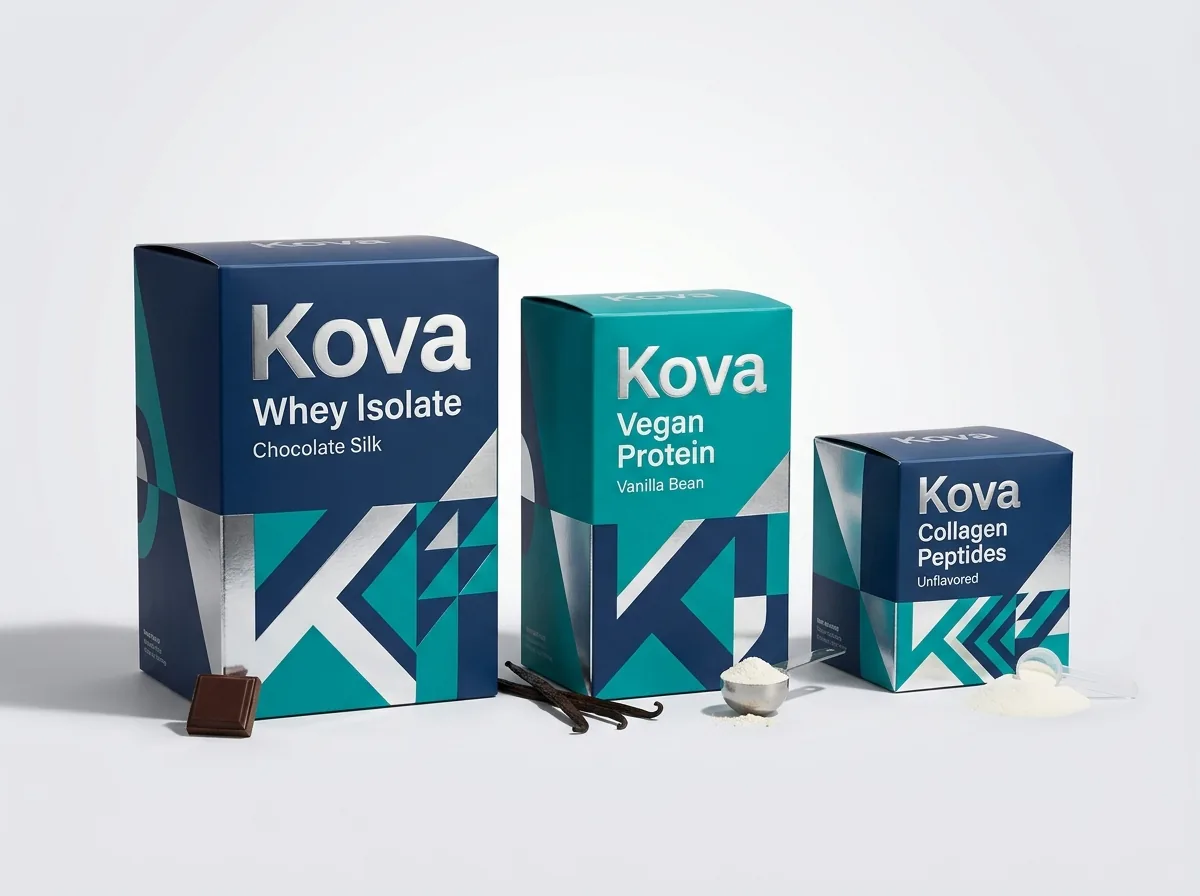
Ready to order pill boxes? Compare up to 3 quantities with a free 3D mockup.
Request a Quote →Questions about pill boxes
How much clearance should I add around a pill bottle or blister pack?
Add 1/16 to 1/8 inch (0.0625 to 0.125 in) to the length and width, and 1/8 inch to the height. If you pack a folded paper leaflet inside the box with the blisters or bottle, add another 1/8 inch to the front-to-back depth.
What size box fits a standard 60-capsule (100 cc) supplement bottle?
Most 100 cc HDPE or PET packer bottles have a diameter around 1.95 to 2.0 inches and a height around 3.65 to 3.75 inches, which fits cleanly inside a 2.125 × 2.125 × 3.875 inch custom pill box.
Can I make a pill box slightly larger to fit all my Drug or Supplement Facts text?
Yes. When a small 2-count or 10-count blister card does not give enough outer surface area for mandatory 6-point text, we size the outer carton larger for legibility and add an internal paperboard cradle so the small blister card does not rattle.
In what order should I write Length, Width and Height for a pill carton?
Always write inside Length × Width × Height in inches. Looking at the front of the box, Length is left-to-right across the front face, Width is front-to-back depth, and Height is bottom-to-top.
Do custom pill box sizes require a separate cutting die fee?
No. Every CubitPack order is cut to your exact inside dimensions with zero die or plate charges, whether you need a slim 0.5-inch blister sleeve or a 4.25-inch cube dispenser for daily vitamin packs.
How can I test my pill box size before running 1,000 units?
Every order includes a free custom dieline, digital proof and 3D mockup before payment. You can print the flat dieline at 100% scale to test your blister card or bottle fit, or request a physical sample before full production.
Still have a question? Ask a packaging specialist.
Request a Quote →Request your pill boxes quote
Tell us your size and quantities, and one dedicated account manager prepares pricing for each tier.
- Free design & AI-to-print studio + 3D mockup
- No die or plate charges · 4–5 day rush available
- Free shipping to all 50 states
- 10% off your first order
The inside dimensions in this guide are based on standard US HDPE/PET packer bottle capacities (60 cc to 250 cc), 10-count foil blister cards and 30-day sachet rolls with 1/16 to 1/8 inch loading clearance. A CubitPack packaging specialist checked every row. Spot an error? Tell us and we will fix it.
Sources
What changed
- October 22, 2026: First published.
- October 22, 2026: Updated specifications, terminology, and verified source links.
More guides
New packaging guides by email
Sizes, materials and design tips. Unsubscribe anytime.