
What size protein powder box do I need for single-serve sachets, stick packs and shaker kits?
Short answer: Stack your actual filled, nitrogen-flushed sachets or stick packs, measure length × width × stack depth, and add ¼ inch on every side. Common custom protein powder boxes use 5.5 × 4.5 × 6.25 in for 15 sachets, 5.0 × 3.25 × 6.0 in for 15 sticks, and 10.5 × 8.0 × 4.5 in for shaker kits.
On this page
- How do I measure filled protein sachets and stick packs for a carton
- What are the standard protein powder box dimensions by packet count and kit
- How does sizing differ between flat 40 g protein sachets and narrow 15 g stick packs
- What size carton replaces a 1.5 lb or 2 lb plastic protein tub
- How do I size a starter-kit mailer for a shaker bottle and sample packets
- Common mistakes
- FAQs
Request a custom quoteFree dieline & 3D mockup
Sizing a protein powder carton starts with a rule every sports nutrition co-packer learns the hard way: never calculate carton depth from an empty flat pouch spec sheet. Once a four-side-seal sachet is filled with 30 to 45 grams of whey isolate or pea protein and sealed with a nitrogen flush, the center belly swells to 0.35 to 0.45 inches thick. Always stack your target count (such as 7, 15 or 20 filled packets) on a flat table, alternate the thicker powder bellies so the column sits level, measure the real length, width and stack height in inches, and add ¼ inch of breathing room on all three dimensions. A 7-count trial pack typically fits a 4.5 × 2.5 × 5.5 inch tuck carton, a 15-count sachet dispenser fits 5.5 × 4.5 × 6.25 inches, and a 2 lb bag-in-box refill fits 6.5 × 5.0 × 8.5 inches.
How do I measure filled protein sachets and stick packs for a carton?
Flexible foil sachets and tubular stick packs behave like small pillows once they come off a vertical form-fill-seal (VFFS) or horizontal pouch line. Fine whey isolate, micellar casein, sprouted brown rice protein and collagen peptides trap air between powder particles during filling, and nitrogen gas flushing adds positive internal pressure so the packet resists crushing in transit. If you measure a single sachet with calipers and multiply by fifteen, your finished carton will end up ¾ inch too shallow and bow outward at the front panel. Instead, ask your co-packer for twenty filled sample packets from a trial run. Stack the exact number of packets you plan to sell in the orientation they will sit inside the carton: either standing vertically on their bottom seal for a top-opening caddy or lying flat in a horizontal stack for a bottom gravity-feed dispenser. When you request a quote for printed protein powder cartons, give us the inside Length × Width × Height in inches so our design team can build the dieline to your exact stack.
- Alternate packet orientation: flip every other sachet 180 degrees or every five packets so the thicker powder belly balances out.
- Measure under natural resting weight: do not press down hard on nitrogen-flushed packets when reading stack height.
- Add ¼ inch (0.25 in) to the sachet width and length so heat-sealed fin edges never catch on carton glue flaps.
- Add ¼ to ⅜ inch to total stack height or depth so packets slide freely down a gravity-feed dispenser chute.
- Split counts of 20 to 30 sachets into two side-by-side columns separated by a vertical paperboard divider.
What are the standard protein powder box dimensions by packet count and kit?
While CubitPack cuts every order to your exact inside dimensions with zero die or plate charges, most sports nutrition and functional wellness brands build their product line around six core carton sizes: a 7-day sample box, a 15-stick collagen caddy, a 15-sachet everyday box, a 20 to 24-sachet two-column box, a 2 lb bag-in-box refill carton, and a shaker-bottle starter mailer. Compare the inside measurements in the reference table below against your pouch dimensions. Notice how boxes holding 15 or more protein packets step up to a pre-glued auto-lock bottom so the combined 1.2 lb to 2.2 lb powder weight cannot push the bottom flaps open on a retail shelf.
| Protein format & count | Typical inside size (L × W × H) | Recommended box style |
|---|---|---|
| 7-count trial pack of 35 g flat protein sachets | 4.5 × 2.5 × 5.5 in | Straight or reverse tuck end |
| 14 or 15-count collagen or greens stick packs (10-15 g) | 5.0 × 3.25 × 6.0 in | Gravity-feed dispenser or PDQ caddy |
| 15-count box of 40 g whey or plant flat sachets | 5.5 × 4.5 × 6.25 in | Auto lock bottom gravity dispenser |
| 20 to 24-count single-serve sachets (two columns) | 6.0 × 5.5 × 7.0 in | Auto lock bottom with center divider |
| 30-count club-store stick pack or sachet caddy | 7.5 × 5.5 × 7.25 in | Auto lock or E-flute dispenser carton |
| 1.5 lb to 2 lb (680-900 g) bag-in-box foil refill + scoop | 6.5 × 5.0 × 8.5 in | Heavy paperboard or E-flute auto-lock |
| 24 oz shaker bottle + 10 flavor sample sachets | 10.5 × 8.0 × 4.5 in | Corrugated starter-kit mailer |
How does sizing differ between flat 40 g protein sachets and narrow 15 g stick packs?
A full scoop of whey or plant protein (typically 30 g to 45 g of powder yielding 20 g to 30 g of protein) requires a wide four-side-seal or three-side-seal flat sachet measuring roughly 4.0 × 5.5 inches to 4.5 × 6.0 inches. By contrast, hydrolyzed bovine or marine collagen peptides, BCAAs, creatine and hydration blends use a smaller 10 g to 18 g serving that packs into a narrow tubular stick pack measuring about 1.25 to 1.5 inches wide by 5.5 to 6.5 inches tall. Flat sachets stack cleanly like envelopes in a single column up to 15 packets high, or in two side-by-side columns for 20 to 30 packets. Narrow stick packs are round in cross-section and roll over each other if placed in a wide open cavity. When sizing a 20-count or 30-count stick-pack carton, keep the front-to-back depth tight to the stick length or add a folded paperboard partition from our custom cardboard inserts line so the sticks stay aligned in neat rows.
- Flat 35-45 g protein sachets: allow 4.5 to 5.5 in width and 0.35-0.42 in of height per packet in a horizontal gravity stack.
- Tubular 10-18 g collagen/BCAA sticks: allow 1.5 to 1.75 in column width per row and keep sticks upright or in partitioned channels.
- Two-row sachet cartons (20-30 count): add ⅛ inch to total length for a vertical center divider wall.
Know your size? Compare pricing across up to 3 quantities.
Request a Quote →What size carton replaces a 1.5 lb or 2 lb plastic protein tub?
Rigid HDPE plastic protein jugs are mostly empty headspace when shipped to co-packers, and they dent easily in parcel mail. Many sports nutrition brands are switching to a bag-in-box setup: filling 1.5 lb to 2 lb (15 to 30 servings) of powder into an economical unprinted barrier foil pillow pouch or custom supplement pouch, dropping in a plastic or wooden scoop, and placing the sealed bag inside a tall auto-lock carton. A filled 1.5 lb to 2 lb foil pillow bag settles at the base as the powder compacts, so the outer carton needs a stable rectangular footprint around 6.5 × 5.0 inches and a height of 8.0 to 8.75 inches. Using heavyweight paperboard or thin E-flute corrugated board prevents the settled powder from bulging the lower side walls, and a reclosable top tuck lid with a thumb notch lets customers scoop directly from the inner bag every day.
How do I size a starter-kit mailer for a shaker bottle and sample packets?
The highest-converting customer acquisition offer in online sports nutrition is a multi-flavor starter kit that pairs a branded 20 oz or 24 oz blender shaker bottle with 7 to 12 single-serve protein sachets. Because a standard 24 oz shaker cup measures roughly 3.75 to 4.0 inches across the lid and 8.5 to 9.0 inches tall, the mailer box depth is dictated by the lid diameter of the cup. An inside dimension of 10.5 × 8.0 × 4.5 inches in our 250-minimum custom mailer boxes gives you a 4.25 × 8.0 inch cradle on the left for the shaker bottle and a 6.0 × 8.0 inch compartment on the right where 10 single-serve flavor packets stand upright like a flip-through file. A die-cut paperboard insert locks the round bottle neck so the shaker never crushes the foil sachets during USPS or UPS delivery.
- 20 oz compact shaker + 7 sachets: 9.5 × 7.5 × 4.0 in E-flute mailer with 2-cell insert.
- 24 oz standard shaker + 10-12 sachets: 10.5 × 8.0 × 4.5 in E-flute mailer with bottle neck cradle.
- 28 oz tall shaker + 14 sachets + scoop: 11.5 × 9.0 × 4.5 in E-flute mailer.
What are the most common protein powder box sizing mistakes?
Almost every protein carton fit issue comes from underestimating the belly swell of nitrogen-flushed sachets or skipping a center divider in wide boxes. Check these five before approving your dieline
- Multiplying empty flat pouch caliper by 15 instead of measuring a real stack of filled, air-cushioned 35 g protein packets.
- Using the exact same carton depth for whey isolate and fluffy pea/hemp plant protein without testing both filled stacks.
- Packing 24 slick foil sachets into a wide box without a vertical center divider, causing the two columns to slide and jam.
- Sizing a shaker starter kit to the bottom diameter of the cup instead of the wider flip-cap lid diameter.
- Making a bottom gravity-feed tear slot taller than 1.25 inches, which lets multiple packets spill out onto the counter.
Find your size
Suggested inside size: 4.5 × 2.5 × 5.5 in
A starting point. Your account manager confirms the size with you before the proof.
Quote this size →Packaging for this
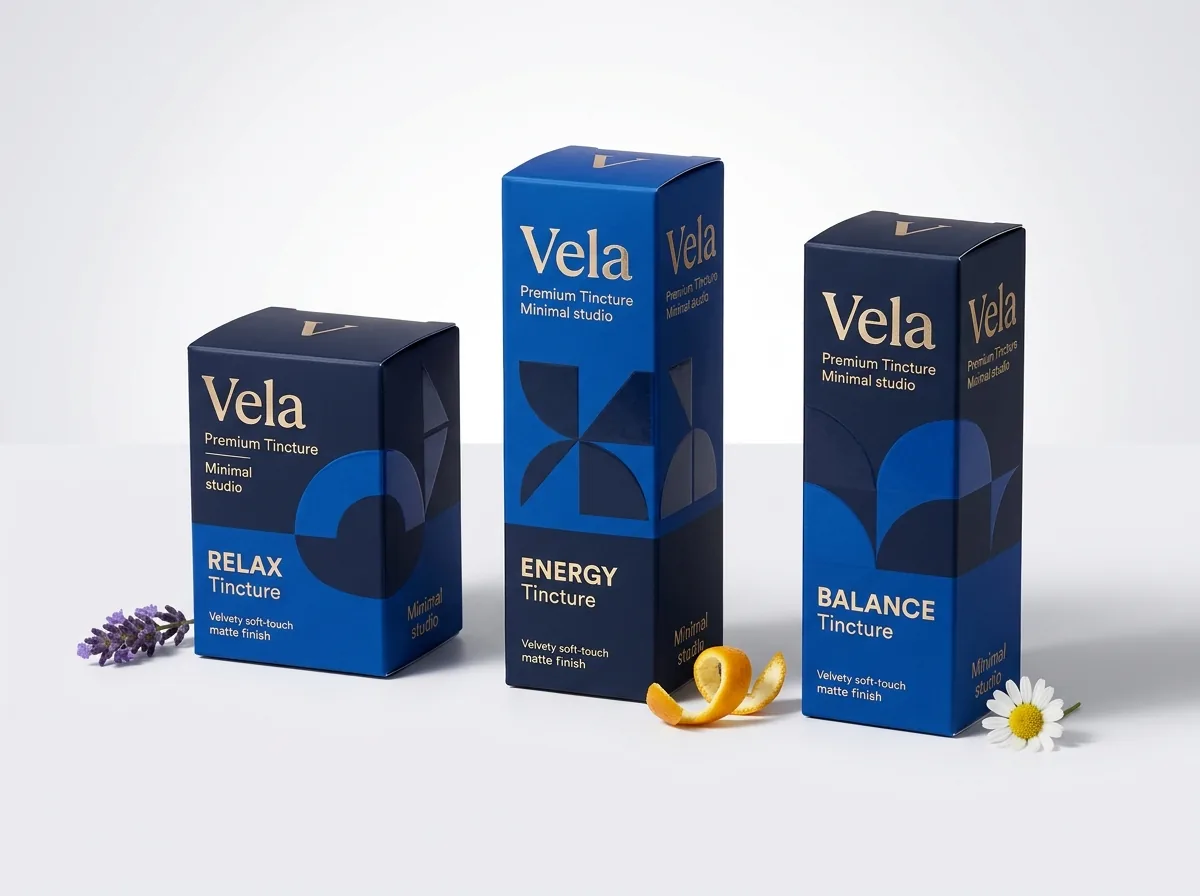
Ready to order protein powder boxes? Compare up to 3 quantities with a free 3D mockup.
Request a Quote →Questions about protein powder boxes
Do your protein powder box dimensions refer to inside or outside measurements?
Every custom carton and mailer at CubitPack is specified using usable inside dimensions (Length × Width × Height in inches). That ensures your stack of filled sachets, stick packs or inner foil bag slides in smoothly without bowing the walls.
How much clearance should I add around a stack of 15 protein sachets?
Add ¼ inch (0.25 in) to the flat sachet length and width so the heat-sealed edges do not catch on the carton corners, and add ¼ to ⅜ inch to the resting height of the 15-packet stack.
What size should the bottom tear-out slot be on a gravity sachet dispenser?
For standard 35 g to 40 g single-serve protein sachets, a bottom front tear-out window roughly 1.0 to 1.25 inches tall leaving a ½ inch bottom lip holds the stack inside while letting one packet slide out cleanly.
Can I use one protein box size across Chocolate, Vanilla and Berry flavors?
Yes. Standardize your carton to the thickest flavor (usually chocolate, which adds cocoa powder volume to the scoop weight) so all flavors share one identical dieline and can be ordered together with zero die charges.
What is the minimum order quantity for custom sized protein powder boxes?
Printed paperboard folding cartons, gravity dispensers and counter caddies start at 1,000 boxes, and corrugated shaker-bottle starter mailers start at 250 boxes. We can also quote up to three quantities side by side.
Can I test my filled protein sachets inside a prototype before full production?
Yes. Every order includes a free custom vector dieline proof and 3D mockup before payment. You can also order our $50 material sample kit or request a physical prototype of your exact box size, credited toward your order.
Still have a question? Ask a packaging specialist.
Request a Quote →Request your protein powder boxes quote
Tell us your size and quantities, and one dedicated account manager prepares pricing for each tier.
- Free design & AI-to-print studio + 3D mockup
- No die or plate charges · 4–5 day rush available
- Free shipping to all 50 states
- 10% off your first order
The protein box dimensions in this guide are based on standard 30 g to 45 g four-side-seal sachet dimensions, 10 g to 18 g stick-pack stacks, 24 oz shaker cups and CubitPack's decided rules in our published product specifications. A CubitPack packaging specialist verified every row. Spot something wrong? Tell us and we will fix it.
Sources
What changed
- October 22, 2026: First published.
- October 22, 2026: Updated specifications, terminology, and verified source links.
More guides
New packaging guides by email
Sizes, materials and design tips. Unsubscribe anytime.