
How do you design custom gummy boxes across multiple flavors and formulas?
Short answer: Standardize one carton dieline across all 60-count jars, assign a distinct Pantone fruit color band to each SKU, and reserve the flat back panel for your 21 CFR 101.36 Supplement Facts table. Start your multi-flavor run on our custom gummy boxes page.
On this page
- How should you assign the four vertical panels on a gummy carton
- How do gummy Supplement Facts panels differ from capsule cartons
- How do you build a color-coded multi-flavor system on one shared dieline
- Which finishes make gummy boxes stand out without ruining lot-code stamping
- What drives the unit cost of custom gummy boxes and how can you save
- Common mistakes
- FAQs
Request a custom quoteFree dieline & 3D mockup
To design a cohesive, cost-effective line of gummy supplement boxes across multiple flavors and formulas, lock in one master structural dieline (such as a 2.75 × 2.75 × 4.875 inch auto-lock bottom carton for 300 cc jars) so every SKU shares the same cutting die, board caliper and co-packer machine setup. Assign each panel a fixed job: front panel for brand mark, benefit headline, flavor badge and gummy count; full back panel for the 21 CFR 101.36 Supplement Facts table (including Total Carbohydrate, Total Sugars, Added Sugars or Sugar Alcohols); left panel for directions and fruit-flavor story; right panel for warnings, certifications and barcode; and an unvarnished 1.5 × 0.6 inch knock-out zone on the bottom flap for inkjet lot and best-by coding. CubitPack prints CMYK and guaranteed Pantone spot colors from 1,000 units with free prepress help.
How should you assign the four vertical panels on a gummy carton?
Gummy supplement packaging has to balance two competing visual goals: appetite appeal (making natural raspberry, elderberry, sour watermelon or peach flavors look delicious) and clinical credibility (proving that each 2-gummy serving delivers verified active ingredients). On a curved 300 cc bottle label, cramming fruit illustrations next to a lengthy Supplement Facts box often results in cluttered 5-point type. Moving that information onto the four flat walls of custom printed gummy cartons gives every element room to breathe. Use the four-panel layout matrix below to keep your artwork consistent across every SKU in your wellness line.
| Carton panel or flap | Primary content to place here | Prepress & finishing rule |
|---|---|---|
| Front panel (Principal Display Panel) | Brand logo, benefit title, flavor callout, net count (e.g., 60 Gummies) | Keep text 0.125 in inside fold scores; spot UV on gummy icons |
| Back panel (Information Panel) | Full 21 CFR 101.36 Supplement Facts table + Other Ingredients | High-contrast dark ink on white/light background; no foil under 6 pt text |
| Left side panel | Suggested use (e.g., Chew 2 gummies daily), pectin/vegan icons, flavor notes | Align benefit icons horizontally with front-panel color band |
| Right side panel | Warnings, storage temp note (store in a cool dry place), manufacturer address, UPC | Print barcode bars vertically (ladder) or horizontally with white quiet zone |
| Top tuck flap | Brand monogram or tamper-seal landing zone | If applying a clear wafer seal, keep glue zone free of heavy silicone slip |
| Bottom auto-lock flap | 1.5 × 0.6 in unvarnished white rectangle for lot & best-by date | Mask off lamination and UV varnish so co-packer inkjet ink dries instantly |
How do gummy Supplement Facts panels differ from capsule cartons?
Unlike dry vegetable capsules that contain zero calories and zero carbohydrates, a two-gummy serving typically contributes 10 to 25 calories and 2 to 6 grams of carbohydrates from tapioca syrup, cane sugar, maltitol, allulose or fruit pectin. Under FDA 21 CFR 101.36 dietary supplement labeling rules, whenever those macronutrients are present in declared amounts, the top half of your Supplement Facts table must list Calories, Total Carbohydrate, Dietary Fiber (if pectin/inulin qualifies), Total Sugars, Added Sugars (with % Daily Value), and Sugar Alcohols (if sweetened with xylitol, erythritol or maltitol) right above the active vitamins or botanicals. Because those extra four to six macronutrient rows make a gummy Supplement Facts box taller than a capsule table, assign the entire back panel of the carton to your nutrition box and ingredient list. Keep the outer hairline border at least 1/8 inch (3 mm) inside the left and right vertical fold scores so board creasing never distorts the % Daily Value column.
- State serving size in household units first: for example, 'Serving Size: 2 Gummies (6 g)' and 'Servings Per Container: 30'.
- List tapioca syrup, cane sugar, pectin, citric acid, sodium citrate, natural flavors and fruit/vegetable juice for color under 'Other Ingredients:' below the box.
- Include a 'Store in a cool, dry place away from direct sunlight' storage instruction on the side panel to prevent heat melting.
- Avoid printing small 6 pt nutrition text in reverse white-out type over a 4-color rich black background where slight plate movement can fill thin serifs.
How do you build a color-coded multi-flavor system on one shared dieline?
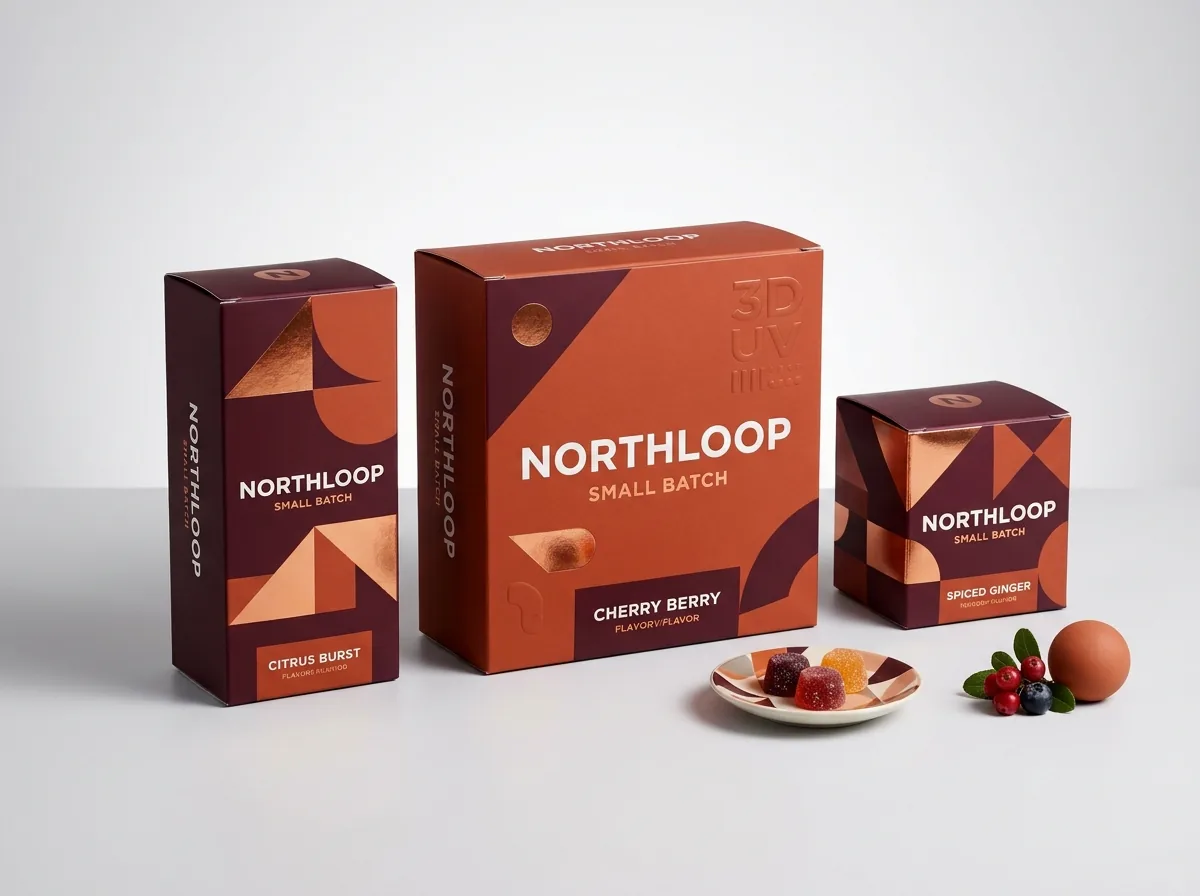
Most gummy brands launch with three to six formulas: Elderberry Immunity, Raspberry Sleep, Tangerine Vitamin C, Strawberry Biotin, Lemon Calm and Tart Cherry Recovery. If you house every 60-count formula in the same 300 cc wide-mouth jar, you can use one identical 2.75 × 2.75 × 4.875 inch carton dieline across your entire catalog. To make each SKU unmistakable on a crowded shelf, and prevent warehouse pick-and-pack mix-ups, divide your front panel into a fixed 60% neutral brand zone (such as clinical matte white, warm alabaster or natural kraft) and a 40% variable flavor zone printed in a dedicated Pantone spot color. Matching that exact Pantone swatch across both the outer carton and your custom supplement labels ensures the jar inside matches the box outside.
Know your size? Compare pricing across up to 3 quantities.
Request a Quote →Which finishes make gummy boxes stand out without ruining lot-code stamping?
Shoppers associate gummies with glossy, chewable fruit textures. One of the highest-impact finishing combinations for gummy cartons is pairing soft-touch lamination or matte lamination over the entire box with raised spot UV applied strictly over the 3D gummy drop illustrations and fruit slices on the front panel. When a customer picks up the matte carton, their thumb immediately feels the smooth, glossy raised gummy shapes. However, film lamination and UV varnish create a non-porous surface that repels water-based and solvent thermal inkjet inks used by contract packagers to print LOT # and EXP / BEST BY dates. Always instruct your designer to place a 1.5 × 0.6 inch unvarnished, unlaminated knock-out rectangle on the bottom flap layer of your artwork file.
- Soft-touch + Spot UV: velvety matte background with glossy raised gummy droplets for sleep and beauty SKUs.
- Hot foil stamping: metallic gold, silver or berry foil on potency badges ('500 mg Elderberry' or 'Zero Sugar').
- Inside carton printing: print a 30-day habit tracker or flavor story inside the box walls with zero extra fold thickness.
- Unvarnished knock-out zone: keep a clearly marked rectangle on the bottom flap free of ink, varnish and film lamination.
What drives the unit cost of custom gummy boxes and how can you save?
Four variables drive the per-box cost of custom gummy cartons: order quantity across your shared dieline, structural style (tuck end vs pre-glued auto-lock bottom or perforated dispenser), board stock, and the number of post-press finishing passes. Because CubitPack charges zero die or plate fees, standardizing all your 60-count gummy SKUs onto one shared 300 cc jar carton dieline is the single fastest way to reach higher quantity tiers (2,500, 5,000 or 10,000 boxes) while keeping co-packer setup simple. If you want the visual pop of metallic foil and glossy fruit icons on a tighter launch budget, use CMYK + Pantone color blocks with a single Spot UV pass over matte lamination instead of multiple separate foil stamping dies. You can also test how different colors and finishes look on your exact box size by reviewing our free 2D digital proof and 3D mockup before payment, or by ordering a physical printed prototype whose cost is credited toward your production run. First-time orders receive 10% off, and we beat written quotes from US competitors for matching specs.
What are the most common custom gummy box artwork mistakes?
A great gummy carton design must survive co-packer inkjet coding, retail barcode scanners and FDA panel checks. Avoid these five prepress pitfalls before sending artwork to press
- Forgetting to include the mandatory Calories, Total Carbohydrate and Added Sugars rows at the top of a gummy Supplement Facts panel when tapioca syrup, cane sugar or pectin adds declared carbohydrates.
- Laminating the entire bottom flap with soft-touch or gloss film without masking a 1.5 × 0.6 inch unvarnished knock-out rectangle, causing the contract packager's inkjet lot number and best-by date to smear right off.
- Using 4-color rich black for 6-point ingredient typography where tiny press registration shifts blur thin letterforms, instead of specifying 100% one-color black ink over a high-contrast white panel.
- Placing a die-cut front window within 1/4 inch of a vertical fold score or too high near the bottle shoulder, causing the front carton wall to buckle or reveal empty headspace.
- Creating slightly different box dimensions for each gummy flavor instead of sharing one master 300 cc jar dieline across all SKUs to combine order volume and eliminate co-packer rail changeovers.
Find your size
Suggested inside size: 2.5 × 2.5 × 4.5 in
A starting point. Your account manager confirms the size with you before the proof.
Quote this size →Packaging for this
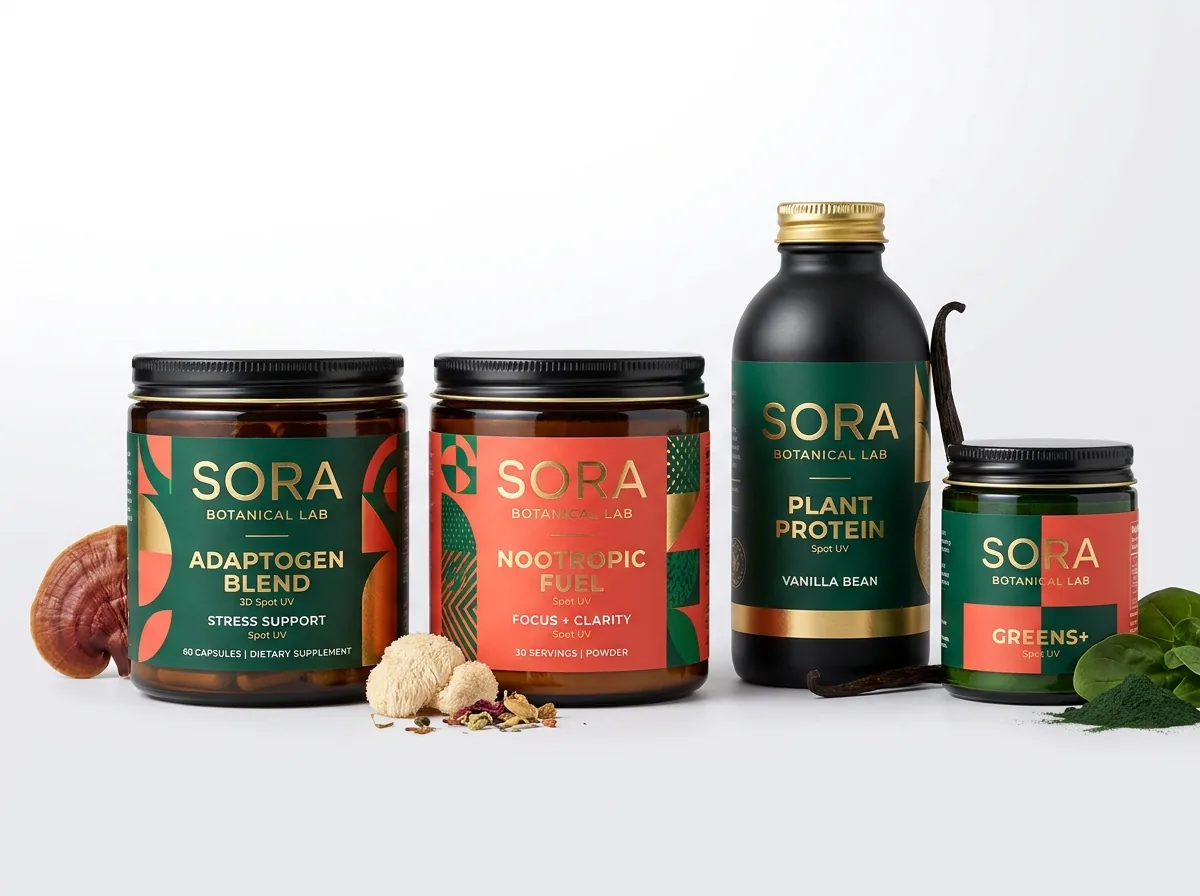
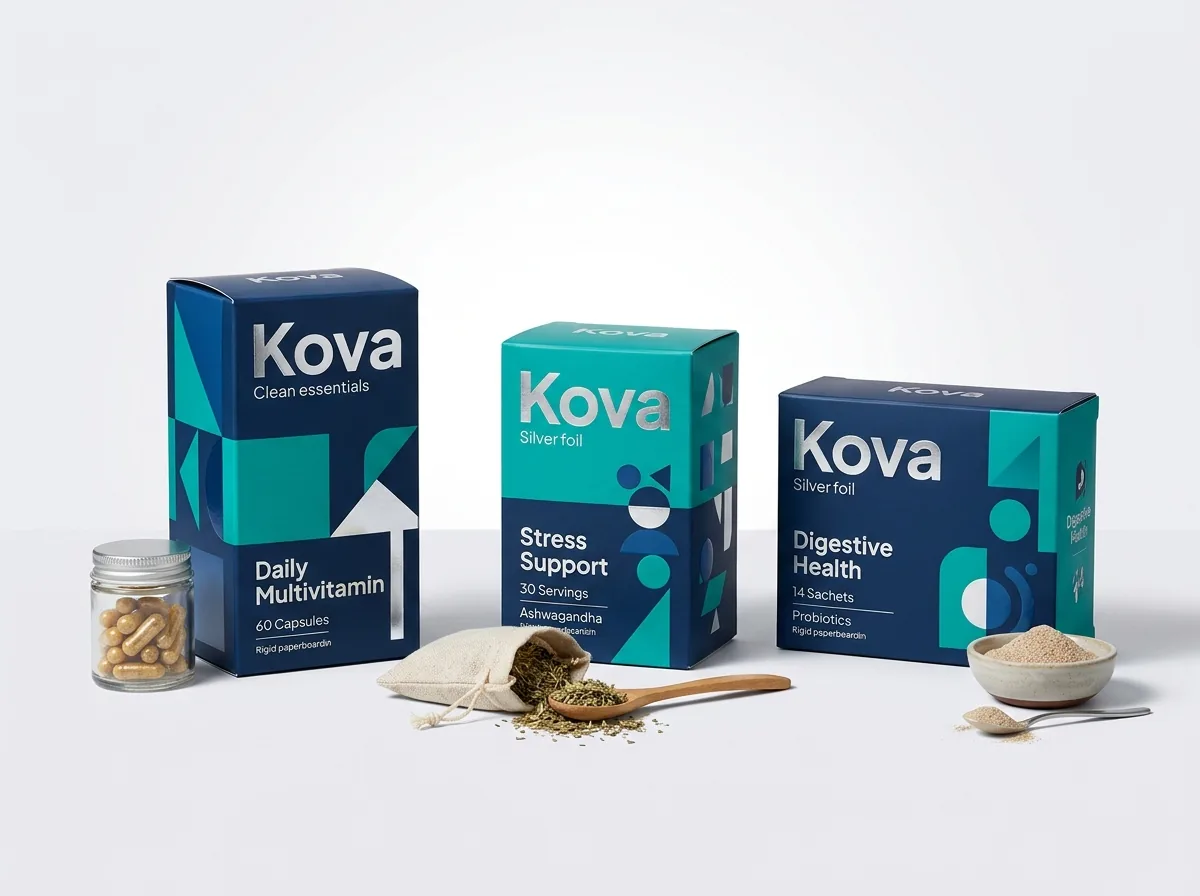
Ready to order gummy boxes? Compare up to 3 quantities with a free 3D mockup.
Request a Quote →Questions about gummy boxes
Can I split a custom gummy box order across multiple fruit flavors?
Yes. Our minimum order starts at 1,000 boxes, and when your berry, citrus, peach and elderberry SKUs share the exact same box size and dieline, you can select 2 designs or 3+ designs in the quote form to have your multi-flavor run quoted together.
Do you charge extra for cutting dies or printing plates when we have multiple gummy SKUs?
No. CubitPack never charges die or plate fees, and we include free structural dielines and free design help with every order. You also review a 2D digital proof and 3D mockup of every flavor before payment.
How do you guarantee that our raspberry or tangerine flavor colors match our bottle labels?
We print both CMYK process and Pantone (PMS) spot colors with a Pantone color match guarantee. We can also print your custom roll labels and stand-up pouches alongside your folding cartons so every component matches.
Where should the UPC barcode be placed on a custom gummy carton?
Place your UPC barcode on the lower right side panel or on the bottom flap (away from the lot-coding window), printed in high-contrast dark ink over a solid white quiet zone at least 0.25 inch inside any fold score.
Can we print our AI-generated fruit or brand artwork on custom gummy boxes?
Yes. Through our Print your AI design service, our prepress team converts AI-generated concept art into print-ready vector dielines with proper 1/8 inch bleeds, CMYK/Pantone color separation, crisp vector typography and spot UV masks.
Can I see a physical printed sample of my gummy carton before running the full order?
Yes. Every order includes a free 2D digital proof and interactive 3D mockup before payment. You can also order our $50 sample kit to inspect paperboard stocks and finishes, or request a custom printed prototype whose cost is credited toward your full order.
Still have a question? Ask a packaging specialist.
Request a Quote →Request your gummy boxes quote
Tell us your size and quantities, and one dedicated account manager prepares pricing for each tier.
- Free design & AI-to-print studio + 3D mockup
- No die or plate charges · 4–5 day rush available
- Free shipping to all 50 states
- 10% off your first order
The four-panel layout rules, 21 CFR 101.36 gummy carbohydrate/sugar formatting notes and co-packer inkjet knock-out specifications in this guide come from FDA dietary supplement labeling guidance and commercial offset prepress standards. A CubitPack packaging specialist verified every detail. Spot an error? Tell us and we will fix it.
Sources
What changed
- October 22, 2026: First published.
- October 22, 2026: Updated specifications, terminology, and verified source links.
More guides
New packaging guides by email
Sizes, materials and design tips. Unsubscribe anytime.