
- Ships flat, packs like a carton, and converts into a shelf or checkout tray in seconds via micro-perforations.
- Optional step-tier risers, die-cut tube holes, or vertical dividers keep pouches, bars, and bottles upright.
- CubitPack makes them from 1,000 boxes in 10–14 business days, with 4–5 day rush available.
- Free design help, no die or plate charges, free US shipping, and a digital proof plus 3D mockup before payment.
Custom Display Boxes
Custom display boxes are dual-purpose paperboard or E-flute corrugated cartons that ship closed to protect multiple retail units in transit and convert at the shelf into an open-top point-of-purchase tray with a low front lip, angled side walls, and a tall upright back header billboard. Order from 1,000 boxes in 10–14 business days with free US shipping.
What is a display box?
Custom display boxes are retail-ready point-of-purchase cartons engineered to hold, ship, and merchandise multipacks of individual units on grocery shelves, pharmacy endcaps, and checkout counters. Each carton is die-cut from a single piece of folding paperboard or thin E-flute corrugated board with precision micro-perforation lines running along the upper front wall and sloped side walls. During packing and distribution, the carton closes like a standard shipping box so pouches, snack bars, lip balm tubes, or mini bottles stay clean and stacked. When the carton reaches the store, retail staff pull a finger-notch tab to zip away the upper perforated hood and fold the top lid back 180 degrees, locking its tabs behind the rear wall to create an upright printed header billboard. A low front lip covering 25% to 35% of the unit height holds the front row securely while keeping brand logos visible.
How a display box is built
A display box combines a protective transit carton with a perforated tear-away hood and a fold-up rear header billboard on a single die-cut sheet: Whether your team calls them custom retail display boxes, point of purchase display boxes, printed display cartons wholesale, tear away top display boxes, custom printed display boxes, display boxes with logo or printed display boxes, every sheet is cut to your exact inside dimensions.
- 1Low front display lip (25%–35% of unit height)
Remains across the bottom of the front wall after the upper shipping hood tears away. Keeps the front row of bars, pouches, or cartons from sliding forward while leaving 65% to 75% of the front product label visible. - 2Sloped side walls & micro-perforation zip rules
Diagonal micro-perforation lines connect the low front lip to the full-height back wall so the side panels taper upward toward the header and tear cleanly by hand without a box cutter. - 3Double-folded upright header billboard
The top closure lid hinges along the back wall, folds 180 degrees over a center crease, and tucks its locking tabs into rear slots to stand rigid and vertical under retail store lighting. - 41-2-3 snap-lock or auto-lock bottom floor
Supports the combined weight of 6 to 24 retail units so the tray floor never bows when store clerks lift the filled display box out of the master shipping case. - 5Optional step-tier riser or die-cut hole insert
Drop-in paperboard dividers, stadium steps, or circular hole grids keep narrow tubes, pens, and nail polish bottles standing upright even when the tray is half empty.
Display box facts
- Style code
- ECMA A20 / FEFCO 0426 + Tear-Away Hood
- Pieces
- 1 piece (optional drop-in divider or step riser)
- Header style
- 180° double-folded locking back billboard
- Minimum
- 1,000 boxes
- Turnaround
- 10–14 business days (4–5 day rush)
- Board options
- White card, Kraft, Corrugated, Recycled
- Front lip height
- 25%–35% of individual unit height
- Arrives
- Flat (pre-glued & perforated)
- Size range
- Any inside L × W × H to order
Display boxes vs counter display boxes vs dispenser boxes
| Display | Counter display | Dispenser | |
|---|---|---|---|
| Primary retail placement | Grocery aisles, club shelves, and pharmacy endcaps | Checkout register counters and boutique tables | Breakrooms, shelves, and self-serve stations |
| How units are held | Open tray with low front lip and angled side walls | Stepped stadium risers or die-cut holes for narrow items | Enclosed vertical magazine with bottom pull-out chute |
| Transit conversion | Built-in perforated top hood zips off at the store shelf | Pre-assembled with riser or packed in an outer sleeve | Ships closed; lower front dispenser flap pulls open |
| Best product format | Pouches, snack bars, small folding cartons, and candy | Lip balm tubes, pens, tincture droppers, and nail polish | Flat tea sachets, hydration sticks, and single-serve packets |
| Minimum order | From 1,000 boxes | From 1,000 boxes | From 1,000 boxes |
| Often used for | Candy, snacks, gummies, protein bars, tea boxes, lip balms | Cosmetics, lip gloss, vape cartridges, stationery pens, CBD | Wrapped tea bags, coffee pods, sanitizer wipes, electrolyte sticks |
Save this comparison
The styles on one sheet. Pin it, or share it with whoever packs your boxes.
Still deciding between styles?
Request a Quote →Is a display box right for my product?
- You pack 6 to 24 bars, pouches, or mini cartons into one multipack that needs to go straight onto a retail shelf
- Your retail buyers require shelf-ready packaging (SRP) with a knife-free perforated tear-away hood
- Your small folding cartons or flexible pouches tip over when stocked loose on wire store shelving
- You want an upright eye-level header billboard to call out flavors, protein count, or certifications
- You want one die-cut carton to serve as both the inner transit multipack and the point-of-purchase tray
- Narrow cylindrical tubes, pens, or droppers that need stepped risers or individual die-cut holes: Counter display boxes
- Flat single-serve tea sachets or stick packs that feed one at a time from a bottom gravity chute: Dispenser boxes
- Individual retail products that hang from a pegboard hook rather than sitting in a shelf tray: Hang tab boxes
- Single unit cartons that stand upright on the shelf without needing a multipack tray: Straight tuck end boxes
What products use display boxes?
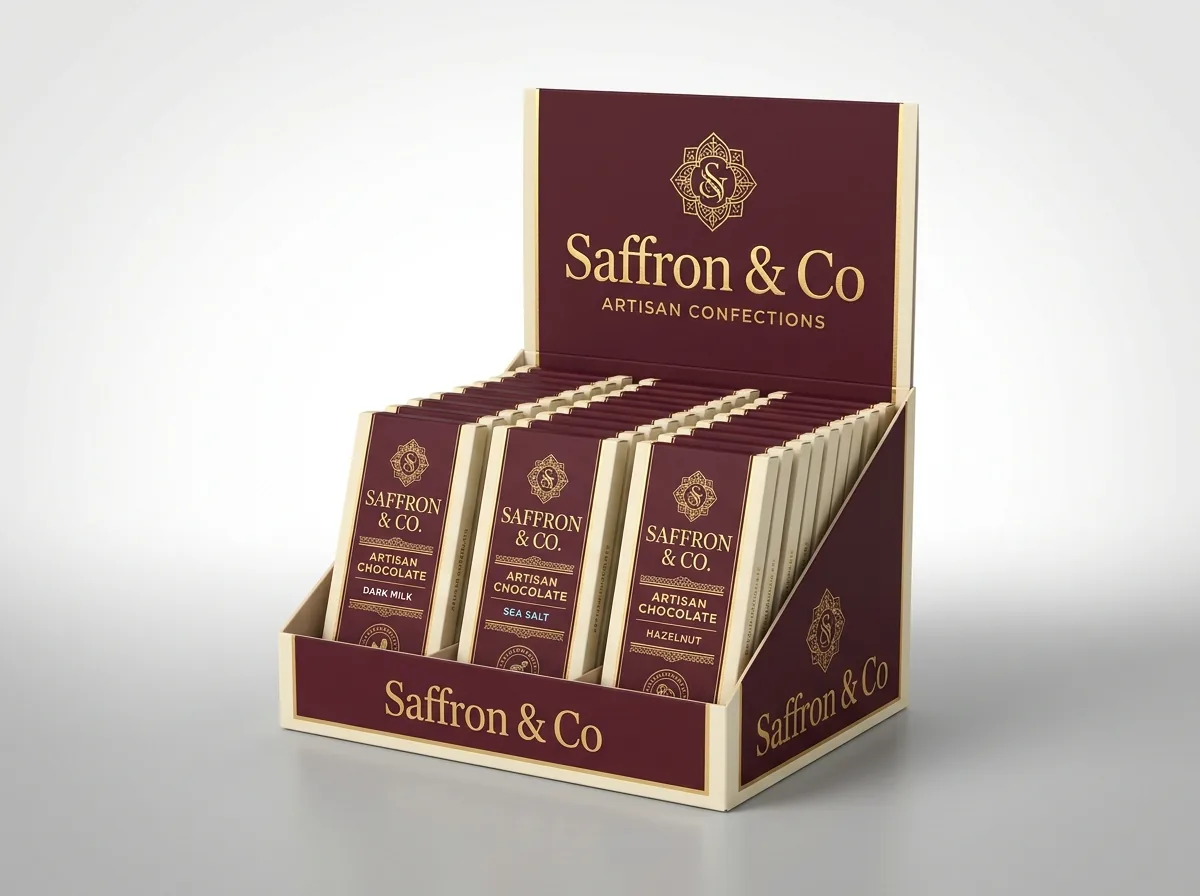
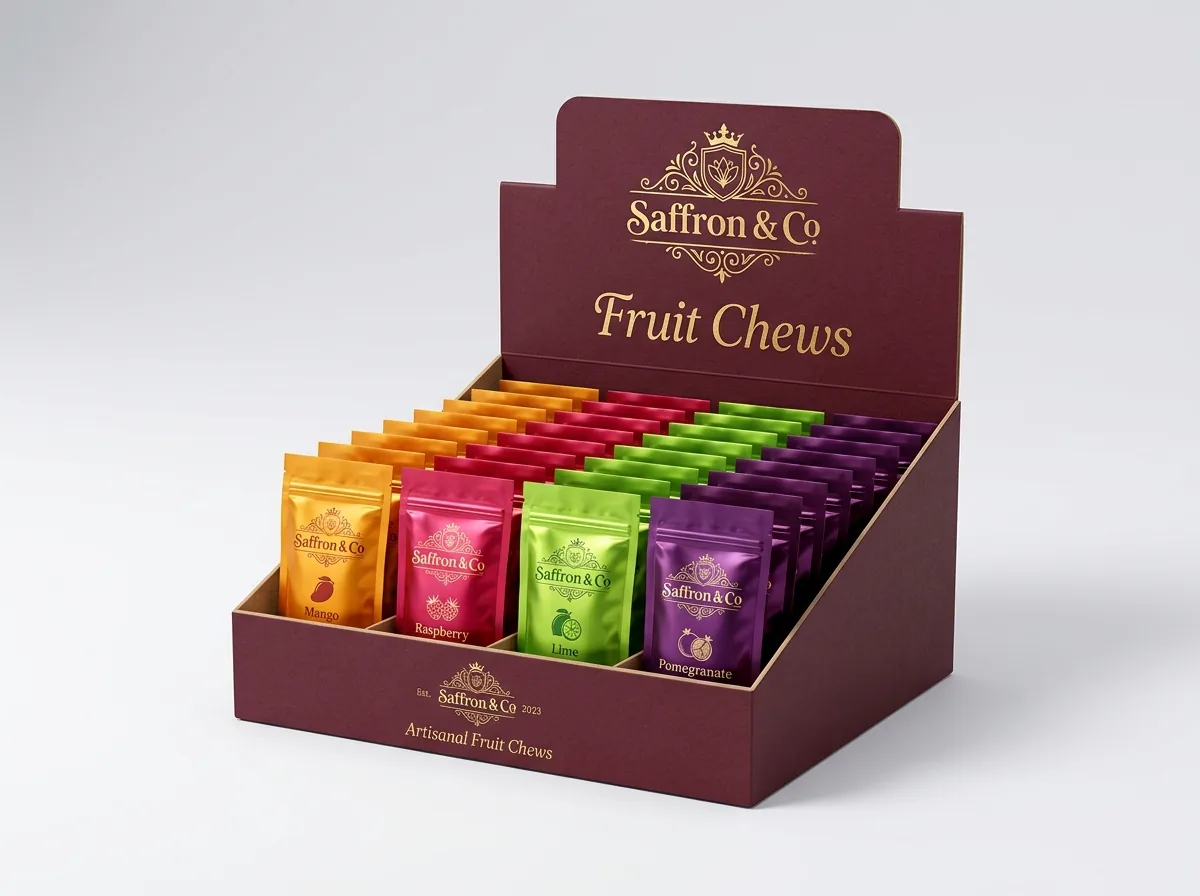
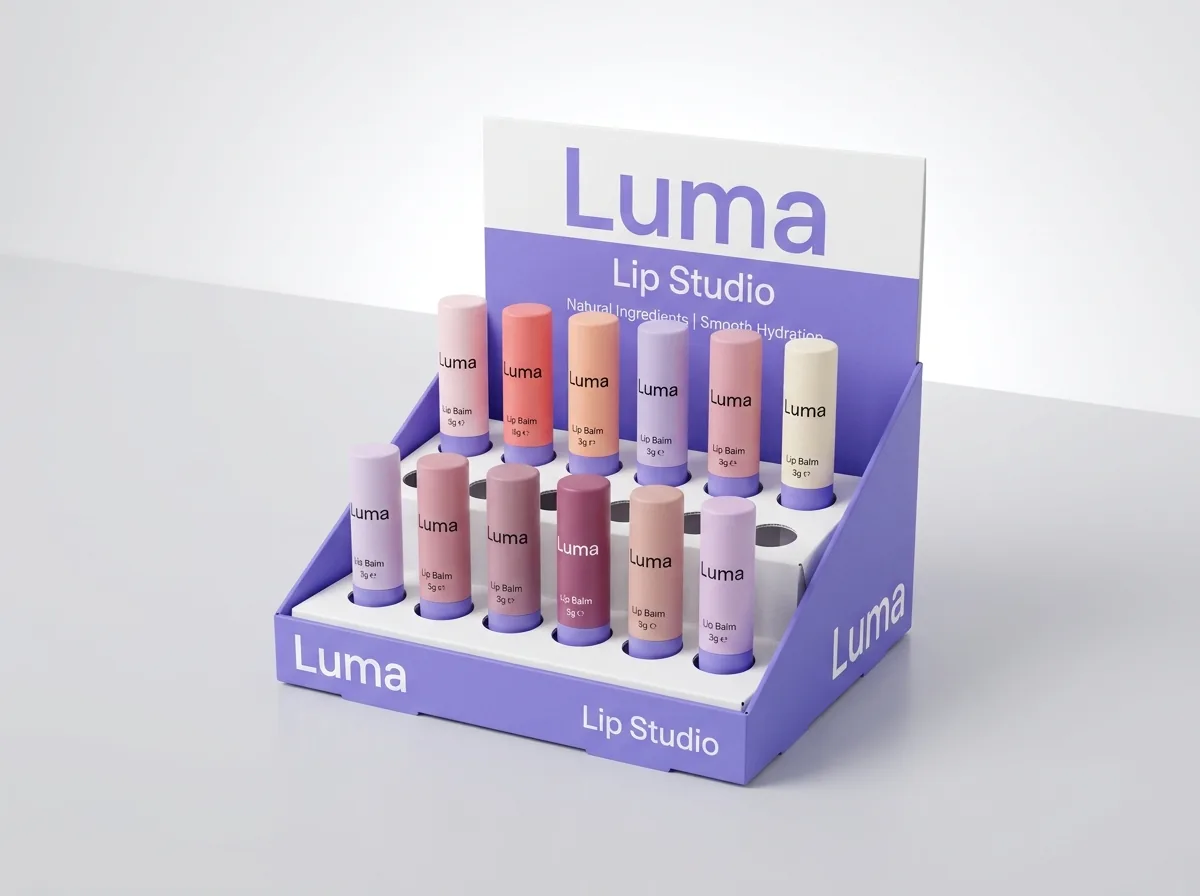
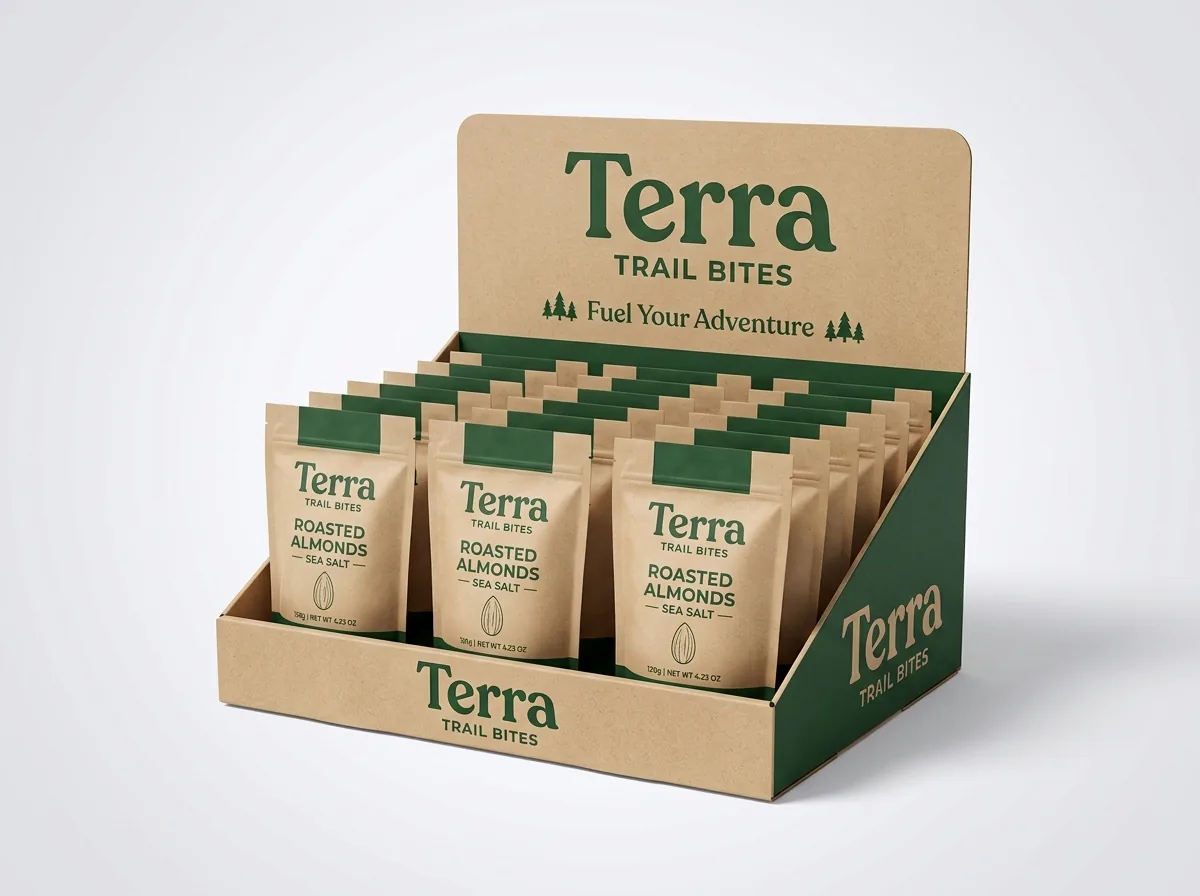
Display boxes are the standard point-of-purchase multipack tray for candy, lip balms, snacks, tea bags, gummies, protein bars, pens, and nail polish
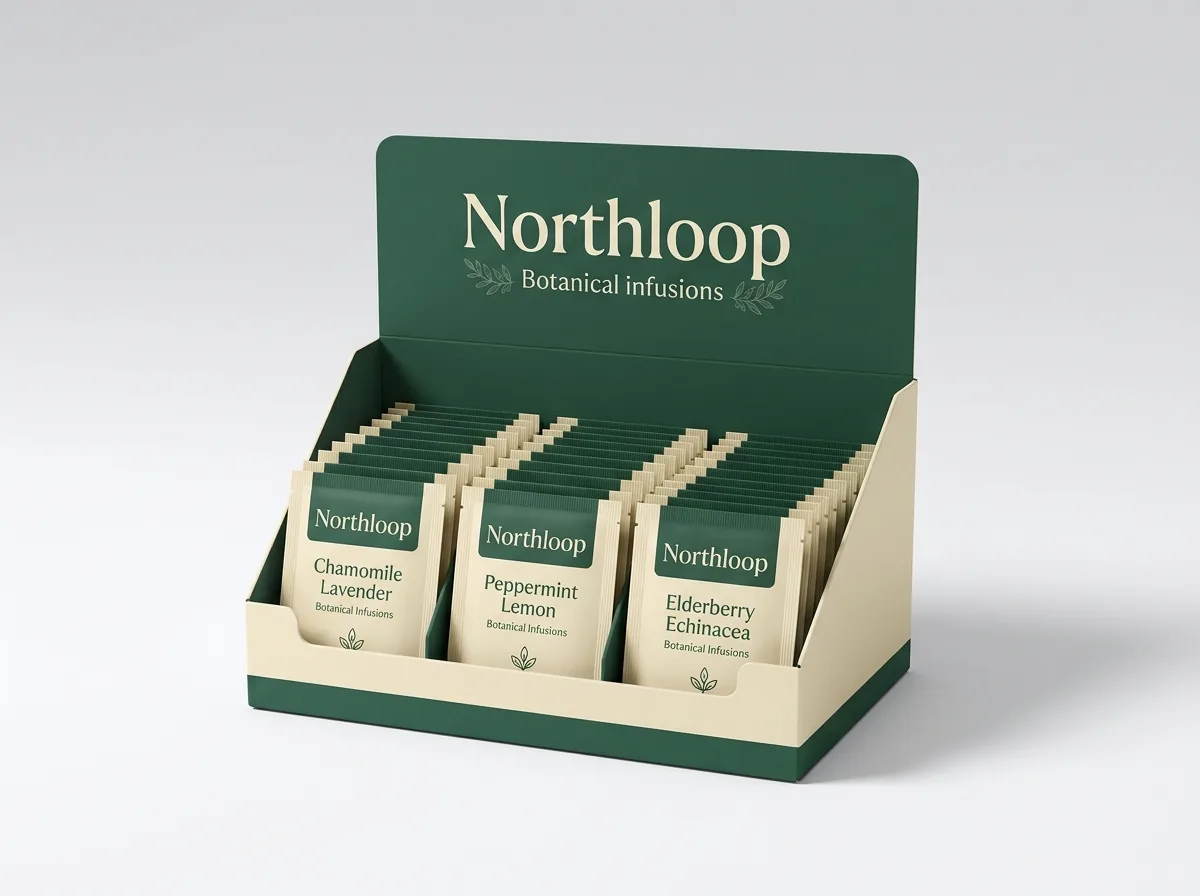
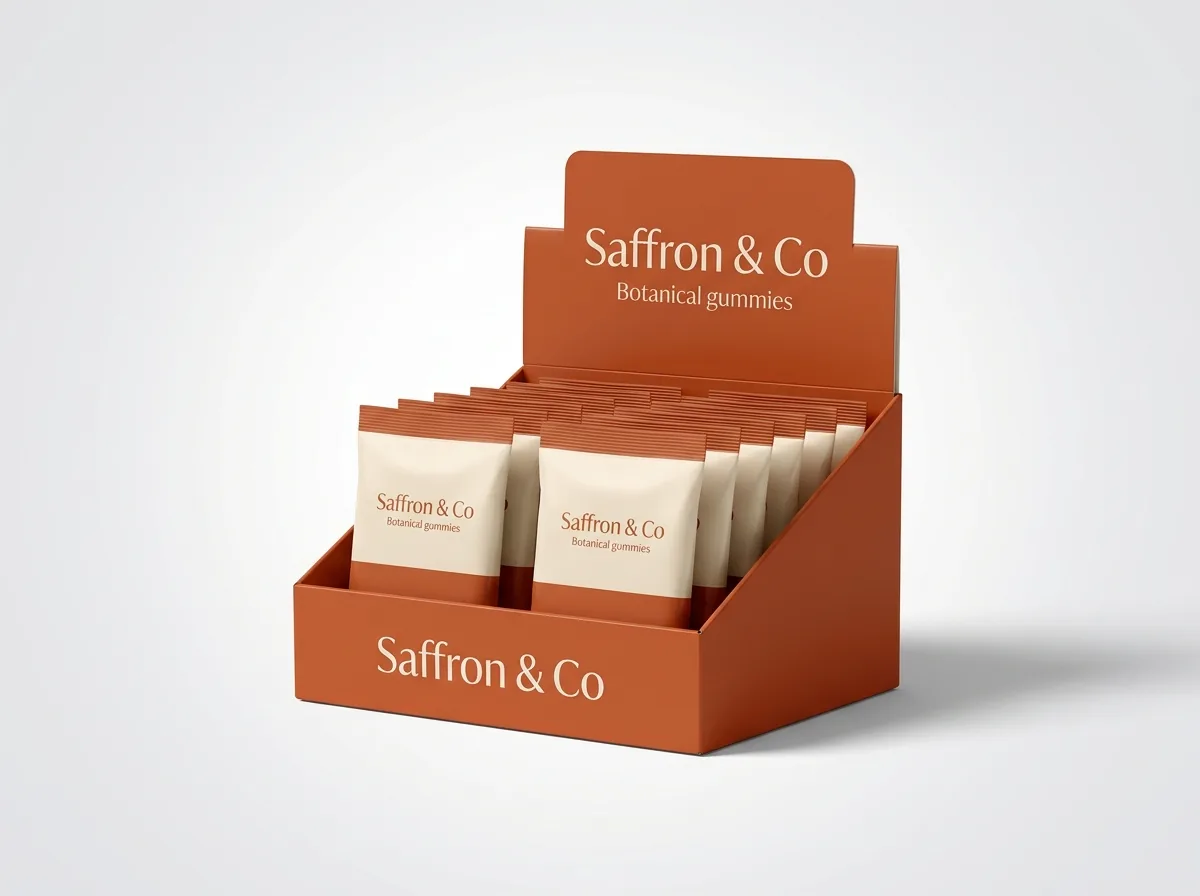
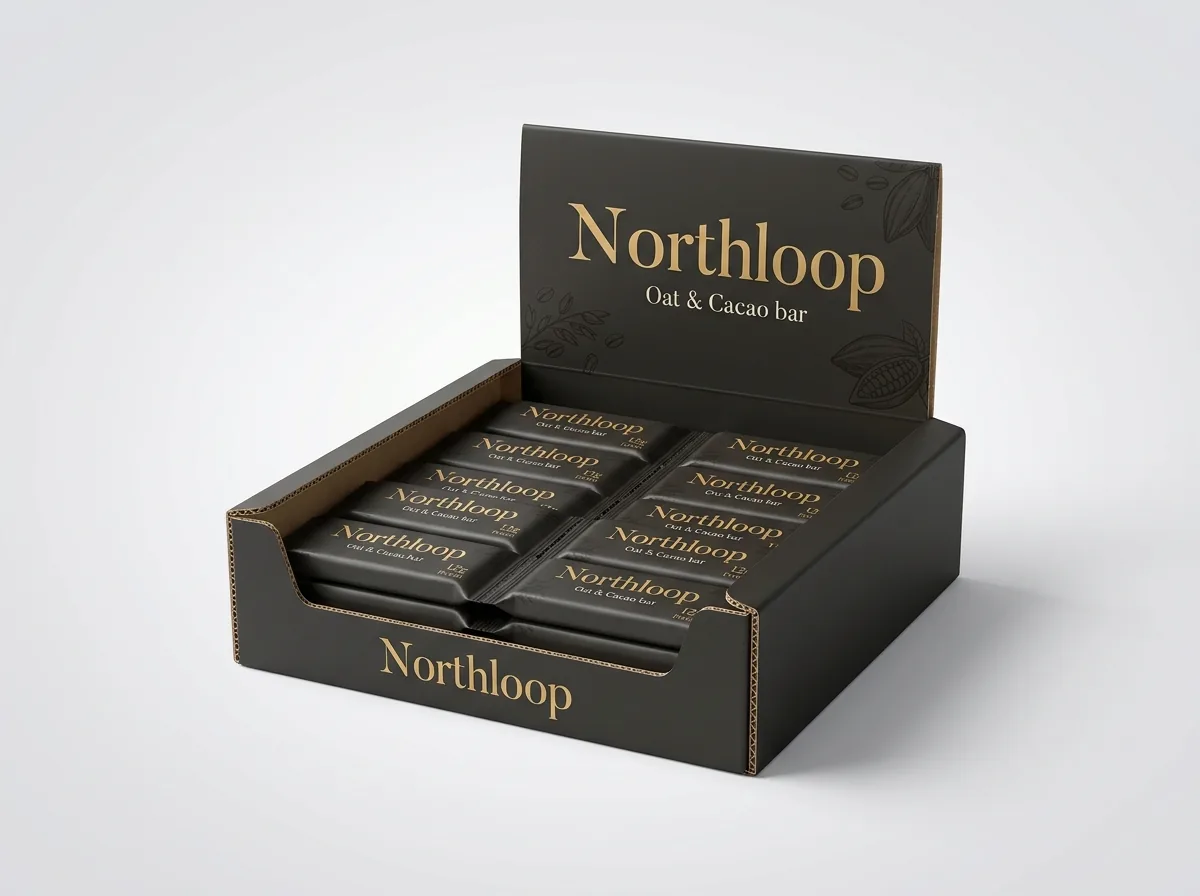
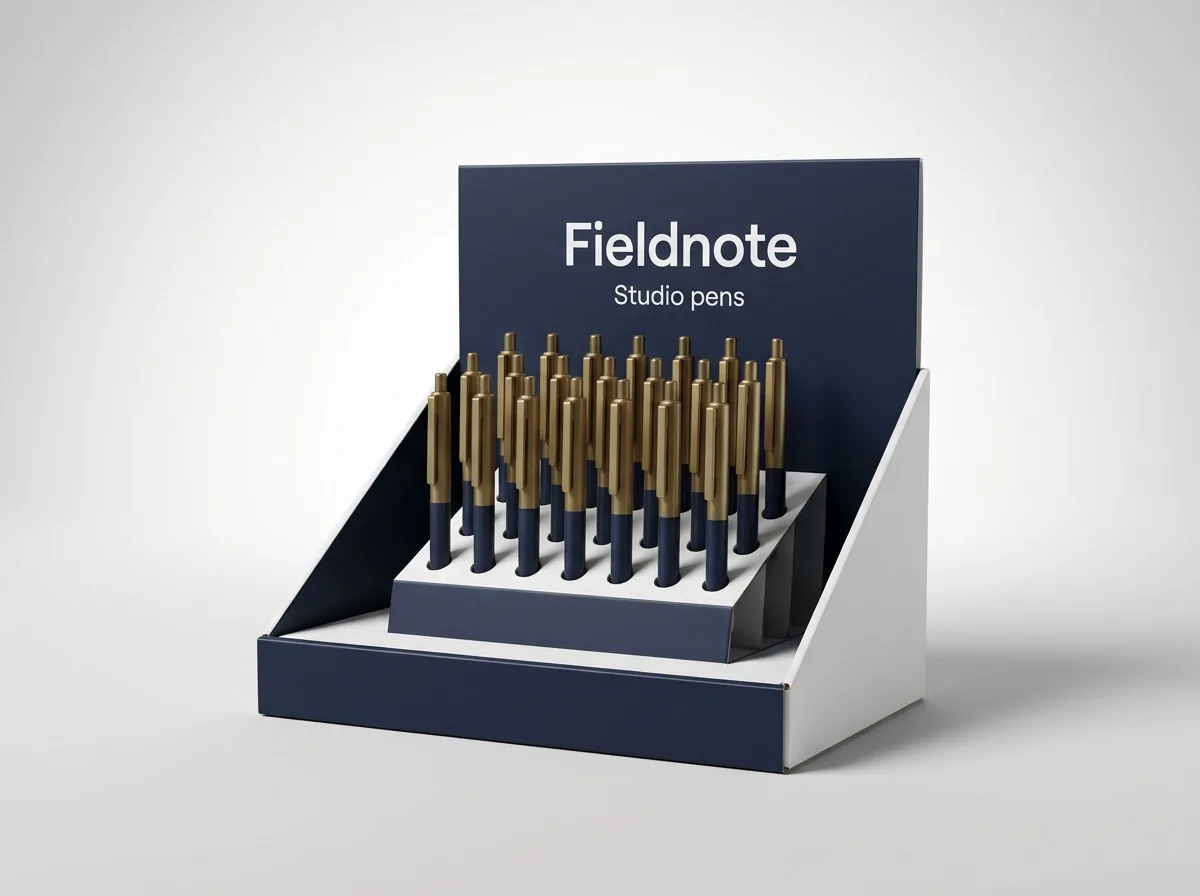
What are display boxes made of?
Light checkout trays for lip balms, pens, and tea sachets use smooth white paperboard or natural kraft board, while heavier snack bar and multipack shelf trays step up to E-flute corrugated board.
Which finishes work on a display box?
What can I add to a display box?
Display box specifications
| Spec | Options |
|---|---|
| Construction | 1-piece folding carton or E-flute tray with micro-perforated tear-away hood, low front lip, and fold-up back header |
| Bottom styles | Tuck bottom (light units), 1-2-3 snap-lock bottom (medium weight), or pre-glued auto-lock bottom (heavy multipacks) |
| Front lip ratio | 25% to 35% of individual unit height (holds units upright while keeping 65%–75% of front label visible) |
| Row & column clearance | Add +1/8 in to +1/4 in total finger clearance to cumulative unit width and depth |
| Board | White card / paperboard, natural brown kraft board, thin E-flute corrugated, recycled |
| Board thickness | Card (paperboard), kraft, corrugated or rigid board matched to product weight |
| Printing | Full color CMYK, Pantone, optional inside tray flood coat so walls look finished as units sell down |
| Lamination | No lamination, matte, gloss, soft-touch |
| Finishes | Foil stamping, embossing, debossing, spot UV |
| Size range | Any inside tray footprint and header height to order; smallest and largest |
| Quantity | From 1,000 boxes; delivered within ±5% of the order |
| Turnaround | 10–14 business days; rush 4–5 days |
| How boxes ship | Flat (pre-glued and perforated) |
Ready to quote display boxes? Compare up to 3 quantities with a free 3D mockup.
Request a Quote →What goes on each panel of a display box?
- 1Upright back header billboard
Your primary eye-level billboard above the product rows: place your brand logo, hero claim, and high-contrast visual oriented for the 180-degree folded-up position. - 2Low front display lip
Sits directly below the front row of units: use bold typography for the flavor name, pack count, or a Grab & Go badge, keeping text 3/16 in below the perforation. - 3Sloped left & right side walls
Visible to shoppers walking down the aisle toward your display: repeat your brand logo, color blocking, and dietary icons below the diagonal tear line. - 4Back wall (exterior)
Faces the back of the shelf: carries master multipack UPC barcodes, case lot numbers, and regulatory distribution copy. - 5Tear-away shipping hood
Removed at the shelf before merchandising: print simple warehouse SKU text and a clear Tear Along Perforation to Open Display diagram for store staff.
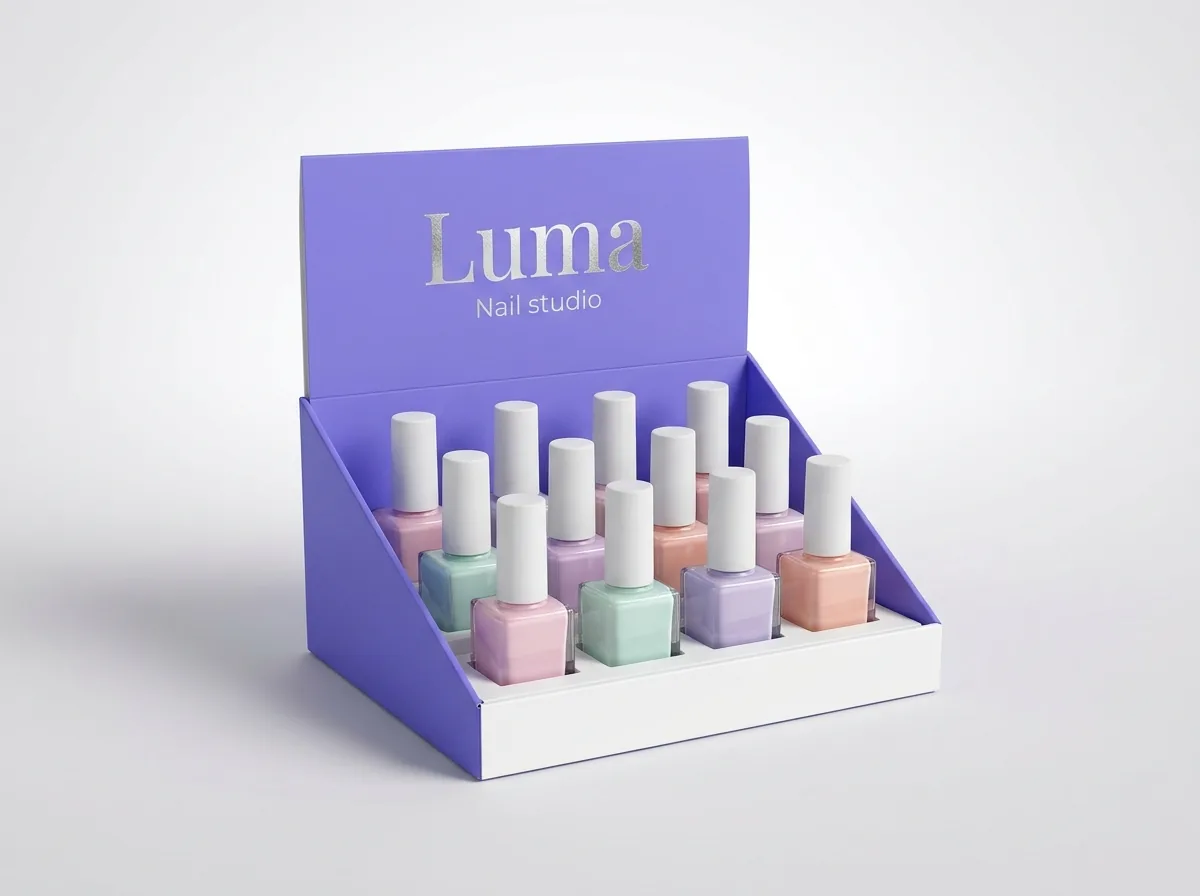
Display box design ideas
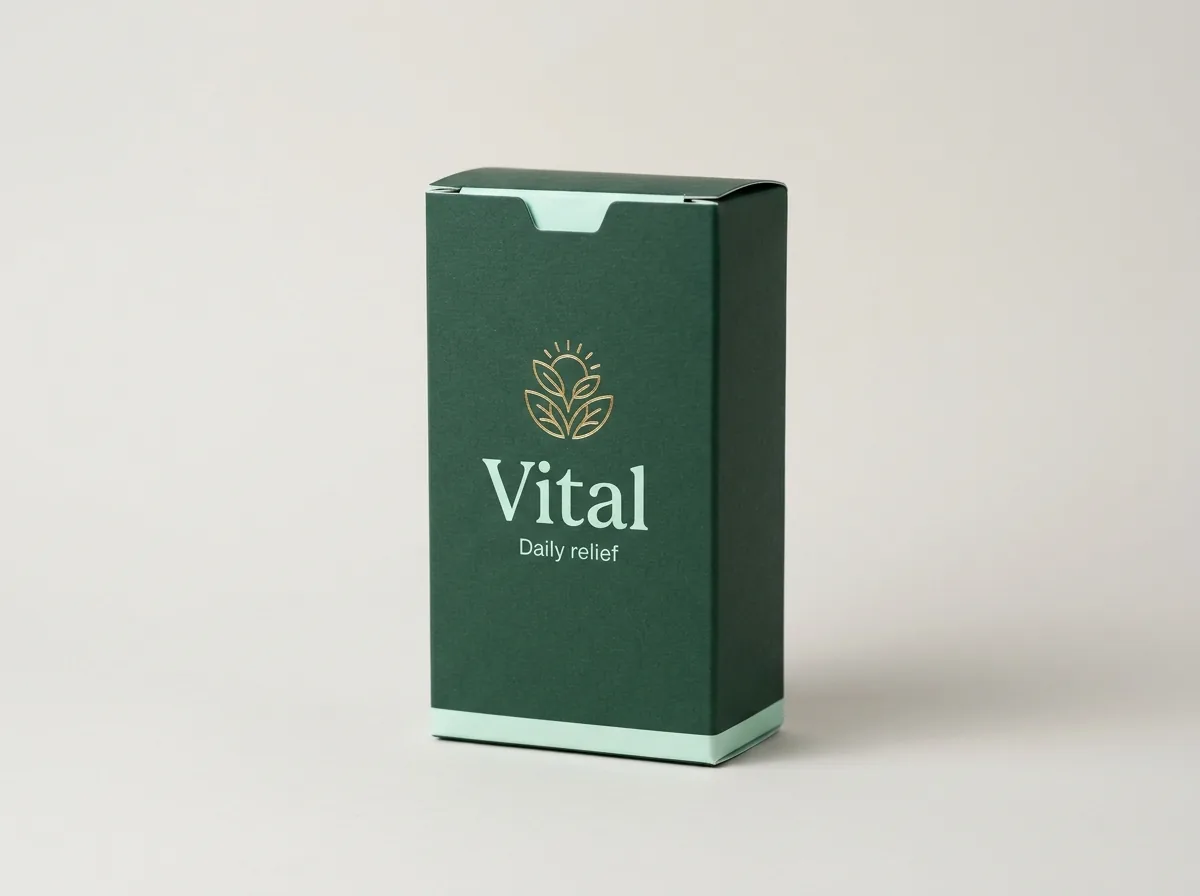
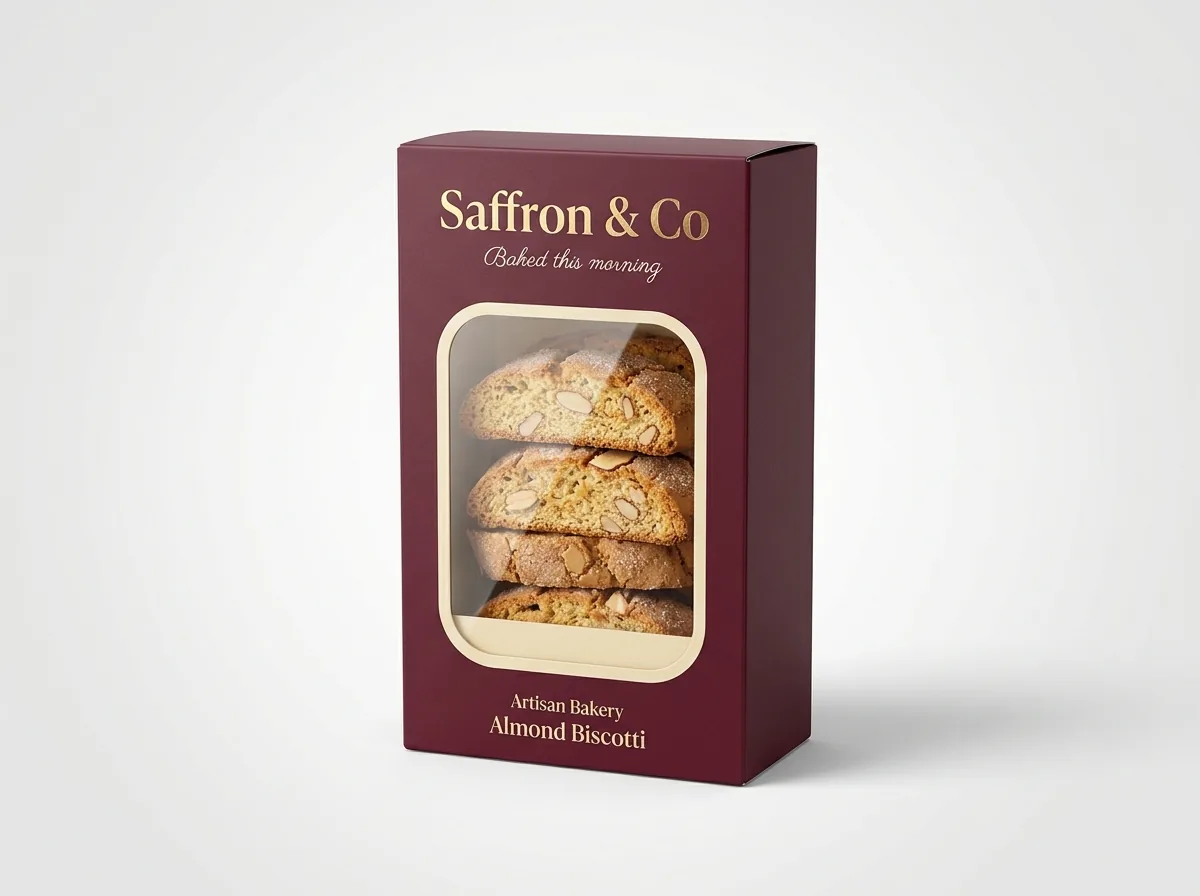
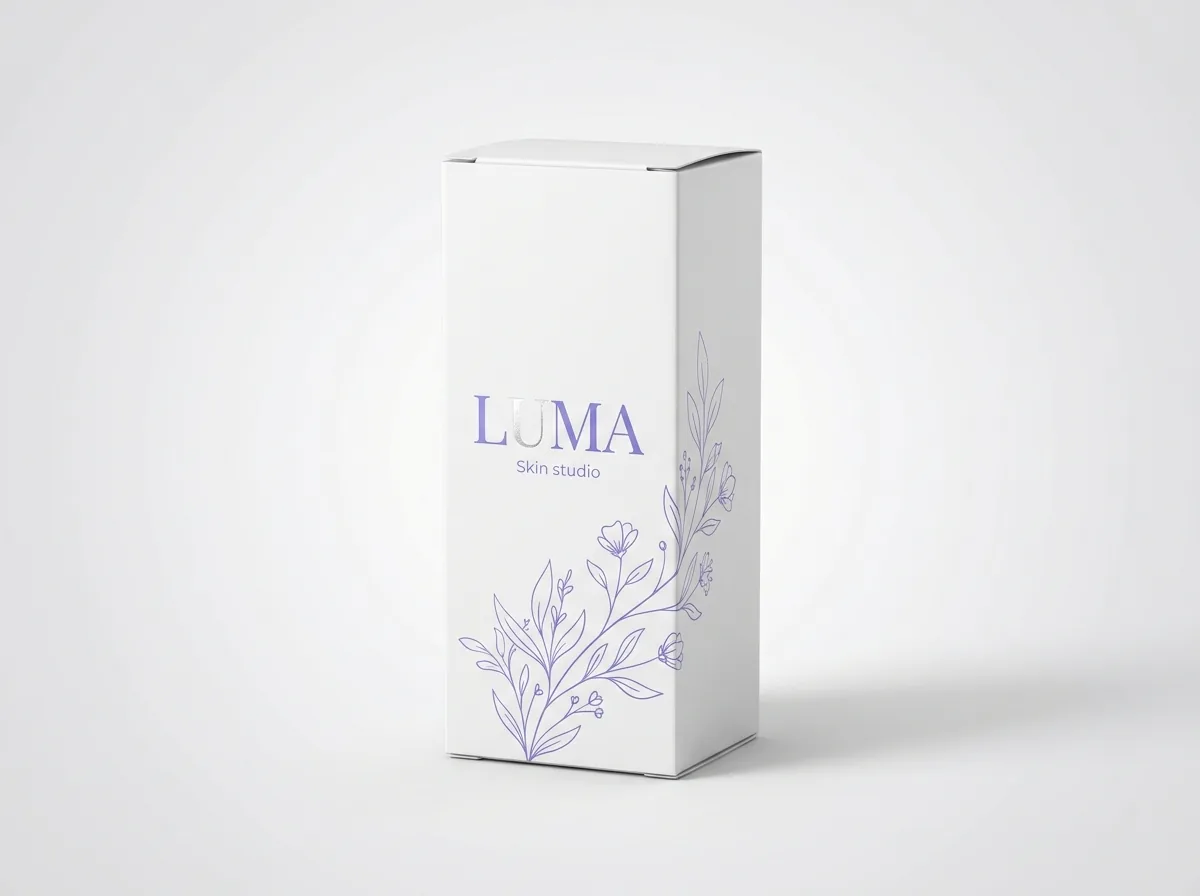
Example designs with made-up brands. Your box is made to your design.
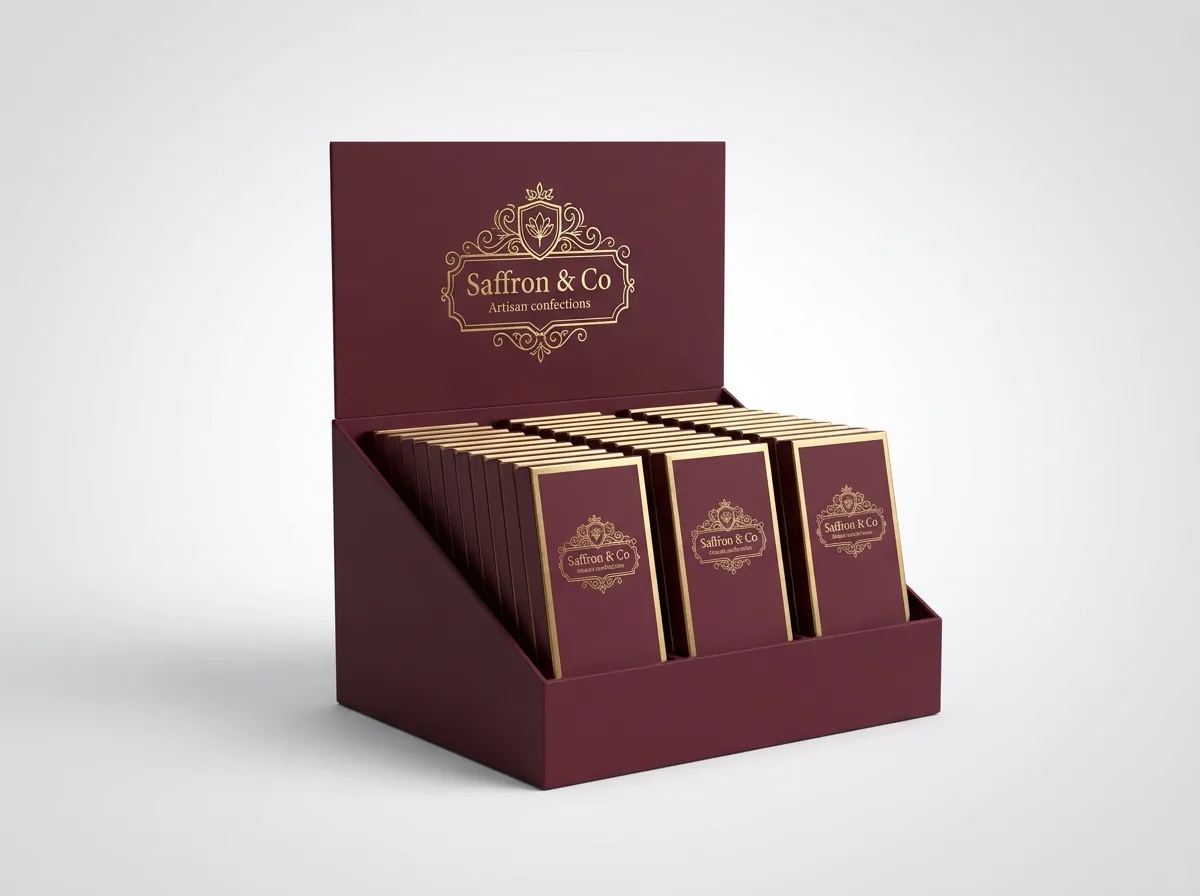
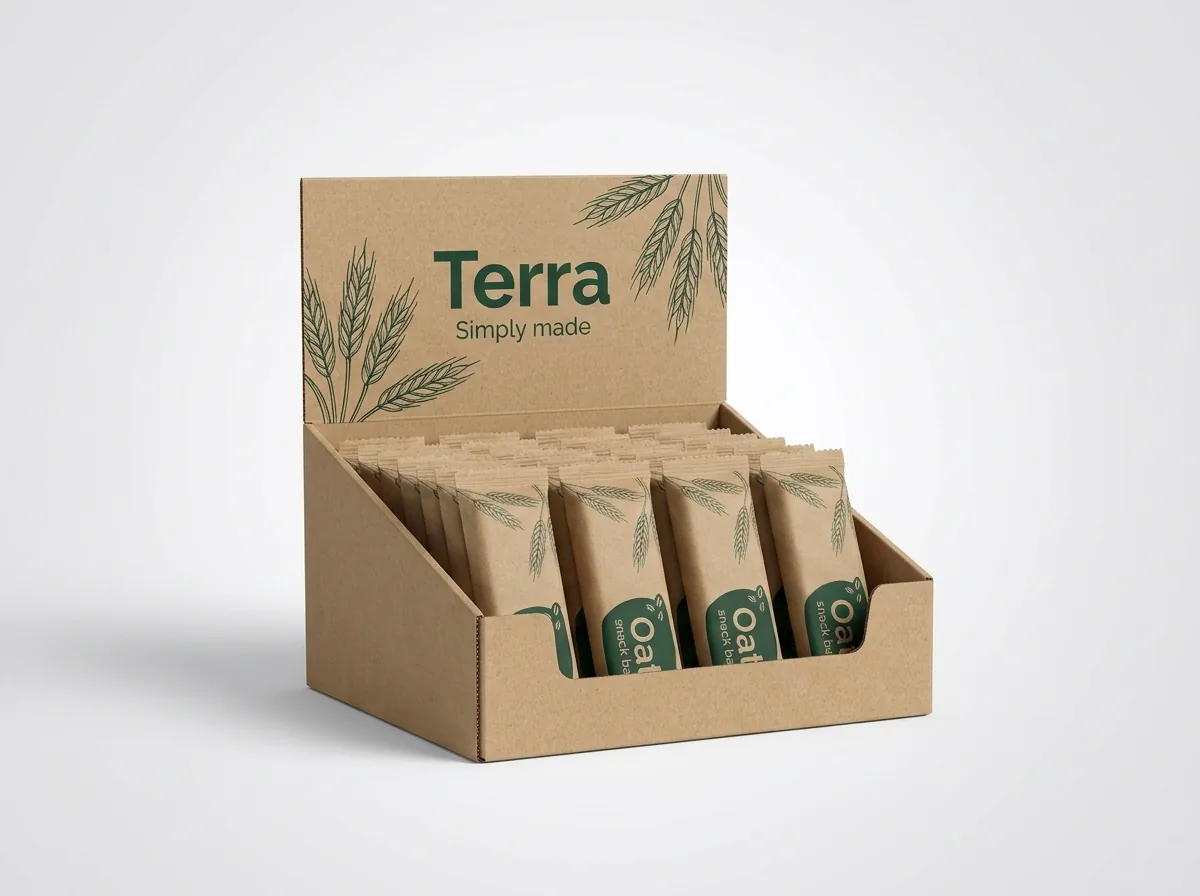
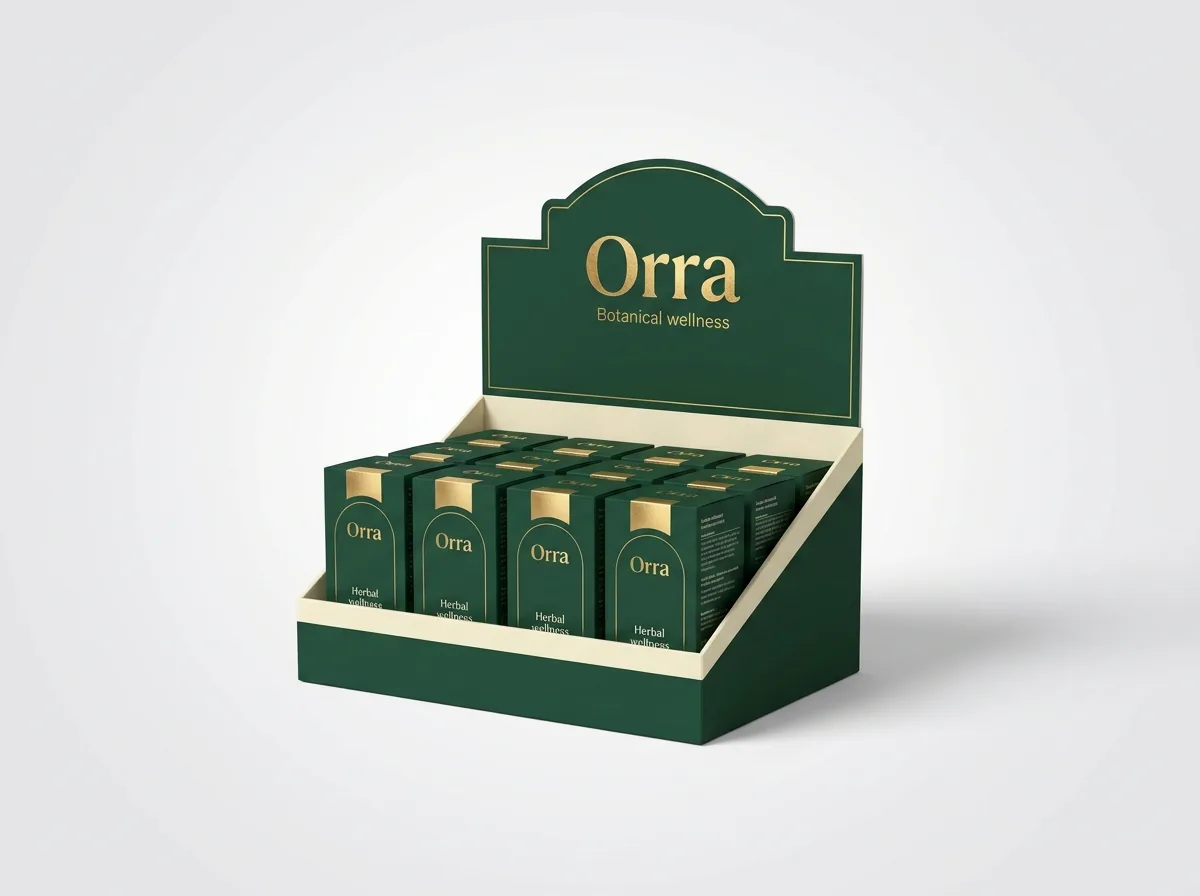
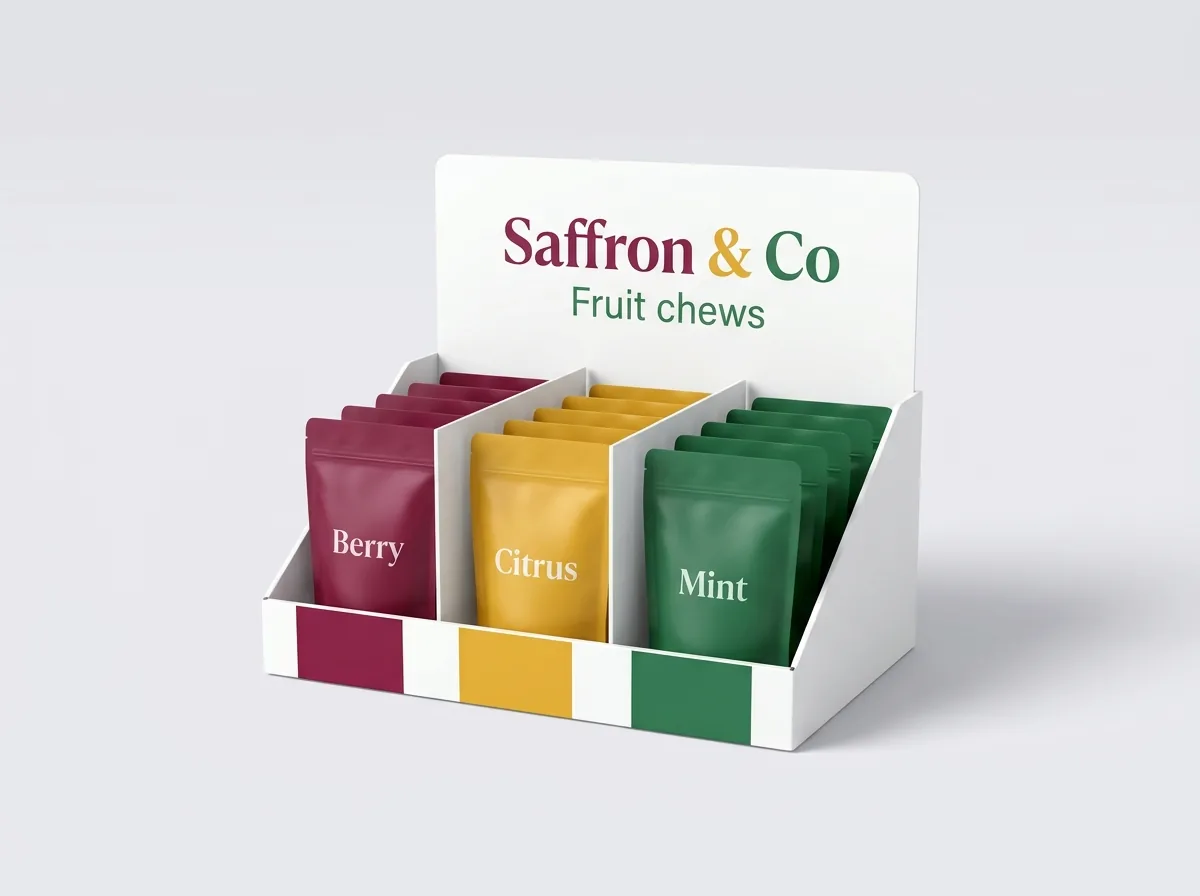
Common mistakes on display boxes (and how we prevent them)
A display box must survive transit as a closed carton and then stand cleanly on the counter once opened. Our prepress checks prevent these five common structural and artwork mistakes. For buyers ordering branded display boxes, wholesale display boxes, bulk custom display boxes, personalized display boxes, custom size display boxes, display boxes with low front display lip or custom paperboard display boxes, watch out for these common sizing and artwork mistakes
- Making the front display lip taller than 40% of the unit height, which blocks the brand name and flavor callout on the front row of products.
- Designing a single-layer unfolded top flap as the header, which curls forward under retail lighting and turns artwork upside down if oriented for the flat lid.
- Leaving zero finger clearance around the grid of packed units, wedging the first bar or pouch so tightly that shoppers pull the whole tray forward.
- Running tear-away micro-perforations right through the vertical corner score lines without an inboard offset, weakening corner stacking strength in transit.
- Using a standard friction tuck bottom for heavy multipacks over 1.5 lb instead of a 1-2-3 snap-lock or pre-glued auto-lock bottom floor.
Chat with a designer now
Share your logo, a sketch or an AI image. We'll rebuild every element cleanly onto your box dieline and send a 3D mockup, free.
Made your design with AI?
Generated a concept in Google Gemini, ChatGPT, Claude or Midjourney? Send us your AI image: we rebuild every element onto your box dieline and show you a 3D mockup before you pay, free.Custom vs stock display boxes: which is better?
| Stock (plain) boxes | Custom boxes from CubitPack | |
|---|---|---|
| Branding | Plain, or a label on the front | Your logo and colors, inside and out |
| Fit | Fixed sizes | Made to your exact size |
| Minimum | Any quantity | 1,000 boxes |
| Lead time | Ships right away | 10–14 business days, rush 4–5 |
| Design | None | Free design help, proof and 3D mockup |
Get custom display boxes made to your exact size, with a free 3D mockup before you pay.
Request a Quote →Are display boxes eco-friendly?
Kraft and recycled board
Choose kraft or recycled board for a lower-impact box.FSC paper available
FSC paper and ISO 9001 production are available on request.Food-safe on request
For food, we make it in a certified partner facility. Certificates and lab tests on request.How do I order custom display boxes?
Tell us what you need
Size, quantities or AI conceptCompare volume pricing
Dedicated account managerApprove your proof
Digital proof + 3D mockupMade and shipped
Free to all 50 statesHow much do custom display boxes cost?
The price depends on four things, and every custom quote is free.
Size
Bigger packaging uses more materialQuantity
The unit price drops as you order moreMaterial
The board, film or paper you chooseFinishes
Foil, windows and lamination add costYour first order is 10% off, and we beat written quotes from US competitors for the same specs.
10% off your first order.
Request a Quote →What do I need to send for a quote?
- The product and how many you need
- The inside size, or what goes in it
- A style, or ask us to suggest one
- Your logo or artwork (an AI image is fine)
- Pantone codes, if you have them
- Delivery ZIP code and the date you need it
Can I see a sample first?
Sample kit
Board and finish swatches, sample boxes, labels and bags. Credited to your first order.Digital proof + 3D mockup
See it before you payPrinted sample
Of your own designHow do the boxes ship?
- Free shipping to all 50 states
- Worldwide with DDP prices: duties and taxes included
- Blind and split shipping
- Damaged in transit? We reprint the damaged units free
Why brands choose CubitPack
Dedicated specialist
One account manager from quote to deliveryPantone guaranteed
Clearly off? We reprintReprint or refund
If we get it wrong, you chooseBBB accredited
A US business you can checkDisplay box questions
How do I calculate the inside dimensions of a custom display box?
First decide how many columns (left to right) and how many rows (front to back) of units the tray will hold. Multiply the width of one unit by the number of columns and add 1/8 to 1/4 inch for finger clearance to get the interior Length (L). Multiply the front-to-back thickness of one unit by the number of rows and add 1/8 to 1/4 inch to get the interior Width (W). Set the back wall Depth (D) equal to the full height of one standing unit.
How tall should the front lip and back header billboard be?
Set the front display lip between 25% and 35% of your individual unit height (typically 1.0 to 1.75 inches) so units stay upright while 65% to 75% of their front label remains visible. Set the upright back header height between 75% and 100% of the tray depth (typically 3.0 to 5.0 inches above the back wall) so it folds down flat as the top lid during shipping.
How does the tear-away perforated hood convert at the store?
Micro-perforations run horizontally across the front wall (at the height of the low front lip) and angle upward across both side walls toward the top of the back wall. When store staff pull the front thumb notch, the upper front and side hood zips off cleanly, leaving the top lid hinged to the back wall. Staff then fold the top lid along its center crease and tuck its bottom tabs into the rear wall slots to form a rigid double-wall header.
Should I choose white card, kraft board, or E-flute corrugated?
Choose smooth white card or natural kraft paperboard when the total weight of all packed units is under 2 to 2.5 lb and the tray footprint is compact (such as lip balms, pens, tea sachets, or small candy packs). Choose thin E-flute corrugated board when the packed multipack weighs 2.5 to 8 lb, when the tray spans wider than 8 inches, or when the carton ships through grocery distribution centers.
Can you add a stepped riser, divider lanes, or die-cut holes inside the tray?
Yes. Select Card insert in Step 2 of the quote form. We engineer custom vertical lane dividers to separate pouch flavors, stadium step risers to elevate the back rows, or die-cut circular and square grids to hold lip balm tubes, pens, and nail polish bottles upright.
Which bottom closure should I use for my display box?
For light checkout packs under 1 lb (such as tea envelopes or single-row lip balm trays), a standard tuck bottom works well. For 1 to 3 lb multipacks, a 1-2-3 interlocking snap-lock bottom provides flat support. For heavier 3 to 8 lb protein bar, beverage, or glass bottle displays, pair the tray with a pre-glued auto-lock bottom.
Do display boxes ship flat?
Yes. Display boxes are die-cut, micro-perforated, and side-seam glued flat into Knocked-Down Flat (KDF) bundles so they take up minimal warehouse space until your packing team squares them up and loads your units.
Can I print inside the tray so the walls look finished as products sell down?
Yes. Select Inside only or Outside & inside printing in Step 2 of the quote form. Adding an interior brand color flood coat ensures that as shoppers buy the front row of units, the exposed inside side walls and back wall match your exterior palette.
How long does production take?
Standard turnaround is 10–14 business days after you approve your digital proof and complete payment. Rush production in 4–5 business days is available at an extra cost quoted per order.
How are display boxes packed and delivered?
Your account manager confirms packing details with your written quote, and shipping is free to all 50 US states.
Still have a question? Ask a packaging specialist.
Request a Quote →Parts of a display box
- Header billboard (header card)
- The upright vertical panel rising above the back wall of a display tray that carries your brand logo and callout at eye level
- Front display lip (kick plate)
- The low front wall of the display tray (25%–35% of unit height) that holds the front row of products in place
- Micro-perforation (zip rule)
- A steel rule with closely spaced cuts and tiny paperboard ties that holds the hood closed in transit and tears cleanly by hand
- Shelf-ready packaging (SRP)
- Secondary multipack cartons designed so store clerks can zip off the top hood without a knife and place the tray straight on the shelf
- Double-folded header
- A top lid scored across its center so it folds back 180 degrees and locks into rear slots as a stiff two-ply billboard
- Step-tier riser
- A folded paperboard insert in the back of a display tray that elevates the rear row of products above the front row
Other box styles
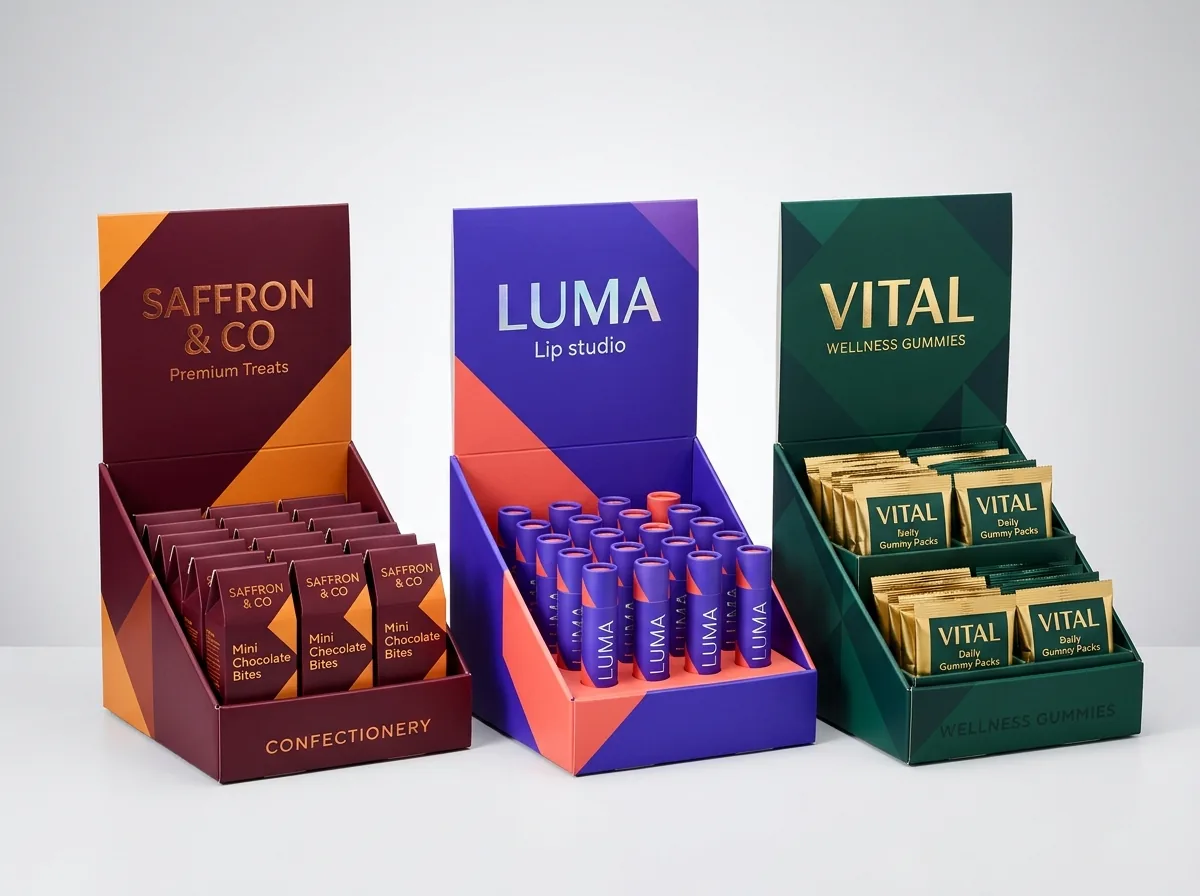
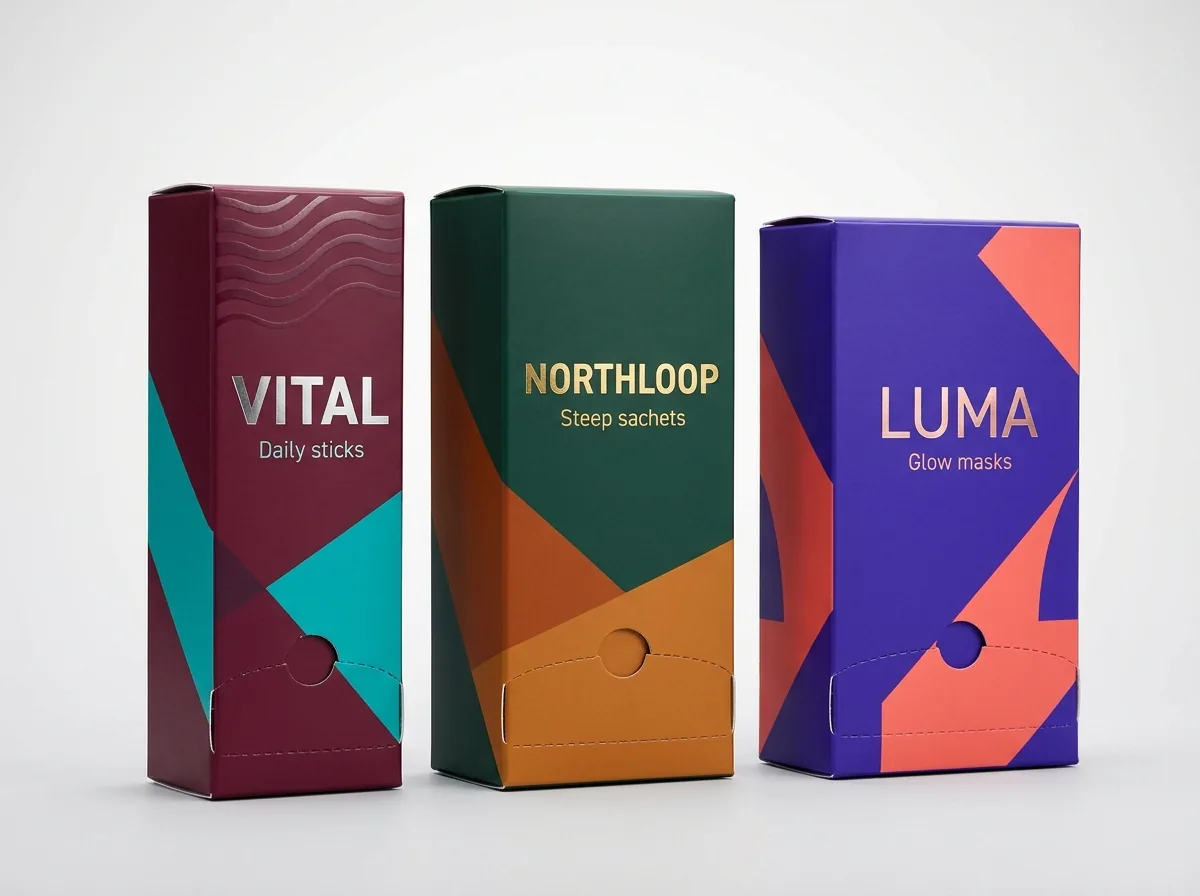
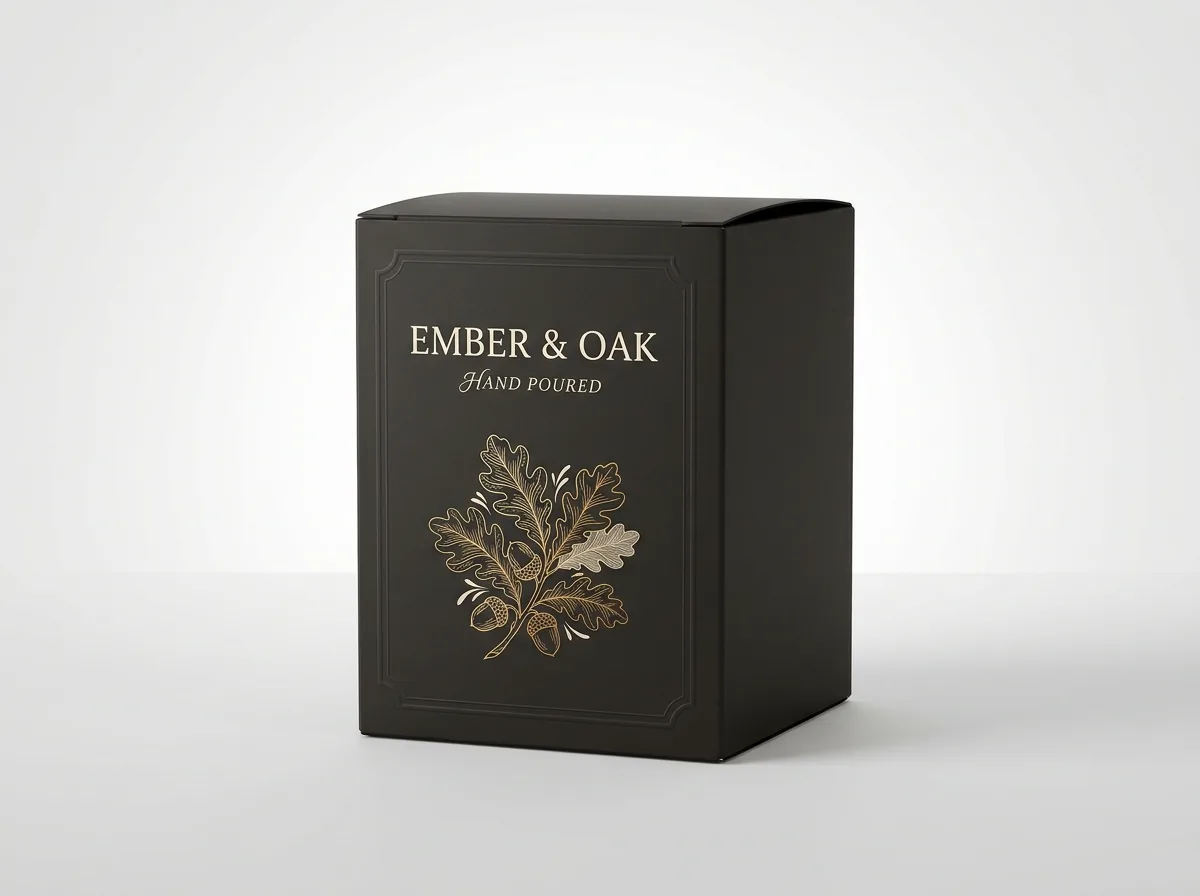
Learn more about display boxes
Get your display boxes price
One dedicated account manager prepares pricing across up to 3 quantities.
- Free design & AI-to-print studio + 3D mockup
- No die or plate charges · 4–5 day rush available
- Free shipping to all 50 states
- 10% off your first order
- Reprint or refund if we get it wrong
Micro-perforation cut-to-tie guidelines, 25%–35% front lip height ratios, 3/8 in corner perforation offsets, and double-folded header locking structures were verified against Fibre Box Association (FBA) Retail Ready Packaging guidelines and Paperboard Packaging Council (PPC) folding carton references. Our packaging specialist reviewed the hand-drawn dieline against CubitPack offerings. Spot something wrong? Tell us and we fix it. Tell us if something looks wrong.
Sources
- Tear-away hood perforation geometry, corner offset keep-out zones, and shelf-ready tray conversion rules.
- Front lip height ratios (25%–35% of unit height), double-folded locking header panels, and bottom closure selection.
- Checkout counter footprint guidelines, step-tier risers, and shopper sightline angles.
What changed
- October 24, 2026: Published with verified tear-away display construction facts, hand-drawn 8 × 6 × 4 in dieline, 15 studio images, and three supporting guides.