
Display boxes vs counter display and dispenser boxes: which retail structure fits your product?
Short answer: Choose standard custom display boxes for snack bars, pouches, and mini cartons that stand stably on a flat tray floor and ship with a zip-off perforated top. Step up to a tiered counter display box (CDU) for narrow tubes that need die-cut holes, or a gravity dispenser box for flat sachets fed from a bottom chute.

On this page
- How do the three retail display box styles differ in construction
- When does a product need a tiered counter display instead of an open tray
- How do display boxes, counter displays, and dispenser boxes compare
- When is a bottom-slot gravity dispenser box the smartest choice
- How do I size and order my retail display structure
- Common mistakes
- FAQs
Request a custom quoteFree dieline & 3D mockup
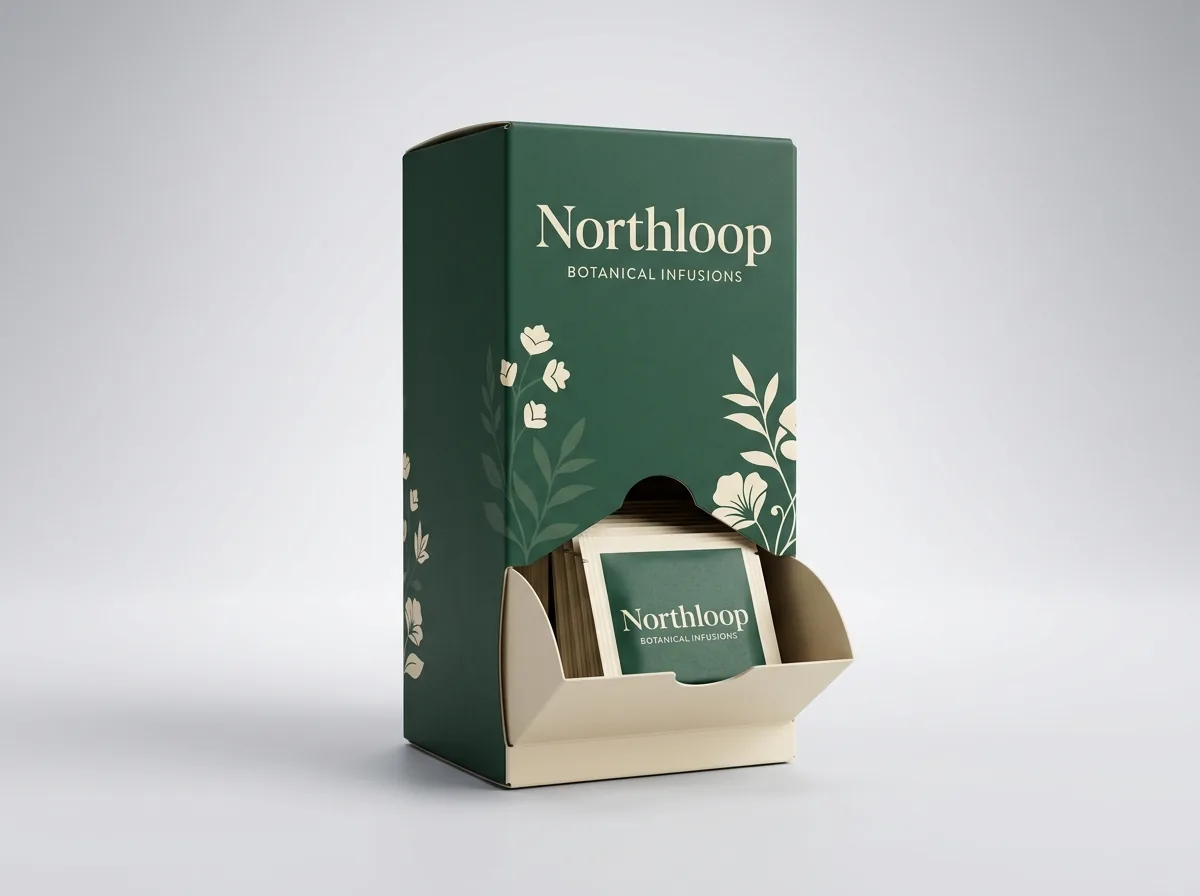
All three structures turn a multipack of 6 to 24 units into a branded point-of-purchase display, but each solves a different mechanical problem at the store. A standard tear-away display box is a 1-piece paperboard or E-flute carton with micro-perforations along the front and side walls; store clerks zip off the upper hood and fold the top lid into an upright back header, leaving an open flat-floor tray for snack bars, candy bags, and small folding cartons. A counter display box (CDU) adds internal stadium step risers or a die-cut hole platform engineered specifically for checkout counters where narrow lip balms, pens, rollerballs, or tincture bottles would otherwise tip over like dominoes. A gravity dispenser box is a tall enclosed vertical tower with an angled internal ramp and a pull-down lower front chute that feeds flat tea envelopes, hydration sticks, or single-serve wipes one at a time.
How do the three retail display box styles differ in construction?
When retail buyers ask for shelf-ready or checkout-ready packaging, they are choosing between three distinct paperboard mechanisms: our standard display boxes, dedicated custom counter display boxes, and vertical custom dispenser boxes
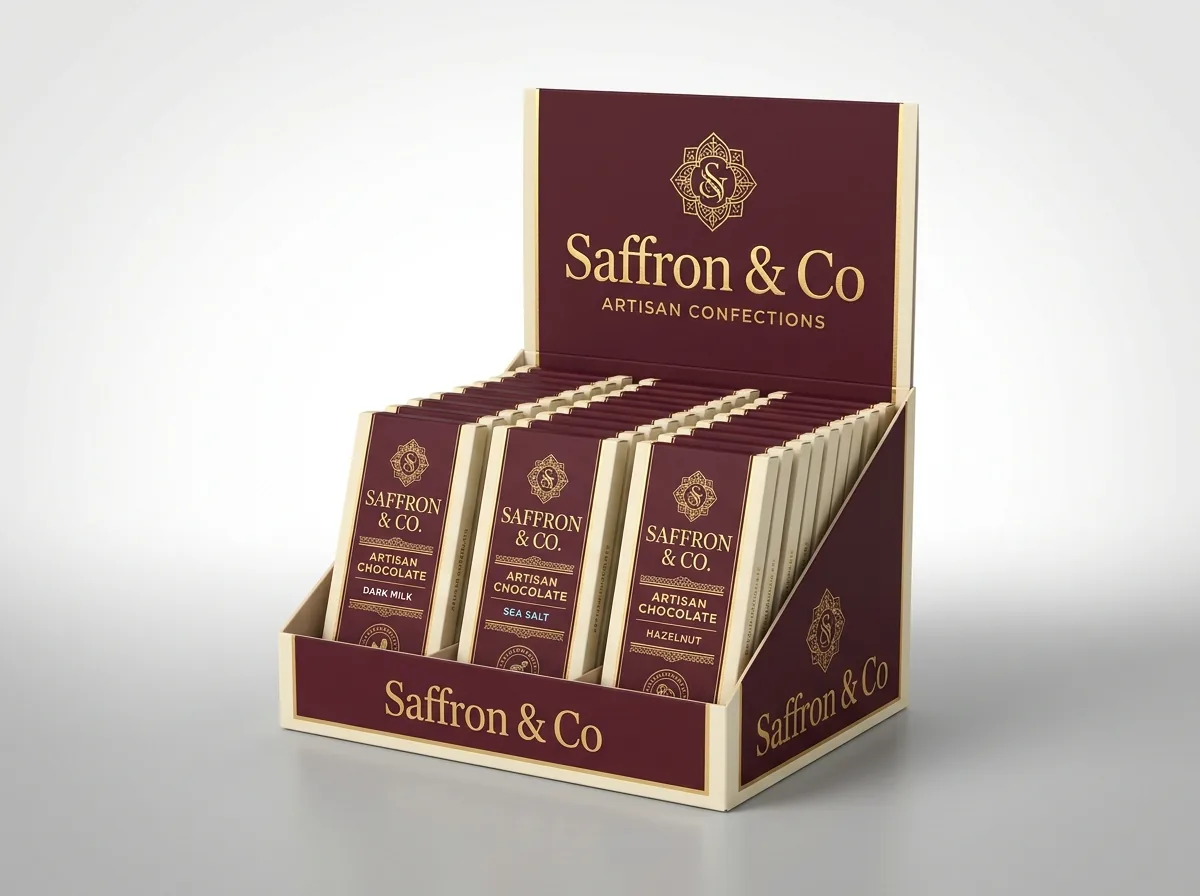
- 1. Standard Tear-Away Display Box (Shelf-Ready Tray): Die-cut from a single piece of folding paperboard or E-flute corrugated board. It packs and ships like a closed carton, then converts in 5 seconds when store staff pull the front thumb notch to zip off the perforated upper hood and lock the double-folded top lid upright behind the back wall.
- 2. Counter Display Box / CDU (Tiered or Cradle-Deck Stand): Built for compact high-traffic checkout ledges alongside the register. Instead of an empty floor, a CDU incorporates a 2-tier or 3-tier stadium step riser or a raised die-cut hole deck that locks narrow cylindrical tubes, pens, and cosmetics upright even when only two units remain.
- 3. Gravity Dispenser Box (Bottom-Chute Tower): Built like a tall vertical magazine with an internal 30-to-40-degree false-bottom ramp. The top and front stay enclosed to protect the stack from dust, while a perforated lower front panel pulls forward into a miniature catch tray so shoppers pull one flat sachet or stick pack from the bottom.
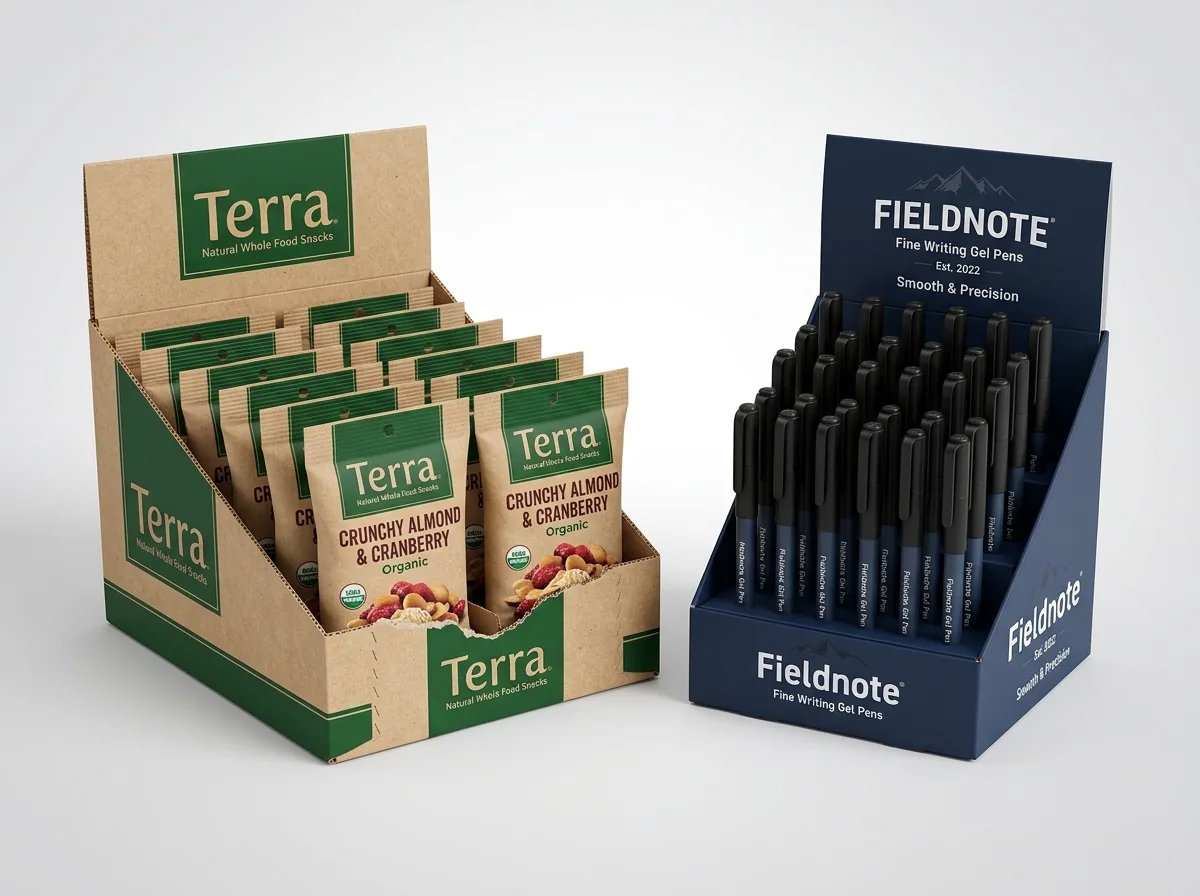
When does a product need a tiered counter display instead of an open tray?
The biggest mistake brands make when ordering point-of-purchase packaging is placing tall, narrow tubes inside an open flat-floor tray without testing what happens after the first three customers buy a unit
- The 3.5-to-1 height-to-base stability threshold: Any unit whose standing height (h) is less than 3.5 times its front-to-back base depth (d), such as a 5-inch snack bar with a 1.5-inch base, a gusseted pouch, or a square candle carton, stands reliably on a flat tray floor.
- Why narrow cylinders domino-topple: A standard 0.15 oz lip balm tube (2.65 in tall × 0.63 in diameter, ratio 4.2:1), a mascara tube, or a stationery pen stays upright only when packed shoulder-to-shoulder in a full box. Once shoppers buy the front three units, the remaining tubes fall flat below the front lip where nobody can see them.
- How a CDU die-cut hole deck solves tipping: By suspending a die-cut paperboard platform 1.0 to 1.5 inches above the tray floor with circular or square cutouts tailored to each unit, every lip balm in custom lip balm boxes, pen in custom pen boxes, or lacquer bottle in custom nail polish boxes stays vertical from the first sale to the last.
- Stadium step risers for short jars and tins: When your units are stable but short (under 2.75 inches tall), the front row blocks the view of rows 2 and 3. A stadium step riser elevates each rear row by 0.75 to 1.0 inch so shoppers see a tiered amphitheater of labels.
How do display boxes, counter displays, and dispenser boxes compare?
Use this engineering comparison table to match your product format, store shelf clearance, and fulfillment workflow to the right structure
| Feature | Standard Display Box | Counter Display Box (CDU) | Gravity Dispenser Box |
|---|---|---|---|
| Best unit geometry | Bars, gusset pouches, & mini cartons (h/d ≤ 3.5) | Narrow tubes, pens, droppers, & short jars | Flat sachets, tea bags, & stick packs |
| Where it sits in store | Grocery shelves, endcaps, & club aisles | POS register counters & boutique tables | Breakrooms, shelves, & tight vertical gaps |
| How shoppers take a unit | Reach into the open top/front of tray | Lift vertically out of hole deck or step tier | Pull 1 unit from bottom-front gravity chute |
| Overhead hand clearance needed | 4 to 6 in above tray for hand access | 4 to 6 in above top row to lift tubes | 0 in overhead needed (feeds at bottom) |
| Internal components | 1-piece blank (optional lane divider) | Tray + step-tier riser or die-cut hole deck | 1-piece tower + internal angled feed ramp |
| Transit protection | Built-in zip-off perforated top hood | Ships in outer protective sleeve or master | Self-enclosed tower; bottom flap pulls open |
| Relative unit cost (from 1,000) | Lowest (single die-cut & glued blank) | Medium (tray + custom die-cut riser/deck) | Low–Medium (tall blank + internal ramp flap) |
Know your size? Compare pricing across up to 3 quantities.
Request a Quote →When is a bottom-slot gravity dispenser box the smartest choice?
While open-top trays dominate snack bars in custom protein bar boxes and gummies in custom gummy boxes, a bottom-feed dispenser box solves three merchandising challenges that an open tray cannot
- Keeps flat single-serve packets from slumping into a messy pile: Individual foil tea envelopes, instant coffee sticks, electrolyte powder packets, and lens wipes have almost zero thickness (0.15 to 0.30 in). Stacked horizontally inside an enclosed vertical dispenser tower, gravity presses the stack neatly downward onto the 35-degree internal feed ramp so the bottom packet always slides forward into the pull tray.
- Works on tightly spaced shelves with zero overhead clearance: Because shoppers pull packets out of the bottom-front slot rather than reaching over the top wall, a dispenser box can sit tucked right underneath a low upper grocery shelf where a top-reach tray would be blocked.
- Maximizes vertical billboard in a tiny counter footprint: A dispenser box for 24 tea sachets needs only a 3.25 × 3.0 inch square counter footprint while rising 7 to 9 inches tall, giving you a massive front panel for brand storytelling in café breakrooms and hotel lobbies.
- Easy stock rotation: If you add a reclosable top tuck lid above the vertical chute, café or store staff can top-load fresh packets while older stock dispenses from the bottom first (first-in, first-out).
How do I size and order my retail display structure?
Once you pick the right structure for your unit geometry, use our step-by-step measurement guide, how to measure for a display box, to calculate your row and column footprint, and read display box dieline and header setup explained to see how tear-away perforations and double-folded headers work. Every order at CubitPack starts from 1,000 boxes in 10–14 business days (with 4–5 day rush available) and includes free structural design help, a free 2D dieline, and a 3D mockup before payment, with zero die or plate charges and free US shipping.
- Choose a Standard Display Box when your bars, pouches, or mini cartons stand on their own and you want the lowest-cost 1-piece tear-away shelf tray.
- Choose a Counter Display Box (CDU) when your narrow tubes, pens, or short bottles need a die-cut hole deck or stepped stadium riser by the register.
- Choose a Gravity Dispenser Box when your flat sachets or stick packs feed cleanest one by one from a bottom-front chute.
What mistakes happen when choosing between display, counter, and dispenser boxes?
Avoid these five structural mismatches when planning your retail point-of-purchase packaging
- Packing narrow cylindrical tubes (lip balm, mascara, pens, 10 ml rollerballs) into a flat-floor display box without a die-cut hole platform, causing every remaining tube to tip over after the first few sales.
- Using an open-top display tray for thin flat sachets or hydration sticks without vertical lane dividers, which lets packets slide sideways into an untidy heap.
- Placing a tall top-reach display tray on a cramped lower grocery shelf where shoppers do not have 4 to 6 inches of overhead space to reach in from above.
- Designing a gravity dispenser box without an internal 30-to-40-degree angled false bottom ramp, leaving the last 3 or 4 packets stranded flat on the back floor where fingers cannot reach them.
- Shipping a pre-filled tiered counter display unit (CDU) with an already-erected header in a loose master case without an outer protective corrugated sleeve or fold-down hood.
Packaging for this




Ready to order display boxes? Compare up to 3 quantities with a free 3D mockup.
Request a Quote →Questions about display boxes
Can a standard tear-away display box also include a die-cut hole insert or step riser?
Yes. Many brands combine the best of both styles by ordering a 1-piece tear-away display box for transit protection and dropping a die-cut paperboard hole platform or 2-step stadium riser inside the base tray before loading their lip balms, pens, or dropper bottles.
Which of the three retail display styles costs the least per box?
A standard 1-piece tear-away display box is the most economical because the tray, protective shipping hood, and fold-up header billboard are die-cut from a single sheet of paperboard or E-flute corrugated board and glued along one side seam.
How do products stay upright in a counter display box when the tray is half empty?
For narrow tubes and bottles, a raised paperboard deck punched with individual circular or square holes holds each unit around its midsection like a test-tube rack. For wider pouches or bars, vertical front-to-back divider walls split the tray into narrow columns so rows cannot fall sideways.
What keeps packets from jamming inside a gravity dispenser box?
We size the interior tower width and depth with 1/8 to 3/16 inch of clearance around the flat sachet stack and build a 35-degree angled paperboard ramp into the base floor. As one packet is pulled from the lower front chute, gravity slides the next packet smoothly down the ramp to the front opening.
Can I order a sample to test whether my units stand better in an open tray or a hole-deck CDU?
Yes. Every production order from 1,000 boxes includes a free digital dieline and 3D mockup before payment, and our packaging specialists can recommend whether your unit's height-to-base ratio works best on a flat floor, a step riser, or a die-cut hole deck.
Still have a question? Ask a packaging specialist.
Request a Quote →Request your display boxes quote
Tell us your size and quantities, and one dedicated account manager prepares pricing for each tier.
- Free design & AI-to-print studio + 3D mockup
- No die or plate charges · 4–5 day rush available
- Free shipping to all 50 states
- 10% off your first order
We compared tear-away shelf display cartons, tiered counter display units (CDUs), and gravity-feed dispenser cartons against Shop! Association (POPAI) point-of-purchase standards and Paperboard Packaging Council (PPC) structural guidelines. A packaging specialist verified the 3.5:1 height-to-base stability rule and internal ramp angles. Spot something wrong? Tell us and we fix it.
Sources
What changed
- October 24, 2026: First published with side-by-side comparison of tear-away display boxes, tiered CDUs, and gravity dispenser boxes.
More guides
New packaging guides by email
Sizes, materials and design tips. Unsubscribe anytime.