
Gravity dispenser cartons vs PDQ counter caddies and auto-lock boxes for protein packets: which works best?
Short answer: Choose a bottom gravity-feed dispenser carton for 14 to 30-count pantry boxes, a tear-top PDQ counter caddy for gym checkouts, a standard tuck box for 7-count trial packs, and an E-flute mailer for shaker kits. Compare all styles on our custom protein powder boxes page.
On this page
- How do the five main protein powder box structures compare
- When should I pick a bottom gravity-feed dispenser over a plain tuck box
- How do tear-away PDQ counter caddies help sell single packets at gyms
- When do protein cartons need an auto-lock bottom or E-flute corrugated board
- Why use a 250-minimum corrugated mailer for shaker starter kits
- Common mistakes
- FAQs
Request a custom quoteFree dieline & 3D mockup
The right box structure for protein powder depends on how your customer grabs a serving and how heavy the filled box is. For 14-count to 30-count home pantry boxes of whey isolate sachets or collagen stick packs, a vertical auto-lock carton with a perforated bottom gravity-feed slot lets athletes pull one packet out each morning without opening the top lid. If you sell individual packets at CrossFit boxes, Pilates studios, smoothie bars or vitamin shop registers, a tear-away PDQ counter caddy converts from a sealed shipping carton into an open counter tray with a pop-up header billboard in five seconds. For heavy 1.5 lb to 2 lb bag-in-box bulk refills, pair a pre-glued auto-lock bottom with heavyweight paperboard or E-flute corrugated board. And for direct-to-consumer shaker starter bundles, our 250-minimum corrugated mailers ship cleanly through parcel carriers without an overbox.
How do the five main protein powder box structures compare?
Whether you pack 35 g whey isolate sachets, 12 g collagen stick packs or 2 lb foil refill pouches, the carton structure controls three things: how fast your co-packer can load the line, whether the base holds under load, and how easy it is for the customer to grab a serving. All five structures below are made to order on our custom printed protein powder boxes line with zero die or plate charges. Use the table below to match your packet count and sales channel to the right structural style before requesting your free dieline and 3D mockup.
| Carton structure | Best protein format & weight | How it opens & dispenses |
|---|---|---|
| Bottom gravity-feed dispenser carton | 14 to 30-count sachets or stick packs (0.5-2.2 lb) | Zip-rule tear strip at bottom front creates a single-packet chute |
| Tear-away PDQ counter display caddy | 12 to 24 upright packets for gym & retail checkouts | Perforated upper hood tears off; lid folds into header billboard |
| Auto lock bottom tuck-top carton | 15-24 sachets or 1.5-2 lb bag-in-box foil refill | Pre-glued crash-lock base; top tuck flap recloses after scooping |
| Straight or reverse tuck end carton | 5, 7 or 10-count single-serve flavor trial packs (under 12 oz) | Standard top and bottom friction tuck flaps with slit locks |
| Corrugated roll-end starter-kit mailer | 24 oz shaker bottle + 7-12 flavor sachets (from 250 boxes) | Full hinged top lid opens to reveal die-cut bottle & packet insert |
When should I pick a bottom gravity-feed dispenser over a plain tuck box?
On a 5-count or 7-count trial pack, a standard straight or reverse tuck end box works well because the customer finishes the box in a single week. Once you step up to a 15-count, 20-count or 30-count monthly supply, a tall top-opening tuck carton becomes awkward inside a kitchen cabinet: customers have to pull the box off the shelf, flip open the top flap, and reach down to the bottom as the stack gets low. Adding a perforated zip-rule tear strip across the bottom of the front panel turns any upright carton into a custom dispenser box at no extra die cost. The customer pulls the perforated tab on day one, folding down a small front lip or removing the strip completely, and pulls a fresh protein sachet from the bottom of the stack while the rest settle downward by gravity.
- Zero tooling surcharge: CubitPack includes custom zip-rule perforations free on your cutting die.
- Always upright on the pantry shelf: your front logo and flavor badge stay visible for all 30 days.
- First-in, first-out dispensing: packets loaded at the bottom of the stack are used first.
- Optional side gauge slot: a narrow die-cut window on the side panel shows how many sachets remain.
How do tear-away PDQ counter caddies help sell single packets at gyms?
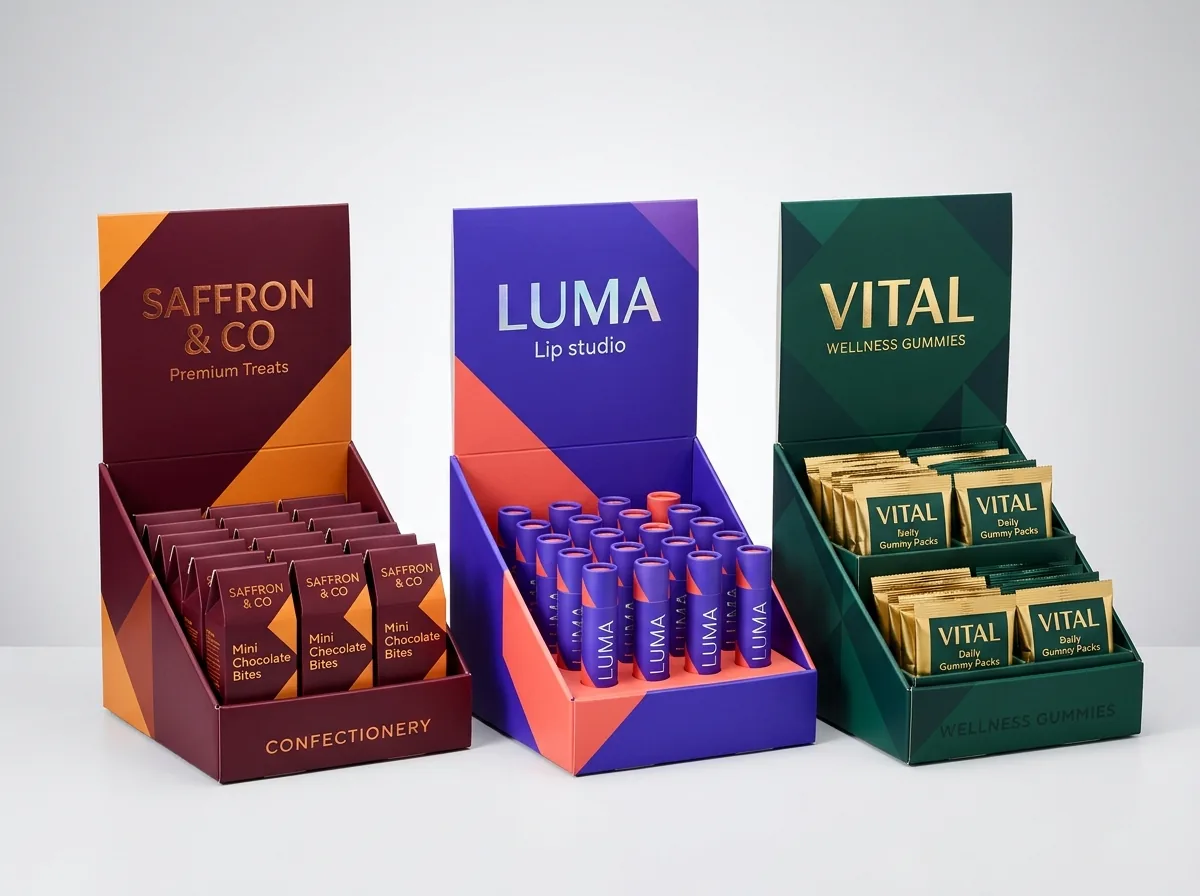
Few gym members want to buy a full 30-serving tub of protein before they have tasted the flavor. Selling single-serve 35 g whey or plant protein packets for post-workout shakes at gym front desks, cycling studios, climbing gyms and health-food registers is one of the fastest ways to sample new customers. If you ship loose sachets to a gym, they end up in an unbranded plastic bin. Instead, pack 12, 15 or 20 upright sachets into a perforated custom counter display box. The carton ships fully enclosed to protect the foil packets in transit. When it arrives at the gym counter, staff zip off the perforated front hood and fold the top lid backward into a double-walled billboard header showing your protein grams, flavor name and price spot.
- Two boxes in one: works as both a sealed e-commerce/wholesale carton and an instant counter display.
- Upright packet presentation: sachets stand vertically facing the shopper with the top half visible.
- Pop-up header card: top tuck flap folds along a back score to lock upright behind the packets.
- Internal step or divider: keeps the last four or five packets standing tall instead of falling flat.
Know your size? Compare pricing across up to 3 quantities.
Request a Quote →When do protein cartons need an auto-lock bottom or E-flute corrugated board?
Protein powder is dense. Twenty single-serve 40 g sachets weigh 800 grams (1.76 lb), and a 2 lb bag-in-box refill pouch weighs over 900 grams. If a customer picks up a 2 lb carton with a standard friction tuck bottom by its sides, the heavy foil pouch or sachet stack can push the bottom flap open and drop onto the floor. For any protein box with a filled net weight above 14 to 16 ounces, we strongly recommend our custom auto lock bottom boxes. The four bottom flaps are pre-glued at the corners during manufacturing so the carton still ships flat, pops square in one second on your co-packer's line, and forms a locked cross-base that cannot slip open. For 2 lb bag-in-box refills or 30-count club-store packs, pairing an auto-lock bottom with E-flute corrugated board prevents side-wall bowing and corner crushing. A bag-in-box setup also lets sports nutrition brands cut rigid HDPE plastic tub usage while shipping flat cartons into their filling facility, saving pallet space on inbound packaging freight.
- Under 12 oz (5-10 sachets): standard straight or reverse tuck end with friction slit locks.
- 14 oz to 1.75 lb (15-24 sachets): heavyweight paperboard with a pre-glued auto-lock bottom.
- 1.75 lb to 2.5 lb (30 sachets or 2 lb foil refill pouch): E-flute corrugated board with an auto-lock bottom.
Why use a 250-minimum corrugated mailer for shaker starter kits?
When launching a direct-to-consumer trial kit that combines a 24 oz blender bottle with 7 to 12 single-serve flavor sachets and a welcome booklet, a thin folding carton cannot survive USPS or UPS parcel sorting without an outer shipping box. By choosing a roll-end tuck-front custom mailer box in E-flute corrugated board (starting at just 250 units), the box itself is the shipping container. Inside the mailer, a custom die-cut paperboard insert cradles the round shaker cup on one side and holds the sample sachets upright in a slotted tray on the other. Printing your mixing instructions, macro calculator QR code and brand story inside the hinged lid turns the first delivery into an unboxing experience that converts trial buyers into monthly subscribers.
- Starts at 250 boxes: test new starter-kit bundles or influencer seeding boxes without a 1,000-unit commitment.
- Ships directly in the mail: triple-thick folded side walls protect the plastic shaker cup from cracking.
- Custom shaker + sachet insert: stops the bottle from crushing the foil packets during transit.
- Inside-lid onboarding space: print shake recipes, QR subscription codes and daily macro charts inside the lid.
What are the most common mistakes when picking a protein box style?
Choosing the wrong base or dispenser opening can slow down your co-packer or leave sachets spilling on the counter. Avoid these five mistakes
- Using a standard friction tuck bottom under 1.5 lb to 2 lb of protein packets instead of a pre-glued auto-lock base.
- Designing a bottom gravity-feed dispenser for upright-standing sachets instead of horizontally stacked packets.
- Packing a gym counter PDQ caddy without an internal divider or riser, letting the last few packets slump flat out of sight.
- Shipping a thin paperboard 20-sachet carton in an unpadded poly mailer where parcel rollers crush the corners.
- Using thin folding board on a 2 lb bag-in-box refill where settled protein powder bulges the lower side panels.
Find your size
Suggested inside size: 4.5 × 2.5 × 5.5 in
A starting point. Your account manager confirms the size with you before the proof.
Quote this size →Packaging for this
Ready to order protein powder boxes? Compare up to 3 quantities with a free 3D mockup.
Request a Quote →Questions about protein powder boxes
Does a perforated gravity-feed dispenser slot cost extra in die charges?
No. CubitPack never charges cutting die or printing plate fees. Adding a bottom zip-rule tear strip, a side packet-count gauge slot or a fold-back PDQ counter header is included in your custom dieline at no extra tooling cost.
Can one carton design work as both a pantry dispenser and a retail shelf box?
Yes. A bottom gravity-feed dispenser carton ships and sits on the retail shelf as a completely sealed six-sided box. The perforated dispenser slot stays closed until the customer brings the box home and pulls the zip strip.
Do auto-lock bottom protein boxes ship flat to my co-packer?
Yes. Auto-lock bottom cartons are pre-glued along the bottom flaps during production and folded completely flat into master shipping cases. When your co-packer squeezes the two opposite corners, the bottom locks flat automatically in one second.
Can I order 1,000 sachet dispenser cartons and 250 shaker starter mailers together?
Yes. Many sports nutrition brands order 1,000+ folding dispenser cartons for their 15-count or 20-count single-flavor refills alongside 250 corrugated mailers for their shaker starter kit, with matched Pantone colors across both.
How long does production take for dispenser cartons and counter caddies?
Standard production takes 10 to 14 business days after you approve your flat digital proof and 3D mockup and complete payment. Rush production in 4 to 5 business days is available on request, and standard shipping is free across all 50 states.
Can I test the tear perforation and board thickness before full production?
Yes. Every order includes a free custom vector dieline and 3D mockup before payment. You can also order our $50 sample kit (credited toward your first order) or request a custom printed prototype to test your filled sachets.
Still have a question? Ask a packaging specialist.
Request a Quote →Request your protein powder boxes quote
Tell us your size and quantities, and one dedicated account manager prepares pricing for each tier.
- Free design & AI-to-print studio + 3D mockup
- No die or plate charges · 4–5 day rush available
- Free shipping to all 50 states
- 10% off your first order
This structural comparison draws on CubitPack's decided minimums and capabilities in our published product specifications (1,000 folding cartons, 250 mailers, free dies and plates), TAPPI folding carton standards and ISTA small-parcel transit guidelines. A CubitPack packaging specialist reviewed every section. Spot an error? Tell us and we will fix it.
Sources
What changed
- October 22, 2026: First published.
- October 22, 2026: Updated specifications, terminology, and verified source links.
More guides
New packaging guides by email
Sizes, materials and design tips. Unsubscribe anytime.