
Folding cartons vs corrugated mailers for health products and test kits: which should you pick?
Short answer: Use paperboard folding cartons for single retail items like sprays, patches and thermometers sold on pharmacy shelves, and E-flute corrugated mailers for multi-part at-home diagnostic test kits shipped by mail. Compare both options on our custom health product boxes page to match your product.
On this page
- How do folding cartons, hang-tab boxes and E-flute kit mailers compare
- When is a single-wall SBS folding carton the right choice
- Why do at-home diagnostic test kits use E-flute corrugated mailers
- Should you pair your health kit with a cardboard insert or EVA foam cradle
- How does a universal mailer base with custom printed sleeves save money across test panels
- Common mistakes
- FAQs
Request a custom quoteFree dieline & 3D mockup
Choosing between a single-wall paperboard folding carton and an E-flute corrugated mailer box comes down to whether your health product sits on a retail pharmacy shelf or travels through postal sorting hubs as a multi-component kit. Smooth SBS paperboard folding cartons (including straight tuck end, auto-lock bottom and five-panel pegboard hang-tab boxes) give single items like nasal sprays, transdermal wellness patches, bandages and digital thermometers crisp clinical print quality and compact shelf footprints inside a master shipping case. By contrast, at-home saliva, blood-spot and microbiome test kits, as well as multi-item recovery bundles, need the crush resistance of 1.5 mm E-flute corrugated board paired with a die-cut insert tray so collection tubes survive both outbound delivery and return transit back to the laboratory. CubitPack produces both structures from 1,000 units with free custom dielines and free 50-state shipping.
How do folding cartons, hang-tab boxes and E-flute kit mailers compare?
Personal healthcare brands often sell across three channels at once: retail pharmacy aisles, practitioner clinics, and direct-to-consumer telehealth subscriptions. A single-wall paperboard carton that looks sharp on a pharmacy shelf will crush if mailed by itself without an outer shipping box, whereas an E-flute mailer is too bulky for a dense pharmacy pegboard hook. Selecting the right outer structure early in development keeps you from paying for unnecessary outer shipping boxes or dealing with damaged specimen vials. Use the comparison table below to match each structure available on our custom printed health product boxes page to your container weight, fulfillment channel and return-shipping requirements.
| Box structure | Board material | Best health & wellness application |
|---|---|---|
| Straight tuck end carton | White SBS or kraft paperboard | Nasal sprays, throat mists, ear drops & topical roll-ons |
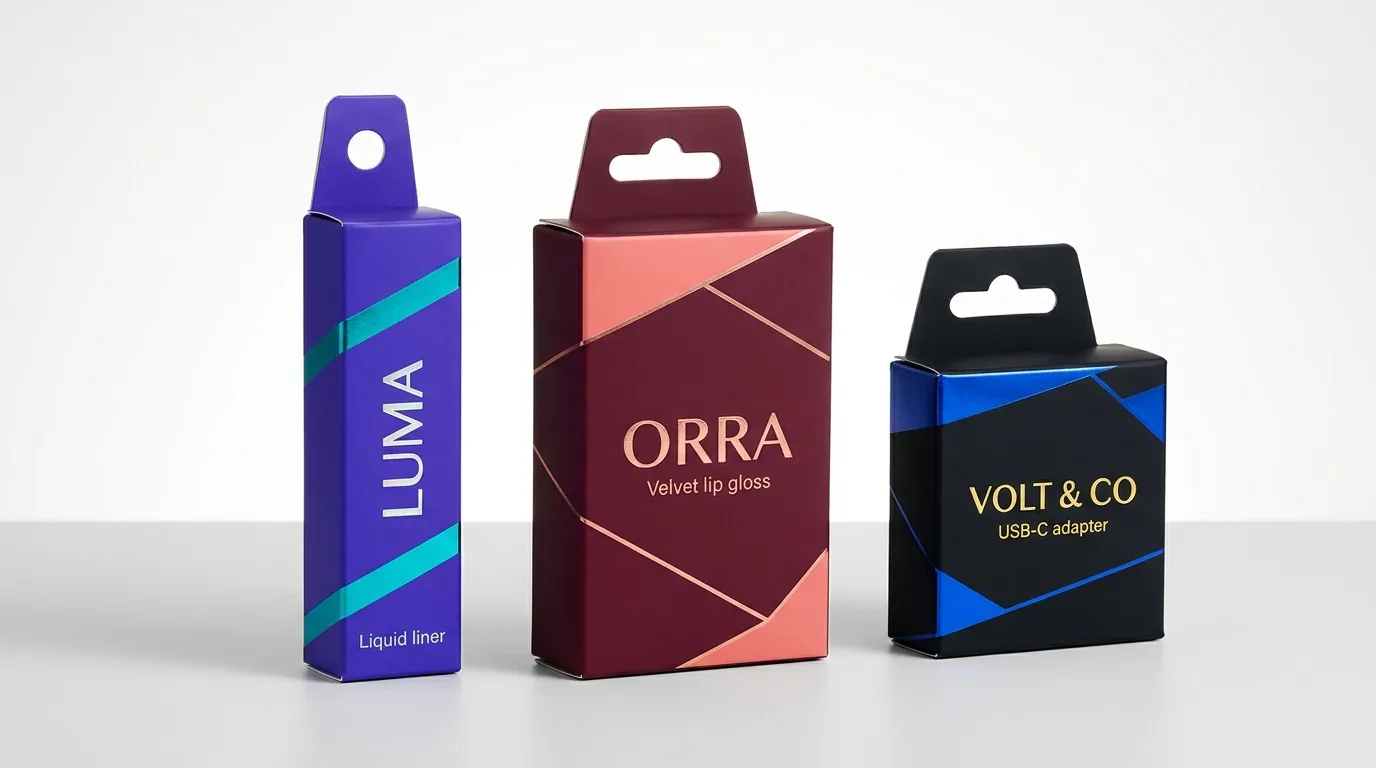
| Five-panel hang-tab carton | White SBS paperboard | Transdermal wellness patches, hydrocolloid strips & thermometers |
| Auto-lock bottom carton | Heavy SBS paperboard | Pulse oximeters, glass dropper bottles & therapy devices |
| Perforated dispenser carton | Laminated SBS paperboard | Sterile wound-care wipes, bandages & clinic prep pads |
| E-flute roll-end mailer + tray | E-flute corrugated board | At-home saliva, blood-spot, hormone & gut test kits |
| Sleeve-and-tray kit box | SBS sleeve + E-flute tray | Multi-panel telehealth kits sharing one universal base tray |
When is a single-wall SBS folding carton the right choice?
If your product is a single primary container (such as a 30 ml saline spray bottle, a 20-pack of transdermal sleep patches, a tube of topical arnica gel or a boxed fever thermometer) that ships to stores in corrugated master cases or ships to online buyers inside a padded mailer bag, a Solid Bleached Sulfate (SBS) folding carton is the industry standard. Paperboard folds with razor-sharp 90-degree edges, accepts high-line-screen CMYK and Pantone clinical typography down to 5-point footnotes, and ships completely flat in dense strapped bundles that take up minimal warehouse pallet space. For lightweight products under 4 ounces that need to hang on pharmacy pegboards, we extend the back panel of a custom straight tuck end box into a double-thick glued hang tab with a Euro slot. For heavier devices or glass bottles over 6 ounces, stepping up to a custom auto-lock bottom box prevents the base from pushing open when shoppers lift the carton off retail shelves.
- Lowest per-unit cost and smallest flat storage footprint at your co-packer or kitting warehouse.
- Bright white clay-coated printing surface for Drug Facts, Supplement Facts and UDI barcodes.
- Integrated dust-flap neck collars stabilize narrow spray bottles with zero extra insert pieces.
- Zip-perforated dispenser windows turn standard cartons into gravity-feed clinic wipe or bandage trays.
Why do at-home diagnostic test kits use E-flute corrugated mailers?
At-home laboratory testing (covering thyroid panels, cortisol, food sensitivity, STI screening, fertility hormones and gut microbiome sequencing) requires a package that makes two trips through the postal network. First, the kit travels from your fulfillment center to the patient's home containing sterile swabs, lancets, collection tubes and transport media. Second, after the patient collects their specimen and seals the tube inside a biohazard bag with an absorbent pad, the box returns via USPS or courier to your CLIA-certified partner lab. A custom mailer box made from 1/16 inch (1.5 mm) E-flute corrugated board provides the vertical compression strength required by postal sorting machinery so plastic collection vials cannot be crushed in transit, while still folding cleanly enough for full-color litho-laminated or digital graphics inside and out. When the front roll-end dust flaps lock into the double-layered side walls, the mailer forms a rigid frame that passes USPS mailable exempt human specimen outer box rules without needing a separate shipping carton.
Know your size? Compare pricing across up to 3 quantities.
Request a Quote →Should you pair your health kit with a cardboard insert or EVA foam cradle?
Inside an at-home health kit or medical device box, the interior insert has two jobs: immobilizing every component during parcel drops and presenting the items in a calm, logical sequence so the user does not feel overwhelmed. Most diagnostic brands choose a die-cut custom cardboard insert folded from matching white or kraft board because it ships flat, folds into a raised platform with recessed tube slots, and can be printed with numbered labels ('1. Prep Pad', '2. Lancet', '3. Sample Card') right beside each cutout. If you are packaging a heavier electronic health monitor (such as a wireless blood pressure cuff, handheld ultrasound probe, digital otoscope or red-light therapy wand), a die-cut custom EVA foam insert or EPE foam pad absorbs high-G shock impacts and holds the device snugly without scratching polished lenses or screens.
- Printed paperboard insert tray: ships flat, recyclable with the box, allows printed step numbers beside each vial slot.
- Corrugated E-flute insert tray: extra rigidity for heavier glass bottles, cold packs or multi-vial hormone kits.
- EVA or EPE foam cradle: precision-cut shock cushioning for sensitive digital monitors, LED therapy wands and glass ampoules.
- Under-tray hidden void: stores prepaid return mailers, biohazard bags and thick multi-language IFU manuals underneath the main presentation deck.
How does a universal mailer base with custom printed sleeves save money across test panels?
Telehealth and longevity brands frequently offer six to ten different blood-spot or saliva test panels (such as Men's Hormone, Women's Fertility, Thyroid Complete, Vitamin D + Inflammation, and Sleep Cortisol) that all use the exact same physical collection tube, lancet and return pouch. Ordering ten separate corrugated mailer runs splits your volume across multiple setups. Instead, many brands order one universal printed white E-flute mailer and insert tray in bulk, then slide a panel-specific custom sleeve over the closed mailer during kitting. Each paperboard sleeve carries the specific test name, Pantone symptom color bar, barcode and kit contents list, letting you launch new diagnostic panels from 1,000 sleeves without touching your core mailer box inventory. Our structural team engineers the sleeve with a 1/16 inch slide clearance so kitting staff can slip it over the closed mailer in two seconds, and we provide a free 2D digital proof and 3D mockup of both the mailer and the sleeve before payment.
What are the most common structural mistakes on health product and test kit boxes?
Choosing the wrong board weight or insert style can result in crushed lab samples or torn retail peg hooks. Avoid these five structural mistakes when specifying your dieline
- Mailing an at-home saliva or blood collection tube in a thin single-wall paperboard carton that crushes inside automated postal sorting equipment.
- Using a single-layer unglued hang tab on a pharmacy carton that tears off the pegboard hook after retail shoppers handle the box.
- Placing the biohazard return bag and prepaid shipping label loose on top of the collection tools so patients misplace them before finishing the test.
- Packing a heavy handheld health device or glass bottle into a standard reverse tuck bottom carton instead of a pre-glued auto-lock bottom.
- Ordering separate corrugated mailer dielines for every diagnostic test panel instead of pairing one universal kit box with custom printed outer sleeves.
Find your size
Suggested inside size: 1.625 × 1.625 × 4.5 in
A starting point. Your account manager confirms the size with you before the proof.
Quote this size →Packaging for this

Ready to order health product boxes? Compare up to 3 quantities with a free 3D mockup.
Request a Quote →Questions about health product boxes
Can an E-flute mailer box be used to mail patient lab samples back through USPS?
Yes. Most at-home diagnostic brands design their E-flute mailer box so the patient places the sealed primary sample tube and absorbent pad inside a secondary biohazard specimen bag, puts that bag back into the rigid E-flute box, seals the box and applies the prepaid return label.
When should I use a paperboard folding carton instead of a corrugated mailer?
Use an SBS or kraft paperboard folding carton whenever your product is sold on retail shelves (pharmacies, grocers, clinics) or ships to online customers inside a master case or padded poly mailer. Folding cartons cost less per unit and store much flatter.
Can you print step-by-step instructions on the inside of both folding cartons and E-flute mailers?
Yes. We offer full inside printing on both single-wall paperboard cartons and E-flute corrugated mailers. On at-home test kits, printing 1-2-3 collection diagrams and activation QR codes inside the lid significantly reduces patient collection errors.
Do you make custom cardboard and foam inserts mapped to our exact vials and swabs?
Yes. Send us your collection tubes, lancets, swabs, spray bottles or handheld devices, and our structural team engineers a custom die-cut cardboard tray or EVA/EPE foam cradle that locks every piece in place.
What is the minimum order quantity for custom health cartons or test kit mailers?
Our minimum order starts at 1,000 boxes for both paperboard folding cartons and E-flute corrugated mailers, with free custom dielines, no die or plate charges and free shipping to all 50 US states.
How quickly can you produce custom health product cartons or diagnostic mailers?
Standard production takes 10-14 business days after you approve your 2D digital proof and 3D mockup and complete payment. Rush production in 4-5 business days is available when you have an urgent clinic or telehealth launch.
Still have a question? Ask a packaging specialist.
Request a Quote →Request your health product boxes quote
Tell us your size and quantities, and one dedicated account manager prepares pricing for each tier.
- Free design & AI-to-print studio + 3D mockup
- No die or plate charges · 4–5 day rush available
- Free shipping to all 50 states
- 10% off your first order
The structural comparisons between SBS folding cartons, five-panel pegboard hanger boxes and E-flute two-way diagnostic kit mailers in this guide are based on ISTA parcel transit standards and US telehealth kitting workflows. A CubitPack packaging specialist verified every detail. Spot an error? Tell us and we will fix it.
Sources
What changed
- October 22, 2026: First published.
- October 22, 2026: Updated specifications, terminology, and verified source links.
More guides
New packaging guides by email
Sizes, materials and design tips. Unsubscribe anytime.