
How do you design vitamin boxes for letter hierarchy and Daily Value panels?
Short answer: Give the front vitamin box panel a 4-tier hierarchy (brand logo, oversized letter badge, potency in mcg/IU/mg, and count), put the Supplement Facts and % Daily Value table on the right panel, leave an unvarnished lot knock-out on the bottom flap, and print a 30-day tracker inside your custom vitamin boxes.
On this page
- What belongs on each of the four panels of a custom vitamin box
- How do you build a multi-SKU Pantone color system across a letter vitamin line
- How do you keep multi-ingredient % Daily Value tables and inkjet lot codes crisp
- How can inside printing turn a vitamin box into a 30-day habit tracker
- Common mistakes
- FAQs
Request a custom quoteFree dieline & 3D mockup
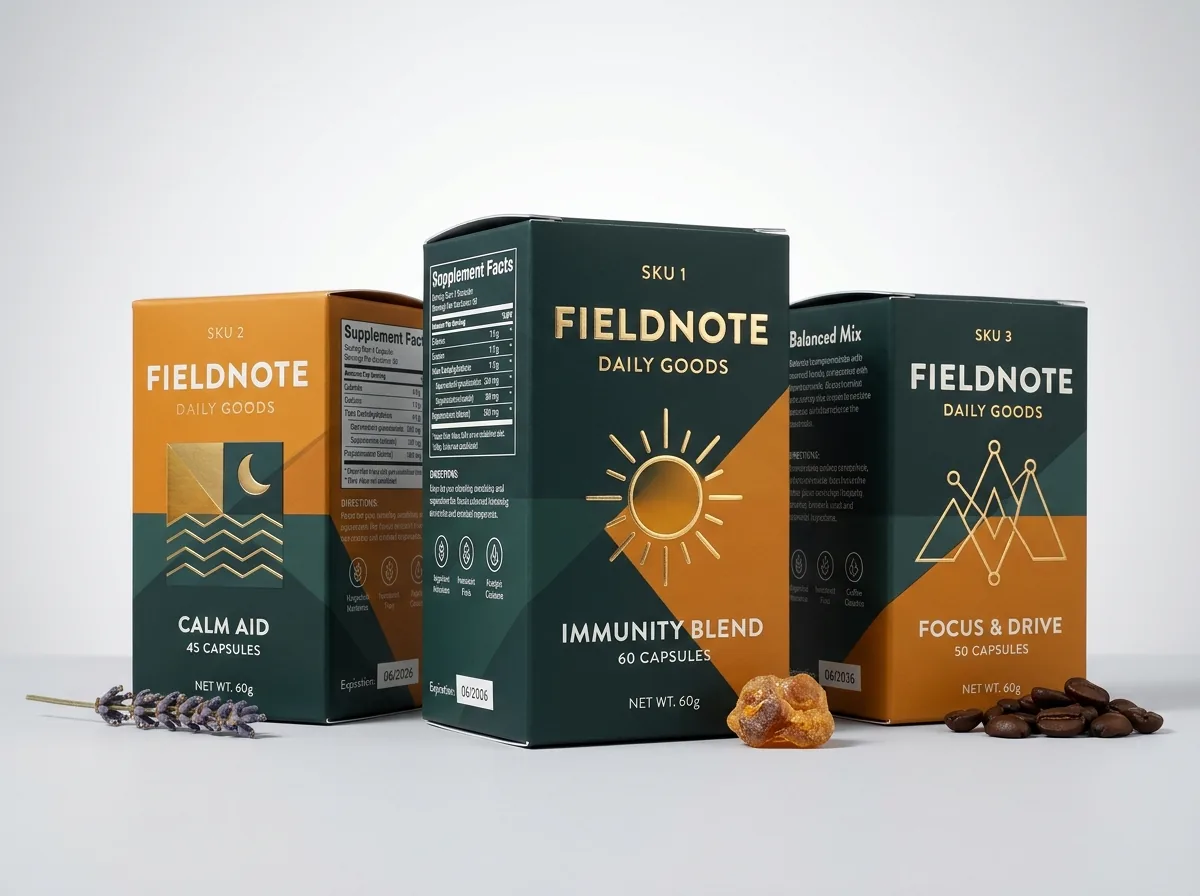
Shoppers scan a pharmacy vitamin aisle in less than three seconds, looking first for the vitamin letter or life-stage badge (such as D3 + K2, B-Complex or Prenatal) and second for the exact potency and delivery format (such as 125 mcg / 5,000 IU Softgels). To keep the front panel scannable from six feet away, restrict front-panel copy to four hierarchical zones: brand logo at the top, a high-contrast Pantone color band with the vitamin letter emblem in the center, a potency pill badge below it, and the delivery format and net count along the bottom edge. Move the dense 20-line Supplement Facts and % Daily Value table to the right or back panel in crisp 100% black ink on a light background, place dosing directions and allergen icons on the left panel, and mask lamination off a 1.5 × 0.625 inch white knock-out box on the bottom flap for co-packer lot and expiry coding. CubitPack checks every panel for free before you pay.
What belongs on each of the four panels of a custom vitamin box?
The biggest advantage of packing a vitamin bottle or dropper vial inside a square folding carton is that four flat paperboard walls provide more than double the readable surface area of a curved cylindrical bottle label. When customers pick up a round 120 cc bottle, they have to rotate it in their hand to read a wrapped Supplement Facts table; on a square carton, every panel sits flat under store lighting. Use the panel assignment grid below when setting up your artwork on a printed vitamin cartons dieline. Our prepress engineers check every panel for score-line clearance, barcode contrast, and varnish knock-outs before sending your free flat digital proof and 3D mockup.
| Carton panel | Primary job on shelf | What to include | Recommended print & finish spec |
|---|---|---|---|
| Front panel (Principal Display Panel) | 6-foot aisle recognition & SKU identification | Brand logo, Vitamin letter badge (C, D3, B12), potency (mcg/IU/mg), format & count | Matte or soft-touch lamination + spot UV or foil on the letter badge |
| Right side or Back panel | Nutritional transparency & % Daily Value lookup | Full Supplement Facts table, % Daily Value column, Other Ingredients, distributor address | 100% K (black) text on white or very pale tint; no foil or spot UV over small type |
| Left side panel | Dosing clarity & dietary trust | Suggested use (e.g., 1 softgel daily with food), allergen-free icons, UV light protection note | Clean vector icons + 0.125 in quiet margin inside vertical score lines |
| Bottom tuck or auto-lock flap | Retail POS scanning & batch traceability | UPC/EAN barcode at 80–100% magnification + 1.5 × 0.625 in lot/expiry knock-out box | Unvarnished, unlaminated bare board knock-out in the lot/expiry rectangle |
| Inside top lid or inner walls | 30-day morning habit retention | Day 1 to Day 30 check-off grid, QR reorder code, or vitamin pairing tips | Inside CMYK or single-Pantone printing on uncoated inner SBS surface |
How do you build a multi-SKU Pantone color system across a letter vitamin line?
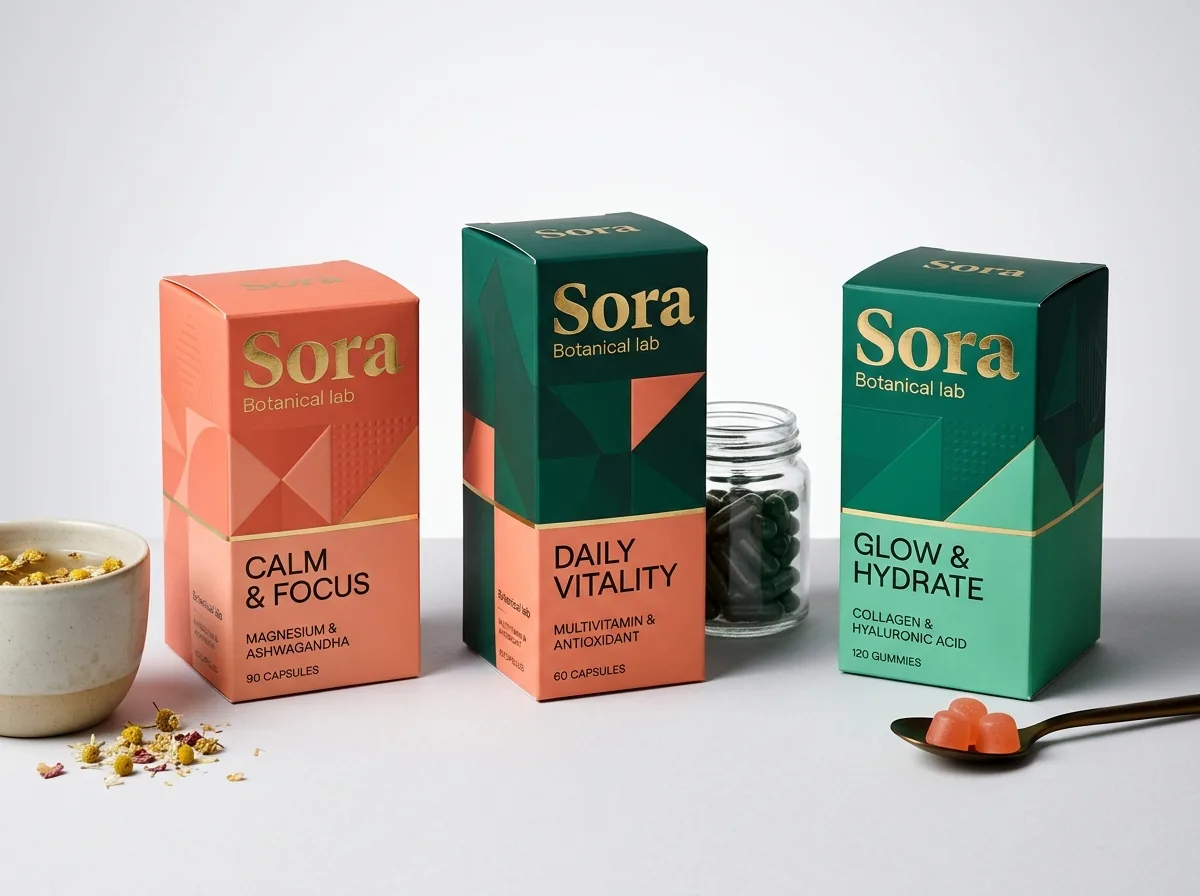
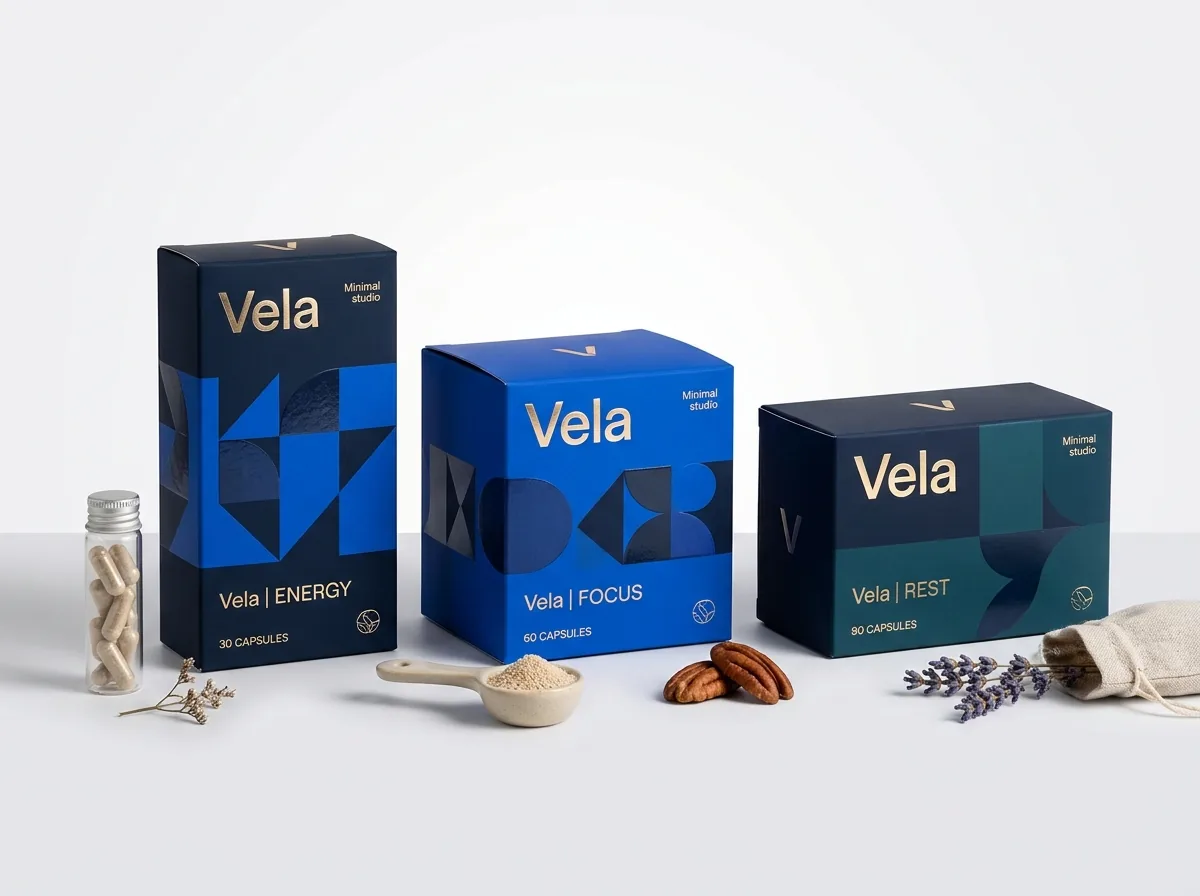
Most vitamin brands launch between four and ten SKUs that share the exact same 150 cc bottle and 2.125 × 2.125 × 4.0 inch carton dieline: Vitamin C, Vitamin D3 + K2, Methylated B-Complex, Chelated Zinc, Magnesium Glycinate, Iron, Women's Multivitamin and Men's Multivitamin. If those eight boxes look too similar, warehouse pickers ship the wrong SKU and pharmacy shoppers grab the wrong bottle; if they look completely unrelated, you lose the visual brand block on retail shelves. The cleanest way to unify a multi-SKU vitamin catalog is to lock a fixed master grid across every carton (identical logo position, identical typography scale, identical matte-white upper background) and assign one dedicated Pantone (PMS) spot color band to the lower 35% of the front panel and the top tuck flap of each SKU. For example, assign warm citrus orange to Vitamin C, golden sun yellow to Vitamin D3, coral rose to B-Complex, and slate blue to Magnesium. Printing the matching Pantone color on the top tuck flap as well as the front color band helps customers and fulfillment staff identify every vitamin from above when cartons are stored upright in a kitchen drawer or warehouse bin. Because all eight SKUs share the exact same 2.125 × 2.125 × 4.0 inch dieline, we run the entire family on one cutting die with zero die or plate charges and guaranteed Pantone color accuracy from run to run.
How do you keep multi-ingredient % Daily Value tables and inkjet lot codes crisp?
Unlike a single-ingredient herbal extract, a comprehensive daily multivitamin or prenatal carton has to list 18 to 25 essential vitamins and minerals along with their specific measurement units (such as Vitamin A in mcg RAE, Vitamin D3 in mcg and IU, Vitamin E in mg, and Folate in mcg DFE) plus the % Daily Value column. On a narrow 2.125-inch wide side panel, printing that dense table in four-color CMYK gray or reversed white text on a dark background causes tiny hairline rules and fraction numbers to blur if press registration shifts by even 0.1 mm. Always set the Supplement Facts and % Daily Value box in 100% single-channel black ink (0C 0M 0Y 100K) over a solid white or very light cream panel, and keep the outer table border at least 0.125 inches (3 mm) inside the vertical fold scores so the corner crease never splits the first letter of an ingredient name or the % Daily Value percentage. Never place glossy spot UV or metallic foil stamping over small nutritional text, as specular glare under pharmacy LED strips makes 6-point type hard to read. If you are packaging a narrow 30 ml liquid Vitamin D3 dropper and need more width for the table, step the carton up from 1.5 × 1.5 inches to 1.875 × 1.875 inches with an internal dust-flap neck collar (see our guide on what size vitamin box do I need for bottles, jars and daily packs). Finally, on the bottom flap, draw a 1.5 × 0.625 inch rectangle on your dieline's NO_VARNISH layer so our plates leave bare, absorptive paperboard exposed for your co-packer's thermal inkjet or laser lot and expiration date stamp.
- Set all Supplement Facts text and hairline rules in 100% black (0C 0M 0Y 100K) rather than 4-color rich black.
- Keep a 0.125 in (3 mm) safety margin between the Supplement Facts box border and all vertical fold scores.
- Mask lamination and UV varnish off a 1.5 × 0.625 in bottom-flap rectangle for smudge-free inkjet lot coding.
- Keep UPC barcodes at 80% to 100% magnification in black bars on a white background for instant pharmacy scanning.
Know your size? Compare pricing across up to 3 quantities.
Request a Quote →How can inside printing turn a vitamin box into a 30-day habit tracker?
The number-one reason vitamin subscribers pause or cancel their monthly auto-ship order is not dissatisfaction with the formula; it is having half a bottle left at Day 30 because they forgot to take their capsules on busy mornings. Printing on the inside of your vitamin carton helps solve morning adherence without adding a single square inch of clutter to your exterior retail panels. On a 30-day coiled sachet dispenser box, a prenatal blister wallet, or a children's chewable multivitamin carton, we can print a numbered Day 1 to Day 30 check-off grid on the inside of the top flap or across the inner front wall. Because the inside of a coated-one-side (C1S) SBS carton is bare uncoated paper fiber, customers can check off each morning's box with any standard ballpoint pen, pencil or marker without ink smearing. On Day 25 of the printed grid, place a small QR code that links straight to their subscription check-in or refill page, along with a friendly note explaining whether the vitamin is fat-soluble (best taken with breakfast) or water-soluble. Every CubitPack order includes free design help, no die or plate charges, guaranteed Pantone color accuracy across all your vitamin SKUs, free shipping across all 50 US states, and a 10% first-order discount. To compare how dispenser cubes, bottle cartons and blister wallets support daily routines, read our comparison of daily sachet dispensers vs bottle cartons vs blister vitamin boxes.
What are the most common vitamin box design and prepress mistakes?
Check your artwork files against these five prepress errors before submitting your custom vitamin cartons for proofing
- Printing the 20-line Supplement Facts and % Daily Value table in 4-color rich black or reversed white text on a dark metallic background where tiny mcg and IU numbers fill in.
- Forgetting to mask soft-touch lamination or UV coating off the bottom lot/expiry zone, causing co-packer inkjet date stamps to bead up and smear.
- Running the Supplement Facts border closer than 1/8 inch (3 mm) to a vertical fold score so the corner of the box creases right through the % Daily Value numbers.
- Using CMYK process mixes instead of locked Pantone (PMS) spot colors for letter-vitamin color bands, leading to noticeable shade drift between reorders.
- Placing a glossy spot UV highlight or foil stamp over the UPC barcode or small warning text on the back panel.
Find your size
Suggested inside size: 1.625 × 1.625 × 4.25 in
A starting point. Your account manager confirms the size with you before the proof.
Quote this size →Packaging for this
Ready to order vitamin boxes? Compare up to 3 quantities with a free 3D mockup.
Request a Quote →Questions about vitamin boxes
Can we combine 6 or 8 different vitamin SKUs in one custom box order?
Yes. When your Vitamin C, D3, B12, Zinc and Multivitamin bottles share the exact same carton dimensions, we run all of your artwork versions on one shared cutting die so you get multi-SKU volume pricing with zero die or plate charges.
How do you prevent co-packer lot numbers and expiration dates from smearing on coated boxes?
We mask all matte, gloss or soft-touch lamination and UV varnish off a designated rectangle on the bottom or side flap (typically 1.5 × 0.625 inches), leaving bare absorptive paperboard where thermal inkjet or laser codes dry instantly.
Can customers write on an inside-lid 30-day vitamin tracker with a regular pen?
Yes. Because standard SBS folding carton board is coated on the outside for vibrant printing and uncoated on the inside, customers can check off a printed 30-day compliance grid inside the lid using any ballpoint pen or marker.
How do you keep a long multivitamin Supplement Facts table legible on a narrow box?
We print the Supplement Facts table in crisp 100% black ink on a light background with zero lamination glare or spot UV over the text, and for narrow 30 ml dropper vials we can widen the carton to 1.875 inches using an internal dust-flap neck collar.
Can CubitPack match our Pantone vitamin colors across both cartons and bottle labels?
Yes. We print custom roll labels for vitamin bottles and jars as well as custom folding cartons and daily vitamin pouches, locking your exact Pantone (PMS) color tolerances across every component.
Still have a question? Ask a packaging specialist.
Request a Quote →Request your vitamin boxes quote
Tell us your size and quantities, and one dedicated account manager prepares pricing for each tier.
- Free design & AI-to-print studio + 3D mockup
- No die or plate charges · 4–5 day rush available
- Free shipping to all 50 states
- 10% off your first order
The panel hierarchy rules, 3 mm score safety margins, 100% K typography standards and bottom-flap varnish knock-out specs in this guide come from our prepress checklist for dietary vitamin cartons and 30-day sachet dispensers. A CubitPack packaging specialist checked every section. Spot an error? Tell us and we will fix it.
Sources
What changed
- October 22, 2026: First published.
- October 22, 2026: Updated specifications, terminology, and verified source links.
More guides
New packaging guides by email
Sizes, materials and design tips. Unsubscribe anytime.