
What size vitamin box do I need for bottles, jars and daily packs?
Short answer: Standard 120 cc to 150 cc round vitamin bottles fit a 2.125 × 2.125 × 4.0 inch inside carton. Wide 300 cc to 400 cc gummy jars use 3.0 × 3.0 × 5.25 inches, 30 ml liquid D3 droppers use 1.625 × 1.625 × 4.25 inches, and 30-day coiled sachet rolls use a 4.5 × 4.0 × 5.25 inch custom vitamin box.
On this page
Request a custom quoteFree dieline & 3D mockup
Always size custom vitamin boxes by inside dimensions (Length × Width × Height in inches) measured around the widest point of the filled, capped container. For round PET, HDPE or amber glass packer bottles, measure both the bottle body diameter and the outer diameter of the closure with digital calipers. Two-piece push-and-turn child-resistant caps on children's chewables, iron tablets and gummy jars often protrude 2.0 to 3.5 mm wider than the bottle shoulder. Take whichever diameter is larger and add 1/16 to 3/32 inch (1.5 to 2.5 mm) of clearance to both Length and Width, then add 1/8 inch (3 mm) to the total capped height. For coiled 30-day personalized daily vitamin sachet rolls, measure the relaxed coil diameter of 30 filled packets on their inner core and add 1/4 inch of clearance so the strip rotates smoothly. CubitPack cuts every vitamin box size to order from 1,000 folding cartons with no die or plate charges.
What are the standard vitamin box sizes by container format?
Dietary vitamin brands across the United States rely on six primary container formats: 100 cc to 150 cc round packer bottles for single-letter capsules and tablets, 200 cc to 250 cc bottles for daily multivitamins and prenatals, 300 cc to 400 cc wide-mouth PET jars for adult and kids' pectin gummies, 30 ml glass pipette vials for liquid Vitamin D3 + K2 drops, 30-day coiled sachet strips for personalized daily packs, and PVC/foil calendar blisters for iron and folate regimens. Use the reference table below to benchmark your inside carton measurements (length × width × height in inches) before measuring your filled sample with digital calipers. Every dimension listed applies to custom printed vitamin cartons and leaves room for smooth loading on manual or automated co-packer cartoning lines.
| Vitamin format & count | Primary container size | Inside box size (L × W × H) | Recommended box style |
|---|---|---|---|
| Single-letter vitamin (60–90 capsules/tablets) | 100 cc – 150 cc PET or HDPE packer | 2.125 × 2.125 × 4.0 in | Reverse or straight tuck end |
| Daily multivitamin or prenatal (120–180 tablets) | 200 cc – 250 cc amber glass or HDPE | 2.5 × 2.5 × 4.75 in | Auto-lock bottom carton |
| Kids' chewables or adult gummy vitamins (60–90 count) | 300 cc – 400 cc wide-mouth PET jar | 3.0 × 3.0 × 5.25 in | Auto-lock bottom carton |
| Liquid Vitamin D3 + K2 or B12 sublingual drops | 30 ml (1 oz) Boston round glass dropper | 1.625 × 1.625 × 4.25 in | Straight tuck + dust-flap neck ring |
| 30-day personalized daily vitamin packet roll | 30 connected 3.25 × 2.5 in sachets on core | 4.5 × 4.0 × 5.25 in | Roll-feed front-slot dispenser box |
| 28-day or 30-day prenatal / iron blister regimen | 2 or 3 PVC/foil push-through blister cards | 6.0 × 3.75 × 0.875 in | Flat tuck carton or book-fold wallet |
| 2-bottle prenatal + DHA starter bundle | Two 150 cc bottles side by side | 4.5 × 2.25 × 4.25 in | Auto-lock carton + partition divider |
Why must you measure both the vitamin bottle body and the child-resistant cap?
On a smooth-walled cylindrical 150 cc PET bottle fitted with a standard 38-400 ribbed screw cap, the widest point of the container is the bottle base or label panel. However, two high-volume vitamin categories regularly use oversized safety closures: iron-containing multivitamins (which require child-resistant packaging under US poison-prevention regulations) and fruit-flavored children's chewable or gummy vitamins where parents want extra cabinet safety. A two-piece push-down-and-turn child-resistant (CR) cap has an outer plastic shell that spins around an inner threaded core. On many 100 cc to 300 cc packer bottles and wide-mouth gummy jars, that outer CR cap collar measures 2.0 to 3.5 mm wider in diameter than the bottle shoulder, and a perforated PVC shrink tamper band adds another 0.3 mm. If you size your folding carton solely from the bottle manufacturer's mold drawing without measuring the capped sample, the bottle body will slide in easily until the wider cap rim wedges at the top crease and prevents the top tuck flap from closing flat. Always measure three points with digital calipers on a filled, labeled, capped sample at room temperature: the base heel diameter, the middle label panel diameter, and the outer diameter of the push-and-turn cap skirt. Take the largest of those three readings and add 1/16 inch (1.5 mm) for hand-packed cartons or 3/32 inch (2.5 mm) for high-speed automatic cartoners. If you want to standardize six or eight single-letter vitamins onto one shared 2.125 × 2.125 × 4.0 inch carton dieline to unlock multi-SKU volume pricing, confirm that your largest daily serving (such as a 2-tablet Calcium or Magnesium SKU) fits the exact same 150 cc bottle before locking the shared dieline.
How do you size a 30-day coiled daily vitamin sachet dispenser box?
Direct-to-consumer personalized vitamin brands and clinical morning-pack subscriptions increasingly package 30 daily servings as a continuous perforated strip of cellophane or foil-laminate sachets wound into a coil inside a countertop dispenser box. Sizing a roll-feed sachet dispenser cube requires three distinct dimensional checks that differ from sizing a rigid bottle carton. First, measure the flat width of a single heat-sealed sachet packet (most US vitamin packagers use a 3.0-inch, 3.25-inch or 3.5-inch pouch web width) and add 0.5 inches (12 mm) of total side-to-side clearance so the strip never rubs or binds against the interior side walls as it uncoils; a 3.5-inch wide vitamin packet pairs cleanly with a 4.0-inch wide box. Second, wind a full 30-day strip of filled packets (typically holding 4 to 7 capsules, tablets and fish oil softgels per daily pouch) around your inner cardstock core cylinder and measure the relaxed outer diameter of the wound coil. Because oval softgels and round tablets create staggered air pockets along the wound strip, a 30-packet roll typically measures 4.0 to 4.25 inches in diameter. Add at least 0.25 to 0.5 inches of clearance to the front-to-back length and height so the coil rotates freely as the customer pulls Day 1 through the lower-front perforated slot. That brings the standard 30-day vitamin dispenser cube to 4.5 × 4.0 × 5.25 inches inside, with a 3.5 × 0.875 inch zipper tear-out slot positioned 0.5 inches above the bottom score line.
- Inside box width (W): single sachet width + 0.5 in (12 mm) total side clearance so packets never bind.
- Inside box length & height (L × H): relaxed 30-packet coil diameter + 0.25 to 0.5 in spin clearance.
- Lower-front pull slot: packet width + 0.25 in wide by 0.875 in high, placed 0.5 in above the bottom crease.
- Inner roll core: a lightweight 1.5 in diameter cardstock tube keeps the last 10 packets from collapsing.
Know your size? Compare pricing across up to 3 quantities.
Request a Quote →How do you size cartons for 30 ml Vitamin D3 droppers and 30-day blister cards?
Liquid Vitamin D3 + K2 drops, methylated B12 sublingual tinctures and infant multivitamin drops are almost universally packaged in a 30 ml (1 oz) amber Boston round glass bottle with a rubber-bulb glass pipette assembly. The glass vial itself measures roughly 1.31 inches (33 mm) in diameter by 4.06 inches (103 mm) tall to the tip of the rubber dropper bulb. You have two structural sizing options for a 30 ml dropper vial: a snug 1.5 × 1.5 × 4.25 inch carton that hugs the glass walls directly, or a wider 1.875 × 1.875 × 4.25 inch carton that gives you 25% more panel width for a readable Supplement Facts and % Daily Value table. Whenever you choose the wider 1.875-inch footprint around a 1.31-inch glass vial, we extend the top inner dust flaps of the straight tuck end carton and die-cut a 0.85-inch circular hole through the overlapping flaps. As the carton closes, that integrated neck ring locks around the ribbed collar of the dropper cap so the glass vial cannot rattle or tilt during parcel shipping. For 28-day or 30-day prenatal and iron blister packs, stack the thermoformed PVC/foil blister sheets together with their raised pill domes nested the way they will ship, and measure the card length, card width, and total stacked thickness. Add 1/8 inch (3 mm) to the card length and width and 3/32 inch (2.5 mm) to the stacked dome thickness. To compare how these structures perform in fulfillment and daily use, read our guide on daily sachet dispensers vs bottle cartons vs blister vitamin boxes and our panel layout guide on how to design vitamin boxes for letter hierarchy and Daily Value panels.
What are the most common vitamin box sizing mistakes?
Avoid these five dimensional errors before approving your custom vitamin carton dieline so your co-packer's line runs smoothly and every bottle or packet roll fits cleanly
- Measuring the body of a gummy vitamin jar or iron bottle while ignoring the wider outer skirt of the push-and-turn child-resistant cap.
- Sizing a 30-day daily vitamin sachet dispenser box from flat empty pouches instead of measuring the bulky coiled diameter of 30 filled pill packets.
- Placing a narrow 33 mm liquid Vitamin D3 glass dropper vial inside a wide 48 mm carton without an extended dust-flap neck ring to stop rattling.
- Forgetting to add 0.04 to 0.06 inch of vertical height when a folded paper dosing leaflet sits on top of the bottle cap.
- Quoting outside dimensions instead of inside dimensions when ordering corrugated trays or two-bottle starter kit dividers.
Find your size
Suggested inside size: 1.625 × 1.625 × 4.25 in
A starting point. Your account manager confirms the size with you before the proof.
Quote this size →Packaging for this
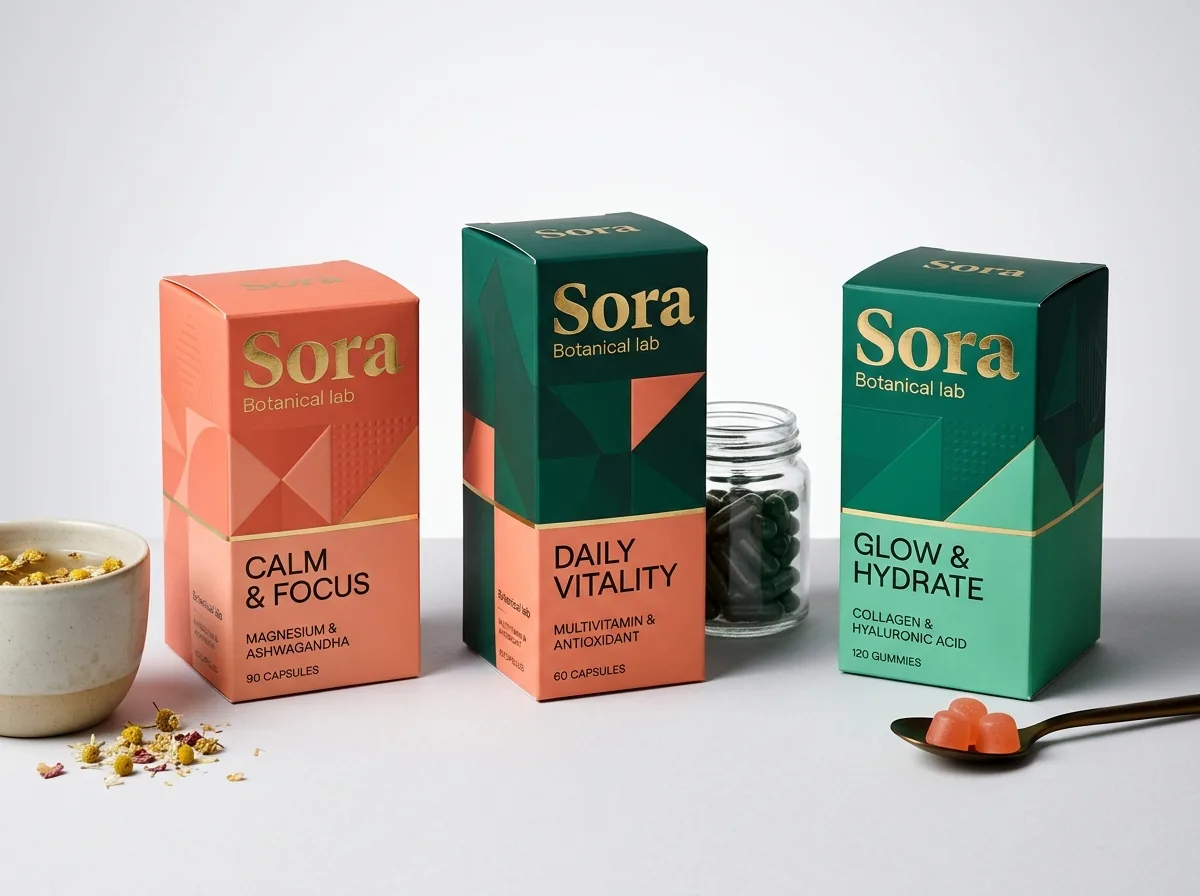
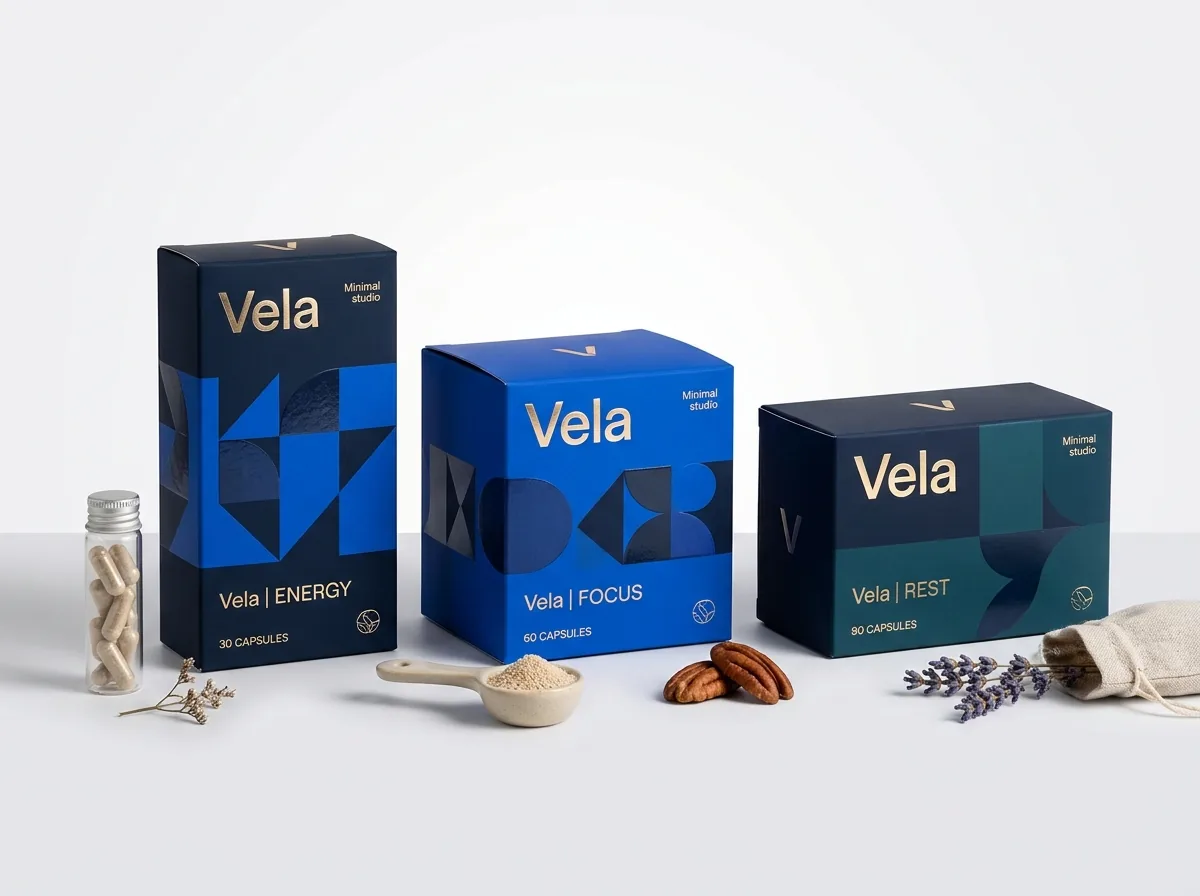
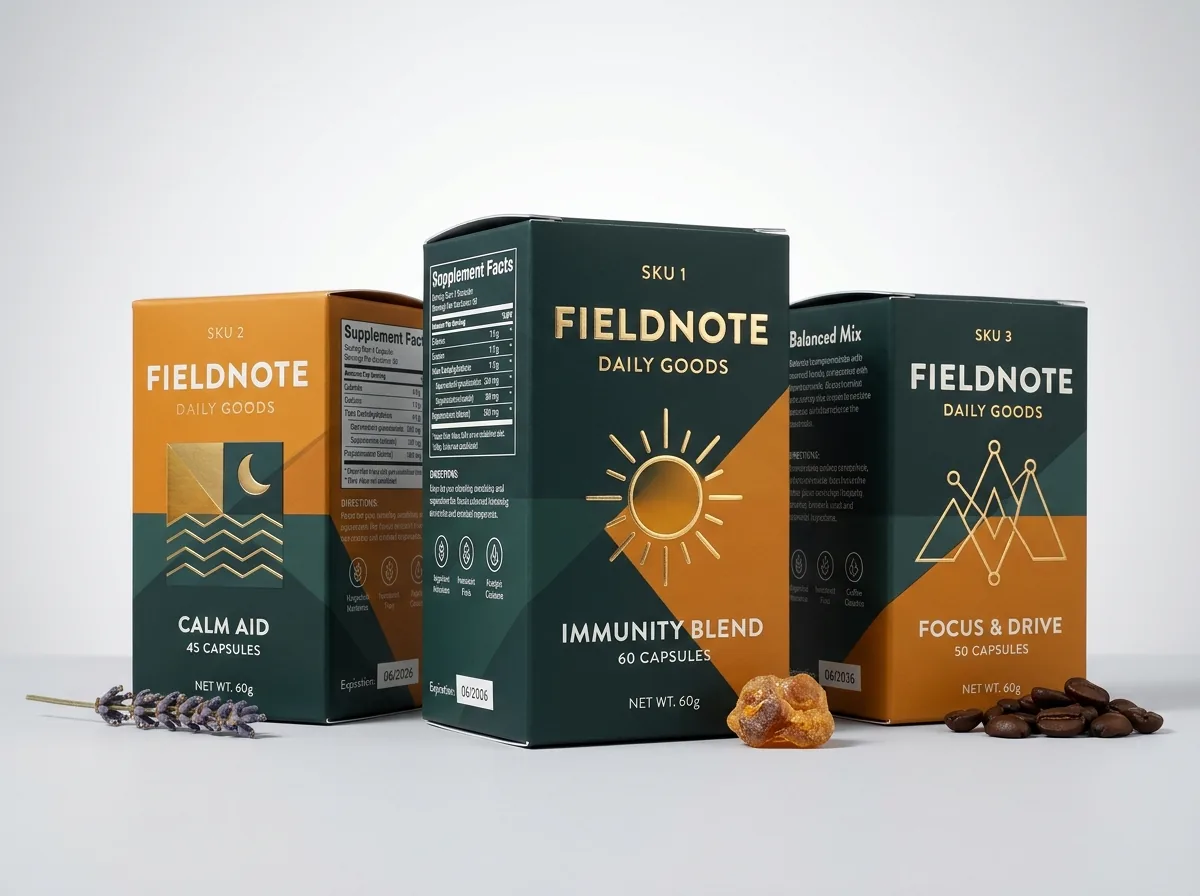
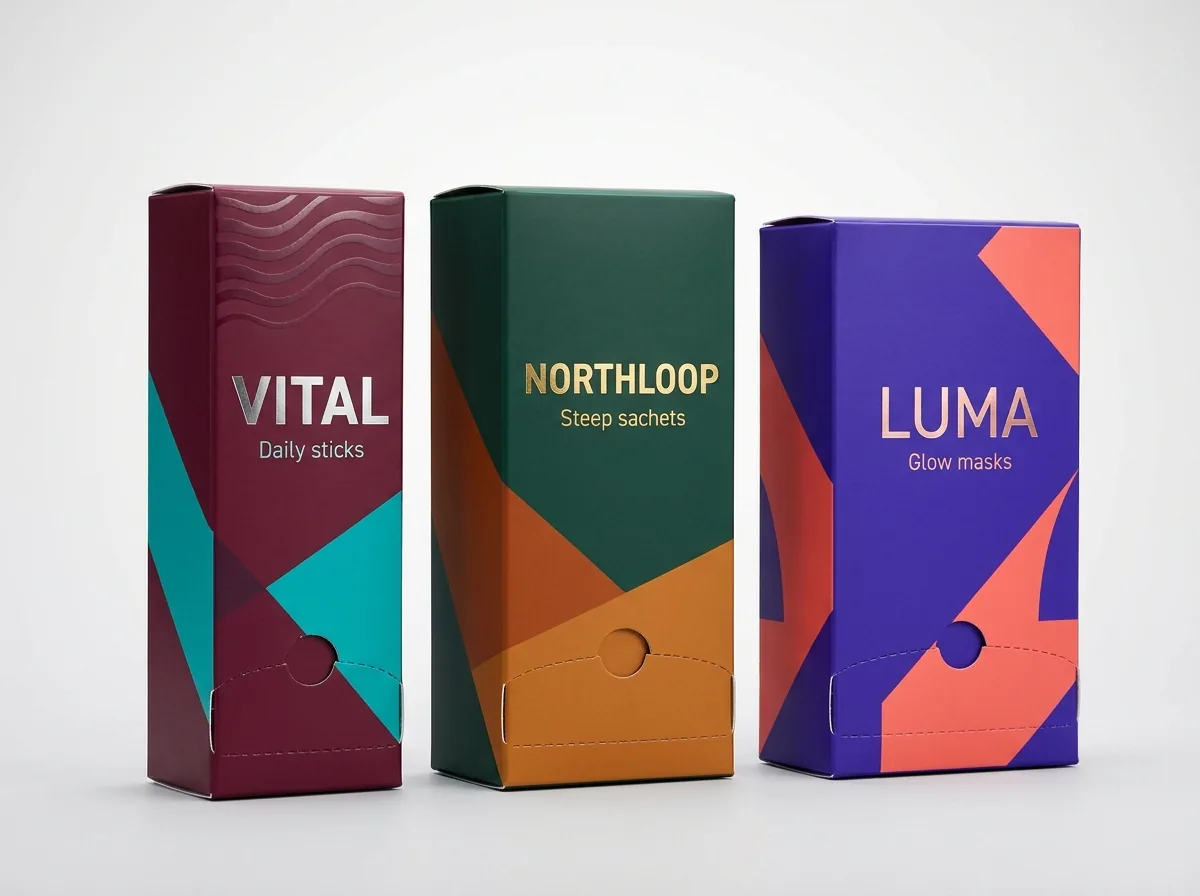
Ready to order vitamin boxes? Compare up to 3 quantities with a free 3D mockup.
Request a Quote →Questions about vitamin boxes
What size box fits a standard 120 cc or 150 cc vitamin bottle?
A standard 120 cc or 150 cc round plastic or glass packer bottle (holding 60 to 90 tablets or capsules) usually fits an inside carton measuring 2.125 × 2.125 × 4.0 inches (54 × 54 × 102 mm) or 2.25 × 2.25 × 4.25 inches. Always verify the exact bottle mold diameter and cap height with calipers.
What size carton do I need for a 300 cc or 400 cc gummy vitamin jar?
Most 60-count and 90-count gummy vitamins use a wide-mouth 300 cc or 400 cc PET jar, which typically requires a 3.0 × 3.0 × 5.25 inch (76 × 76 × 133 mm) inside carton with an auto-lock bottom base to support the 8 to 11 ounce weight of pectin gummies.
How big is a 30-day personalized daily vitamin sachet dispenser box?
A standard 30-day coiled daily vitamin packet dispenser cube measures roughly 4.5 × 4.0 × 5.25 inches (114 × 102 × 133 mm) inside, with a perforated 3.5 × 0.875 inch pull slot on the lower front panel for 3.25-inch wide sachets.
Can I use a wider box than my 30 ml Vitamin D3 dropper bottle for more label space?
Yes. Stepping up from a 1.5 × 1.5 inch footprint to a 1.875 × 1.875 × 4.25 inch carton gives you wider panels for legible Supplement Facts text, and we die-cut a circular neck ring into the inner dust flaps to keep the 30 ml vial centered.
What is the minimum order quantity for custom-sized vitamin boxes?
CubitPack produces custom paperboard folding vitamin boxes (tuck-end cartons, auto-lock bottom boxes, blister wallets and cardstock sachet dispensers) from 1,000 units, corrugated mailers from 250 units, and rigid gift boxes from 50 units.
Can I test my vitamin bottles inside a sample box before full production?
Yes. Every order includes a free digital proof and 3D mockup at your exact container dimensions before payment, and you can also request a physical sample to test-fit on your co-packer's cartoning line.
Still have a question? Ask a packaging specialist.
Request a Quote →Request your vitamin boxes quote
Tell us your size and quantities, and one dedicated account manager prepares pricing for each tier.
- Free design & AI-to-print studio + 3D mockup
- No die or plate charges · 4–5 day rush available
- Free shipping to all 50 states
- 10% off your first order
The container capacities, child-resistant cap clearances and 30-day sachet coil dimensions in this guide were measured across standard 100 cc to 400 cc packer bottles and jars, 30 ml Boston round glass droppers, and 3.25-inch wide daily vitamin packet rolls. A CubitPack packaging specialist checked every row. Spot an error? Tell us and we will fix it.
Sources
What changed
- October 22, 2026: First published.
- October 22, 2026: Updated specifications, terminology, and verified source links.
More guides
New packaging guides by email
Sizes, materials and design tips. Unsubscribe anytime.