
What size medicine box do I need for syrups, ointment tubes and sprays?
Short answer: Measure the widest feature of your primary container (the flat crimped tail on an ointment tube, the actuator collar on a nasal spray, or the over-cap dosing cup on a syrup bottle) and add 1/16 to 1/8 inch. Order custom medicine boxes cut to any size.
On this page
- What are the standard inside dimensions for custom medicine boxes
- How do I measure a crimped aluminum or laminate ointment tube for a box
- How do I size a carton for a liquid syrup bottle with a dosing cup or oral syringe
- How do I stabilize tapered nasal sprays and small eye drop vials inside a carton
- How much room should I leave for folded patient leaflets and blister trays
- Common mistakes
- FAQs
Request a custom quoteFree dieline & 3D mockup
Sizing a medicine box accurately requires measuring the widest and tallest feature of the assembled container rather than its nominal fluid volume or tube diameter. On a collapsible 15 g, 30 g or 60 g ointment tube, the flat crimped tail at the bottom is roughly 1.5 times wider than the cylindrical barrel, so a 30 g tube needs a 4.75 × 1.375 × 1.125 inch carton. On a 4 fl oz or 8 fl oz oral cough or fever syrup, snapping a graduated plastic dosing cup over the child-resistant cap adds 0.5 to 0.75 inch to the total height, calling for a 2.25 × 2.25 × 5.0 inch or 2.625 × 2.625 × 6.0 inch carton. Compact 10 ml to 30 ml eye drops and nasal sprays fit 1.25 × 1.25 × 3.25 inch to 1.625 × 1.625 × 4.25 inch cartons with a neck-centering collar. CubitPack cuts every medicine carton to order from 1,000 units with no die fees.
What are the standard inside dimensions for custom medicine boxes?
Over-the-counter (OTC) liquid remedies, topical tubes and metered sprays fall into six standard primary container families. Unlike round supplement packer bottles that are nearly uniform cylinders, medicine containers have asymmetric geometry: flattened tube crimps, winged nasal actuators, snap-on dosing cups and side-packed oral syringes. Use the benchmark table below to match your container to a proven inside carton dimension (length × width × height in inches). When you order custom printed medicine cartons, our structural team builds the dieline to your exact millimeter or fractional inch specs.
| Medicine container & accessories | Typical inside box size (L × W × H) | Recommended carton style |
|---|---|---|
| 10 ml - 15 ml eye or ear drop LDPE bottle + leaflet | 1.25 × 1.25 × 3.25 in | Reverse or straight tuck end |
| 1 fl oz (30 ml) metered nasal or throat spray | 1.625 × 1.625 × 4.25 in | Straight tuck end with neck hole |
| 15 g - 30 g crimped aluminum or laminate tube | 4.75 × 1.375 × 1.125 in | Horizontal reverse tuck end |
| 50 g - 60 g topical pain or antibiotic cream tube | 6.0 × 1.75 × 1.375 in | Horizontal reverse tuck or hang tab |
| 2 fl oz (60 ml) pediatric liquid drop + syringe | 2.5 × 1.75 × 4.25 in | Auto-lock bottom with divider |
| 4 fl oz (118 ml) oral syrup + over-cap dosing cup | 2.25 × 2.25 × 5.0 in | Auto-lock bottom or seal end |
| 8 fl oz (236 ml) liquid medicine + dosing cup | 2.625 × 2.625 × 6.0 in | Auto-lock bottom |
How do I measure a crimped aluminum or laminate ointment tube for a box?
Collapsible metal and poly-foil laminate tubes for hydrocortisone, antibiotic ointment, scar gel and medicated creams start out as round cylinders at the shoulder and cap, then flatten into a wide heat-sealed or double-folded crimp at the tail. Basic geometry dictates that when a cylinder of diameter D is pressed flat, its flat crimp width becomes roughly 1.57 × D (half of the circumference). For example, a 30 g ointment tube with a 22 mm (0.87 in) round barrel has a flat crimped tail that measures 34.5 mm (1.36 in) wide. If you size the carton cross-section to the 0.87 inch barrel, the crimped tail cannot enter the box unless it is twisted diagonally, which crushes the tube walls on an automated cartoner. Always set one cross-sectional dimension of the carton to the flat crimp width plus 1/16 inch (1.5 mm), and the other cross-sectional dimension to the cap or shoulder diameter plus 1/16 inch.
- Tube carton Length (L): measure from the tip of the nozzle cap to the outer edge of the crimped tail, then add 1/8 in (3 mm).
- Tube carton Width (W): measure the flat width of the bottom crimped seal, then add 1/16 in (1.5 mm).
- Tube carton Height (H): measure the round shoulder or cap diameter at the thickest point near the neck, then add 1/16 in (1.5 mm).
- Orientation choice: horizontal tube cartons make the long side the front panel so shoppers can read the active ingredient clearly.
How do I size a carton for a liquid syrup bottle with a dosing cup or oral syringe?
Liquid cough, cold, allergy and pediatric fever medicines almost always ship with a graduated measuring device: either a clear polypropylene dosing cup snapped over the bottle cap, or a plastic oral dosing syringe packed alongside the bottle. Both accessories change the inside dimensions of your folding carton. When using a snap-on over-cap dosing cup, seat the cup firmly onto the child-resistant closure the exact way it leaves the filling line, then measure the combined vertical height from the bottle base to the top rim of the cup. Add 1/8 inch (3 mm) of vertical clearance so the top flap closes without pressing the cup down onto the cap threads. If you are packing a 5 ml or 10 ml oral syringe or a calibrated dosing spoon beside a 2 fl oz or 4 fl oz bottle, increase the carton width (left-to-right) by 0.65 to 0.85 inch and add a custom cardboard insert partition wall so the syringe sits in its own narrow side channel.
Know your size? Compare pricing across up to 3 quantities.
Request a Quote →How do I stabilize tapered nasal sprays and small eye drop vials inside a carton?
Metered nasal sprays, throat sprays and ophthalmic eye drop bottles are top-light and bottom-heavy, tapering from a 1.1 to 1.5 inch base down to a narrow finger actuator or dropper tip at the top. Worse yet, many 10 ml eye drop bottles are so small that a carton sized tightly to the bottle alone would not have enough surface area on the back and sides to print a legible 21 CFR 201.66 OTC Drug Facts panel. To solve both problems at once, OTC brands frequently make the outer carton slightly wider or taller than the vial so the four panels can carry 6 pt Drug Facts text without a costly multi-page booklet, then lock the small bottle in place using an internal die-cut cardboard cradle or extended dust-flap neck collar. A die-cut circle in the top inner dust flaps grips the narrow neck of a nasal spray actuator right below the finger wings so the bottle cannot tip or rattle inside the oversized carton.
- Nasal spray wing check: measure across the finger-rest wings of the spray actuator as well as the bottle base.
- Integrated dust-flap collar: cuts a centering hole directly into the top side dust flaps at zero extra piece cost.
- Step-base false floor: raises a short 10 ml eye drop vial inside a taller carton built for Drug Facts legibility.
- Folded patient leaflet slot: leave 1/8 in (3 mm) of front-to-back clearance when wrapping a folded paper insert around the bottle.
How much room should I leave for folded patient leaflets and blister trays?
Unlike cosmetic cartons where the container touches all four walls, an OTC medicine box frequently carries a folded multi-panel patient information leaflet (outsert) glued to the bottle cap or wrapped in a U-shape around the container. A machine-folded paper outsert is typically 1.5 mm to 3.0 mm thick at its folded spine. Always test-measure your bottle or blister stack together with the folded outsert so the paper spine does not bow the front panel of your custom straight tuck end box or custom seal end box. When packing cold, allergy or pain-relief tablets in thermoformed PVC/foil blister cards, stack the blister sheets with their raised cavities nested face-to-face where possible, measure the combined stack thickness plus the patient leaflet, and add 1/16 inch (1.5 mm) of loading clearance.
What are the most common medicine box sizing mistakes?
A 2 mm miscalculation on a tube crimp or dosing cup can jam an automated cartoning line. Check these five sizing pitfalls before signing off on your dieline
- Sizing an ointment tube carton as a square based on the round cap diameter instead of a rectangle matched to the wider flat crimped tail.
- Measuring a liquid syrup bottle without the snap-on plastic dosing cup seated on the cap, leaving the carton 0.5 inch too short.
- Forgetting to add 2 to 3 mm of depth for a thick machine-folded patient information leaflet (outsert) packed beside the bottle.
- Letting a small 10 ml eye drop vial or tapered nasal spray rattle loose inside a wider Drug-Facts-sized carton without a neck collar.
- Specifying outside box dimensions instead of inside dimensions when sending specs from an existing carton.
Find your size
Suggested inside size: 1.25 × 1.25 × 3.25 in
A starting point. Your account manager confirms the size with you before the proof.
Quote this size →Packaging for this
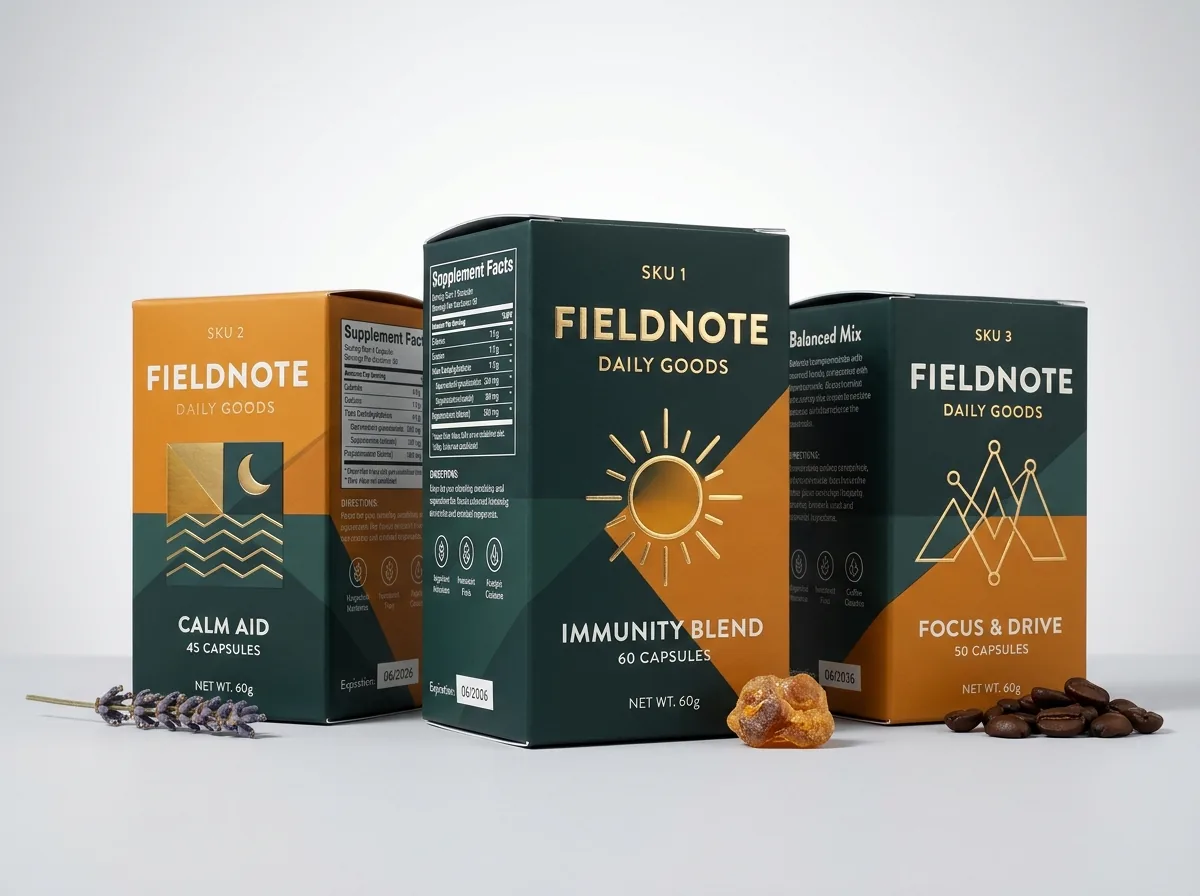

Ready to order medicine boxes? Compare up to 3 quantities with a free 3D mockup.
Request a Quote →Questions about medicine boxes
Why are ointment tube medicine boxes rectangular instead of square?
When a round aluminum or laminate ointment tube is filled and sealed, the bottom tail is flattened into a wide crimp that is roughly 1.5 times wider than the round tube body. Making the carton cross-section rectangular (such as 1.375 × 1.125 in) fits the wide crimp while keeping the barrel from rolling.
What size box fits a standard 4 fl oz cough or cold syrup bottle?
A standard 4 fl oz (118 ml) oral syrup bottle topped with a child-resistant cap and a graduated plastic dosing cup typically fits a 2.25 × 2.25 × 5.0 inch inside carton. Because bottle shoulder shapes vary, always measure your exact bottle with the dosing cup snapped in place.
How do I size a box that holds both a liquid bottle and an oral dosing syringe?
Add 0.65 to 0.85 inch to the left-to-right width of the carton alongside the bottle, and let our structural team add an internal cardboard divider wall. The divider keeps the 5 ml or 10 ml syringe upright in its own slot so it never drops below the bottle.
Can I make my medicine carton larger than the bottle so the Drug Facts text fits?
Yes. On small 10 ml eye drops or 15 ml nasal sprays, the primary vial is often too small for a full 21 CFR 201.66 Drug Facts table. We size the outer carton to fit the text and build an internal cardboard collar and false floor to hold the small vial centered.
How much clearance do automated horizontal tube cartoners need?
High-speed horizontal cartoners that push an ointment tube and a folded leaflet into the end of a reverse tuck end carton typically require 1/16 inch (1.5 mm) of clearance around the crimp width and 1/8 inch (3 mm) on total length.
Can I order a physical prototype of my medicine box to test on our filling line?
Yes. Every order includes a free flat 2D proof and 3D mockup before payment, and you can also order custom printed and die-cut prototypes to test on your co-packer's cartoner before the full run, with the prototype cost credited to your order.
Still have a question? Ask a packaging specialist.
Request a Quote →Request your medicine boxes quote
Tell us your size and quantities, and one dedicated account manager prepares pricing for each tier.
- Free design & AI-to-print studio + 3D mockup
- No die or plate charges · 4–5 day rush available
- Free shipping to all 50 states
- 10% off your first order
The tube crimp formulas (flat width = 1.57 × diameter), syrup dosing-cup clearances and actuator collar layouts in this guide come from standard OTC primary packaging dimensions and co-packer cartoning specs. A CubitPack packaging specialist checked every row. Spot something wrong? Let us know and we will fix it.
Sources
What changed
- October 22, 2026: First published.
- October 22, 2026: Updated specifications, terminology, and verified source links.
More guides
New packaging guides by email
Sizes, materials and design tips. Unsubscribe anytime.