
Tray and sleeve vs sleeve-only belly bands and rigid drawer boxes: which slide package fits your product?
Short answer: Choose custom tray and sleeve boxes when you want a two-piece slide-drawer unboxing reveal that ships flat and starts at 1,000 units. Pick a custom sleeve box when you only need a printed belly band over an existing container, or upgrade to custom drawer boxes for 2 mm rigid chipboard.
On this page
- How is each horizontal slide structure built
- How do tray and sleeve, belly bands, and rigid drawer boxes compare side by side
- How much freight and warehouse space do flat tray and sleeve boxes save
- How do wall stiffness, windows, and unboxing feel compare
- How do I choose and quote the right slide format
- Common mistakes
- FAQs
Request a custom quoteFree dieline & 3D mockup
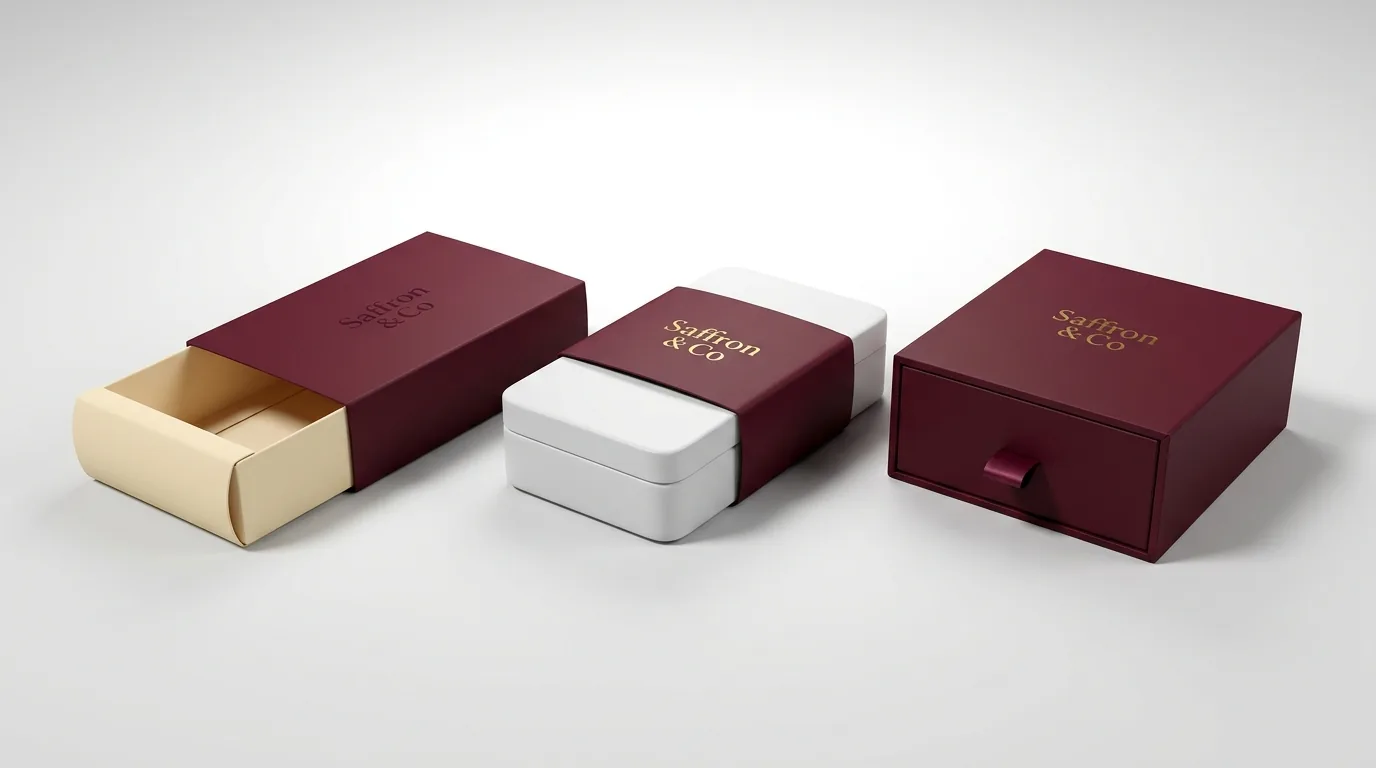
All three formats use a horizontal sliding motion to reveal or brand the product inside, yet they serve different product weights, warehouse footprints, and order quantities. A paperboard tray and sleeve box is a two-piece folding carton (16 pt to 24 pt card or E-flute corrugated board) pairing a rolled double-wall tray with a four-panel pre-glued outer sleeve; both pieces ship flat to save roughly 80% on freight and warehouse storage compared with rigid boxes. A sleeve-only belly band removes the inner tray altogether, sliding a four-panel paperboard band over an existing soap bar, meal tub, or stock carton at the lowest unit cost and fastest kitting speed. A rigid drawer setup box uses 1.5 mm to 2.5 mm high-density chipboard wrapped in printed paper with a ribbon or thumb pull, shipping pre-assembled starting from 50 units for luxury jewelry, watches, and heavy glass gift sets.
How is each horizontal slide structure built?
Although shoppers open all three styles by sliding an outer band horizontally, each format is built on a different manufacturing line and board caliper
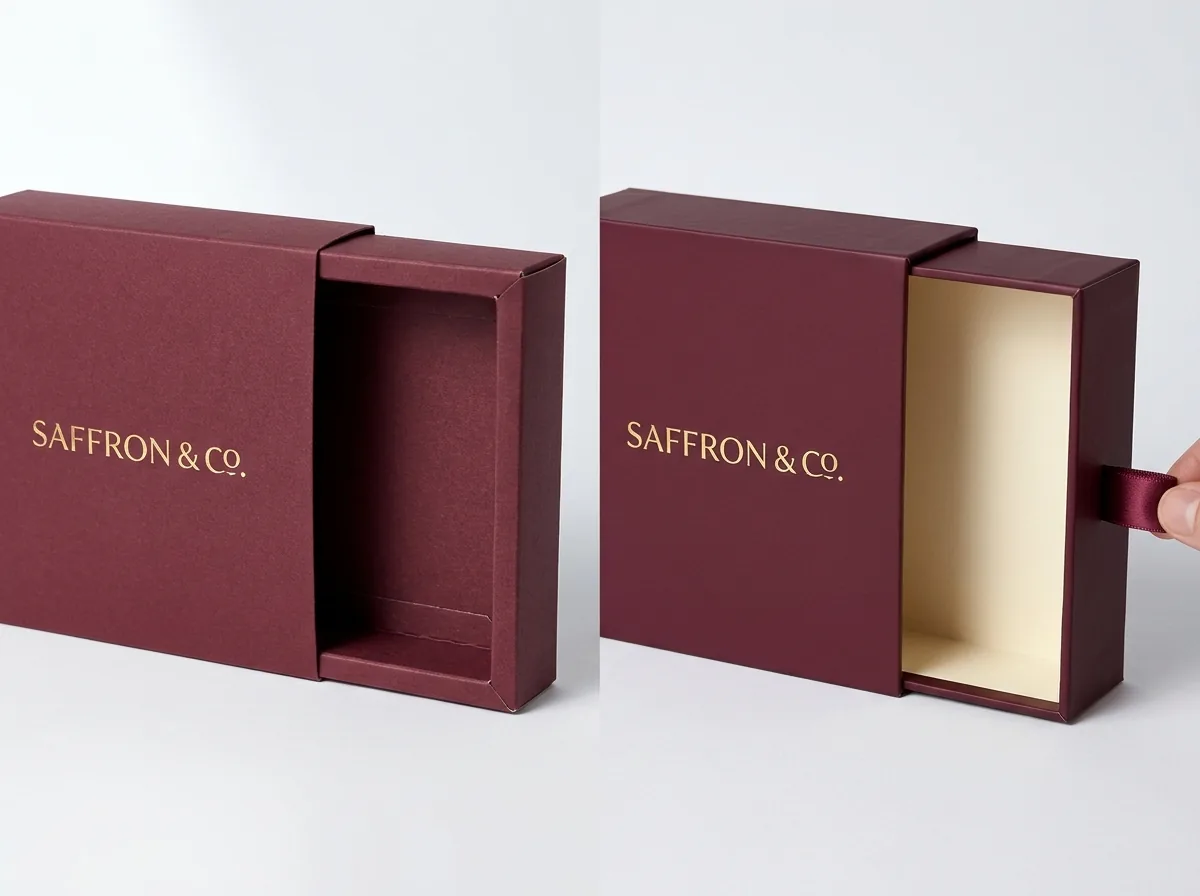
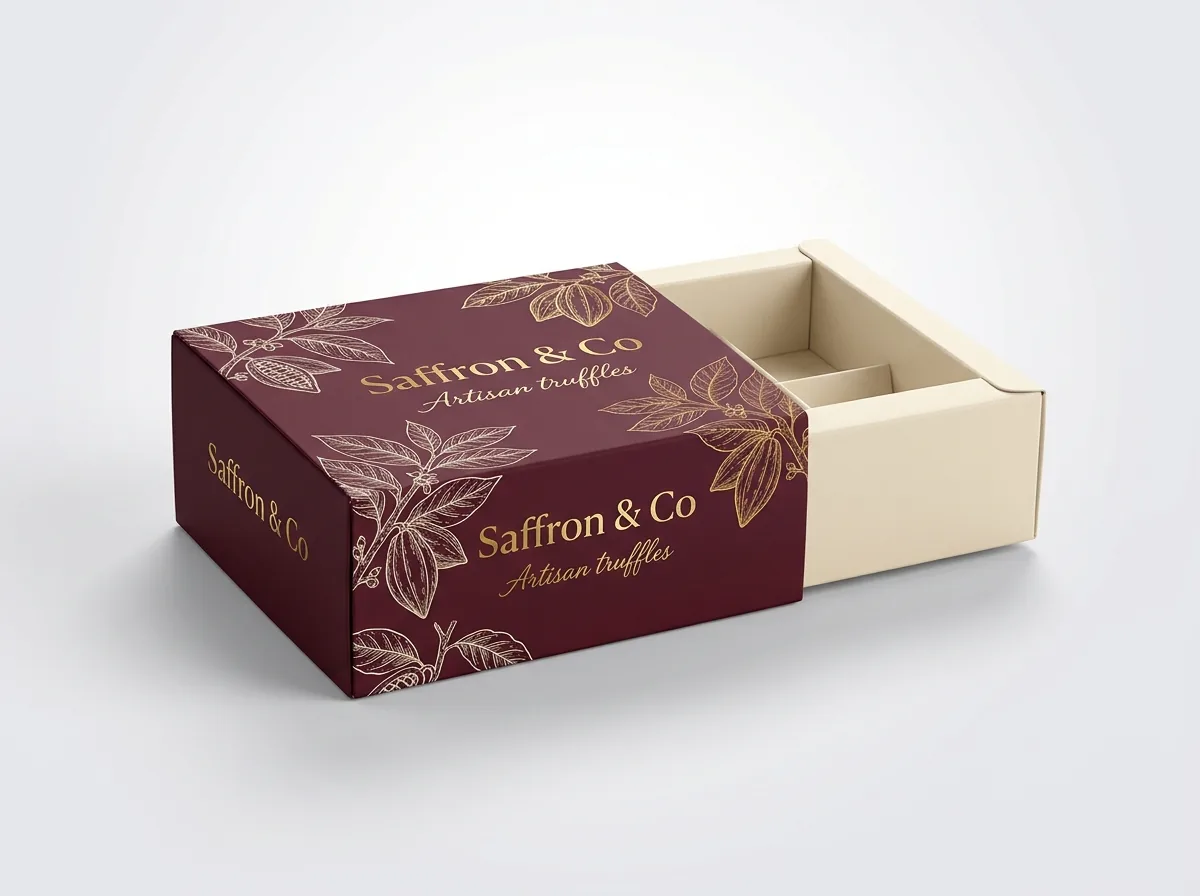
- Paperboard tray and sleeve box (2 pieces, ships flat): Die-cut from 16 pt to 24 pt SBS white card, natural kraft board, or E-flute corrugated board. Piece one is an open-top rectangular tray whose four walls fold up 90 degrees, roll 180 degrees over four corner dust flaps, and lock into floor slots to create double-thick perimeter walls without glue. Piece two is a four-panel tubular sleeve pre-glued along one longitudinal seam.
- Sleeve-only belly band (1 piece, ships flat): Built as a four-panel pre-glued tubular band (or an open wrap strip with a peel-and-seal adhesive strip) in 14 pt to 20 pt paperboard. Because there is no inner tray, the sleeve relies on your existing tub, thermoformed tray, bare soap bar, or plain carton for structural rigidity.
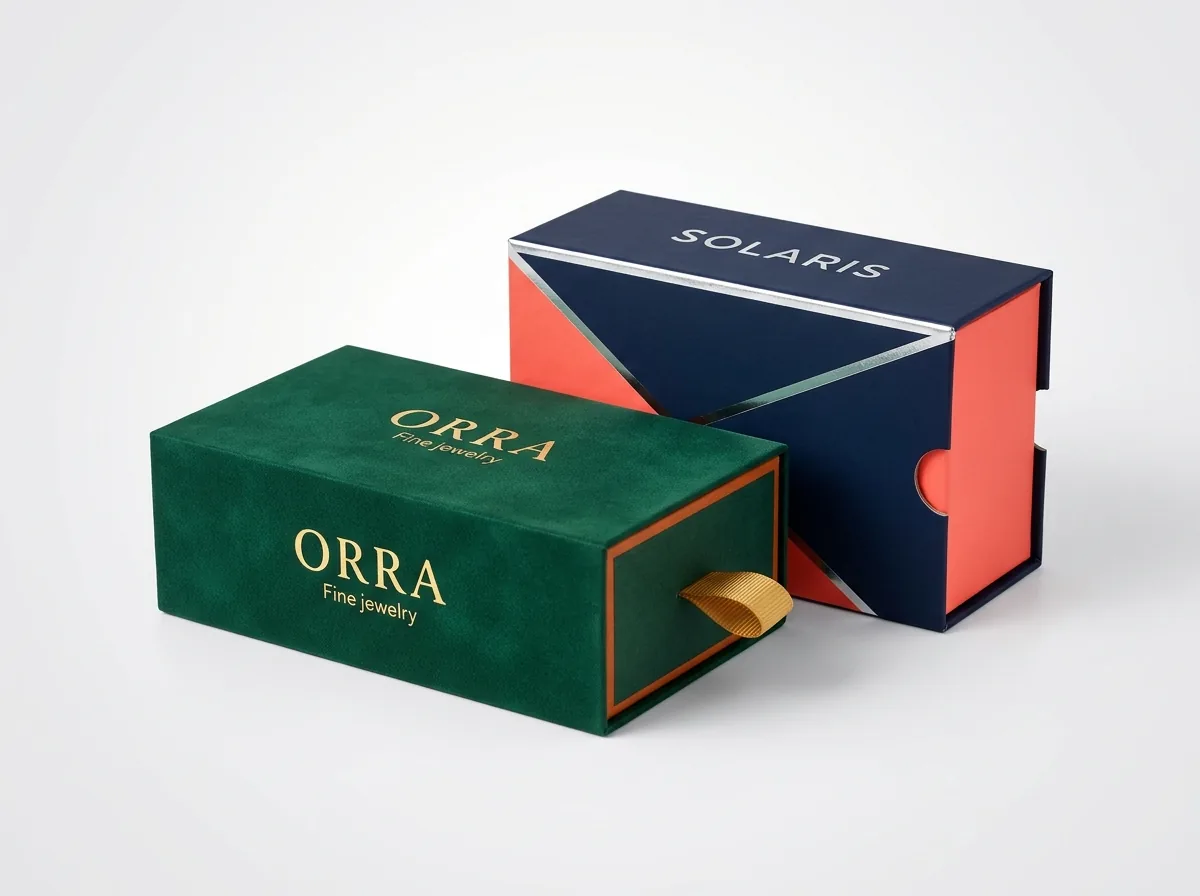
- Rigid drawer setup box (2 pieces, ships pre-assembled): Built from 1.5 mm to 2.5 mm (60 pt to 100 pt) dense gray chipboard that is V-grooved at the corners, stayed with corner tape, and wrapped in printed 120 gsm to 157 gsm art paper. Because chipboard cannot fold flat, every box ships fully formed with an optional satin ribbon pull tab or die-cut thumb notch.
How do tray and sleeve, belly bands, and rigid drawer boxes compare side by side?
Use the benchmark table below to compare piece count, minimum order quantity, warehouse footprint, packing speed, and product pairings across all three slide formats
| Feature | Paperboard Tray & Sleeve | Sleeve-Only Belly Band | Rigid Drawer Setup Box |
|---|---|---|---|
| Piece count | 2 pieces (double-wall tray + glued sleeve) | 1 piece (4-panel glued band only) | 2 pieces (wrapped chipboard drawer + shell) |
| Typical board weight | 16–24 pt SBS/kraft or E-flute corrugated | 14–20 pt SBS white card or kraft board | 1.5–2.5 mm chipboard + 157 gsm wrap |
| Minimum order (MOQ) | From 1,000 boxes | From 1,000 sleeves | From 50 boxes |
| Ships flat (KDF)? | Yes, both tray and sleeve ship flat | Yes, pre-glued sleeves ship flat | No, ships fully assembled at 3D volume |
| Warehouse footprint | Low (roughly 15–20% of rigid volume) | Minimal (flat folded bands only) | High (full assembled box volume) |
| Fulfillment assembly time | 10 to 15 seconds (fold tray + slide sleeve) | 3 to 5 seconds (pop band + slide over item) | 2 to 3 seconds (pre-assembled, just slide) |
| Crush & drop protection | Medium-high (rolled double-layer tray walls) | Surface wrap only (relies on inner tub/box) | Maximum (unyielding 2 mm chipboard walls) |
| Pull tab options | Die-cut thumb notch or ribbon loop | Open at both ends (no tab needed) | Grosgrain/satin ribbon tab or thumb notch |
| Best product match | Macarons, chocolates, soaps, cosmetics, tea | Meal trays, bare soaps, plain cartons, jars | Fine jewelry, watches, luxury fragrance sets |
How much freight and warehouse space do flat tray and sleeve boxes save?
Inbound freight and 3PL pallet storage often shift the total landed cost of slide packaging more than the factory unit price. Consider a production run of 5,000 chocolate truffle boxes measuring 7.0 × 4.0 × 1.75 inches
- Paperboard tray and sleeve (approx. 1.5 pallets for 5,000 sets): Because the die-cut tray blanks stack flat and the four-panel sleeves arrive pre-glued and folded flat (KDF), all 5,000 two-piece sets pack compactly into master corrugated cartons on roughly 1.5 standard pallets.
- Non-collapsible rigid drawer box (approx. 8 to 10 pallets for 5,000 boxes): Because 2 mm chipboard drawers and shells ship at their full assembled 3D volume, the exact same 5,000 units require 8 to 10 pallets of ocean, air, or truck freight plus monthly warehouse rack space.
- Sleeve-only belly band (approx. 0.5 pallets for 5,000 bands): With no tray blank required, 5,000 flat-glued sleeves fit into just four master cases. Many confectionery, soap, and bakery brands stock one bulk unprinted white or kraft inner tray size and print smaller runs of seasonal or flavor-specific outer sleeves.
Know your size? Compare pricing across up to 3 quantities.
Request a Quote →How do wall stiffness, windows, and unboxing feel compare?
Why choose a full paperboard tray and sleeve over a straight tuck end box or a sleeve-only band? When a shopper slides the outer sleeve off a double-wall paperboard tray, the entire top face of the tray opens at once with zero top tuck flaps or dust flaps blocking the view. Multi-piece assortments, such as six macarons in custom macaron boxes, eight pralines in custom chocolate boxes, or three glass dropper vials in custom cosmetic boxes, sit framed inside the rolled double walls like a display case.
- Hollow-beam tray rim stiffness: Each rolled tray wall consists of an outer panel, a 0.125 to 0.25 inch top rollover bridge, and an inner locking wall with floor tabs, creating a rigid double-layer frame that resists side squeezing.
- Top sleeve window framing: Both paperboard tray and sleeve cartons and sleeve-only bands support open cutouts or clear PET film windows across the top panel. On a tray and sleeve box, the rolled inner tray walls hide any raw edges inside the cavity.
- When to step up to a rigid drawer box: If your product weighs more than 16 oz (1 lb), if you need a low-MOQ run of 50 to 500 units, or if the box serves as a permanent dresser-top keepsake for fine jewelry or watches, choose custom drawer boxes or custom magnetic closure boxes.

How do I choose and quote the right slide format?
Once you pick your structure, check our companion guides on how to measure for a tray and sleeve box and tray and sleeve box dieline explained to set your inside tray dimensions and window margins on tray and sleeve boxes. Every order on CubitPack includes free design help, a free digital proof, and a free 3D mockup before payment, with zero die or plate charges, 10–14 business days standard turnaround (4–5 business days rush), and free shipping across all 50 US states. You can also request a single custom prototype or our $50 pre-made sample kit to compare paperboard tray and sleeve cartons against rigid drawer boxes in hand.
- Choose a sleeve-only belly band when your product already sits inside a primary container, like a sealed meal tray, glass jar, metal tin, or plain folding carton, and you want 360-degree branding at the lowest cost per unit.
- Choose a paperboard tray and sleeve box when you are packing 1,000+ units of macarons, chocolates, soaps, cosmetics, tea sachets, or gift cards and want a horizontal slide-drawer reveal that ships flat to save 80% on warehouse storage.
- Choose a wrapped 2 mm rigid drawer box when your product weighs over 16 oz, when you only need 50 to 500 boxes, or when you want a thick keepsake drawer chest with a satin ribbon pull tab for fine jewelry, watches, or VIP gifts.
What are the most common mistakes when choosing between slide box styles?
Avoid these five structural mismatches before placing your packaging order
- Ordering a sleeve-only belly band for loose multi-piece items (like macarons or truffles) that have no rigid inner tray to hold them together.
- Paying rigid setup box freight and storage for a high-volume food, soap, or cosmetic SKU that fits cleanly inside a flat-shipping 20 pt paperboard tray and sleeve carton.
- Using a single-wall unrolled tray inside a paperboard sleeve. Single-wall tray edges bow inward and catch on the sleeve opening during re-closing.
- Packing heavy glass bottles over 16 oz inside a light 16 pt paperboard tray without upgrading to E-flute corrugated board or a 2 mm rigid drawer box.
- Forgetting to coordinate the slide clearance when ordering trays and sleeves from two different suppliers.
Get a tray and sleeve dieline at your size
A simplified drawing for planning your design. Your free production dieline comes with your proof, made for your exact size and board.
Packaging for this




Ready to order tray and sleeve boxes? Compare up to 3 quantities with a free 3D mockup.
Request a Quote →Questions about tray and sleeve boxes
Can I add a satin ribbon pull tab to a paperboard tray and sleeve box?
Yes. While die-cut half-moon thumb notches on the sleeve edge are the most common and economical option on paperboard tray and sleeve boxes, we can also slot and secure a satin or grosgrain ribbon loop through the front double-layer end wall of an 18 pt to 24 pt paperboard tray.
How much faster is packing a rigid drawer box vs a paperboard tray and sleeve?
A pre-assembled rigid drawer box takes 2 to 3 seconds to open, load, and close because the tray and shell arrive already formed. A flat-packed paperboard tray and sleeve takes 10 to 15 seconds per unit to fold the four double-layer tray walls, pop open the pre-glued sleeve, and slide them together.
Will a sleeve-only belly band slide off my container during shipping?
A properly sized belly band is engineered with 1/32 inch (0.8 mm) of snug friction clearance so it grips the container walls. For heavy tubs or multi-item bundles, we can also add small die-cut locking tabs that catch on the container rim or place a tamper-evident wafer seal across the sleeve edge.
Can I use a clear plastic sleeve over a printed paperboard tray?
Yes. Combining a printed double-wall paperboard tray with a clear PET plastic outer sleeve lets customers see 100% of the product arrangement, such as colorful macarons, bath bombs, or stationery sets, while keeping dust out and preventing the tray from opening in transit.
What is the minimum order quantity for each slide box style?
Custom paperboard tray and sleeve boxes and custom sleeve-only belly bands both start at 1,000 units. Custom wrapped rigid drawer setup boxes start at 50 units.
Still have a question? Ask a packaging specialist.
Request a Quote →Request your tray and sleeve boxes quote
Tell us your size and quantities, and one dedicated account manager prepares pricing for each tier.
- Free design & AI-to-print studio + 3D mockup
- No die or plate charges · 4–5 day rush available
- Free shipping to all 50 states
- 10% off your first order
We compared two-piece paperboard tray and sleeve cartons, four-panel belly band sleeves, and wrapped chipboard rigid drawer setup boxes against ECMA folding carton codes, FEFCO 0500 slide-box standards, and Paperboard Packaging Council caliper guidelines. A packaging specialist verified all warehouse pallet ratios and assembly times. Spot something wrong? Tell us and we fix it.
Sources
What changed
- October 24, 2026: First published with side-by-side comparison table, 5,000-unit pallet storage math, and structural selection rules.
More guides
New packaging guides by email
Sizes, materials and design tips. Unsubscribe anytime.