
How do I measure my product and cutout for a window box?
Short answer: Sizing custom window boxes takes two measurements: first, the usable inside carton cavity in Length × Width × Height order; second, the window aperture Width × Height and its distance from the panel edges. Always keep at least 3/8 inch (9.5 mm) of solid paperboard between any window edge and a fold line.

On this page
- What are the two sets of dimensions on a window box
- Why must every window stay at least 3/8 inch away from fold lines
- What are standard window box and cutout sizes by product
- How do I align a card insert so my product stays centered in the window
- How do I test my window box dimensions before printing
- Common mistakes
- FAQs
Request a custom quoteFree dieline & 3D mockup
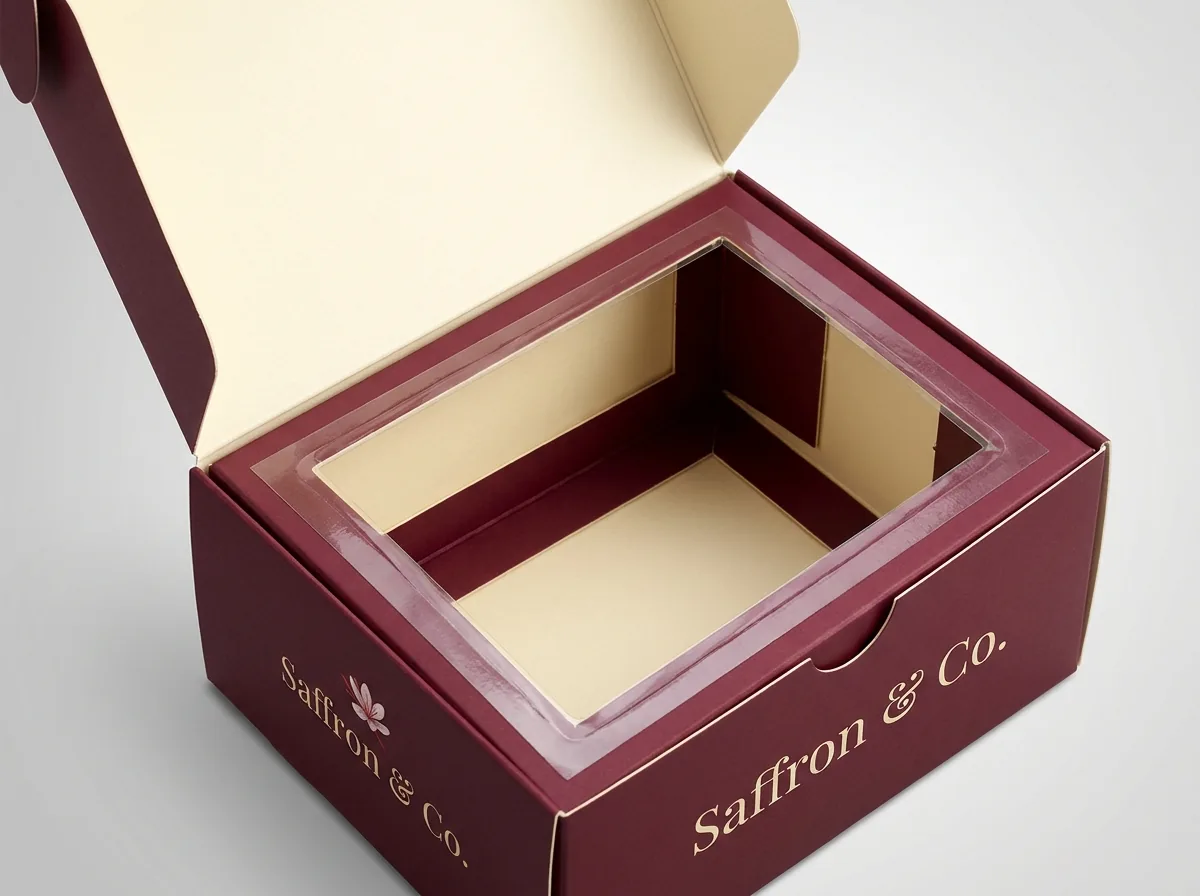
When you order a custom window box, you are sizing both the outer carton shell and the display frame that spotlights your product. First, measure your product (or its insert cradle) to set the usable inside carton dimensions in Length × Width × Height order, adding 1/16 to 1/8 inch of breathing room so items load without catching on the inner PET window patch. Second, decide which part of your product should show, such as a soap bar texture, frosted cupcake swirl, or bottle label, and set your window Width × Height so the cutout crops out empty headspace and any base insert wall. To keep the carton corners rigid and hide the 1/4 inch adhesive track that bonds a clear PET film patch, every edge of the window opening must sit at least 3/8 inch (0.375 in / 9.5 mm) away from any score or fold line.
What are the two sets of dimensions on a window box?
Following European Carton Makers Association (ECMA) and Paperboard Packaging Council (PPC) conventions, every dimension you enter on our window boxes page starts with the usable inside cavity of the carton, followed by the window opening on the front or top panel
- Carton Length (L, left to right across the front window face): The horizontal inside width of the main display panel facing the shopper on the retail shelf.
- Carton Width (W, front to back depth): The horizontal inside depth from the inside of the front windowed wall to the inside of the back wall.
- Carton Height (H, bottom to top): The vertical inside height from the locked bottom floor to the top score line of the carton.
- Window Width × Window Height (WW × WH): The horizontal and vertical opening of the die-cut cutout itself, plus its bottom offset (distance from the bottom fold line up to the lower edge of the window).
Why must every window stay at least 3/8 inch away from fold lines?
The most important structural rule in window carton design is the 3/8 inch (0.375 in / 9.5 mm) minimum paperboard frame margin, often called the bridge, between any edge of the die-cut window and the nearest score line
- Preserves vertical stacking strength: Cutting an aperture removes paperboard from the main load-bearing face of the carton. Keeping a 3/8 inch (or 1/2 inch on taller boxes over 6 inches) frame strip along the left and right vertical creases prevents the corners from bowing outward when boxes are stacked on a shelf.
- Hides the 1/4 inch PET window glue track: On film-patched window boxes, our window-patching machine cuts a crystal-clear PET film sheet 1/2 to 3/4 inch wider and taller than the die-cut hole (a 1/4 to 3/8 inch overhang on all four sides) and applies a thin bead of liquid adhesive around the inside perimeter. A 3/8 inch paperboard frame hides that film edge and glue track completely out of sight.
- Prevents score-line interference during folding: If a PET film patch overhangs across a vertical score line on a single-panel window, the stiff plastic edge resists folding and makes the carton skew. Keeping the cutout 3/8 inch away from the crease lets the paperboard fold crisp and square.
- Panoramic two-sided corner windows: Want your window to wrap 90 degrees across the front panel and right side wall for a toy, perfume bottle, or doll? We keep a 1/2 inch (12.7 mm) top and bottom paperboard header/footer margin and pre-crease the PET film patch directly along the vertical corner score line.
What are standard window box and cutout sizes by product?
Every order at CubitPack is die-cut to your exact inside box size and window shape starting from 1,000 units, with zero die or plate charges. Use the reference chart below to benchmark inside carton dimensions and recommended window openings across eight popular categories
| Product category | Recommended inside box L × W × H (in) | Recommended window size & shape | Window type & base style |
|---|---|---|---|
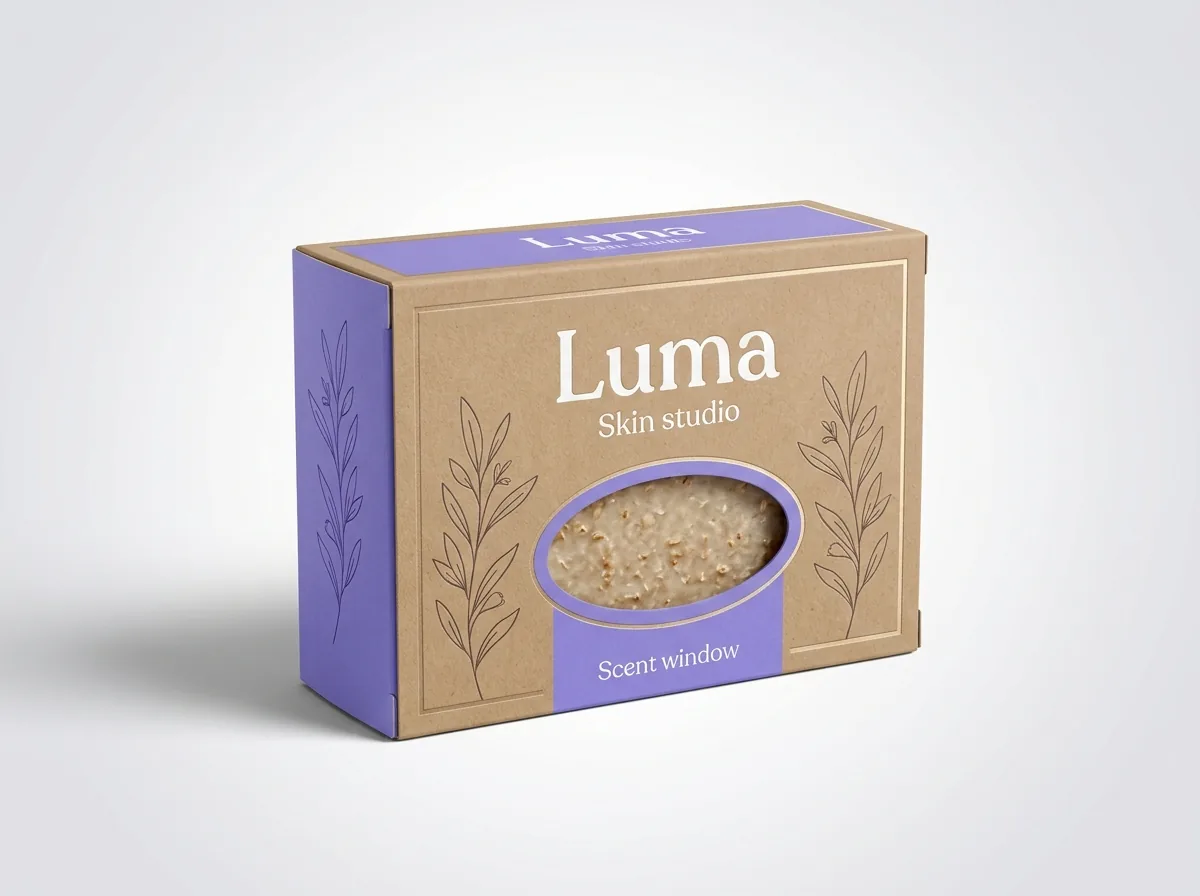
| Artisan bar soap (4–5 oz) | 3.5 × 2.5 × 1.25 in | 1.75 × 1.25 in centered oval or leaf | Open cutout (scent) · STE or RTE |
| 30 ml dropper serum bottle | 1.75 × 1.75 × 4.5 in | 1.0 × 2.75 in vertical arch | Clear PET patch · STE + card insert |
| Single gourmet cupcake | 4.0 × 4.0 × 4.5 in | 2.5 × 3.0 in front-to-top wrap window | Clear PET patch · Auto-lock + insert |
| 8 oz glass candle jar | 3.5 × 3.5 × 4.25 in | 2.25 × 2.25 in square or arch | Open or PET patch · Auto-lock bottom |
| 6-piece French macaron sleeve | 7.25 × 2.25 × 2.0 in | 5.5 × 1.25 in top horizontal rectangle | Clear PET patch · Tray & sleeve |
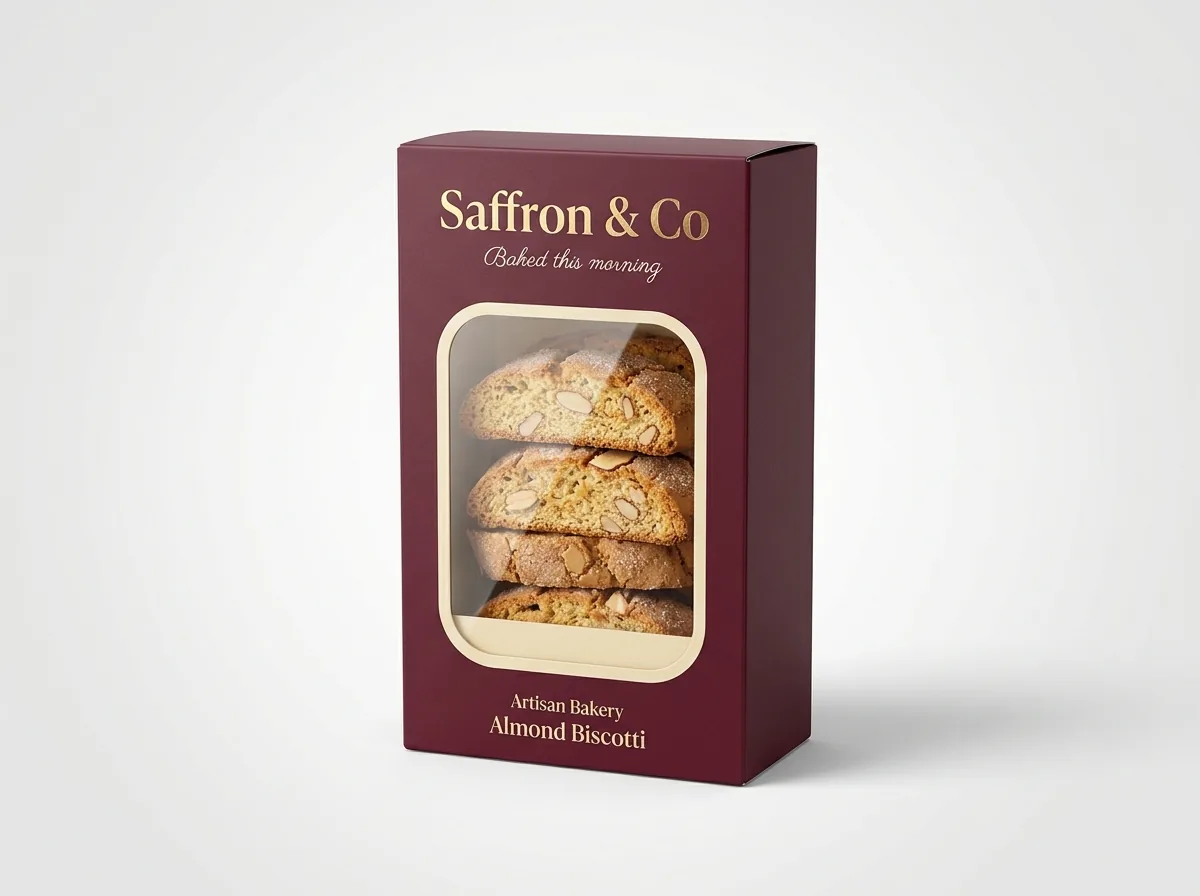
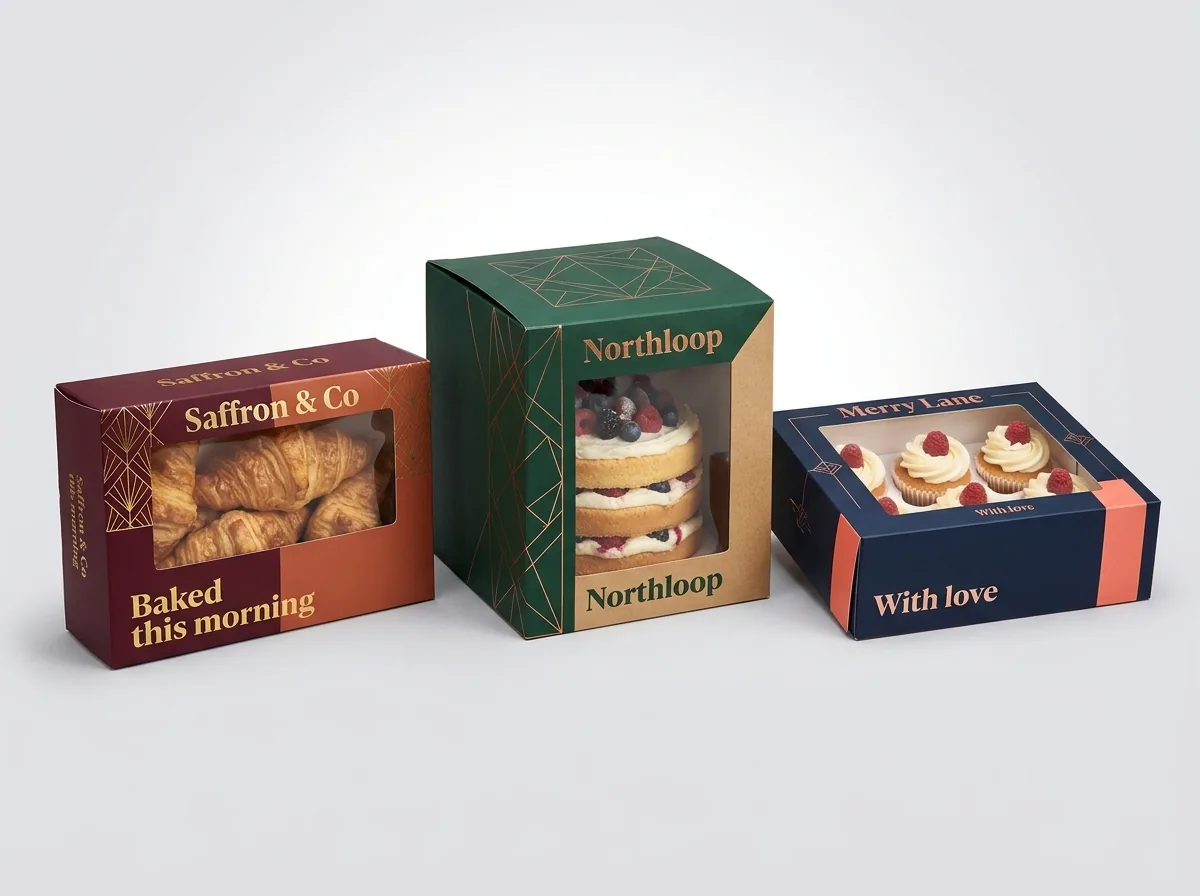
| Bakery cookie / pastry 4-pack | 8.0 × 6.0 × 2.5 in | 6.0 × 4.0 in top lid rectangle | Clear PET patch · Lock-corner bakery |
| Collectible vinyl figure / toy | 5.0 × 3.5 × 7.5 in | 3.75 + 2.0 × 5.25 in corner wrap | Creased PET patch · 22–24 pt STE/ALB |
| Loose-leaf tea pouch / tin carton | 3.25 × 2.75 × 5.25 in | 1.75 × 3.0 in botanical arch | Clear PET patch · 18–20 pt STE |
Know your size? Compare pricing across up to 3 quantities.
Request a Quote →How do I align a card insert so my product stays centered in the window?
When packing cookies in custom cookie boxes, pastries in custom bakery boxes, serums in custom cosmetic boxes, or figures in custom toy boxes, the window opening should act like a camera viewfinder that frames only the best part of your product
- Crop out the bottom insert pedestal: If your bottle, candle, or cupcake sits inside a 0.75-inch-tall folded paperboard base cradle, start the bottom edge of your front window at least 0.85 inches up from the bottom score line so shoppers see the product rather than the structural tabs of the insert.
- Crop out empty top headspace: Stop the top edge of a front window 0.5 to 0.75 inches below the top score line so the top side dust flaps and bottle neck gap stay hidden behind the upper paperboard header.
- Add 1/16 inch extra depth (W) for thick PET patches: On very snug cartons (like bar soap boxes or deck boxes), remember that a 0.15 mm PET patch plus its glue bead sits on the inside of the front wall. Adding 1/16 inch (1.5 mm) to your inside Width (W) prevents the product from catching on the top edge of the film patch when sliding in.
- Compare open vs film-patched windows: Not sure whether your product needs a clear PET film shield or an open plastic-free cutout? Read our comparison of open cutout vs film-patched window boxes.

How do I test my window box dimensions before printing?
You can preview a standard front-window layout right on our style page and read our companion walkthrough, window box dieline and patch margins explained. When you request a quote on CubitPack (from 1,000 boxes, with 10–14 business day standard turnaround or 4–5 business day rush), our packaging specialists build your exact custom dieline showing the outer box cuts, the window cutout loop, and the inner PET patch glue zone at no charge. Every order includes free design help, a free digital proof, and a free 3D mockup before payment, with zero die or plate charges and free shipping to all 50 US states.
- Step 1: Measure your product Length, Width, and Height and add 1/16 to 1/8 inch of breathing room to set your inside carton cavity.
- Step 2: Choose your window style (clear PET film patch, open plastic-free cutout, or two-sided corner wrap) and tell us what part of the product should show.
- Step 3: Review your free 2D vector dieline and 3D proof to verify that the window frames your product and hides any interior insert tabs.
What are the most common measurement mistakes on window boxes?
Avoid these five sizing pitfalls before locking in your window box dieline
- Extending the window cutout closer than 3/8 inch (9.5 mm) to a vertical or horizontal fold line, which causes the side bridge to buckle and exposes the PET film glue track.
- Starting the bottom of the window too low when using a base card insert, which exposes the folded cardboard pedestal tabs inside the window.
- Extending the top of the front window all the way into the top 3/8 inch zone where the folded top side dust flaps hang down inside the carton.
- Sizing a narrow bottle or toy carton without a centering insert, allowing the product to slide into the corner out of view of the front window.
- Zeroing out the front-to-back Width (W) clearance on a tight soap or card box so the top edge of the product snags on the inside edge of the PET window film during loading.
Get a window dieline at your size
A simplified drawing for planning your design. Your free production dieline comes with your proof, made for your exact size and board.
Packaging for this

Ready to order window boxes? Compare up to 3 quantities with a free 3D mockup.
Request a Quote →Questions about window boxes
How close can a window cutout be to the edge or fold line of a box?
Keep every edge of your die-cut window at least 3/8 inch (0.375 in / 9.5 mm) away from any score or fold line. On larger cartons over 6 inches tall or panoramic two-panel corner windows, we recommend a 1/2 inch (12.7 mm) frame margin for maximum corner stiffness.
Do I need to give exact window cutout measurements to get a price quote?
No. To generate your price quote, we only need your inside box Length × Width × Height, board preference, and quantity (from 1,000 boxes). Our packaging specialists size the window opening to frame your product on your free CAD dieline.
Does the clear PET window patch reduce the usable inside space of the box?
A standard 0.12 to 0.15 mm PET window patch and its thin adhesive bead add less than 0.3 mm inside the front wall. However, adding 1/16 to 1/8 inch (1.5 to 3 mm) of inside Width (W) clearance ensures your product slides past the top edge of the film patch without snagging during fast hand packing.
How do you measure a two-sided panoramic corner window?
A corner window is measured by its horizontal width on the Front Panel (e.g., 3.5 inches), its horizontal width wrapping onto the Side Panel (e.g., 1.75 inches), and its shared vertical Window Height, keeping at least 1/2 inch of solid board at the top and bottom of the crease.
Can you size a custom card insert to match my window cutout?
Yes. Select Card insert in Step 2 of the quote form and share your product dimensions. We engineer the insert platform height so the base cradle sits cleanly below the bottom edge of your window opening.
Still have a question? Ask a packaging specialist.
Request a Quote →Request your window boxes quote
Tell us your size and quantities, and one dedicated account manager prepares pricing for each tier.
- Free design & AI-to-print studio + 3D mockup
- No die or plate charges · 4–5 day rush available
- Free shipping to all 50 states
- 10% off your first order
We verified interior Length × Width × Height conventions, 3/8 inch score-line bridge margins, and 1/4 inch PET window patch adhesive overhang rules against Paperboard Packaging Council (PPC) window-patching standards and European Carton Makers Association (ECMA) codes. A packaging specialist checked every dimension rule. Spot something wrong? Tell us and we fix it.
Sources
What changed
- October 24, 2026: First published with inside carton L × W × H rules, 3/8 inch window frame margin math, insert crop rules, and category size chart.
More guides
New packaging guides by email
Sizes, materials and design tips. Unsubscribe anytime.