
How do I measure my product for a tuck end box?
Short answer: Measure the item itself at its widest and tallest points, never an old carton. Add 1/16 to 1/8 inch of clearance to length and width so the item slides in smoothly, and add 1/8 inch to height so the top tuck flap closes flat on custom straight tuck end boxes.

On this page
- Which dimension is length, width, and height on a tuck end box
- What are typical inside sizes for tuck end boxes
- How much clearance should I add to my product measurements
- How do card inserts and windows change the box size
- Why are folding cartons quoted by inside dimensions instead of outside
- How do I verify my tuck end box size before production starts
- Common mistakes
- FAQs
Request a custom quoteFree dieline & 3D mockup
Every folding carton is quoted and engineered using inside dimensions written in strict order: Length by Width by Height (L × W × H) in inches. Looking straight down at the open top of a standing carton, Length is the left-to-right width of your main front display panel, Width is the front-to-back depth of the side panel, and Height is the vertical distance from the closed bottom crease to the top crease. If you measure tightly against a glass bottle or cosmetic tube with zero allowance, the side dust flaps will catch on the cap and the top tuck panel will bow upward. Adding 1/16 inch (about 1.5 mm) of breathing room on Length and Width for smooth paperboard goods, or 1/8 inch (3 mm) when pairing heavy glass with a paperboard insert, keeps hand packing fast and prevents torn dust flaps. Send your item dimensions with your quote and we verify the dieline before you pay.
Which dimension is length, width, and height on a tuck end box?
In paperboard converting, swapping Length and Width changes which wall carries your front artwork and which panels hold the side dust flaps. Stand your product upright in the exact orientation it will sit on a retail shelf. The face looking at the shopper sets the Length, the side depth sets the Width, and the vertical standing height sets the Height. On printed straight tuck end boxes, both the top and bottom closures hinge off the Length panel, while the dust flaps attach to the Width panels. If you reverse Length and Width when sending specs, your front panel becomes narrow and the side panels carry the main closure hinges.
- Length (L): The horizontal left-to-right measurement across the front display face of the standing carton.
- Width (W): The front-to-back depth measurement along the left and right side walls.
- Height (H): The vertical top-to-bottom measurement between the top score line and bottom score line.
- Standard notation: Always write inside dimensions as L × W × H in inches (for example, 2.5 × 2.5 × 5.25 in).
What are typical inside sizes for tuck end boxes?
While every order is die-cut to your exact measurements with no die or plate charges, standard retail categories cluster around proven inside dimensions. Use the reference chart below to benchmark your product before measuring with calipers. If your product uses a pump, sprayer hood, or dropper bulb, always measure to the top of the closure cap rather than the bottle shoulder. You can explore category-specific examples on our custom serum boxes, custom lip balm boxes, and custom candle boxes pages.
| Retail item | Item measurement (in) | Recommended inside box size L × W × H (in) |
|---|---|---|
| Standard 0.15 oz lip balm tube | 0.63 dia × 2.63 tall | 0.75 × 0.75 × 2.75 |
| 10 ml essential oil dropper bottle | 0.98 dia × 3.25 tall | 1.125 × 1.125 × 3.375 |
| 30 ml (1 oz) glass serum bottle | 1.30 dia × 4.10 tall | 1.50 × 1.50 × 4.25 |
| 50 ml facial moisturizer jar | 2.35 dia × 2.00 tall | 2.50 × 2.50 × 2.25 |
| 4.5 oz artisan bar soap | 3.35 × 1.00 × 2.35 | 3.50 × 1.125 × 2.50 |
| 60 count supplement capsule bottle | 2.10 dia × 4.00 tall | 2.25 × 2.25 × 4.25 |
| 20 count enveloped tea bag carton | 3.10 × 2.60 × 5.10 stack | 3.25 × 2.75 × 5.25 |
| 8 oz glass tumbler candle (lightweight) | 3.125 dia × 3.50 tall | 3.25 × 3.25 × 3.75 |
How much clearance should I add to my product measurements?
Paperboard score lines fold inward with a slight radius, and the two side dust flaps sit inside the top and bottom openings when the carton is closed. If the inside Height of the carton equals the exact height of your bottle, the top closure panel must bend over the thickness of the two dust flaps plus the bottle cap, causing the top lid to dome upward and pop open on the shelf. Adding 1/16 inch (0.0625 in) to Length and Width lets rigid bottles slide in without scraping the inside wall, while adding 1/8 inch (0.125 in) to Height gives room for the folded dust flaps at both ends.
- Rigid bottles, jars, and tins (no insert): Add 1/16 in to Length, 1/16 in to Width, and 1/8 in to Height.
- Soft pouches, tea sachets, or blister cards: Add 1/8 in across all three dimensions so bulges do not bow the front panel.
- Products with a corrugated or paperboard insert: Measure the outer footprint of the folded insert cradle, typically adding 1/4 in to 3/8 in around the bottle.
Know your size? Compare pricing across up to 3 quantities.
Request a Quote →How do card inserts and windows change the box size?
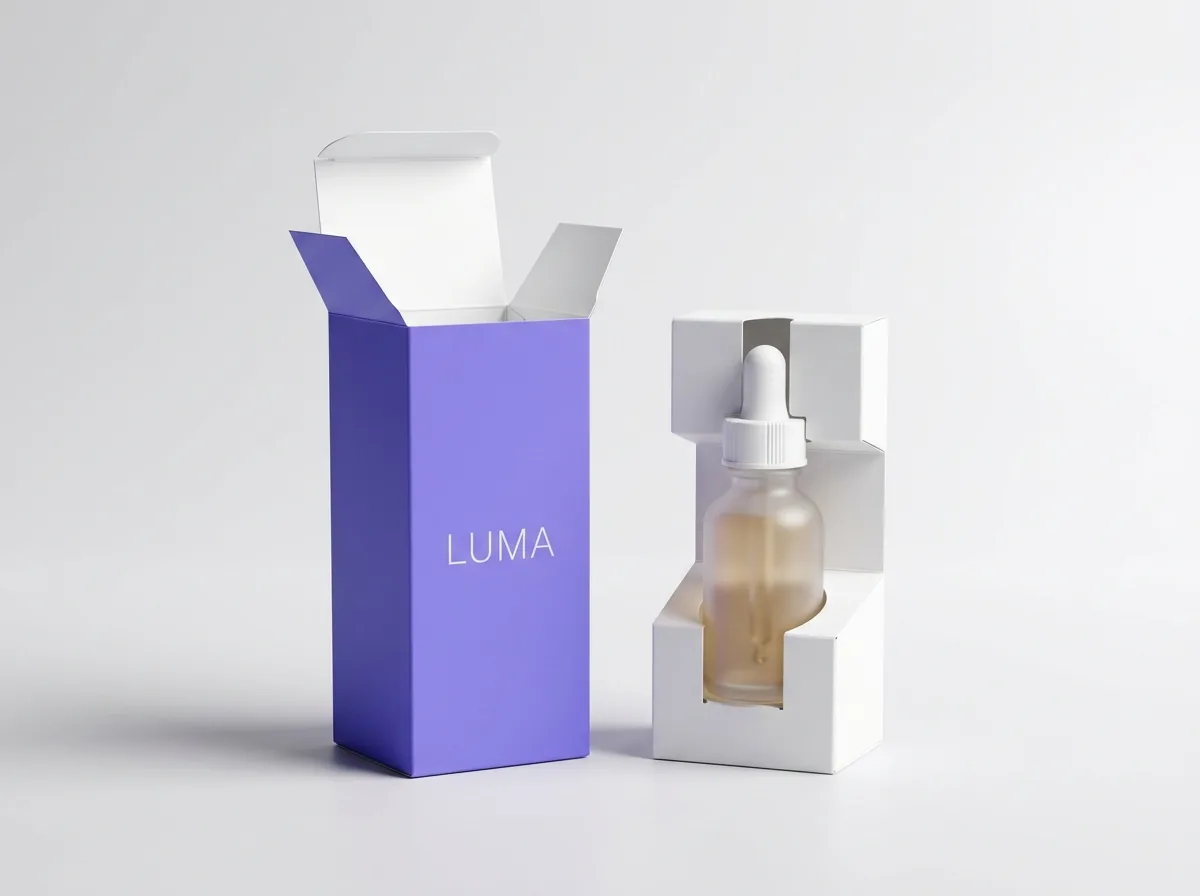
When a fragile glass dropper bottle or narrow cosmetic vial needs extra drop protection or a wider shelf presence, a folded paperboard insert cradles the product in the center of the carton. Because the insert walls fold around the item, the outer carton must be sized to the insert rather than the bare bottle. For example, a 1.3-inch diameter serum bottle that fits a 1.5 × 1.5 inch bare carton typically steps up to a 2.25 × 1.75 inch carton when held by a die-cut neck-lock insert. Similarly, if you add a front film window patch like on our custom window boxes, leave at least 3/8 inch of solid paperboard border between the window cutout and every score line so the front wall stays rigid.
Why are folding cartons quoted by inside dimensions instead of outside?
Inside dimensions govern whether your product fits; outside dimensions govern how many finished cartons fit inside a master shipping case or retail counter display tray. Paperboard thickness (caliper) and the double-layered dust flaps add roughly 1/16 to 1/8 inch to the outside footprint of a finished carton. When you order both unit cartons and a matching custom counter display box or master shipper in the same run, tell your account manager how many units sit in each row and we calculate the exact outside stack allowance automatically. Because paperboard creases fold along the center of the score rules, a structural designer offsets the outer panel widths by the board thickness so the inside cavity stays true to your requested Length, Width, and Height.
- Inside size (L × W × H): The usable interior space where your bottle, jar, soap bar, or insert sits.
- Outside size: Approximately 1/16 to 1/8 inch larger than the inside dimensions, depending on paperboard caliper.
- Flat blank size: The open unfolded press-sheet footprint before the side glue seam is folded and bonded.
How do I verify my tuck end box size before production starts?
Even careful caliper measurements benefit from a pre-production check before 1,000 or 5,000 cartons go to press. At CubitPack, every order includes a free custom structural dieline and a 3D digital mockup built to your exact inside dimensions before you make payment. You can inspect where the front, side, and back panels wrap around your product, verify that the top and bottom closures fold front-to-back, and check that text and barcodes sit safely inside the crease lines. If you are launching a new bottle shape or pairing a glass jar with a custom folded insert, you can also order a physical prototype or a printed sample (priced per product and credited toward your order) to test the hand-packing fit in person, or start with our $50 sample kit (credited to your first order) to compare white card, kraft, and finishes.
What are the most common mistakes when measuring for a tuck end box?
Five measurement errors account for almost every poorly fitting sample or bowed carton lid
- Zero height clearance for dust flaps. Forgetting to add 1/8 inch to the vertical Height forces the top closure panel to bend over the side dust flaps, making the tuck flap pop open.
- Swapping Length and Width. Writing the narrow side panel first puts the main closure hinge on the narrow edge instead of the wide front display face.
- Measuring the bottle shoulder instead of the cap. Dropper bulbs, spray nozzles, and pump locks often stand 1 to 1.5 inches above the glass shoulder.
- Measuring a flattened sample carton with a tape measure. Flat panel widths include manufacturing score allowances that overstate the true inside space.
- Sizing the box before the insert. Always let the structural designer build the insert around your item first, then size the outer carton to fit the insert.
Get a straight tuck end dieline at your size
A simplified drawing for planning your design. Your free production dieline comes with your proof, made for your exact size and board.
Packaging for this
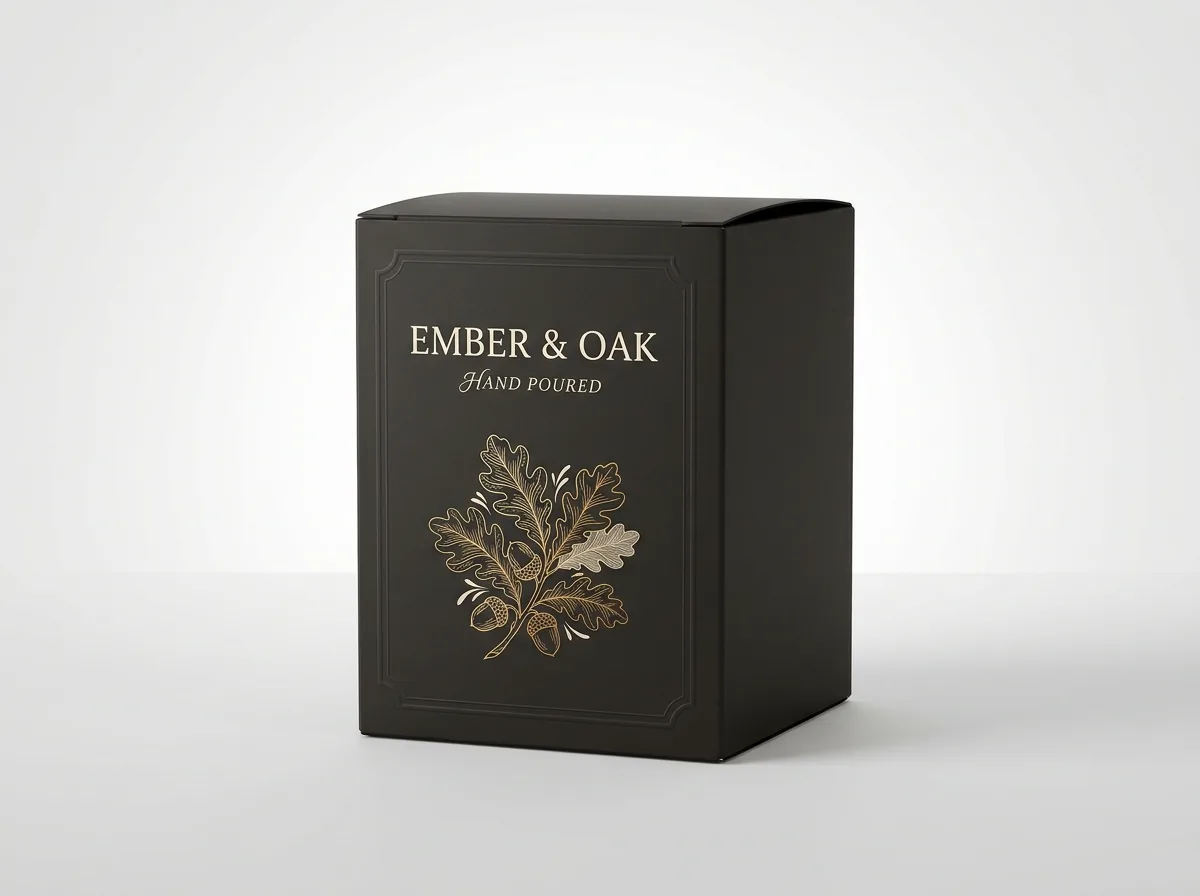

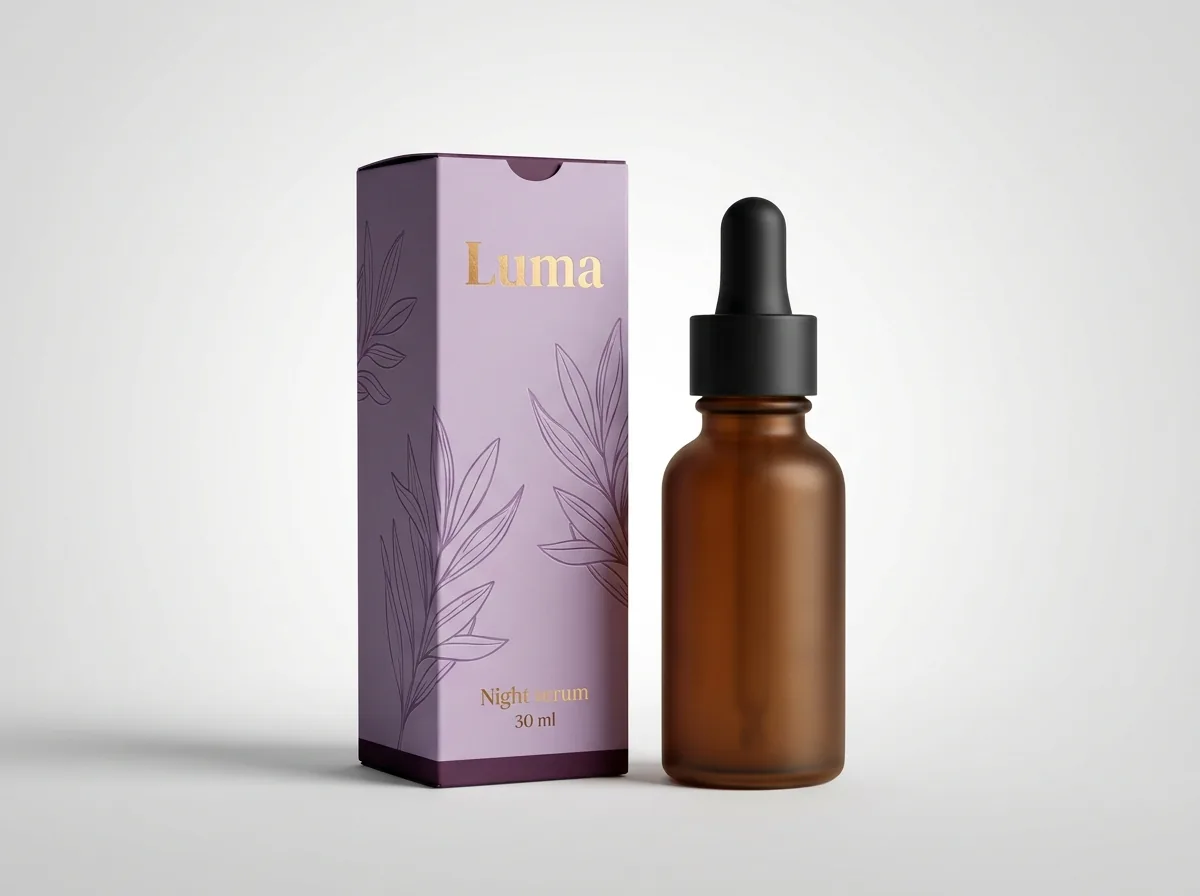
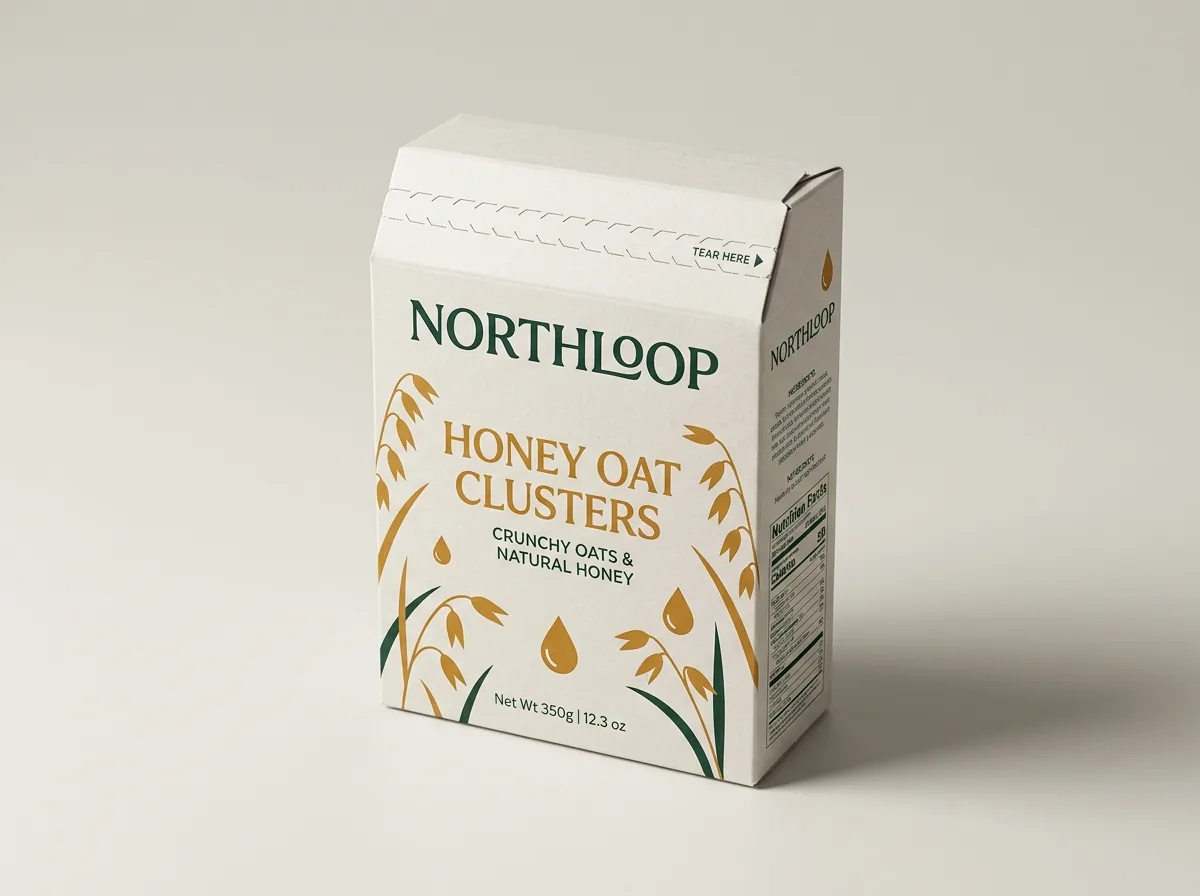
Ready to order straight tuck end boxes? Compare up to 3 quantities with a free 3D mockup.
Request a Quote →Questions about straight tuck end boxes
In what order do I write tuck end box dimensions?
Always write dimensions as Length × Width × Height (L × W × H) in inches. Looking down at the open top of the box, Length is the left-to-right width of the front panel, Width is the front-to-back depth of the side panel, and Height is the vertical distance from top to bottom.
How much bigger should a tuck end box be than my product?
Add 1/16 inch (about 1.5 mm) to Length and Width so rigid bottles, jars, or tubes slide in without catching, and add 1/8 inch (3 mm) to Height to leave room for the folded top and bottom dust flaps inside the carton.
Are custom tuck end box sizes inside or outside measurements?
Custom folding cartons are always specified and quoted using inside dimensions (L × W × H), because inside space determines how your product fits. If your boxes must also fit inside a counter display or master shipping carton, share that outer limit with your account manager.
What is the best tool to measure a bottle or jar for packaging?
A digital caliper gives the most accurate reading across curved glass shoulders, tapered bottoms, and pump caps. If you only have a standard ruler, stand the item between two flat blocks or books and measure the gap between the blocks to the nearest 1/16 inch.
Can I order multiple tuck end box sizes in one production run?
Yes. Our minimum order for custom straight tuck end boxes is 1,000 units, and you can list multiple sizes or artwork versions in the quote notes. Your dedicated account manager will quote all sizes together and provide a digital proof and 3D mockup for each.
When is a product too heavy for a standard tuck end bottom?
Standard friction or slit-lock tuck bottoms work well for light to medium retail items such as serums, soaps, tea, and small candles. For heavier glass jars or bottles that could push a bottom tuck flap open when lifted, we recommend an auto lock bottom box.
Still have a question? Ask a packaging specialist.
Request a Quote →Request your straight tuck end boxes quote
Tell us your size and quantities, and one dedicated account manager prepares pricing for each tier.
- Free design & AI-to-print studio + 3D mockup
- No die or plate charges · 4–5 day rush available
- Free shipping to all 50 states
- 10% off your first order
We checked the Length × Width × Height panel convention, dust-flap clearance allowances, and retail bottle dimensions against ECMA folding carton standards and Paperboard Packaging Council guidelines. A packaging specialist verified every measurement rule. Spot something wrong? Tell us and we fix it.
Sources
What changed
- October 23, 2026: First published.
More guides
New packaging guides by email
Sizes, materials and design tips. Unsubscribe anytime.