
How do I measure my product for a tray and sleeve box?
Short answer: Always measure a tray and sleeve box by the usable inside cavity of the sliding inner tray in Length × Width × Height order: Length along the slide direction, Width across the open sleeve entrance, and Height from the tray floor to the underside of the sleeve top on custom tray and sleeve boxes.

On this page
- What do Length, Width, and Height mean on a tray and sleeve box
- How do double-wall tray thickness and sleeve glide clearance work
- What are standard tray and sleeve box sizes by product type
- How do cavity dividers and top sleeve windows affect tray sizing
- How do I test my tray and sleeve size before full production
- Common mistakes
- FAQs
Request a custom quoteFree dieline & 3D mockup
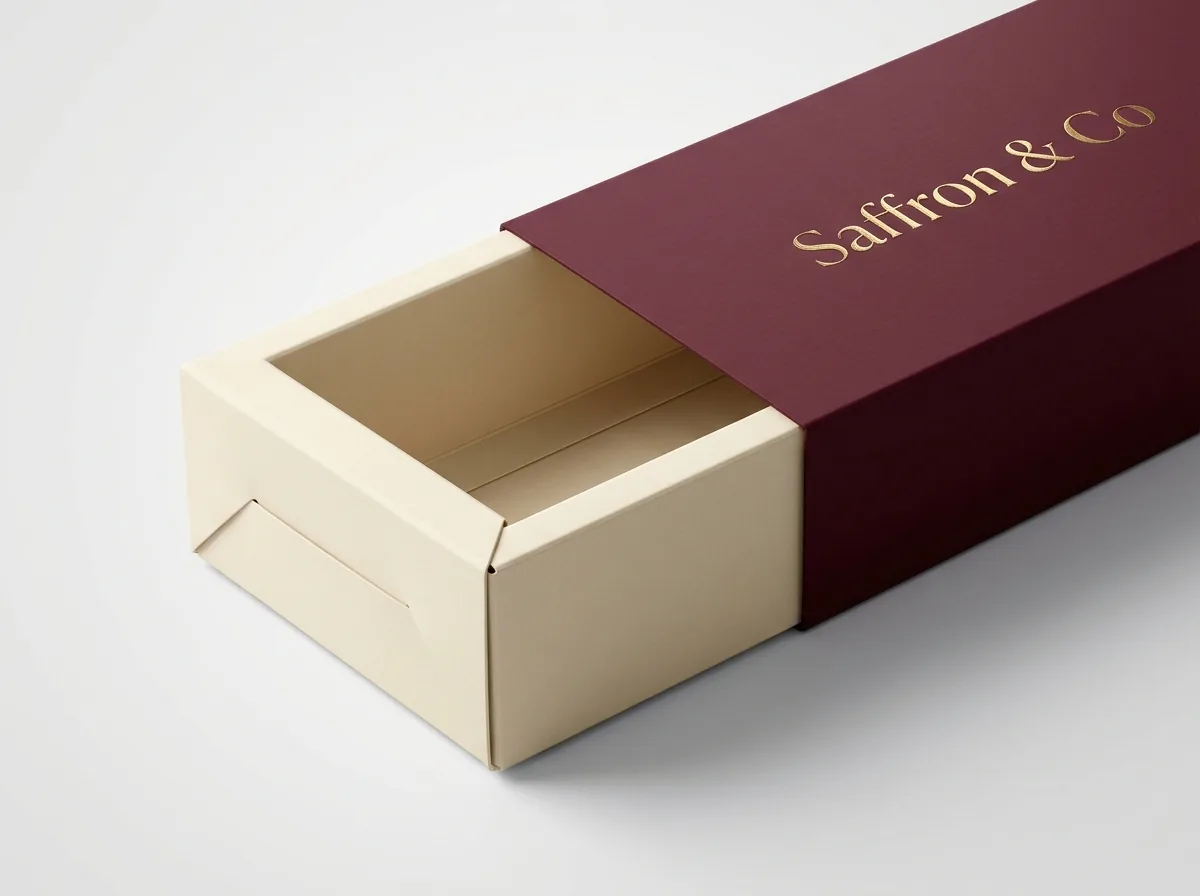
Because a tray and sleeve box (also called a sleeve and tray or matchbox-style slide carton) is built from two separate paperboard pieces that must glide smoothly against each other, two hidden structural offsets sit between your product and the outside of the closed package. First, the inner tray uses rolled double-layer perimeter walls that fold 180 degrees over corner locking flaps to create a sturdy frame without glue, which makes the outside of the tray 0.20 to 0.35 inches (5 to 9 mm) wider and longer than its usable inside cavity. Second, the four-panel outer sleeve is engineered with a 1.5 to 2.5 mm (0.06 to 0.10 inch) total friction clearance around the outside of that double-wall tray so the drawer slides by hand without binding or falling out. When you quote your box on CubitPack, simply give the usable inside tray Length × Width × Height; our dieline generator and prepress specialists calculate the double-wall tray buildup and sleeve glide tolerance automatically.
What do Length, Width, and Height mean on a tray and sleeve box?
Following European Carton Makers Association (ECMA) and FEFCO 0500 slide-box conventions, every dimension you enter on our tray and sleeve boxes page refers to the usable inside cavity of the inner sliding tray
- Length (L, left to right along the slide axis): The long horizontal dimension of the inner tray cavity parallel to the direction the tray slides in and out of the sleeve.
- Width (W, front to back across the sleeve opening): The horizontal width of the inner tray cavity measured across the open end of the sleeve.
- Height (H, bottom to top): The vertical depth from the inside floor of the tray up to the top rim of the rolled tray walls (just below the top panel of the outer sleeve).
How do double-wall tray thickness and sleeve glide clearance work?
The secret to a satisfying matchbox unboxing is getting the friction balance between the rolled double-wall tray and the tubular outer sleeve just right. If the sleeve is even 1.5 mm too tight, the folded tray corners will catch and bow the top of the sleeve; if the sleeve is 4 mm too loose, the tray will slide out on its own when a shopper picks up the box.
- Product to inside tray wall (add 1/16 to 1/8 in / 1.5 to 3 mm): Give a single soap bar, gift card stack, or inner blister tray 1/16 to 1/8 inch of breathing room inside the tray cavity so packers can drop the item in without scraping the rolled walls.
- Vertical head clearance (add 1/16 to 1/8 in / 1.5 to 3 mm): Make your inside tray Height at least 1/16 to 1/8 inch taller than your tallest macaron, truffle, or bottle cap so the top of your product never rubs against the underside of the sleeve as the drawer slides.
- Rolled double-wall tray buildup (handled automatically on your dieline): Each rolled tray wall consists of two layers of paperboard plus the corner locking flap tucked between them, adding roughly 0.10 to 0.15 inches (2.5 to 3.8 mm) per wall on standard 16–24 pt paperboard, or 0.18 to 0.25 inches per wall on E-flute corrugated board.
- Sleeve-to-tray glide tolerance (1.5 to 2.5 mm total clearance): Our structural template sets the inside width and height of the four-panel outer sleeve 1.5 mm larger than a small paperboard tray (or 2.0 to 2.5 mm larger on wide boxes and E-flute corrugated trays) for an air-cushioned glide.
What are standard tray and sleeve box sizes by product type?
Every order at CubitPack is die-cut to your exact custom inside tray dimensions starting from 1,000 boxes, with zero die or plate charges. Use the size chart below as a starting point for confectionery, bakery, beauty, and gifting products
| Product category | Typical tray arrangement | Recommended inside tray L × W × H (in) | Recommended board & add-ons |
|---|---|---|---|
| Gift card or voucher slide box | Standard 3.375 × 2.125 in card in a die-cut card well | 4.5 × 3.25 × 0.65 in | 18 pt white card + thumb notch |
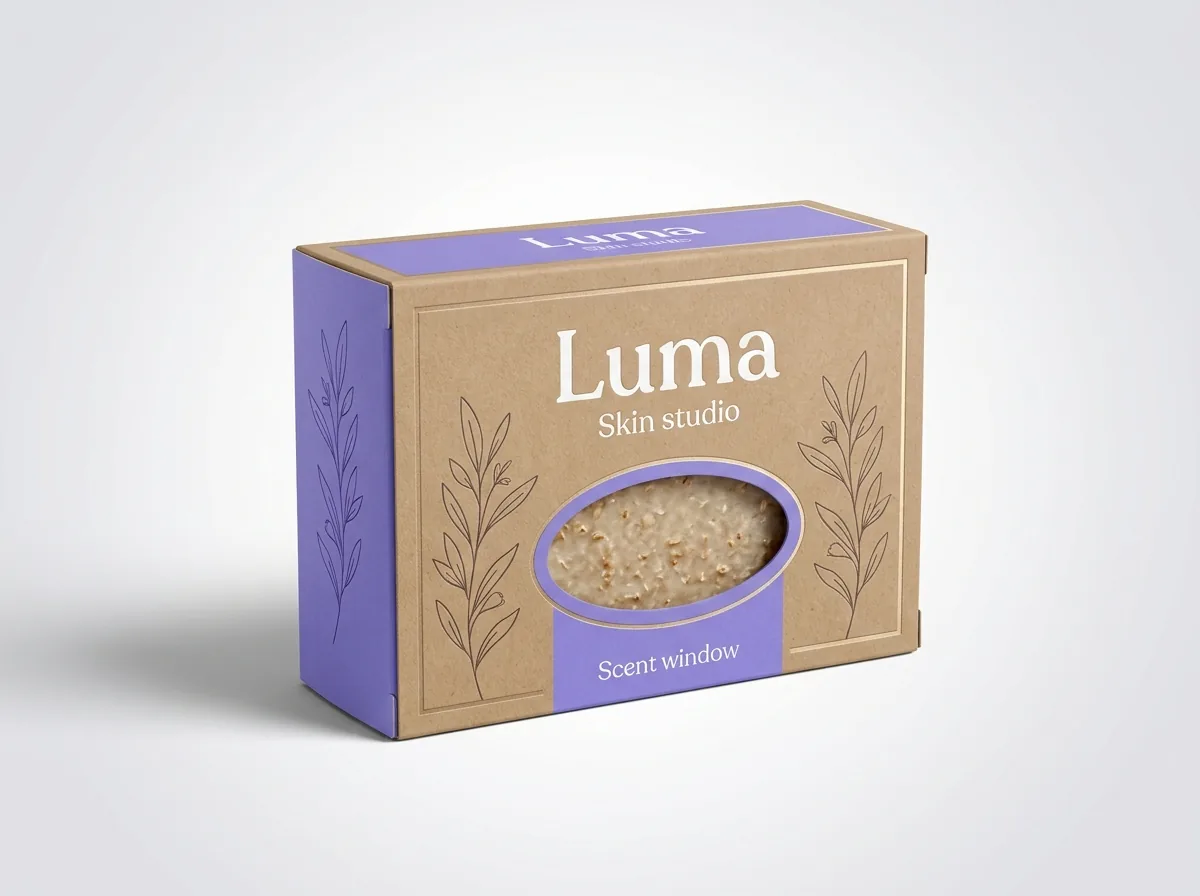
| Artisan bar soap box | Single 4 to 5 oz cold-process soap bar | 3.75 × 2.75 × 1.35 in | 18–20 pt kraft board + top cutout window |
| 6-piece French macaron box | Single row of 6 macarons Standing on edge | 7.25 × 2.25 × 2.0 in | 18 pt white card + clear PET sleeve window |
| 12-piece macaron box (2 rows) | Two rows of 6 macarons with center card divider | 7.25 × 4.25 × 2.0 in | 20 pt white card + clear PET sleeve window |
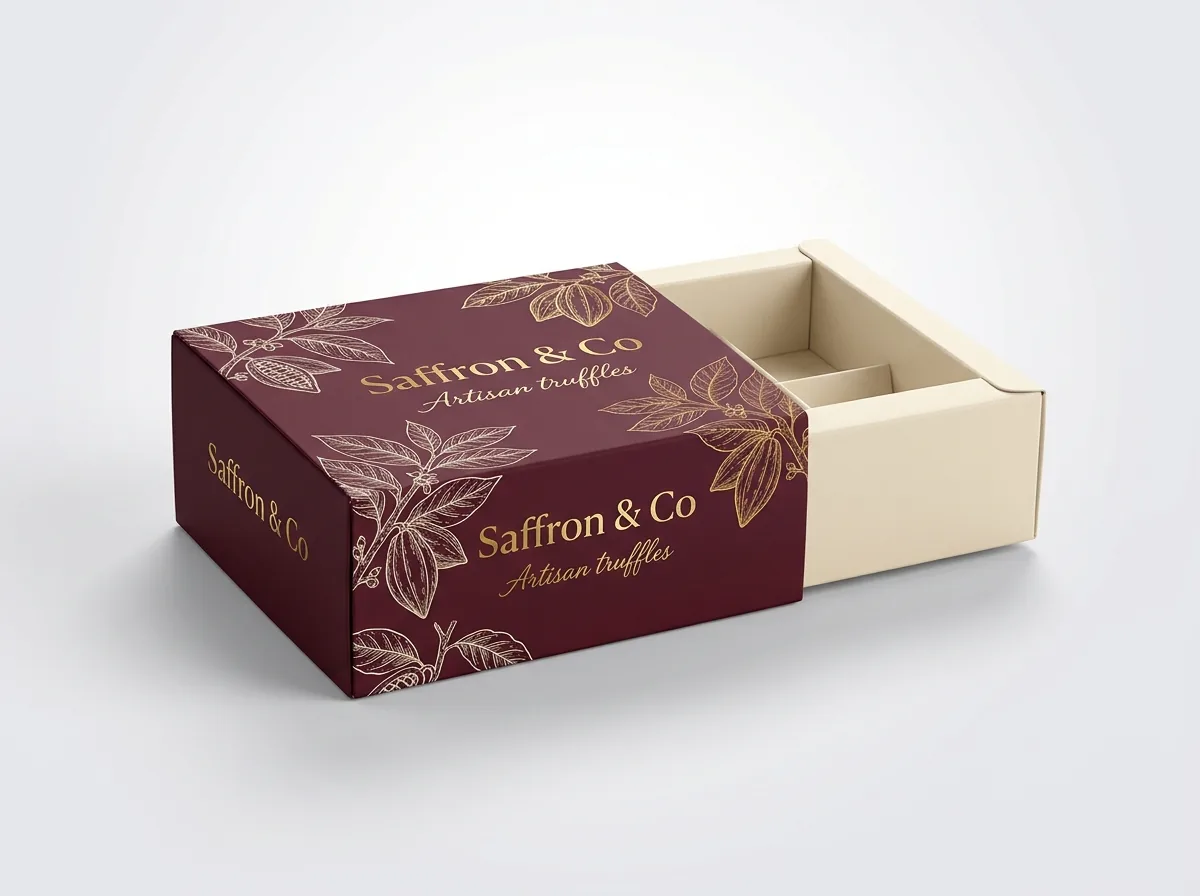
| 6-piece chocolate truffle box | 2 × 3 grid of 1.25 in truffles in a 6-cavity divider | 5.25 × 3.65 × 1.5 in | 18–20 pt card + gold foil + glassine pad |
| Cosmetic vial / rollerball trio | Three 10 ml glass rollerballs in a fluted card cradle | 6.0 × 3.5 × 1.5 in | 20 pt white card + soft-touch lamination |
| Herbal tea sachet chest | 3 compartments of 8 wrapped pyramid tea bags (24 ct) | 8.5 × 3.75 × 3.0 in | 20–24 pt card + 2-slot divider insert |
| 3-jar mini candle flight | Three 2 oz votive glass jars side by side in insert | 8.25 × 3.0 × 2.75 in | E-flute corrugated tray + 20 pt card sleeve |
Know your size? Compare pricing across up to 3 quantities.
Request a Quote →How do cavity dividers and top sleeve windows affect tray sizing?
When packing delicate items like macarons in custom macaron boxes, pralines in custom chocolate boxes, or glass vials in custom cosmetic boxes, your inner tray often holds a slotted card divider or a folded platform insert
- Account for divider wall thickness: Each paperboard partition strip inside a chocolate or tea tray adds roughly 0.03 to 0.06 inches (0.8 to 1.5 mm). For a 6-cavity (2 × 3) truffle grid where each cell is 1.5 × 1.5 inches, add 0.25 inches to Length and 0.15 inches to Width so the divider grid drops cleanly into the tray.
- Align top sleeve windows with the inner tray rim: Because the rolled double walls of the inner tray frame all four sides of the cavity, we size any top sleeve window at least 3/8 inch (9.5 mm) narrower than the outside of the sleeve so the window opening frames your product rather than exposing the top edges of the tray walls.
- Compare sibling slide formats: If you only need an outer band for an existing container, or if you want a thick 2 mm rigid box for fine jewelry, see our comparison of tray and sleeve vs packaging sleeves and rigid drawer boxes.

How do I test my tray and sleeve size before full production?
You can test your inside tray Length, Width, and Height right on the style page using our interactive dieline tool and read our companion walkthrough, tray and sleeve box dieline explained. When you request a quote on CubitPack (from 1,000 boxes, with 10–14 business day standard turnaround or 4–5 business day rush), our packaging specialists build your exact two-piece vector dieline with calibrated double-wall and sleeve tolerances at no charge. Every order includes free design help, a free digital proof, and a free 3D mockup before payment, with zero die or plate charges and free shipping to all 50 US states. You can also order a single custom prototype or our $50 pre-made sample kit to test the drawer glide in hand.
- Step 1: Measure your product or cavity grid: Record the longest horizontal slide length (L), the front-to-back width (W), and the standing depth (H) of your macarons, truffles, soap bar, or cosmetic vials, then add 1/16 to 1/8 inch of breathing room on all three axes.
- Step 2: Check your board weight and finish: Let your packaging specialist know whether you want 18 pt or 20 pt paperboard, an E-flute corrugated tray, or a soft-touch laminated outer sleeve so we can set your sleeve-to-tray friction clearance between 1.5 mm and 2.5 mm.
- Step 3: Approve your 2D dieline and 3D mockup: Review the exact outer sleeve dimensions, window cutout margins, and thumb-notch placement on your digital proof before production begins.
What are the most common measurement mistakes on tray and sleeve boxes?
Avoid these five sizing pitfalls before locking in your tray and sleeve dimensions
- Measuring the outside of the outer sleeve instead of the usable inside cavity of the inner tray. Rolled double tray walls reduce the usable interior by 0.20 to 0.35 inches.
- Making the tray Height identical to the product height. If macarons, truffles, or bottle caps sit proud of the tray rim, they will scrape the underside of the sleeve as the drawer slides.
- Designing a manual dieline with zero glide clearance between the outside of the tray and the inside of the sleeve.
- Forgetting to add partition thickness when laying out a 6-cavity or 12-cavity chocolate or tea divider grid.
- Drawing a top sleeve window so wide that it reveals the folded double-wall rims of the inner tray instead of framing the interior cavity.
Get a tray and sleeve dieline at your size
A simplified drawing for planning your design. Your free production dieline comes with your proof, made for your exact size and board.
Packaging for this




Ready to order tray and sleeve boxes? Compare up to 3 quantities with a free 3D mockup.
Request a Quote →Questions about tray and sleeve boxes
Should I enter the inner tray dimensions or the outer sleeve dimensions in the quote form?
Always enter the usable inside dimensions (Length × Width × Height) of the inner sliding tray. Our structural dieline automatically adds the rolled double-wall tray thickness and the 1.5–2.5 mm sleeve glide clearance.
How much clearance do you leave between the inner tray and the outer sleeve?
We build a 1.5 mm to 2.5 mm (0.06 to 0.10 inch) total friction clearance between the outside of the assembled double-wall tray and the inside of the four-panel sleeve so the tray glides smoothly without jamming or sliding out on its own.
How much wider is the outside of a tray and sleeve box than the inside tray cavity?
On standard 18–20 pt paperboard, the rolled double-layer tray walls plus the outer sleeve add approximately 0.25 to 0.30 inches (6 to 7.5 mm) to the total outside Length and Width, and about 0.12 inches (3 mm) to the outside Height.
How much top clearance should I leave above macarons or chocolates?
Leave at least 1/8 inch (3 mm) of vertical clearance between the top of your macarons, truffles, or cushioning pad and the top rim of the inner tray so nothing catches on the sleeve opening.
Can you size a custom cavity divider insert to fit inside my sliding tray?
Yes. Select Card insert in Step 2 of the quote form and tell us how many compartments you need (such as 6 truffles, 12 macarons, or 3 glass vials). We engineer the divider slots alongside your tray dieline at no extra die cost.
What is the minimum order quantity for custom tray and sleeve boxes?
Custom paperboard tray and sleeve boxes start at 1,000 units, with 10–14 business days standard turnaround, 4–5 day rush, and free US shipping. If you need 50 to 500 slide-drawer boxes, check our custom rigid drawer boxes.
Still have a question? Ask a packaging specialist.
Request a Quote →Request your tray and sleeve boxes quote
Tell us your size and quantities, and one dedicated account manager prepares pricing for each tier.
- Free design & AI-to-print studio + 3D mockup
- No die or plate charges · 4–5 day rush available
- Free shipping to all 50 states
- 10% off your first order
We verified interior Length × Width × Height conventions, rolled double-wall tray caliper buildup, and 1.5–2.5 mm sleeve-to-tray glide clearances against European Carton Makers Association (ECMA) standards, FEFCO 0500 slide-box rules, and Paperboard Packaging Council guidelines. A packaging specialist checked every dimension rule. Spot something wrong? Tell us and we fix it.
Sources
What changed
- October 24, 2026: First published with inside tray L × W × H rules, double-wall buildup offsets, 1.5–2.5 mm sleeve glide clearances, and product size chart.
More guides
New packaging guides by email
Sizes, materials and design tips. Unsubscribe anytime.