
How do I measure my food or multipack product and choose board for a seal end box?
Short answer: To size a seal end box, measure your filled pouch or multipack grid in a vertical jig to capture Length (L), settled belly depth (Width, W), and Height (H), then add +0.25 inches for bag-in-box pouches or +0.1875 inches for wrapped bar arrays. Choose 18–20 pt board under 20 oz and 24 pt or E-flute up to 5 lb.
On this page
- What is the 3-step formula for measuring usable inside L × W × H on a seal end box
- How much clearance do cereal bags, granola pouches, protein bars, and cookie trays require
- Should I choose 18 pt, 20 pt, 24 pt paperboard, or E-flute corrugated board for a seal end box
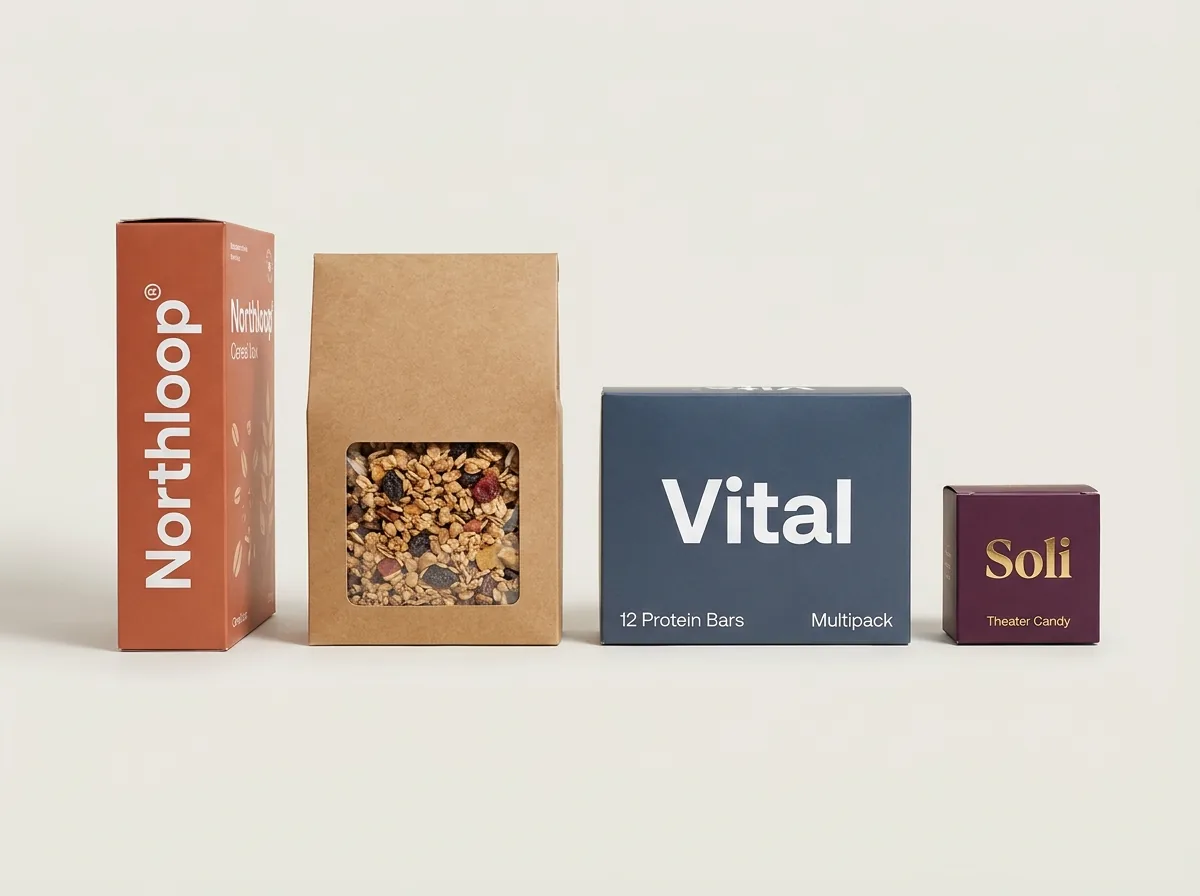
- What are standard seal end box sizes across cereal, snacks, bars, and candy
- How do I verify my seal end box size before full production
- Common mistakes
- FAQs
Request a custom quoteFree dieline & 3D mockup
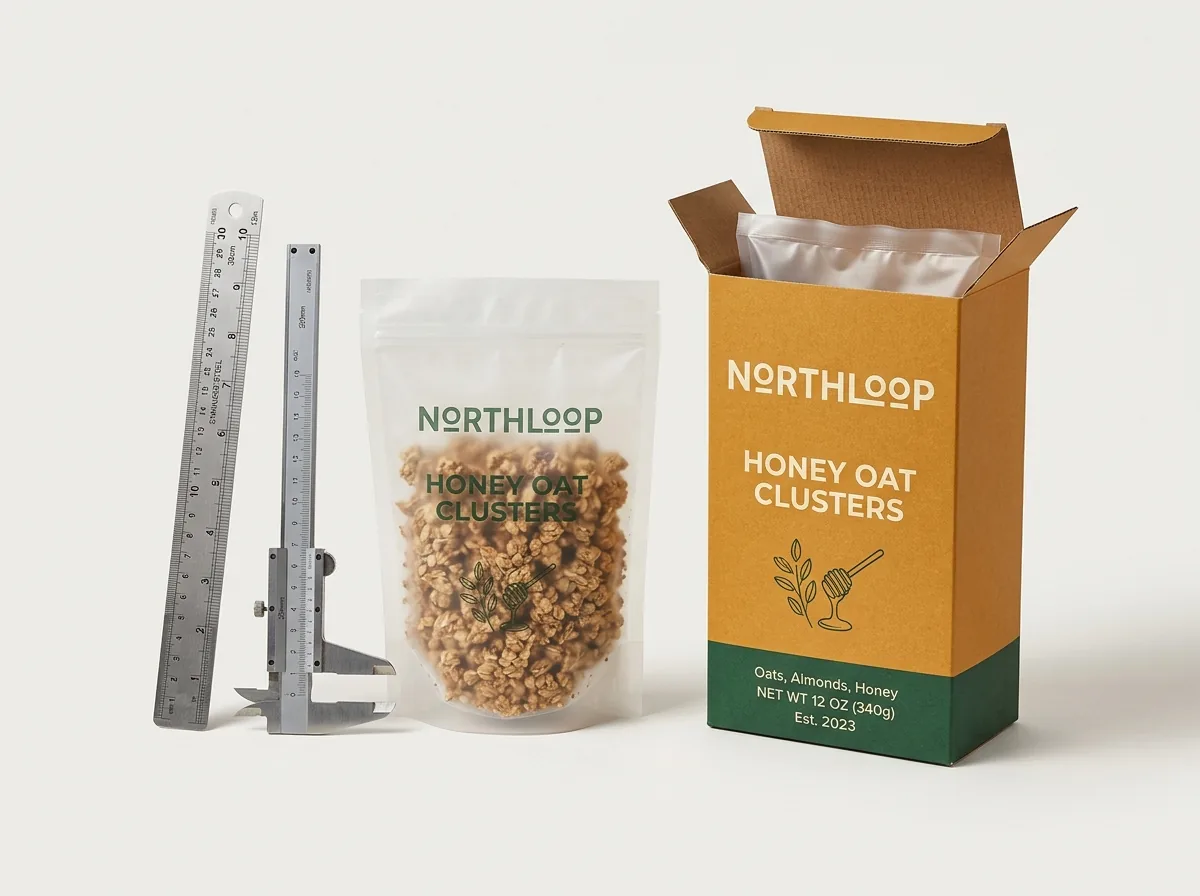
When ordering custom seal end boxes (ECMA A10.10.01.01, Full-Overlap Seal End), always specify Inside Dimensions in the sequence Length (L) × Width (W) × Height (H). Length (L) runs left-to-right across the front display panel, Width (W) runs front-to-back along the narrower side panels, and Height (H) runs vertically between the top and bottom glue scores. Unlike rigid bottles, dry foods packed in flexible inner pillow bags (such as cereal, granola, crackers, and cookies) settle downward and bulge outward at the lower belly when standing upright. If you measure a flat bag lying on a table, the filled pouch will bow the front panel of your carton and prevent the four end flaps from folding square. Stand your filled pouch between two vertical bookends, measure its constrained L × W × H, and add +0.25 inches to L and W (+0.375 inches to H for the top fin seal). Pair 18–20 pt board up to 20 oz and 24 pt or E-flute up to 5 lb.
What is the 3-step formula for measuring usable inside L × W × H on a seal end box?
Whether you are packaging bagged breakfast cereal, 12-count protein bar caddies, bakery cookie trays, or theater candy, folding carton manufacturers quote and die-cut seal end boxes by their interior score-to-score dimensions. Because all four top flaps and all four bottom flaps fold inward at 90 degrees and bond flat with hot-melt or cold PVA glue, your inside dimensions must give the inner pouch or multipack array room to slide in without catching on the minor dust flaps
- Step 1: Constrain your filled pouch or stack your multipack array in its exact retail orientation. For a Bag-in-Box product (cereal, granola, crackers, pasta), stand a filled, heat-sealed inner pillow bag upright between two vertical plates or bookends spaced so the bag reaches your target fill height without pinching. For flow-wrapped multipacks (6 or 12 protein bars, snack bags, or microwave popcorn pouches), stack the bars in their 2 × 3 or 2 × 6 grid including the flexible crimps at both ends of each wrapper.
- Step 2: Record Inside Length (L), Inside Width (W), and Inside Height (H). Length (L) is the horizontal width across the main front display face (where the outer major glue flaps hinge); Width (W) is the front-to-back side depth (where the minor dust flaps hinge); and Height (H) is the vertical distance from the bottom score line to the top score line.
- Step 3: Add format-specific clearance to L, W, and H. Add +0.25 in (6 mm) to L and W and +0.375 to +0.50 in (10–13 mm) to H for flexible inner pillow bags so the top heat-seal fin folds down below the glue flaps; add +0.125 to +0.1875 in (3–5 mm) to L, W, and H for flow-wrapped bar grids or thermoformed cookie trays.
How much clearance do cereal bags, granola pouches, protein bars, and cookie trays require?
On a high-speed horizontal or vertical cartoning line (or during rapid hand loading at a co-packer), tight cartons cause line jams and bowed sidewalls. Because dry flakes, clusters, and extruded puffs settle during vibration on delivery trucks, the lower half of an inner pillow pouch expands outward while the upper heat-sealed fin needs vertical folding room beneath the top minor dust flaps. For multipack nutrition bars or microwave popcorn pouches, each individual flow-wrapper has crimped end fins and longitudinal back seams that add cumulative thickness across a 6-count or 12-count stack. Use this engineering clearance table to set your inside dimensions before requesting your 2D dieline
| Product & inner pack format | Inside L & W clearance | Inside Height (H) clearance | Recommended closure & board spec |
|---|---|---|---|
| Bag-in-Box pillow pouch (cereal, oats, crackers) | +0.25 in (6.0 mm) over constrained bag | +0.375 to +0.50 in (10–13 mm) for top fin | 18–22 pt SBS/Kraft · Zipper strip + pantry tab |
| Flow-wrapped bar grid (6, 8, or 12 protein bars) | +0.125 to +0.1875 in (3.0–4.8 mm) | +0.1875 in (4.8 mm) above top layer | 18–20 pt SBS · Perforated top or display caddy lid |
| Thermoformed plastic cookie or cracker tray | +0.125 in (3.0 mm) over rigid tray lip | +0.125 in (3.0 mm) over tray height | 20–24 pt SBS/Kraft · Horizontal or vertical load |
| Microwave popcorn / snack pouch multipack | +0.1875 to +0.25 in (4.8–6.0 mm) | +0.25 in (6.0 mm) for folded pouch stack | 20–24 pt SBS · Full-overlap hot-melt glued ends |
| Direct-fill dry pasta, rice, or theater candy | Calculated by bulk density (g/cm³) + 12% headspace | +0.50 to +0.75 in (13–19 mm) shake headspace | 20–24 pt food-safe board · Sift-proof + pour spout |
Should I choose 18 pt, 20 pt, 24 pt paperboard, or E-flute corrugated board for a seal end box?
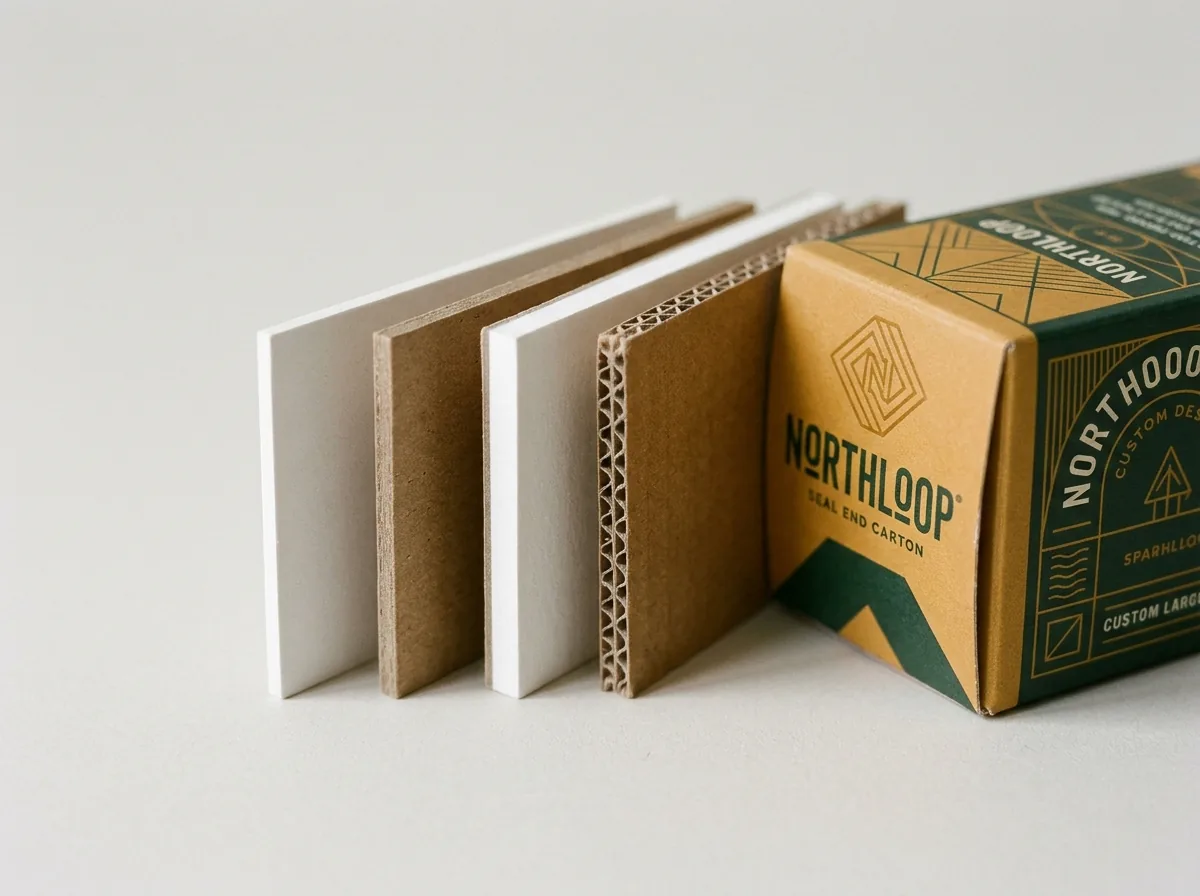
Because grocery pallets and club-store displays stack cartons several layers high, a seal end box must resist both vertical top-to-bottom compression and outward sidewall belly bulge from settled food contents. In addition to selecting the right caliper, always specify horizontal paperboard grain (running around the box perpendicular to the vertical scores) when you want maximum front-panel flatness against a bulging inner bag
| Board caliper & stock | Thickness & GSM equivalent | Safe payload weight | Best seal end box applications | Top opening style |
|---|---|---|---|---|
| 18 pt SBS / Kraft | 0.45 mm · ~350 gsm | Up to 10 oz (280 g) | Theater candy boxes, 4–5 count granola bar cartons, tea/cocoa boxes | Zipper tear strip or side pour spout |
| 20 pt SBS / Kraft | 0.50 mm · ~375–400 gsm | 10 oz to 20 oz (280–565 g) | Standard 10–16 oz cereal boxes, 12 oz granola cartons, pasta boxes | Zipper tear strip + tab-in-slot pantry lid |
| 24 pt SBS / Kraft | 0.60 mm · ~450 gsm | 20 oz to 40 oz (1.25–2.5 lb) | 12-count heavy protein bar boxes, family-size cereal, 6-bag popcorn | Heavy-duty zipper strip + rotary glue teeth |
| E-Flute Corrugated | 1.60 mm (1/16 in) micro-flute | 2.5 lb to 5.0 lb (1.1–2.3 kg) | Club-store 24–36 count snack multipacks, bulk grain or pet treat boxes | Full-overlap hot-melt seal + tear-open hood |
Know your size? Compare pricing across up to 3 quantities.
Request a Quote →What are standard seal end box sizes across cereal, snacks, bars, and candy?
Every CubitPack order includes free custom die-making with zero die or plate fees, so we build your carton to your exact pouch or multipack dimensions. Use these eight industry-standard sizes from our custom cereal boxes, custom snack boxes, custom granola boxes, custom protein bar boxes, and custom candy boxes catalogs as reference benchmarks
| Grocery & retail category | Inside L × W × H (inches) | Inside L × W × H (mm) | Typical board & closure spec |
|---|---|---|---|
| Standard retail cereal box (10–12 oz) | 7.50 × 2.25 × 10.50 in | 191 × 57 × 267 mm | 20 pt SBS · Zipper tear strip + tab-in-slot lid |
| Family-size cereal carton (18 oz) | 8.25 × 2.75 × 11.75 in | 210 × 70 × 298 mm | 22–24 pt SBS · Full-overlap glued ends + pantry tab |
| Artisan granola / muesli box (11–12 oz) | 6.00 × 2.25 × 8.50 in | 152 × 57 × 216 mm | 20 pt Kraft or SBS · Front PET window + tear strip |
| Protein or nutrition bar box (12 bars) | 6.25 × 5.50 × 2.50 in | 159 × 140 × 64 mm | 20–24 pt SBS · Perforated top/front retail caddy |
| Snack pouch multipack (6 × 1 oz bags) | 7.75 × 3.25 × 8.25 in | 197 × 83 × 210 mm | 20 pt SBS · Top zipper tear strip |
| Bakery cookie carton (7–8 oz tray) | 5.50 × 2.25 × 7.50 in | 140 × 57 × 191 mm | 20 pt SBS/Kraft · Foil logo + tear strip |
| Microwave popcorn box (6 bags) | 6.00 × 3.50 × 6.25 in | 152 × 89 × 159 mm | 20–22 pt SBS · Hot-melt glued top and bottom |
| Concession / theater candy box (3.5–5 oz) | 6.00 × 1.125 × 3.25 in | 152 × 29 × 83 mm | 18 pt SBS · Glued ends + side press-in pour spout |
How do I verify my seal end box size before full production?
Once you have measured your filled pouch or multipack grid, review our companion guides on seal end boxes vs tuck end and auto lock bottom boxes and seal end box dieline, tear strips, and glue flaps explained. When you order printed seal end cartons from CubitPack starting at 1,000 units, our packaging specialists verify your inside dimensions, major and minor flap overlaps, and glue-assist knockouts before you pay. Testing a physical white or printed sample with your actual filled inner pouch or flow-wrapped bar array is the surest way to confirm that the top fin seal clears the minor dust flaps, the front display wall stays flat without bowing, and the outer major glue flap meets the inner glue-assist strips squarely. Whether you fill cartons by hand at a commercial kitchen or run a high-speed horizontal cartoner, follow this 5-step verification checklist
- Step 1: Enter your target Inside L × W × H, quantity (from 1,000 boxes), and paperboard stock in our quote form to receive a custom price in 5-7 minutes.
- Step 2: Tell your specialist whether your product is a flexible pillow bag, a flow-wrapped bar array, a plastic cookie tray, or a direct-fill dry food so we can set the right flap overlap and clearance.
- Step 3: Choose your consumer opening hardware (perforated zipper tear strip, re-closable tab-in-slot cereal top, or side pour spout) and let us add unvarnished glue-assist masks to the inner major flaps.
- Step 4: Approve your free 2D vector dieline proof and interactive 3D mockup before payment, or order a physical sample to test with your filled pouches or multipacks on your packing line.
- Step 5: Load a filled sample box at target net weight, seal the top and bottom major flaps with hot-melt adhesive or transfer tape, and stand the carton upright for 24 hours to verify zero sidewall bulge and crisp 100% fiber-tear opening along the zipper tear strip.
What are the most common sizing and board mistakes on seal end boxes?
Avoid these five dimensional errors before approving your seal end carton dieline
- Measuring an empty flat pillow bag instead of constraining a filled bag upright, resulting in an Inside Width (W) that is too narrow for the settled belly of the pouch.
- Forgetting to include the flexible end crimps (fin seals) of flow-wrapped protein or granola bars when calculating the stacked multipack footprint.
- Making Inside Width (W) narrower than 1.0 inch on a tall cereal-style carton, which leaves the box unstable on flat grocery shelves.
- Choosing thin 16 pt board for a 24 oz multipack or family-size cereal carton that requires 20 pt to 24 pt board to prevent bowed front and back walls.
- Placing a front PET window closer than 0.50 inches (13 mm) to the top or bottom score lines where the heavy overlapping glue flaps fold.
Get a seal end dieline at your size
A simplified drawing for planning your design. Your free production dieline comes with your proof, made for your exact size and board.
Packaging for this
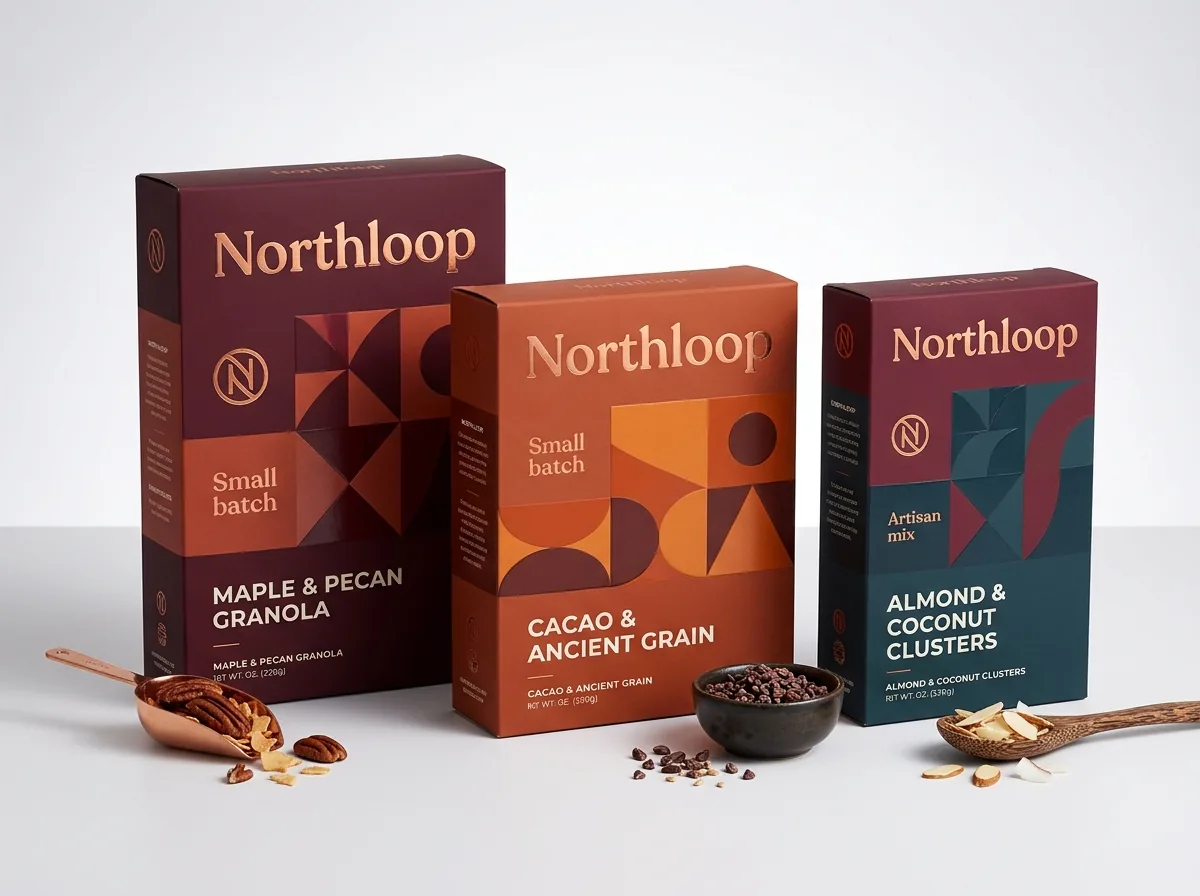
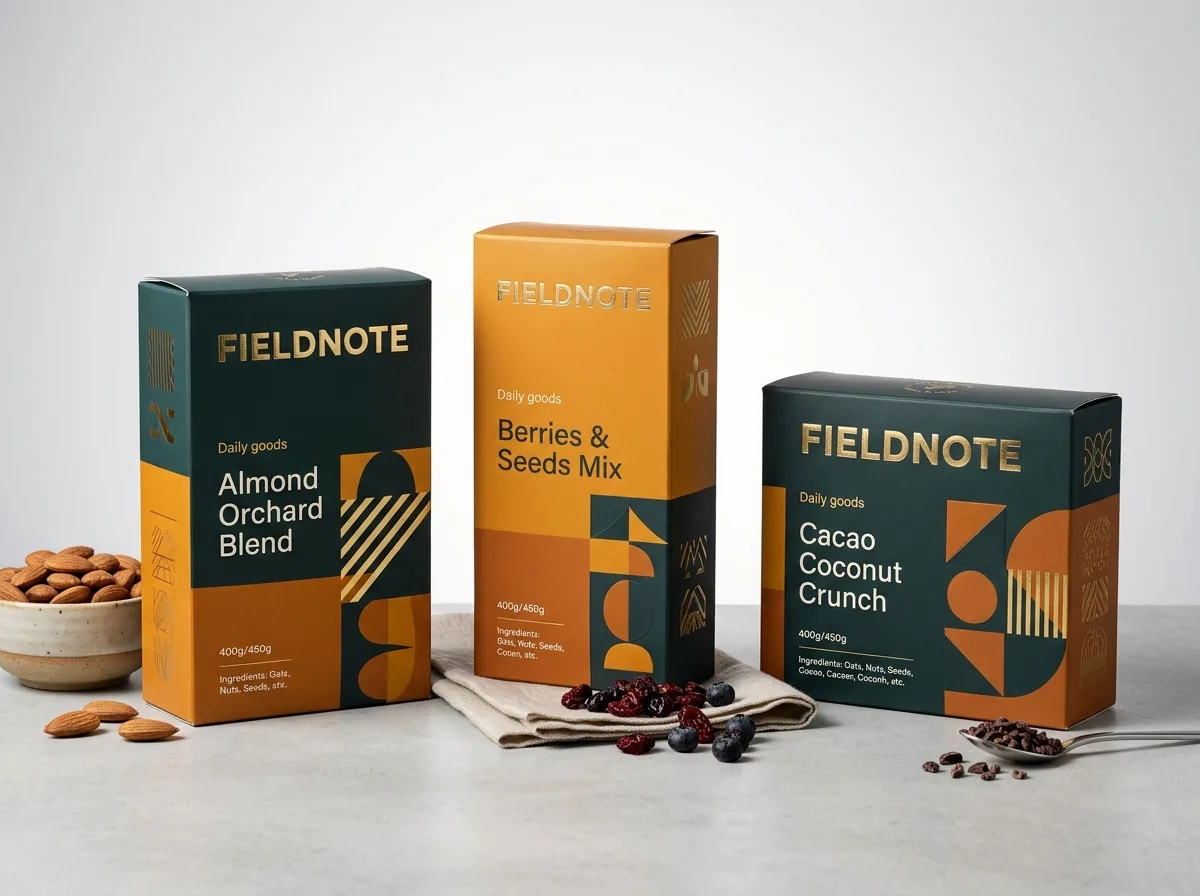
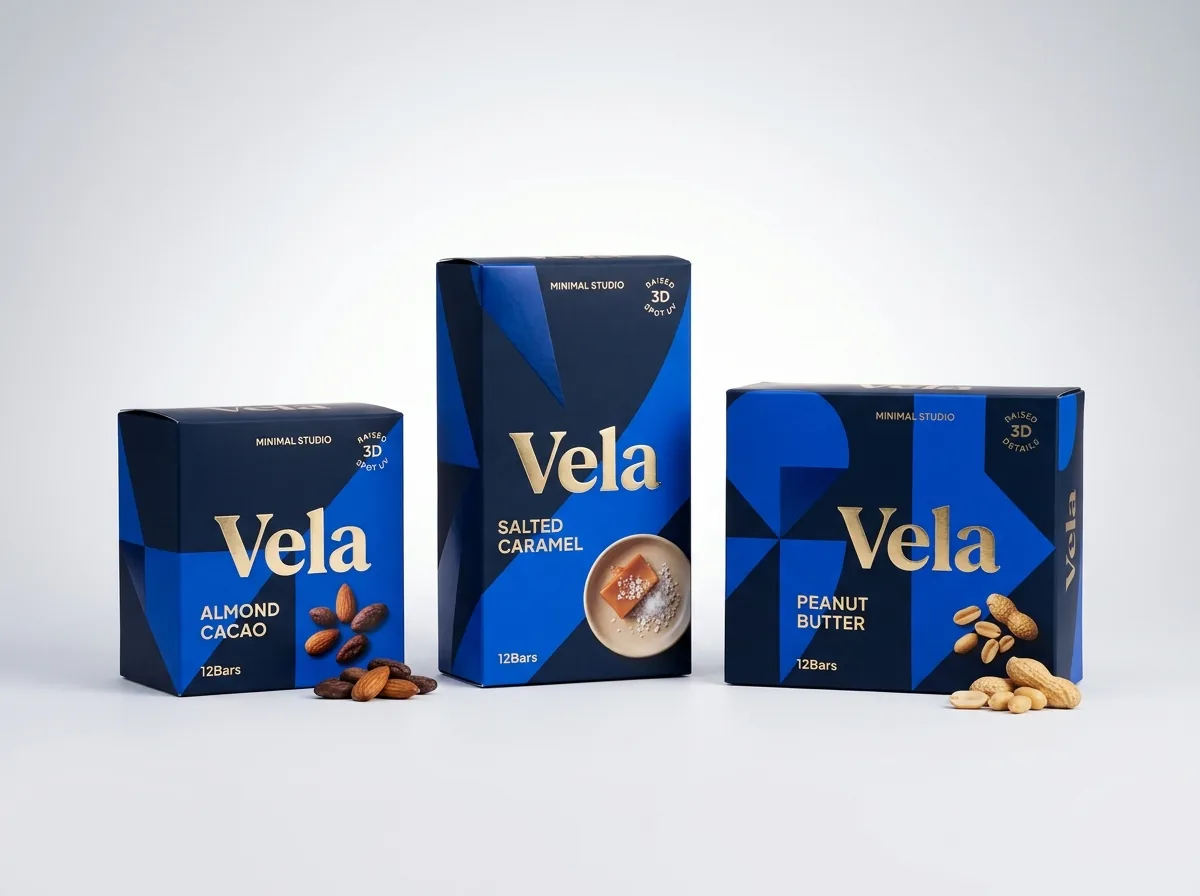
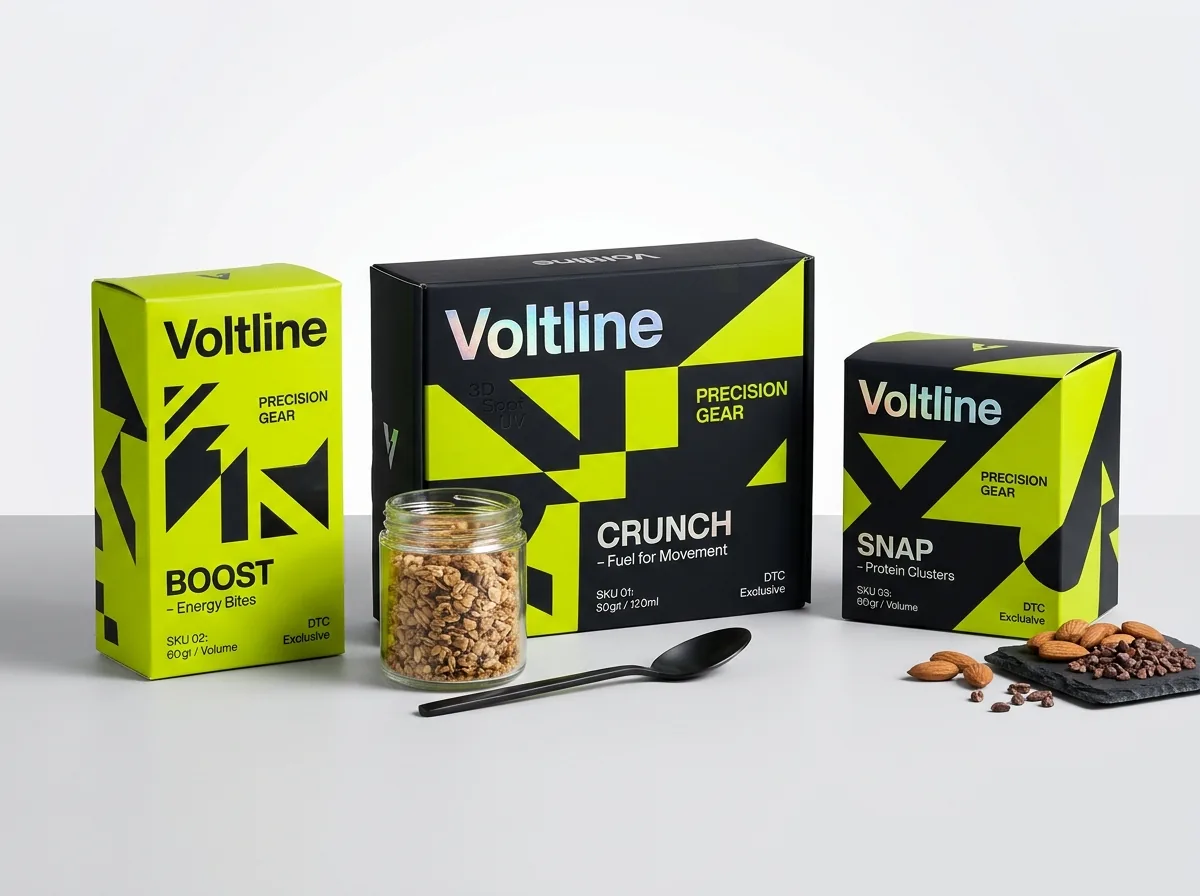
Ready to order seal end boxes? Compare up to 3 quantities with a free 3D mockup.
Request a Quote →Questions about seal end boxes
Are seal end box dimensions measured on the inside or the outside?
All custom seal end boxes are specified using Inside Dimensions (Length × Width × Height) measured from score line to score line inside the erected tube. That guarantees your inner pillow pouch, thermoformed tray, or bar grid fits properly regardless of board caliper.
How do I stop a filled cereal or granola bag from bulging the front of my seal end box?
First, measure your filled bag while constrained between two vertical plates so your Inside Width (W) matches the natural settled depth of the pouch plus 0.25 inches. Second, use 20 pt to 24 pt paperboard with horizontal grain direction running around the carton.
How deep are the top and bottom glue flaps on a full-overlap seal end box?
On a standard Full-Overlap Seal End (FOSE) carton, the inner and outer major flaps are engineered at 75% to 95% of your Inside Width (W) so the two major flaps overlap generously across the center of the opening for a strong glue bond.
What is the maximum weight a seal end box can hold?
Because both the top and bottom closures consist of two overlapping glued major flaps supported by two minor dust flaps, a 20–24 pt paperboard seal end box safely supports 2 to 3 lb, and an E-flute corrugated seal end box supports up to 5 lb.
Can I order multiple flavor designs of the same seal end box size in one 1,000-unit run?
Yes. Because all flavor SKUs share the exact same cutting die, you can split your 1,000+ carton order across multiple flavor designs with zero die charges. Select the number of designs in Step 2 of our quote form.
Still have a question? Ask a packaging specialist.
Request a Quote →Request your seal end boxes quote
Tell us your size and quantities, and one dedicated account manager prepares pricing for each tier.
- Free design & AI-to-print studio + 3D mockup
- No die or plate charges · 4–5 day rush available
- Free shipping to all 50 states
- 10% off your first order
We verified ECMA A10.10.01.01 inside dimension conventions, bag-in-box pouch settling allowances, multipack bar tolerances, and 18–24 pt / E-flute payload ratings against European Carton Makers Association (ECMA), Paperboard Packaging Council (PPC), and TAPPI standards. A packaging specialist checked every formula and table row. Spot something wrong? Tell us and we fix it.
Sources
What changed
- October 25, 2026: First published with 3-step bag-in-box & multipack sizing formula, food format clearance table, 18–24 pt & E-flute board chart, and 8-category grocery size table.
More guides
New packaging guides by email
Sizes, materials and design tips. Unsubscribe anytime.