
How do you set up gable box handle lock tabs, roof gussets, and window dielines?
Short answer: Keep a minimum 0.55 to 0.75 inch double-ply bridge above the oval finger hole, flare winged ear-lock tabs 3 to 4 mm wider than +1.0 mm receiver slots, keep clear front windows at least 0.50 inches below the horizontal roof crease, and leave V-pleat side gussets and auto-lock glue zones free of critical copy.
On this page
- What CAD tolerances govern each zone of an unfolded gable box dieline
- How do winged ear-lock tabs stay shut without tape, ribbons, or stickers
- Where can you place a clear front display window without warping the gable fold
- How do you check your gable artwork file in 5 minutes before production
- Common mistakes
- FAQs
Request a custom quoteFree dieline & 3D mockup
Setting up print artwork and structural tolerances on custom gable boxes requires extra care above the horizontal roof score line because four vertical walls transform into two sloped roof billboards, two inward-collapsing V-pleat gussets, and an interlocking double-ply handle. When a generic online template omits relief radii on the winged ear-lock tabs, cuts the oval finger hole too close to the top edge, or lets a front display window cross into the 45-degree roof slope, boxes either pop open mid-carry or buckle across the front panel during bakery counter packing. Following proven ECMA and PPC CAD clearances keeps your handle bridge crisp, your clear window film glass-flat, and your metallic foil logos centered squarely at eye level. CubitPack supplies a custom 2D vector CAD dieline and interactive 3D digital proof free before payment on every 1,000+ unit order.
What CAD tolerances govern each zone of an unfolded gable box dieline?
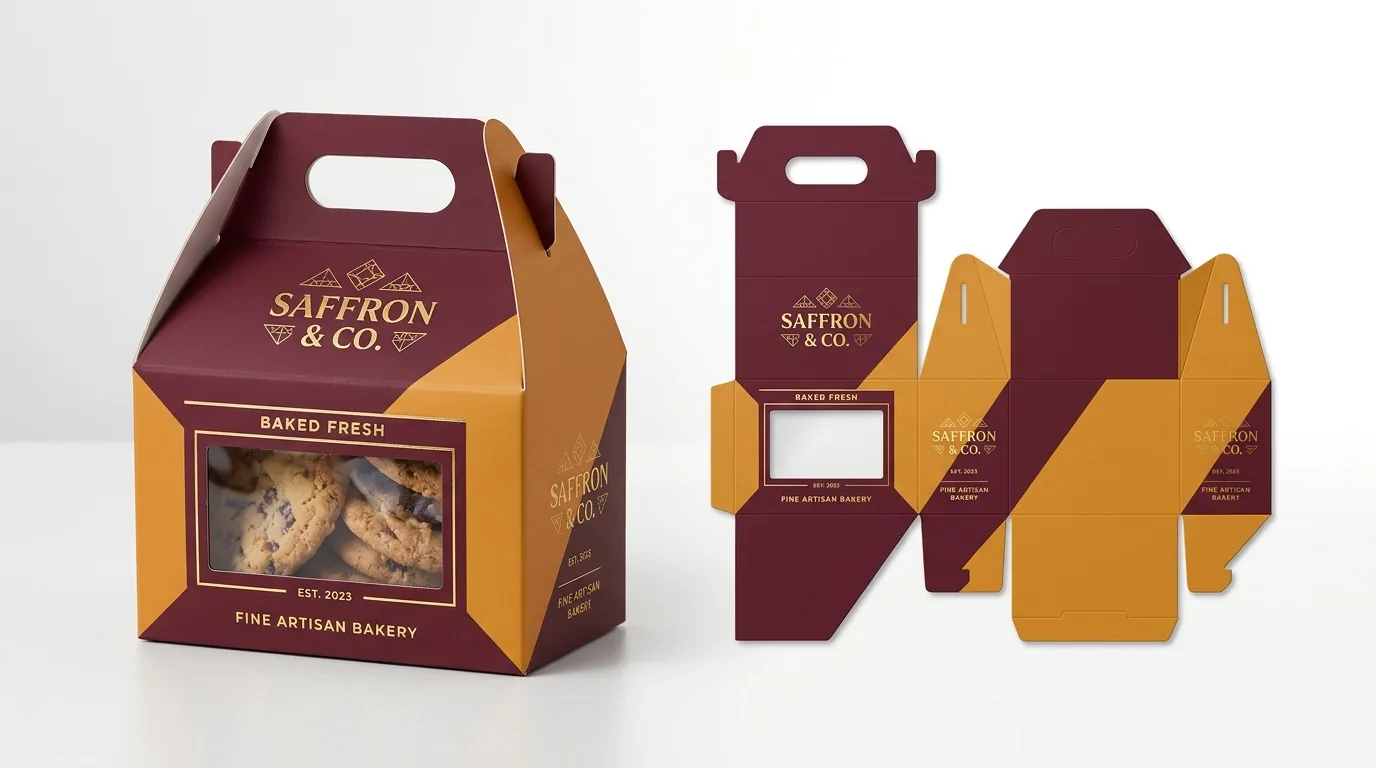
When laid flat in Adobe Illustrator, a one-piece auto-lock gable dieline reads left to right as Side Glue Lap, Left Wall + V-Gusset, Front Wall + Sloped Roof + Slotted Handle, Right Wall + V-Gusset, and Back Wall + Sloped Roof + Ear-Tab Handle, with four crash-lock bottom flaps hanging beneath. Unlike a simple tuck carton where every panel sits at 90 degrees, the upper gable assembly folds along diagonal reverse creases and 180-degree locking ears. On production steel-rule dies, our structural team alternates standard crease rules on outward corners with reverse score rules along the center vertical line of each V-pleat gusset so the side triangles fold inward automatically when squeezed. That balanced rule geometry lets staff form hundreds of boxes an hour without fighting stiff corner pleats. Check all six structural zones in the prepress table below before placing artwork for custom bakery boxes, custom cupcake boxes, or custom wedding favor boxes
- All four upright walls share one baseline: Unlike wrap-around sleeves where the back panel sits upside down, all four side walls and both sloped roof panels on a standard side-glued gable dieline stand right-side up simultaneously.
- Board grain orientation: Running paperboard grain horizontally around the carton body gives the horizontal roof crease crisp fold memory while putting high cross-grain tear resistance above the oval finger hole.
- Smooth rolled grip comfort: Our CAD dielines curve the upper corners of the oval hand hole generously so carried weight never pinches fingers.
| Dieline zone | Mechanical CAD rule | Prepress artwork rule |
|---|---|---|
| Double-ply handle bridge | 0.55–0.75 in solid board web above oval finger grip | Extend flood ink +0.125 in bleed; avoid micro text |
| Winged ear-lock tabs | 3–4 mm flared shoulders; rounded tear-relief corners | Flood solid brand color on both sides or match roof |
| Opposing receiver slots | Slot height +1.0 mm over folded tab neck thickness | Keep foil crests and logos 0.25 in clear of slot cuts |
| Sloped front & back roofs | 40–50 degree inward incline above horizontal roof line | Upright orientation; prime 45-degree zone for foil |
| V-pleat side gussets | Center vertical + two diagonal inward bellows scores | Continuous pattern or solid color only; zero text |
| Pre-glued crash bottom | 45-degree diagonal fold scores + center lock tongue | Knock out ink/varnish on glue flaps; barcode on flat zone |
How do winged ear-lock tabs stay shut without tape, ribbons, or stickers?
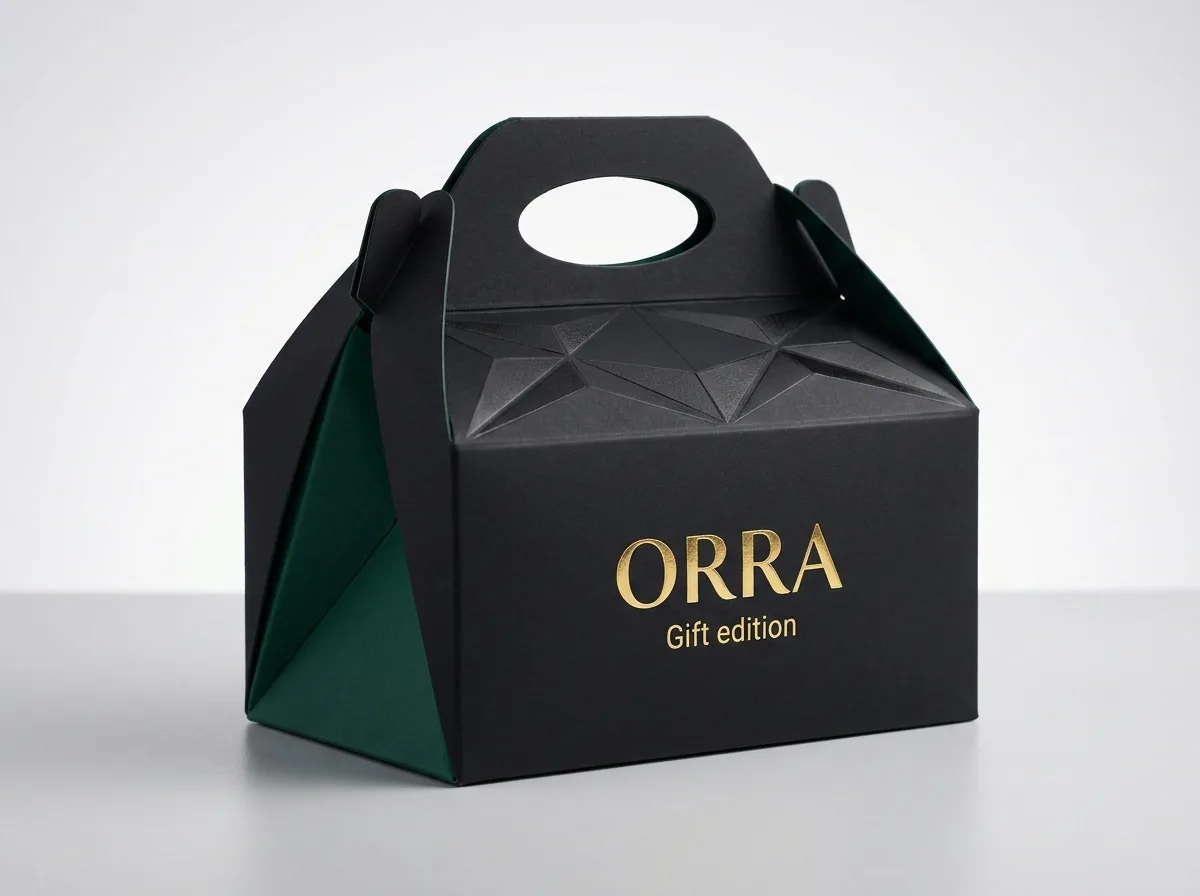
The signature closure on printed custom gable cartons works like a mechanical toggle latch cut directly from the paperboard sheet. Hinged on the left and right outer edges of the back handle extension, two flared ear tabs fold 180 degrees forward around the vertical edges of the front handle extension and push into precision die-cut receiver slots. Once each flared wing clears the slot, its upper and lower shoulders spring flat behind the front handle wall. Adding small 1.5 mm teardrop relief radii at the top and bottom root of each ear crease prevents coated SBS or laminated film from cracking after repeated openings. The heavier the pastries or jars inside, the harder upward finger lift presses the two handle plies together, locking the wings even tighter
- 18 pt vs 24 pt vs E-flute slot width: Our die-makers widen receiver slot apertures from 1.5 mm (for 18 pt card) to 2.0 mm (for 24 pt laminated card) and 3.5 mm (for 1.5 mm E-flute) so thumbs click ear tabs through without bending them.
- Clean repeatable unlocking: Because the flared wings flex slightly along rounded relief notches, recipients pinch the wings inward slightly to unlock and spread the peaked roof open intact.
- Discreet side steam vents for hot food: When designing warm savory takeout custom food boxes, punching two small half-moon vents inside the upper V-pleat side gussets lets steam escape without reducing handle bridge strength.
Where can you place a clear front display window without warping the gable fold?
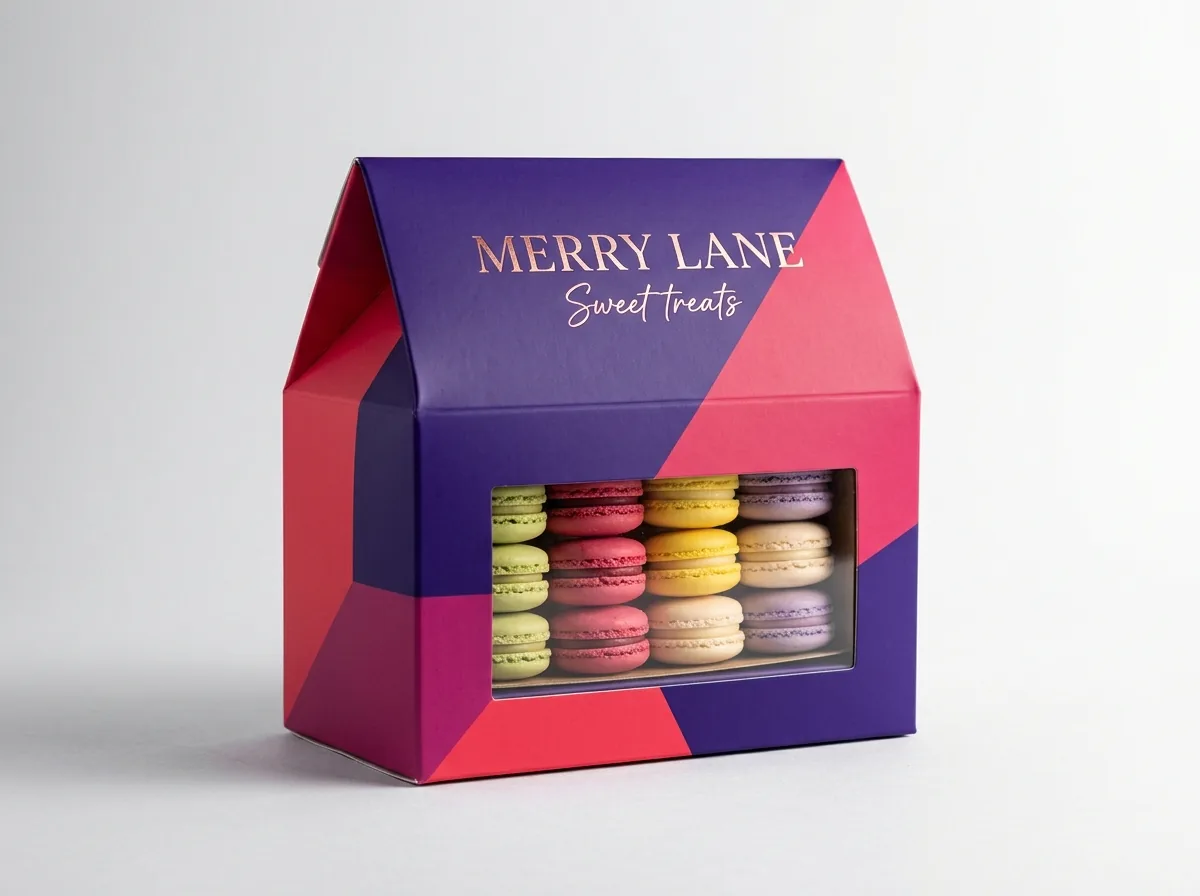
Adding a clear PET or cellulose film window turns cupcake, macaron, and gift-favor gable boxes into instant self-selling displays, provided the window cutout respects the structural load frame of the front wall. In a gable carton, the horizontal roof score line acts as a hinge beam pulling the front wall inward at 45 degrees. Cutting a window across or right up against that horizontal crease removes paperboard hinge tension, causing stiff window film to pop outward and peel at the corners. Equally important, the adhesive track inside the front wall needs an unvarnished, ink-free paperboard rim so high-speed window-patching glue forms a permanent fiber-tearing bond that will not lift in humid pastry display cases or chilled catering vans. Follow these exact margins across custom window boxes, custom party favor boxes, and custom candy boxes
| Window boundary | Minimum board border | Structural reason |
|---|---|---|
| Below horizontal roof crease | 0.50 in (12.7 mm) minimum | Preserves rigid fold hinge and adhesive bond strip for film patch |
| Inside left & right wall folds | 0.625 in (16.0 mm) minimum | Maintains vertical corner column strength when lifted by handle |
| Above auto-lock floor crease | 0.625 in (16.0 mm) minimum | Hides paperboard insert platform edge and crash-bottom flaps |
| Interior film glue track | 0.375 in (9.5 mm) around cutout | Kept free of interior ink/coating so window adhesive bonds tight |
Know your size? Compare pricing across up to 3 quantities.
Request a Quote →How do you check your gable artwork file in 5 minutes before production?
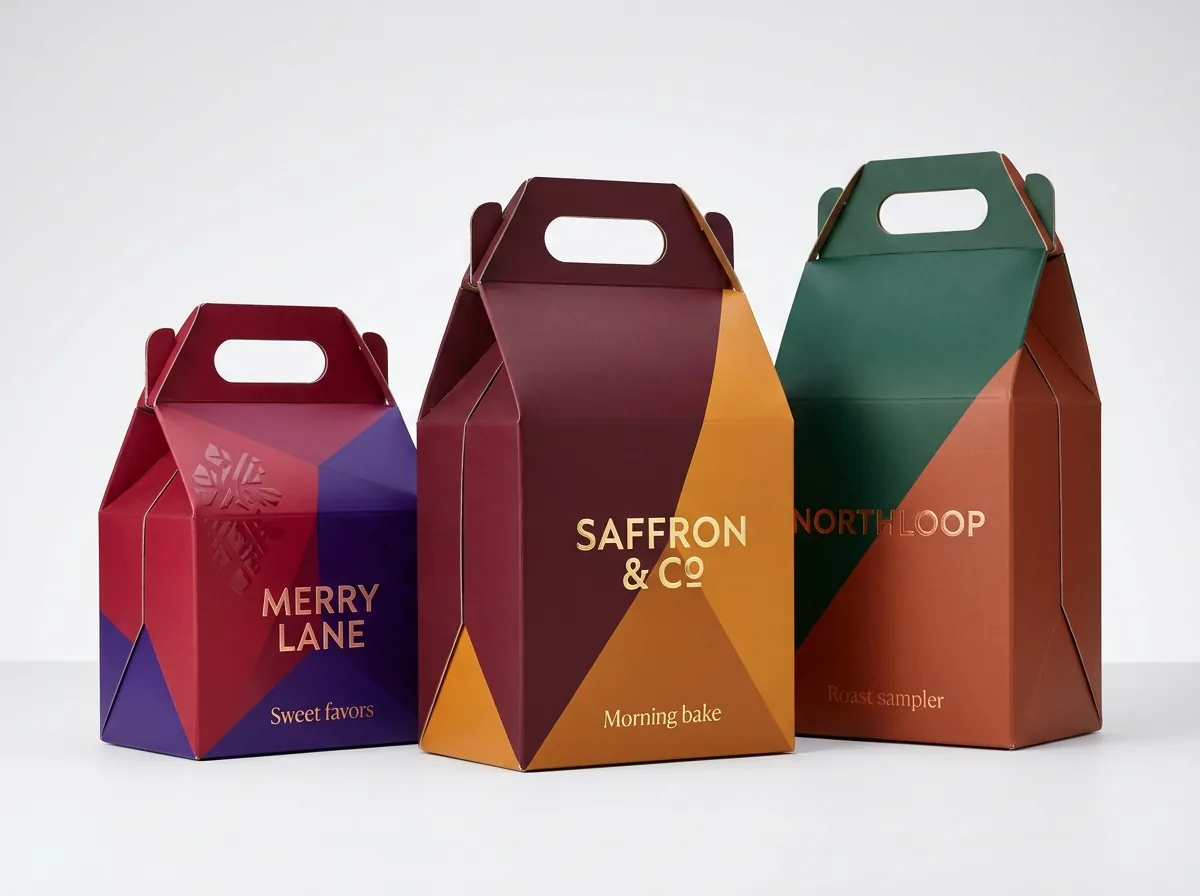
Pair this dieline prepress walkthrough with our sizing reference on gable box sizes, usable headroom, and handle weight limits, our structural comparison of auto-lock gable boxes vs briefcase boxes and bakery tuck cartons, and our design guide on how to design custom cupcake boxes with windows and handles. Before exporting your print PDF, fold a scaled laser-printed paper mockup at your desk to inspect where the V-pleat side gussets tuck inward and where the two winged ear tabs emerge on the front handle face. Checking that physical fold in thirty seconds confirms whether your roof crest logo sits upright at eye level and whether dark background ink wraps cleanly around every visible cut edge. Running this 5-point Illustrator check before uploading files for custom birthday boxes or custom gift basket boxes ensures your free 3D digital proof approves on round one
- 1. Keep CAD cut, crease, and window layers as separate non-printing spot-color vector strokes on top of your CMYK/Pantone artwork layer.
- 2. Extend background color-blocking and geometric patterns 0.125 in (3 mm) past all outer perimeter cut edges AND 0.125 in inward into the oval hand hole cutout so die tolerances never show white slivers.
- 3. Supply hot metallic foil stamping and raised Spot UV elements as 100% K solid vector layers positioned at least 0.125 in away from roof fold creases and ear-lock slots.
- 4. Confirm zero logos or ingredient lines cross into the triangular V-pleat side gussets, which fold inward out of sight once locked.
- 5. Request your free custom vector CAD dieline and 3D proof from CubitPack (from 1,000 units, zero die or plate charges, 10–14 business days standard or 4–5 rush, with our $50 sample kit credited toward your first order).
What dieline and artwork errors delay custom gable box proofs?
Check your Illustrator file against these five frequent gable prepress mistakes
- Extending a clear front display window across the horizontal roof fold crease where stiff window film buckles and breaks adhesive bonds.
- Placing event dates, flavor names, or social handles inside the upper V-pleat side gusset triangles, which fold inward and vanish when closed.
- Forgetting to bleed exterior background color 0.125 inches inside the oval finger grip cutout, leaving a thin unprinted ring inside the handle hole.
- Positioning metallic foil crests directly over the receiver handle slots where winged ear-lock tabs fold through and cover part of the logo.
- Printing heavy varnish or ink across the side-seam glue lap or the 45-degree auto-lock bottom glue patches.
Packaging for this
Ready to order gable boxes? Compare up to 3 quantities with a free 3D mockup.
Request a Quote →Questions about gable boxes
Does CubitPack send a custom gable box vector dieline before I place an order?
Yes. Enter your desired usable Length × Width × Sidewall Height (plus any front window or insert request) in our quote form, and our packaging specialists send a print-ready 2D vector PDF/AI CAD dieline and 3D digital proof free before payment.
Can I print a pattern or message inside a gable box so it shows when the roof spreads open?
Yes. Two-sided CMYK or Pantone flood printing lets you add a bold contrasting interior color, geometric pattern, or welcome message that greets customers the moment they unlatch its winged ear tabs and spread the peaked roof open.
Why does the back side of the winged ear-lock tabs show on the front of a gable box?
Because the two ear tabs hinge from the back handle panel and fold 180 degrees forward through the front receiver slots, the interior face of those small ear tips ends up visible on the front handle, or we can orient the tabs to tuck from front to back so the front handle face stays uninterrupted.
Can I leave a front peek cutout open without plastic window film?
Yes. If your candies, cookies, tea sachets, or party favors are already individually sealed inside pouches or wrappers, an unpatched open die-cut arch or geometric peek window showcases the product cleanly with zero film.
Are custom window shapes or arch cutouts charged extra die fees?
No. Custom window silhouettes, steam vents, and matched cavity inserts are cut on the same steel-rule production die starting at 1,000 boxes, with zero die or printing plate setup fees from CubitPack.
Still have a question? Ask a packaging specialist.
Request a Quote →Request your gable boxes quote
Tell us your size and quantities, and one dedicated account manager prepares pricing for each tier.
- Free design & AI-to-print studio + 3D mockup
- No die or plate charges · 4–5 day rush available
- Free shipping to all 50 states
- 10% off your first order
We verified double-ply handle bridge widths, winged ear-lock tab and slot clearances, V-pleat side gusset score angles, and front window border margins against ECMA Folding Carton Design Codes, Paperboard Packaging Council (PPC) structural design guidelines, and TAPPI paperboard grain and crease standards. Spot something wrong? Tell us and we fix it.
Sources
What changed
- November 6, 2026: First published with 6-zone gable CAD tolerance table, winged ear-tab locking mechanics, and safe front window margin rules.
More guides
New packaging guides by email
Sizes, materials and design tips. Unsubscribe anytime.