
What size beer can and bottle label do I need?
Short answer: A standard 12 oz beer can uses an 8.0 × 3.5 inch wrap, and a 16 oz tallboy pint can uses an 8.0 × 4.75 inch wrap. A 12 oz longneck bottle takes a 3.5 × 4.0 inch front panel. Order custom beer labels cut to your exact can or bottle size.
On this page
- What are the standard beer can and bottle label sizes
- How do 12 oz standard and 16 oz tallboy beer can wraps compare
- Why do full-wrap beer can labels need a ⅛ to ¼ inch seam gap
- How do I size labels for 12 oz longnecks, stubbies and 22 oz bombers
- What size label fits 32 oz taproom crowlers, growlers and keg collars
- Common mistakes
- FAQs
Request a custom quoteFree dieline & 3D mockup
Beer can and bottle label sizes are determined by the straight cylindrical wall between the top neck taper and the bottom base curve, plus a small vertical seam gap so the ends never overlap. Standard US 12 oz and 16 oz aluminum brite cans share the exact same 2.60 inch body diameter (an 8.17 inch circumference), so both formats use an 8.0 inch or 7.75 inch wrap width. Only the vertical height changes: 3.5 inches tall on a 12 oz standard can and 4.75 to 5.0 inches tall on a 16 oz tallboy pint can. Slim 12 oz sleek cans use a 6.75 × 5.0 inch wrap, and 32 oz taproom crowlers use a 9.75 × 5.5 inch wrap. Glass 12 oz longnecks take a 3.5 × 4.0 inch front rectangle or a 7.75 × 3.0 inch wrap, while 22 oz bombers take a 4.0 × 5.0 inch front label. Every CubitPack order is cut to size with zero die charges.
What are the standard beer can and bottle label sizes?
Whether you are ordering roll labels for a mobile canning line or flat sticker sheets for a taproom release, most North American craft beer cans and glass bottles follow six proven industry templates. When reading or entering dimensions for custom printed beer can and bottle labels, always list Width first and Height second (W × H in inches). On a wraparound can label, Width is the longer 8.0 inch horizontal wrap around the cylinder, and Height is the shorter 3.5 or 4.75 inch vertical wall from top to bottom. Writing those two numbers in the right order matters because roll label presses orient your artwork relative to the web feed direction. If you enter 4.75 × 8.0 inches instead of 8.0 × 4.75 inches, the label will sit rotated 90 degrees on the roll and will not feed properly through an inline rotary or tabletop can labeler. Use the reference table below to verify the exact width, height and seam gap for your vessel before setting up your artboard.
| Beer can or bottle format | Standard label size (W × H) | Body diameter & layout notes |
|---|---|---|
| 12 oz standard can (202/211) | 8.0 × 3.5 in (or 7.75 × 3.5 in) | 2.60 in diameter; full wrap with ⅛-⅜ in gap |
| 16 oz tallboy pint can (202/211) | 8.0 × 4.75 in (or 8.0 × 5.0 in) | 2.60 in diameter; full wrap below neck chime |
| 12 oz sleek slim can (202/204) | 6.75 × 5.0 in | 2.25 in diameter; popular for seltzers & ciders |
| 19.2 oz stovepipe single-serve can | 8.0 × 6.25 in | 2.60 in diameter; tall convenience-store wrap |
| 32 oz aluminum taproom crowler | 9.75 × 5.5 in (or 4.0 × 5.0 in front) | 3.25 in diameter; full wrap or taproom badge |
| 12 oz longneck or stubby bottle | 3.5 × 4.0 in front (or 7.75 × 3.0 in wrap) | 2.40-2.50 in diameter; optional 2.5 × 3.5 in back |
| 22 oz bomber or 750 ml ale bottle | 4.0 × 5.0 in front (or 8.0 × 4.0 in wrap) | 2.95-3.15 in diameter; front crest or wrap |
| 64 oz glass growler jug | 4.0 × 5.0 in or 3.5 × 4.0 in | 5.0 in diameter; front panel below handle |
How do 12 oz standard and 16 oz tallboy beer can wraps compare?
The biggest advantage of North American 12 oz standard and 16 oz tallboy aluminum cans is that both are formed from the same 211 body diameter (2.60 inches across, with a 202 necked-in lid). Because their circumference is identical at roughly 8.17 inches, your horizontal wrap width stays at 8.0 inches (or 7.75 inches) across both can sizes. Your designer only needs to adjust the vertical height when adapting artwork from a 16 oz taproom 4-pack to a 12 oz grocery 6-pack. On a 16 oz tallboy can, most breweries prefer a 4.75 inch vertical height rather than pushing to 5.0 or 5.125 inches. While the straight aluminum wall measures just over 5 inches between the bottom curve and the top neck taper, leaving an extra eighth of an inch of bare aluminum at the top and bottom gives high-speed applicator rollers margin for minor vertical bounce and keeps the upper label edge clear of plastic PakTech 4-pack carrier rings.
- 12 oz standard can (4.83 in total can height): use an 8.0 × 3.5 inch or 7.75 × 3.5 inch wrap.
- 16 oz tallboy pint can (6.19 in total can height): use an 8.0 × 4.75 inch wrap for foolproof PakTech clearance.
- 12 oz sleek slim can (6.125 in total can height): use a narrower 6.75 × 5.0 inch wrap to match the 2.25 inch diameter.
- 19.2 oz stovepipe can (7.40 in total can height): use an 8.0 × 6.25 inch wrap for single-serve retail coolers.
Why do full-wrap beer can labels need a ⅛ to ¼ inch seam gap?
New brewers often calculate the circumference of a 2.60 inch brite can (2.60 × 3.1416 = 8.17 inches) and order an 8.17 inch or 8.25 inch label expecting a tight overlap. On a pressure-sensitive roll label, an overlapped seam causes two problems on canning day. First, if the aluminum can sits even one degree off-kilter as the wipe-down brush rolls it, an 8.25 inch label spirals slightly and forms a raised dog-ear ridge at the top corner where the trailing edge climbs over the leading edge. Second, many matte and gloss laminations have low surface energy designed to shed water and condensation; standard can adhesive grips bare aluminum much more strongly than it grips a laminated ink surface. Unless you specifically design an unvarnished overlap strip, the trailing edge can flag or lift in an ice chest. Sizing your wrap width to 8.0 inches leaves a clean 0.17 inch (roughly 3/16 inch) vertical sliver of silver aluminum, and 7.75 inches leaves a wider 0.42 inch gap that is even more forgiving on manual tabletop rollers.
Know your size? Compare pricing across up to 3 quantities.
Request a Quote →How do I size labels for 12 oz longnecks, stubbies and 22 oz bombers?
Glass beer bottles have a long tapered shoulder and a molded heel at the bottom, so you must measure only the flat vertical cylinder between the two curves before ordering custom roll labels. On a North American 12 oz Industry Standard Bottle (ISB longneck), the straight wall is roughly 3.65 to 4.10 inches tall with a 2.41 inch diameter (7.57 inch circumference). Breweries either apply a single 7.50 × 3.0 inch wraparound band or pair a 3.5 × 4.0 inch front crest with a 2.5 × 3.5 inch back panel. Heritage stubby bottles and Belgian 330 ml / 500 ml bottles have shorter straight walls and wider shoulders, typically calling for a compact 3.5 × 3.0 inch rectangle or an oval front medallion. On 22 oz glass bombers used for barrel-aged imperial stouts and wild ales, the straight wall comfortably holds a bold 4.0 × 5.0 inch front panel or an 8.0 × 4.0 inch full wrap. If you also bottle ciders, meads or grape co-ferments in 750 ml glass, compare our custom wine labels sizing guide for Bordeaux and Champagne profiles.
What size label fits 32 oz taproom crowlers, growlers and keg collars?
Taproom to-go vessels give you a huge canvas and lower unit volume, making them ideal for either roll labels or flat custom sticker sheets. A 32 oz aluminum crowler can measures roughly 3.25 inches in diameter (10.2 inch circumference) and 6.19 inches tall. A full-wrap crowler label is typically 9.75 × 5.5 inches, leaving a clean seam gap and clearance for the bar seamer chuck at the top rim. Many brewpubs save money on crowlers and 64 oz glass growlers by ordering a single 4.0 × 5.0 inch or 3.5 × 4.0 inch front badge printed with the brewery logo, government warning and three blank matte boxes where bartenders write the beer name, ABV and fill date with a permanent marker. For 1/2 barrel and 1/6 barrel stainless kegs leaving your cold box for distribution, a 6.5 inch round custom circle label with a center spear cutout serves as a durable keg collar.
- 32 oz crowler full wrap: 9.75 × 5.5 inches on rolls for high-volume taproom releases.
- 32 oz crowler & 64 oz growler write-on badge: 4.0 × 5.0 inches with an unlaminated marker zone.
- 4-pack & 6-pack cardboard carrier toppers: 2.5 × 3.5 inch or 3.0 × 4.0 inch rectangles to brand stock kraft holders.
- Stainless keg collars: 6.5 inch diameter circle with a 2.25 inch inner cutout to slip over the Sankey valve.
What are the most common beer can and bottle label sizing mistakes?
A tenth of an inch makes the difference between a smooth canning run and labels catching on seamer chucks or carrier rings. Check these five sizing mistakes before approving your proof
- Reversing Width and Height (writing 4.75 × 8.0 in instead of 8.0 × 4.75 in), which winds the can wrap sideways on the roll.
- Sizing a 12 oz or 16 oz can wrap to the full 8.17 inch circumference with zero gap, causing overlapped edges to flag or catch.
- Making a 16 oz tallboy label taller than 5.0 inches so the top edge hits the neck taper and interferes with PakTech 4-pack rings.
- Measuring the total height of a 12 oz longneck glass bottle instead of only the straight cylinder below the shoulder break.
- Ordering rectangular neck bands for tapered glass bottle necks instead of a curved arc dieline that wraps flat on a cone.
Find your label size
Suggested label size: 9⅛ × 2¾ in (width × height)
A typical starting point. Your account manager confirms the size on the proof.
Quote this size →Packaging for this
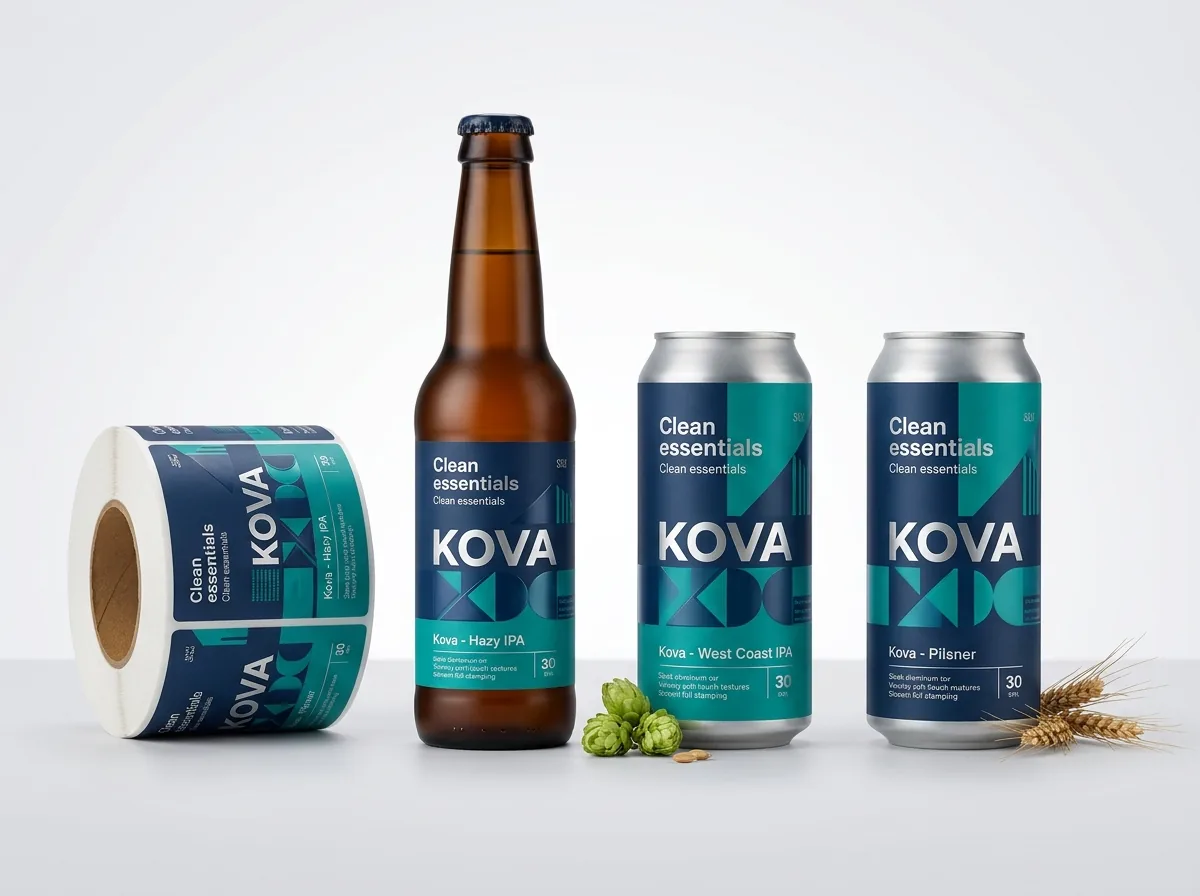

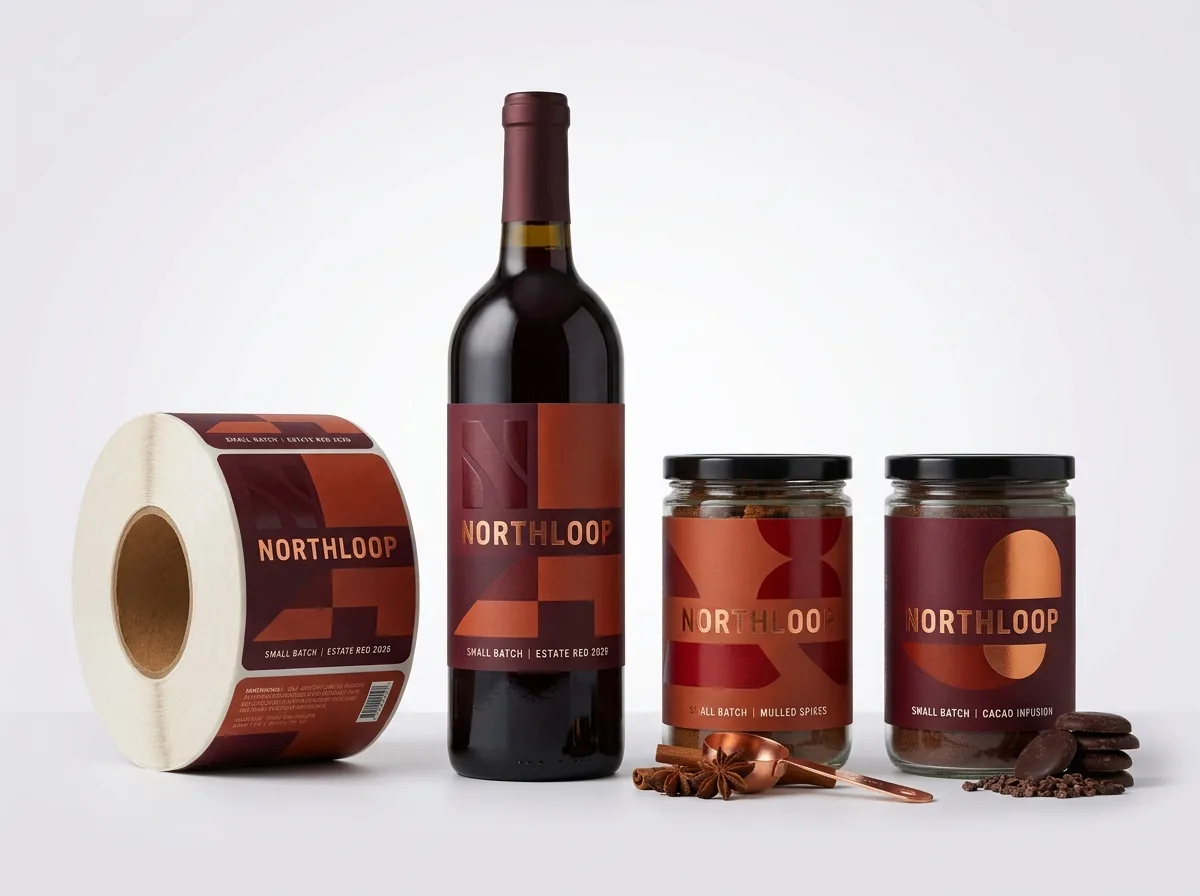
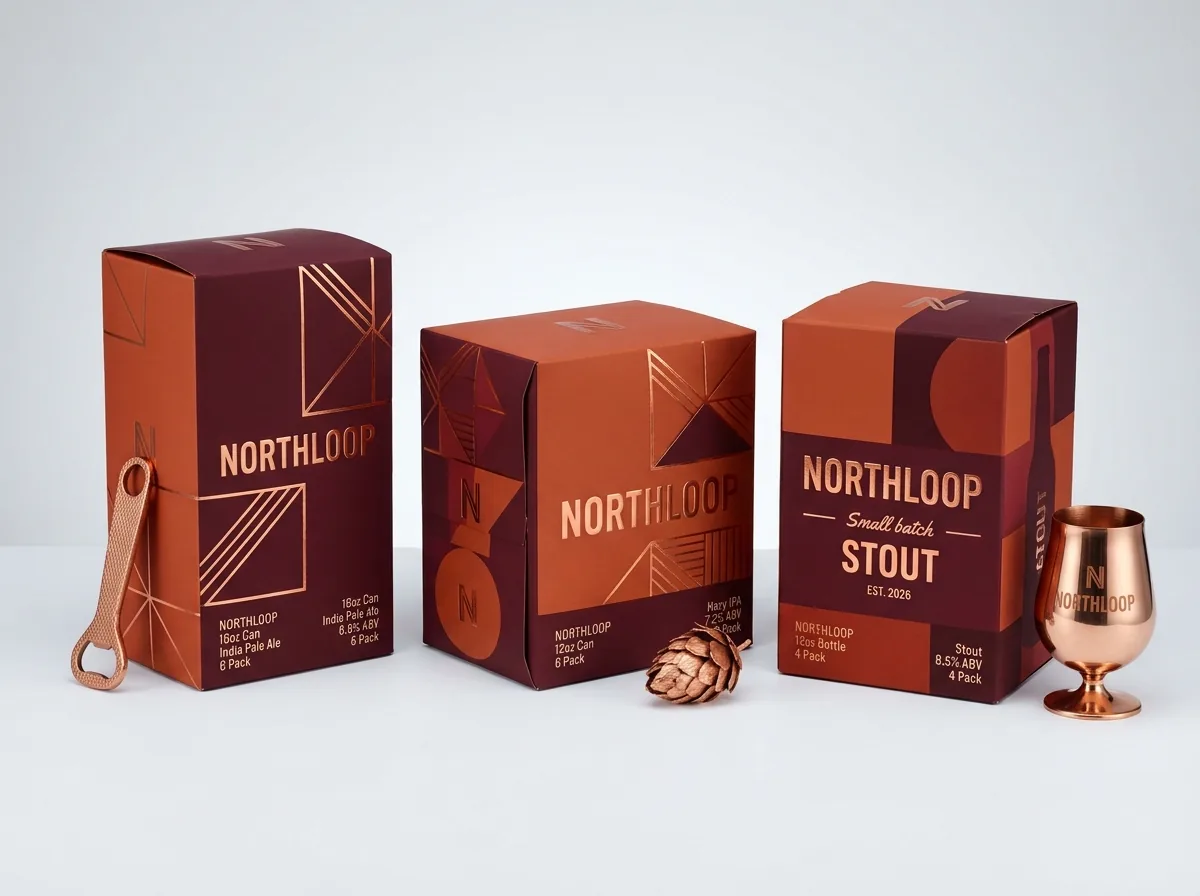
Ready to order beer labels? Compare up to 3 quantities with a free 3D mockup.
Request a Quote →Questions about beer labels
Do 12 oz standard cans and 16 oz tallboy cans have the same label width?
Yes. Both standard 12 oz and 16 oz North American beverage cans have a 2.60 inch body diameter (8.17 inch circumference). Both use an 8.0 inch or 7.75 inch wrap width; only the vertical height changes from 3.5 inches (12 oz) to 4.75 inches (16 oz).
Should I order 8.0 × 4.75 inches or 7.75 × 4.75 inches for a 16 oz tallboy?
Choose 8.0 × 4.75 inches if you run an automated inline or rotary can labeler and want a tight 3/16 inch seam gap. Choose 7.75 × 4.75 inches if you use a manual or semi-automatic tabletop roller, where a slightly wider gap prevents accidental overlap.
Why does Width come before Height on a beer can label?
Label dimensions are always written horizontally first, then vertically (W × H) as you read the can upright. Because a beer label wraps 8.0 inches around the can horizontally and stands 4.75 inches tall vertically, it is written 8.0 × 4.75 inches.
What size label fits a 12 oz sleek slim can for hard seltzer or cider?
A 12 oz sleek can has a narrower 2.25 inch diameter (7.07 inch circumference) and a taller straight wall than a standard 12 oz can. The standard full-wrap label size for a 12 oz sleek can is 6.75 × 5.0 inches.
Can I use my 16 oz tallboy label on a 32 oz taproom crowler?
Yes. Many breweries apply their standard 8.0 × 4.75 inch tallboy label onto the front of a 32 oz aluminum crowler can instead of ordering a separate 9.75 × 5.5 inch crowler wrap. It covers about four-fifths of the crowler circumference cleanly.
How do I test a beer can or bottle label size before printing?
Cut a rectangle of plain copy paper to your exact planned width and height, wrap it around a filled can or bottle at room temperature, and snap on your 4-pack ring or slide it into your carton to verify clearance.
Still have a question? Ask a packaging specialist.
Request a Quote →Request your beer labels quote
Tell us your size and quantities, and one dedicated account manager prepares pricing for each tier.
- Free design & AI-to-print studio + 3D mockup
- No die or plate charges · 4–5 day rush available
- Free shipping to all 50 states
- 10% off your first order
The can and bottle dimensions in this guide are based on standard North American 202/211 and 202/204 aluminum brite can specs and ISB longneck glass molds. A CubitPack packaging specialist checked every measurement and formula.
Sources
What changed
- October 22, 2026: First published.
- October 22, 2026: Updated specifications, terminology, and verified source links.
More guides
New packaging guides by email
Sizes, materials and design tips. Unsubscribe anytime.