
What size label fits a 12 oz, 1 lb or 5 lb coffee bag?
Short answer: A standard 12 oz coffee bag takes a 3 × 4 inch or 3.5 × 4 inch rectangle label, a 1 lb bag takes 3.5 × 4.5 inches, and a 5 lb wholesale bag takes 4 × 6 inches. Order custom coffee bag labels sized ½ inch inside heat seals and below the degassing valve.
On this page
- What are the standard coffee bag label sizes from 4 oz to 5 lb
- How do I measure a coffee pouch around heat seals and the degassing valve
- How do stand-up pouches, flat-bottom bags and side-gusset bags change label width
- Should I use separate front-and-back labels or a top fold-over gusset strip
- How should roasters size labels for 5 lb wholesale bags and cold brew containers
- Common mistakes
- FAQs
Request a custom quoteFree dieline & 3D mockup
The right coffee bag label size depends on the flat printable zone of your pouch, not its outer bag dimensions. Every flexible coffee bag has welded side heat seals, a top zipper track or tin-tie fold, a one-way plastic degassing valve, and a bottom or side gusset crease that expands outward once filled with roasted beans. For a standard 12 oz (340 g) stand-up or flat-bottom bag, a 3 × 4 inch vertical rectangle fits cleanly below the aroma valve and above the bottom gusset curve. On 8 oz bags, step down to 3 × 3.5 inches; on 16 oz (1 lb) bags, step up to 3.5 × 4.5 inches; and on 5 lb wholesale bulk bags, use a 4 × 6 inch panel so baristas can read roast dates from across the bar. At CubitPack, every size is cut to order with no die fees.
What are the standard coffee bag label sizes from 4 oz to 5 lb?
While stock coffee pouches from different bag suppliers vary by ¼ to ½ inch in width and valve height, most specialty roasters standardize their lineup around six proven rectangle and badge dimensions. Using a consistent label size across your 12 oz retail bags means every single-origin release, seasonal blend and decaf roast shares the same dieline setup. Use the reference table below as your starting benchmark, then verify the numbers against your physical empty and bean-filled pouches with a flat ruler. Remember that label dimensions are always written as Width × Height in inches, where width runs horizontally from left to right across the bag face and height runs vertically from top to bottom.
| Coffee bag capacity & style | Typical flat face (W × H) | Recommended label size (W × H) |
|---|---|---|
| 4 oz sample flight pouch | 3.5 × 4.25 in | 2.5 × 3 in rectangle |
| 8 oz to 10 oz stand-up or box pouch | 4.25 × 4.75 in | 3 × 3.5 in rectangle |
| 12 oz stand-up pouch (Doypack) | 4.75 × 5.25 in | 3 × 4 in or 3.5 × 4 in |
| 12 oz flat-bottom (box-bottom) bag | 4.25 × 5.5 in | 3 × 4 in rectangle or 3 × 3 in square |
| 16 oz (1 lb) side-gusset or quad-seal bag | 4.5 × 6.5 in | 3.5 × 4.5 in rectangle |
| 2 lb retail or office coffee bag | 5.5 × 7.5 in | 4 × 5 in rectangle |
| 5 lb wholesale cafe bulk gusset bag | 6.5 × 9.5 in | 4 × 6 in rectangle |
| Roast-level badge or tin-tie seal | Top fold or corner | 1.5 in or 2 in circle |
How do I measure a coffee pouch around heat seals and the degassing valve?
Never take the outer width × height printed on a coffee bag supplier's invoice and order a label near that size. A 12 oz stand-up pouch listed as 6 × 9 inches overall loses ¾ inch at the top to the tear notch and zipper track, ⅜ inch on each side to the vertical heat-seal seams, 1.5 inches near the upper center to the plastic one-way degassing valve, and 1.5 inches at the bottom where the gusset folds inward. If a label edge crosses onto a raised heat-seal weld or sits directly on top of the circular aroma valve dimple, the adhesive cannot make full contact and the edge will tunnel or peel up. Lay an empty coffee bag flat on your packing table and measure only the smooth, un-seamed interior rectangle below the degassing valve and above the bottom gusset crease. Subtract ½ inch from both that horizontal width and vertical height so you leave a clean ¼ inch border of bag material framing all four sides of your printed coffee bag labels.
- Measure horizontal width between the inner edges of the left and right side heat seals, then subtract ½ inch.
- Locate the bottom edge of the plastic one-way degassing valve and start your top label boundary at least ¼ inch below it.
- Find the horizontal fold crease where the bottom gusset tucks into the pouch and stop your label at least ½ inch above that crease.
- On bags without a front valve (where the valve is mounted on the back panel), start your front label ½ inch below the zipper track or tin-tie fold line.
- Cut a paper rectangle to your calculated width × height, tape it onto the bag, and fill the bag with roasted beans to check how the gusset pulls the lower panel.
How do stand-up pouches, flat-bottom bags and side-gusset bags change label width?
The three main bag constructions used by specialty coffee roasters behave very differently once filled with whole beans. A traditional stand-up pouch (also called a Doypack) has a wide oval bottom gusset and wide welded side seams; when filled, the lower half of the pouch swells into a rounded belly while the top stays pinched flat along the zipper. Because of that curve, a 3 × 4 inch label on a 12 oz stand-up pouch should sit slightly higher on the flat panel so its bottom edge does not fight the gusset bend. Flat-bottom box pouches (eight-side-seal bags) have crisp vertical side creases and a rectangular floor, so the front panel stays much flatter from top to bottom after filling. However, the front face between the vertical corner seals is often slightly narrower than a Doypack, making a 3 × 4 inch vertical rectangle or a 3 × 3 inch square ideal. Traditional side-gusseted bags have no side weld flanges on the front face at all, just soft folded edges; they accept tall 3.5 × 4.5 inch front labels or long vertical strips that wrap over the top tin-tie fold. If you also source pouches, compare dimensions on our custom coffee bags and custom stand up pouches pages.
Know your size? Compare pricing across up to 3 quantities.
Request a Quote →Should I use separate front-and-back labels or a top fold-over gusset strip?
Most roasters choose between two layout systems: a two-piece front-and-back set or a single long fold-over strip. A two-piece set places a 3 × 4 inch origin and brand label on the front and a matching 3 × 4 inch information label on the back for roast level scales, brewing ratios, roastery address and UPC barcodes. Because both pieces share the exact same 3 × 4 inch rectangle dieline, you can combine front and back designs in one roll order. A top fold-over strip (often 2.5 × 7 inches or 3 × 8 inches) starts on the front panel below or beside the valve, folds squarely over the rolled top of a side-gusseted bag, and runs down the back panel. It doubles as a tamper-evident closure seal so customers know the bag has not been opened on a grocery shelf. The trade-off is that fold-over strips must be applied after filling and rolling the top of the bag, whereas flat front-and-back labels can be applied to empty flat bags in advance.
How should roasters size labels for 5 lb wholesale bags and cold brew containers?
Wholesale 5 lb bags live in dark cafe storage bins, walk-in closets and espresso bar drawers where baristas need to grab the right hopper refill in seconds. A small 3 × 4 inch retail label looks lost on a 5 lb gusseted bag and forces staff to squint at the roast date. Stepping up to a 4 × 6 inch rectangle gives you room for 36-point blend names, bold color-coded header bars for espresso vs filter roasts, and a wide white knock-out box for stamping the roast date, batch weight and grind setting. If you want to avoid ordering separate 4 × 6 inch labels for every single wholesale coffee, print one universal 4 × 6 inch roastery master label with an open 2.5 × 3 inch window in the center, then apply your standard 12 oz retail origin label or a thermal-printed sticker right inside that frame. For ready-to-drink cold brew glass bottles and concentrate jugs, pair your pouch lineup with waterproof custom bottle labels or custom roll labels matched to the same Pantone colors.
What are the most common coffee bag label sizing mistakes?
Nearly every coffee bag label fit problem comes from measuring an empty bag's outer edges without accounting for valves, heat seals and bean expansion. Watch out for these five mistakes
- Using the bag supplier's outer width × height instead of measuring inside the welded side heat seals and below the zipper track.
- Placing a solid un-notched label over the plastic one-way degassing valve, which blocks CO2 release and causes the label to bubble.
- Extending the bottom of a front label down into the bottom gusset fold crease, where bean expansion bends the pouch wall and lifts corners.
- Applying flat front-and-back labels after filling the bag with whole beans instead of labeling empty flat pouches on a hard table.
- Using tiny 12 oz retail labels on 5 lb wholesale cafe bags where baristas cannot read the blend name or roast date from a shelf.
Find your label size
Suggested label size: 9⅛ × 2¾ in (width × height)
A typical starting point. Your account manager confirms the size on the proof.
Quote this size →Packaging for this
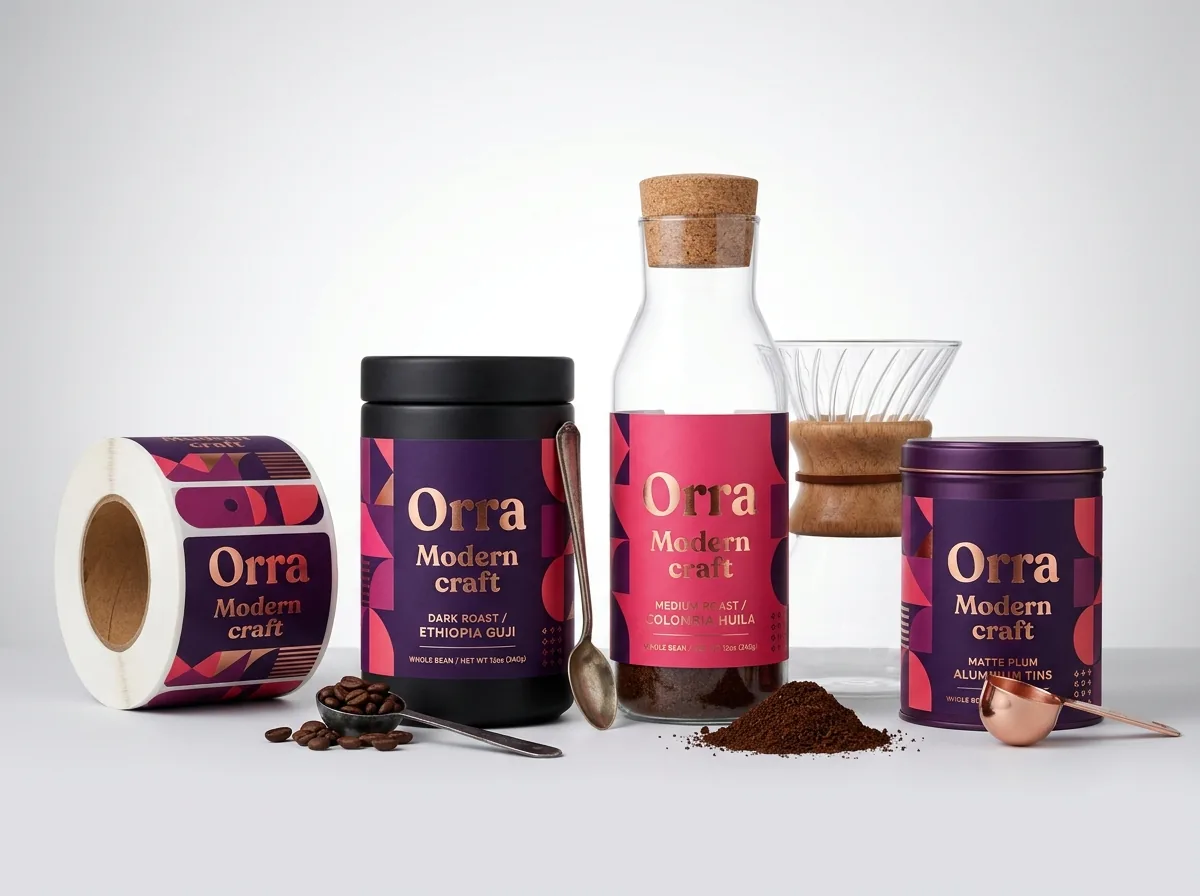
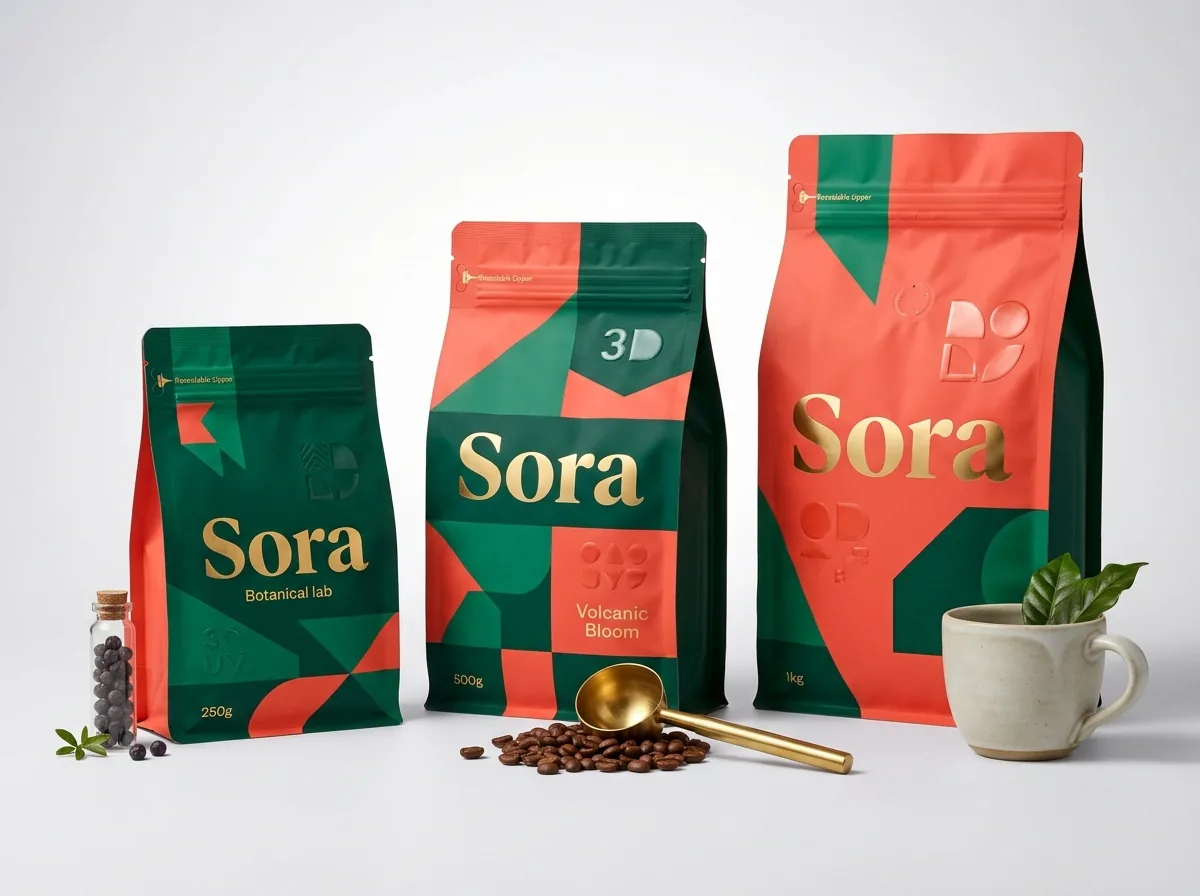
Ready to order coffee bag labels? Compare up to 3 quantities with a free 3D mockup.
Request a Quote →Questions about coffee bag labels
What is the most popular label size for a 12 oz coffee bag?
A 3 × 4 inch vertical rectangle is the industry standard for 12 oz stand-up and flat-bottom coffee bags, with 3.5 × 4 inches close behind for wider pouches. It leaves clean breathing room below the one-way degassing valve and inside the side heat seals.
How close can my coffee bag label sit to the degassing valve?
Leave at least ¼ inch (0.25 in) between the top edge of your label and the outer plastic ring of the one-way degassing valve. That plastic ring is heat-welded into the inside of the pouch film, creating a slight ridge around the vent holes.
Can you cut a keyhole or notch in my label to fit around the valve?
Yes. Because CubitPack does not charge die or plate fees, our prepress designers can add a circular cutout or a U-shaped top notch to your dieline so a tall front label frames the degassing valve without covering the vent.
What size label fits a 4 oz coffee sample pouch?
Most 4 oz coffee sample pouches and subscription flight bags take a 2.5 × 3 inch vertical rectangle or a 2.5 × 2.5 inch square label. Always check whether your 4 oz bag has a tear notch or zipper track that reduces vertical height.
Should I write width or height first when ordering coffee bag labels?
Always list width first and height second (W × H in inches). On a standard vertical coffee bag label, the 3 inch horizontal measurement across the bag face is the width and the 4 inch vertical measurement from top to bottom is the height.
Can I use the same 3 × 4 inch label on both 12 oz and 1 lb coffee bags?
Yes, many roasters use one 3 × 4 inch label on both 12 oz and 16 oz (1 lb) bags so they only stock one label size per origin. If the 1 lb bag is sold by weight, simply stamp or print the net weight in a knock-out box.
Still have a question? Ask a packaging specialist.
Request a Quote →Request your coffee bag labels quote
Tell us your size and quantities, and one dedicated account manager prepares pricing for each tier.
- Free design & AI-to-print studio + 3D mockup
- No die or plate charges · 4–5 day rush available
- Free shipping to all 50 states
- 10% off your first order
The sizing chart and clearance rules in this guide were built by measuring flat printable panels across stand-up, flat-bottom and side-gusseted coffee bags from 4 oz to 5 lb. A CubitPack packaging specialist verified every dimension and formula. Spot something wrong? Tell us and we will fix it.
Sources
What changed
- October 22, 2026: First published.
- October 22, 2026: Updated specifications, terminology, and verified source links.
More guides
New packaging guides by email
Sizes, materials and design tips. Unsubscribe anytime.