
How do I design craft beer labels for canning lines and TTB rules?
Short answer: Build your artboard to the exact wrap width × height (such as 8.0 × 4.75 in for a 16 oz tallboy), extend background art ⅛ inch past the cut line for bleed, keep TTB text ⅛ inch inside, and place your barcode vertically with a white background. Order custom beer labels with free prepress review.
On this page
- What mandatory items does the TTB require on a craft beer label
- How do I lay out the front panel, side panels, bleed and safe margin
- Why should beer can barcodes be oriented vertically (ladder style)
- How do I set up white ink layers for metallic foil and clear beer labels
- How do roll unwind direction and AI artwork prep work at CubitPack
- Common mistakes
- FAQs
Request a custom quoteFree dieline & 3D mockup
Designing a craft beer label that runs smoothly on a canning line and passes TTB review requires combining creative artwork with five technical prepress rules. First, size the artboard horizontally as Width × Height (8.0 × 3.5 inches for 12 oz cans or 8.0 × 4.75 inches for 16 oz tallboys) and add a ⅛ inch (0.125 in) bleed on all four sides plus a ⅛ inch inner safe margin. Second, include all mandatory TTB malt beverage disclosures: brand name, class/type designation (such as Hazy India Pale Ale), net contents in fluid ounces, brewer name and city/state, and the 27 CFR Part 16 GOVERNMENT WARNING with a bold all-caps header. Third, orient the UPC barcode vertically (ladder style) on a solid white rectangle so curved can glare never blocks grocery scanners. Fourth, add a white ink underbase layer when printing on clear or metallic foil stock. Finally, confirm your applicator's roll unwind direction.
What mandatory items does the TTB require on a craft beer label?
Before a malt beverage is sold across state lines or in retail accounts requiring a Certificate of Label Approval (COLA), the Alcohol and Tobacco Tax and Trade Bureau (TTB) checks your label against 27 CFR Part 7 and Part 16. Even when a taproom-only release is exempt from federal COLA filing in your state, following the standard TTB checklist keeps your cans ready for wholesale distribution the moment an account asks for cases. When you upload your file for custom printed beer labels, our prepress team verifies that small regulatory typography sits inside the safe zone and stays sharp against your background color. Note that TTB requires the words GOVERNMENT WARNING to appear in capital letters and bold type, while the body of the two warning statements must appear in regular (non-bold) type on a contrasting background.
| Mandatory TTB element | Placement & formatting rule | Common craft brewery example |
|---|---|---|
| Brand name | Front panel; min 2 mm type (≤ ½ pint) or 2 mm+ on 12-16 oz | Northloop Brewing Co. |
| Class & type designation | Front panel; recognized malt beverage style or fanciful name + class | India Pale Ale / Ale Brewed with Raspberries |
| Net contents | Front panel; expressed in US fluid ounces (and pints/quarts if ≥ 1 pt) | 12 FL. OZ. (355 mL) or 1 PINT (16 FL. OZ.) |
| Name & address of brewer | Front, side or back panel; city and state as shown on brewer's notice | Brewed & Canned by Northloop Brewing, Portland, OR |
| Health Warning Statement | Any panel; 'GOVERNMENT WARNING:' in ALL CAPS BOLD, body regular | 27 CFR Part 16 two-part Surgeon General warning |
| Alcohol by volume (ABV) | Optional under federal malt rules unless required by state law | ALC. 6.8% BY VOL. |
| Country of origin / sulfites | Required if imported or if sulfites ≥ 10 ppm; optional state deposit line | CA CRV · ME-VT-MA-NY-CT-IA 5¢ |
How do I lay out the front panel, side panels, bleed and safe margin?
A wraparound 16 oz tallboy label (8.0 × 4.75 inches) wraps nearly 360 degrees around a 2.60 inch cylinder, which means shoppers looking at your 4-pack in a cooler can only see about 3.0 to 3.25 inches of horizontal width at one time. Divide your 8.0 inch artboard into three logical zones: a 3.25 inch primary front brand face in the center, a 2.25 inch left story/tasting panel, and a 2.50 inch right regulatory panel holding the TTB warning, brewer address, UPC barcode and date-notch strip. Extend all background colors, textures and hop illustrations 0.125 inches (⅛ inch) outside the 8.0 × 4.75 inch cut line on all four sides (making your total bleed file 8.25 × 5.0 inches). Keep every piece of text, border line and logo at least 0.125 inches inside the cut line so rotary die cutting never clips a letter.
- Finished cut line: 8.0 × 4.75 in for 16 oz tallboys, or 8.0 × 3.5 in for 12 oz standard cans.
- Bleed boundary (+⅛ in per side): 8.25 × 5.0 in for 16 oz tallboys, or 8.25 × 3.75 in for 12 oz cans.
- Inner safe zone (−⅛ in per side): 7.75 × 4.50 in for 16 oz tallboys; keep all TTB text inside this box.
- Front shelf face: keep your beer name, style and ABV inside a 3.0 inch wide window so shoppers read it without turning the can.
Why should beer can barcodes be oriented vertically (ladder style)?
On a flat cardboard custom beer box, a UPC-A barcode can sit horizontally (picket-fence style) without distortion. On a curved 2.60 inch aluminum beer can, wrapping a horizontal barcode around the cylinder curves the outer bars away from the checkout laser and creates a specular glare line down the middle of the symbol. If a grocery store or bottle-shop scanner cannot read the barcode on the first pass, clerks have to key in the digits by hand. Rotating the barcode 90 degrees so the bars run horizontally like the rungs of a ladder (vertical ladder orientation) keeps every bar at the exact same distance from the scanner lens along the straight vertical wall of the can. Always print the barcode in 100% black (K-only) ink over a solid opaque white box measuring at least 1.25 × 0.85 inches, and place a vertical month/day notch strip or blank inkjet box along the seam edge for canned-on dating.
Know your size? Compare pricing across up to 3 quantities.
Request a Quote →How do I set up white ink layers for metallic foil and clear beer labels?
One of the easiest ways to make a craft IPA or barrel-aged stout look custom-painted onto the aluminum can is printing on custom foil labels or custom clear labels. Standard CMYK process inks are semi-transparent: any area printed directly over silver foil or clear stock will take on a metallic sheen (turning yellow ink into metallic gold and red ink into anodized ruby), while any area backed with a spot White Ink underbase will print solid and opaque. If you do not have time to build a separate vector spot-white channel in Adobe Illustrator, simply tell our design team in the quote notes which elements should stay solid (always including your small TTB text, government warning and UPC barcode box) and which elements should shimmer with bare metal. We set up the white ink mask for free and show it on your digital proof and 3D mockup.
How do roll unwind direction and AI artwork prep work at CubitPack?
When you order custom roll labels for an automated or tabletop can labeler, unwind direction tells the press which edge of the label feeds off the roll first. Most horizontal wraparound can labelers use either Left Edge Leading (position 4, label facing out) or Right Edge Leading (position 3, label facing out) on a 3 inch core. Add your machine model or unwind number in the quote notes so your rolls arrive ready to load. If you generated a hop character or taproom illustration using Midjourney, DALL-E or Firefly, you can also use our free print your AI design service. Our prepress specialists upscale the raster artwork to 300 DPI, convert RGB neon tones to press-ready CMYK or Pantone equivalents, build the vector dieline and ⅛ inch bleed, and add clean vector typography for your TTB panel at no extra cost.
- Vector text & barcodes: keep all typography, TTB warnings and barcodes as sharp vector paths (or outlined fonts).
- 300 DPI raster art: size paintings, photographs and AI illustrations to at least 300 DPI at 100% print scale.
- CMYK or Pantone color mode: convert RGB files to CMYK, and specify Pantone codes for brand colors that must match across cans and cartons.
- Free prepress & 3D proof: every order includes a free digital proof and 3D can or bottle mockup before you pay.
What are the most common craft beer label artwork and TTB mistakes?
A great beer illustration can still stall a canning run or a TTB COLA submission if a technical detail is missed. Check these five prepress errors before sending files to print
- Setting the words 'GOVERNMENT WARNING:' in regular type instead of ALL CAPS BOLD, or setting the body text of the warning in bold.
- Placing a UPC barcode horizontally around the curve of a 12 oz or 16 oz can, or printing it over metallic foil without a solid white box.
- Forgetting the ⅛ inch bleed outside the cut line, which leaves a thin white or unprinted sliver along the top rim of a dark stout label.
- Making the front brand logo wider than 3.25 inches on a 2.60 inch diameter can, forcing shoppers to rotate the can to read the beer name.
- Exporting small 6-point TTB and brewer-address text as a low-resolution JPEG instead of crisp vector outlines.
Find your label size
Suggested label size: 9⅛ × 2¾ in (width × height)
A typical starting point. Your account manager confirms the size on the proof.
Quote this size →Packaging for this
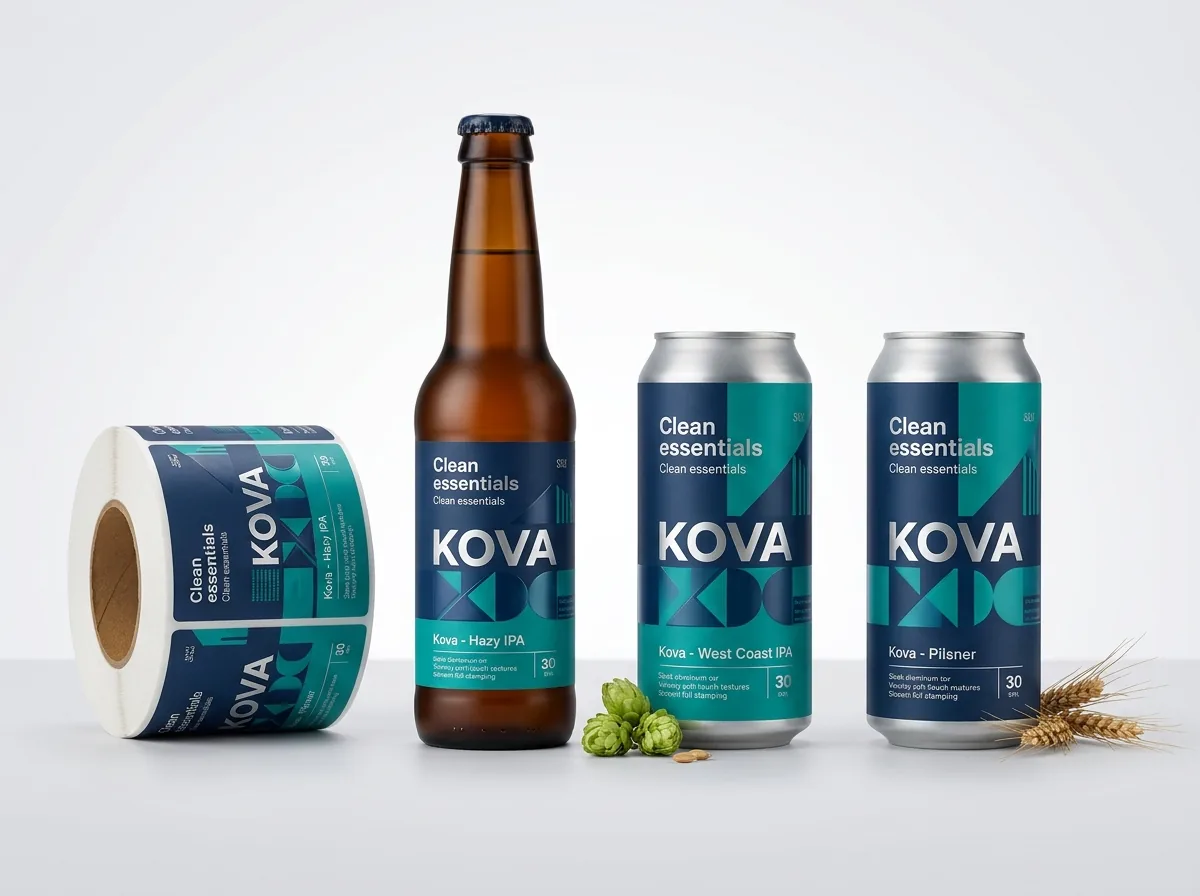
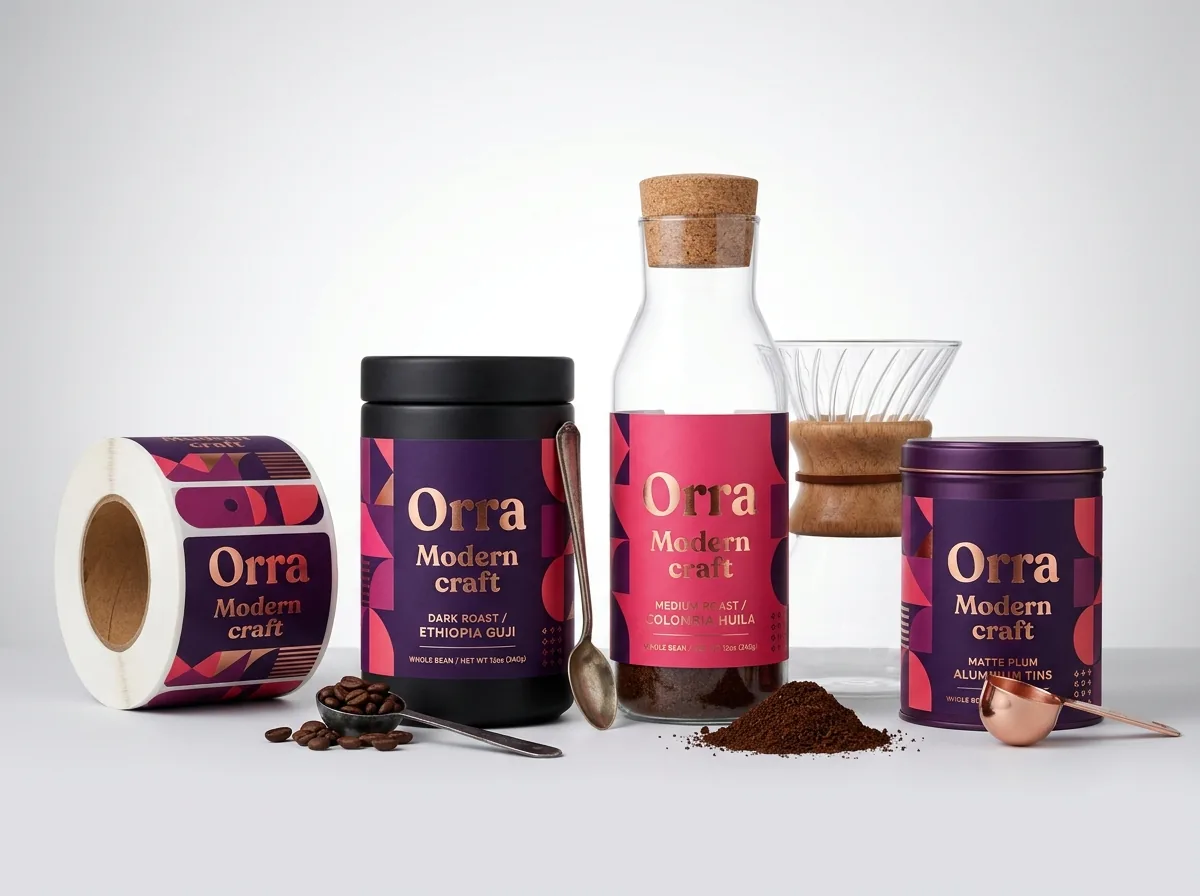
Ready to order beer labels? Compare up to 3 quantities with a free 3D mockup.
Request a Quote →Questions about beer labels
Does the TTB require bold type on the entire Government Warning statement?
No. Under 27 CFR Part 16, only the header words 'GOVERNMENT WARNING:' must appear in capital letters and bold type. The remainder of the two warning sentences must appear in regular (non-bold) continuous type so the header stands out clearly.
How much bleed and safe margin do I need on a 16 oz tallboy beer label?
Add 0.125 inches (⅛ inch) of bleed on all four sides outside the 8.0 × 4.75 inch cut line, making your full bleed document 8.25 × 5.0 inches. Keep all text, logos and barcodes at least 0.125 inches inside the cut line.
Why should I rotate my beer can barcode vertically?
A vertical (ladder-style) barcode aligns the bars parallel to the curve of the 2.60 inch can wall. That stops cylinder curvature and overhead cooler glare from distorting the spaces between bars when scanned at retail checkouts.
Can CubitPack set up the white ink layer and dieline for my brewery?
Yes. Design help, custom dielines and white-ink underbase setup on clear or metallic foil labels are completely free. Tell us which areas you want metallic and which areas you want opaque, and we will show both on your digital proof.
What file format is best for submitting craft beer label artwork?
Vector PDF, Adobe Illustrator (.ai) or EPS files with fonts converted to outlines and embedded 300 DPI images are ideal. If you only have a PNG, PSD or AI-generated image, upload it with your quote and our prepress team will prepare the print file.
How do I mark the canned-on date without an inkjet date coder?
Ask our designers to place a narrow vertical strip of twelve month boxes (JAN-DEC) and year or batch numbers along the right vertical edge of your wrap label. Your crew can notch the edge of the stack before loading the applicator.
Still have a question? Ask a packaging specialist.
Request a Quote →Request your beer labels quote
Tell us your size and quantities, and one dedicated account manager prepares pricing for each tier.
- Free design & AI-to-print studio + 3D mockup
- No die or plate charges · 4–5 day rush available
- Free shipping to all 50 states
- 10% off your first order
This prepress and layout guide combines TTB 27 CFR Part 7 and Part 16 malt beverage labeling rules with standard rotary flexo/digital roll label specifications (⅛ inch bleed, ladder barcodes, spot-white underbases). Reviewed by a CubitPack packaging specialist.
Sources
What changed
- October 22, 2026: First published.
- October 22, 2026: Updated specifications, terminology, and verified source links.
More guides
New packaging guides by email
Sizes, materials and design tips. Unsubscribe anytime.