
What size single-serve sachet or stick pack do I need by milliliters and grams?
Short answer: To size custom sachets accurately, start from your usable cavity and add 0.5 to 0.75 inches in width for side heat welds plus 20% to 25% top headspace: use 2 × 3 inches for 2 ml serums, 1.25 × 5.5 inch stick packs for 5 g electrolytes, and 3 × 4.5 inches for 12 ml sauces.
On this page
- How do outer sachet dimensions differ from usable interior fill space
- What size sachet fits 1.5 ml to 35 ml liquids, creams, sauces, and wet wipes
- What size stick pack or 3-side-seal sachet fits 2 g to 35 g supplement powders
- Why does powder bulk density change sachet size at the exact same gram weight
- How do you size a retail counter dispenser box around 14 or 30 single-serve sachets
- Common mistakes
- FAQs
Request a custom quoteFree dieline & 3D mockup
Single-serve sachet and stick-pack dimensions always describe outer edge-to-edge Width × Height in inches or millimeters, never interior fill capacity. Because flexible barrier packets have no bottom gusset, perimeter heat-sealing jaws consume 0.25 to 0.375 inches (6 to 9.5 mm) along every welded margin, while liquid splash and powder loft require an extra 0.5 to 0.75 inches of dry headspace at the top opening. In practice, 1.5 to 3 ml facial serums fit a 2 × 3 inch packet, 4 to 7 ml lotions fit 2.5 × 3.5 inches, 5 to 8 g drink powders fit a 1.25 × 5.5 inch stick pack, 8 to 15 ml condiments or 10 g collagen scoops fit 3 × 4.5 inches, and 25 to 35 g whey servings fit 4.5 × 6 inches. At CubitPack, custom printed sachets start at 500 units, ship in 10 to 14 business days (4 to 5 days rush), and include free custom dielines, zero die fees, and free 50-state US delivery.
How do outer sachet dimensions differ from usable interior fill space?
Every flexible converter quotes sachet dimensions from outer cut edge to outer cut edge. Because a gusset-free packet starts as two flat sheets of barrier film, two distinct geometric deductions shrink your actual product pocket before a single drop or gram goes inside. You can model starting pouch dimensions in our pouch size and volume calculator before requesting your dieline for single-serve custom printed sachets
- Perimeter heat-weld crimp deductions (0.25 to 0.375 in / 6 to 9.5 mm per sealed edge): On a 4-side-seal liquid packet measuring 3.0 × 4.5 inches outside, two 0.31-inch side welds reduce interior width to 2.38 inches, and top and bottom welds reduce interior height to 3.88 inches before accounting for headspace.
- Pillow-bulge foreshortening as the flat sheets bow apart: As liquid cream, folded wet-wipe fabric, or powder pushes the front and back barrier panels outward into a 3D lens shape, the outer edges draw inward slightly. Adding half of your filled packet thickness to both width and height prevents tight, drum-stretched seams.
- Anti-splash top fill headspace (0.5 to 0.75 in / 13 to 19 mm): Dosing nozzles need clean air space above the product level so viscous droplets or airborne powder dust never land on the inner sealant layer where your impulse or band sealer clamps shut.
- Tear-notch clearance zone: Side V-notches sit 0.375 to 0.625 inches below the top edge so consumers rip across the empty headspace rather than slicing directly into pressurized liquid.
What size sachet fits 1.5 ml to 35 ml liquids, creams, sauces, and wet wipes?
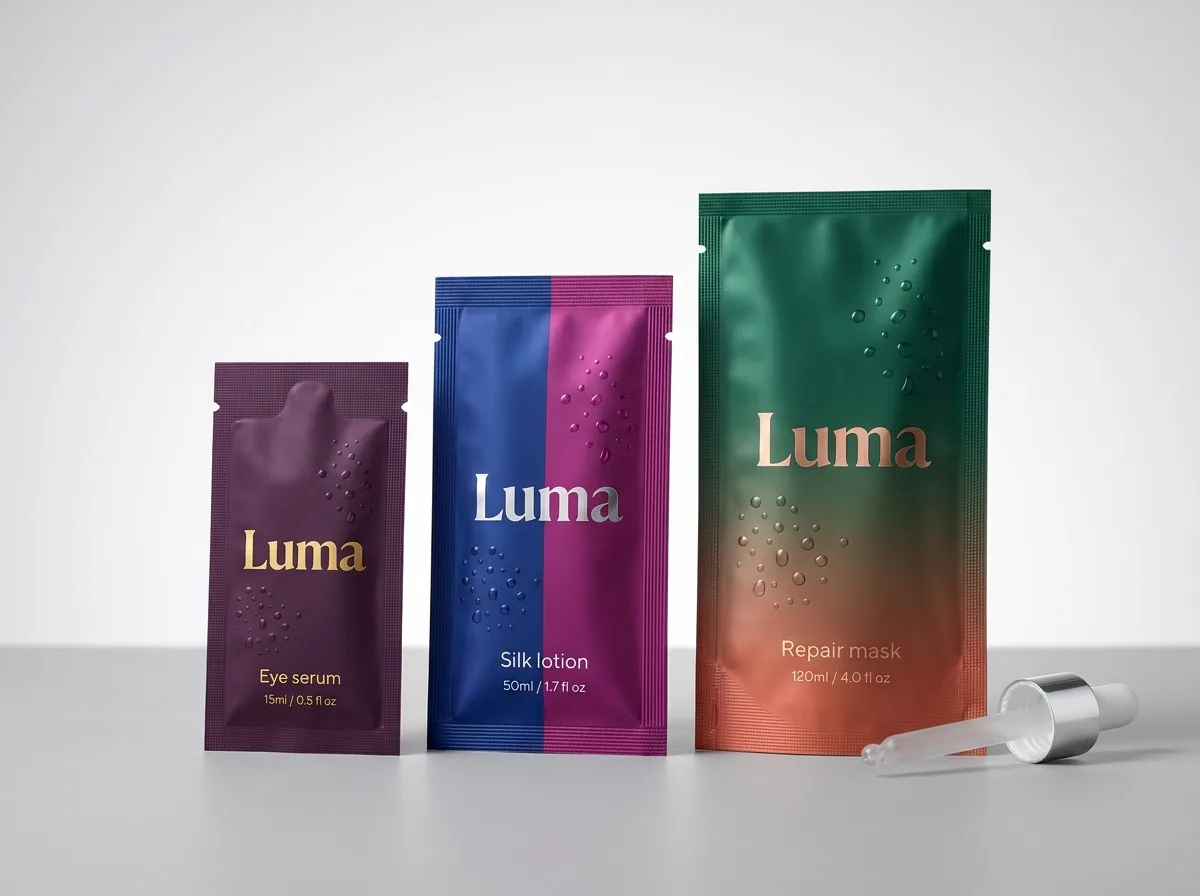
Liquids and gels have predictable specific gravity near water (1 ml equals roughly 1 cubic centimeter), except thick emulsions, raw honey, nut butters, and oil scrubs cling to dosing nozzles and require slightly wider mouths to avoid seal-zone stringing. When sizing wet-wipe sachets, always fold the spunlace or bamboo substrate to its final rectangle first, measure the folded stack thickness with calipers, and add 0.75 inches to both width and height so heated crimping jaws never pinch damp fibers. Compare seam options in 3-side-seal sachets vs 4-side-seal packets vs stick packs or step up to custom spout pouches above 50 ml
- Low-viscosity serums and toners (1.5 to 5 ml): Water-thin liquids spread flat across the cavity, requiring at least 0.625 inches of vertical headspace so capillary surge does not wet the top weld during vertical or horizontal sealing.
- Medium-viscosity lotions, SPF creams, and sauces (5 to 15 ml): Emulsions hold a dome shape in the center of the packet; adding 0.25 inches of extra width keeps internal hydraulic pressure low when shipping cartons are stacked on pallets.
- Saturated alcohol pads and cosmetic wipes: Folded nonwoven wipes trap liquid solution in the center square, so a 2 × 2 inch folded wipe fits cleanly inside a 2.75 × 3.5 inch or 3.0 × 4.0 inch 4-side-seal sachet.
| Target liquid or wipe fill | Outer size (inches) | Outer size (mm) | Net usable cavity & common products |
|---|---|---|---|
| 1.5 to 3 ml serum / pad | 2.0 × 3.0 in | 50 × 76 mm | ~1.38 × 1.88 in net · Eye serum, retinol sample, alcohol prep pad |
| 4 to 7 ml lotion / cream | 2.5 × 3.5 in | 64 × 89 mm | ~1.88 × 2.25 in net · SPF moisturizer, liquid foundation, hotel shampoo |
| 5 to 10 ml gel stick | 1.25 × 5.5 in Stick | 32 × 140 mm | Tubular center-fin · Raw honey straw, marathon energy gel, syrup shot |
| 8 to 15 ml sauce / oil | 3.0 × 4.5 in | 76 × 114 mm | ~2.38 × 3.25 in net · Hot sauce, olive oil drizzle, ketchup, body oil |
| 15 to 25 ml mask / wipe | 3.5 × 5.0 in | 89 × 127 mm | ~2.88 × 3.75 in net · Deep hair conditioner, folded cleansing wet wipe |
| 25 to 35 ml scrub / duo | 4.0 × 6.0 in (or 4.5 × 6 in) | 102 × 152 mm | ~3.38 × 4.75 in net · Sugar body scrub, salad dressing, twin skincare duo |
What size stick pack or 3-side-seal sachet fits 2 g to 35 g supplement powders?
Dry nutrition brands split single-dose packaging into two silhouettes: slender tubular stick packs under 1.5 inches wide that funnel straight into a standard 28 mm reusable water bottle neck without spilling on gym counters, and wider rectangular 3-side-seal packets for larger 10 g to 35 g scoops stirred into shaker cups, coffee mugs, or smoothie bowls. Keep in mind that tubular center-fin stick packs form a round cylinder when filled, whereas 3-side-seal sachets flatten into an elliptical pillow. For multi-serving resealable bags, compare our custom supplement pouches and custom flat pouches
- Bottle-neck pouring clearance: Standard disposable and reusable water bottles measure 0.85 to 1.1 inches inside the mouth, which is why 0.9 to 1.38 inch wide stick packs dominate hydration electrolytes, instant coffee, and energy mixes.
- Auger drop tube diameter: Stick packs narrower than 1.0 inch require smaller auger dosing funnels and free-flowing granulated powders so product bridges do not clog the mouth during high-speed vertical filling.
- Single-scoop protein and meal shakes (25 to 35 g): At 30 grams, a stick pack becomes impractically long (over 8 inches), making a 4.5 × 6.0 inch 3-side-seal flat sachet far easier to pack inside starter kits and subscription mailers.
| Dry powder dose (grams) | Recommended format | Outer size (in / mm) | Typical dry supplement or beverage use |
|---|---|---|---|
| 2 to 4 g fine powder | Slim stick pack | 1.0 × 4.5 in (25 × 114 mm) | Instant espresso, probiotic blend, stevia or monk-fruit sweetener |
| 5 to 8 g drink mix | Standard stick pack | 1.25 × 5.5 in (32 × 140 mm) | Electrolyte hydration mix, BCAA recovery, energy drink powder |
| 8 to 12 g medium scoop | Wide stick or 3-side seal | 1.5 × 6.0 in or 3.0 × 4.5 in | Hydrolyzed collagen peptides, mushroom coffee, daily superfood greens |
| 15 to 20 g full scoop | 3-side-seal sachet | 3.5 × 5.0 in (89 × 127 mm) | Pre-workout complex, hot cocoa mix, oatmeal topping, bath soak salt |
| 25 to 35 g protein dose | Large 3-side-seal sachet | 4.5 × 6.0 in (114 × 152 mm) | Single-serving whey or plant protein isolate, meal-replacement shake |
Know your size? Compare pricing across up to 3 quantities.
Request a Quote →Why does powder bulk density change sachet size at the exact same gram weight?
Never copy another supplement brand's outer sachet dimensions based on net gram weight alone. Powders vary more than twofold in untapped bulk density (grams per cubic centimeter), plus auger fillers whip air into fine botanical particles during high-speed dosing
- Heavy crystalline powders (0.85 to 1.10 g/cm³): Sodium-potassium electrolyte salts, granulated sugar, citric acid, and Epsom bath crystals pack tightly. Ten grams occupies only 10 to 12 ml of cavity volume, fitting effortlessly inside a compact 2.5 × 3.5 inch sachet or 1.25 × 5.0 inch stick.
- Medium-density peptides and cocoa (0.50 to 0.65 g/cm³): Hydrolyzed collagen, creatine monohydrate, and instant coffee agglomerates take roughly 16 to 20 ml per 10-gram serving, matching a 3.0 × 4.5 inch 3-side-seal packet.
- Fluffy botanical greens and plant proteins (0.35 to 0.45 g/cm³): Spirulina, wheatgrass, pea protein, and milled adaptogen mushrooms trap air pockets. Ten grams expands to 23 to 28 ml during auger drop, requiring a 3.5 × 5.0 inch sachet so dust clears the top seal.
- Verify with physical swatches before locking artwork: Order our $50 packaging sample kit (credited toward your first order) or request a size check while reviewing liquid and powder sachet barrier films and seal margins.
How do you size a retail counter dispenser box around 14 or 30 single-serve sachets?
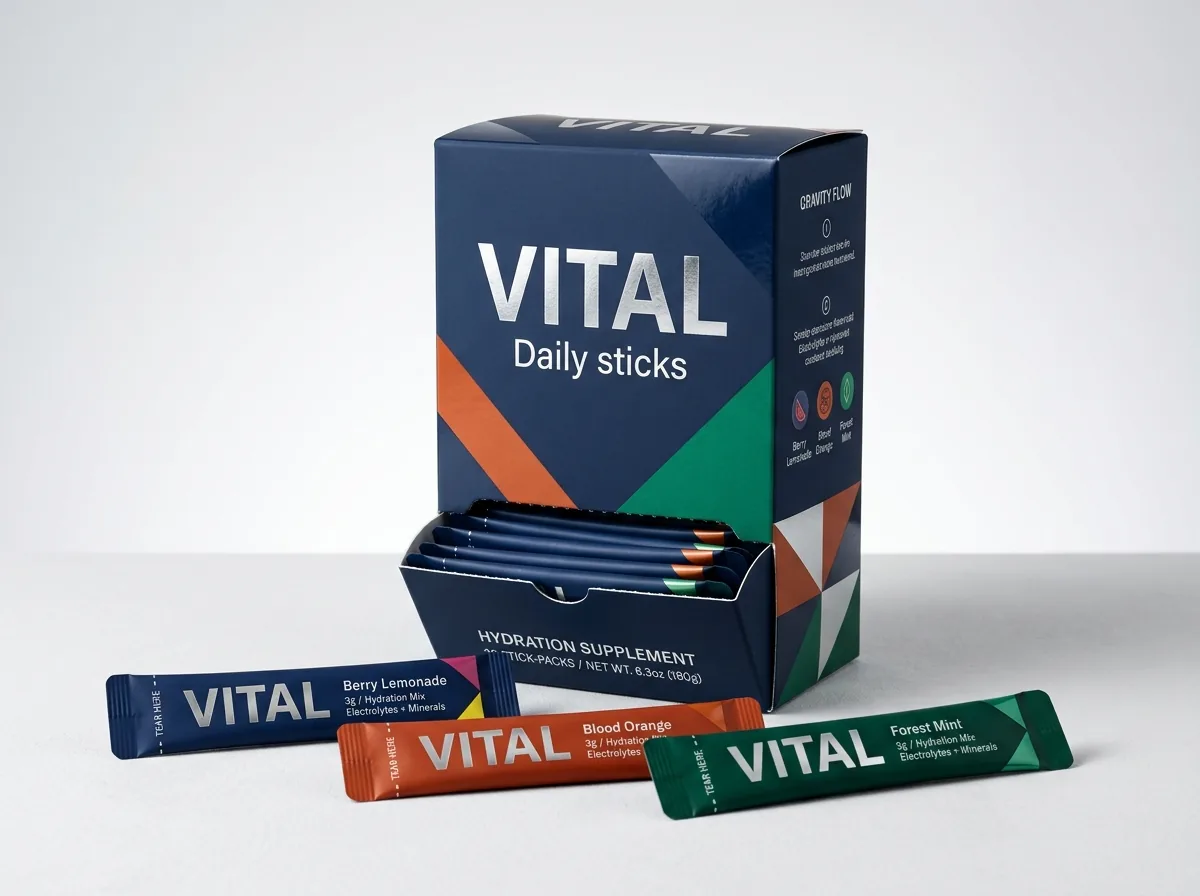
Because gusset-free sachets and stick packs cannot stand upright on retail shelves by themselves, wellness and beauty brands bundle 7, 14, 20, or 30 portions inside custom dispenser boxes or custom counter display boxes. Getting carton fit right comes down to filled pillow thickness
- Measure filled center thickness, not flat empty film: Twenty-four empty sachets stack under 0.25 inches tall, whereas 24 filled 10 g powder sachets each bow out to 0.28 inches at the center, requiring nearly 6.75 inches of carton depth.
- Alternate head-to-toe orientation on liquid sachets: Because liquid settles slightly toward the bottom half when standing, packing pairs front-to-back keeps the stack square inside gravity-fed dispenser cartons.
- Add 0.125 to 0.1875 inches of side clearance inside dispenser slots: Leaving 1/8 inch of breathing room on left and right carton walls lets sachets drop smoothly down a perforated pull-out slot without jamming on crimp corners.
- Coordinate sachets and cartons on one quote: CubitPack manufactures both your sachets (from 500 units) and matching paperboard cartons with guaranteed Pantone alignment, zero die or plate charges, and free shipping to all 50 US states.
What are the five most common sachet and stick-pack sizing mistakes?
Double-check your milliliter or gram calculations against these five sizing traps before approving your sachet dieline
- Using outer packet Width × Height as interior volume without subtracting 0.5 to 0.75 inches for left and right heat-weld crimps.
- Copying a crystalline salt electrolyte sachet size for fluffy greens or plant protein that occupies twice the volume per gram.
- Skipping the 0.5 to 0.75 inch dry top headspace allowance, causing serum droplets or powder dust to ruin top heat seals.
- Choosing a wide 3.5-inch packet for on-the-go hydration mixes that spill outside a narrow 1-inch water bottle opening.
- Sizing outer retail dispenser cartons from empty film thickness instead of measuring filled, pillowed sachets.
Packaging for this
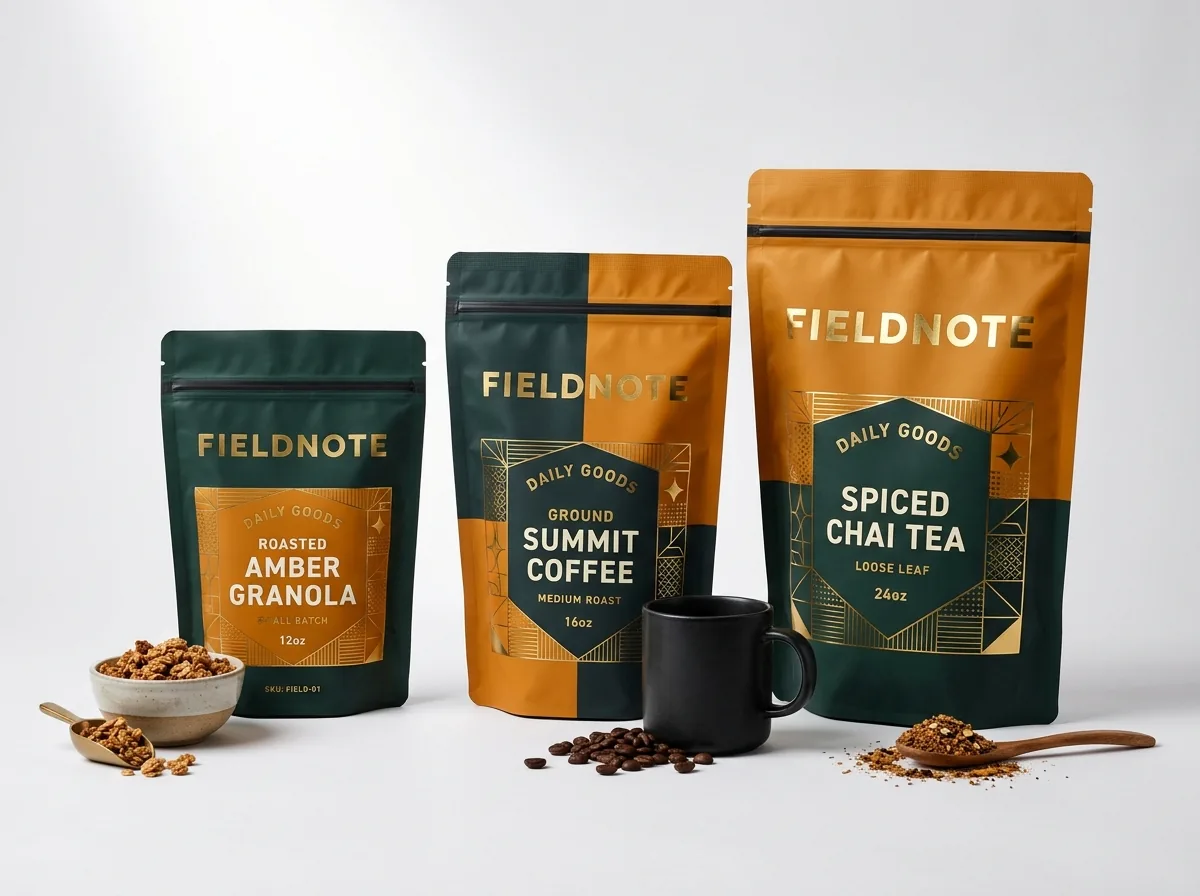
Ready to order sachets? Compare up to 3 quantities with a free 3D mockup.
Request a Quote →Questions about sachets
Are custom sachets measured by inside or outside dimensions?
Custom sachets and stick packs are always measured by outside Width × Height from cut edge to cut edge, including all perimeter heat-weld seams. Always subtract 0.25 to 0.375 inches per welded edge plus top headspace to find usable interior space.
What size sachet do I need for a 5 ml cosmetic serum or moisturizer sample?
A 2.5 × 3.5 inch (64 × 89 mm) 4-side-seal sachet is the cosmetic industry benchmark for 4 to 7 ml of facial serum, SPF lotion, liquid foundation, or shampoo, leaving clean top headspace for leak-free sealing.
What size stick pack fits 5 to 7 grams of electrolyte drink powder?
A 1.25 × 5.5 inch (32 × 140 mm) center-fin stick pack comfortably holds 5 to 8 grams of crystalline hydration or energy drink powder while pouring neatly into standard narrow-neck water bottles.
What is the minimum order quantity for custom sized sachets at CubitPack?
Minimum orders start at 500 sachets, with smaller trial runs reviewed case by case. Every order includes custom Width × Height sizing with zero die or plate charges, free design help, and a 3D mockup before payment.
How do I size a sachet for a folded wet wipe or sanitizing towelette?
Fold your saturated wipe to its finished square or rectangle first, measure its folded length, width, and thickness, then add 0.75 inches to both width and height so perimeter crimp jaws clear the wet fabric completely.
How long does it take to get custom sized sachets delivered?
Standard production takes 10 to 14 business days after digital proof approval and payment, with 4 to 5 business day rush production quoted per order. Standard shipping across all 50 US states is included free.
Still have a question? Ask a packaging specialist.
Request a Quote →Request your sachets quote
Tell us your size and quantities, and one dedicated account manager prepares pricing for each tier.
- Free design & AI-to-print studio + 3D mockup
- No die or plate charges · 4–5 day rush available
- Free shipping to all 50 states
- 10% off your first order
We calculated single-serve sachet and stick-pack outer dimensions by combining ASTM F88 flexible weld margin clearances with typical cosmetic specific-gravity and nutritional powder bulk-density ranges (0.35 to 1.05 g/cm³). A packaging specialist checked every dimension row and deduction rule. Spot an error? Tell us and we will fix it.
Sources
- Perimeter heat-weld crimp width deductions (6 to 9.5 mm) and dry seal headspace rules.
- Outer dimension measurement conventions for 3-side-seal, 4-side-seal, and center-fin stick-pack formats.
- Untapped vs tapped bulk-density differences across crystalline electrolytes, collagen peptides, and botanical powders.
What changed
- November 16, 2026: First published with liquid milliliter (1.5-35 ml) and dry powder gram (2-35 g) sachet and stick-pack sizing matrices, bulk-density comparison diagram, and dispenser carton fit math.
More guides
New packaging guides by email
Sizes, materials and design tips. Unsubscribe anytime.