
What size kraft stand up pouch do I need?
Short answer: Kraft stand up pouches are measured by outside Width × Height × Bottom Gusset in inches. Choose 5 × 8 × 2.5 in for 4 oz tea or jerky, 6 × 9 × 3 in for 8 to 12 oz coffee or granola, and 7 × 10.5 × 3.5 in for 1 lb fills in custom kraft stand up pouches.
On this page
- Why do multi-layer kraft pouches measure differently than thin plastic bags
- What are the standard kraft stand up pouch sizes by weight and product
- How do I size kraft stand up pouches for whole-bean coffee vs loose-leaf tea
- How do clear windows and degassing valves affect usable pouch height
- When should I switch from a round Doypack gusset to a K-seal kraft base
- Common mistakes
- FAQs
Request a custom quoteFree dieline & 3D mockup
To size a kraft stand up pouch accurately, start with the cubic volume of your product rather than its weight in ounces alone, and allow an extra quarter-inch of width compared with a thin single-layer plastic bag. Because a kraft barrier pouch bonds real unbleached brown or bleached white kraft paper to an inner metallized or foil barrier core and a heat-sealable polyethylene liner, the multi-ply wall is noticeably crisper and stiffer than plain film. That added stiffness makes the bag stand tall and wrinkle-free on retail shelves, but it also means the W-folded bottom gusset needs enough product weight and side-wall flex to pop completely open. Always subtract 0.5 to 0.75 inches from outer Width for the two side heat seals and 1.5 inches from outer Height for the top press-to-close zipper and impulse seal header.
Why do multi-layer kraft pouches measure differently than thin plastic bags?
When you order printed kraft stand up pouches, the dimensions on your quote (Width × Height × Bottom Gusset in inches) always describe the flat outside footprint of the bag before filling. Width runs left to right from outer edge to outer edge, Height runs from the bottom fold to the top lip above the tear notches, and Bottom Gusset is the full unfolded depth of the oval base. If you test-fill a thin polyethylene sandwich bag at home and order those exact outside numbers in a 3-ply kraft-foil-polyethylene laminate, the finished pouch will feel tighter. Real paper fibers laminated over a barrier core resist stretching and bend along a wider arc when the bottom gusset opens. Adding 0.25 inches to Width and 0.5 inches to Height over a thin film prototype ensures the stiffer kraft walls bow open smoothly without pinching the product below the zipper.
- Side seal deduction: subtract 0.25 to 0.375 inches on both the left and right edges (0.5 to 0.75 inches total) for vertical heat-seal seams.
- Top zipper header: subtract 1.25 to 1.5 inches at the top for the impulse seal strip, V-cut tear notches and press-to-close zipper track.
- Paper-laminate flex allowance: add 0.25 inches of extra width so stiffer kraft + foil walls open into a round oval base.
- Bottom gusset fold height: when empty, the W-folded bottom gusset tucks halfway up its total depth inside the lower bag.
- Scoop and hand clearance: verify that the interior mouth width (outer Width minus side seals) is at least 1.5 inches wider than your filling funnel.
What are the standard kraft stand up pouch sizes by weight and product?
While CubitPack cuts every kraft stand up pouch to your exact Width × Height × Bottom Gusset with no die or plate charges, six standard dimensions cover the vast majority of specialty coffee, loose-leaf tea, granola, baking mixes, pet treats and bath soaks. Each row below is calibrated for medium-density dry goods like whole-bean coffee or oat clusters. Use the volume column alongside the ounce column when picking your starting size. Eight ounces of whole chamomile flowers or freeze-dried apple slices occupies nearly double the volume of 8 ounces of roasted coffee beans, whereas 8 ounces of coarse Dead Sea bath salt takes up only half the space.
| Outer size (W × H × Gusset) | Medium-density dry weight | Fluid volume & typical kraft pouch products |
|---|---|---|
| 4 × 6 × 2 in | 1 to 2 oz (28 to 57 g) | 8–12 fl oz · Loose-leaf tea samples, spice rubs, travel soak |
| 5 × 8 × 2.5 in | 4 oz (113 g) | 16–22 fl oz · Beef jerky, dried mango, dog training treats |
| 6 × 9 × 3 in | 8 to 12 oz (227 to 340 g) | 28–38 fl oz · Whole-bean coffee, granola, cookies, bath salts |
| 7 × 10.5 × 3.5 in | 16 oz / 1 lb (454 g) | 48–60 fl oz · Almond flour, pancake mix, oats, cacao powder |
| 8.5 × 12 × 4 in | 32 oz / 2 lb (907 g) | 85–105 fl oz · Plant protein, bulk roasted nuts, pet kibble |
| 10 × 14 × 5 in | 3 to 5 lb (1.36 to 2.27 kg) | 150–210 fl oz · Wholesale cafe coffee, family snack refills |
How do I size kraft stand up pouches for whole-bean coffee vs loose-leaf tea?
Coffee roasters and tea blenders are the two largest users of foil-lined kraft pouches, yet their products have opposite bulk densities. Whole roasted coffee beans (especially dark roasts where beans expand more during roasting) need a 6 × 9 × 3 inch or 6.25 × 9.5 × 3.5 inch pouch to hold a standard 12 ounce retail bag with enough headspace for a one-way degassing valve above the bean line. Ground coffee packs roughly 15 to 20 percent denser than whole beans, so 12 ounces of ground espresso sits lower in the same bag. Loose-leaf botanical teas, herbal tisanes and ceremonial matcha require careful volume testing. Four ounces of dense rolled gunpowder green tea easily fits inside a compact 5 × 8 × 2.5 inch pouch, while 4 ounces of whole-leaf peppermint, lemon verbena or hibiscus petals requires stepping up to a 6 × 9 × 3 inch or 7 × 10.5 × 3.5 inch pouch so the fragile leaves are not crushed when pressing the zipper shut. See our dedicated custom coffee bags and custom tea pouches pages for category-specific valve and barrier options.
Know your size? Compare pricing across up to 3 quantities.
Request a Quote →How do clear windows and degassing valves affect usable pouch height?
Adding a clear peek window or a one-way degassing valve to a kraft stand up pouch changes how your filled product looks and functions inside the bag. On a windowed kraft pouch, the clear cutout must sit at least 0.75 inches inside the left and right side seals, 1.25 inches above the bottom edge (so the internal W-gusset fold never peeks through the bottom of the window), and 1.75 inches below the top edge to clear the zipper track. If you size the pouch too large for your fill weight, the top surface of your granola, nuts or pet treats will drop below the top edge of the clear window, making a brand-new bag look half-empty on the store shelf. Size a windowed kraft pouch so the settled product fills at least 75 percent of the interior cavity below the zipper, completely covering the window opening from bottom to top. If you want a full-face window on a non-paper film bag, compare our custom stand up pouches with window.
When should I switch from a round Doypack gusset to a K-seal kraft base?
For fills under 16 ounces (1 pound), a standard round Doypack bottom gusset forms a rigid oval ring that keeps kraft pouches standing straight on flat shelves. Once your fill weight climbs into the 1.5 to 3 pound range (common for almond flour, gluten-free baking mixes, Epsom bath salts and bulk pet biscuits), the downward pressure of the dense contents can push the center of a round bottom gusset below the outer bottom seal rim, causing the bag to rock. Switching to a K-seal bottom gusset angles the lower left and right corner seals at 30 degrees. That geometry shifts weight off the bottom seam onto the side walls and lets heavier 1.5 to 3 pound kraft pouches sit completely flat without rocking.
What are the most common kraft stand up pouch sizing mistakes?
Avoid these five sizing errors when moving your product into multi-layer kraft barrier pouches
- Copying exact dimensions from a stretchy thin plastic bag without adding 0.25 inches of width for the stiffer kraft-plus-foil laminate.
- Sizing a windowed kraft pouch too tall for the fill weight, so the product settles below the top of the clear window and looks underfilled.
- Using the same pouch size for 4 oz of rolled green tea and 4 oz of fluffy herbal blossoms without checking bulk volume.
- Forgetting to leave 1.5 inches of top headspace for the zipper track and heat-seal band, plus room above the product line for a coffee degassing valve.
- Packing 2 to 3 pounds of dense bath salts or baking flour in a narrow round-gusset pouch instead of stepping up to a wider K-seal base.
Packaging for this
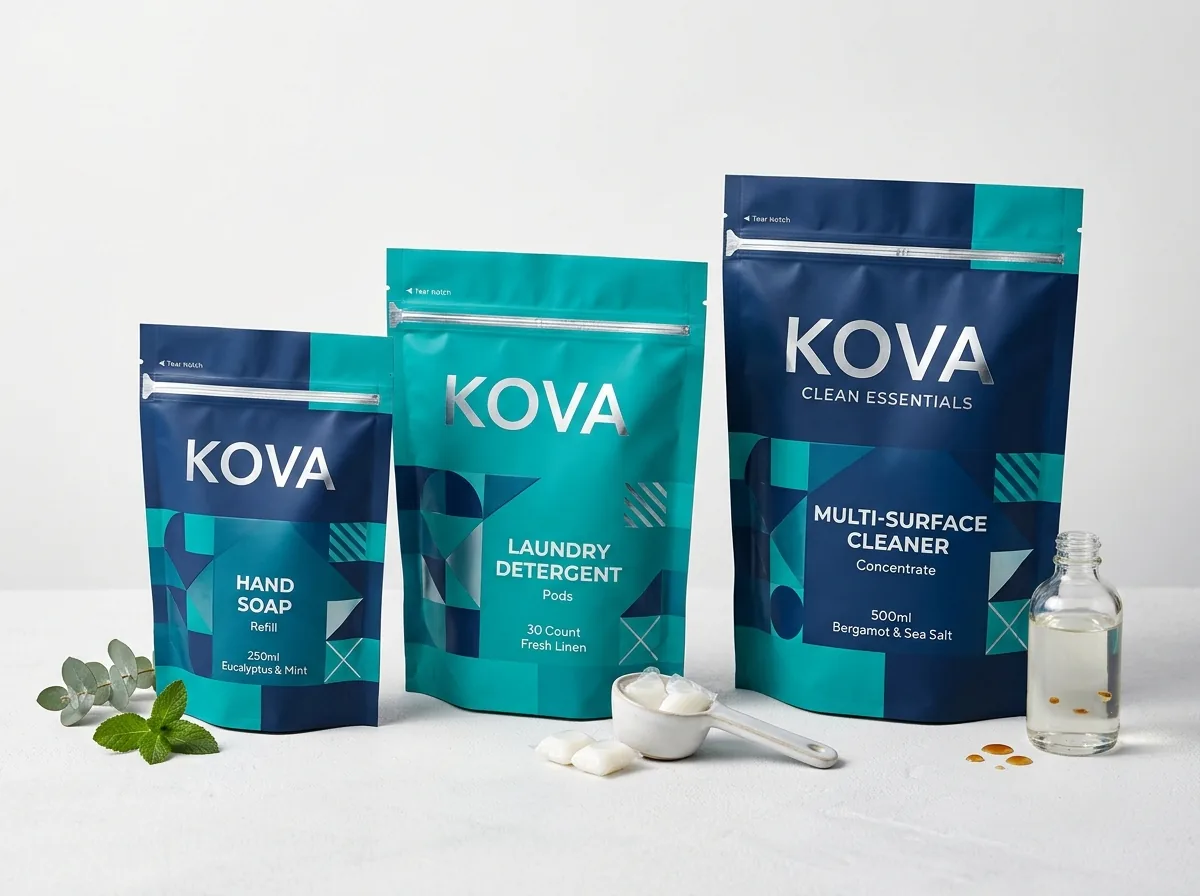
Ready to order kraft stand up pouches? Compare up to 3 quantities with a free 3D mockup.
Request a Quote →Questions about kraft stand up pouches
What size kraft stand up pouch fits 12 oz of whole-bean coffee?
A 6 × 9 × 3 inch or 6.25 × 9.5 × 3.5 inch kraft stand up pouch is the most common size for 12 oz (340 g) of whole-bean coffee. Dark roasts are slightly less dense than light roasts, so test-fill your darkest roast first to verify headspace below the zipper.
How do I measure a kraft stand up pouch that I already use?
Lay the empty pouch flat and measure the total outer Width from left edge to right edge, then measure total outer Height from the bottom edge to the very top above the zipper. Open the bottom fold completely and measure the front-to-back depth for the Bottom Gusset.
How far above the bottom edge should a clear window sit on a kraft pouch?
Keep the bottom edge of a clear window at least 1.25 to 1.5 inches above the bottom of the pouch on a bag with a 2.5 to 3 inch bottom gusset. That prevents the internal W-folded bottom gusset from showing through the lower half of the window.
Can I order a custom kraft stand up pouch size with no cutting-die charge?
Yes. CubitPack produces custom kraft stand up pouches to your exact Width × Height × Bottom Gusset with zero die or plate charges, whether you choose a solid foil-lined pouch or a custom window cutout.
How much space does a one-way degassing valve need inside a kraft coffee pouch?
A one-way degassing valve is heat-welded to the inside of the front or back wall, usually centered 2.25 to 3 inches below the top edge of the pouch (just below the zipper track). Leave at least 0.5 inches of headspace between the top of the coffee beans and the valve.
How can I test kraft pouch sizes with my actual product before printing?
Order our $50 sample kit to test-fill real multi-layer kraft barrier pouches on your packing table, or order a paid custom-printed sample made to your exact dimensions, both credited toward your full production order.
Still have a question? Ask a packaging specialist.
Request a Quote →Request your kraft stand up pouches quote
Tell us your size and quantities, and one dedicated account manager prepares pricing for each tier.
- Free design & AI-to-print studio + 3D mockup
- No die or plate charges · 4–5 day rush available
- Free shipping to all 50 states
- 10% off your first order
The sizing rules in this guide account for outer W × H × Bottom Gusset flexible pouch conventions, multi-ply kraft paper + barrier film stiffness, window frame margins and bulk density differences across coffee, tea and dry foods. Checked by a CubitPack packaging specialist. Spot an error? Tell us and we will fix it.
Sources
What changed
- October 22, 2026: First published.
- October 22, 2026: Updated specifications, terminology, and verified source links.
More guides
New packaging guides by email
Sizes, materials and design tips. Unsubscribe anytime.