
How do you spec barrier films, crimp margins, and tear notches for liquid and powder sachets?
Short answer: When specifying custom sachets, pair an aluminum-foil barrier core with a chemical-resistant inner sealant for liquid serums, alcohol wipes, and sauces, or a metallized film for dry powders, while keeping all text 0.25 to 0.375 inches inside crimp welds and 0.5 inches below V-tear notches.
On this page
- How does a 3-layer sachet barrier laminate protect sensitive liquids and powders
- When do you need pure aluminum foil vs metallized film, clear film, or kraft
- Which inner sealant layers stop essential oils, alcohol wipes, and hot sauces from delaminating
- How wide should crimp margins, tear-notch buffers, and lot-code zones be on a sachet dieline
- How do you turn an AI concept or rough sketch into print-ready sachet artwork
- Common mistakes
- FAQs
Request a custom quoteFree dieline & 3D mockup
A single-serve sachet has far more surface area per gram of product than a full-size jar or tub, which means tiny moisture, oxygen, or solvent leaks ruin shelf life rapidly. Reliable portion packets combine three laminated layers: a heat-resistant outer print web, a middle barrier shield (solid aluminum foil, vacuum-metallized film, or oxide-coated clear polymer), and an inner thermoplastic sealant matched to your formula's oil, acid, or alcohol content. Equally critical is dieline prepress geometry: perimeter sealing jaws crush 0.25 to 0.375 inches (6 to 9.5 mm) around the packet, dosing nozzles need 20% to 25% dry headspace to prevent product stringing in the weld, and laser tear lines require a 0.5-inch copy buffer. At CubitPack, custom printed sachets start at 500 units with free prepress file checks, zero plate or die fees, 10 to 14 business day turnaround, and free 50-state US shipping.
How does a 3-layer sachet barrier laminate protect sensitive liquids and powders?
No single plastic or paper sheet can resist 350°F heat-sealing jaws on the outside, block oxygen and water vapor in the middle, and melt into an airtight weld on the inside at the same time. Flexible converters laminate two to four specialized webs together when manufacturing high-barrier single-serve sachets
- Outer print and heat-shield layer (typically PET or kraft paper): Carries reverse-printed CMYK and Pantone ink (or surface printing under matte, soft-touch, or gloss lamination) and withstands direct contact with hot crimping jaws without melting or sticking.
- Middle barrier core (aluminum foil, VMPET metallized film, or clear barrier polymer): Acts as the environmental vault, governing Oxygen Transmission Rate (OTR) and Water Vapor Transmission Rate (WVTR) so hygroscopic drink powders never clump into bricks and active skincare serums never oxidize.
- Inner product-contact heat-sealant layer (LLDPE or specialized copolymer): Melts at a much lower temperature than the outer film so the two interior faces fuse into a hermetic weld seam while isolating your formula from inks and adhesives.
When do you need pure aluminum foil vs metallized film, clear film, or kraft?
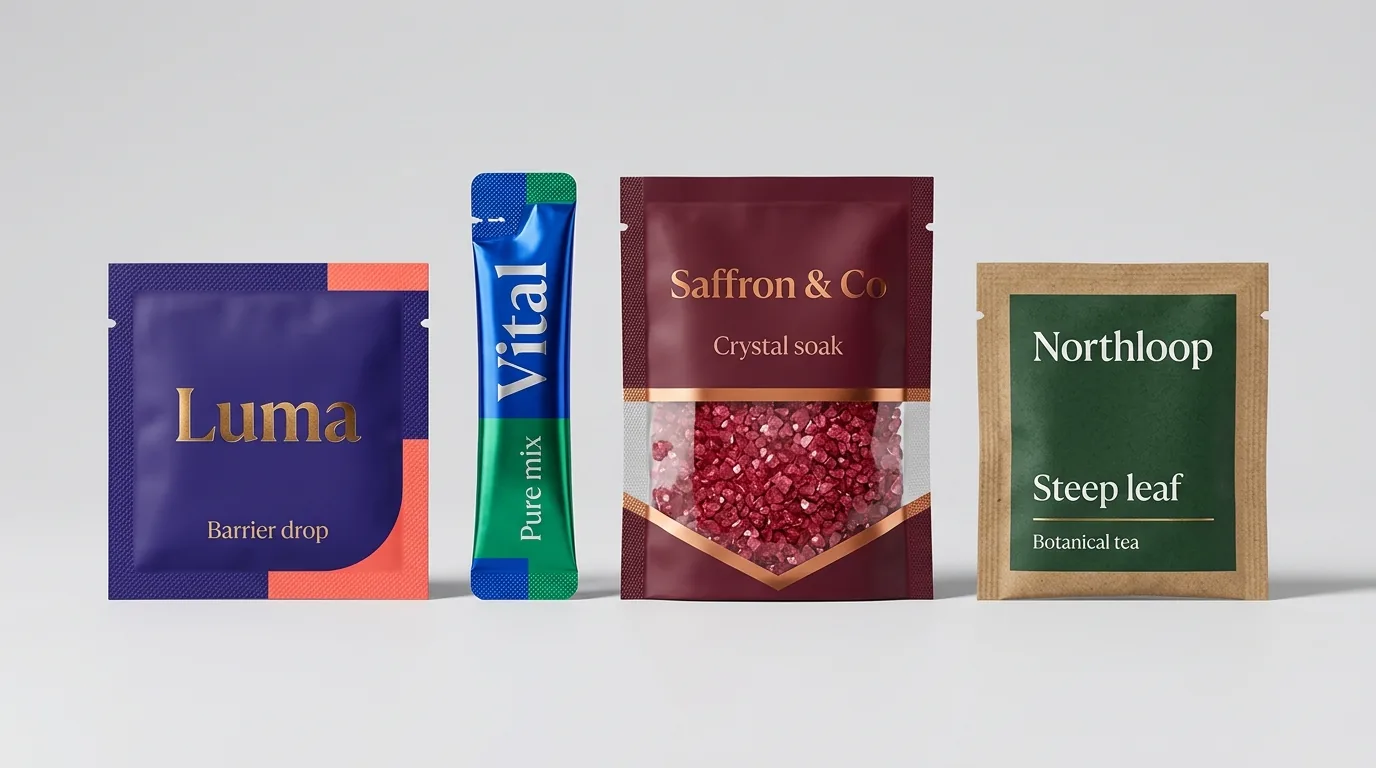
Over-specifying solid aluminum foil on a dry bath crystal wastes budget, whereas under-specifying a clear non-barrier film on an electrolyte stick turns powder into hard clumps in humid summer transit. Compare structures alongside our 3-side-seal vs 4-side-seal vs stick-pack comparison, custom tea pouches, and custom snack pouches
- Aluminum foil tri-laminates: Delivers dead-fold stiffness, 100% UV blackout, and near-zero moisture and oxygen transmission. Mandatory for vitamin C and retinol serums, isopropyl alcohol prep pads, wet wipes, liquid sauces, and moisture-sensitive effervescent or probiotic powders.
- Vacuum-metallized film (VMPET): Deposits a microscopic reflective aluminum vapor coat onto flexible polyester, giving lively spring-back flex and strong moisture protection without foil crease pinholing. Popular for collagen scoops, whey samples, and instant coffee stick packs.
- High-barrier clear or window laminates: Uses transparent oxide or EVOH-style barrier coatings so shoppers see colorful sugar scrubs, bath salts, gummies, or two-capsule vitamin doses directly through a front peek window.
- Natural brown or white kraft barrier laminates: Bonds tactile paper on the outside to a hidden foil or metallized heat-seal core on the inside for botanical tea envelopes, spice blends, and apothecary samples.
| Laminate family | Light & UV block | Moisture / O2 shield | Primary single-serve applications |
|---|---|---|---|
| Aluminum foil core | 100% opaque blackout | Ultra-high (near zero) | Cosmetic serums, wet wipes, alcohol pads, hot sauce, electrolytes |
| Metallized film (VMPET) | ~99% reflective block | High dry-goods barrier | Protein scoops, collagen sticks, instant coffee, cocoa mixes |
| Clear barrier polymer | Transparent / window | Medium to high | Gummies, colorful bath crystals, capsules, botanical toppings |
| Kraft + inner barrier | 100% opaque paper | High (with foil liner) | Herbal tea sachets, organic-look spices, bath soak samples |
Which inner sealant layers stop essential oils, alcohol wipes, and hot sauces from delaminating?
The primary cause of swollen, bubbly, or leaking liquid sachets 30 days after filling is not weak heat sealing; it is aggressive ingredients migrating through a standard polyethylene liner and dissolving the laminating adhesive between layers. Always list active solvents in your quote notes and order our $50 physical sample kit (credited to your order) when testing new formulas
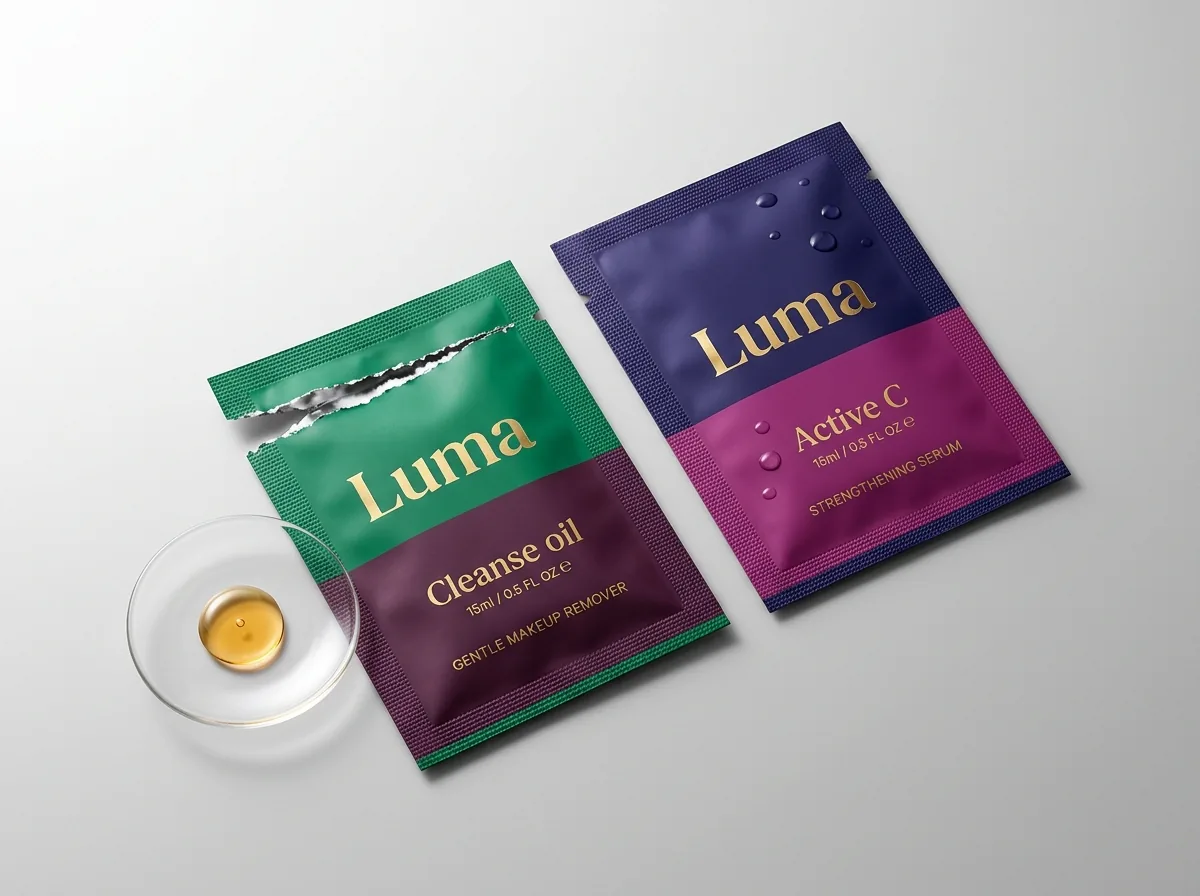
- Essential oils, terpenes, and fragrance wipes: Citrus oils, tea tree oil, menthol, and perfume compounds penetrate standard PE rapidly, causing foil delamination. Specify an oil- and solvent-resistant copolymer inner sealant layer and run a 2-week elevated-temperature stability test.
- 70% isopropyl alcohol and micellar surfactants: Sanitizing pads and makeup-remover wipes lower surface tension so liquid creeps into micro-channels along crimp edges unless sealed with a high-tack, solvent-compatible liner.
- High-acid hot sauces, vinegars, and citrus shots (pH below 4.0): Acetic and citric acids combined with salt require food-safe acid-resistant inner liners produced through certified partner facilities (with material certificates provided on request).
- Dusty micronized powders (creatine, greens, cocoa): Fine airborne dust coats the inner mouth during auger drop; specifying a broad hot-tack sealant grade lets jaws fuse reliably right through minor dust traces.
Know your size? Compare pricing across up to 3 quantities.
Request a Quote →How wide should crimp margins, tear-notch buffers, and lot-code zones be on a sachet dieline?
On a compact 2.5 × 3.5 inch packet, a 2 mm artwork shift is immediately visible. After confirming outer dimensions in our sachet and stick-pack size chart by ml and grams, run your file through our AI packaging prepress checker against these six dieline rules
- 0.125 in (3 mm) outer artwork bleed: Extend background colors and patterns 1/8 inch past all outer cut edges so rotary slitting knives never leave hairline white slivers.
- 0.25 to 0.375 in (6 to 9.5 mm) crimp-jaw safe zone: Keep every letter of ingredient copy, net-weight text, and QR codes inside the inner weld line so waffle crimping teeth do not emboss over tiny 5-point type.
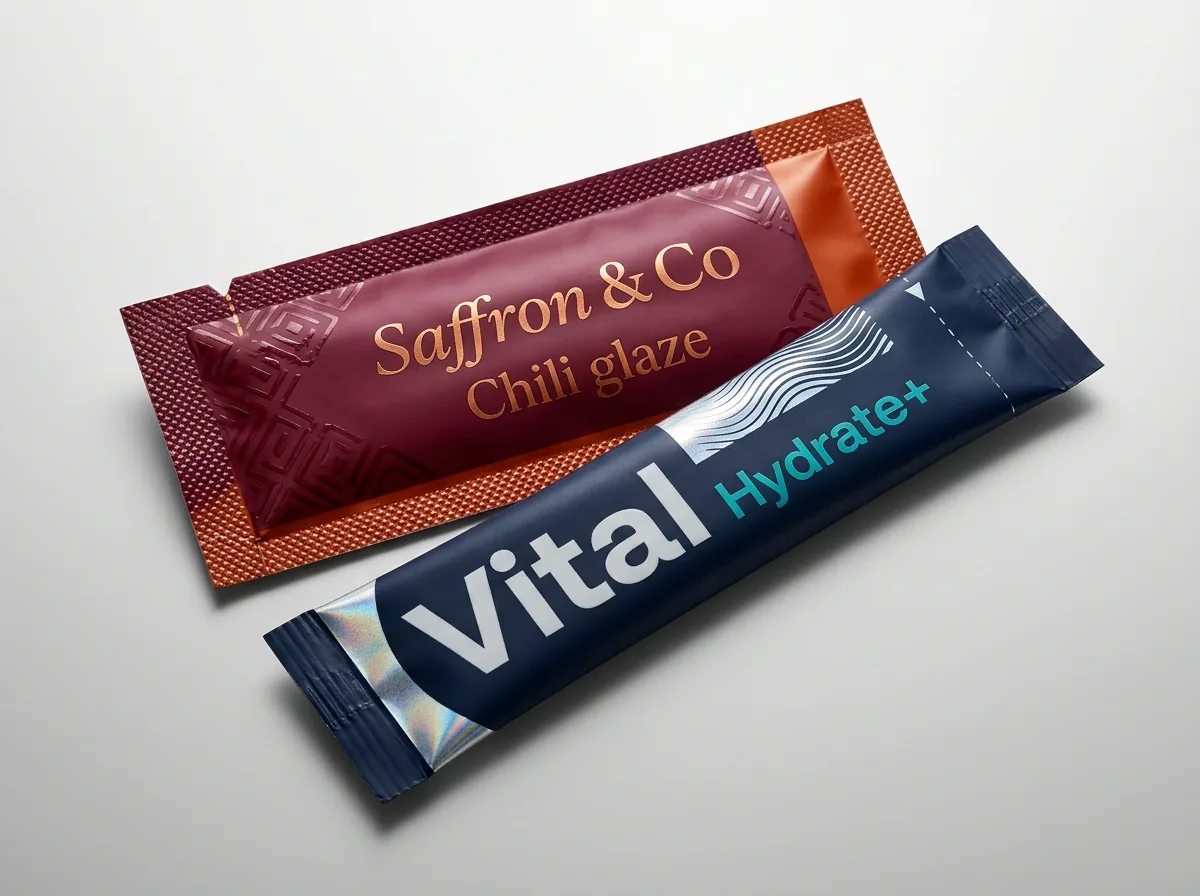
- 0.5 in (13 mm) tear-notch headline clearance: V-cut tear notches and laser score paths sit near the top headspace. Position your brand logo, product name, and dosing directions below the tear path so ripping off the top strip leaves instructions intact.
- High-contrast micro typography (minimum 5 pt positive, 6 pt reverse): On tiny cosmetic and supplement sachets, print ingredient tables in single-channel dark ink on a light panel rather than thin 4-color reverse white text that can fill in.
- Unvarnished steel-stamp lot and expiry zone: Co-packers emboss or thermal-transfer batch numbers and expiration dates into the top or bottom crimp seal; keep heavy Spot UV varnish out of that coding strip.
How do you turn an AI concept or rough sketch into print-ready sachet artwork?
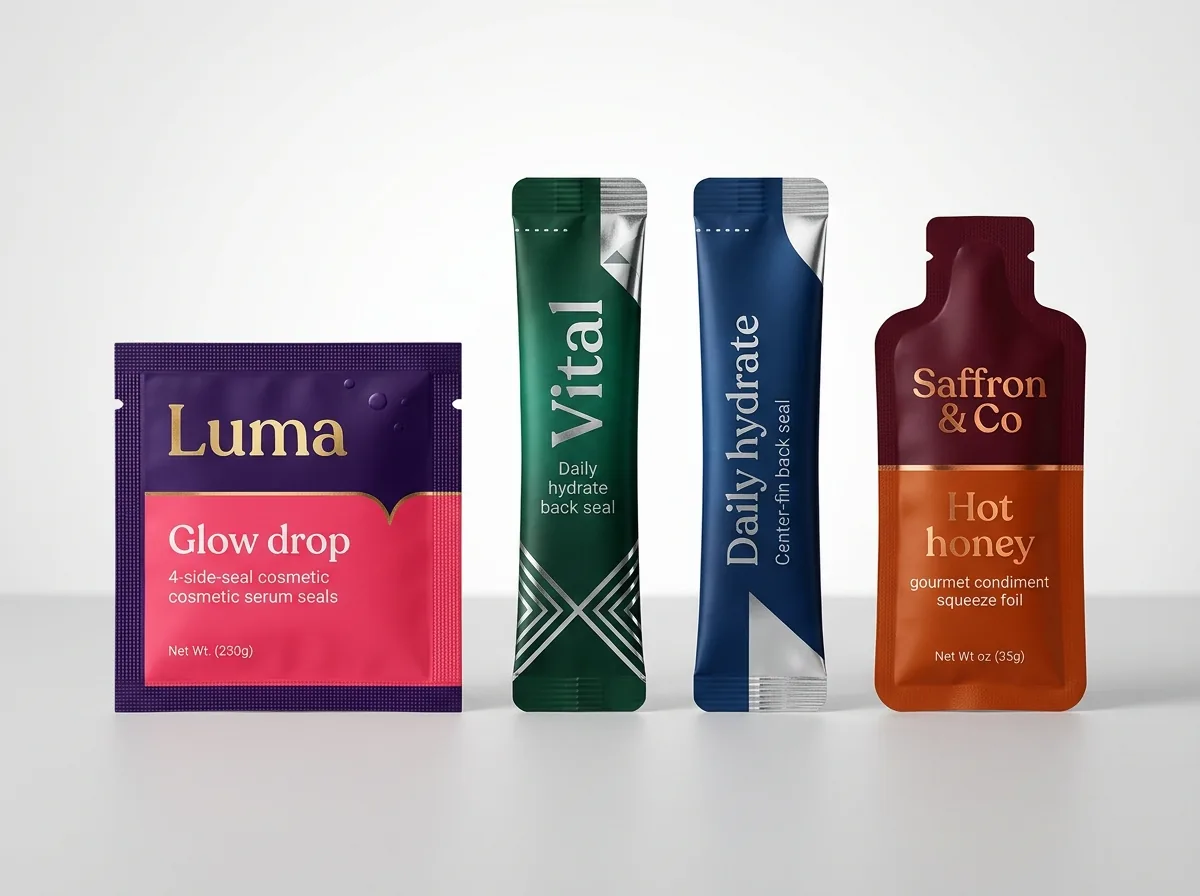
Whether you mocked up a sachet family in an AI image tool, have full-size bottle labels you want adapted onto trial packets, or are pairing sachets with custom supplement pouches and custom dispenser boxes, our AI design-to-print service handles technical prepress free of charge
- Clean vector rebuild onto your exact sachet dieline: Send your AI concept, sketch, or bottle file; our designers rebuild typography, vector icons, white-ink masks, metallic foil knockouts, and Spot UV layers cleanly onto your exact 3-side-seal, 4-side-seal, or stick-pack template at zero cost.
- 2D digital proof and interactive 3D mockup before payment: Inspect crimp borders, V-notch alignment, back-fin splits, and Pantone color targets in 3D before spending a dollar.
- 500-unit minimums and fast US delivery: Approve your proof and receive custom printed sachets in 10 to 14 business days (or 4 to 5 business days rush, quoted per order) with zero die or plate charges and free shipping to all 50 US states.
What are the five most common sachet barrier and prepress mistakes?
Check your laminate spec and artwork file against these five production pitfalls before going to press
- Packing essential-oil serums, 70% alcohol wipes, or acidic sauces inside standard dry-goods polyethylene sealant films without checking chemical compatibility.
- Using non-foil clear or light-barrier film on hygroscopic electrolyte or vitamin C formulas that clump or oxidize rapidly.
- Placing brand logos or mandatory dosing instructions across the upper V-notch tear path where users rip the header off.
- Running 5-point ingredient text or scannable QR codes into the outer 0.31-inch textured heat-crimp border.
- Printing four-color CMYK reverse 4-point text on metallic film without an opaque white underbase or single-ink knockout.
Packaging for this
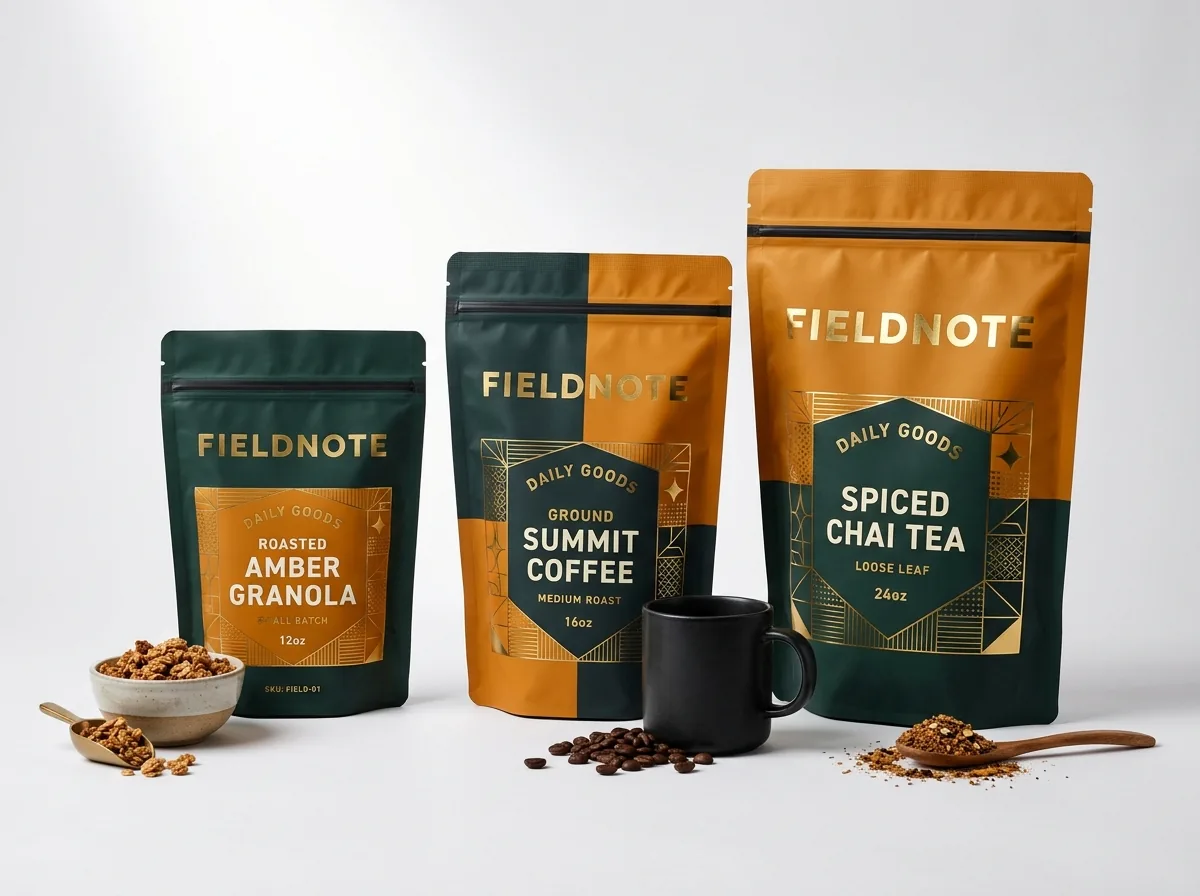
Ready to order sachets? Compare up to 3 quantities with a free 3D mockup.
Request a Quote →Questions about sachets
Do liquid cosmetic serums and alcohol wipes require an aluminum-foil sachet layer?
In almost all cases, yes. A solid aluminum-foil middle core blocks 100% of UV light and reduces moisture and solvent vapor transmission to near zero, preventing 2 ml retinol serums and alcohol pads from drying out.
Why do foil sachets sometimes need a laser score line in addition to V-cut tear notches?
Multi-layer polyester and aluminum-foil laminates have high tear strength to survive shipping drops. Adding a micro-etched laser score line across the outer polyester layer guides the tear straight across from the V-notch without stretching.
Are CubitPack sachet films safe for food, beverages, and dietary supplements?
Yes. Food-safe barrier laminates and inner sealant films are available on request through certified partner facilities for drink mixes, honey, sauces, tea, and supplements, and material certificates or lab test reports are shared on request.
How wide are the heat-seal margins on a custom sachet?
Standard 3-side-seal and 4-side-seal sachets use 0.25 to 0.375 inch (6 to 9.5 mm) perimeter heat-weld margins, while narrow center-fin stick packs use a 4 to 6 mm vertical back fin seal plus crimped end welds.
Can you emboss lot numbers and expiration dates into the sachet seal?
Yes. Pre-made sachets leave a clean, unvarnished crimp margin at the top or bottom edge so your benchtop band sealer or rotary co-packer can steel-emboss or inkjet-code batch numbers and expiry dates clearly.
Do I pay extra for custom sachet dielines, prepress checks, or printing plates?
No. CubitPack charges zero die or printing plate fees, builds your custom sachet dieline free, checks tear-notch and crimp clearances before production, and shows a 2D proof and 3D mockup before payment.
Still have a question? Ask a packaging specialist.
Request a Quote →Request your sachets quote
Tell us your size and quantities, and one dedicated account manager prepares pricing for each tier.
- Free design & AI-to-print studio + 3D mockup
- No die or plate charges · 4–5 day rush available
- Free shipping to all 50 states
- 10% off your first order
We compiled flexible sachet barrier layer properties, solvent-compatibility considerations, and crimp/tear-notch prepress tolerances using Flexible Packaging Association materials references, ASTM F88 seal-strength methods, and US cosmetic/supplement labeling layout practices. A packaging specialist verified every clearance rule. Spot an issue? Tell us and we will fix it.
Sources
What changed
- November 16, 2026: First published with 3-layer barrier laminate cross-section, foil vs metallized vs clear vs kraft selection table, oil/alcohol sealant checklist, and sachet dieline tolerances.
More guides
New packaging guides by email
Sizes, materials and design tips. Unsubscribe anytime.