
Rigid drawer boxes vs tray and sleeve vs book-style boxes: which should you choose?
Short answer: Choose a custom rigid drawer box when you want a thick 1.5–2.5 mm magnet-free sliding keepsake starting at 50 units, a paperboard tray and sleeve box for lightweight retail runs starting at 1,000 units, and a side-hinged book-style rigid box when you need a wide inside-cover story reveal.
On this page
- How do rigid drawer boxes, tray-and-sleeve cartons, and book-style boxes compare side by side
- When should you upgrade from a paperboard tray and sleeve box to a turned-edge rigid drawer box
- Why choose a rigid drawer box over a side-hinged book-style or magnetic closure rigid box
- How do you pair rigid drawer boxes with outer corrugated mailers for e-commerce transit
- How do I make the final call between a rigid drawer, tray-and-sleeve, or book-style box
- Common mistakes
- FAQs
Request a custom quoteFree dieline & 3D mockup
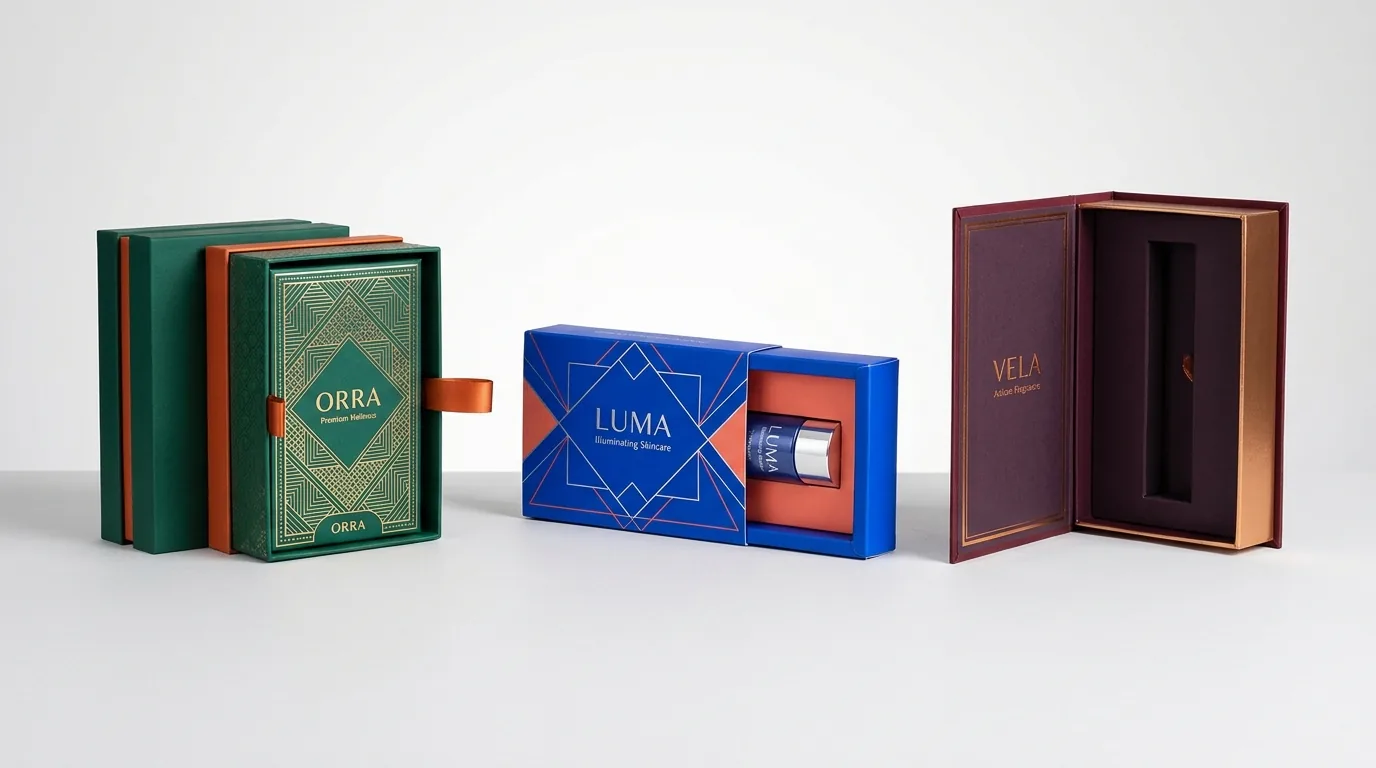
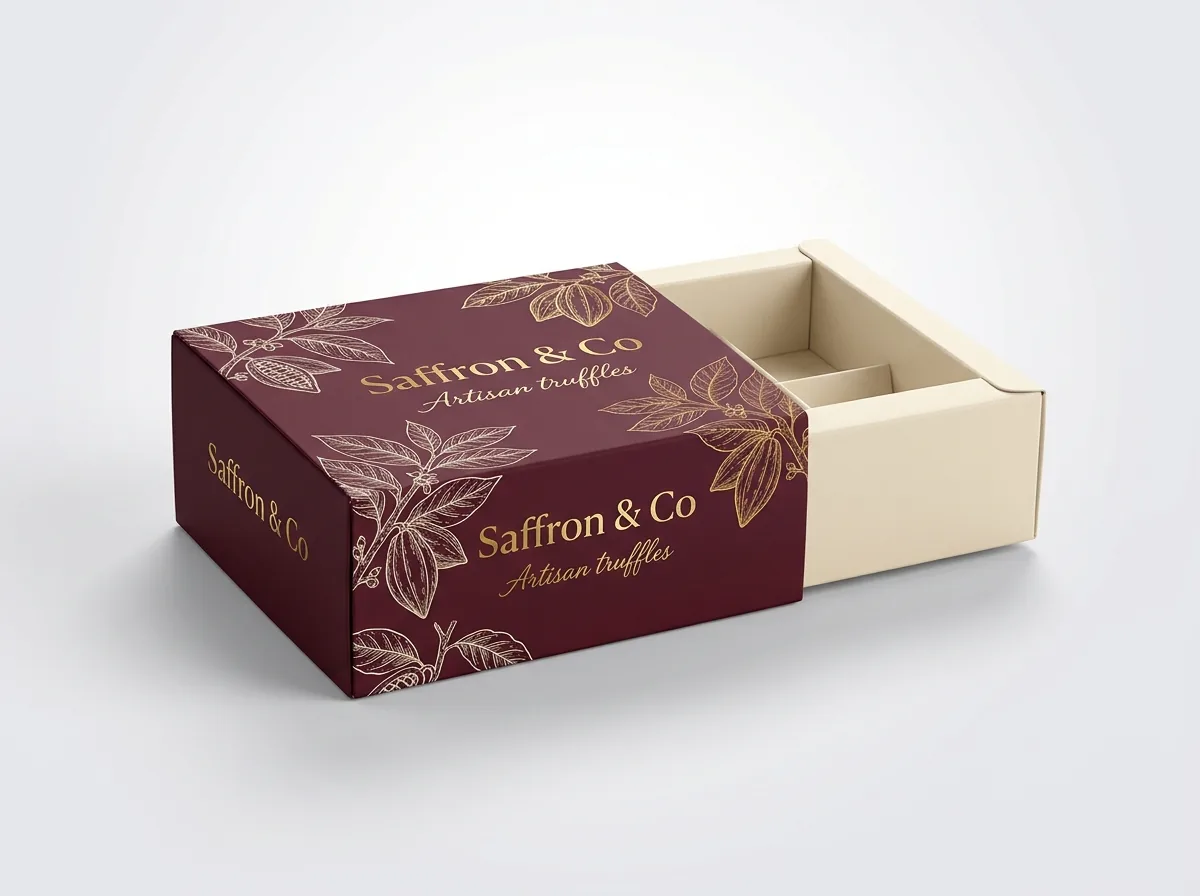
Brands comparing custom drawer boxes against custom tray and sleeve boxes and custom book style boxes are choosing between two material families and two distinct unboxing motions. Both rigid drawer boxes and tray-and-sleeve boxes reveal the product horizontally as an inner tray glides out of an outer wrap, yet their structural cores are worlds apart: rigid drawer boxes use 1.5 to 2.5 mm solid grayboard wrapped in turned-edge paper (starting at 50 boxes), whereas tray-and-sleeve boxes use thinner 16 to 24 pt folding paperboard (starting at 1,000 boxes). Meanwhile, book-style rigid boxes share the same heavy grayboard core and 50-box minimum as rigid drawer boxes, replacing the horizontal pull with a three-panel hardcover jacket hinged along the left spine. Selecting the right structure comes down to order quantity, magnet sensitivity, counter stacking, and parcel shipping.
How do rigid drawer boxes, tray-and-sleeve cartons, and book-style boxes compare side by side?
Although two of these styles slide open and two belong to the luxury turned-edge rigid family, each format solves a different set of branding, fulfillment, and retail merchandising constraints. A custom rigid drawer box acts like a solid piece of furniture packaging: its outer slipcase resists top-load crushing in storage, while its inner drawer glides horizontally along a calibrated 1.0 to 1.5 mm friction track without needing magnets or tuck tabs. By contrast, a folding paperboard tray-and-sleeve carton trims material weight and unit volume for fast-moving consumer goods, while a side-hinged book-style box turns unboxing into a wide horizontal spread with an inside-cover print panel. Evaluating wall caliper, closure mechanics, order minimums, and counter footprint upfront ensures your packaging aligns with both your assembly line and your customer's dresser or desk. Use this six-factor comparison table to benchmark all three options before requesting your quote
| Engineering & commercial factor | Custom Rigid Drawer Box | Paperboard Tray & Sleeve Box | Book-Style Rigid Box |
|---|---|---|---|
| Core board & wall caliper | 1.5–2.5 mm solid grayboard + turned-edge wrap | 16–24 pt (0.4–0.6 mm) SBS or kraft paperboard | 1.5–2.5 mm solid grayboard + 3-panel book jacket |
| Opening motion & closure | Horizontal slide via ribbon pull or thumb notch | Push-through open-ended paperboard sleeve | 180° side-hinged cover + hidden spine magnets |
| Minimum order quantity | 50 boxes (CubitPack rigid family) | 1,000 boxes (CubitPack card box family) | 50 boxes (CubitPack rigid family) |
| Magnet-free safety | 100% magnet-free calibrated friction fit | 100% magnet-free paperboard friction fit | Contains neodymium magnets unless ribbon tie used |
| Vanity & shelf footprint | Stacks vertically and opens while stacked | Compact lightweight retail shelf or peg unit | Requires 2× horizontal width when swung open |
| Keepsake reuse potential | Highest functional reuse (acts as desk/vanity drawer) | Light short-term storage; curbside recyclable | High bookshelf display for collector editions |
When should you upgrade from a paperboard tray and sleeve box to a turned-edge rigid drawer box?
Shoppers and first-time founders frequently use the words 'drawer box' and 'sleeve and tray' interchangeably, yet switching between them changes your minimum order, crush resistance, warehouse storage footprint, and unboxing feel. A folding paperboard tray-and-sleeve carton is die-cut from thin single-ply card stock so high-volume soap, cookie, apparel, and cosmetic brands can order 1,000 to 50,000 units that store completely flat before rapid packing-bench assembly. By contrast, a rigid drawer box is built like hardcover bookbinding over dense V-grooved chipboard wrapped in 157 gsm art or specialty linen paper, creating a heirloom gift package that never flexes in the customer's hand
- Small-batch launch friendly (50 vs 1,000 minimum): If you are launching a boutique jewelry line, a VIP corporate holiday gift, or a 100-unit influencer seeding drop, rigid drawer boxes start at just 50 units without requiring a 1,000-unit folding carton run.
- Closed-back matchbox stop vs open push-through tube: Most paperboard sleeves are open at both ends, meaning a heavy glass perfume bottle can slide out the back if tilted. A five-panel rigid slipcase seals the rear end permanently so the inner drawer stops cleanly against the back wall.
- 4× thicker crush protection and zero bench folding: A 2.0 mm rigid grayboard sleeve offers over four times the wall thickness of an 18 pt carton and arrives pre-assembled so packers simply pull the ribbon, load the product, and push it closed.
Why choose a rigid drawer box over a side-hinged book-style or magnetic closure rigid box?
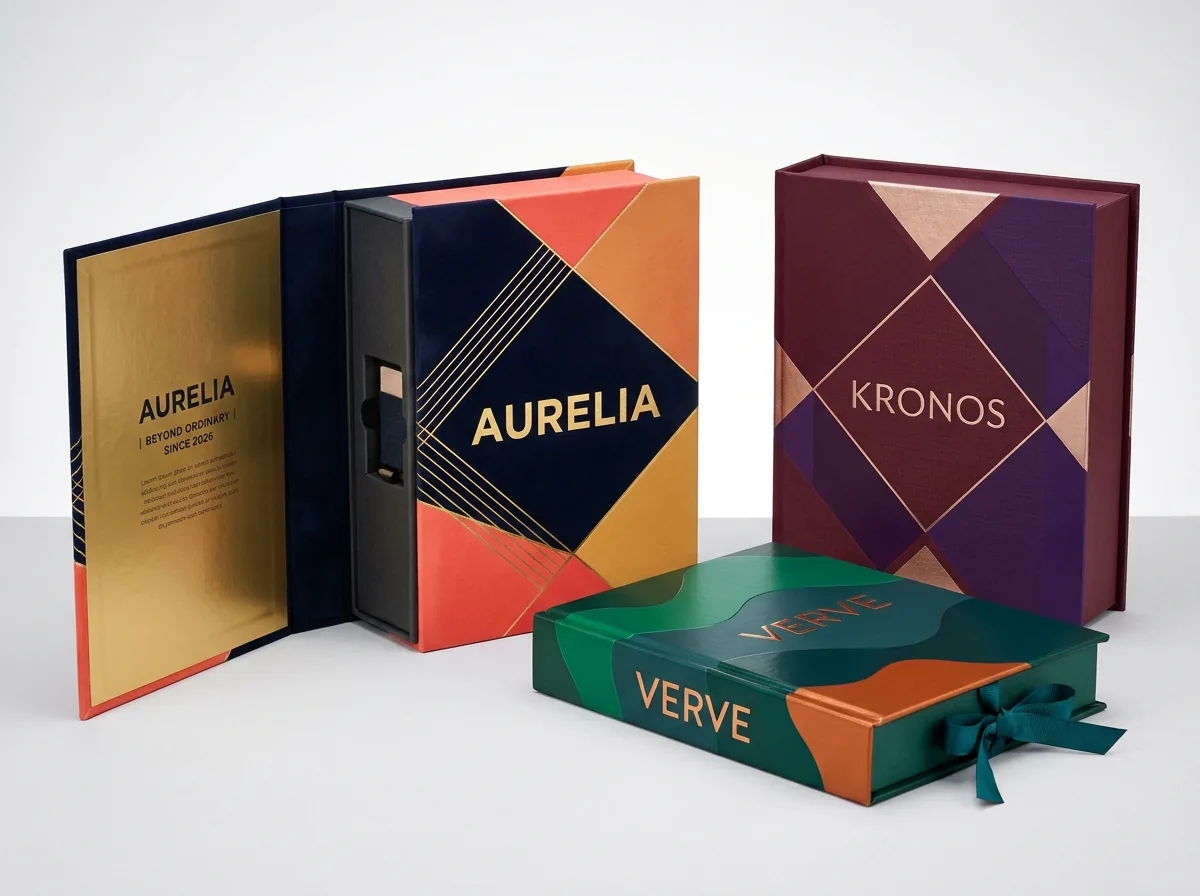
When your product already calls for luxury 1.5–2.5 mm grayboard, the choice narrows to horizontal sliding drawers versus hinged magnetic covers. Both styles start at a 50-box minimum order quantity and accept hot foil stamping, blind embossing, Spot UV gloss, and custom-cut EVA foam inserts. While book-style boxes excel when you want a large printed manifesto, founder letter, or instruction diagram across the inside front cover, rigid drawer boxes win in three practical luxury scenarios
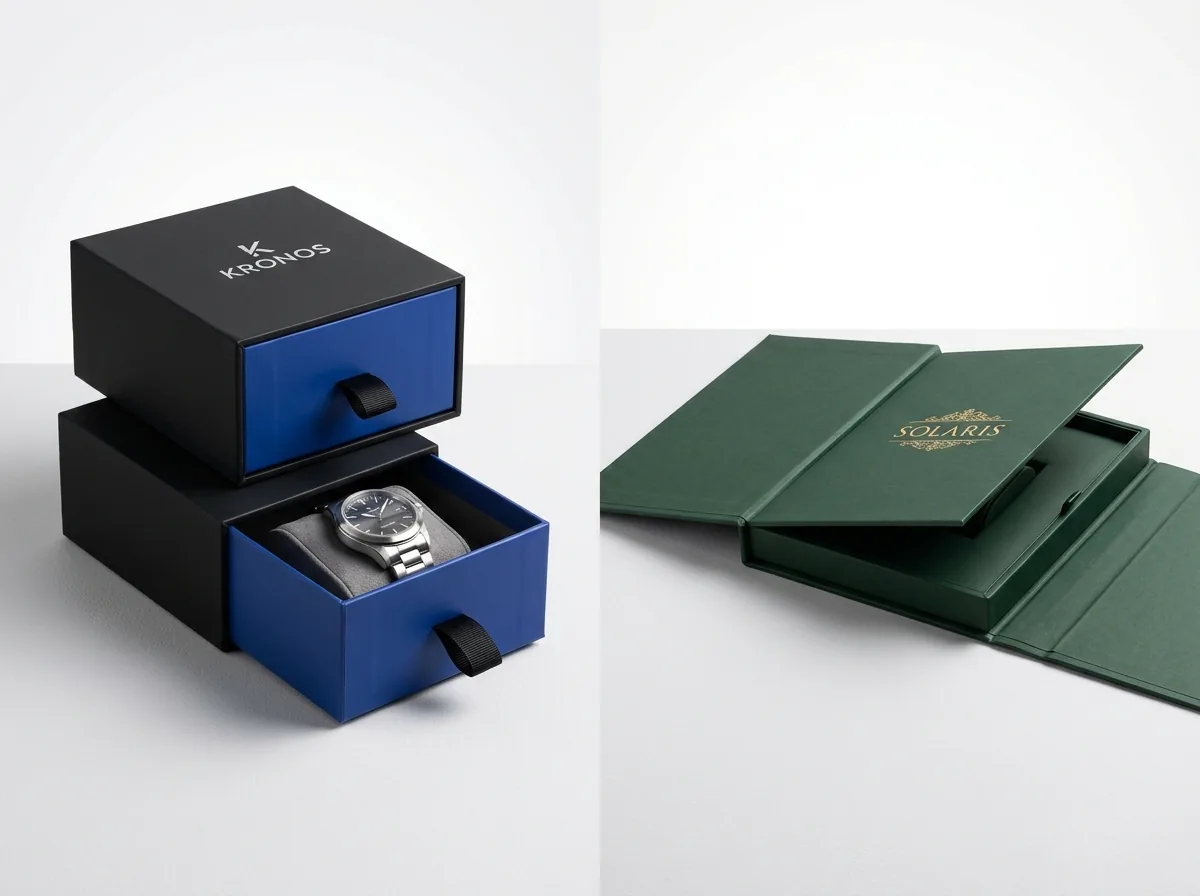
- Horology and electronics peace of mind: Mechanical watchmakers strongly prefer magnet-free packaging so strong neodymium closure discs never sit millimeters from a balance spring during storage.
- Modular dresser-drawer collectibility: Beauty and jewelry brands that release seasonal sets in matching footprints turn their packaging into stackable vanity organizers that stay in the customer's bedroom for years.
- Single-handed unboxing in retail boutiques: Associates behind a jewelry or fragrance counter can hold the outer sleeve steady and pull the ribbon loop smoothly in a narrow presentation tray without needing double table width.
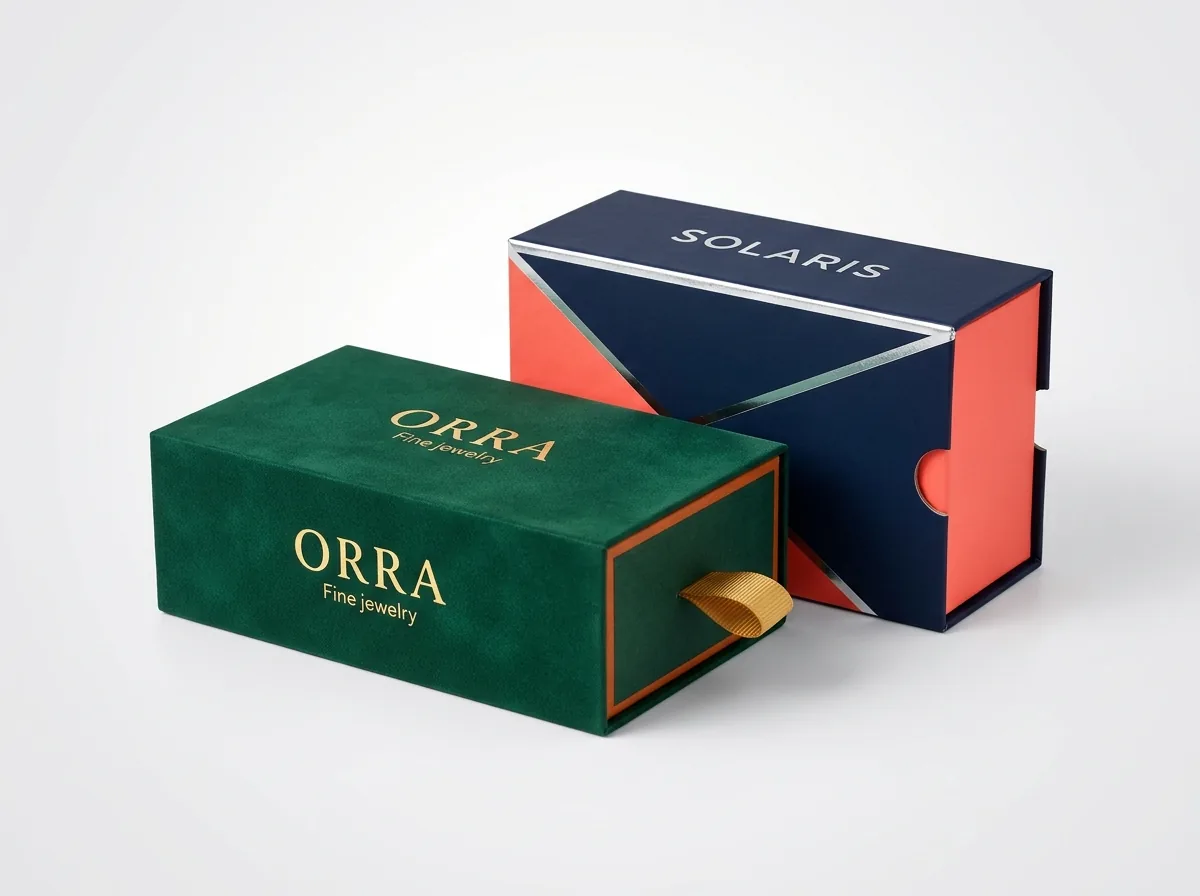
- Two-tone progressive color reveal: Wrapping the outer rigid sleeve in deep matte emerald or obsidian black and wrapping the inner rigid drawer in burnt orange or coral creates an unmistakable color-blocking reveal as every millimeter of the drawer slides out.
| Luxury packaging requirement | Why Rigid Drawer Boxes win | When Book-Style Rigid Boxes win |
|---|---|---|
| Mechanical automatic watches & audio tech | 100% magnet-free friction closure avoids hairspring magnetization | Requires swapping standard magnets for satin ribbon ties |
| Modular vanity or desk storage | Customers stack 2–4 boxes and pull any drawer open without unstacking | Top boxes must be lifted off before opening a hinged lid |
| Narrow single-row confections (macarons, truffles) | Progressive linear reveal frames each piece one by one as pulled | Exposes the entire tray at once; takes double table width |
| Long printed founder letter or shade map | Requires a separate insert card or outer sleeve back print | Wide inside front cover acts as a built-in billboard |
Know your size? Compare pricing across up to 3 quantities.
Request a Quote →How do you pair rigid drawer boxes with outer corrugated mailers for e-commerce transit?
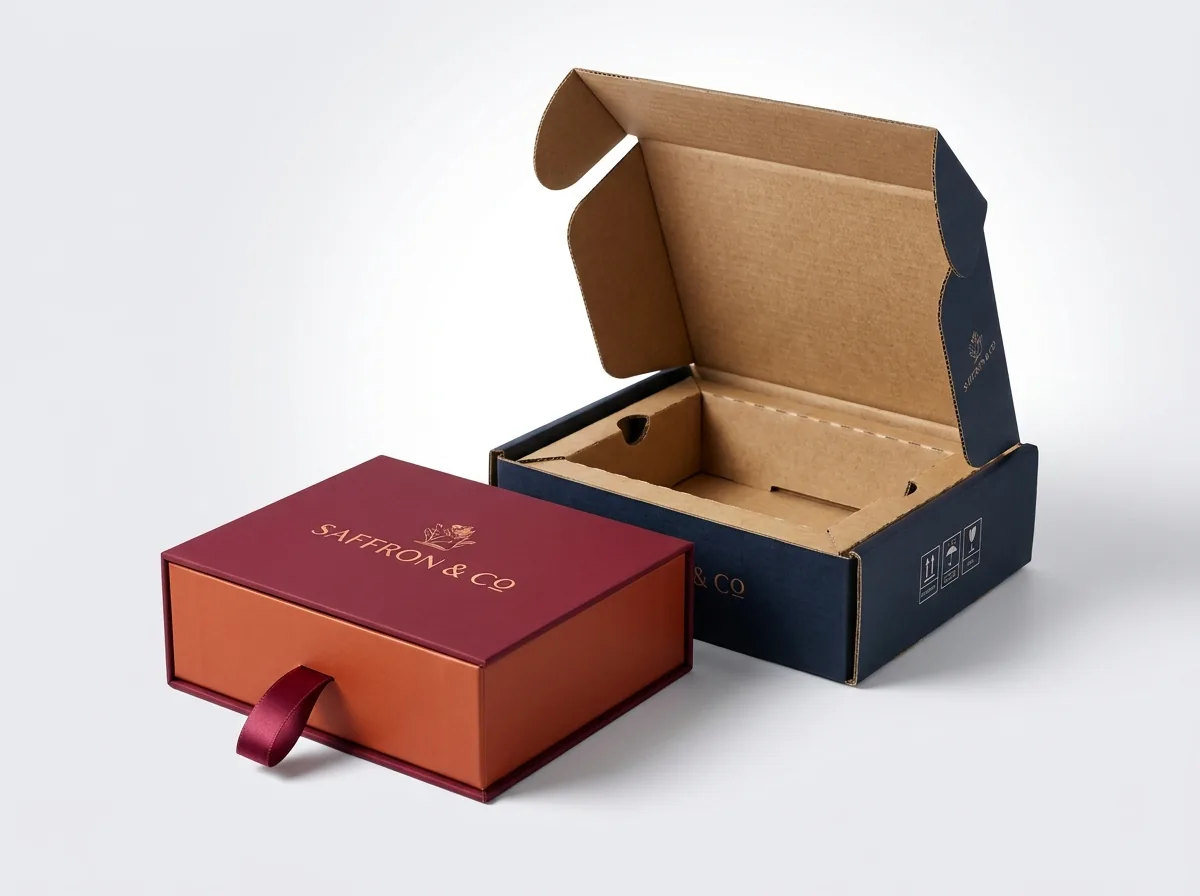
Every CubitPack rigid and paperboard order includes free prepress file checks and free US shipping across all 50 states. Whether you are building custom jewelry boxes, custom watch boxes, custom chocolate boxes, custom macaron boxes, or custom tie boxes, remember that turned-edge rigid sleeves are primary luxury presentation packages rather than parcel shipping cartons. Because soft-touch matte wraps, metallic foil stamping, and woven grosgrain ribbons are designed for tactile luxury, sending a rigid box naked through automated parcel chutes would scuff the corners. Pairing your custom rigid slide drawer boxes with a snug E-flute corrugated outer mailer sized +5 mm larger than the outer sleeve keeps every surface spotless through UPS, FedEx, and USPS sorting hubs
| Product line | Best primary box style | Recommended insert & pull | E-commerce shipping setup |
|---|---|---|---|
| Fine jewelry & rings | 1.5 mm Rigid Drawer Box (MOQ 50) | Velvet-flocked EVA foam + grosgrain pull | Padded bubble mailer or mini E-flute mailer |
| Mechanical chronographs | 2.0 mm Double-Wall Rigid Drawer | Suede watch pillow + magnet-free glide | Snug E-flute corrugated outer shipping box |
| 12-pc chocolates or macarons | 1.8 mm Rigid Drawer + PET Window | Food-safe PET tray + satin ribbon pull | Insulated cold-pack corrugated shipper |
| Everyday retail bar soap / socks | 18 pt Paperboard Tray & Sleeve (MOQ 1,000) | Open-ended push sleeve + die-cut window | Poly mailer or multi-unit corrugated shipper |
| Collector fragrance + story booklet | 2.0 mm Book-Style Rigid Box (MOQ 50) | Recessed EVA cavity + inside cover print | Snug E-flute outer mailer with +5 mm buffer |
How do I make the final call between a rigid drawer, tray-and-sleeve, or book-style box?
Ready to lock in your specification? Before submitting your quote request, evaluate your first-run quantity target, the total weight of your product plus insert, whether your item contains magnet-sensitive watch movements or electronics, and how much counter space your retail partners have available. Pair this comparison with our guides on how to measure and choose grayboard for rigid drawer boxes and rigid drawer box dieline, ribbon pulls, and drawer stops explained
- Pick a Custom Rigid Drawer Box if you need 50+ luxury units, magnet-free watch or tech safety, modular vanity stacking, closed-back slipcase security, or a tactile grosgrain ribbon-pull reveal.
- Pick a Paperboard Tray & Sleeve Box if you are ordering 1,000+ lightweight retail units (under 12 oz) such as bar soaps, socks, or cookies and want flat-shipping folding cartons.
- Pick a Book-Style Rigid Box if your unboxing centers on a full-panel printed founder story, shade map, or ceremonial foil certificate inside a side-hinged hardcover lid.
- Combine Rigid Drawer + Corrugated Mailer for nationwide DTC e-commerce drops where your box must survive parcel carriers and still look boutique-fresh on unboxing.
What are the most common mistakes when choosing between sliding and hinged box styles?
Avoid these five structural selection pitfalls before placing your custom packaging order
- Ordering a thin 18 pt open-ended paperboard tray-and-sleeve carton for a heavy 100 ml glass perfume bottle without end stops, allowing the bottle tray to slide out when lifted.
- Packing a sensitive mechanical wristwatch inside a magnetic-closure book box where strong neodymium magnets sit right next to the movement.
- Applying shipping labels directly onto a soft-touch rigid drawer sleeve instead of nesting it inside an outer corrugated mailer for parcel delivery.
- Assuming rigid drawer boxes require a 1,000-unit minimum like folding cartons when CubitPack produces custom rigid drawer boxes starting at 50 units.
- Choosing a wide-swinging book-style box for cramped boutique checkout counters where a linear sliding drawer box takes half the horizontal space.
Packaging for this


Ready to order drawer boxes? Compare up to 3 quantities with a free 3D mockup.
Request a Quote →Questions about drawer boxes
Can I get the sliding drawer look at a 50-box minimum order quantity?
Yes. Custom turned-edge rigid drawer boxes belong to CubitPack's rigid setup family and start at just 50 boxes, whereas folding paperboard tray-and-sleeve cartons belong to the card box family and start at 1,000 boxes.
Why are rigid drawer boxes recommended for mechanical watches?
Standard rigid drawer boxes close via a calibrated 1.0–1.5 mm paper-wrapped friction channel rather than concealed neodymium magnets, eliminating any magnetic field near mechanical watch hairsprings while still delivering heavy 2.0 mm grayboard protection.
Which lasts longer as a customer keepsake: a rigid drawer box or a tray-and-sleeve box?
A 1.5–2.5 mm solid grayboard rigid drawer box is engineered for years of reuse, so shoppers frequently stack them on dressers and desks to store jewelry, cables, or pens, while a 16–24 pt paperboard tray-and-sleeve carton is built for lightweight retail display and easy recycling.
Do rigid drawer boxes cost more to ship than paperboard tray-and-sleeve boxes?
Because non-collapsible rigid drawer boxes ship pre-assembled at full 3D volume, they occupy more master carton space than flat-packed folding paperboard sleeves, though they save 100% of manual box-folding labor at your fulfillment bench. CubitPack includes free US shipping on every quote.
Can a rigid drawer box include an interior brand story like a book-style box?
Yes. You can print a progressive reveal message along the outer side walls of the sliding tray, print the interior floor beneath the product, or place a foil-stamped card on top of the EVA foam cavity.
Still have a question? Ask a packaging specialist.
Request a Quote →Request your drawer boxes quote
Tell us your size and quantities, and one dedicated account manager prepares pricing for each tier.
- Free design & AI-to-print studio + 3D mockup
- No die or plate charges · 4–5 day rush available
- Free shipping to all 50 states
- 10% off your first order
We compared 1.5–2.5 mm solid grayboard rigid drawer specifications against 16–24 pt folding paperboard tray-and-sleeve cartons and 3-panel book-style rigid boxes using Paperboard Packaging Council (PPC), National Paperbox Association (NPA), and TAPPI T 411 references, plus CubitPack minimums and turnaround rules. Spot something wrong? Tell us and we fix it.
Sources
What changed
- November 5, 2026: First published with 6-factor comparison matrix, MOQ 50 vs 1,000 breakdown, magnet-free watch comparison, and parcel shipping pairings.
More guides
New packaging guides by email
Sizes, materials and design tips. Unsubscribe anytime.