
How do I measure a collapsible rigid box and choose the right grayboard thickness?
Short answer: Always measure a collapsible rigid box by its usable inside dimensions, Inside Length (L, hinged lid span) × Inside Width (W, front-to-back span) × Inside Depth (D, wall height), and make sure Length (L) is at least twice Depth (D) plus 10 mm (0.4 in) so the opposing side walls fold flat without colliding.
On this page
- What is the 4-step formula for measuring a collapsible rigid box in L × W × D
- How do the L >= 2D flat-fold rule, corner gusset allowance, and front magnetic flap height interact
- Which grayboard caliper (1.5 mm, 2.0 mm, or 2.5 mm) works best for foldable rigid boxes
- What are standard custom collapsible rigid box sizes across apparel, shoes, PR kits, and gift baskets
- How do I verify my collapsible rigid box measurements before full production
- Common mistakes
- FAQs
Request a custom quoteFree dieline & 3D mockup
When ordering custom collapsible rigid boxes (also called foldable magnetic gift boxes), every structural measurement starts inside the assembled tray cavity in the order Length (L) × Width (W) × Depth (D). Unlike a pre-glued set-up box that can be built in any narrow tower or cube proportion, a one-piece collapsible rigid box folds flat along four 45-degree diagonal origami corner gussets. During flat folding, both the left side wall (height D) and the right side wall (height D) hinge 90 degrees inward onto the interior base floor (span L). That kinematics creates one ironclad geometric rule: your usable Inside Length (L) must equal or exceed (2 × Inside Depth D) + 10 mm (+0.4 inches) so the two folded walls lie flat side by side at ~10 mm total stack height instead of overlapping in the center. Pairing that proportion with 1.5 mm, 2.0 mm, or 2.5 mm high-density grayboard saves 75% to 85% warehouse volume.
What is the 4-step formula for measuring a collapsible rigid box in L × W × D?
Whether you are packaging a folded cashmere sweater, a pair of designer sneakers, or a multi-piece corporate onboarding kit, collapsible rigid boxes are specified from the usable interior cavity outward. You enter your usable Inside L × W × D in the quote form, and our prepress team calculates the outer 4-panel hinged jacket, spine height, and corner gussets
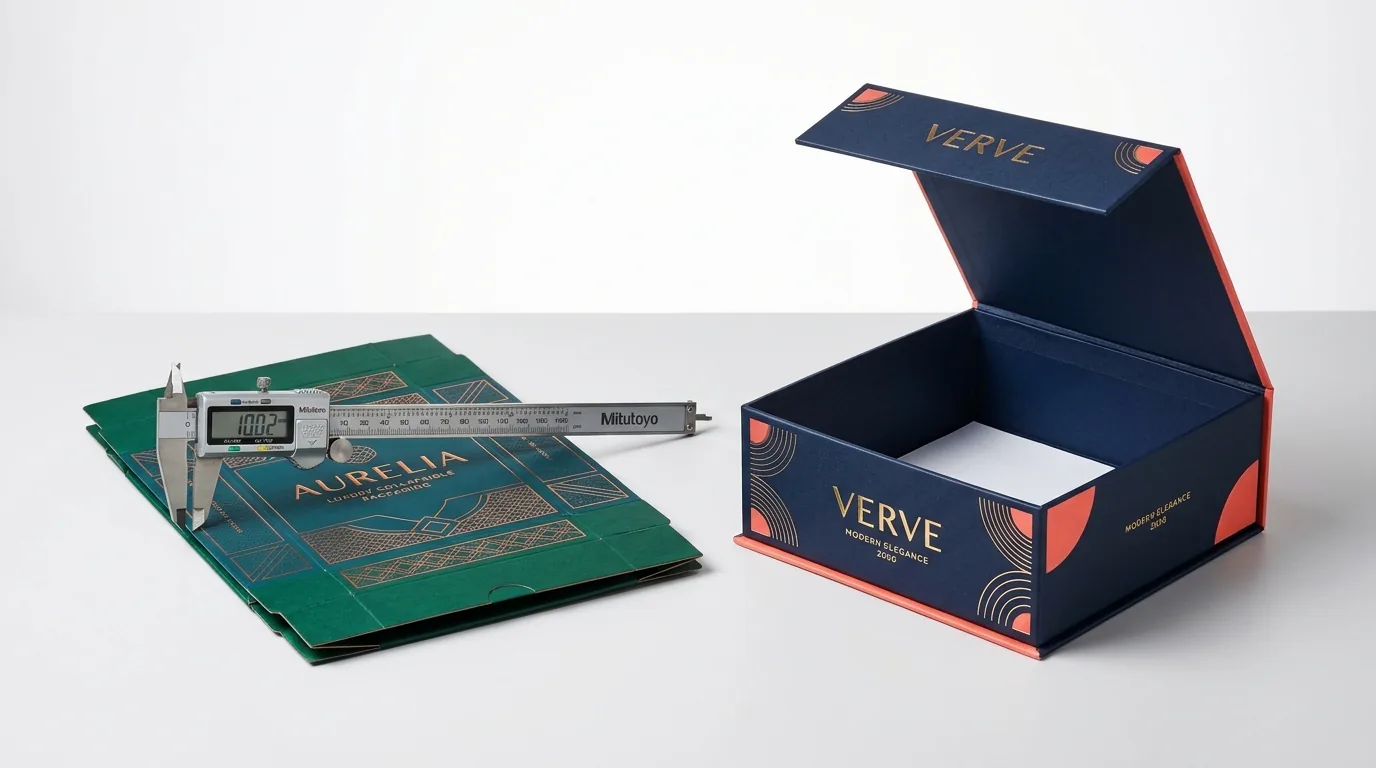
- Step 1: Measure Usable Inside Length (L), Inside Width (W), and Inside Depth (D). Lay your folded garment, shoe pair, or drop-in EVA foam pad layout on a flat table. Measure the left-to-right hinged spine span as Length (L), the front-to-back depth as Width (W), and the vertical height as Depth (D). Add +3.0 mm (+0.125 in) of horizontal breathing room around soft goods or +1.0 mm around a drop-in foam pad, plus +2.0 to +3.0 mm of vertical headspace so the closed lid ceiling never presses on your product.
- Step 2: Verify the Flat-Fold Clearance Equation, L >= (2 × D) + 10 mm (+0.40 in). Multiply your usable Inside Depth (D) by two and add 0.40 inches (10 mm). If your box is 4.0 inches deep, Inside Length (L) must be at least 8.4 inches so the left and right inward-hinging side walls clear each other cleanly when collapsed flat.
- Step 3: Calculate the Outer Top Lid and Base Floor Footprint. Because the 4-panel outer rigid jacket wraps over the collapsible inner frame with a subtle 1.5 to 2.0 mm protective rim, Outer Lid Length equals L + (2 × Wrapped Wall Caliper) + 4.0 mm, and Outer Lid Width equals W + (2 × Wrapped Wall Caliper) + 3.0 mm.
- Step 4: Calculate Collapsed Flat-Stack Thickness for Pallet Planning. When folded 100% flat in master cartons, each blank stacks four rigid board layers thick (Outer Floor + Inner Floor + Folded Side Walls + Outer Top Lid), equaling roughly (4 × Wrapped Caliper) + 0.8 mm, or ~10.0 mm (0.39 in) per blank on standard 2.0 mm grayboard.
How do the L >= 2D flat-fold rule, corner gusset allowance, and front magnetic flap height interact?
Every collapsible rigid box relies on precise millimeter coordination between its hinged outer jacket and its folding inner walls. If the inner walls are cut 1.0 mm too tall for the back spine board, the top lid tilts upward instead of snapping flush against the front wall magnets. Conversely, if the front magnetic flap is cut too short on a deep 5-inch shoe or gift basket box, the magnet pair sits too high above the center of gravity and can pop open if lifted by the lid. Use these six production tolerances when reviewing your 2D CAD proof
| Collapsible structural element | Engineering formula / target spec | Typical value on 2.0 mm board | Why this tolerance is critical |
|---|---|---|---|
| Minimum Usable Inside Length (L) | L >= (2 × Inside Depth D) + 10 mm | 8.4 in min length for a 4.0 in deep box | Prevents inward-folding left and right walls from colliding in the center |
| Collapsed Flat Blank Height | (4 × Wrapped Board Caliper) + 0.8 mm | ~9.8 to 10.5 mm (0.39 to 0.41 in) flat | Shrinks a 4-inch (102 mm) tall box by ~90% during ocean & truck transit |
| Back Spine Board Height | Inside Depth D + (2 × Board Caliper) + 2.0 mm | D + 6.0 mm total outer spine height | Keeps the closed top lid 100% parallel to the bottom base floor |
| Front Magnetic Flap Coverage | 65% to 95% of Outer Front Wall Height | 2.75 to 3.75 in flap on a 4.0 in box | Positions dual N35–N42 magnets low enough for high-shear closure lock |
| 45° Origami Gusset Hinge Gap | 4.0 to 6.0 mm flexible BOPP-laminated channel | 5.0 mm diagonal crease relief | Lets rigid triangular gusset halves fold 180° flat without paper tearing |
| Drop-In Insert Pad Outer Size | (Usable L - 1.0 mm) × (Usable W - 1.0 mm) | 11.96 × 8.96 in pad for a 12 × 9 in box | Drops smoothly past locked corner gussets without bowing side walls |
Which grayboard caliper (1.5 mm, 2.0 mm, or 2.5 mm) works best for foldable rigid boxes?
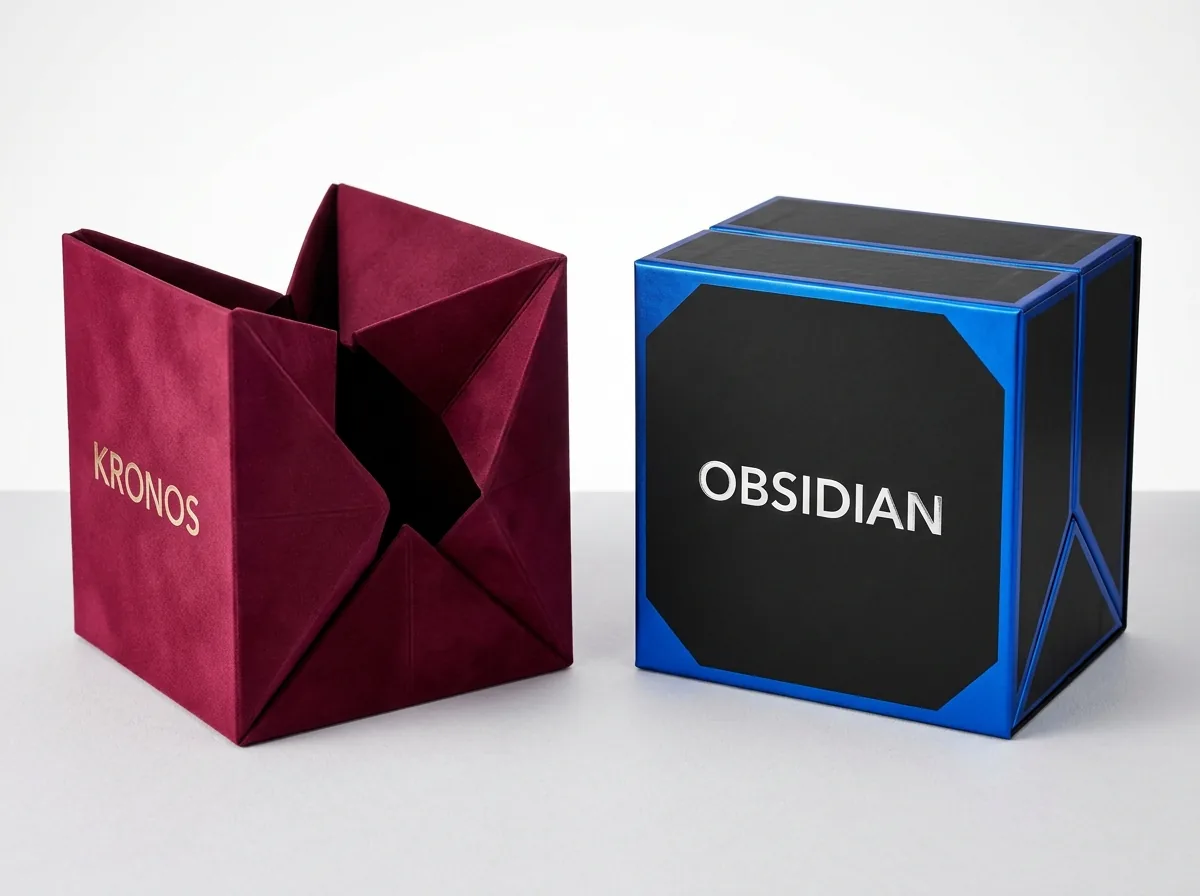
In collapsible rigid manufacturing, grayboard caliper governs both vertical stacking strength and how cleanly the four 45-degree corner gussets fold flat. While non-collapsible set-up trunks occasionally use ultra-thick 3.0 mm grayboard, foldable rigid boxes perform best between 1.5 mm (60 pt) and 2.5 mm (100 pt) high-density laminated grayboard wrapped in 157 gsm C1S art paper with scuff-free matte, soft-touch, or gloss BOPP film lamination: Choosing a board that is too thin for a wide garment box allows the hinged lid to sag across the middle, whereas choosing an overly thick board on a tiny cosmetics box adds unnecessary folded stack height. Match your box span and product weight to the three proven grayboard tiers below
| Grayboard caliper & GSM | Collapsed flat blank thickness | Recommended Length (L) & payload | Best collapsible rigid box uses |
|---|---|---|---|
| 1.5 mm (60 pt / ~950 GSM) | ~7.5 to 8.0 mm per folded blank | 6.0 to 8.5 in span · Under 1.0 lb (450 g) | Cosmetics & skincare duos, silk scarves, neckties, intimate apparel, compact tech mailers |
| 2.0 mm (80 pt / ~1200 GSM): Standard | ~9.8 to 10.5 mm per folded blank | 8.5 to 14.5 in span · 1.0 to 3.5 lb (1.6 kg) | Folded sweaters & dress shirts, luxury sneakers & heels, influencer PR kits, corporate welcome boxes |
| 2.5 mm (100 pt / ~1500 GSM) | ~12.0 to 12.8 mm per folded blank | 14.0 to 20.0 in span · 3.5 to 7.0 lb (3.2 kg) | Heavy winter outerwear, bridal boxes, tall leather boots, multi-bottle gourmet holiday hampers |
Know your size? Compare pricing across up to 3 quantities.
Request a Quote →What are standard custom collapsible rigid box sizes across apparel, shoes, PR kits, and gift baskets?
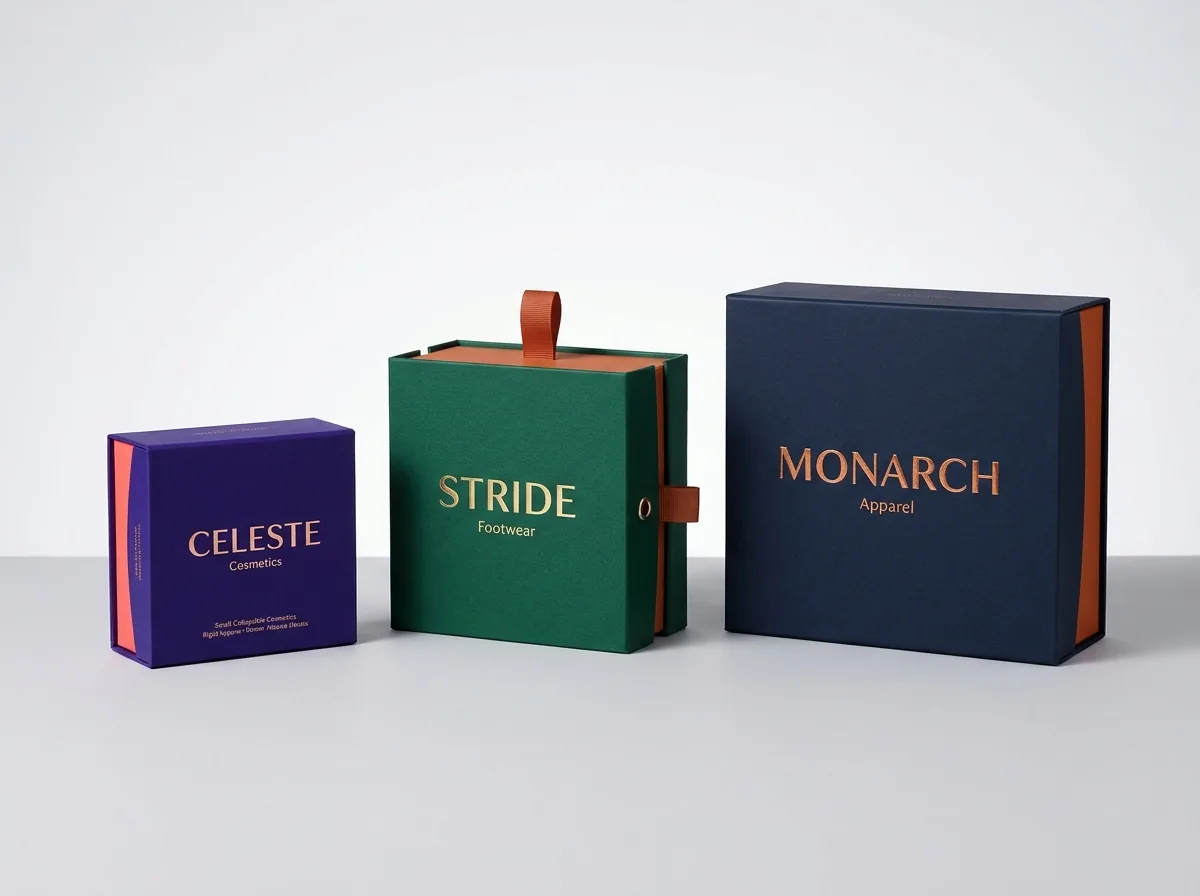
Every CubitPack order is custom-cut to your exact usable cavity dimensions with zero die or plate charges. Use these eight proven retail benchmarks, each engineered to satisfy the L >= (2 × D) + 0.4 in flat-folding rule, across our custom apparel boxes, custom shoe boxes, custom corporate gift boxes, custom pr boxes, and custom gift basket boxes lines
| Product application | Usable Inside L × W × D (in) | Flat-fold check (2D + 0.4 in) | Recommended grayboard & corner lock |
|---|---|---|---|
| Skincare serum & moisturizer gift duo | 7.50 × 5.50 × 2.75 in | 5.90 in <= 7.50 in (Passes) | 1.5–2.0 mm Grayboard · 3M tape + drop-in EVA |
| VIP subscription & creator seeding box | 9.50 × 7.00 × 3.50 in | 7.40 in <= 9.50 in (Passes) | 2.0 mm Grayboard · 3M corner tape + ribbon tab |
| Influencer PR launch kit with foam pad | 11.00 × 8.50 × 4.00 in | 8.40 in <= 11.00 in (Passes) | 2.0 mm Grayboard · 3M tape + separate EVA pad |
| Folded cashmere sweater & shirt box | 12.00 × 9.50 × 3.50 in | 7.40 in <= 12.00 in (Passes) | 2.0 mm Grayboard · Reusable magnetic or 3M corners |
| Executive corporate onboarding kit | 13.00 × 10.00 × 4.25 in | 8.90 in <= 13.00 in (Passes) | 2.0 mm Grayboard · 3M tape + die-cut foam tray |
| Luxury sneaker & designer heel shoe box | 13.50 × 9.50 × 5.00 in | 10.40 in <= 13.50 in (Passes) | 2.0–2.5 mm Grayboard · 3M tape + grommet pull |
| Tailored blazer, robe & bridal keepsake box | 15.50 × 11.50 × 4.50 in | 9.40 in <= 15.50 in (Passes) | 2.5 mm Grayboard · Reusable magnetic corners |
| Holiday gourmet hamper & gift basket box | 17.00 × 13.00 × 6.00 in | 12.40 in <= 17.00 in (Passes) | 2.5 mm Grayboard · High-tack 3M corners + dividers |
How do I verify my collapsible rigid box measurements before full production?
After confirming your usable cavity dimensions, explore our companion guides on collapsible rigid boxes vs setup magnetic and folding mailer boxes and collapsible rigid box dieline, corner gussets, and 3M tape explained. When you order custom foldable magnetic rigid boxes from CubitPack starting at 1,000 units, our prepress team verifies your L >= 2D clearance and builds both your box dieline and any drop-in insert dieline for free. Run through this 5-step verification checklist before mass production
- Step 1: Measure your folded garment, shoe pair, or multi-item insert arrangement using calipers to determine usable Inside L × W × D.
- Step 2: Check that usable Inside Length (L) is at least (2 × Inside Depth D) + 0.40 inches (10 mm); if not, rotate L and W or switch to a set-up magnetic box.
- Step 3: Choose between permanent 3M peel-and-seal corner adhesive strips (fastest for DTC fulfillment) or reusable concealed corner magnets (ideal for keepsake retail).
- Step 4: Select 1.5 mm, 2.0 mm, or 2.5 mm grayboard and confirm matte, soft-touch, or gloss lamination so the 45-degree corner gussets fold cleanly.
- Step 5: Pop up a physical sample at the packing bench, drop in your product or EVA foam pad, and verify that the front magnetic flap snaps squarely over the front wall.
What are the most common measurement and board mistakes on collapsible rigid boxes?
Avoid these five sizing and substrate errors before signing off on your foldable rigid box proof
- Ordering a deep narrow cube (such as 6 × 6 × 4.5 in) where Length (L) is less than twice Depth (D), causing the inward-folding left and right walls to collide.
- Measuring the outside of a sample box instead of the usable Inside L × W × D, which leaves folded garments or drop-in foam pads 8 to 10 mm too tight.
- Cutting a drop-in EVA foam pad to 100% of usable L × W with zero clearance instead of -1.0 mm, causing the pad to snag on the 45-degree corner gusset folds.
- Choosing thin 1.5 mm grayboard on a wide 15-inch coat or shoe box, allowing the long hinged top lid to flex in the center.
- Forgetting to add +2.0 to +3.0 mm of vertical headspace above rigid jars or electronics, preventing the front magnetic flap from aligning with its steel strike discs.
Packaging for this



Ready to order collapsible rigid boxes? Compare up to 3 quantities with a free 3D mockup.
Request a Quote →Questions about collapsible rigid boxes
Should I enter the flat blank dimensions or the assembled inside dimensions in the quote form?
Always enter the usable inside dimensions of the assembled 3D box cavity: Inside Length (L) × Inside Width (W) × Inside Depth (D). Our prepress team calculates the outer 4-panel jacket expansion, spine board height, and flat-folded blank size automatically.
Why can't a 6 × 6 × 5 inch tall cube be made as a standard one-piece collapsible rigid box?
In a standard collapsible rigid box, the left 5-inch wall and the right 5-inch wall both fold 90 degrees inward onto the 6-inch floor. Because 5 + 5 = 10 inches, the two walls overlap by 4 inches in the middle and cannot lie flat. For tall cubes where L < 2D, use a pre-assembled set-up magnetic box or a two-piece rigid box.
How thin is a collapsible rigid box when folded flat in the shipping carton?
A folded collapsible rigid box stacks four wrapped grayboard plies high, which equals roughly 7.8 mm on 1.5 mm board, 10.0 mm (0.39 inches) on standard 2.0 mm board, and 12.4 mm on heavy 2.5 mm board.
What grayboard thickness is best for a 12 × 9 × 4 inch apparel or PR collapsible box?
2.0 mm (80 pt / 1200 GSM) high-density grayboard is ideal for 12 × 9 × 4 inch apparel, shoe, and PR boxes. It provides crisp 90-degree corner rigidity for payloads up to 3.5 lb while folding cleanly along the 45-degree corner gussets.
How do I size an outer corrugated shipping box for my collapsible rigid box?
Once your collapsible rigid box is assembled, its outer dimensions are roughly +8 to +10 mm larger than usable L × W × D. Size your outer E-flute or B-flute corrugated mailer inside cavity +4 to +6 mm larger than the rigid box's outer dimensions so it slides in smoothly without scuffing.
Still have a question? Ask a packaging specialist.
Request a Quote →Request your collapsible rigid boxes quote
Tell us your size and quantities, and one dedicated account manager prepares pricing for each tier.
- Free design & AI-to-print studio + 3D mockup
- No die or plate charges · 4–5 day rush available
- Free shipping to all 50 states
- 10% off your first order
We verified collapsible rigid L >= (2 × D) + 10 mm flat-folding geometry, 4-ply collapsed stack thickness math, and 1.5–2.5 mm grayboard caliper span limits against Paperboard Packaging Council (PPC), TAPPI T 411, and FEFCO standards. A packaging specialist checked every formula and benchmark row. Spot something wrong? Tell us and we fix it.
Sources
What changed
- November 5, 2026: First published with 4-step collapsible L × W × D sizing formula, L >= 2D flat-fold table, 1.5–2.5 mm grayboard selector, and 8-product size chart.
More guides
New packaging guides by email
Sizes, materials and design tips. Unsubscribe anytime.