
How do rigid drawer box dielines, ribbon pulls, safety stops, and inserts work?
Short answer: A custom rigid drawer box dieline contains two separate V-grooved grayboard layouts: Part A (a closed-back slipcase or open-ended outer sleeve with 15–18 mm wrap turn-ins) and Part B (a corner-stayed inner drawer tray fitted with a ribbon pull or thumb notch, optional safety stop, and custom insert).
On this page
- How is a two-part custom rigid drawer box CAD dieline structured
- Should I choose a woven ribbon pull tab or a semicircular thumb-cut notch
- How do internal safety drawer stops and double-wall rolled trays protect fragile luxury goods
- Which custom inserts work best inside rigid drawer boxes for jewelry, watches, perfume, and chocolates
- How do I prepare print-ready artwork on a rigid drawer box dieline
- Common mistakes
- FAQs
Request a custom quoteFree dieline & 3D mockup
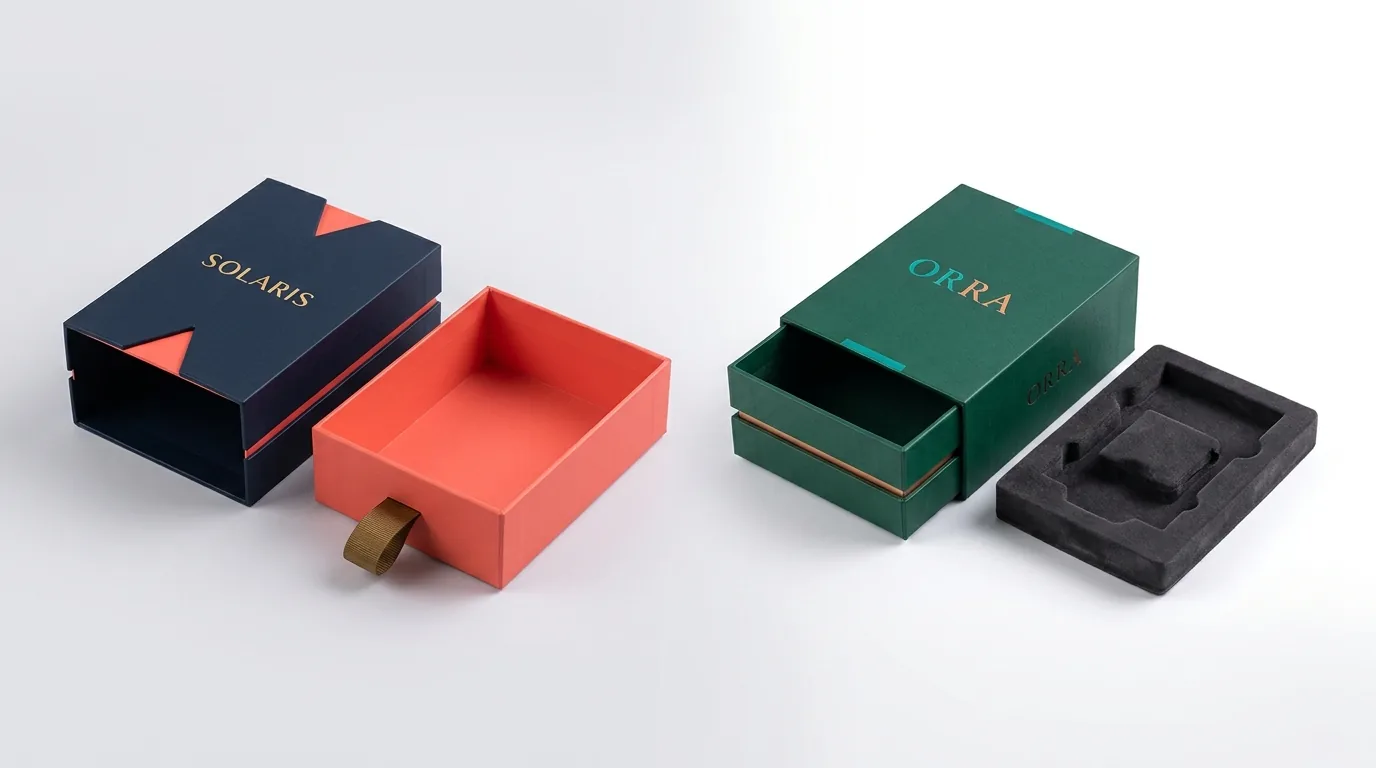
Unlike one-piece folding cartons cut from a single flat sheet, custom drawer boxes are engineered across two coordinated CAD dielines that come together after wrapping. Subassembly A forms the rigid outer sleeve from 1.5 to 2.5 mm solid grayboard grooved at 90 degrees along four longitudinal corners, built either with a fifth sealed back cap (closed-back slipcase) or open at both ends (push-through sleeve). Subassembly B forms the sliding inner drawer from 1.2 to 2.0 mm grayboard with crisp corner-stayed walls and 15 to 18 mm artwork turn-in margins. Because a closed-back slipcase traps an air cushion behind the drawer, prepress integrates either a woven satin or grosgrain ribbon pull tab into the front tray wall or a semicircular thumb notch along the sleeve mouth, plus optional internal safety-stop tethers and custom velvet EVA foam or food-safe dividers.
How is a two-part custom rigid drawer box CAD dieline structured?
When our prepress team sends your free 2D vector proof, you will see two separate board dielines alongside two larger printed paper wrap layouts. Every outer sleeve and inner drawer edge includes a 15 to 18 mm wrap turn-in zone where your background color or pattern bleeds around the grayboard rim and tucks cleanly inside the cavity so zero raw gray chipboard ever shows. Understanding each dieline zone helps your graphic designer place logos, foil crests, and bleed artwork accurately on the first proof
- 90-degree V-grooving vs rounded scores: Carving a 90-degree V-shaped channel partway through the solid grayboard allows the outer sleeve panels to fold into razor-sharp architectural corners rather than soft rounded curves.
- Closed-back slipcase vs open-both-ends tube: Specify a 5-panel closed-back slipcase whenever you attach a ribbon pull tab to the front drawer face; specify an open-both-ends 4-panel sleeve when you want shoppers to push the inner tray out from either side.
- Separate wrap sheet and grayboard templates: Because 157 gsm art paper wraps over the outer grayboard surface and turns 15 to 18 mm inside the rim, your graphic artwork file is sized slightly larger than the finished millimeter footprint of the rigid core.
| Dieline subassembly & zone | Structural specification | Artwork & bleed rule | Functional purpose |
|---|---|---|---|
| Part A · Outer Sleeve Body | 4 longitudinal panels + 90° V-grooves + glue lap | Extend full bleed 18 mm past open sleeve rims | Creates sharp, square 90-degree outer slipcase corners |
| Part A · Closed 5th Back Cap | Rear grayboard end panel (closed-back build) | Wrap turn-in hides corner seams cleanly | Stops drawer flush at front mouth and prevents rear exit |
| Part A · Optional PET Window | Die-cut opening >= 15 mm inside V-groove scores | Keep foil and critical text 8 mm clear of window | Showcases chocolates, macarons, or bottles dust-free |
| Part B · Inner Drawer Tray | Center floor + 4 corner-stayed vertical walls | Wrap paper turns 16 mm down inside tray walls | Forms rigid sliding drawer bed for products and inserts |
| Part B · Double-Wall Shoulder | Optional inner collar wall (+1.5 mm per side) | Contrast color wrap creates framed inner border | Conceals die-cut EVA foam edges and boosts wall rigidity |
Should I choose a woven ribbon pull tab or a semicircular thumb-cut notch?
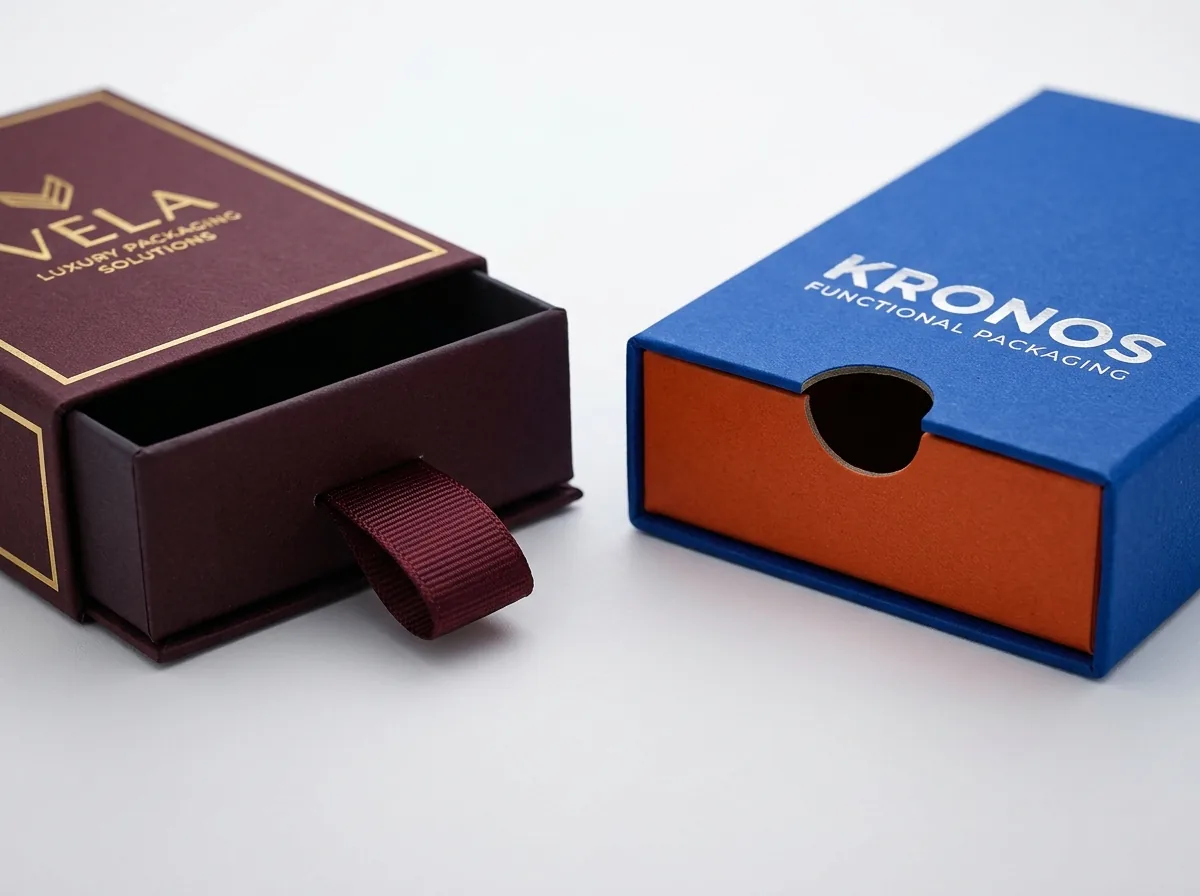
When an inner drawer nests inside a closed-back rigid slipcase with a 1.0 to 1.5 mm friction clearance, pulling the drawer forward momentarily creates mild air resistance behind the rear wall. Without a dedicated extraction feature, customers would have to shake the sleeve upside down to get the tray moving. Choosing between a textile ribbon pull and a die-cut thumb notch defines both the visual personality and the assembly detail of your box
- Hidden slot-anchored ribbon loops: Tested to withstand strong repeated pulls without fraying or detaching, even when extracting a heavy 2 lb glass fragrance or tumbler drawer.
- Dual-sided thumb notches: Cutting matching half-moon notches on both the top and bottom lips of the outer sleeve lets right- or left-handed users pinch the front drawer wall directly between thumb and index finger.
| Pull feature | Grosgrain, Satin, or Cotton Ribbon Pull | Semicircular Thumb-Cut Notch | Open-Ended Push-Through Sleeve |
|---|---|---|---|
| How it works | 20–30 mm folded loop or flat tail anchored into front drawer wall | 18–22 mm wide half-moon cutout on top/bottom sleeve mouth | 4-panel open sleeve; finger pushes rear tray wall forward |
| Anchoring options | Hidden slot under inner liner (cleanest) or metal eyelet | Die-cut into grayboard before wrapping turn-in paper | No cutout or hardware required |
| Visual & tactile vibe | Classic boutique jewelry, fragrance & gift-box luxury | Minimalist modern tech, watch & menswear geometry | Clean symmetric sleeve for confections & soap trios |
| Two-tone color reveal | Ribbon color contrasts against front drawer face | Exposes a crescent peek of the contrasting inner tray | Inner tray ends show flush at both open sleeve mouths |
How do internal safety drawer stops and double-wall rolled trays protect fragile luxury goods?
One risk with standard matchbox-style drawers carrying fragile glass perfume bottles, ceramic candle vessels, or luxury timepieces is an enthusiastic customer pulling the ribbon all the way out until the inner tray detaches and tips forward. Adding a built-in drawer stop keeps the unboxing motion smooth on narrow retail counters and prevents heavy bottles from sliding onto hard floors. Two structural upgrades solve this completely while elevating the interior look to flagship boutique quality
- Concealed internal ribbon tether stop: A short high-tensile grosgrain ribbon is bonded invisibly between the outside of the rear inner drawer wall and the inside floor of the outer sleeve. The drawer glides smoothly out to 80% of its length, giving full two-handed access to lift out the product, and stops softly before the tray can ever leave the sleeve.
- Interlocking paperboard stop lip: An alternative all-paper stop mechanism uses a stepped cuff folded along the rear top edge of the inner drawer that catches gently against a matching turned-in lip inside the front mouth of the outer sleeve.
- Double-wall (rolled-shoulder) inner drawer walls: Wrapping a second rigid inner collar inside all four drawer walls doubles the visible rim thickness to ~4.5 mm, increases corner stiffness on wide gift drawers, and hides the perimeter gap of die-cut EVA foam inserts.
- Contrasting interior liner reveal: Pairing a dark soft-touch outer slipcase with a bright saturated inner collar wall turns the moment the safety stop engages into a bold two-tone frame around your product.
Know your size? Compare pricing across up to 3 quantities.
Request a Quote →Which custom inserts work best inside rigid drawer boxes for jewelry, watches, perfume, and chocolates?
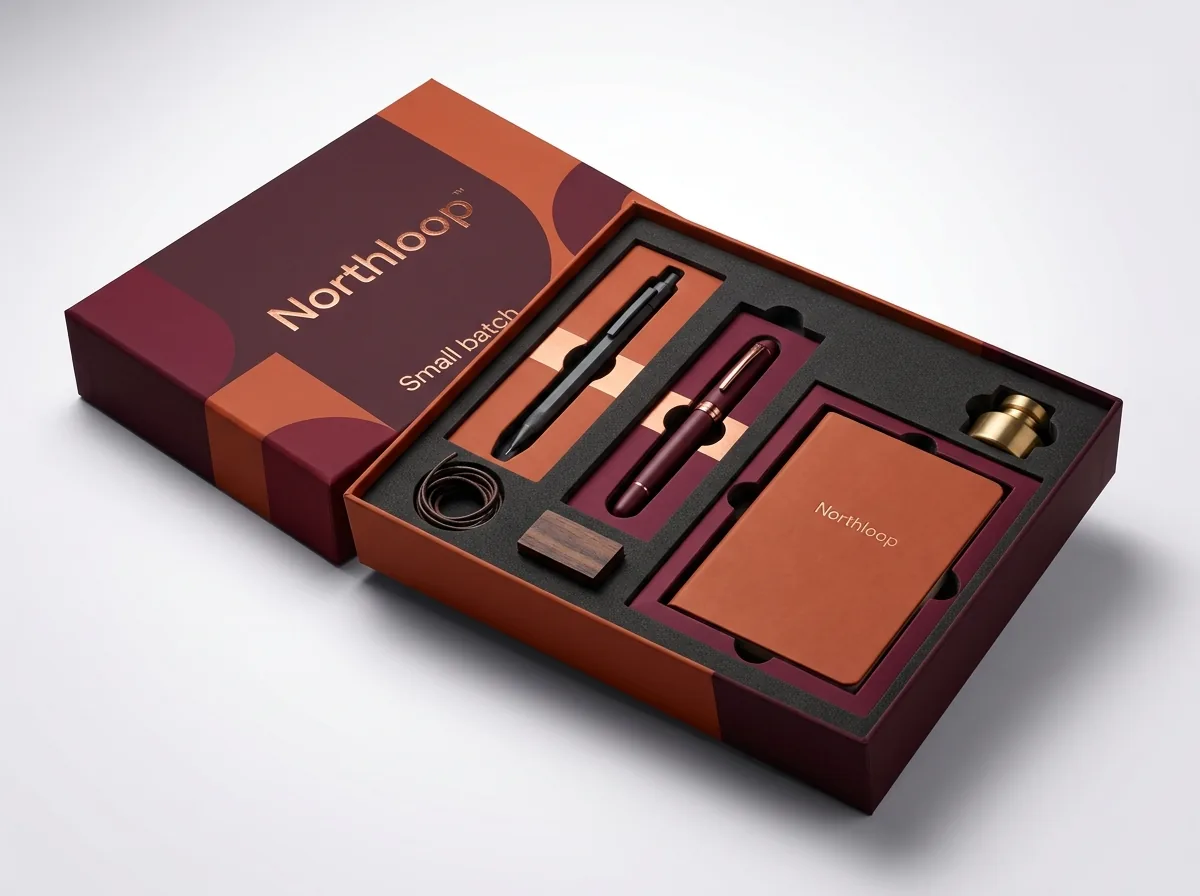
Because rigid drawer boxes ship pre-assembled at full 3D height, custom inserts are factory-fitted directly into the inner drawer bed so your fulfillment team can pack immediately without folding dividers by hand. Matching insert density and surface texture to your product prevents glass rattling and keeps delicate luxury finishes scratch-free during transit. Explore our custom box inserts, custom eva foam inserts, custom cardboard inserts, custom jewelry boxes, and custom perfume boxes options alongside custom printed rigid drawer boxes starting at 50 units
| Insert material | Key engineering detail | Food or watch suitability | Best rigid drawer pairing |
|---|---|---|---|
| Velvet-Flocked or Paper-Topped EVA Foam | Die-cut 15–20 mm deep with semicircular finger notches; top sits 2.5 mm below tray rim | Non-magnetic, lint-free luxury grip | Perfume flacons, rings, necklaces, serums, corporate pens & tumblers |
| Removable Suede Watch Pillow in Cavity | Plush compressible C-pillow seated inside a square rigid divider cell | 100% magnet-free horology storage | Automatic wristwatches, chronographs, cufflinks & bracelets |
| Food-Safe Clear or Gold PET Blister Tray | Individual thermoformed domes preventing lateral truffle or shell contact | Food-safe on request via partner facility | French macarons, chocolate bonbons, artisan pralines & dates |
| Smooth Molded Pulp or Folded Card Cradle | 100% paper-stream recyclable contoured cavities color-matched to brand wrap | Plastic-free sustainable presentation | Clean beauty sets, botanical oils, candles & tea tins |

How do I prepare print-ready artwork on a rigid drawer box dieline?
Before uploading your Illustrator or PDF artwork, review our companion guides on how to measure and choose grayboard for rigid drawer boxes and rigid drawer boxes vs tray and sleeve and book style boxes. Setting up clean vector layers prevents registration delays between outer sleeve wraps, hot foil dies, and inner tray liners. Prepress checks every file for free, confirms glide tolerances against your chosen laminate, and sends a 3D mockup before payment
- Step 1: Extend background colors and patterns across the entire 15 to 18 mm wrap turn-in bleed zone on both the outer sleeve and inner drawer dielines.
- Step 2: Place hot foil stamping, Spot UV, and debossing vectors on separate named spot-color layers at 100% K vector paths.
- Step 3: Keep raised 3D embossing and thick glitter coatings off the exterior side walls of the inner drawer so they never drag inside the 1.2 mm glide channel.
- Step 4: Mark your exact ribbon Pantone shade and width (typically 12 mm to 20 mm grosgrain or satin) or verify thumb-notch placement on the proof.
- Step 5: Outline all fonts to vector curves and embed linked 300 DPI CMYK raster textures so typography and fine foil lines stay crisp across every panel.
What are the most common dieline and hardware mistakes on custom rigid drawer boxes?
Avoid these five structural and prepress mistakes before approving your rigid drawer proof
- Stopping background bleed at the grayboard edge instead of extending across the 15–18 mm turn-in margin, which leaves an unprinted white rim around the sleeve opening.
- Gluing a surface ribbon tab lightly onto soft-touch film instead of anchoring the ribbon loop through a slit beneath the inner drawer liner.
- Placing a die-cut PET sleeve window closer than 12–15 mm to a 90-degree V-groove fold line, weakening the top sleeve corner.
- Designing an EVA foam insert without semicircular finger cutouts around recessed glass bottles, making tightly held vials hard to lift out.
- Skipping an internal safety-stop ribbon on heavy 100 ml perfume or ceramic drawers where a full pull could tip the tray out of the sleeve.
Packaging for this


Ready to order drawer boxes? Compare up to 3 quantities with a free 3D mockup.
Request a Quote →Questions about drawer boxes
How is the ribbon pull attached so it doesn't rip off when pulling a heavy drawer?
In quality turned-edge rigid manufacturing, both ends of the folded satin or grosgrain ribbon pass through a narrow die-cut slot in the front grayboard wall and are bonded flat beneath the interior lining paper, locking the pull mechanically into the board core.
Can I combine a clear PET sleeve window with foil stamping on the same top panel?
Yes. Keep your die-cut window at least 15 mm inside the V-grooved sleeve edges for corner strength, and leave an 8 mm buffer between the window edge and hot-stamped foil logos so stamping pressure never distorts the window frame.
What is a double-wall (rolled-edge) inner drawer and when is it worth adding?
A double-wall inner drawer folds a second wrapped grayboard wall down to the floor inside the tray, creating a thick 4 to 5 mm luxury rim that hides the outer cut edges of EVA foam inserts on flagship watch, jewelry, and perfume boxes.
Does CubitPack charge extra to create a custom two-part rigid drawer dieline?
No. CubitPack includes a free custom 2D vector dieline for both the outer sleeve and inner drawer (plus any custom insert), a free prepress artwork check, zero die or plate charges, and a 3D mockup before payment.
Can the inside of the outer sleeve be printed too?
Yes. While standard closed-back sleeves use clean white or black interior lining paper for smooth low-friction drawer travel, custom flood-printed interior liners are available whenever the open sleeve interior shows through a window or thumb cut.
Still have a question? Ask a packaging specialist.
Request a Quote →Request your drawer boxes quote
Tell us your size and quantities, and one dedicated account manager prepares pricing for each tier.
- Free design & AI-to-print studio + 3D mockup
- No die or plate charges · 4–5 day rush available
- Free shipping to all 50 states
- 10% off your first order
We verified two-part V-grooved rigid slipcase and inner drawer CAD dieline rules, 15–18 mm wrap turn-in margins, slot-anchored ribbon pull mechanics, and safety-stop tethers against Paperboard Packaging Council (PPC), National Paperbox Association (NPA), and TAPPI T 411 standards. A packaging specialist checked every tolerance. Spot something wrong? Tell us and we fix it.
Sources
What changed
- November 5, 2026: First published with two-part CAD dieline zone guide, ribbon pull vs thumb notch comparison, safety-stop diagram, and 4-insert selector.
More guides
New packaging guides by email
Sizes, materials and design tips. Unsubscribe anytime.