
How do I measure a rigid drawer box and choose the right grayboard thickness?
Short answer: Always measure a custom rigid drawer box by the usable interior cavity of the sliding inner tray: Inside Length (L) × Inside Width (W) × Inside Depth (D, usable tray wall height), adding 2–3 mm of vertical headroom so your product never scrapes the inside ceiling of the outer sleeve.

On this page
- What is the 4-step formula for measuring a custom rigid drawer box in L × W × D
- How do sliding clearance tolerances, pull orientation, and closed-back sleeves affect drawer math
- Which grayboard caliper (1.5 mm, 2.0 mm, or 2.5 mm) works best for the outer sleeve and inner tray
- What are standard custom rigid drawer box sizes across jewelry, confections, watches, and gifts
- How do I verify my rigid drawer box dimensions before full production
- Common mistakes
- FAQs
Request a custom quoteFree dieline & 3D mockup
When ordering custom drawer boxes (also called rigid slide boxes or matchbox-style luxury boxes), every dimension starts inside the removable inner drawer tray in the sequence Length (L) × Width (W) × Depth (D). Unlike a lift-off lid box where the cap lifts vertically away from the product, an inner rigid drawer slides horizontally through a fixed-height outer rigid sleeve. That horizontal motion makes usable Inside Depth (D) your single most important measurement: if a perfume cap, watch pillow, or truffle liner rises even 1.0 mm above the inner tray rim, it will snag against the outer sleeve opening. Once you supply your usable Inside L × W × D, prepress adds the inner tray grayboard caliper (1.2 to 2.0 mm), four plies of turned-edge wrapping paper, and a calibrated 1.0 to 1.5 mm sliding friction clearance to engineer the outer rigid sleeve.
What is the 4-step formula for measuring a custom rigid drawer box in L × W × D?
Whether you are sizing a petite jewelry drawer box, an elongated chocolate truffle assortment, or a deep timepiece slipcase, rigid drawer dimensions always work outward from the usable interior cavity of the sliding tray. Enter your usable Inside L × W × D in the quote form, and prepress builds both V-grooved subassemblies automatically
- Step 1: Measure Usable Inside Length (L) and Inside Width (W) of the Tray Floor. Place your product, multi-piece skincare layout, or confection blister tray on a flat bench. Measure the primary horizontal span as Inside Length (L) and the perpendicular span as Inside Width (W). Add +3.0 mm (+0.125 in) per side for folded silk ties or tissue-wrapped goods, or specify a custom die-cut EVA foam insert with at least 10 to 12 mm of foam border around glass bottles.
- Step 2: Set Usable Inside Depth (D) with +2.0 to +3.0 mm of Ceiling Headroom. Measure the tallest point of your seated product (including sprayer caps, watch crowns, or cushion loft) and add +2.0 to +3.0 mm (+0.08 to +0.12 in) of vertical clearance. Every part of the product and insert must sit slightly below the top edge of the inner drawer walls so nothing rubs the inside roof of the sleeve.
- Step 3: Calculate Wrapped Outer Tray Dimensions. Add twice the inner tray grayboard caliper plus four plies of wrapping and lining paper (~0.8 mm total paper buildup): Outer Tray L = L + (2 × Tray Caliper) + 0.8 mm, Outer Tray W = W + (2 × Tray Caliper) + 0.8 mm, and Outer Tray H = D + Tray Caliper + 0.6 mm.
- Step 4: Add the 1.0 to 1.5 mm Sliding Friction Clearance for the Outer Sleeve. To prevent jamming while keeping the drawer snug when tilted, Inner Sleeve Width equals Outer Tray W + 1.0 to 1.5 mm, and Inner Sleeve Height equals Outer Tray H + 1.0 to 1.2 mm. For a five-panel closed-back slipcase, Inner Sleeve Length equals Outer Tray L + 1.0 mm so the front pull wall sits crisp and flush at the sleeve mouth.
How do sliding clearance tolerances, pull orientation, and closed-back sleeves affect drawer math?
Two structural decisions change how your rigid drawer box feels in the hand: which edge carries the ribbon pull (short-end matchbox pull versus wide-front dresser pull) and whether the outer sleeve has a closed fifth back panel. Pulling from the narrow end gives a long, dramatic travel path ideal for neckties, pens, and 6-piece macarons, whereas pulling from the wide front edge opens like a luxury vanity drawer with immediate two-handed access to multi-bottle cosmetics or jewelry sets. Review these six engineering tolerances before approving your 2D dieline
| Drawer box structural parameter | Target engineering formula | Typical spec on 2.0 mm board | What happens if miscalculated |
|---|---|---|---|
| Horizontal Width Glide Gap | Outer Tray W + 1.0 to 1.5 mm | +1.2 mm total (+0.6 mm per side) | Under 0.7 mm jams; over 2.2 mm wobbles and drops out |
| Vertical Height Glide Gap | Outer Tray H + 1.0 to 1.2 mm | +1.0 mm roof clearance | Too tight scuffs top drawer rim; too loose shows top gap |
| Product-to-Rim Headroom | Max Seated Product H + 2.0 to 3.0 mm | Product sits 2.5 mm below tray rim | Bottle caps or truffles scrape inside ceiling of sleeve |
| Closed-Back Depth Stop | Outer Tray L + 0.8 to 1.2 mm | Front drawer wall aligns flush | Too shallow leaves tray sticking out; too deep recesses face |
| Double-Wall Rolled Tray Rim | Adds +(2 × Inner Wall Caliper) to L & W | 4.5 to 5.5 mm thick luxury rim | Shrinks usable cavity if not added outward from Inside L × W |
| Outer Box Footprint (Shipping) | Inside L/W + ~9 to 11 mm total | 8.4 × 5.9 × 2.5 in on 8 × 5.5 × 2.2 in | Required when sizing snug outer corrugated shipping mailers |
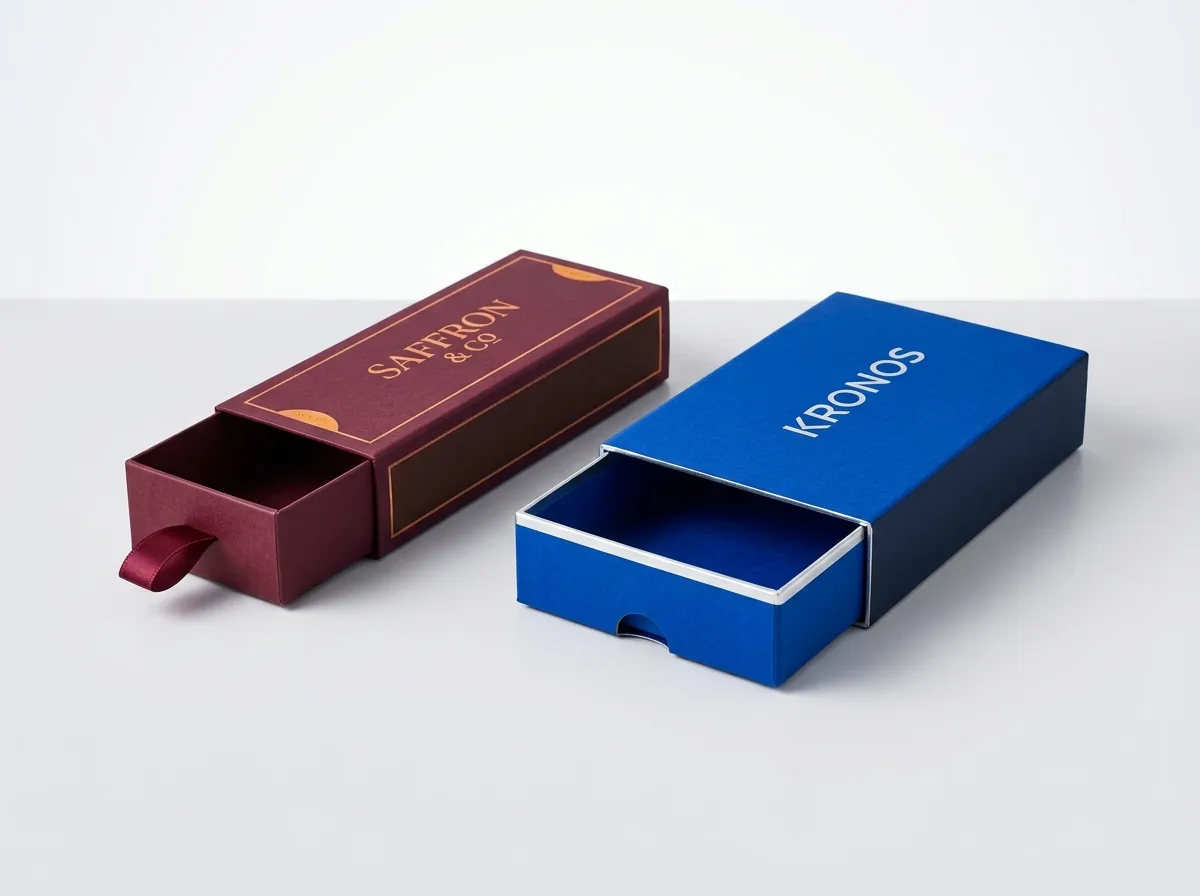
Which grayboard caliper (1.5 mm, 2.0 mm, or 2.5 mm) works best for the outer sleeve and inner tray?
Unlike hinged magnetic boxes that must use the same grayboard thickness across a single continuous spine, a rigid drawer box is built from two separate subassemblies. That lets structural specialists pair a heavier V-grooved grayboard on the outer sleeve (to prevent top-panel bowing across wide spans) with a slightly trimmer grayboard on the inner drawer (to keep sleek proportions and smooth glide weight). Match your box span and payload weight to the three caliper pairings below
- Preventing top-sleeve belly sag on wide boxes: Whenever the horizontal width across the sleeve opening exceeds 8.5 inches, step the outer sleeve up to 2.0 mm or 2.5 mm solid grayboard so the unsupported top span stays dead flat when stacked.
- Differential caliper advantage: Using a 2.0 mm outer sleeve with a 1.5 mm inner drawer saves ~1.0 mm of wall bulk per side on compact cosmetic and confection drawers while maintaining an heirloom outer shell.
- Double-wall rolled inner drawers: For flagship watches and fine jewelry, folding a second 1.5 mm collar wall inside the drawer rim creates a 4.5 mm thick border that hides die-cut EVA foam seams completely.
| Grayboard pairing tier | Outer sleeve caliper | Inner drawer caliper | Recommended box span & product weight | Ideal product applications |
|---|---|---|---|---|
| Petite Boutique Tier | 1.5 mm (60 pt / 950 GSM) | 1.2–1.5 mm (50–60 pt) | Up to 6 in span · Under 0.75 lb | Rings, earrings, pendant necklaces, macarons, gift cards, lipsticks |
| Standard Luxury Tier | 2.0 mm (80 pt / 1200 GSM) | 1.5–1.8 mm (60–70 pt) | 6 to 10 in span · 0.75 to 2.5 lb | Perfume flacons, wristwatches, 12-pc chocolates, silk ties, serums |
| Heavy Presentation Tier | 2.5 mm (100 pt / 1550 GSM) | 2.0 mm (80 pt / 1200 GSM) | 10 to 15 in span · 2.5 to 5.5 lb | Corporate tumblers & journals, multi-jar skincare, spirits & barware |
Know your size? Compare pricing across up to 3 quantities.
Request a Quote →What are standard custom rigid drawer box sizes across jewelry, confections, watches, and gifts?
Every CubitPack rigid order is built to your exact millimeter or fractional-inch dimensions starting at 50 boxes with zero tooling charges. Use these eight production-tested drawer benchmarks across custom jewelry boxes, custom chocolate boxes, custom watch boxes, custom perfume boxes, and custom corporate gift boxes to plan your layout
| Product category | Usable Inside Drawer (L × W × D) | Pull style & orientation | Recommended sleeve / tray board |
|---|---|---|---|
| Fine ring, earrings, or pendant | 3.5 × 3.5 × 1.5 in (89 × 89 × 38 mm) | Square drawer · Grosgrain ribbon pull | 1.5 mm sleeve / 1.5 mm tray |
| 6-piece French macaron sleeve | 7.2 × 2.4 × 2.0 in (183 × 61 × 51 mm) | Narrow-end matchbox pull · PET window | 1.8 mm sleeve / 1.5 mm tray |
| 50 ml / 100 ml Eau de Parfum | 6.5 × 4.0 × 2.4 in (165 × 102 × 61 mm) | Narrow-end satin pull + safety tether | 2.0 mm sleeve / 1.8 mm tray |
| Mechanical watch on pillow | 5.5 × 4.5 × 3.2 in (140 × 114 × 81 mm) | Wide-front pull · 100% magnet-free | 2.0 mm sleeve / 2.0 mm double-wall |
| 12-piece chocolate truffle box | 8.5 × 4.2 × 1.6 in (216 × 107 × 41 mm) | Wide-front satin pull + food-safe tray | 1.8 mm sleeve / 1.5 mm tray |
| Rolled silk necktie & square | 9.0 × 4.0 × 2.0 in (229 × 102 × 51 mm) | Narrow-end semicircular thumb notch | 2.0 mm sleeve / 1.5 mm tray |
| 3-bottle skincare ritual kit | 9.5 × 7.0 × 2.8 in (241 × 178 × 71 mm) | Wide-front dresser pull + EVA foam | 2.0 mm sleeve / 1.8 mm tray |
| Executive corporate welcome kit | 12.0 × 9.0 × 3.8 in (305 × 229 × 97 mm) | Wide-front heavy ribbon + safety stop | 2.5 mm sleeve / 2.0 mm tray |
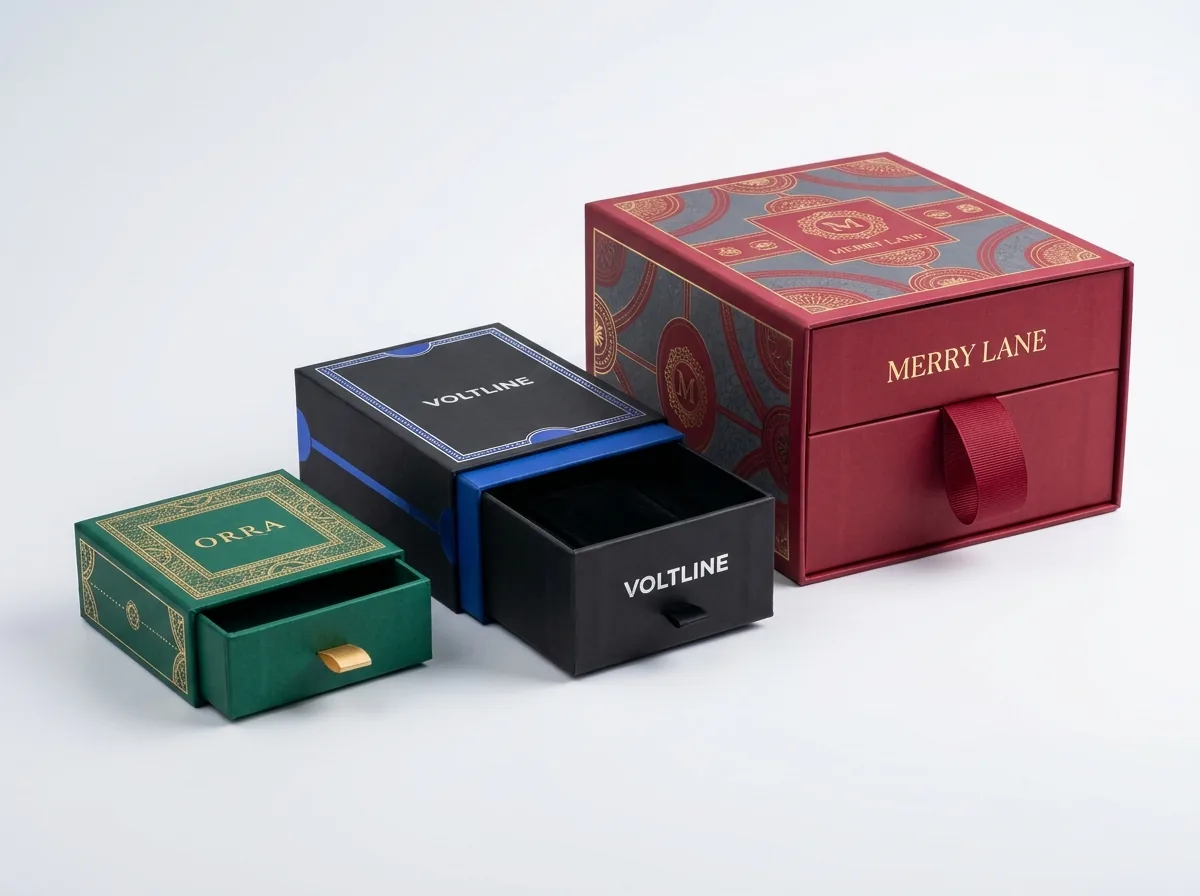
How do I verify my rigid drawer box dimensions before full production?
Once your usable cavity numbers are ready, read our companion guides on rigid drawer boxes vs tray and sleeve and book style boxes and rigid drawer box dieline, ribbon pulls, and drawer stops explained. When you order custom rigid slide drawer boxes from CubitPack starting at 50 units, prepress checks your ceiling clearance and calibrates your 1.0–1.5 mm sleeve friction gap free of charge. Run through this 5-step check before approving your proof
- Step 1: Measure your product or multi-item insert arrangement with digital calipers to establish usable Inside Tray Length (L) × Width (W) × Depth (D).
- Step 2: Confirm at least +2.0 to +3.0 mm of vertical headroom above the highest cap, bow, or cushion inside Depth (D) so nothing touches the sleeve ceiling.
- Step 3: Choose your pull orientation (short-end matchbox slide vs wide-front vanity drawer slide) and specify closed-back slipcase vs open-both-ends sleeve.
- Step 4: Select your outer sleeve and inner drawer grayboard calipers (1.5 mm, 2.0 mm, or 2.5 mm) and note any textured wrap papers that affect friction.
- Step 5: Test-slide a physical sample loaded with real product weight to verify smooth one-handed ribbon extraction and tilt hold.
What are the most common measurement and board mistakes on rigid drawer boxes?
Avoid these five sizing and caliper errors before signing off on your custom rigid drawer box dieline
- Giving outside sleeve measurements instead of usable Inside Tray L × W × D, which steals 8 to 11 mm of interior room once board caliper and glide gaps are subtracted.
- Setting usable Inside Depth (D) equal to exact bottle or truffle height with zero headroom, causing caps or chocolate tops to scrape the inside roof of the sleeve.
- Using thin 1.5 mm grayboard on a wide 11-inch outer sleeve opening, allowing the top sleeve face to bow slightly downward and pinch the sliding drawer.
- Switching from smooth matte lamination to thick woven cloth wrap without adding +0.4 mm to the sleeve cavity width, making the drawer overly tight.
- Forgetting to account for the extra +9 to +11 mm outer sleeve footprint when ordering snug outer corrugated shipping mailers.
Packaging for this





Ready to order drawer boxes? Compare up to 3 quantities with a free 3D mockup.
Request a Quote →Questions about drawer boxes
Should I enter the inner tray size or the outer sleeve size in the CubitPack quote form?
Always enter the usable inside dimensions of the inner sliding drawer cavity: Inside Length (L) × Inside Width (W) × Inside Depth (D). Prepress adds your inner drawer board thickness, paper wrap plies, and the 1.0–1.5 mm glide clearance to size the outer sleeve automatically.
How much clearance gap keeps a rigid drawer box from jamming or falling out?
A total gap of 1.0 to 1.5 mm (+0.5 to +0.75 mm per side) between the wrapped outer width of the inner tray and the inner cavity width of the rigid sleeve produces a smooth, damped furniture-drawer glide that stays put when tilted.
How much taller is the outside of a rigid drawer box than its usable inside depth?
On standard 2.0 mm grayboard, the total outside height of the assembled rigid sleeve is roughly 6.5 to 7.5 mm (0.26 to 0.30 inches) taller than usable Inside Depth (D), accounting for one tray floor, two sleeve walls, wrap paper, and vertical glide clearance.
Can the outer sleeve use thicker grayboard than the inner sliding tray?
Yes. Pairing a 2.0 mm or 2.5 mm solid grayboard outer sleeve with a 1.5 mm or 1.8 mm inner drawer tray is standard luxury practice: the thick sleeve resists crushing and top-span sag while keeping the sliding drawer crisp and balanced.
What is the smallest and largest rigid drawer box CubitPack can make?
Compact jewelry and gift-card rigid drawers commonly start around 3.0 × 3.0 × 1.0 inches usable cavity, while heavy 2.5 mm corporate and apparel drawers scale up to 15 × 12 × 4.5 inches; exact min/max limits are confirmed per quote.
Still have a question? Ask a packaging specialist.
Request a Quote →Request your drawer boxes quote
Tell us your size and quantities, and one dedicated account manager prepares pricing for each tier.
- Free design & AI-to-print studio + 3D mockup
- No die or plate charges · 4–5 day rush available
- Free shipping to all 50 states
- 10% off your first order
We verified rigid slipcase and inner drawer L × W × D expansion formulas, 1.0–1.5 mm horizontal and vertical friction clearances, and differential 1.2–2.5 mm grayboard calipers against Paperboard Packaging Council (PPC), National Paperbox Association (NPA), and TAPPI T 411 technical manuals. A packaging specialist checked every formula and size row. Spot something wrong? Tell us and we fix it.
Sources
What changed
- November 5, 2026: First published with 4-step Inside Drawer L × W × D formula, 1.0–1.5 mm sleeve glide table, differential sleeve/tray grayboard selector, and 8-category size chart.
More guides
New packaging guides by email
Sizes, materials and design tips. Unsubscribe anytime.