
How do you lay out Nutrition Facts, allergens, and UPCs on food boxes?
Short answer: Place the product name and net weight (in ounces and grams) on the front Principal Display Panel, and place the Nutrition Facts table, ingredient list, allergen statement, and company address on the Information Panel immediately to the right. Our free prepress check on custom food boxes keeps every panel clear of fold scores.
On this page
- Which elements belong on each panel of a retail food carton
- What has to appear on the front Principal Display Panel (PDP)
- How do you arrange Nutrition Facts, ingredients, and the 9 major allergens
- Where should the UPC barcode and Best-By date stamp sit on a food box
- How do you set up artwork across multiple food flavors on one dieline
- Common mistakes
- FAQs
Request a custom quoteFree dieline & 3D mockup
A retail food carton has six outer surfaces, and US FDA food labeling regulations (21 CFR Part 101) assign specific jobs to two of them: the Principal Display Panel (PDP) on the front face that shoppers see on the supermarket shelf, and the Information Panel immediately to the right of the front face. The front PDP must display the statement of identity (what the food is) and the net quantity of contents in both US customary weight (oz / lb) and metric weight (g / kg) inside the bottom 30% of the panel. The right-hand Information Panel holds the Nutrition Facts box, the descending ingredient list, the major food allergen statement (covering milk, eggs, fish, crustacean shellfish, tree nuts, peanuts, wheat, soybeans, and sesame), and the manufacturer or distributor name and address. Leaving the back panel free for your brand story and preparation steps makes the entire box clean and easy to scan.
Which elements belong on each panel of a retail food carton?
When you open a flat folding carton dieline in Adobe Illustrator, you see four vertical panels in a row (Back, Left Side, Front, Right Side) plus a narrow glue tab and top/bottom closure flaps. Mapping each regulatory and merchandising block to its standard panel before you start illustrating stops you from crowding mandatory disclosures onto the front cover. Use the table below to assign every required element on your custom printed grocery cartons. When you send us your copy, our design team checks that no text sits within 1/8 inch of a fold score line or glue flap.
| Carton panel | FDA & retail role | What goes on this panel |
|---|---|---|
| Front panel | Principal Display Panel (PDP) | Brand logo, product identity, photography/window, net weight in bottom 30% |
| Right side panel | Information Panel (first choice) | Standard vertical Nutrition Facts, ingredient list, Contains allergen line, company address |
| Back panel | Story & preparation panel | Cooking or serving directions, brand story, recipe ideas, or wide tabular Nutrition Facts |
| Left side panel | Secondary merchandising panel | Flavor color band, dietary badges, storage tips, vertical shelf-stacking title |
| Top tuck or seal flap | Top visibility & date coding | Brand logo, flavor name, unvarnished lot/best-by inkjet zone |
| Bottom flap | Checkout scanner panel | UPC-A barcode in a solid white box (or lower back panel) |
What has to appear on the front Principal Display Panel (PDP)?
Under 21 CFR 101.3 and 101.105, the front Principal Display Panel has two non-negotiable jobs: telling the shopper what the food is (Statement of Identity, such as "Artisanal Rigatoni Pasta" or "Rosemary Sea Salt Crackers") and stating how much food is inside (Net Quantity of Contents). The net weight statement must sit in the lower 30% of the front panel, running parallel to the base of the box, with dual declarations in both US avoirdupois ounces/pounds and metric grams/kilograms - for example, NET WT 12 OZ (340 g). The minimum letter height for the net weight depends on the total area of your front panel (width × height): panels up to 5 square inches need at least 1/16 inch type, panels from 5 to 25 square inches need at least 1/8 inch type, and panels from 25 to 100 square inches (which covers most pasta, cracker, and custom cereal boxes) need at least 3/16 inch type.
How do you arrange Nutrition Facts, ingredients, and the 9 major allergens?
As you look at the front of the carton, the panel immediately to the right is the official FDA Information Panel (21 CFR 101.2). Unless that right side panel is too narrow (for example, on a very thin 1.25 inch frozen pizza or bar box, where the back panel can serve as the Information Panel instead), grocery buyers and regulators expect to find three items grouped together on the right side without any intervening marketing slogans between them: the Nutrition Facts table, the ingredient list, and the manufacturer or distributor name and street address. Immediately below or beside the ingredient list, include your major food allergen declaration in plain language. Under the Food Allergen Labeling and Consumer Protection Act (FALCPA) and the FASTER Act, you must declare any of the nine major US allergens - milk, eggs, fish, crustacean shellfish, tree nuts (by specific nut name, such as almond or walnut), peanuts, wheat, soybeans, and sesame - either in parentheses inside the ingredient list or in a dedicated Contains: Wheat, Milk, Soy. line right after the ingredients.
- Standard Vertical Nutrition Facts: fits side panels at least 1.75 to 2.0 inches wide.
- Tabular or Linear Nutrition Facts: allowed on smaller cartons with under 40 square inches of total printable surface area.
- No intervening material: do not put promotional badges or marketing copy between the ingredients and the company address.
- High-contrast legibility: print Nutrition Facts rules and text in 100% black (K) ink on a white or light background.
Know your size? Compare pricing across up to 3 quantities.
Request a Quote →Where should the UPC barcode and Best-By date stamp sit on a food box?
Supermarket checkout clerks sweep cartons across a flatbed laser or optical scanner in one quick motion, which is why the bottom panel or the lower right corner of the back panel is the standard home for a retail UPC-A barcode. At nominal 100% magnification, a UPC-A symbol (including its left and right quiet zones) measures 1.469 × 1.020 inches. You can truncate the bar height slightly on narrow panels, but never shrink the horizontal width below 80% magnification (1.175 in wide) or shave off the white quiet margins on the left and right. Equally important is leaving an unvarnished, unlaminated white rectangle (typically 1.5 × 0.5 in) on the top or bottom flap for your filling line's inkjet date coder or thermal lot stamp. Inkjet lot numbers and BEST BY dates smear easily if printed directly onto slick gloss lamination or UV coating, so knocking out the coating in that small zone keeps your date codes smudge-free. If you apply separate batch or flavor stickers instead, see our custom food labels and custom nutrition labels.
How do you set up artwork across multiple food flavors on one dieline?
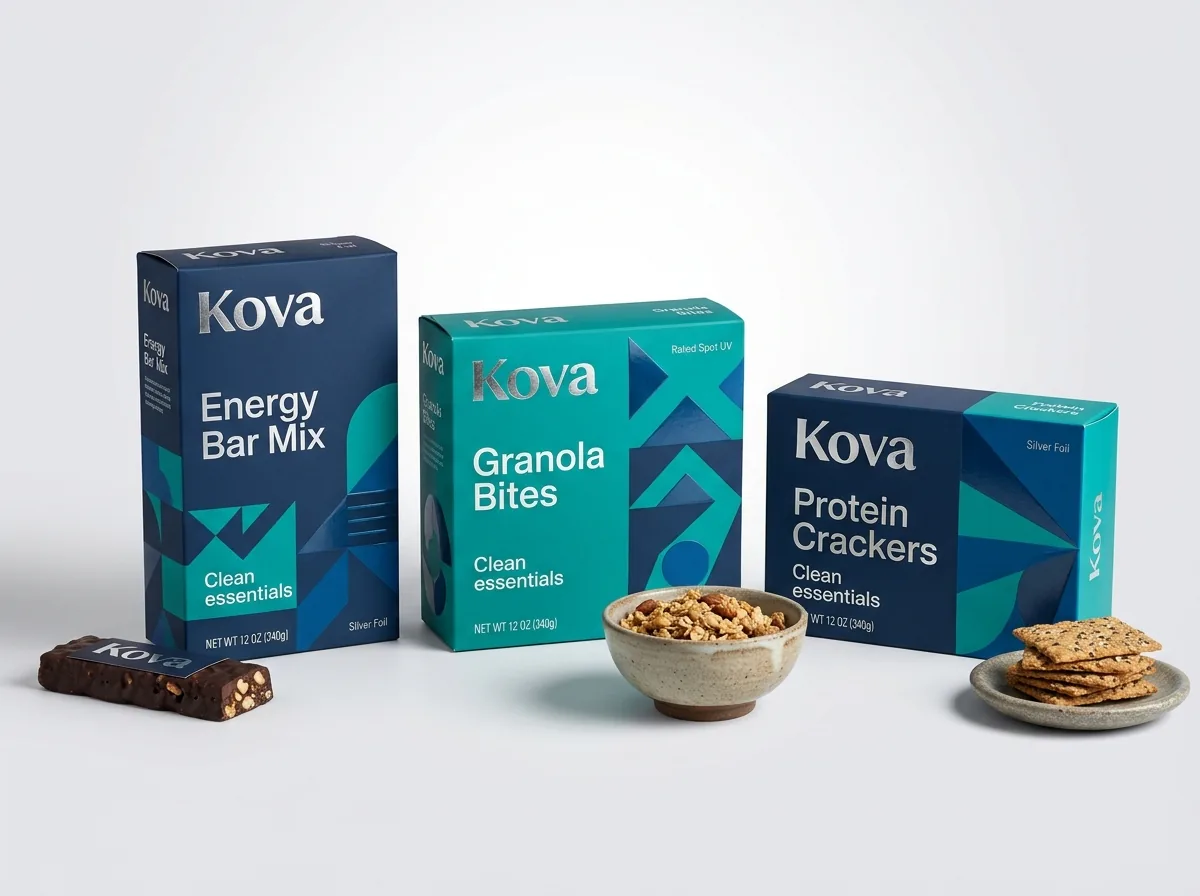
Most food brands launch a line of three to five flavors - such as Sea Salt, Cracked Pepper, and Rosemary Garlic - in the exact same carton size. Building a single master dieline file with locked regulatory layers keeps your whole line consistent on the shelf and avoids prepress mistakes when updating a single recipe. Lock the structural cut and crease lines on their own non-printing layer, keep the brand header, net weight position, and white barcode box in the exact same coordinates across every file, and swap only the flavor name, Pantone color band, hero illustration, Nutrition Facts numbers, and ingredient text. When you submit your files to CubitPack, our prepress specialists check every SKU individually and send a digital proof and 3D mockup for each flavor before you pay.
- Layer 1 (Locked Dieline): structural cut lines, fold score lines, and 1/8 inch inner safe margins.
- Layer 2 (Shared Master Graphics): brand wordmark, net weight baseline, company address, and white barcode box.
- Layer 3 (Flavor Variable Copy): SKU flavor title, Pantone color band, vertical Nutrition Facts, ingredients, and UPC digits.
- Layer 4 (Finishes & Knockouts): Spot UV mask, foil stamping plates, and unvarnished Best-By date stamp window.
What are the most common food box labeling and layout mistakes?
Retail grocery distributors inspect outer cartons against FDA and GS1 rules before accepting a new item into their warehouse. Avoid these five artwork mistakes
- Listing net weight only in ounces on the front panel while forgetting the mandatory metric gram or kilogram equivalent.
- Placing marketing slogans or icons between the Nutrition Facts table, ingredient list, and distributor address on the Information Panel.
- Forgetting to include sesame alongside the other major food allergens in the Contains statement.
- Printing a UPC barcode in metallic foil, red ink, or rich 4-color black instead of 100% black (K) ink inside a white quiet zone.
- Laminating right over the Best-By / Lot Code stamp box on the top flap without leaving a knockout window for inkjet coding.
Find your size
Suggested inside size: 5.5 × 2.0 × 5.75 in
A starting point. Your account manager confirms the size with you before the proof.
Quote this size →Packaging for this
Ready to order food boxes? Compare up to 3 quantities with a free 3D mockup.
Request a Quote →Questions about food boxes
What if my food box right side panel is too narrow for a standard Nutrition Facts table?
If the right side panel is too narrow to fit the standard vertical Nutrition Facts box cleanly, FDA rules (21 CFR 101.2) allow you to place the Information Panel on the back panel instead, or use a side-by-side or tabular Nutrition Facts format if your package meets the surface-area criteria.
Do restaurant takeout boxes need a Nutrition Facts panel printed on the box?
Carryout boxes packed to order at a restaurant or cafe counter generally do not require a Nutrition Facts panel on the box itself. However, if you sell pre-packaged grab-and-go foods in retail grocery stores or convenience cases, full retail food labeling applies.
Can I print the Nutrition Facts table on the bottom of the food box?
Generally no, unless the carton is so flat or shallow (such as a very thin tray or confection box) that the side and back panels cannot accommodate it. For standard upright grocery cartons, keep Nutrition Facts on the right-hand Information Panel or back panel.
What is the minimum font size for the ingredient list on a food carton?
Under 21 CFR 101.2(c), the ingredient list, allergen statement, and manufacturer name and address on the Information Panel must be printed in a type size at least 1/16 inch (1.6 mm) tall, measured by the height of the lowercase letter 'o'.
Will CubitPack check my food box dieline for fold clearance and barcode contrast?
Yes. Every order includes free prepress design help, a custom dieline, a flat digital proof, and an interactive 3D mockup before payment. Our prepress team checks bleed, safe margins, barcode contrast, and panel orientation before plates are made.
Can I print multiple food flavors in one order?
Yes. Select 2 designs or 3+ designs in the quote form when your flavors share the same box dimensions. Sharing one dieline across multiple flavors keeps your shelf display uniform and helps lower your per-box cost.
Still have a question? Ask a packaging specialist.
Request a Quote →Request your food boxes quote
Tell us your size and quantities, and one dedicated account manager prepares pricing for each tier.
- Free design & AI-to-print studio + 3D mockup
- No die or plate charges · 4–5 day rush available
- Free shipping to all 50 states
- 10% off your first order
The panel layout map, net weight type heights, and allergen placement rules in this guide reference US FDA food labeling regulations (21 CFR Part 101, FALCPA, and the FASTER Act). A CubitPack packaging specialist reviewed every section. Spot an error? Tell us and we will fix it.
Sources
What changed
- October 22, 2026: First published.
- October 22, 2026: Updated specifications, terminology, and verified source links.
More guides
New packaging guides by email
Sizes, materials and design tips. Unsubscribe anytime.