
How do I size custom food boxes for dry, frozen, and takeout packs?
Short answer: Measure the filled inner pouch, thermoformed tray, or jar group at its widest point, then add 1/8 to 1/4 inch of clearance on each dimension. Common inside sizes for custom food boxes include 4.5 × 2.25 × 7.25 in for dry pasta and 7.5 × 6.0 × 1.75 in for frozen entrees.
On this page
- How do I measure a filled pillow bag or meal tray for a food box
- What are standard inside sizes for retail grocery, frozen, and takeout boxes
- How do bulk density and settling affect pasta, grain, and cracker boxes
- How do you size a paperboard carton or sleeve around a frozen meal tray
- How do I size takeout gable boxes and multi-jar gourmet food sets
- Common mistakes
- FAQs
Request a custom quoteFree dieline & 3D mockup
The right inside size for a food carton comes from the shape of the filled food package, not its net weight on the scale. Twelve ounces of flaky crackers in a nitrogen-flushed pillow pouch needs nearly twice the box volume of twelve ounces of dense short-cut pasta or Arborio rice. When sizing a bag-in-box grocery carton, fill and seal your inner pouch first, stand it upright the way it will sit on the supermarket shelf, and measure the widest belly of the bag from front to back before adding 1/4 inch of depth clearance. For rigid frozen meal trays, measure the outer lip of the top heat-seal flange and add 1/8 inch to length and width so the tray slides in without catching on the side dust flaps. Every CubitPack food carton is built to your exact inside Length × Width × Height in inches with zero die fees.
How do I measure a filled pillow bag or meal tray for a food box?
Flexible inner bags and thermoformed plastic or fiber trays behave very differently when loaded into a folding carton. A flexible pillow pouch bulges outward in the middle as dry crackers, cereal, pretzels, or pancake mix settle toward the bottom third of the bag. If you measure an empty flat pouch or calculate volume mathematically without testing a filled bag, the center of the pouch will push the front and back carton walls into a rounded curve that prevents boxes from standing straight on grocery shelves. To get an accurate measurement for printed grocery food cartons, fill three sample pouches to your exact target net weight plus your normal gas headspace, seal the top fin, and place a pouch between two flat books or boxes held upright on a table. Slide the books inward until they lightly touch the front and back faces of the pouch without squashing the contents inside. The distance between the two books, plus 3/16 to 1/4 inch of breathing room, is your carton's inside Width (front-to-back depth).
- Length (L): left-to-right width across the front Principal Display Panel of the food carton.
- Width (W): front-to-back depth across the side Nutrition Facts panel (critical for pouch belly).
- Height (H): bottom-to-top vertical height from the bottom score line to the top flap crease.
- Bag-in-box clearance: add 1/4 in to Width (depth) and 1/4 to 3/8 in to Height for the folded top fin seal.
- Rigid tray clearance: measure outside the top flange lip and add 1/8 in to Length, Width, and Height.
What are standard inside sizes for retail grocery, frozen, and takeout boxes?
While CubitPack cuts every order to your custom dieline with no die or plate charges, most supermarket aisles and carryout counters organize around proven shelf heights and tray footprints. Use the chart below as a starting benchmark across dry pantry staples, single-serve bar multipacks, frozen skillet trays, takeout combos, and gourmet jar sets. Notice that grocery shelf cartons are tall and narrow - typically 1.75 to 2.75 inches deep from front to back - so they present a wide front billboard to shoppers walking down the aisle while keeping the center of gravity stable.
| Food product or pack type | Typical inside size (L × W × H) | Usual box style |
|---|---|---|
| 5 to 6 granola, protein, or fruit bars | 5.5 × 2.0 × 5.75 in | Straight tuck end or dispenser box |
| 12 oz to 16 oz dry pasta, rice, or grains | 4.5 × 2.25 × 7.25 in | Seal end with clear window |
| 6 oz to 8 oz cracker or biscuit pillow bag | 6.0 × 2.5 × 8.25 in | Seal end or straight tuck end |
| 10 oz to 12 oz cereal or granola bag-in-box | 7.5 × 2.75 × 10.5 in | Seal end carton |
| Single-serve frozen meal tray (8–11 oz) | 7.5 × 6.0 × 1.75 in | End-load tuck carton or slide sleeve |
| Family-size frozen entree or flatbread | 10.5 × 8.5 × 2.25 in | Seal end or straight tuck end |
| Restaurant carryout lunch or market combo | 9.0 × 5.0 × 5.0 in | Gable box with auto lock bottom |
| Three 8 oz gourmet sauce, jam, or honey jars | 10.5 × 3.75 × 6.5 in | Auto lock bottom or mailer + divider |
How do bulk density and settling affect pasta, grain, and cracker boxes?
Dry foods settle during vibration on delivery trucks. When a carton of penne pasta, rice, or pancake mix leaves your filling line, the product fills roughly 85% to 90% of the carton height; after 500 miles on a highway trailer, the pieces nest together and drop by half an inch to an inch. If you size the carton far larger than the settled volume, shoppers picking up the box feel excessive empty space at the top - and US FDA slack-fill rules (21 CFR 100.100) prohibit non-functional empty space that misleads buyers. Keep your carton height within 15% to 20% of the settled fill height, and place any clear viewing window in the middle third of the front panel rather than near the top crease. That way, even after normal transit settling, shoppers looking through your custom window box see a full window of pasta or grains rather than empty headspace. For dedicated snack and cereal formats, see our custom snack boxes and custom cereal boxes.
Know your size? Compare pricing across up to 3 quantities.
Request a Quote →How do you size a paperboard carton or sleeve around a frozen meal tray?
Frozen and refrigerated ready meals usually sit inside a CPET, PP, or molded-fiber tray sealed on top with lidding film. When measuring a meal tray for an end-load carton or a slide-on tray and sleeve box, never measure the tapered bottom well of the tray. The widest part of any meal tray is the flat top rim flange where the lidding film seals. Measure the exact outer length and width of that top flange, plus the vertical height from the bottom ribs of the tray to the highest dome of the food or lidding film. Add 1/8 inch to the flange length and width, and 1/8 inch to height. If you use an open-ended paperboard sleeve instead of a fully enclosed box, we can size the sleeve height 1/16 inch tighter so friction along the top and bottom walls holds the sleeve snug around the tray without needing glue dots.
How do I size takeout gable boxes and multi-jar gourmet food sets?
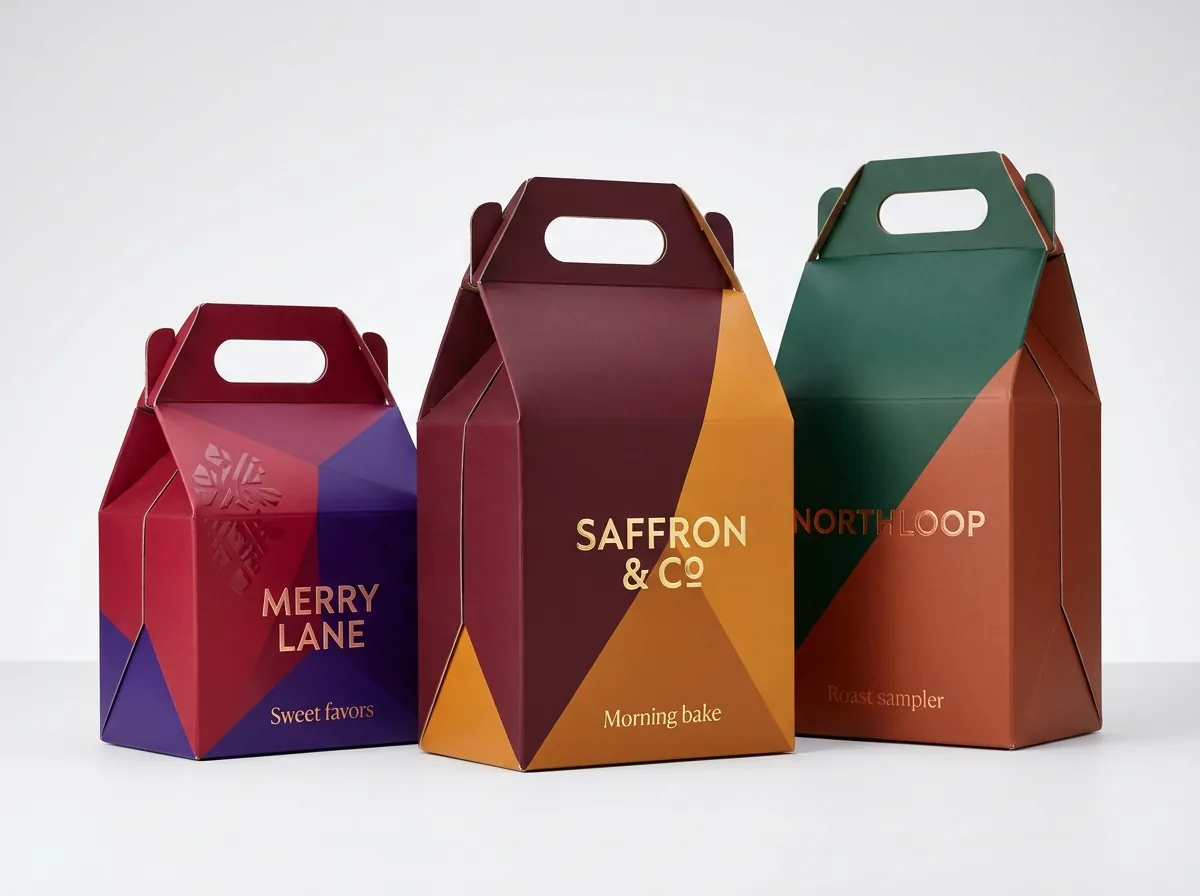
For restaurant carryout combos, box lunches, and farmers market packs, a custom gable box combines a flat auto lock floor with a sloped top handle. Because the upper walls angle inward to meet at the handle slot, the usable vertical height for tall drink cups or stacked sandwich clamshells is the wall height up to the horizontal shoulder crease, not the total height to the top of the handle. Always match your tallest inner container to the shoulder score height. For gourmet food gift sets holding two, three, or four glass jars of salsa, jam, honey, or spice blends, size the carton around both the jars and the cardboard insert partitions. Multiply the widest jar diameter by the number of jars in a row, add 3/16 inch for each E-flute corrugated divider wall between jars, and add 1/8 inch on the outer ends so the filled divider assembly slides in smoothly.
- Gable box usable height: measure from the flat floor to the shoulder fold line below the sloped handle.
- Three-jar gift box Length: (3 × jar diameter) + (2 × 3/16 in divider walls) + 1/8 in end clearance.
- Three-jar gift box Width: 1 × jar diameter + 1/8 in front-to-back clearance.
- Heavy jar base rule: use a pre-glued auto lock bottom or corrugated mailer whenever total weight exceeds 12 oz.
What are the most common food box sizing mistakes?
Nearly every food carton fit issue traces back to measuring an empty container instead of a filled, sealed one. Avoid these five sizing errors
- Measuring an empty flat pillow pouch instead of the puffed belly of a filled, nitrogen-flushed bag.
- Sizing a frozen entree carton from the narrow bottom well of the tray rather than the wider top heat-seal flange.
- Placing a front display window too high on a pasta or grain box, where normal transit settling reveals empty space.
- Using the total handle height of a gable takeout box instead of the lower shoulder crease height for tall containers.
- Forgetting to add 3/16 inch per corrugated partition wall when laying out a multi-jar gourmet sauce or honey box.
Find your size
Suggested inside size: 5.5 × 2.0 × 5.75 in
A starting point. Your account manager confirms the size with you before the proof.
Quote this size →Packaging for this

Ready to order food boxes? Compare up to 3 quantities with a free 3D mockup.
Request a Quote →Questions about food boxes
Are food box dimensions quoted as inside or outside measurements?
All CubitPack food boxes are quoted by inside dimensions: Length × Width × Height in inches. Inside dimensions ensure your inner pouch, meal tray, or glass jars fit properly. If you also have a fixed supermarket shelf height or master case limit, share that outer dimension in your quote notes.
How much clearance should I add around a filled cracker or cereal bag?
Add about 1/4 inch to the front-to-back Width (depth) of the filled bag's widest belly, and 1/4 to 3/8 inch to the Height so the folded top fin seal tucks down without pushing the top carton flaps open.
What size box fits a standard single-serve frozen meal tray?
Most 8 oz to 11 oz single-serve frozen meal trays fit an inside carton size around 7.5 × 6.0 × 1.75 inches. Always measure across the outer lip of your specific tray's top flange and add 1/8 inch on each axis.
Can I use one food box size for multiple flavors in my line?
Yes. Keeping all your flavors or recipes in the exact same carton size lets you share one structural dieline, pack every SKU in the same master shipping case, and combine quantities to lower your unit cost.
How do I prevent non-functional slack fill in a dry food carton?
Test how much your dry pasta, rice, crackers, or mix settles after vibration, and size the carton height so the settled product fills at least 80% to 85% of the interior cavity after allowing for top fin seals.
Can I test my food box size before paying for production?
Yes. Every order includes a free custom dieline and a 3D mockup before you pay. You can print the flat dieline at 100% scale to check fit, order our $50 sample kit (credited to your first order), or request a paid physical prototype.
Still have a question? Ask a packaging specialist.
Request a Quote →Request your food boxes quote
Tell us your size and quantities, and one dedicated account manager prepares pricing for each tier.
- Free design & AI-to-print studio + 3D mockup
- No die or plate charges · 4–5 day rush available
- Free shipping to all 50 states
- 10% off your first order
The clearance rules and benchmark dimensions in this guide are based on standard CPG bag-in-box, thermoformed tray, and corrugated divider tolerances. A CubitPack packaging specialist checked every formula and table row. Spot an error? Let us know and we will fix it.
Sources
What changed
- October 22, 2026: First published.
- October 22, 2026: Updated specifications, terminology, and verified source links.
More guides
New packaging guides by email
Sizes, materials and design tips. Unsubscribe anytime.