
Bordeaux vs Burgundy wine labels: which shape and finish fits your bottle?
Short answer: High-shouldered Bordeaux bottles have a tall 5 inch straight cylinder that suits vertical rectangles (3.5 × 4 in to 3.75 × 4.75 in) and cathedral arches. Sloped-shoulder Burgundy bottles have a wider, shorter lower cylinder that suits horizontal rectangles (4 × 3.25 in), ovals and crests when ordering custom wine labels.
On this page
- How do Bordeaux, Burgundy, Hock and Champagne bottles compare
- Which label shapes and layouts suit straight-sided Bordeaux bottles
- Why do sloped-shoulder Burgundy bottles favor wider rectangles and ovals
- How do you match clear, foil and matte finishes to red, white and rose wines
- How do you unify a release that mixes Bordeaux and Burgundy bottles
- Common mistakes
- FAQs
Request a custom quoteFree dieline & 3D mockup
Matching your label shape and finish to your wine bottle's glass silhouette is what makes a release look like an established estate vintage rather than a stock template. A 750 ml Bordeaux bottle gives you a tall, dead-straight vertical canvas ideal for structured vertical rectangles, tall arches and two-part split labels paired with matte lamination and hot gold foil stamping. A 750 ml Burgundy or Rhone bottle curves inward almost immediately above its lower belly, rewarding wider horizontal rectangles, rounded ovals or die-cut shields that hug the lower cylinder without corner wrinkling. Meanwhile, flint-glass Rose and Sauvignon Blanc bottles shine with transparent clear labels or bright gloss finishes that withstand ice buckets. At CubitPack, every shape and finish starts at 500 printed wine labels in 10 to 14 business days with zero die fees.
How do Bordeaux, Burgundy, Hock and Champagne bottles compare?
Before choosing a rectangle, oval or custom crest, check which of the four classic 750 ml glass molds your winery or co-packer is filling. Each silhouette evolved in a specific European wine region and carries a distinct diameter, shoulder slope and standard glass color. Because a glass wine bottle is a rigid, non-compressible surface, even a quarter-inch of shoulder taper will force a stiff rectangular corner to lift or crease if the label extends past the straight cylindrical zone. Measuring the straight vertical wall between the heel radius at the bottom of the bottle and the shoulder break at the top tells you immediately whether your artwork wants a tall portrait format or a wide landscape format. Use the comparison table below to match your bottle mold to its ideal label proportion, shape and finish.
| Bottle silhouette | Glass geometry & varietals | Best label shapes & proportions | Popular finishes |
|---|---|---|---|
| 750 ml Bordeaux | 2.95-3.0 in wide; tall 5 in straight wall, high sharp shoulder (Cabernet, Merlot, Sauv Blanc) | Vertical rectangle (3.5 × 4 in to 3.75 × 4.75 in), tall arch, split two-piece | Matte + gold foil stamping, or clear on flint Sauv Blanc |
| 750 ml Burgundy / Rhone | 3.35-3.5 in wide; sloped shoulder, 3.25 in lower cylinder (Pinot Noir, Chardonnay, Syrah) | Horizontal rectangle (4 × 3.25 in), classic oval, rounded crest | Velvety matte + spot UV crest or antique gold foil |
| 750 ml Hock / Alsace flute | 2.85 in narrow width; tall slender taper (Riesling, Gewurztraminer, desert wines) | Slender vertical rectangle (3 × 4.25 in) or vertical diamond | High-gloss botanical print or metallic foil stock |
| 750 ml Champagne / sparkling | 3.45 in wide heavy glass; deep punt, sloped neck (Brut, Prosecco, Pet-Nat) | Shield, wide oval or 4 × 3.5 in rectangle + tapered neck collar | Metallic foil stock, hot foil stamping, gloss coat |
Which label shapes and layouts suit straight-sided Bordeaux bottles?
Because a standard 750 ml Bordeaux bottle has straight, parallel vertical walls for roughly 5 inches between the heel and the high shoulder break, you have almost complete creative freedom with vertical height. Traditional Napa and Bordeaux cabernets use a 3.5 × 4.25 inch or 3.75 × 4.75 inch custom rectangle label with the estate engraving at the top, the varietal and appellation in the center, and the vintage year at the bottom. Two modern variations also work beautifully on straight Bordeaux walls without costing a penny in die fees: a cathedral arch top that echoes cellar architecture, or a two-part split label where a 3.5 × 3 inch main graphic panel sits above a separate 3.5 × 0.75 inch bottom strip carrying the vintage and appellation.
- Tall estate rectangle (3.5 × 4.25 in or 3.75 × 4.75 in): maximizes shelf presence on dark green Cabernet and Merlot glass.
- Cathedral arch or stepped crest: custom die-cut top contour that stands out on crowded retail racks at zero die cost.
- Split two-piece front layout: pairs a main artwork square with a narrow bottom strip on the same roll web.
- 360-degree full wrap (9.125 × 3.75 in): popular for natural wines, sangrias and tasting-room releases.
Why do sloped-shoulder Burgundy bottles favor wider rectangles and ovals?
Pick up a 750 ml Burgundy bottle (or its heavier Rhone cousin) and trace your finger up the side wall: the glass begins curving inward toward the neck just 3.25 to 3.5 inches above the table. Because the bottle is also 3.35 to 3.5 inches wide, a tall narrow label looks pinched and its upper left and right corners will lift where the shoulder tapers. Instead of fighting the slope, design a wider horizontal rectangle (such as 4 × 3.25 inches or 3.875 × 3 inches) or a classic custom oval label or shield crest. An oval or rounded-corner crest naturally narrows at the top and bottom, allowing the sticker to sit higher on a Burgundy or Champagne shoulder without any square corners buckling on the curve. Many Sonoma and Willamette Valley Pinot Noir producers also add a separate 3 × 0.875 inch crescent neck band just below the capsule to display the vintage year or single-vineyard designation while keeping the main lower panel clean and balanced.
- Wide landscape rectangle (4 × 3.25 in or 3.875 × 3 in): fills the broader 3.4 inch Burgundy belly while staying safely below the shoulder slope.
- Classic oval medallion (3.5 × 4 in or 3.25 × 3.75 in): tapered top and bottom arcs glide over gentle glass transitions without corner lift.
- Heraldic shield or scalloped crest: custom die-cut geometry with rounded shoulders that frames vineyard illustrations at zero die cost.
- Main belly panel plus curved neck collar: separates the vintage badge onto the upper taper for traditional Old World presentation.
Know your size? Compare pricing across up to 3 quantities.
Request a Quote →How do you match clear, foil and matte finishes to red, white and rose wines?
Glass bottle color and serving temperature should guide your stock and finish decision. Deep antique green and dead-leaf green bottles used for red wines absorb light, so they pair best with high-contrast cream or dark charcoal matte labels enhanced with foil stamping or raised spot UV on the vineyard crest. The low-glare matte background prevents cellar and dining-room spotlight reflections from washing out your typography, while the hot-stamped gold or copper foil catches candle light from across the room. Crystal-clear flint glass bottles used for Rose, Pinot Grigio, Sauvignon Blanc and fruit wines let the pale coral or straw-gold liquid act as your background canvas. Applying transparent custom clear labels printed with opaque white ink and metallic gold foil creates an effortless screen-printed bottle look that also shrugs off condensation when chilled. For tall, slender Hock and Alsace Riesling flutes, a high-gloss finish or metallic foil stock sharpens botanical illustrations and vibrant color gradients.
How do you unify a release that mixes Bordeaux and Burgundy bottles?
Many wineries release a Sauvignon Blanc and Cabernet in Bordeaux glass alongside a Chardonnay and Pinot Noir in Burgundy glass. You have two clean ways to handle the run: either choose one universal 3.5 × 3.25 inch square-proportion front label that fits the straight lower zone of both bottle styles, or order your 3.5 × 4.25 inch Bordeaux labels and 4 × 3.25 inch Burgundy labels together in one combined multi-design quote. Because CubitPack prints both labels and custom wine boxes with guaranteed Pantone color matching, we keep your vineyard crest, foil shade and signature house colors identical across every bottle style and gift carrier.
- Shared universal size (3.5 × 3.25 in): fits both Bordeaux and Burgundy molds so all varietals share one cutting setup.
- Shared back label (2.75 × 3 in): works on the back of both Bordeaux and Burgundy 750 ml bottles.
- Color-coded varietal bands: swap the Pantone band or foil color for Red, White and Rosé while keeping typography consistent.
What are the most common mistakes when choosing wine label shapes and finishes?
A label shape that looks great on a flat computer screen can fight the curves of a glass wine bottle. Avoid these five mistakes
- Using a tall, sharp-cornered 4.75 inch rectangle on a sloped Burgundy bottle instead of a wider 4 × 3.25 inch panel or oval.
- Printing dark text on a clear label for a dark antique-green red wine bottle, where the lettering disappears into the dark glass.
- Putting fine 6-point TTB government warning text in metallic foil stamping instead of crisp high-contrast ink on the back label.
- Forgetting that tapered conical luxury Bordeaux bottles need an arched dieline to prevent rectangular wraps from angling upward.
- Ordering mismatching gold shades or Pantone colors between the bottle label, the neck collar and the outer wine gift box.
Find your label size
Suggested label size: 9⅛ × 2¾ in (width × height)
A typical starting point. Your account manager confirms the size on the proof.
Quote this size →Packaging for this
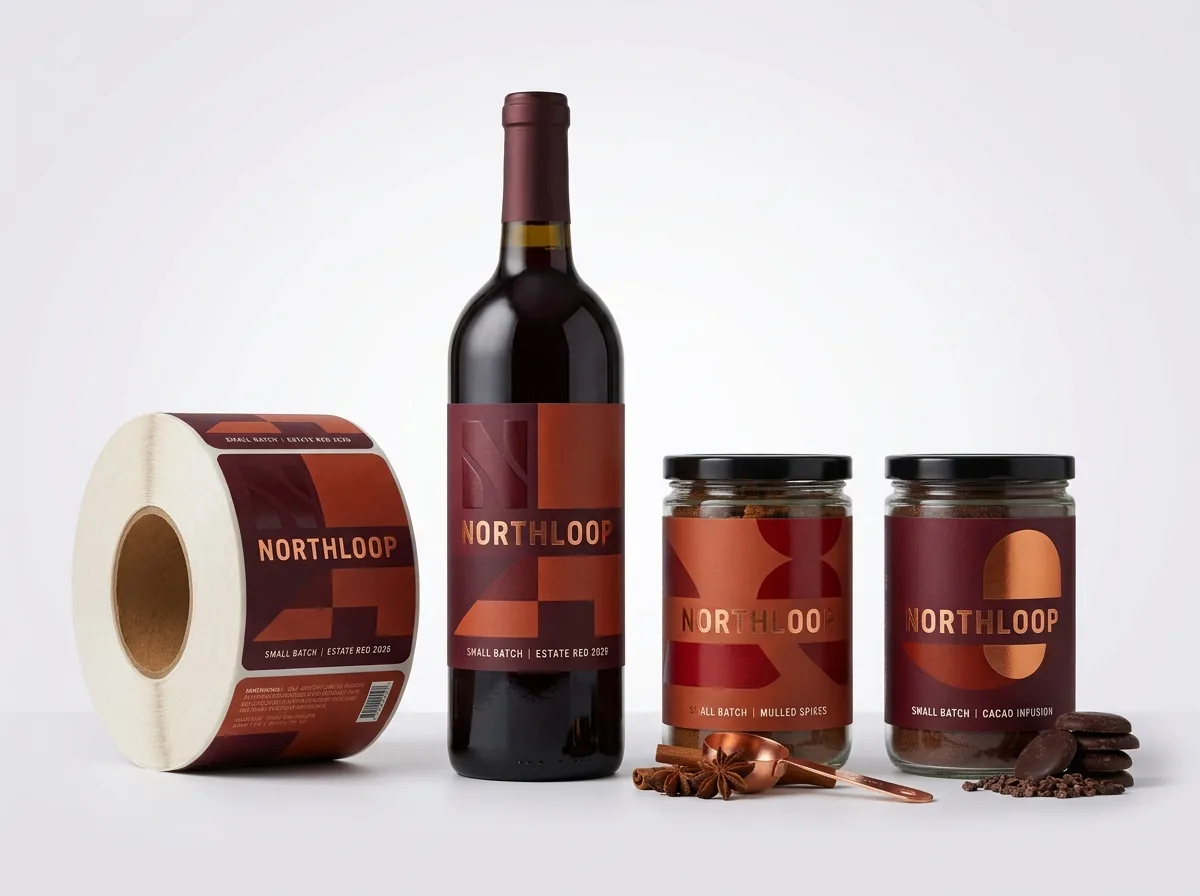
Ready to order wine labels? Compare up to 3 quantities with a free 3D mockup.
Request a Quote →Questions about wine labels
Can I order custom oval, arched or shield-shaped wine labels with no die charge?
Yes. CubitPack never charges die or plate fees. Whether you want a classic Burgundy oval, a cathedral arch, a scalloped vineyard crest or a custom neck collar, our prepress team sets up the cut line for free.
What is the best label shape for a sloped-shoulder Pinot Noir or Chardonnay bottle?
A wider horizontal rectangle (such as 4 × 3.25 inches or 3.75 × 3 inches) or an oval medallion works best on Burgundy glass because it sits completely inside the straight lower cylinder below the shoulder slope.
Can I combine matte finish, gold foil stamping and spot UV on the same wine label?
Yes. Combining a velvety matte background with hot gold or silver foil stamping on the estate crest and raised spot UV over a background pattern is a popular setup for reserve releases and gift bottles.
Do clear wine labels work on green or amber glass bottles?
Yes, as long as your artwork uses opaque white ink, light cream ink or metallic foil stamping. Dark inks alone will blend into dark green or amber glass, so we place a white ink backup layer behind colored artwork.
Can I get a 3D mockup of my label on a Bordeaux or Burgundy bottle before paying?
Yes. Every CubitPack quote includes a free flat digital proof and a 3D mockup rendered on your bottle silhouette before you pay, and you can also order our $50 sample kit or a printed sample.
Are custom shapes and foil finishes available on rolls for bottling machines?
Yes. All custom die-cut shapes, clear and foil stocks, and hot foil or spot UV finishes can be supplied wound on rolls for semi-automatic rollers and inline winery bottling lines, or on flat sheets starting at 500 pieces.
Still have a question? Ask a packaging specialist.
Request a Quote →Request your wine labels quote
Tell us your size and quantities, and one dedicated account manager prepares pricing for each tier.
- Free design & AI-to-print studio + 3D mockup
- No die or plate charges · 4–5 day rush available
- Free shipping to all 50 states
- 10% off your first order
This comparison combines standard 750 ml Bordeaux, Burgundy, Hock and Champagne bottle mold geometry with CubitPack's decided shapes, stocks and finishes. Checked by a packaging specialist. Spot something wrong? Tell us and we will fix it.
Sources
What changed
- October 22, 2026: First published.
- October 22, 2026: Updated specifications, terminology, and verified source links.
More guides
New packaging guides by email
Sizes, materials and design tips. Unsubscribe anytime.