
Full-wrap vs front-and-back bottle labels: which should you choose?
Short answer: Choose a single full-wrap label for round cylindrical bottles (such as 1 oz droppers, 5 oz hot sauce woozies and 12 oz drinks) to cut application time in half and maximize space for nutrition panels. Choose separate front and back custom bottle labels for square bottles, tapered shoulders or when showing off liquid color.
On this page
- How do full-wrap and front-and-back bottle labels compare
- When is a single full-wrap bottle label the smarter choice
- When do bottles need separate front and back labels
- How do you order front and back bottle labels for a labeling machine
- When can you use a front-only bottle label with no back label
- Common mistakes
- FAQs
Request a custom quoteFree dieline & 3D mockup
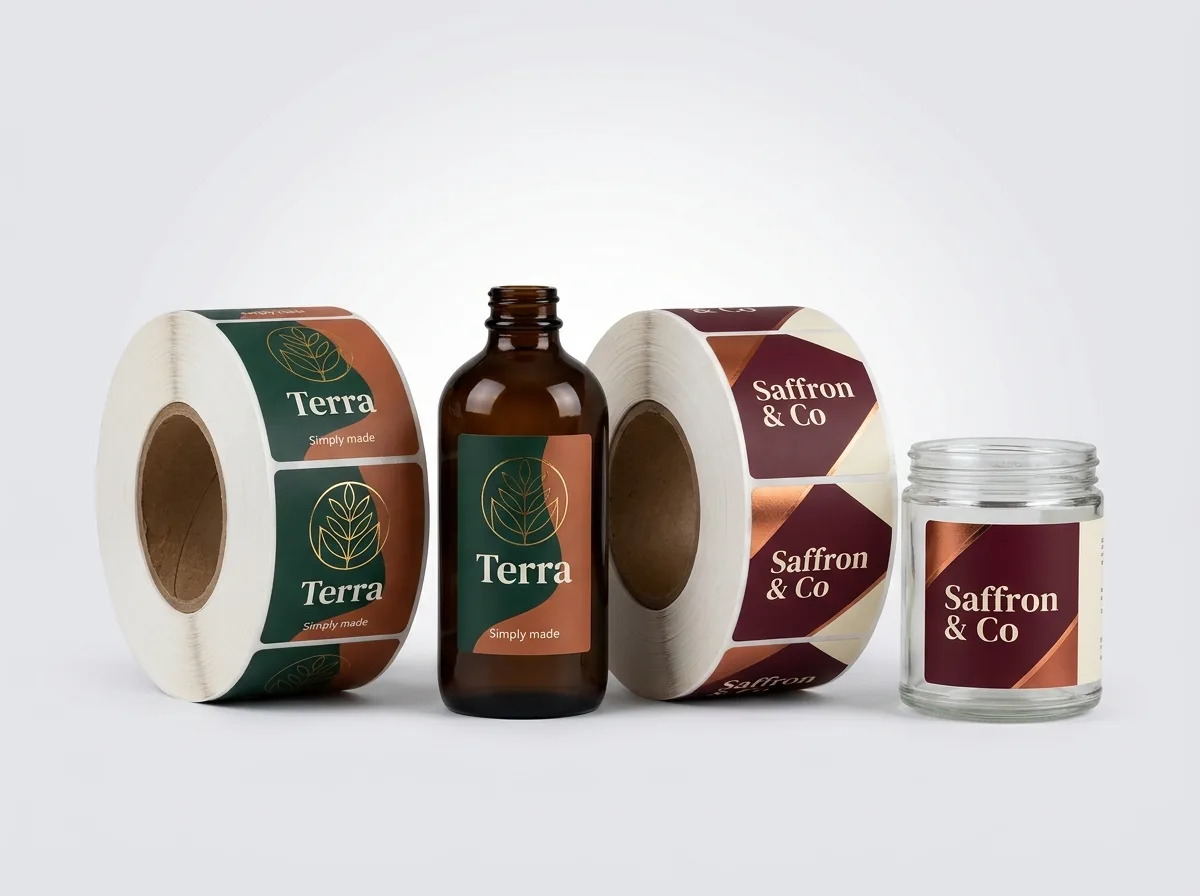
Deciding between a one-piece full-wrap label and a two-piece front-and-back set comes down to your bottle geometry, how much glass you want visible on the sides, and how your team applies labels on bottling day. A full wrap circles almost 360 degrees around a round cylinder (leaving a ¼ inch gap in back), meaning you only peel and roll one sticker per bottle while gaining three full columns of space for branding, nutrition facts and barcodes. Separate front and back panels leave the left and right sides of the glass open so golden olive oil, cold-pressed juice or craft spirits catch the light, and they avoid bridging raised vertical glass mold seams. At CubitPack, both setups start at 500 printed bottle labels in 10 to 14 business days with zero die charges, free design help and a 3D bottle mockup before payment.
How do full-wrap and front-and-back bottle labels compare?
Both layouts use the exact same inks, adhesives and finishes, but they behave very differently on the bottling table and on the store shelf. A single wrap consolidates everything into one rectangular piece, whereas a front-and-back pair splits the principal display panel and the regulatory information panel onto two narrower stickers. Use the side-by-side table below to compare how each layout handles application speed, glass mold seams, liquid visibility and unit cost across a 500 to 10,000 bottle run.
| Feature | Full-wrap label (1 piece) | Front & back labels (2 pieces) | Front-only label (1 narrow piece) |
|---|---|---|---|
| Stickers applied per bottle | 1 wrap per bottle | 2 separate stickers per bottle | 1 front sticker per bottle |
| Hand & roller bottling speed | Fastest (single pass on roller) | Slower by hand (align twice); or dual-head machine | Fastest by hand (short width, no spiral drift) |
| Space for text & barcodes | Maximum (3 full panels around cylinder) | High (dedicated back nutrition/barcode panel) | Limited (best when outer carton holds ingredients) |
| Liquid & glass visibility | Covers ~95% of straight cylinder wall | Leaves ~40% of glass visible on both sides | Leaves ~65% of glass visible around bottle |
| Glass mold seam handling | Wraps right over vertical parting seams | Sits between the two vertical side seams | Sits on one smooth face between seams |
| Best bottle shapes | 1 oz-4 oz Boston rounds, 5 oz woozies, 12 oz drinks | Square Marasca oil bottles, wine, spirits, flasks | Boxed serums, apothecary bottles, carafe necks |
When is a single full-wrap bottle label the smarter choice?
If you are bottling round cylindrical containers (such as 1 oz (30 ml) Boston round dropper vials, 2 oz wellness shots, 5 oz woozy hot sauce bottles, 8 oz cosmo round pump bottles or 12 oz beverage bottles), a single full wrap is almost always faster and more economical. Instead of buying, storing and aligning two separate stickers for every bottle, you place the bottle in a tabletop cradle roller, pull the lever once, and apply your front branding, side story, nutrition panel and UPC barcode in a single two-second motion. To make a full wrap read cleanly on a retail shelf, divide your artwork canvas into three zones: place your front brand mark and product name in the dead-center third (covering roughly diameter × 1.05 in width), put your brand story or usage instructions on the left wing, and place your FDA Nutrition Facts or Supplement Facts panel and vertical barcode on the right wing.
- 1 oz and 2 oz dropper bottles: a 3 × 1.75 in or 3.75 × 2.25 in wrap holds mandatory ingredient text that would never fit on a tiny front sticker.
- 5 oz woozy hot sauce bottles: a 5 × 3 in wrap gives you room for heat-scale graphics, nutrition tables and batch codes in one pass.
- 12 oz and 16 oz beverage bottles: a 7.75 × 3 in wrap feeds rapidly on manual and motorized wrap-around rollers.
- Single-SKU simplicity: one roll per flavor means zero chance of pairing the wrong back ingredient label with the front flavor.
When do bottles need separate front and back labels?
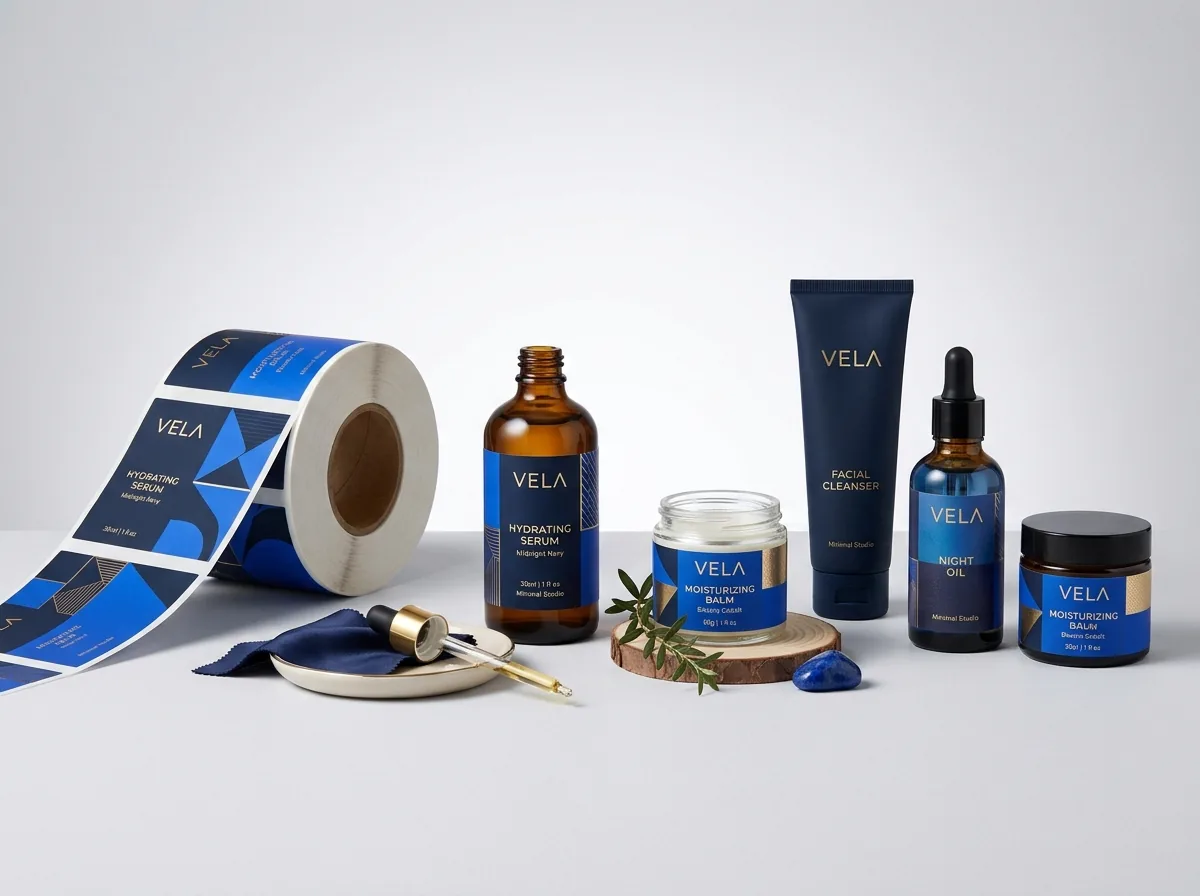
Two-piece front-and-back labels are essential on four types of containers: square or rectangular bottles (like 500 ml Marasca olive oil bottles and French square juice bottles), flat oval flasks, tapered wine and spirits bottles, and flint glass bottles where showing off the liquid on the left and right profile is part of the shelf appeal. On a square bottle, wrapping a single paper label around four 90-degree glass corners traps air pockets whenever a wall is slightly concave; sticking a 2 × 4.5 inch front label on the front face and a matching 2 × 4.5 inch nutrition label on the back face guarantees flat contact. Two-piece sets also solve a common glassmaking quirk on round bottles: vertical mold parting seams. Every blow-molded glass bottle has two faint vertical ridges on opposite sides (180 degrees apart) where the two halves of the steel mold met. A full wrap crosses right over both ridges, whereas separate front and back labels sit neatly on the smooth glass faces between the seams.
Know your size? Compare pricing across up to 3 quantities.
Request a Quote →How do you order front and back bottle labels for a labeling machine?
If you choose separate front and back labels, you can order them wound in two ways on custom roll labels: on separate rolls (one roll of front labels and one roll of back labels) or alternating on the same roll (Front, Back, Front, Back in sequence). Separate rolls are used when you label the fronts first by hand, or when your inline conveyor applicator has two independent labeling heads mounted on opposite sides of the belt. Alternating front-and-back rolls are designed for single-head semi-automatic bottle rollers that index two stops per bottle rotation: the machine applies the front label, rotates the bottle 180 degrees, and immediately applies the back label from the same web. For alternating rolls to feed smoothly, keep your front and back labels the exact same height (or design them to fit within the same web width) and note your required gap spacing and unwind direction in the quote form.
When can you use a front-only bottle label with no back label?
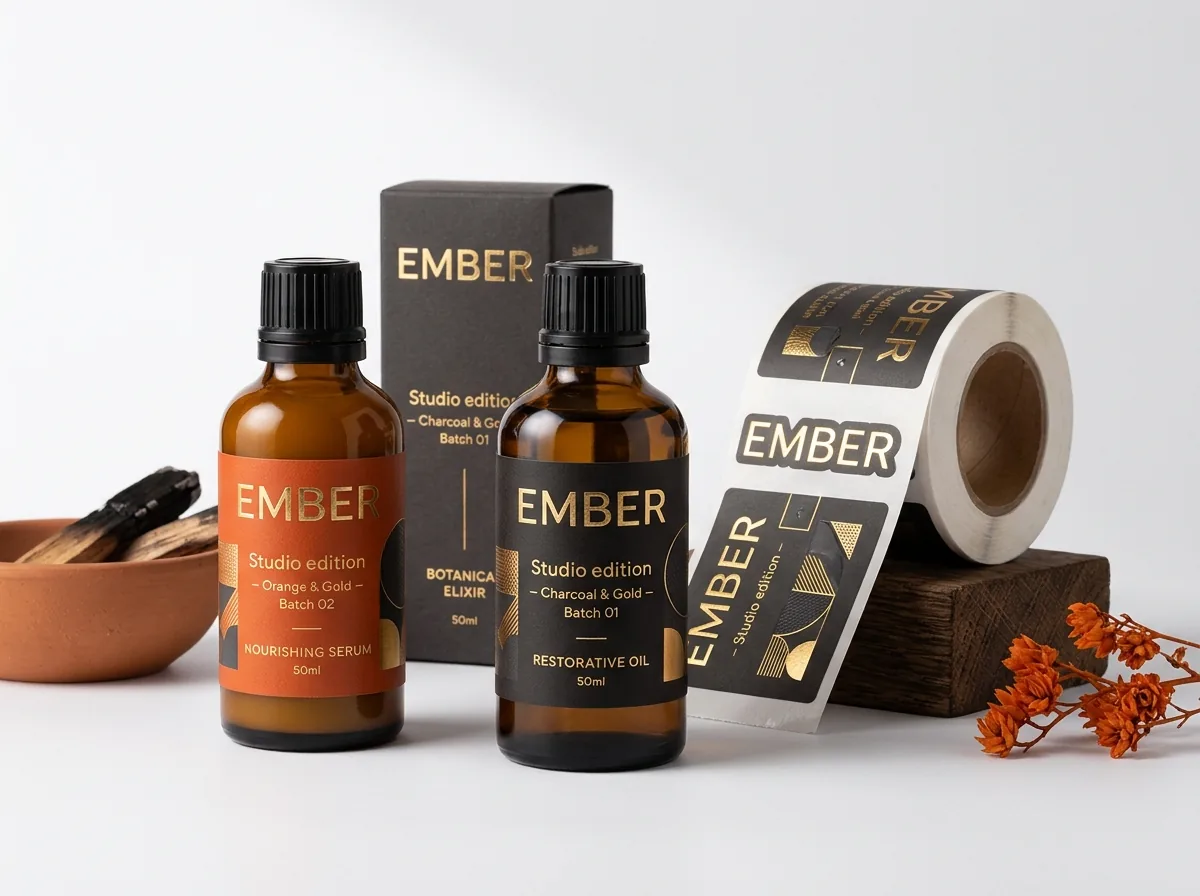
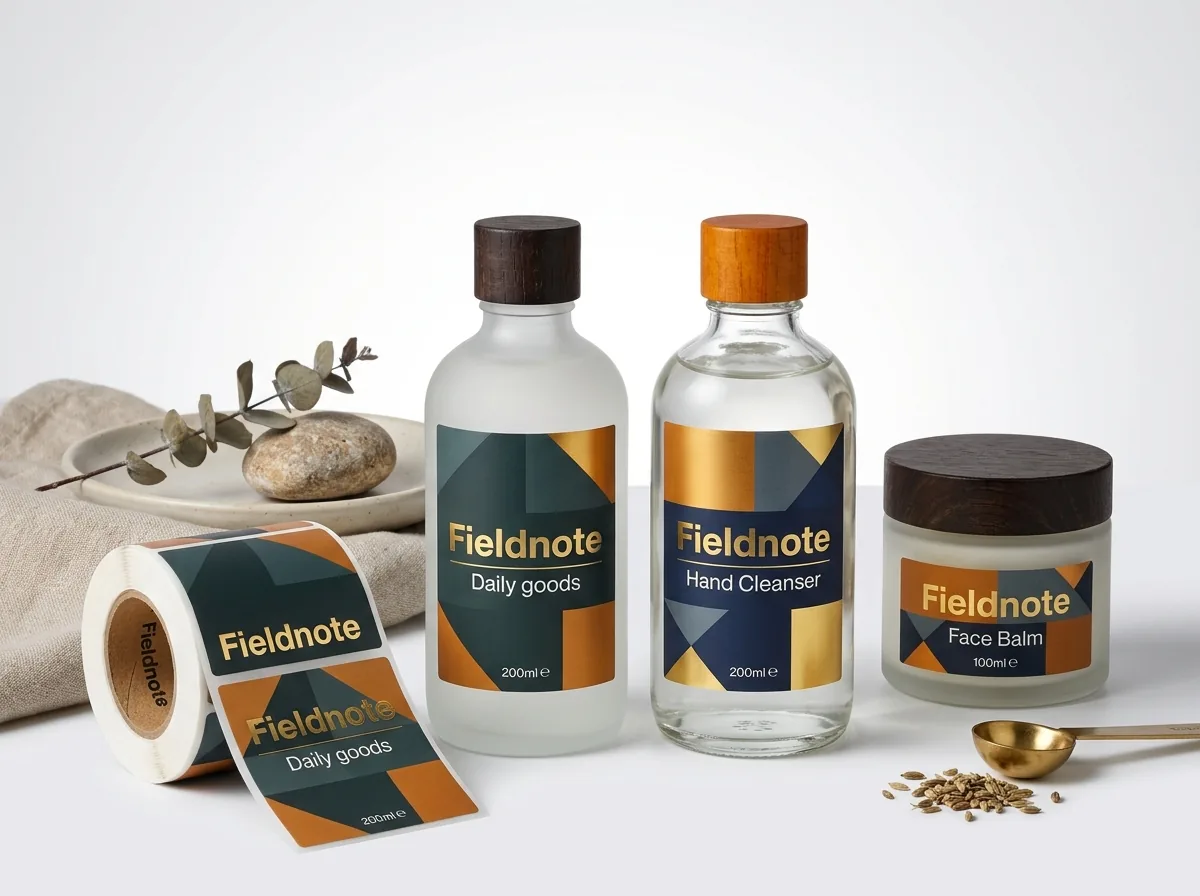
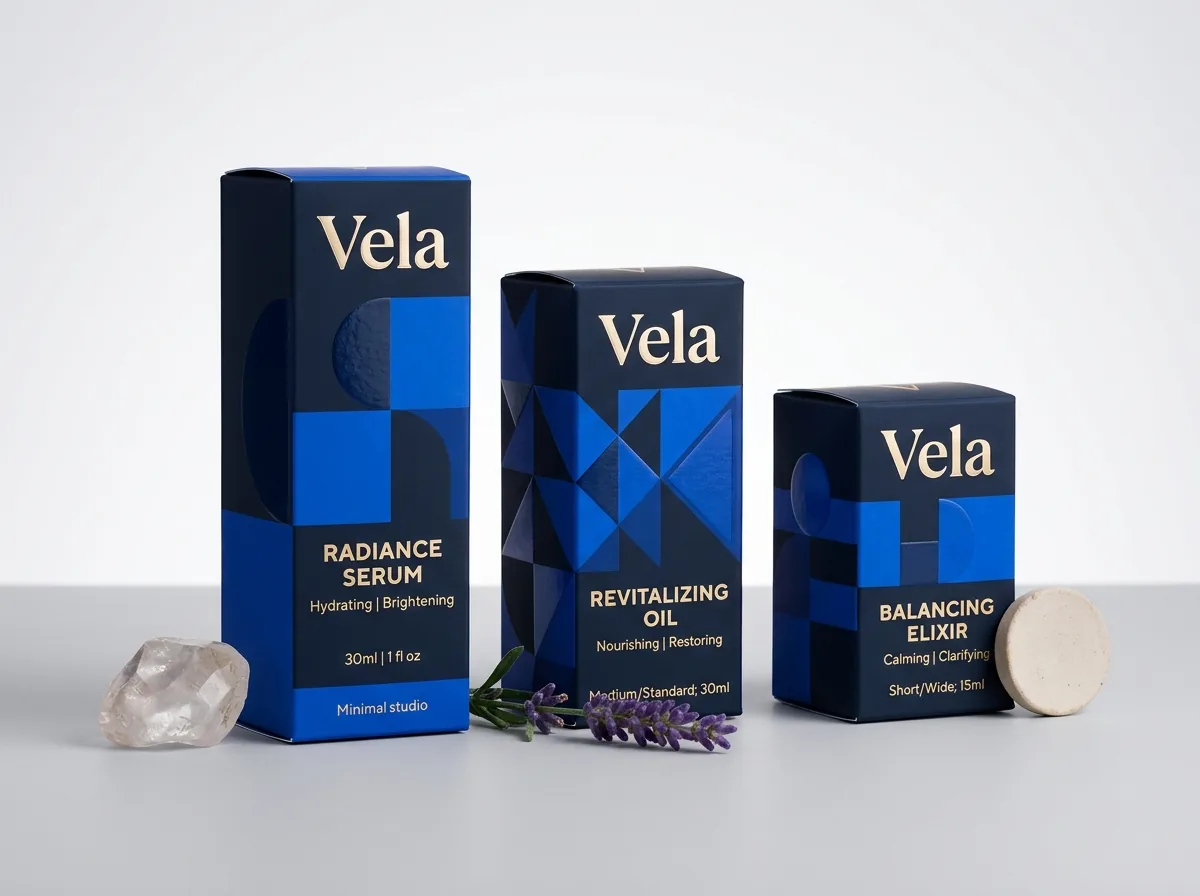
Skincare serums, facial oils, perfume vials and herbal tinctures that are sold inside a printed outer folding carton often skip the back bottle label altogether. When your outer custom dropper bottle boxes or custom serum boxes already carry the full INCI ingredient list, barcode and distribution address, the inner glass bottle only needs a clean front label (covering about one-third of the circumference) with the product name, net volume and key usage line. Using a short front-only label on a boxed bottle showcases 65 percent of the frosted or amber glass, eliminates spiral alignment drift during hand labeling, and pairs effortlessly with custom clear labels or hot foil stamping.
- Short front width (about diameter × 1.05): smoothing a 1.25 inch wide sticker by thumb takes one second with zero spiral skew.
- Outer box synergy: put lengthy regulatory copy and barcodes on the folding carton so the bottle stays minimalist on the vanity.
- Bottom batch sticker: add a tiny 0.75 inch or 1 inch circle underneath the bottle base if you need a lot number.
- Matched Pantone inks: our prepress team prints your front bottle label and your outer carton to the exact same Pantone color code so the unboxing set matches.
- Cost savings on small runs: ordering one 500-label front roll instead of two separate front and back rolls cuts your label outlay in half when your carton already carries the back panel.
What are the most common mistakes when choosing wrap vs front-and-back labels?
Picking the wrong layout for your bottle shape can double your hand-labeling labor or cause corner lifting. Avoid these five mistakes
- Ordering separate front and back labels for a round 1 oz dropper or 5 oz woozy bottle when a single 3-panel wrap applies twice as fast.
- Wrapping a single continuous paper label around all four corners of a square Marasca olive oil bottle, where slightly recessed flat walls trap air bubbles.
- Centering a front label directly over the raised vertical glass mold parting seam instead of placing it on the smooth face between the two seams.
- Making the front and back labels different heights when your single-head bottle applicator requires an alternating Front-Back roll on one web.
- Making the front logo zone on a full wrap wider than one-third of the circumference, so the edges of your brand name curve out of sight.
Find your label size
Suggested label size: 9⅛ × 2¾ in (width × height)
A typical starting point. Your account manager confirms the size on the proof.
Quote this size →Packaging for this
Ready to order bottle labels? Compare up to 3 quantities with a free 3D mockup.
Request a Quote →Questions about bottle labels
Does a full-wrap bottle label cost less than separate front and back labels?
Often yes. Even though a full wrap uses slightly more square inches of material to bridge the sides, you are ordering and applying 500 or 1,000 total pieces instead of 1,000 or 2,000 separate front and back pieces, and your bottling labor time is cut in half.
How do I keep a long full-wrap bottle label from spiraling crookedly by hand?
Rest the bottle horizontally in a V-shaped channel (such as an open book, a wooden cradle block or a tabletop roller) so the bottle cannot roll away while you line up the leading edge parallel to the straight cylinder wall.
Can my front bottle label be an oval or custom crest while my back label is a rectangle?
Yes. Because CubitPack never charges die or plate fees, you can pair a custom arched or oval front display label with a clean rectangular back nutrition and barcode label at no extra tooling cost.
Where do FDA nutrition facts and ingredient lists go on a full-wrap bottle label?
Under FDA food and beverage labeling rules, the information panel (nutrition facts, ingredients and manufacturer address) sits immediately to the right of the principal display panel as the shopper looks at the front of the bottle.
Can you print front and back bottle labels on flat sheets instead of rolls?
Yes. For small batches of 500 bottles, we can lay out matching pairs of front and back labels side by side on flat kiss-cut sticker sheets so your team can peel one front and one back sticker together for each bottle.
How much space should I leave between separate front and back labels on a round bottle?
Size each label to roughly one-third of the bottle's circumference (about diameter × 1.05). That leaves two equal 1/6 circumference glass gaps on the left and right sides so neither label crowds the vertical glass mold seams.
Still have a question? Ask a packaging specialist.
Request a Quote →Request your bottle labels quote
Tell us your size and quantities, and one dedicated account manager prepares pricing for each tier.
- Free design & AI-to-print studio + 3D mockup
- No die or plate charges · 4–5 day rush available
- Free shipping to all 50 states
- 10% off your first order
This comparison combines cylinder wrap geometry, FDA 21 CFR 101 information panel placement rules, and CubitPack's decided roll and sheet label specs. Checked by a packaging specialist. Spot something wrong? Tell us and we will fix it.
Sources
What changed
- October 22, 2026: First published.
- October 22, 2026: Updated specifications, terminology, and verified source links.
More guides
New packaging guides by email
Sizes, materials and design tips. Unsubscribe anytime.