
What size wine bottle label do I need for 750 ml, splits and magnums?
Short answer: For a standard 750 ml straight-sided Bordeaux bottle, choose a 3.5 × 4 in or 3.75 × 4.75 in front label paired with a 2.75 × 3.5 in back label. For a sloped-shoulder 750 ml Burgundy bottle, choose a shorter, wider 4 × 3.25 in front label when ordering custom wine labels.
On this page
- How do I measure a wine bottle for front and back labels
- What are the standard wine label sizes by bottle style and volume
- Why do 750 ml Bordeaux and Burgundy bottles take different label heights
- How do I size labels for Hock flutes, Champagne bottles and 375 ml splits
- How much space should sit between front and back wine labels (or can you full-wrap)
- Common mistakes
- FAQs
Request a custom quoteFree dieline & 3D mockup
Even though four wine bottles on a shelf all hold 750 milliliters, their straight cylindrical label zones vary by nearly two inches in height depending on the glass mold silhouette. A classic Bordeaux bottle has tall, straight vertical walls and a sharp high shoulder that accepts a 4 to 5 inch tall vertical rectangle. A Burgundy or Rhone bottle has long, gently sloping shoulders and a wider lower body that only stays straight for about 3.5 inches near the base, requiring a shorter, wider 4 × 3.25 inch front panel so the top corners never cross the shoulder taper and crease. Always measure the flat vertical band of your specific bottle mold with a rigid ruler and subtract ¼ inch. At CubitPack, every order of printed wine bottle labels is cut to your exact width and height with zero die fees starting at 500 labels.
How do I measure a wine bottle for front and back labels?
Glass catalogs list a 750 ml wine bottle as roughly 11.5 to 13 inches tall overall, but the cork neck, capsule skirt, sloped shoulder and bottom heel punt consume more than half of that height. Only the dead-straight cylindrical section between the shoulder break and the bottom heel will hold a paper or film label flat without dart wrinkles. Set a physical bottle from your glass pallet on a flat table and hold a straight metal ruler vertically against the side wall. Mark the top point where the glass begins curving inward toward the neck and the bottom point where the heel rounds toward the base punt. Subtract ¼ inch from that straight vertical span to get your maximum front label height. Next, wrap a flexible tailor's tape around the straight band to read the circumference (about 9.4 inches on a 3 inch wide Bordeaux bottle, or 10.6 inches on a 3.375 inch wide Burgundy bottle). Size your front label to about 35 to 40 percent of the circumference and your back label to about 28 to 32 percent so clear glass margins remain on both sides.
- Hold a rigid ruler flat against the bottle side and measure only the dead-straight vertical band below the shoulder break.
- Subtract ¼ inch from the straight band height so you leave ⅛ inch of glass clearance at top and bottom.
- Measure circumference around the straight band (π × diameter): about 9.4 in on Bordeaux, 10.6 in on Burgundy.
- Set front label width to ~35%-40% of circumference (3.5 in to 4 in) so the entire vineyard name reads in one glance.
- Set back label width ½ in to ¾ in narrower than the front (2.75 in to 3.25 in) so neither label crosses the vertical side mold seams.
What are the standard wine label sizes by bottle style and volume?
While CubitPack cuts every order to your exact width and height with no die or plate charges, wineries and mobile bottling lines rely on a proven set of front and back dimensions for each standard glass mold. Use the reference chart below to benchmark your layout across 187 ml mini splits, 375 ml half-bottles, 750 ml standard bottles and 1.5 L magnums. In every row below, the first number is horizontal width wrapping around the bottle and the second number is vertical height from bottom to top.
| Wine bottle style & volume | Typical front label (W × H) | Typical back label (W × H) |
|---|---|---|
| 187 ml mini split / single-serve | 2.25 × 2.75 in | 1.75 × 2.5 in |
| 375 ml half-bottle / dessert split | 2.75 × 3.25 in or 2.5 × 3.5 in | 2.25 × 3 in |
| 750 ml Bordeaux (high straight shoulder) | 3.5 × 4 in or 3.75 × 4.75 in | 2.75 × 3.5 in or 3 × 4 in |
| 750 ml Burgundy / Rhone (sloped shoulder) | 4 × 3.25 in or 3.75 × 3 in | 3 × 3 in or 3.25 × 2.75 in |
| 750 ml Alsace / Hock flute (slender tall) | 3 × 4.25 in or 2.875 × 4.5 in | 2.5 × 3.75 in |
| 750 ml Champagne / sparkling wine | 4 × 3.5 in or 3.75 × 3.25 in | 3 × 3 in (+ tapered neck foil collar) |
| 1.5 L Magnum (double bottle) | 4.5 × 5.5 in or 4.25 × 5 in | 3.5 × 4.5 in |
| 3.0 L Double Magnum / Jeroboam | 5.5 × 6.5 in | 4 × 5 in |
Why do 750 ml Bordeaux and Burgundy bottles take different label heights?
A 750 ml Bordeaux bottle (used for Cabernet Sauvignon, Merlot, Malbec and Sauvignon Blanc) has a 2.95 to 3.0 inch diameter and a straight vertical body that runs 5 to 5.5 inches tall before the sharp shoulder curve. That tall cylinder easily supports a classic 3.5 × 4 inch, 3.5 × 4.5 inch or 3.75 × 4.75 inch vertical estate label. A 750 ml Burgundy bottle (used for Pinot Noir, Chardonnay, Gamay and Syrah) is wider at the base (3.35 to 3.5 inches in diameter), and its shoulder taper begins much lower on the bottle wall. Often only the bottom 3.25 to 3.5 inches of a Burgundy bottle is truly cylindrical. Putting a 4.5 inch tall Bordeaux label onto a Burgundy bottle forces the top 1 inch of the sticker onto the narrowing cone, creating instant vertical wrinkles. Switching to a 4 × 3.25 inch horizontal rectangle or a 3.75 × 3 inch oval keeps the entire label inside the straight lower band.
Know your size? Compare pricing across up to 3 quantities.
Request a Quote →How do I size labels for Hock flutes, Champagne bottles and 375 ml splits?
Alsace and Mosel Hock flute bottles (traditional for Riesling, Gewurztraminer and ice wines) are tall and narrow (about 2.85 inches in diameter), with a long graceful neck taper. Keep Hock front labels slender - around 2.875 × 4.25 inches or 3 × 4.25 inches - so the left and right edges do not wrap too far around the narrow cylinder. Heavy-walled 750 ml Champagne and sparkling wine bottles have a wide 3.45 inch lower body and a deep bottom punt. A 4 × 3.5 inch shield, oval or horizontal rectangle sits cleanly on the lower belly, often paired with a custom die-cut neck collar that wraps around the base of the foil hood. For 375 ml half-bottles and wedding favors packed in custom wine boxes, scale your front label down to 2.5 × 3.25 inches or 2.75 × 3 inches.
How much space should sit between front and back wine labels (or can you full-wrap)?
Every blow-molded glass wine bottle has two vertical parting seams on opposite sides (180 degrees apart) where the two halves of the glass mold met. When you size a front label at 3.5 inches wide and a back label at 2.75 inches wide on a 9.4 inch Bordeaux circumference, you leave two equal 1.58 inch bare glass channels along the left and right sides. Those bare glass channels let your bottling roller center the front and back labels on the smooth faces between the vertical mold seams. Some modern natural wine, cidery and sangria brands prefer a single 360-degree full-wrap label on straight-walled Bordeaux bottles. For a full wrap on a 3.0 inch diameter Bordeaux bottle, multiply 3.0 × 3.14 (9.42 inches) and subtract a ¼ inch gap to order a 9.125 × 3.75 inch custom roll label.
- Standard two-piece gap: leave at least 1.25 in to 1.75 in of bare glass between the front and back label edges on each side.
- Back label width: making the back label ½ in narrower than the front gives your two-stop bottle roller extra alignment margin.
- Full-wrap Bordeaux option: 9.125 × 3.75 in or 9.125 × 4 in wraps nearly 360 degrees with a clean ¼ in gap in back.
- Neck vintage band: typically 2.75 × 0.75 in oval or curved strip placed below the capsule skirt.
What are the most common wine bottle label sizing mistakes?
Glass mold tapers and heavy eco-glass vs antique-glass variations catch many wineries off guard. Avoid these five sizing errors
- Ordering a tall 4.5 inch Bordeaux rectangle for a sloped-shoulder Burgundy or Rhone bottle, where the top edge rides onto the taper and creases.
- Assuming two '750 ml Bordeaux' bottles from different glassmakers have the exact same straight wall height without measuring a sample from the new pallet.
- Making the front and back labels too wide on a two-piece setup, so the edges collide with the raised vertical glass mold seams on the sides.
- Using a flat rectangular neck band on a tapered wine bottle neck instead of a curved arc collar dieline, causing the bottom edge of the neck band to flare out.
- Swapping Width and Height when ordering rolls for a bottling machine, which changes how the label feeds off the unwind core.
Find your label size
Suggested label size: 9⅛ × 2¾ in (width × height)
A typical starting point. Your account manager confirms the size on the proof.
Quote this size →Packaging for this
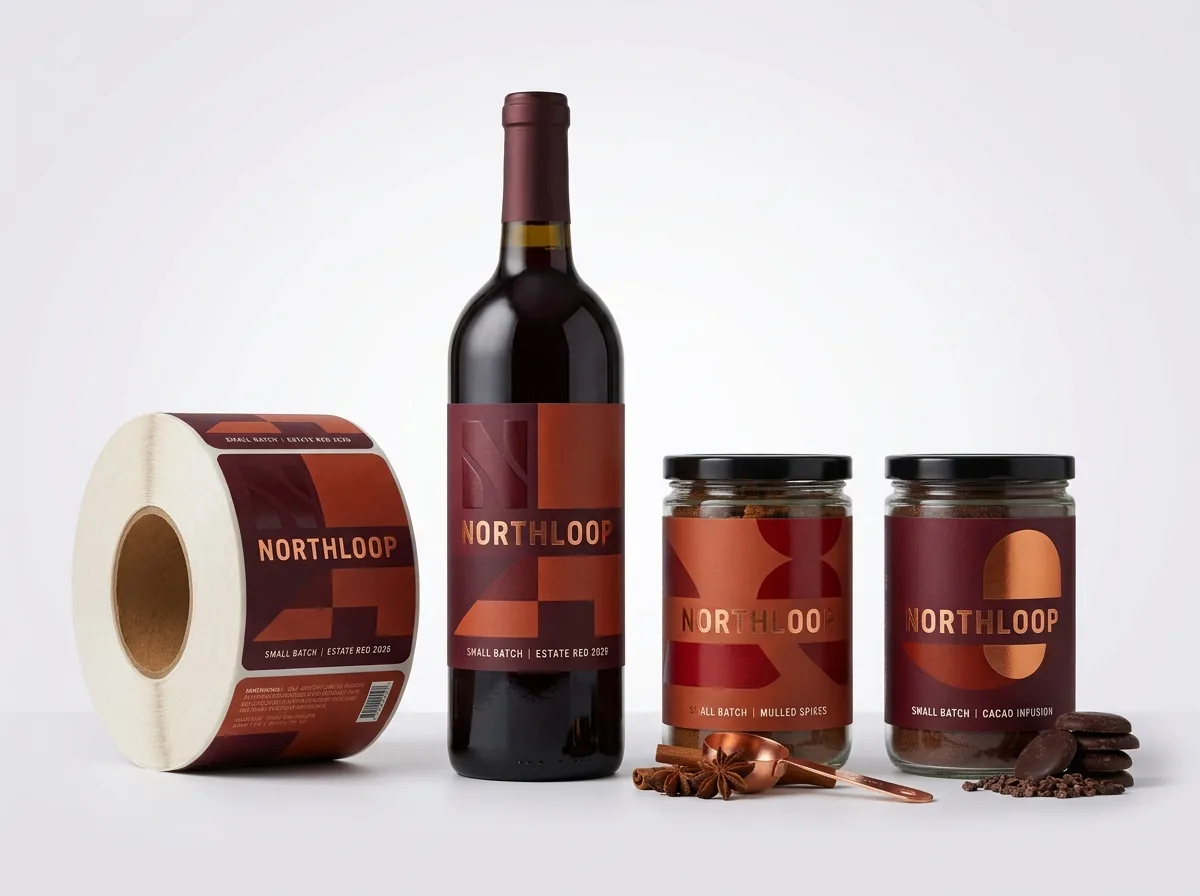
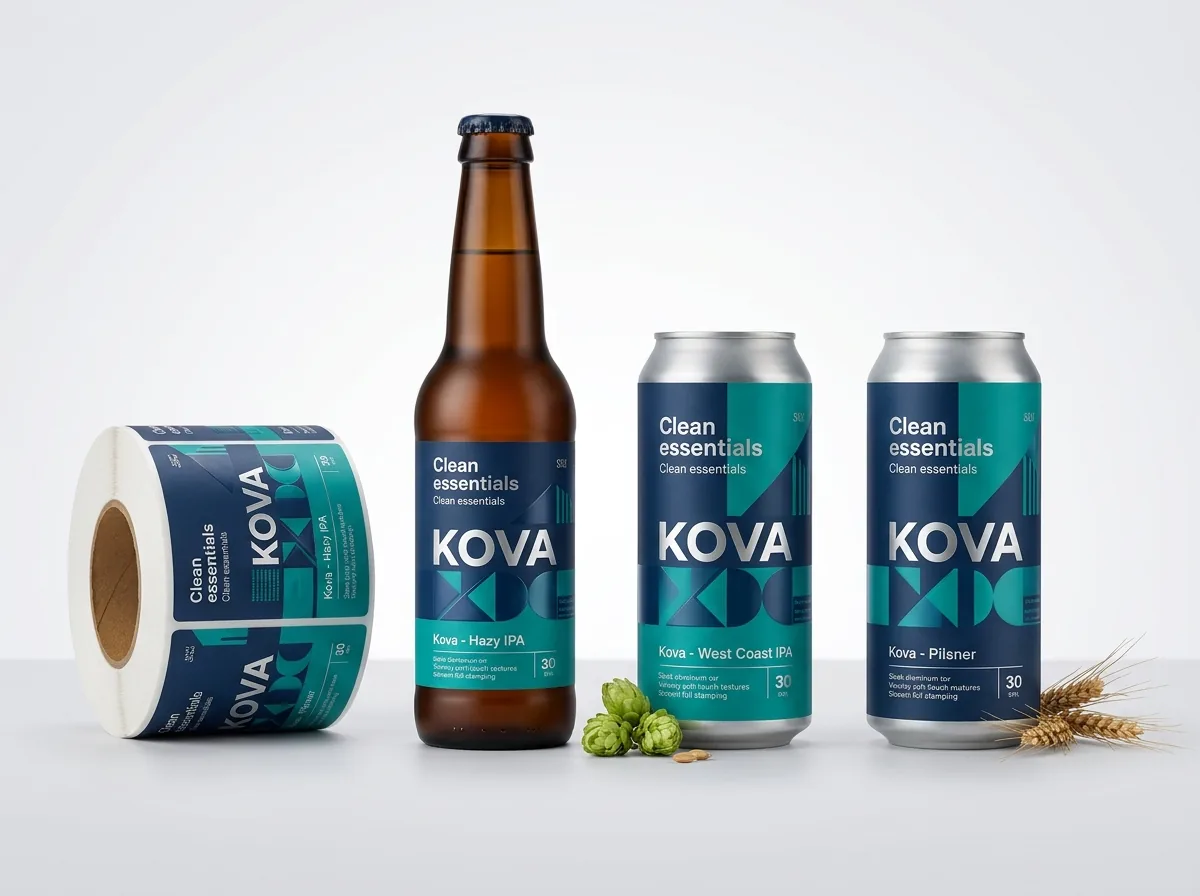
Ready to order wine labels? Compare up to 3 quantities with a free 3D mockup.
Request a Quote →Questions about wine labels
What is the single most versatile wine label size if I use multiple bottle styles?
A 3.5 × 3.25 inch or 3.5 × 3.5 inch front label (paired with a 2.75 × 3 inch back label) fits comfortably on the straight lower band of both 750 ml Bordeaux and 750 ml Burgundy bottles without hitting the Burgundy shoulder taper.
Should my back wine label be the same height as my front wine label?
If your bottling line feeds Front and Back labels alternating from the same roll on a single-head applicator, making both labels the same vertical height (for example, 3.5 × 3.5 in front and 2.75 × 3.5 in back) keeps the roll web uniform and easy to index.
What size wine label do I need for a wedding or corporate gift bottle?
If you are soaking off the original front label and applying a custom event label over a standard 750 ml bottle, measure the straight wall first: 3.5 × 4 inches fits most Cabernet and Sauvignon Blanc bottles, while 4 × 3.25 inches fits Pinot Noir and Chardonnay bottles.
Can I order custom arch or crest shapes at these sizes without a die fee?
Yes. CubitPack never charges die or plate fees. You can order an arched top, scalloped estate crest, oval medallion or two-part split label at any exact inch dimension for the same cost as a standard rectangle.
How do I size a label for a tapered conical Bordeaux bottle?
Heavy luxury 'conical' Bordeaux bottles taper outward from a narrower base to a wider shoulder. Measure both the top diameter and bottom diameter of your desired label band and tell our design team so we build a custom curved arc dieline that wraps flat.
Can I order front labels, back TTB labels and neck bands in one order?
Yes. Select 2 designs or 3+ designs in Step 2 of the quote form and list your front, back and neck dimensions in the notes. Your dedicated account manager will quote the complete bottling run together in 5-7 minutes.
Still have a question? Ask a packaging specialist.
Request a Quote →Request your wine labels quote
Tell us your size and quantities, and one dedicated account manager prepares pricing for each tier.
- Free design & AI-to-print studio + 3D mockup
- No die or plate charges · 4–5 day rush available
- Free shipping to all 50 states
- 10% off your first order
Dimensions in this guide are based on standard North American and European 187 ml, 375 ml, 750 ml (Bordeaux, Burgundy, Hock and Champagne) and 1.5 L glass mold specifications and straight-wall cylinder geometry. Checked by a packaging specialist. Spot something wrong? Tell us and we will fix it.
Sources
What changed
- October 22, 2026: First published.
- October 22, 2026: Updated specifications, terminology, and verified source links.
More guides
New packaging guides by email
Sizes, materials and design tips. Unsubscribe anytime.