
Two-piece hexagon boxes vs tuck-top hex cartons, cube boxes, and tubes: which fits your SKU?
Short answer: Choose a two-piece telescoping hexagon box when luxury unboxing, reusable keepsake appeal, and double-wall rim strength matter most (candles, chocolates, jewelry, gift cards). Pick a one-piece tuck-top hex carton for high-speed flat-packed retail runs, a square cube for handled mugs, or a wound tube for 360-degree canisters.
On this page
- How do two-piece hexagons, tuck-top hexagons, cubes, and tubes compare
- When should you upgrade from a one-piece tuck-top hex to a two-piece hexagon box
- Why do honeycomb hexagon clusters stand out against cubes and round tubes
- Which structure wins for each of the 8 core hexagon product categories
- Common mistakes
- FAQs
Request a custom quoteFree dieline & 3D mockup
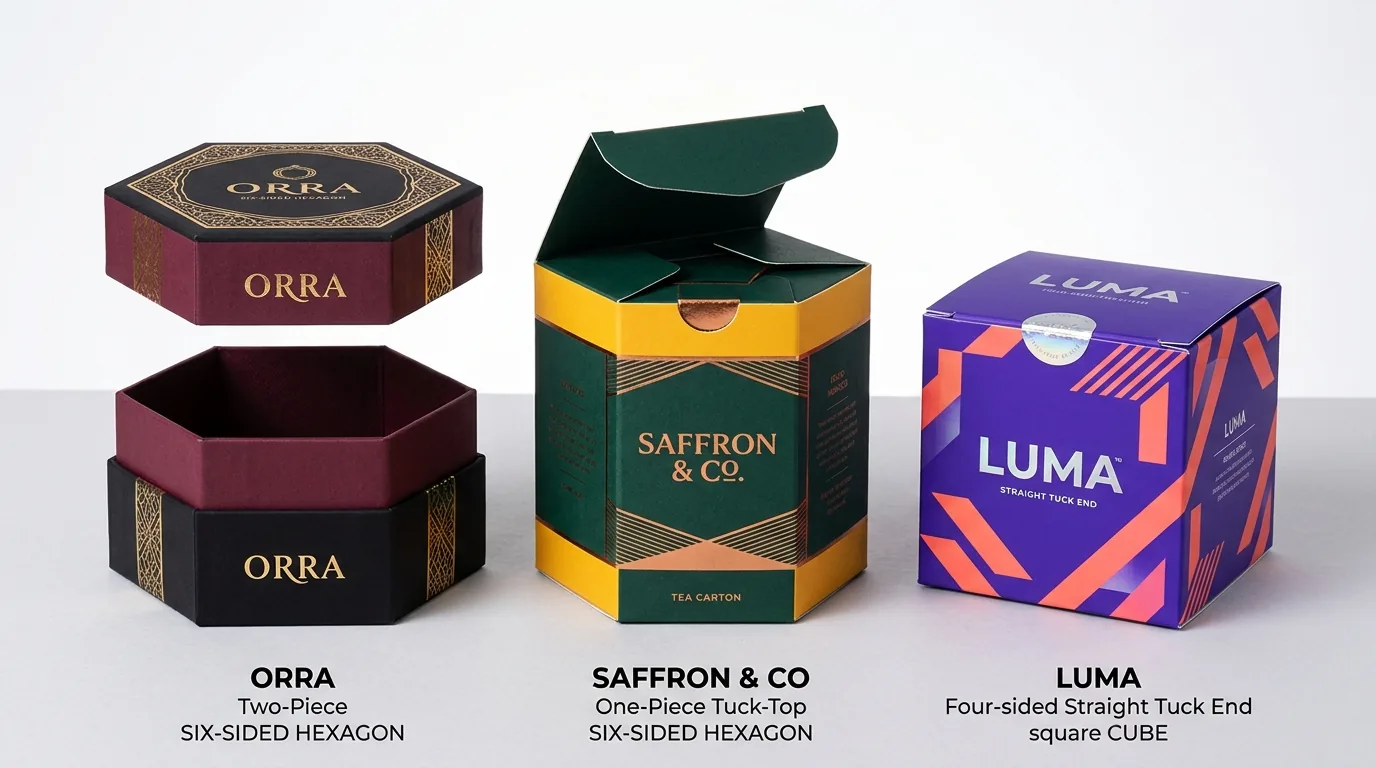
Once a brand decides on the signature honeycomb look of custom hexagon boxes, two structural choices shape both unit economics and customer unboxing. First, within six-sided geometry itself, you can build the box either as a two-piece telescoping lid-and-base set (where a separate six-sided cap slides straight down over a six-sided tray) or as a one-piece six-panel folding carton with an attached hexagonal tuck lid. Second, brands packing cylindrical jars, loose-leaf teas, or artisan confections frequently weigh six-sided hexagons against four-sided custom cube boxes and cylindrical custom tube boxes. Comparing flat pallet freight volume, fulfillment bench assembly seconds, inline window-patching capability, and gap-free honeycomb shelf tiling side-by-side clarifies which structure wins for your retail or direct-to-consumer launch. CubitPack custom-manufactures both two-piece and tuck-top hexagons starting at 1,000 units with zero die fees and free US shipping.
How do two-piece hexagons, tuck-top hexagons, cubes, and tubes compare?
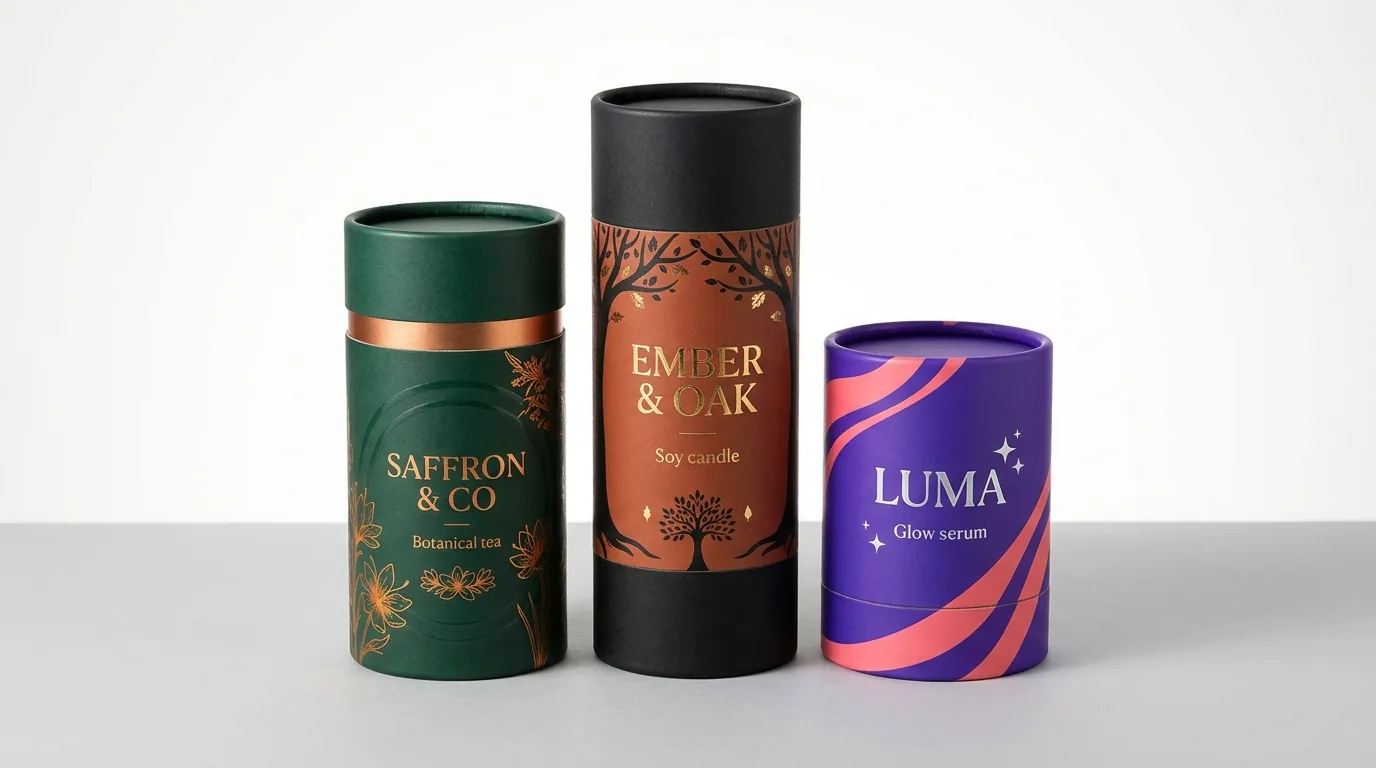
Evaluating packaging solely from a front render hides major operational trade-offs in pallet freight, warehouse shelf space, and inline window patching. For example, spiral-wound rigid paper tubes deliver a classic tea-canister silhouette yet ship pre-formed at full 3D air volume (often requiring four to five times as many inbound pallet spaces as flat-packed folding cartons) and cannot run through standard flat PET window-patching machines. Folding paperboard hexagons and custom two-piece boxes, by contrast, travel flat in dense master cartons while giving every vertical facet a crisp flat surface for hot foil stamping, embossing, and clear windows. Reviewing closure mechanics, packing labor, and jar stabilization together prevents costly surprises when scaling from a boutique batch to thousands of retail units. Compare all four options across six engineering benchmarks
- Double-wall rim protection on 2-piece hexagons: Where the six-sided lid skirt overlaps the upper base tray, combined board thickness doubles across all six corners, giving glass candles and delicate confections superior side-impact stiffness during transit.
- Single-piece economy on tuck-top hexagons: Die-cutting the six walls, hinged hexagonal lid, and interlocking bottom from one press sheet minimizes material area and eliminates lid-to-base matching on high-volume grocery tea, honey, and soap runs.
- Zero custom tooling fees: CubitPack includes custom steel-rule dies and printing plates free at 1,000+ units across both two-piece telescoping and one-piece tuck-top hexagon styles.
| Engineering factor | 2-piece hexagon box | 1-piece tuck-top hex | Square cube carton | Wound paper tube |
|---|---|---|---|---|
| Opening motion | Vertical lift-off 6-sided lid | Hinged hex top tuck flap | Rear-hinged square tuck | Round slip-on cap |
| Flat-packed freight | Ships flat as lid/base blanks | Ships 100% flat (1 glue seam) | Ships 100% flat | Ships rigid (high volume) |
| Bench setup speed | 8–12 sec (fold lid + base) | 4–6 sec (pop sleeve + tuck) | 2.5–5 sec (ALB or STE) | 2–3 sec (already formed) |
| Round-jar stability | 6 flat tangent walls | 6 flat tangent walls | 4 walls (needs collar) | Continuous circular hug |
| Inline clear windows | Lid crown or any side facet | Any of 6 flat side facets | Any flat square wall | Rarely supported |
| Tabletop anti-roll | 6 flat walls prevent rolling | 6 flat walls prevent rolling | 4 flat walls prevent rolling | Rolls if laid horizontally |
When should you upgrade from a one-piece tuck-top hex to a two-piece hexagon box?
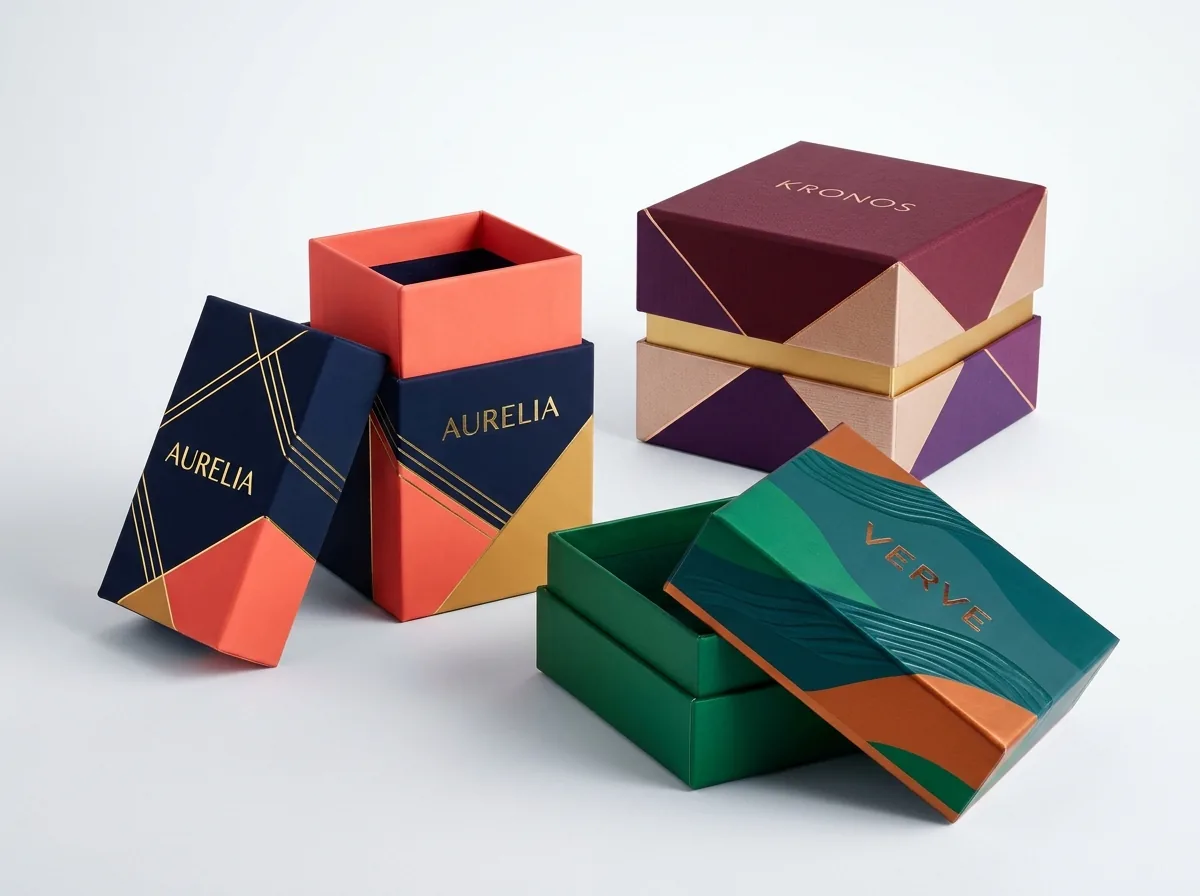
Inside the six-sided family, choosing between a hinged tuck top and a separate telescoping lid comes down to retail price positioning, top-down display visibility, and how delicate the contents are during customer lift-out. On a one-piece tuck-top six-sided hexagon carton, the top hexagon hinges off the rear panel and tucks a friction tab into the front wall, making bench setup fast while leaving a visible hinge score along one upper edge and small perimeter dust tabs inside the rim. Upgrading to a separate six-sided telescoping lid removes every top-hinge seam, doubles rim caliper where the lid skirt overlaps the base walls, and elevates gift presentation for custom chocolate boxes, custom jewelry boxes, and custom gift card boxes
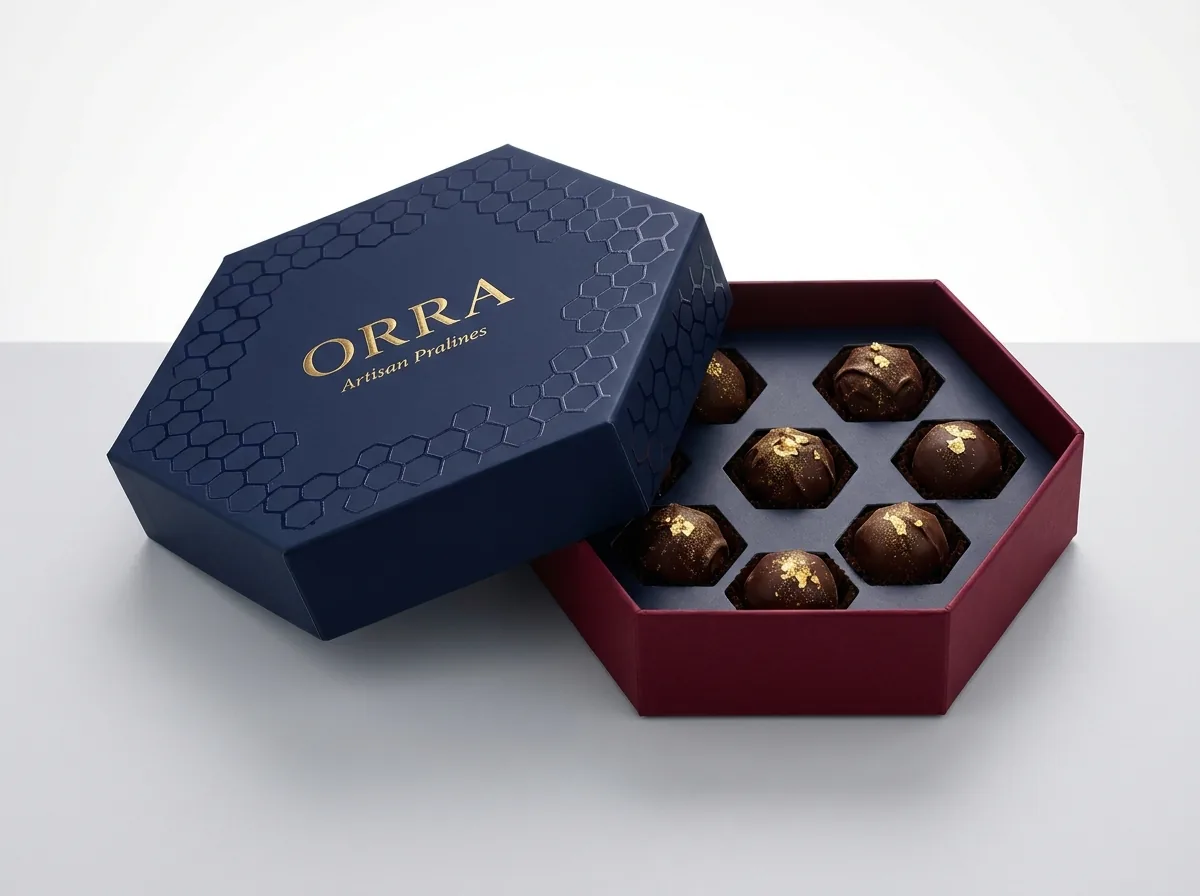
- Unobstructed 360-degree top reveal: Lifting off a separate six-sided cap exposes delicate chocolate pralines, gift cards, or glass ornaments from straight above with no hinged flap leaning in the way or scraping piped frosting.
- Contrast neck & color-blocked skirts: Printing the lower base tray in metallic gold or deep burgundy while keeping the partial-depth six-sided lid matte black creates an architectural two-tone reveal band around all six facets.
- Reusable vanity & desk storage: Shoppers routinely keep sturdy 24 pt two-piece hexagon boxes on dressers, vanities, and office desks to hold jewelry, loose tea sachets, or small keepsakes long after unboxing.
Why do honeycomb hexagon clusters stand out against cubes and round tubes?
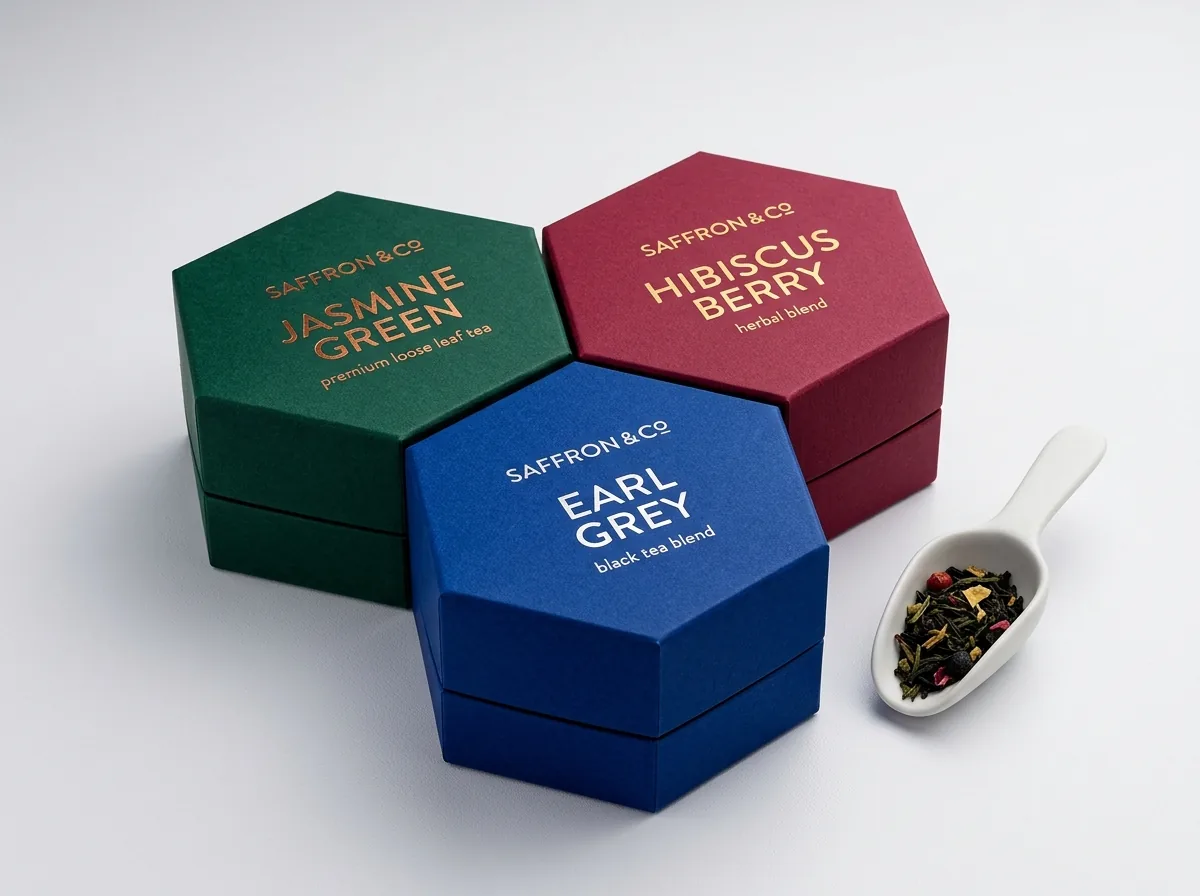
In crowded candle, tea, and specialty food aisles dominated by 90-degree rectangular cartons, geometry is the fastest visual differentiator from ten feet away. Even better, regular 120-degree hexagons obey nature's honeycomb tiling law: unlike circular custom tube boxes that touch at thin single points and leave star-shaped air gaps between canisters (allowing round tubes to spin out of label alignment whenever a shopper brushes past the display), hexagon facets lock flat against one another across custom candle boxes and custom tea boxes. That interlocking geometry also makes multi-flavor sampler packs effortless to bundle inside an outer gift tray without complex foam spacers
- Anti-spin label alignment: Once three or seven hexagon boxes nest inside a counter tray or gift hamper, flat-to-flat wall contact stops individual canisters from twisting backward on the shelf so every hero logo stays facing the aisle.
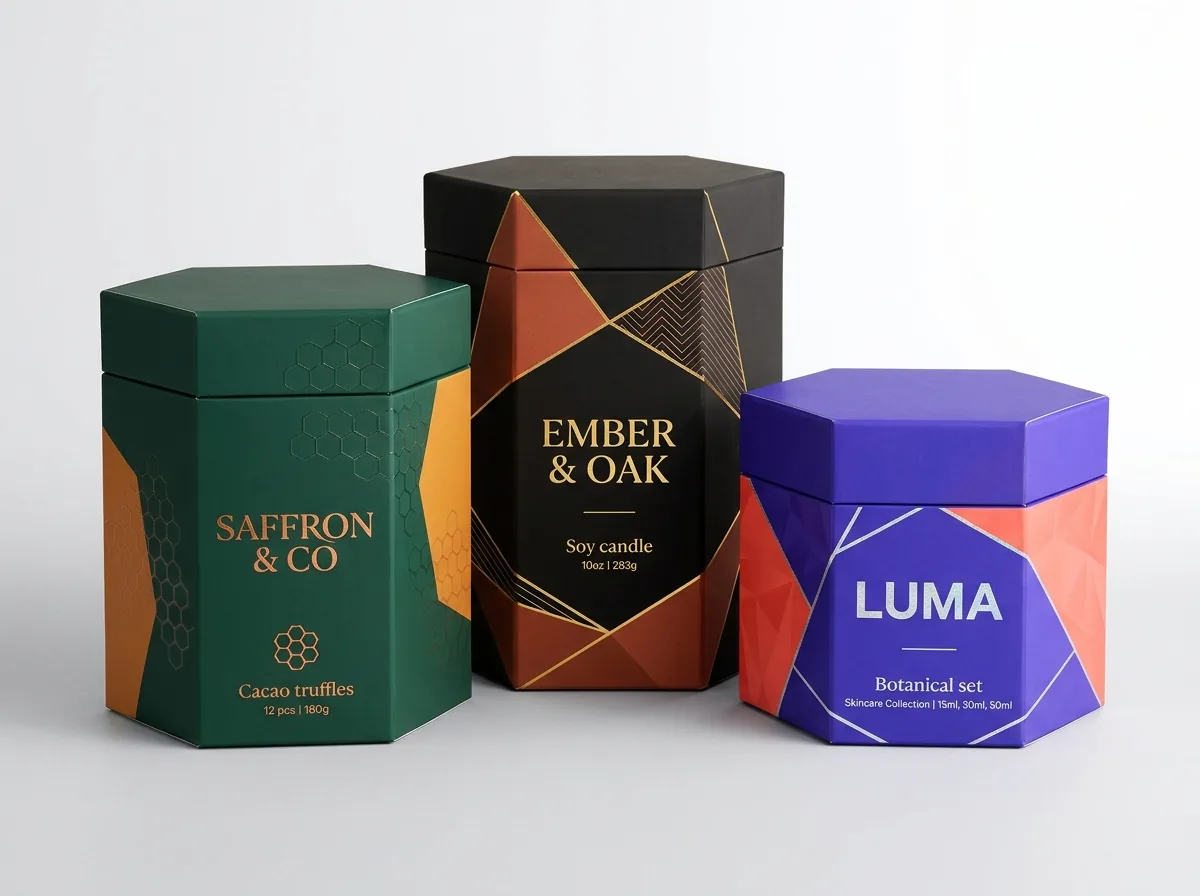
- Three-facet 3D front view: Facing a hexagon corner-on or flat-on lets shoppers read three adjacent facets at once, creating natural light-and-shadow depth for raised Spot UV patterns, blind embossing, and hot metallic foil.
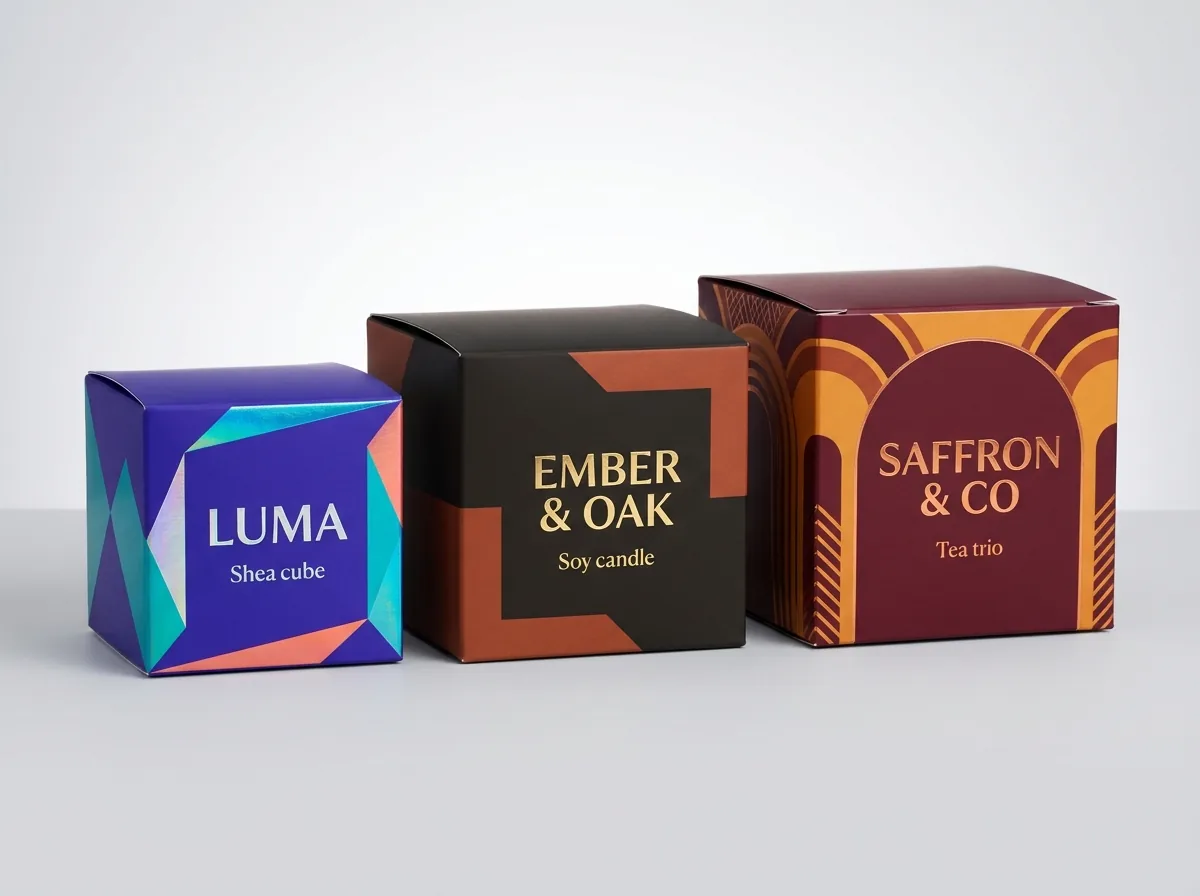
- When square cubes still win: Stick with a four-sided cube box whenever your product has a protruding side handle (such as an 11 oz ceramic coffee mug angled 45 degrees into a 90-degree square corner) or is itself a square artisan soap bar or square gift tin.
Know your size? Compare pricing across up to 3 quantities.
Request a Quote →Which structure wins for each of the 8 core hexagon product categories?
Combine this closure comparison with exact flat-to-flat sizing math in our hexagon box dimensions and round-jar fit guide and prepress setup rules in our hexagon box dieline and six-panel artwork guide, alongside confection barrier tips in how to design custom chocolate boxes that protect aroma and shine. Many multi-SKU brands even combine both closures within a single seasonal collection, using two-piece telescoping hexagons for flagship gift sets and fast-folding tuck-top hexagons for everyday single refills. Match your SKU across custom macaron boxes, custom wedding favor boxes, and custom ornament boxes below
- Luxury soy candles, artisan chocolates, fine jewelry & retail gift cards: 24 pt laminated Two-Piece Telescoping Hexagon Box (+ optional six-sided paperboard divider insert or centered lid window).
- Loose-leaf tea sachets, raw honey jars & vertical French macaron stacks: 18–24 pt One-Piece Tuck-Top Hexagon Carton (or partial-lid Two-Piece Hexagon with a tall clear front window).
- Wedding & milestone event table favors: Petite 2.5 in Flat-to-Flat 18–20 pt Two-Piece or Petal-Top Hexagon Box that doubles as an architectural place-setting centerpiece without tipping.
- Blown-glass & ceramic keepsake ornaments: 20–24 pt Two-Piece Hexagon Box featuring a centered clear film display window and a fitted six-sided paperboard collar cradle that stops glass baubles from touching outer walls.
- Test physical prototypes first: Request free caliper-compensated 2D vector CAD dielines and interactive 3D digital proofs starting at 1,000 units, or order CubitPack's $50 sample kit (credited in full toward your first production order).
What mistakes happen when choosing between hexagon closures, cubes, and tubes?
Avoid unnecessary freight bills and slow packing tables by checking these five selection pitfalls
- Ordering pre-formed rigid cylindrical tubes when warehouse space is tight and a flat-shipping six-sided hexagon carton would cut storage volume by 75%.
- Picking a hinged one-piece tuck-top hexagon for delicate hand-piped truffles where lifting off a separate two-piece lid prevents smudging chocolate tops.
- Trying to force a wide-handled ceramic coffee mug into a hexagon box instead of using a 4.5-inch square cube box's deep 45-degree corner diagonal.
- Designing a full-depth two-piece hexagon lid without thumb notches or a lower base lip, making snug six-sided lids slow to lift off.
- Assuming curved cylindrical paper tubes can accept low-cost inline clear window patches like flat-faceted hexagon boxes.
Packaging for this
Ready to order hexagon boxes? Compare up to 3 quantities with a free 3D mockup.
Request a Quote →Questions about hexagon boxes
Do folding two-piece hexagon boxes cost as much to ship as rigid setup boxes?
No. Folding paperboard two-piece hexagon lids and bases ship flat as die-cut blanks stacked densely in master cartons, avoiding the bulky air freight and warehouse storage costs of pre-glued rigid chipboard boxes or wound tubes.
Can a one-piece tuck-top hexagon carton have an auto-lock or snap-lock bottom?
Yes. For 12 oz to 2.5 lb honey jars and poured glass candles packed in one-piece six-panel hexagon cartons, we engineer interlocking six-tab or pre-glued polygonal crash bottoms so heavy vessels cannot push through from underneath.
Which looks cleaner on a gift table: a two-piece hexagon or a tuck-top hexagon?
A two-piece telescoping hexagon box looks cleaner from above because the six-sided lid crown has six crisp folded perimeter edges with zero rear hinge crease, dust-flap gaps, or front tuck slit breaking up your foil monogram.
Can I put a clear window on the top lid of a two-piece hexagon box?
Yes. A centered regular hexagonal or circular PET window on the six-sided top crown is one of our most popular configurations for artisan chocolate assortments, macarons, ornaments, and wedding table favors.
Can CubitPack quote both a two-piece hexagon and a one-piece tuck-top hexagon for comparison?
Yes. Share your product dimensions, filled weight, and target quantity (starting at 1,000 units) in our quote form and our packaging specialists can compare both closures side-by-side with free 2D vector CAD dielines and interactive 3D digital proofs before you pay.
Still have a question? Ask a packaging specialist.
Request a Quote →Request your hexagon boxes quote
Tell us your size and quantities, and one dedicated account manager prepares pricing for each tier.
- Free design & AI-to-print studio + 3D mockup
- No die or plate charges · 4–5 day rush available
- Free shipping to all 50 states
- 10% off your first order
We evaluated two-piece six-sided telescoping lids, one-piece six-panel tuck-top hexagons, equilateral square cubes, and cylindrical paperboard tubes across freight density, bench setup seconds, window-patching compatibility, and honeycomb shelf tiling using ECMA Folding Carton Design Codes, PPC structural manuals, and FEFCO standards. Spot something wrong? Tell us and we fix it.
Sources
- Mechanical differences between two-piece six-sided telescoping lids, one-piece polygonal tuck-top sleeves, and rectangular cartons.
- Flat shipping economics, inline PET window-patching compatibility, and honeycomb retail display tiling.
- Double-wall rim crush protection on telescoping hexagonal lids and micro-fluted heavy jar bases.
What changed
- November 6, 2026: First published with 4-way hexagon/cube/tube matrix, 2-piece vs 1-piece closure breakdown, and honeycomb merchandising guide.
More guides
New packaging guides by email
Sizes, materials and design tips. Unsubscribe anytime.