
How do hexagon box CAD dielines, 120-degree corner creases, and six-panel artwork work?
Short answer: An unfolded six-panel hexagon body spans (6 × facet s) + glue lap wide, where s = Flat-to-Flat F ÷ 1.732. On two-piece hexagons, the six-sided lid dieline expands +1.5 to +2.0 mm wider flat-to-flat than the outer base so all six 120-degree corners glide smoothly without binding.
On this page
- What flat press-sheet math governs six-panel sleeves and six-sided star lids
- How do you design for the 3-facet front view and align top-crown monograms
- What safe margins govern hexagon windows, foil stamping, and dark creases
- What 5 file checks ensure your hexagon artwork passes prepress on the first round
- Common mistakes
- FAQs
Request a custom quoteFree dieline & 3D mockup
Setting up print-ready artwork on a custom hexagon box CAD template feels very different from designing a standard four-panel carton. First, each individual vertical facet is noticeably narrower than the overall width of the box (a 4.0-inch Flat-to-Flat hexagon has six equal facets that each measure just 2.31 inches wide), which rewards vertical typography and multi-facet wraparound graphics rather than wide horizontal headlines crammed inside one column. Second, because adjacent hexagonal walls angle back at a gentle 60 degrees instead of disappearing around a sharp 90-degree corner, shoppers standing directly in front of your display see three full facets simultaneously (Faces 6, 1, and 2). Understanding flat blank formulas, +1.5 mm telescoping lid clearances, and window margins turns six-sided geometry into an advantage. CubitPack builds exact vector CAD dielines and 3D digital proofs free starting at 1,000 units.
What flat press-sheet math governs six-panel sleeves and six-sided star lids?
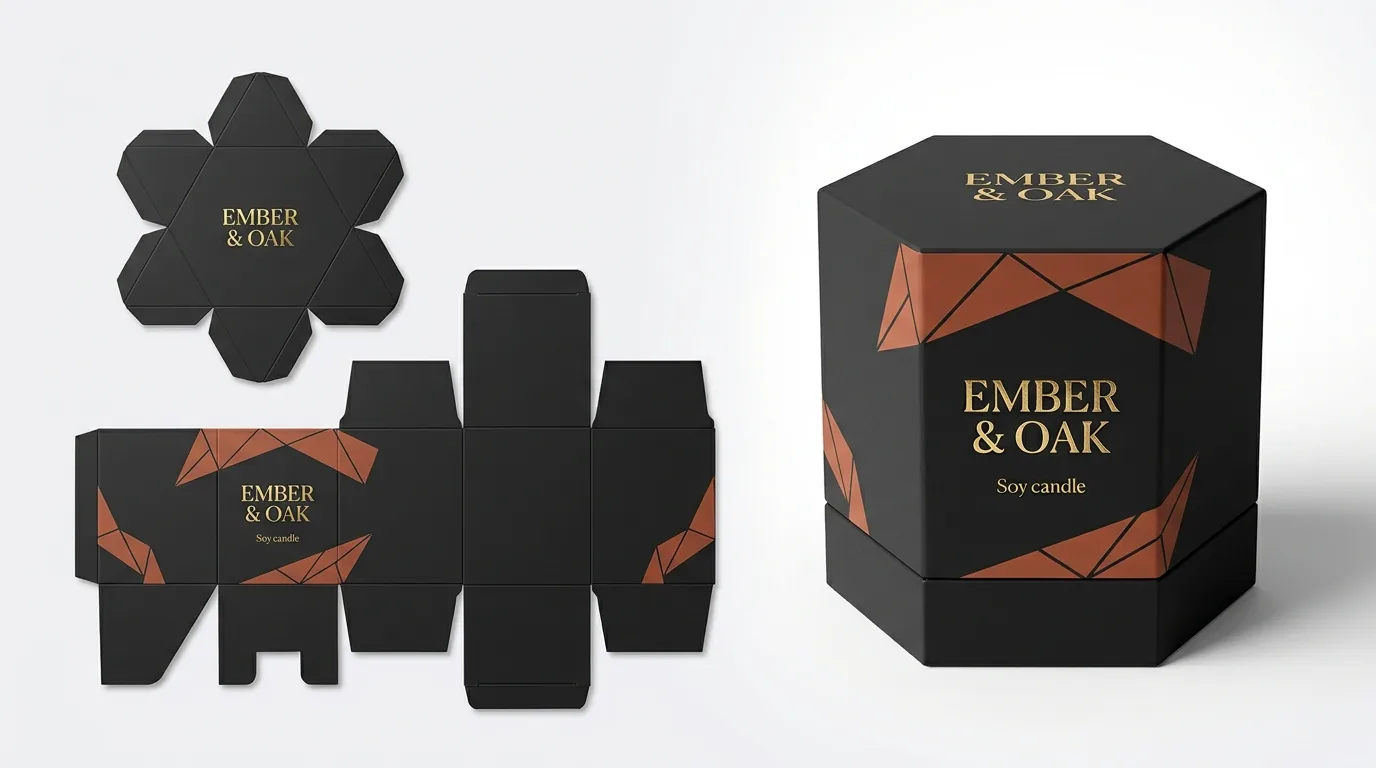
When our structural team builds a two-piece template for six-sided custom hexagon boxes, the project uses two coordinated steel-rule dies: Part B (the six-panel vertical base sleeve with hexagonal floor) and Part A (the six-sided radial star lid blank whose regular hexagonal top crown is surrounded by six fold-down side skirts and corner locking ears). Critically, Part A cannot simply duplicate Part B's dimensions: the lid's inner Flat-to-Flat span must clear twice the board thickness plus +1.5 to +2.0 millimeters of air tolerance so six simultaneous 120-degree corners slide home smoothly. Use the CAD reference table below to gauge flat blank widths and maximum single-facet window widths
- Why 60-degree creases fold cleaner than 90-degree corners: Forming a 120-degree interior hexagon corner bends the paperboard only 60 degrees from flat (33% less outer fiber stretch than a 90-degree square fold), keeping dark colors crisp.
- Raw glue-lap masking rule: Keep ink, Spot UV, and film lamination masked 0.125 in clear of the adhesive strip on the side glue lap and corner lid tabs.
- One-piece tuck-top blank height: Adding a hinged regular hexagonal lid (height = F) plus a 0.625 in tuck tongue above Face 4 sets total vertical sheet height.
| Base flat-to-flat (F) | Single facet (s) | Flat 6-panel sleeve + lap | 2-piece lid inner F | Max single-face window W |
|---|---|---|---|---|
| 3.00 in (76.2 mm) | 1.73 in (44.0 mm) | 10.89 in (incl. 0.5 in lap) | 3.09 in (+ caliper) | 0.98 in (with 0.375 in frame) |
| 3.75 in (95.3 mm) | 2.17 in (55.0 mm) | 13.62 in (incl. 0.625 in lap) | 3.84 in (+ caliper) | 1.42 in (with 0.375 in frame) |
| 4.00 in (101.6 mm) | 2.31 in (58.7 mm) | 14.48 in (incl. 0.625 in lap) | 4.09 in (+ caliper) | 1.56 in (with 0.375 in frame) |
| 5.00 in (127.0 mm) | 2.89 in (73.3 mm) | 18.07 in (incl. 0.75 in lap) | 5.09 in (+ caliper) | 1.89 in (with 0.50 in frame) |
| 6.00 in (152.4 mm) | 3.46 in (88.0 mm) | 21.53 in (incl. 0.75 in lap) | 6.11 in (+ caliper) | 2.46 in (with 0.50 in frame) |
How do you design for the 3-facet front view and align top-crown monograms?
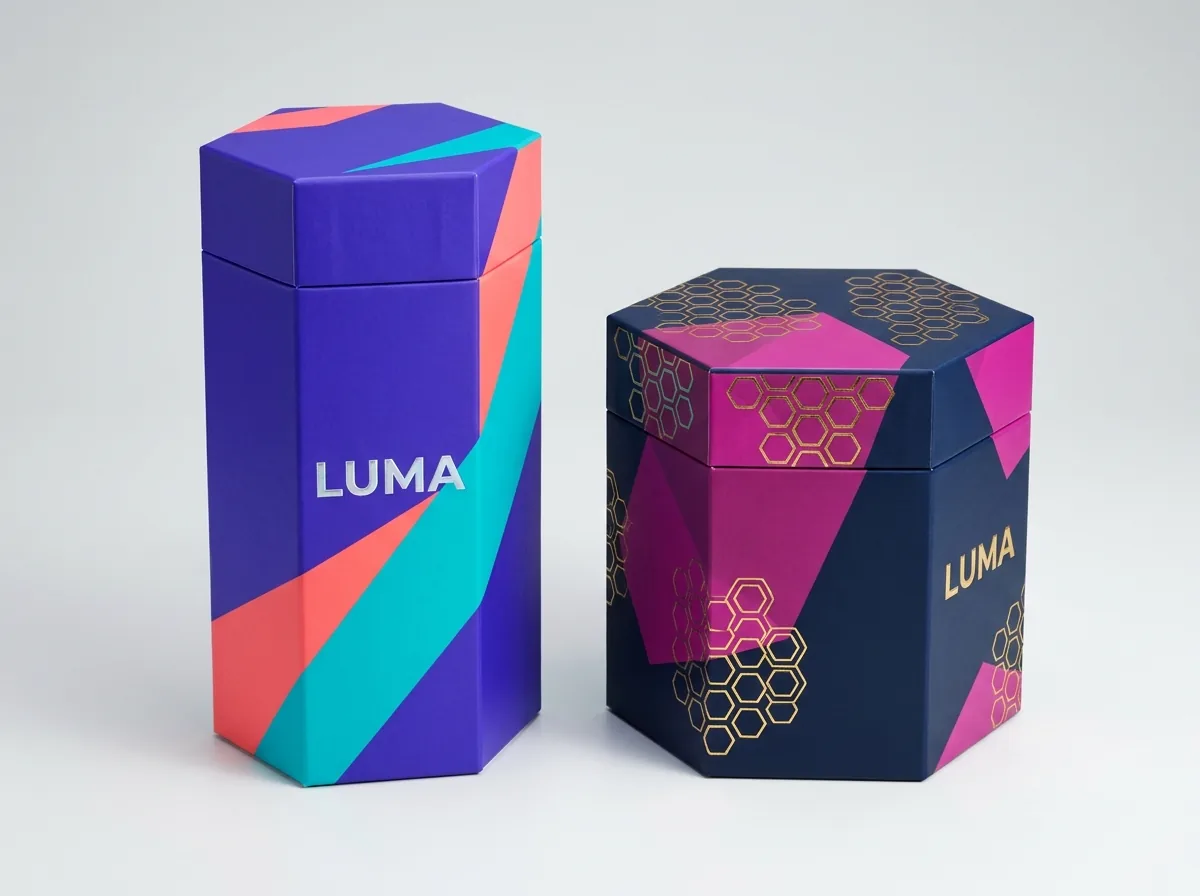
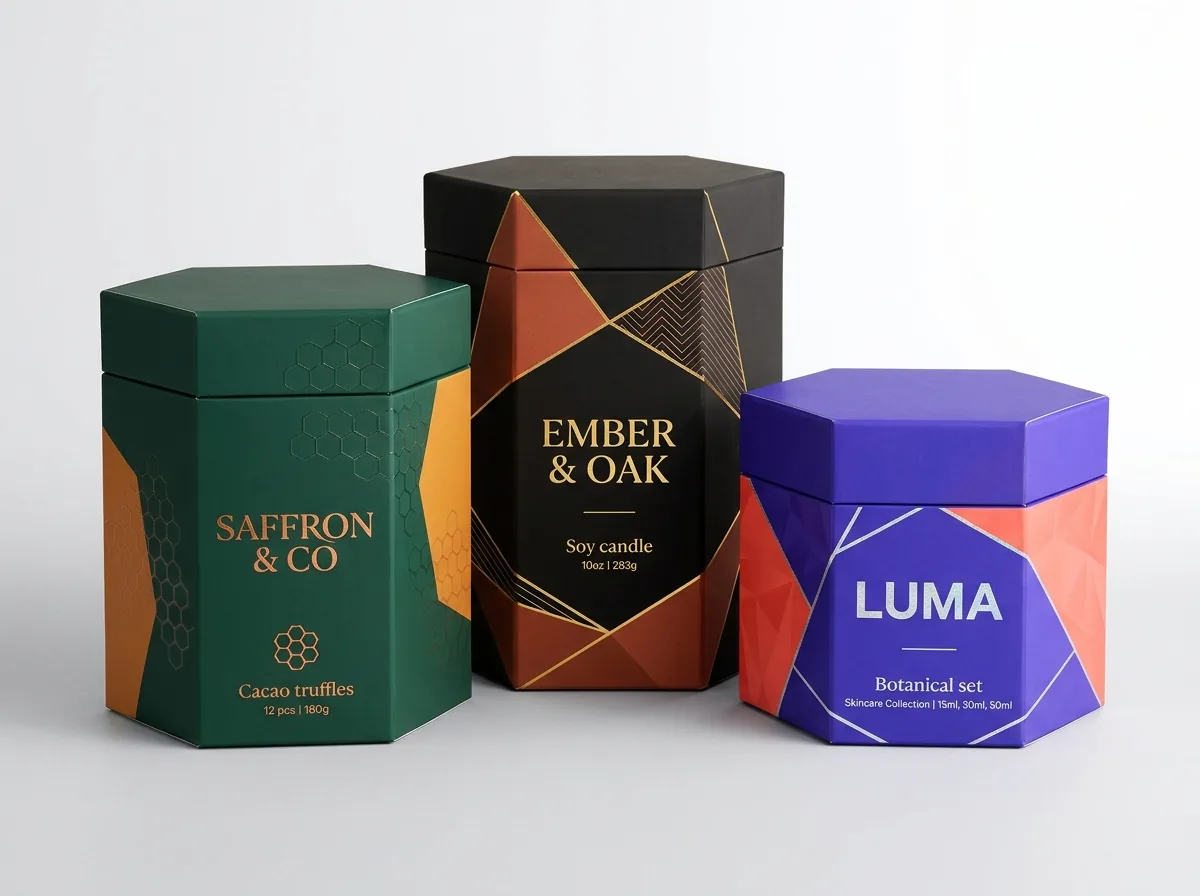
Stand directly in front of a square box and the two side walls vanish at 90 degrees, leaving only one flat square facing the shopper. Stand directly in front of Face 1 on a hexagon box across custom candle boxes, custom tea boxes, or custom macaron boxes, and both flanking walls (Face 6 on the left and Face 2 on the right) remain clearly visible at 60-degree angles. Treating those three front-facing panels as one coordinated visual stage rather than six isolated postage stamps makes even a compact 3.25-inch hexagon command strong shelf presence from across a boutique aisle
- Hero center + color-blocked wings: Keep your brand wordmark and SKU title centered upright inside Face 1 (with 0.125 in inner safe margins) while sweeping bold diagonal color blocks or botanical illustrations continuously across Faces 6, 1, and 2.
- Remember Face 6 wraps around to glue to Face 1: On the flat 6-panel strip (Faces 1-2-3-4-5-6), Face 1 sits on the far left while Face 6 sits on the far right; match background colors at both outer ends so the glued corner between Face 6 and Face 1 matches cleanly.
- Aligning the six-sided lid crown: Always pick one specific straight edge of the hexagonal top crown to face forward over Face 1, and verify that alignment on CubitPack's interactive 3D proof so packers orient lids consistently.
What safe margins govern hexagon windows, foil stamping, and dark creases?
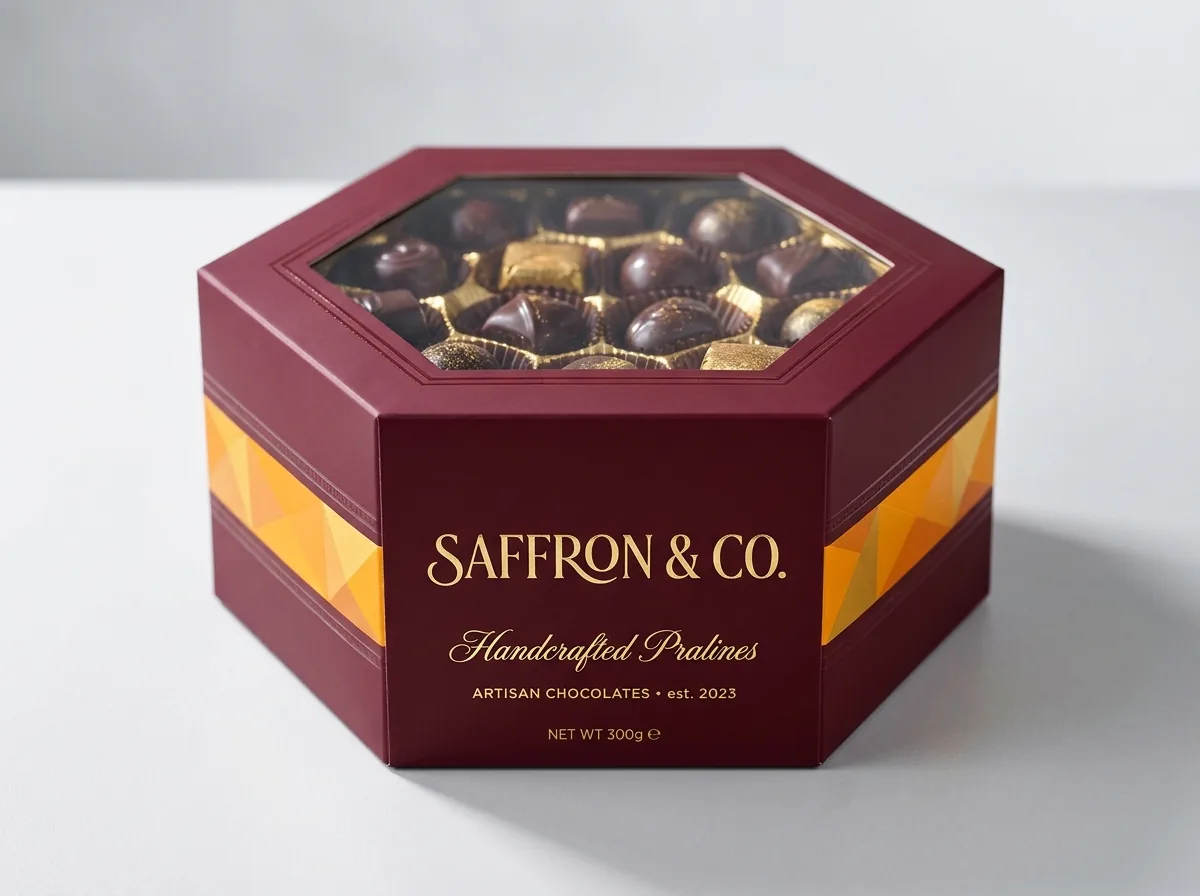
Because individual hexagonal facets are narrower than rectangular carton panels, die-cut window widths require extra discipline across custom chocolate boxes, custom ornament boxes, and custom wedding favor boxes. Cutting an overly wide aperture on Face 1 leaves paper-thin pillars beside the two front 120-degree creases, causing the wall to bow inward when the telescoping lid slides down or when cartons stack two high in a master shipper. Keeping solid paperboard bridges around every window and pairing dark inks with flexible film lamination protects structural crispness from press to shelf. Respect these four prepress finishing tolerances
- Side-facet window bridge minimum: Leave at least 0.375 in of solid board between a window cutout and adjacent 60-degree vertical score lines on 2.5–4.0 in hexagons (and 0.50 in on 4.5–6.0 in hexagons).
- Top-crown hexagonal window option: On shallow praline, macaron, and favor boxes, placing a centered regular hexagonal PET window on the top lid crown gives a larger viewing area without touching vertical wall strength.
- Soft-touch & matte film lamination: Even though 60-degree hexagon folds stress fibers less than 90-degree corners, always pair deep obsidian black, navy, burgundy, or emerald floods with exterior BOPP film lamination.
- Metallic foil & emboss clearance: Hold hot-stamped foil and 3D embossing dies at least 0.15 to 0.1875 in back from vertical creases and lid skirt edges.
Know your size? Compare pricing across up to 3 quantities.
Request a Quote →What 5 file checks ensure your hexagon artwork passes prepress on the first round?
Pair these file setup rules with our flat-to-flat sizing formulas in hexagon box dimensions and round-jar fit and our closure breakdown in two-piece hexagon boxes vs tuck-top hex cartons and cube boxes, plus chilled window-film advice in how to design custom macaron boxes for fridge and shipping. Catching bleed gaps, narrow window pillars, or rotated top-crown logos before plate making keeps your 10 to 14 business day production window right on schedule. Before uploading your Adobe Illustrator or vector PDF artwork for custom jewelry boxes or custom gift card boxes, run this five-point check
- 1. Build directly inside CubitPack's custom vector CAD dieline (never trace generic web hexagon clip-art, whose angles and +1.5 mm lid offsets will not match steel-rule tooling).
- 2. Extend exterior color floods +0.125 in (3.175 mm) past every cut perimeter on both the star lid blank and the 6-panel base strip.
- 3. Check the glued seam between Face 6 (far right of strip) and Face 1 (far left of strip) so wraparound graphics connect cleanly.
- 4. Put Spot UV, hot foil stamping, and embossing artwork on separate 100% K vector spot-color layers.
- 5. Outline all typography, embed 300+ DPI CMYK or Pantone PMS imagery, place your retail UPC barcode flat on the hexagonal bottom panel, and inspect all six facets plus top-crown alignment on your free interactive 3D digital proof before payment.
What prepress dieline errors happen most often on six-sided hexagon boxes?
Catch these five CAD and layout mistakes during 3D proof review before press plates are made
- Using the exact same flat-to-flat measurement for both the six-sided lid and six-sided base without a +1.5 mm lid glide allowance.
- Forgetting that Face 6 (right end of flat strip) glues directly to Face 1 (left end of flat strip), leaving an jarring color clash right beside the hero front facet.
- Squeezing wide horizontal copy up to within 1 millimeter of the 60-degree vertical score lines where light reflection curves away.
- Cutting a wide front window with less than 0.375 inches of side frame, causing narrow hexagonal walls to flex when the lid slides down.
- Printing ink or lamination across the corner locking tabs of a folding two-piece hexagonal lid so factory glue cannot bite into paper fibers.
Packaging for this

Ready to order hexagon boxes? Compare up to 3 quantities with a free 3D mockup.
Request a Quote →Questions about hexagon boxes
How do I get an exact two-piece or one-piece hexagon box vector CAD dieline?
Enter your desired interior Flat-to-Flat width, Height, and quantity (from 1,000 units) in CubitPack's quote form. Our packaging specialists generate a caliper-compensated 2D vector PDF/AI dieline for both the lid and base free before payment.
Can a continuous pattern wrap around all 6 vertical facets without a visible gap?
Yes. Five of the six corners are continuous scored folds on one sheet, and extending +0.125 in bleed at the glued corner between Face 6 and Face 1 lets geometric tessellations and horizon stripes wrap all 360 degrees.
Can CubitPack print inside a two-piece hexagon box as well as outside?
Yes. Two-sided offset or digital printing lets you flood the interior base walls, hexagonal floor, and underside of the six-sided lid crown with contrasting brand colors or care rituals while keeping adhesive glue tabs masked raw.
What is the narrowest facet width you recommend for clear front window patching?
We recommend a minimum facet width s of at least 1.65 to 1.75 inches (roughly a 2.85 to 3.0 inch Flat-to-Flat hexagon) for side-wall windows so a 0.90 to 1.0 inch window still retains sturdy 0.375-inch side pillars.
Do I get to see how my 6-panel artwork and six-sided lid line up in 3D before printing?
Yes. Every order includes a free prepress audit plus an interactive 3D digital proof showing the assembled six-sided lid crown, three-facet front panorama, and glued seam alignment from every angle before you pay.
Still have a question? Ask a packaging specialist.
Request a Quote →Request your hexagon boxes quote
Tell us your size and quantities, and one dedicated account manager prepares pricing for each tier.
- Free design & AI-to-print studio + 3D mockup
- No die or plate charges · 4–5 day rush available
- Free shipping to all 50 states
- 10% off your first order
We verified six-panel flat sleeve formulas (6s + glue lap), six-sided star lid telescoping clearances (+1.5 to +2.0 mm), 60-degree crease fiber mechanics, and facet window bridge minimums against ECMA Folding Carton Design Codes, Paperboard Packaging Council (PPC) structural manuals, and TAPPI prepress standards. Spot something wrong? Tell us and we fix it.
Sources
What changed
- November 6, 2026: First published with 6s flat blank table, +1.5 mm lid clearance math, and 3-facet front artwork layout map.
More guides
New packaging guides by email
Sizes, materials and design tips. Unsubscribe anytime.