
How do you set up a paperboard tube wrap dieline, 360-degree seam overlap, and cap artwork?
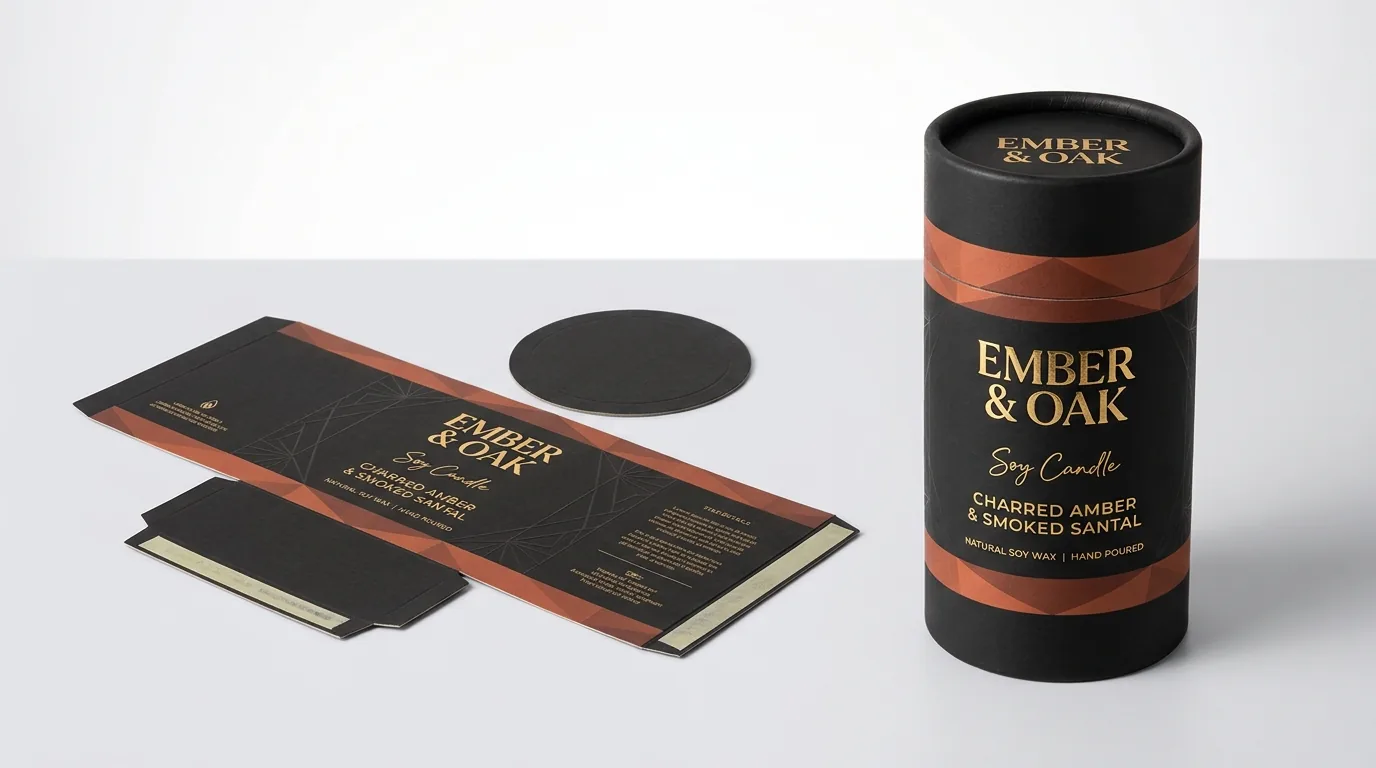
Short answer: A custom paperboard tube box uses four flat artwork pieces: a rectangular cap wrap, a circular top disc, a rectangular body wrap, and a circular bottom disc. Wrap width equals π × Outer Diameter (OD) plus a 3–5 mm rear overlap seam and 12–15 mm rim turn-ins.
On this page
- How do you calculate flat wrap width, seam overlap, and rim turn-ins for a custom tube
- Why must your primary brand wordmark fit inside the front 110–120° arc of the cylinder
- How do metallic foil bands, soft-touch lamination, and GS1 ladder barcodes work on curved wraps
- What 5-step prepress check should you run before approving your 3D tube proof
- Common mistakes
- FAQs
Request a custom quoteFree dieline & 3D mockup
Preparing press-ready artwork for custom tube boxes works differently from laying out a four-panel folding carton because cylindrical canisters have zero vertical score lines - instead, flat offset-printed 80–100 lb litho wraps are glued continuously around a rigid multi-ply wound cylinder core and tucked into rolled top and bottom rims. That means your Illustrator dieline consists of two flat rectangular wrap sheets (one for the slip-on or flush cap skirt, one for the lower cylinder body) paired with two circular disc dielines (for the top cap crown and bottom base). Getting the exact outer circumference (C = 3.1416 × OD), the 4 mm rear seam overlap, the 12–15 mm rim turn-in bleed, and the 120-degree front viewing zone right ensures unbroken 360-degree graphics. CubitPack supplies custom vector tube wrap dielines and 3D digital proofs free starting from 1,000 units.
How do you calculate flat wrap width, seam overlap, and rim turn-ins for a custom tube?
Because the printed paper wrap is applied to the outside of the wound paperboard cylinder, wrap width is always calculated from Outer Diameter (OD = Internal Diameter ID + 2 × wall thickness t), never from Internal Diameter. Multiplying OD by pi (3.1416) gives the exact 360-degree perimeter, to which prepress adds a 3.0 to 5.0 mm (0.12 to 0.20 in) vertical overlap strip along the rear seam so no raw brown or white core board ever peeks through. Moreover, on a 2-piece telescoping tube, the cap lid has a wider Outer Diameter than the lower body tube - so the cap wrap rectangle is always slightly wider than the body wrap rectangle! Compare the exact flat wrap dimensions across four popular custom candle boxes, custom tea boxes, custom essential oil boxes, and custom spirits boxes cylinder sizes
- Top and bottom rim turn-in bleed (+12 to +15 mm each): Extend background colors and continuous patterns 0.50 in (12.7 mm) past the top and bottom trim lines of the rectangular wrap so the paper curls cleanly over the tube rim without showing unprinted edges.
- Unvarnished 4 mm glue overlap strip: Keep lamination film, Spot UV varnish, and silicone coatings off the 4 mm under-lap edge at the back seam so water-based wrapping adhesive bonds fiber-to-fiber.
- Circular top and bottom disc bleed (+3 to +5 mm radius): Extend background color past the circular disc cut line so the rolled rim curl traps full ink coverage.
| Tube ID × IH (wall t) | Base OD | Body wrap width (π×OD + 4mm) | Front 120° hero zone | 2-pc cap wrap width |
|---|---|---|---|---|
| 1.50 × 4.25 in (0.8 mm) | 1.56 in (39.6 mm) | 5.06 in (128.4 mm) | 1.63 in (41.5 mm) | 5.31 in (134.9 mm) |
| 2.75 × 4.75 in (1.0 mm) | 2.83 in (72.0 mm) | 9.05 in (230.2 mm) | 2.96 in (75.4 mm) | 9.34 in (237.2 mm) |
| 3.50 × 6.50 in (1.2 mm) | 3.59 in (91.4 mm) | 11.45 in (291.1 mm) | 3.76 in (95.7 mm) | 11.77 in (299.0 mm) |
| 3.62 × 12.50 in (1.5 mm) | 3.74 in (95.0 mm) | 11.91 in (302.5 mm) | 3.92 in (99.5 mm) | 12.25 in (311.2 mm) |
Why must your primary brand wordmark fit inside the front 110–120° arc of the cylinder?
When graphic designers open a flat 11.45-inch wide rectangular tube wrap in Adobe Illustrator, the most common temptation is to treat the middle half of the sheet like a flat billboard and stretch the brand name 5 inches wide. Once that flat sheet is wrapped around a 3.59-inch diameter cylinder, however, any typography extending past 55 to 60 degrees left or right of dead-center curves sharply away from the viewer's eye due to cosine perspective foreshortening. To make custom cosmetic boxes and custom coffee boxes read unmistakably from three feet away on a retail shelf, divide your 360-degree wrap circumference into three functional arcs: Designing custom printed tube canisters around that front third prevents perspective distortion on retail shelves
- Front 110–120° Hero Arc (~30% to 33% of circumference): Center your primary brand logo, product name, scent or flavor callout, and net weight inside this front third so shoppers read every letter head-on without picking up and rotating the tube.
- Flanking Transition Arcs (60° left and 60° right): Use these curved shoulder zones for continuous 360-degree botanical illustrations, diagonal color-blocking waves, or metallic foil rings that draw the eye around the cylinder.
- Rear 120° Story & Compliance Arc (centered on the back seam): Place ingredients, steeping or candle burn instructions, origin copy, and your ladder-oriented UPC barcode on the back third, positioning the 4 mm vertical lap seam neatly at the 180-degree rear centerline.
How do metallic foil bands, soft-touch lamination, and GS1 ladder barcodes work on curved wraps?
Because the outer 80–100 lb art paper or unbleached kraft wrap is printed, laminated, and foil-stamped flat on sheetfed presses before being wrapped around the rigid cylinder core, you can combine high-precision offset finishes across custom t-shirt boxes and custom sock boxes without curved-surface stamping distortion - provided your prepress file follows three cylindrical rules
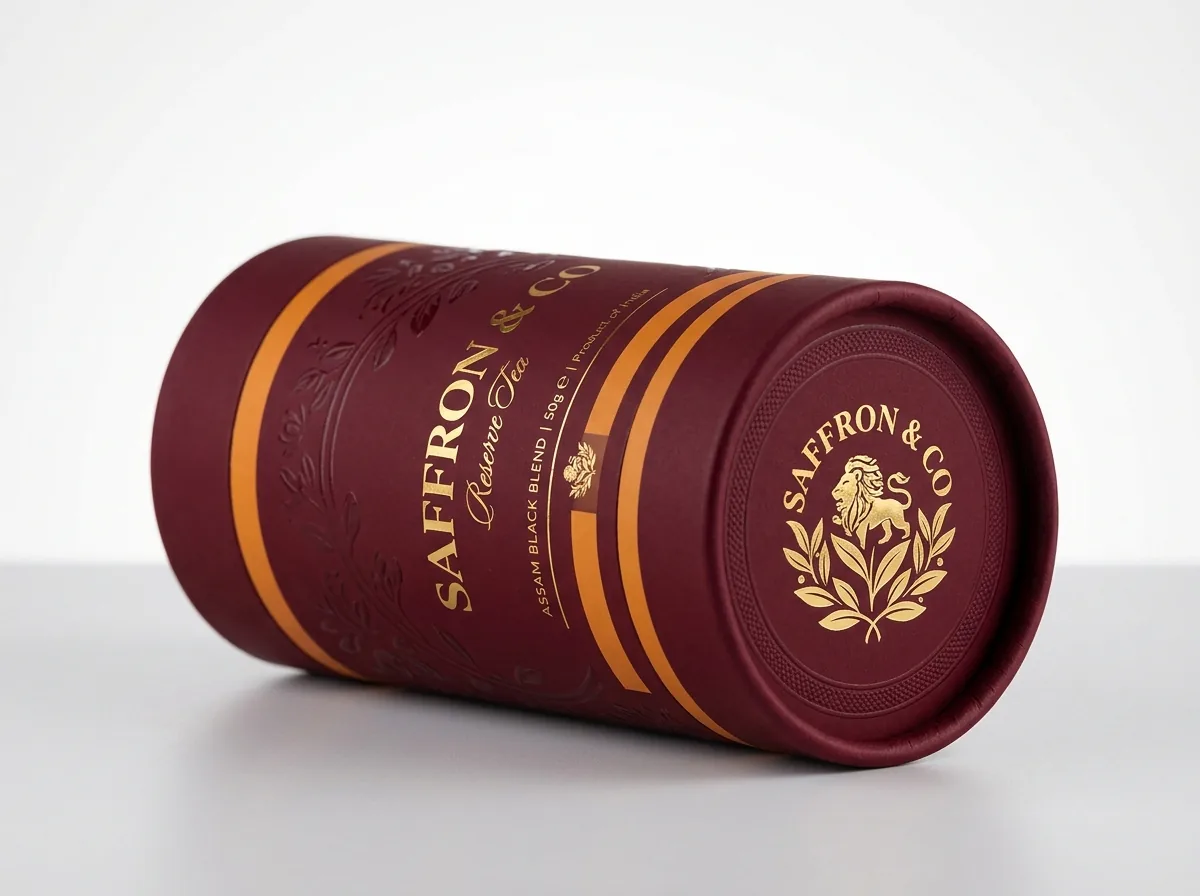
- Velvety soft-touch matte lamination: Protects dark midnight navy, charcoal, emerald, and burgundy wraps from scuffing when the telescoping cap slides up and down over the lower cylinder.
- Continuous 3D Spot UV rings and lattices: As a customer turns a cylindrical tube in their hands, raised gloss Spot UV lines over matte lamination catch a moving specular highlight around all 360 degrees.
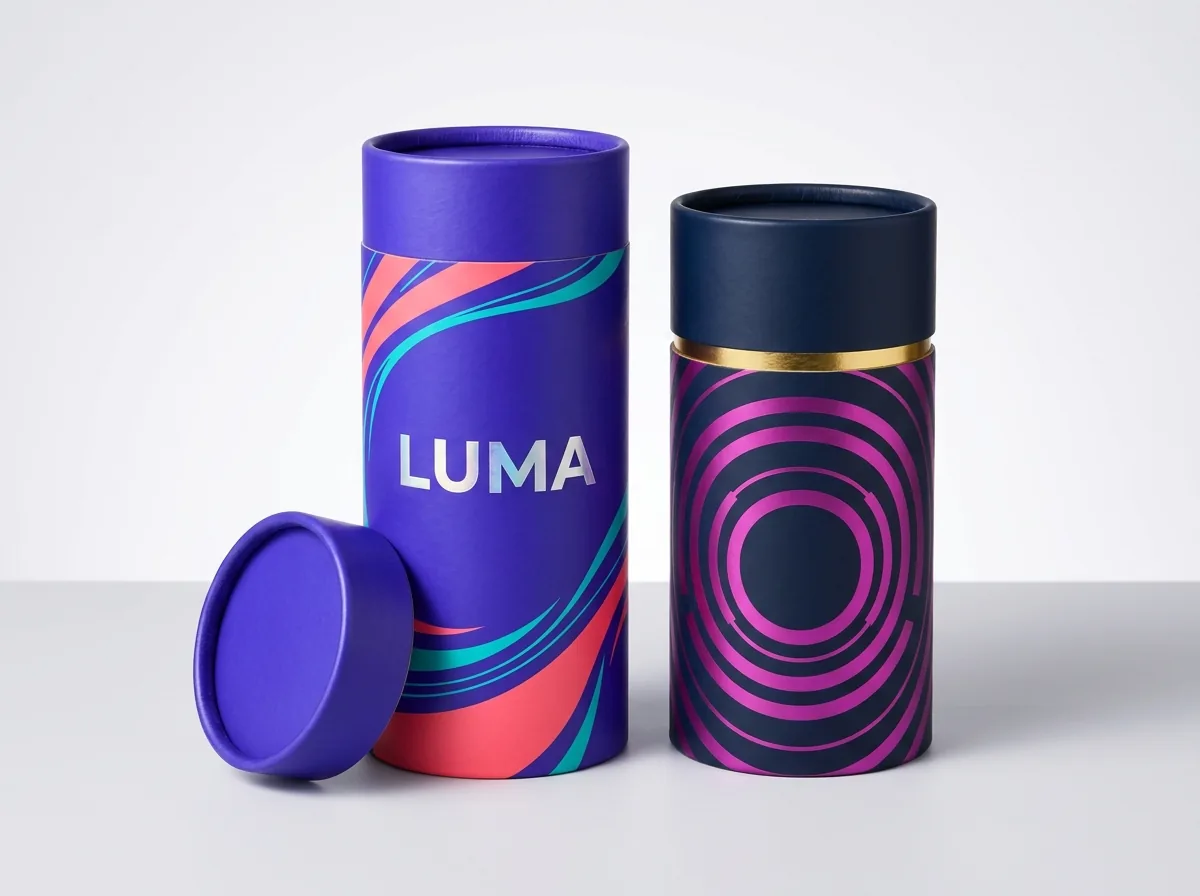
- Contrast inner shoulder-neck wraps: On 3-piece shoulder-neck tubes, wrapping the recessed inner collar in metallic gold foil paper or vibrant coral creates an unmistakable luxury band without extra exterior stamping.
| Prepress element | Cylindrical tube rule | Why it matters on round canisters |
|---|---|---|
| GS1 UPC / EAN barcode | Rotate 90° to 'ladder' orientation | Curved horizontal bars distort scanner laser reflection on tubes under 4 in OD |
| Circumferential foil bands | Extend foil +2 mm into rear overlap seam | Ensures 24k gold, copper, or silver rings meet smoothly around 360 degrees |
| Cap-to-body vertical registration | Use 3-piece shoulder-neck + alignment mark | 2-piece slip caps step outward by 1.2 mm; 3-piece flush tubes align OD-to-OD |
| Top cap disc embossing | Keep 3D emboss ≥ 6 mm inside rim curl | Prevents deep rolled rim crimping tools from flattening raised center crests |
Know your size? Compare pricing across up to 3 quantities.
Request a Quote →What 5-step prepress check should you run before approving your 3D tube proof?
Combine this artwork guide with our measurement walkthrough on paperboard tube box dimensions, internal diameter, and bottle fit and our structural comparison of telescoping tube boxes vs hexagon boxes and two-piece cartons, plus our label sizing guide on what size cosmetic label fits dropper bottles, jars, and tubes. Run this 5-point prepress audit before signing off on your free CubitPack 3D digital proof: Walking through each measurement and print zone on the flat wrap template before plates are imaged prevents costly press delays and guarantees crisp 360-degree alignment
- Check 1: Confirm that your rectangular cap wrap and body wrap widths are built from CubitPack's exact Outer Diameter (π × OD + 4 mm overlap) rather than Internal Diameter.
- Check 2: Verify that your primary brand wordmark and product title sit inside the dashed 120-degree front hero zone (~30% of wrap width).
- Check 3: Confirm that background fills and continuous bands bleed 12–15 mm past top and bottom trim lines for rim curling.
- Check 4: Check that your retail UPC barcode is rotated 90 degrees into ladder orientation with a high-contrast white quiet zone.
- Check 5: Inspect the interactive 3D cylinder proof from front, back-seam, and top-cap angles before payment (starting at 1,000 units with zero die or plate charges and free US shipping).
What artwork and dieline mistakes happen most often on custom tube boxes?
Prevent white core gaps at the back seam, unreadable curved titles, and non-scanning barcodes by avoiding these five prepress errors
- Calculating wrap width from Internal Diameter (π × ID) instead of Outer Diameter (π × OD + 4 mm lap), leaving the printed label 6 to 10 mm too short to close around the cylinder.
- Using the exact same wrap width for both the cap and the base on a 2-piece telescoping tube (where the outer slip cap has a larger diameter than the base).
- Spanning a primary brand logo across 160–180 degrees of the cylinder perimeter so the first and last letters vanish around the curved sides on retail shelves.
- Placing a UPC barcode in horizontal 'picket fence' orientation around a curved 1.5–3.0 in tube instead of vertical 'ladder' orientation.
- Stopping background ink right at the top or bottom trim line without adding 12–15 mm of rim turn-in bleed, exposing raw white paper along the rolled top curl.
Packaging for this
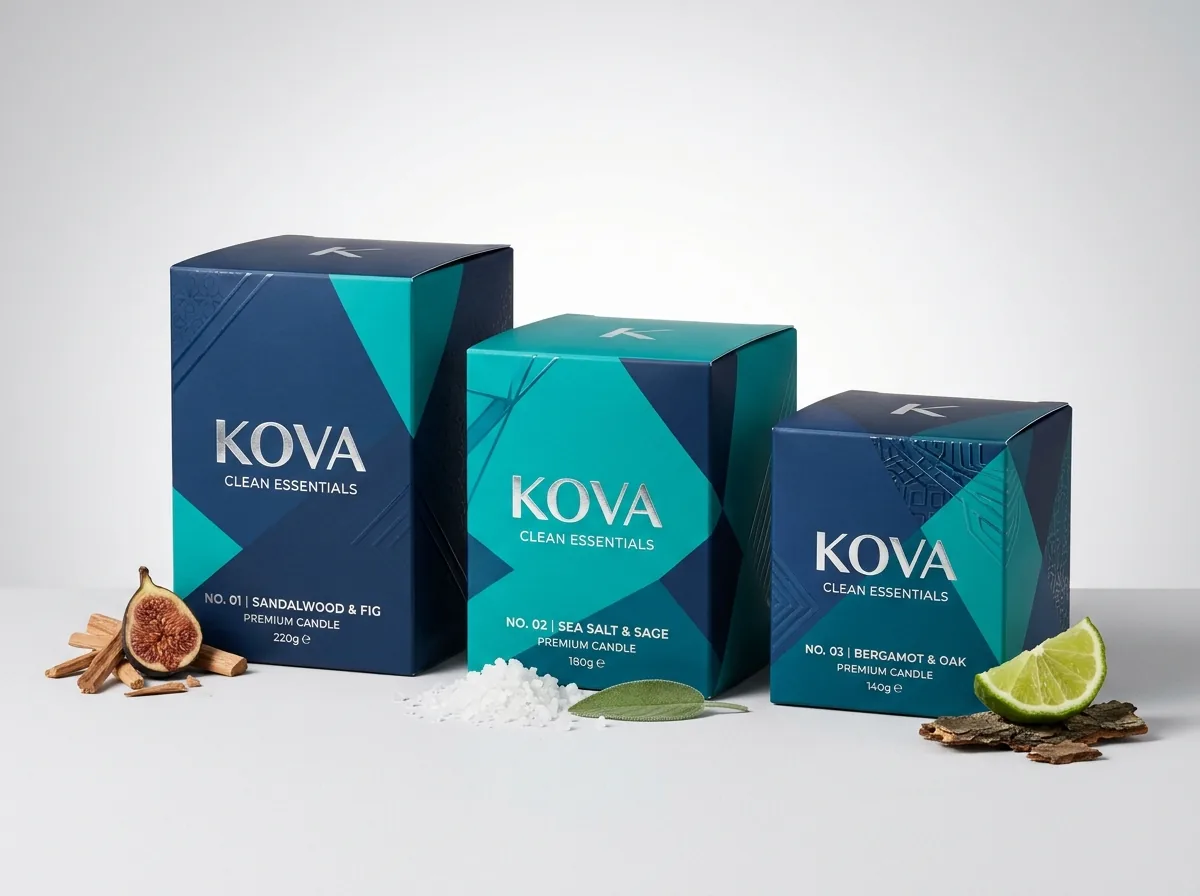
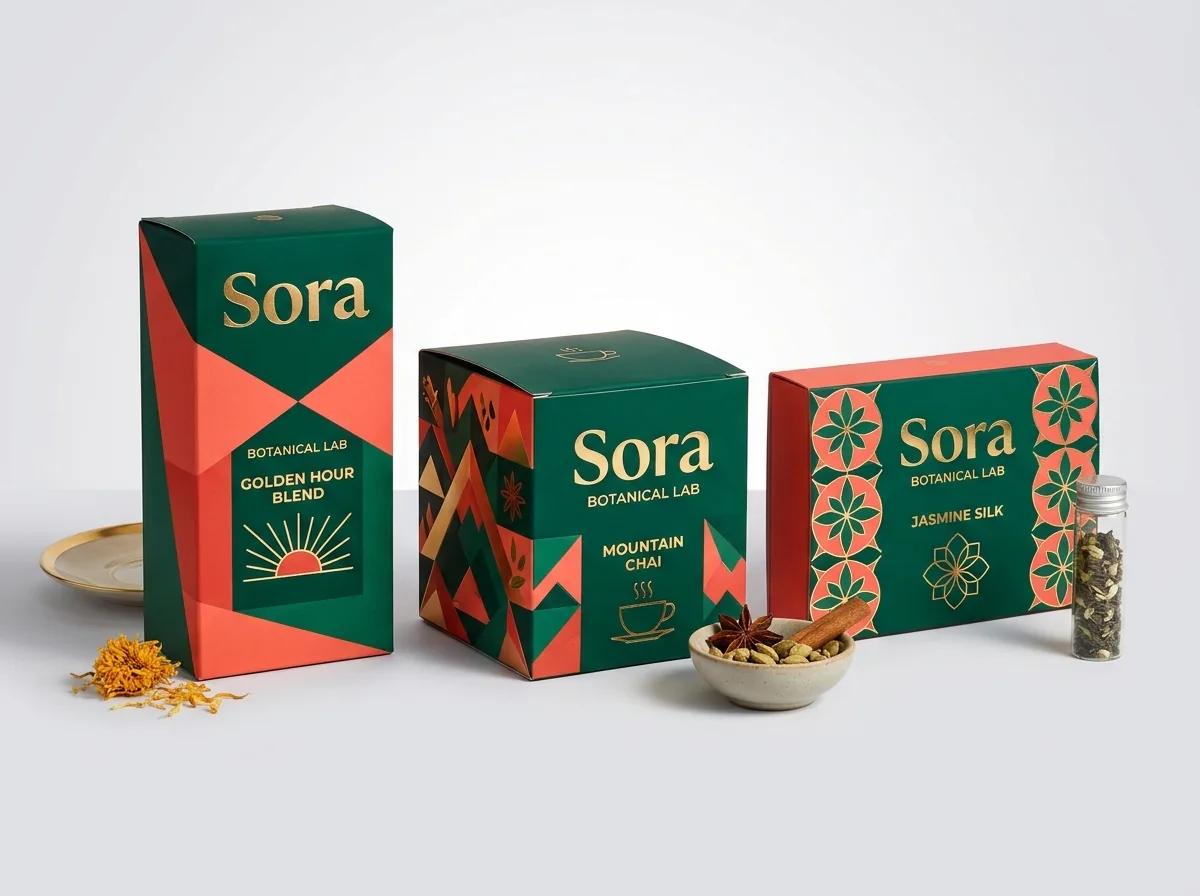

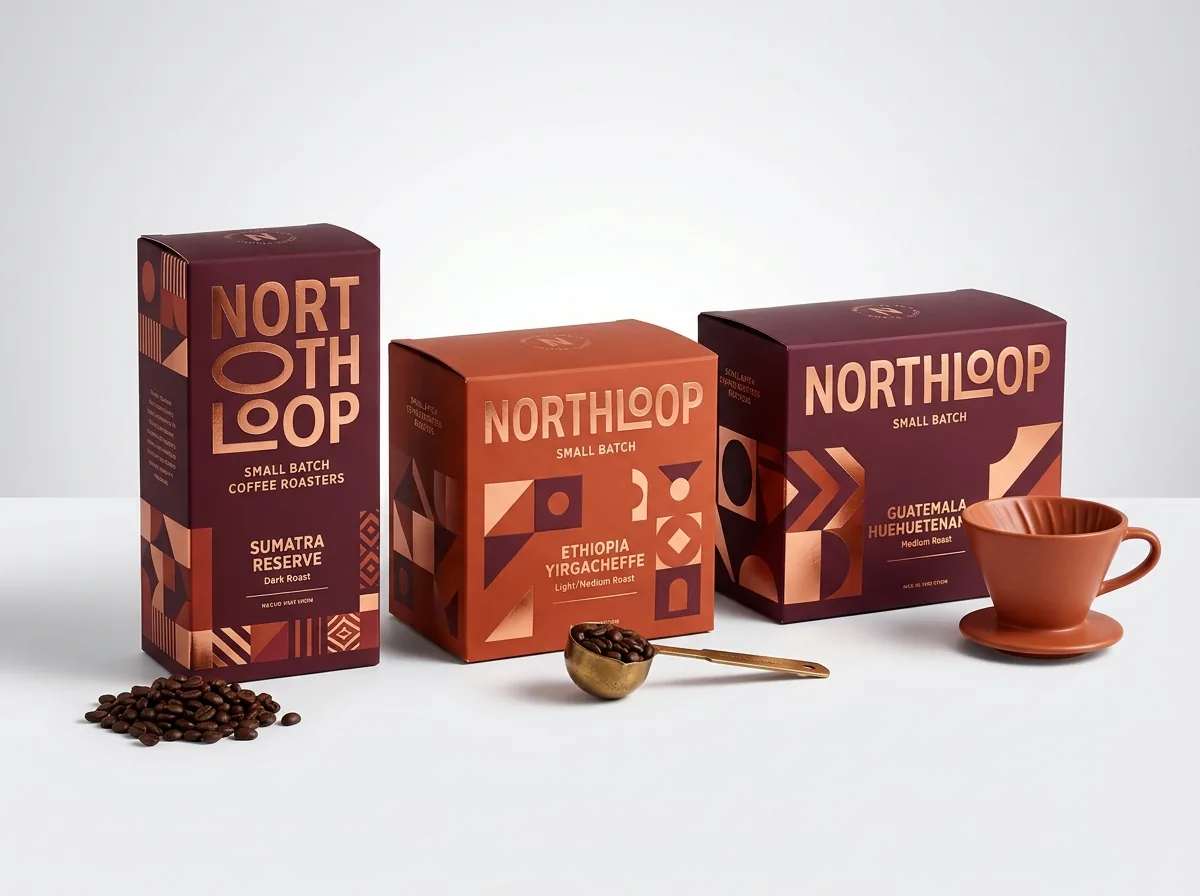

Ready to order tube boxes? Compare up to 3 quantities with a free 3D mockup.
Request a Quote →Questions about tube boxes
What is the formula for the flat wrap width of a cylindrical tube box?
Multiply the cylinder's Outer Diameter (OD) by pi (3.1416) and add 0.15 inches (4 mm) for the vertical rear overlap seam: Wrap Width = (3.1416 × OD) + 4 mm. Also add 12 to 15 mm (0.50 in) at both the top and bottom edges for rim turn-in bleed.
Why is the cap wrap wider than the body wrap on a 2-piece telescoping tube?
Because a 2-piece slip-on cap slides over the outside of the lower base cylinder, its Outer Diameter is roughly 2.4 to 3.0 mm wider than the base OD. Multiplying that extra diameter by 3.1416 makes the cap wrap circumference 7.5 to 9.5 mm wider than the body wrap.
How wide should my front logo be on a 3.5-inch diameter tube box?
A 3.50-inch ID tube (3.59-inch OD) has a total circumference of 11.28 inches. Keeping your main logo and product name inside the front 110–120 degree arc means designing your hero lockup within a 3.45 to 3.76 inch wide front column.
What does 'ladder orientation' mean for a barcode on a round tube?
Ladder orientation means rotating the barcode 90 degrees so the black bars run horizontally stacked on top of one another like the rungs of a ladder. That way, each individual bar lies flat along the vertical axis of the cylinder instead of curving away from the checkout laser.
Does CubitPack provide the exact flat wrap and circular disc CAD template before I design?
Yes. Request a quote for your target Internal Diameter and Internal Height (from 1,000 units) and our prepress specialists send a custom 2D vector CAD template - marking exact cap wrap, body wrap, seam overlap, rim turn-ins, 120° hero zone, and circular discs - plus a 3D proof before payment.
Still have a question? Ask a packaging specialist.
Request a Quote →Request your tube boxes quote
Tell us your size and quantities, and one dedicated account manager prepares pricing for each tier.
- Free design & AI-to-print studio + 3D mockup
- No die or plate charges · 4–5 day rush available
- Free shipping to all 50 states
- 10% off your first order
We verified cylindrical litho wrap circumference formulas (C = π × OD + overlap), 2-piece cap-vs-body wrap offsets, 12–15 mm rim turn-in allowances, 110–120° front viewing arcs, and GS1 ladder barcode orientation standards against Composite Can and Tube Institute (CCTI) guidelines, Paperboard Packaging Council (PPC) manuals, and GS1 General Specifications. Spot something wrong? Tell us and we fix it.
Sources
- Outer wrap circumference calculation (π × OD + overlap seam), 2-piece cap-vs-body diameter offset, and 12–15 mm rim turn-in tolerances.
- Front 110–120° hero viewing arc for cylindrical shelf legibility and circular top/bottom disc die-cutting bleed.
- Mandatory 90-degree 'ladder' barcode orientation on curved cylindrical surfaces to prevent laser reflection distortion.
What changed
- November 9, 2026: First published with 4-size π × OD wrap circumference table, 120-degree front viewing arc diagram, and 5-step cylindrical prepress checklist.
More guides
New packaging guides by email
Sizes, materials and design tips. Unsubscribe anytime.