
How do you measure paperboard tube box dimensions, internal diameter, and bottle fit?
Short answer: Always specify custom paperboard tube boxes by Internal Diameter (ID) and Internal Height (IH), never Outer Diameter (OD). Because a wound cylinder wall is 0.8 to 1.5 mm thick on all sides, OD equals ID + 2t. Add +1.5 to +3.0 mm over your bottle diameter for a smooth fit.
On this page
- What 6 benchmark paperboard tube dimensions fit droppers, tea, socks, candles, t-shirts, and spirits
- Why do cylindrical glass bottles need +2 mm air-escape clearance or a ribbon pull tab
- Which wound cylinder wall thickness (0.8 mm, 1.2 mm, or 1.5 mm) matches your product weight
- How do you confirm your exact tube box dimensions in 4 steps before ordering
- Common mistakes
- FAQs
Request a custom quoteFree dieline & 3D mockup
Specifying dimensions for custom tube boxes requires a different measurement mindset than flat folding cartons because rigid paperboard cylinders are wound over solid steel mandrels whose diameters define the Internal Diameter (ID) of the lower body tube. Every multi-ply spiral or convolute wall adds 0.8 to 1.5 millimeters of rigid paperboard on both sides of the circle, plus another 0.8 to 1.5 millimeters per wall on a telescoping slip-on cap lid. If a brand measures a 3.25-inch candle tumbler and mistakenly orders a 3.25-inch Outer Diameter (OD) tube, the two 1.2 mm walls shrink the interior opening to 3.15 inches and the glass jar cannot enter the canister. Pairing true Internal Diameter math with the right wall thickness and foam collar keeps bottles, candles, tea pouches, and rolled apparel snug. CubitPack engineers custom cylindrical tube dielines free starting at 1,000 units.
What 6 benchmark paperboard tube dimensions fit droppers, tea, socks, candles, t-shirts, and spirits?
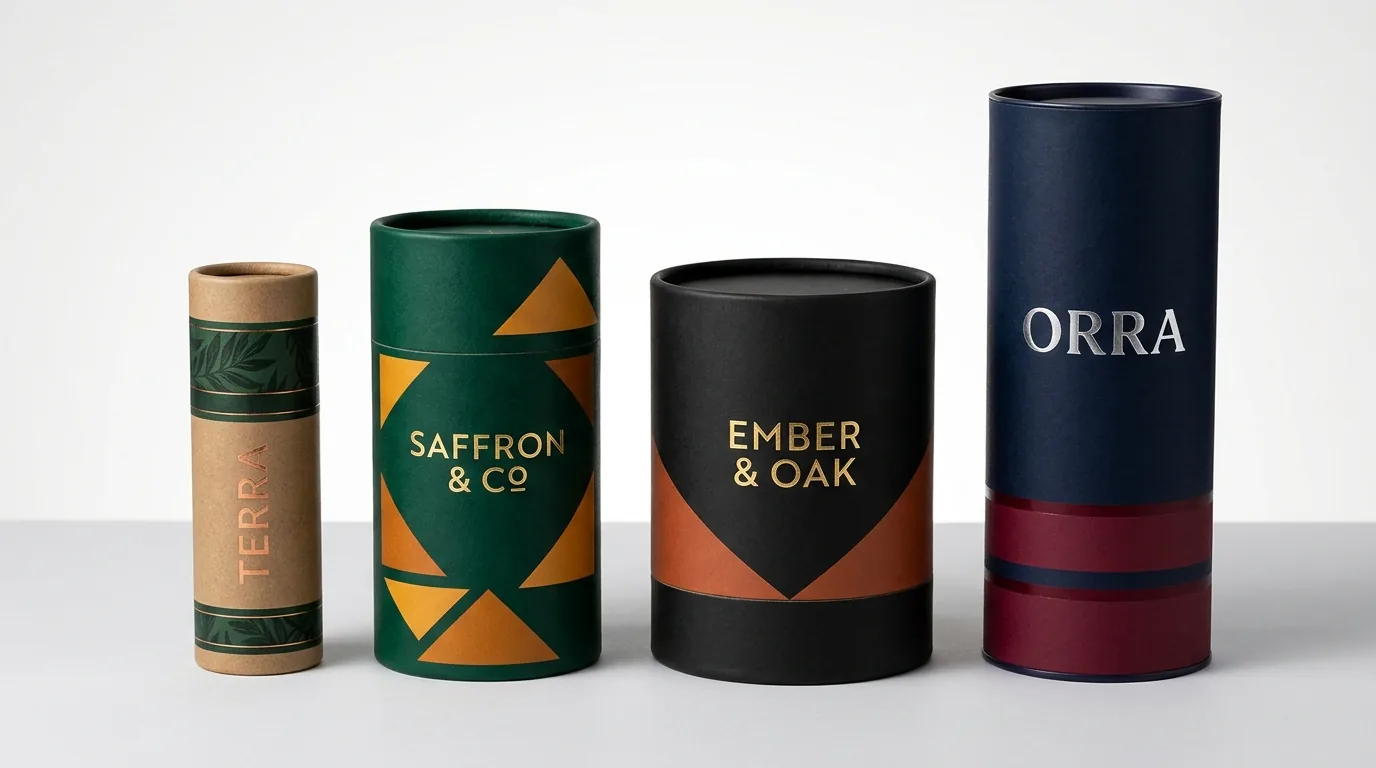
Every mandrel specification in cylindrical paperboard manufacturing starts with usable interior space: Internal Diameter (ID) across the circular opening and Internal Height (IH) from the top surface of the rolled bottom disc to the underside of the closed cap lid. Once ID and wall thickness (t) are locked, the base cylinder's Outer Diameter follows the formula OD = ID + 2t, while a two-piece telescoping slip cap adds another +0.8 to +1.2 mm of radial glide clearance plus its own wall thickness. Keeping ID, base OD, and cap OD distinct ensures your glass bottle slides in effortlessly while your fulfillment team sizes master shipping cartons to the true exterior cap diameter. Compare how bestselling SKUs across custom essential oil boxes, custom tea boxes, custom candle boxes, and custom spirits boxes map to six industry-standard cylindrical footprints
- Direct slip fit (no foam ring): Add +1.5 to +3.0 mm (+1/16 to +1/8 in) to your bottle, jar, or tin's widest outer diameter so trapped air can escape around the vessel as it slides down.
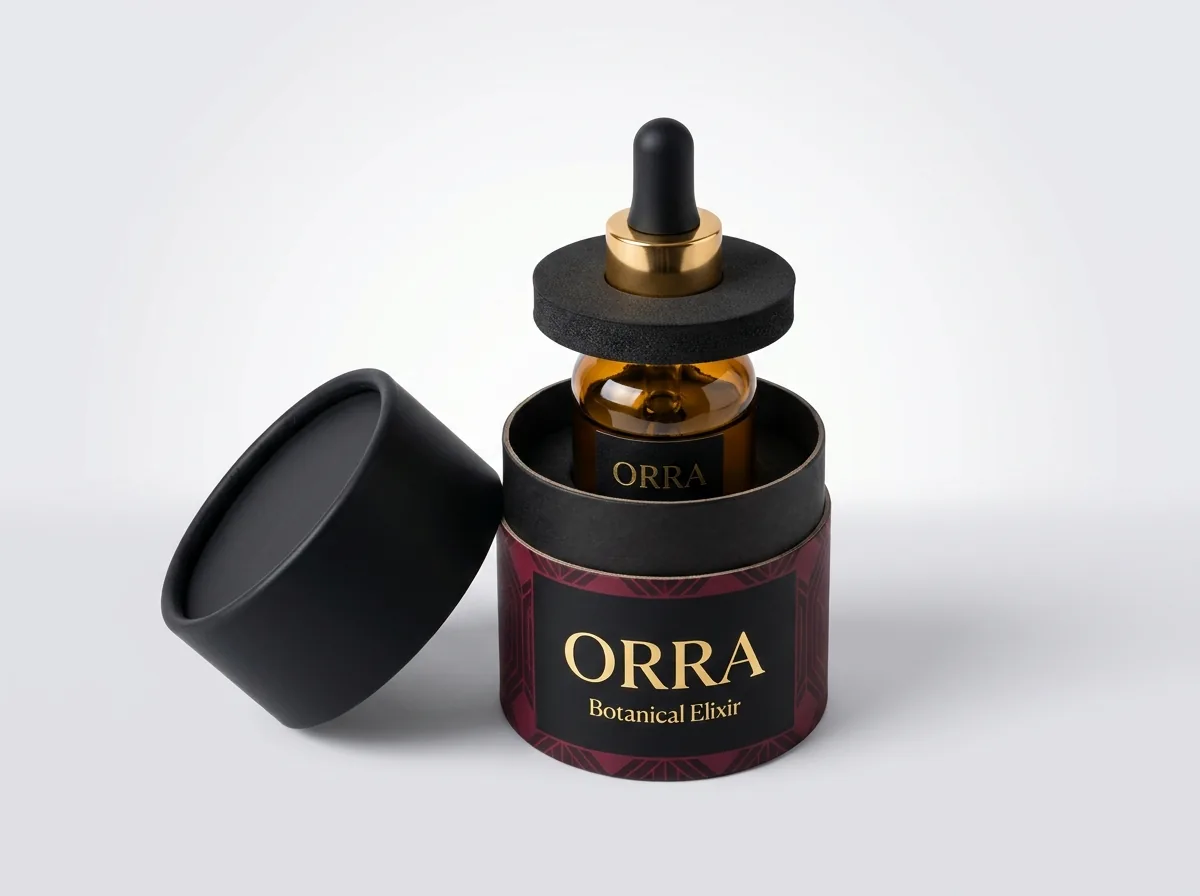
- Suspended fit with EVA foam or paperboard rings: Add +8.0 to +12.0 mm (+5/16 to +1/2 in) to the bottle diameter so the circular foam collar has at least 4 to 6 mm of cushioning rim wall all around.
- Internal height (IH) head-space rule: Add +3.0 to +5.0 mm (+1/8 to +3/16 in) above the bottle cap or candle lid (plus the thickness of any bottom/top foam shock discs) so the cap lid closes flush without bottoming out on the product.
| Internal size (ID × IH) | Wall thickness (t) | Base OD | Typical product fit | Recommended tube style |
|---|---|---|---|---|
| 1.50 × 4.25 in (38 × 108 mm) | 0.8–1.0 mm | 1.58 in | 30 ml glass essential oil dropper or lip serum vial | 2-piece slip cap or 3-piece neck |
| 2.75 × 4.75 in (70 × 120 mm) | 1.0 mm | 2.83 in | 50 ml skincare pump bottle or rolled dress socks | 3-piece flush shoulder-neck |
| 3.25 × 5.50 in (83 × 140 mm) | 1.0–1.2 mm | 3.34 in | 4–6 oz loose-leaf tea pouch or whole-bean coffee | 2-piece slip cap (+ foil liner) |
| 3.50 × 4.25 in (89 × 108 mm) | 1.2 mm | 3.59 in | 8–10 oz poured soy candle jar (3.25 in jar diameter) | 2-piece deep slip cap or neck |
| 4.00 × 7.50 in (102 × 190 mm) | 1.2 mm | 4.09 in | Rolled heavyweight graphic t-shirt or 12 oz coffee | 2-piece telescoping cylinder |
| 3.62 × 12.50 in (92 × 318 mm) | 1.5 mm | 3.74 in | 750 ml craft spirits, wine, or olive oil glass bottle | Heavy-wall 2-piece + EVA rings |
Why do cylindrical glass bottles need +2 mm air-escape clearance or a ribbon pull tab?
Unlike a four-sided square carton where four triangular corner pockets naturally vent air when you drop a jar inside, a cylindrical tube hugs a round glass vessel around all 360 degrees like a piston inside a sleeve. If you size a tube's Internal Diameter within 0.5 millimeters of a straight-sided candle tumbler, the trapped air cushion underneath slows the jar to a crawl - and once seated at the bottom, customers cannot slip their fingers between the glass wall and the paperboard cylinder to lift the candle out. Designing cylindrical custom tube boxes for custom cosmetic boxes and custom t-shirt boxes requires balancing snug lateral protection with effortless vertical extraction
- Piston air-vent clearance (+2.0 to +3.0 mm ID): Leaving 1.0 to 1.5 mm of breathing room on each side of a straight-walled candle jar lets air bypass the glass smoothly while preventing lateral rattle.
- Shallow base + tall lid proportion for heavy jars: Making the lower base tray 40–50% of the bottle's height (or using a 3-piece shoulder-neck base) leaves the upper half of the jar exposed as soon as the cap lifts off, so shoppers grab the glass directly.
- Satin ribbon pull tab or stepped EVA base ring: When a tall base cylinder conceals the entire candle jar, anchoring a 12 mm grosgrain ribbon pull strip underneath the jar lifts it up with one finger.

Which wound cylinder wall thickness (0.8 mm, 1.2 mm, or 1.5 mm) matches your product weight?
Because a circular ring distributes radial squeezing forces into uniform hoop compression around 360 degrees, a 1.0 mm wound paperboard cylinder resists side-crush far better than a flat 24 pt folding carton wall. Even so, heavier glass vessels require thicker multi-ply cores and deeper rolled bottom crimp curls so the circular base disc never dishes or punches out when a customer lifts the tube by its cap. Match your filled SKU weight across custom sock boxes and custom coffee boxes to these three tested wall-thickness tiers
- Telescoping cap friction tuning (+0.8 to +1.2 mm): We calibrate the inner diameter of the slip-on cap so it glides down with a slow, cushioned pneumatic seal rather than dropping loose or sticking tight.
- Food-safe inner foil barrier for dry goods: When packing loose-leaf tea, matcha, or roasted coffee directly or in thin pouches, an interior aluminum foil liner locks out oxygen and humidity.
- Humidity-stable kraft and SBS winding: Alternating spiral plies sealed with plant-based adhesives keep cylinders round across winter and summer warehouse humidity.
| Filled weight tier | Wound core thickness (t) | Combined wall + wrap | Bottom disc & insert spec |
|---|---|---|---|
| Light (up to 12 oz) | 0.8–1.0 mm (32–40 pt) | ~1.0–1.2 mm total wall | Rolled paperboard bottom disc; direct or card ring fit |
| Medium (12 oz to 2.0 lb) | 1.2 mm (48 pt) heavy core | ~1.4 mm total wall | Deep-curled base disc + 10 mm EVA foam base pad |
| Heavy (2.0 to 4.0 lb) | 1.5 mm (60 pt) rigid core | ~1.7 mm total wall | Reinforced double-crimp base + top & bottom EVA rings |
Know your size? Compare pricing across up to 3 quantities.
Request a Quote →How do you confirm your exact tube box dimensions in 4 steps before ordering?
Combine this sizing checklist with our structural comparison of telescoping tube boxes vs hexagon boxes and two-piece cartons and our prepress guide to paperboard tube wrap dielines, 360-degree seams, and cap artwork, plus our beverage packaging breakdown on folding spirits cartons vs rigid decanter boxes and tubes. Measuring three actual production bottles or rolled garments before locking mandrel diameter takes two minutes and guarantees a luxury slip-cap reveal
- Step 1: Measure the widest outer diameter of your bottle, jar, or rolled garment (checking base heels, shoulder bulges, dropper bulbs, and overhanging lids) with digital calipers.
- Step 2: Add +2.0 to +3.0 mm (+3/32 in) for a direct cylinder fit, or +8.0 to +12.0 mm if adding a circular EVA foam collar, to lock your target Internal Diameter (ID).
- Step 3: Measure total product height and add +3.0 to +5.0 mm (plus any bottom and top foam pad thicknesses) to lock your Internal Height (IH).
- Step 4: Enter ID (in both Length and Width) and IH (in Height) in CubitPack's quote form (from 1,000 units) for a free 2D wrap CAD dieline and 3D proof before payment; our $50 sample kit credits toward your first order.
What sizing mistakes happen most often on custom paperboard tube boxes?
Avoid jammed glass bottles, loose slip caps, and crushed bottle necks by preventing these five cylinder sizing errors
- Sending your bottle's 3.25-inch diameter as the tube's Outer Diameter (OD) instead of Internal Diameter (ID), which subtracts 2.4–3.0 mm of wall thickness from the interior opening.
- Sizing Internal Diameter to within 0.5 mm of a straight-walled candle jar without a ribbon pull tab or low-base pedestal, creating an air-lock piston that shoppers cannot pull out.
- Forgetting to add the thickness of a 10 mm bottom EVA foam pad and a 10 mm top cap foam pad to the tube's Internal Height (IH), leaving the cap 20 mm short of closing.
- Measuring a glass spirits or serum bottle at its base while overlooking a wider shoulder bulge or dropper pipette collar near the top.
- Packing a heavy 750 ml glass bottle inside a thin 0.8 mm wall tube without upper and lower EVA foam centering rings.
Packaging for this


Ready to order tube boxes? Compare up to 3 quantities with a free 3D mockup.
Request a Quote →Questions about tube boxes
How do I calculate Outer Diameter (OD) from Internal Diameter (ID) on a paperboard tube?
Multiply the single cylinder wall thickness (t) by 2 and add it to the Internal Diameter: OD = ID + 2t. For example, a 3.50-inch (89 mm) ID tube built with a 1.2 mm (0.047 in) wall has a base Outer Diameter of roughly 3.59 inches (91.4 mm), and its telescoping slip cap adds another ~2.5 to 3.0 mm.
What size tube box fits a standard 30 ml (1 oz) essential oil or serum dropper bottle?
A standard 30 ml Boston round glass dropper bottle measures roughly 1.30 inches (33 mm) in diameter by 4.00 inches (102 mm) tall. It fits cleanly inside a 1.50 × 4.25 in (38 × 108 mm) ID tube for a direct slip fit, or a 1.75 × 4.50 in ID tube with a die-cut foam base well.
How do I enter cylindrical tube dimensions into CubitPack's L x W x H quote form?
Enter your target Internal Diameter (ID) in both the Length and Width fields and your Internal Height (IH) in the Height field (for example, 3.5 × 3.5 × 6.5 in). Our packaging team converts those figures into exact circular mandrel ID, outer wrap circumference, and cap clearance.
Can CubitPack customize both the diameter and height of a paperboard tube box?
Yes. Both Internal Diameter (from 1.25 in vials up to 5.50 in gift canisters) and Internal Height (from shallow 2.0 in cosmetic jars up to 14.0 in spirits cylinders) are cut to your exact product specification starting at 1,000 units.
Are there setup or mandrel charges for custom tube diameters?
No. Custom printed paperboard tube boxes start at 1,000 units with zero die or plate charges, and you receive a free 2D vector wrap dieline and 3D digital proof before payment.
Still have a question? Ask a packaging specialist.
Request a Quote →Request your tube boxes quote
Tell us your size and quantities, and one dedicated account manager prepares pricing for each tier.
- Free design & AI-to-print studio + 3D mockup
- No die or plate charges · 4–5 day rush available
- Free shipping to all 50 states
- 10% off your first order
We verified cylindrical paperboard tube Internal Diameter (ID) vs Outer Diameter (OD = ID + 2t) formulas, telescoping slip-cap tolerances (+0.8 to +1.2 mm), bottle air-escape clearances (+1.5 to +3.0 mm), and wound core wall-thickness tiers (0.8–1.5 mm) against Composite Can and Tube Institute (CCTI) standards, Paperboard Packaging Council (PPC) manuals, and ECMA guidelines. Spot something wrong? Tell us and we fix it.
Sources
- Internal Diameter (ID) vs Outer Diameter (OD = ID + 2t) mandrel sizing, wound cylinder wall thickness tiers (0.8–1.5 mm), and slip-cap clearance.
- Direct bottle slip-fit clearance (+1.5 to +3.0 mm ID), EVA foam collar clearance (+8 to +12 mm ID), and internal height head-space rules.
- Comparison of 360-degree cylindrical piston air-venting vs four-corner square and six-corner hexagonal folding cartons.
What changed
- November 9, 2026: First published with 6-size paperboard tube benchmark chart, ID vs OD wall formulas, and 3-tier wall thickness guide.
More guides
New packaging guides by email
Sizes, materials and design tips. Unsubscribe anytime.