
How do five-panel hanger boxes compare to hang tab boxes and header card cartons?
Short answer: Choose a custom five-panel hanger box when your product weighs 8 to 24 ounces, needs a full-width 2-ply top billboard, or loads from the side. Choose an integral die-cut hang tab box for slim items under 8 to 12 ounces when you want a compact pop-up tab that folds flat for shelf display.
On this page
- How do five-panel hanger boxes, integral hang tab boxes, adhesive tabs, and header cards compare side by side
- Why does a 2-ply glued fifth panel hold 2x more weight than a stick-on plastic tab or single-ply neck
- When should you choose a five-panel hanger box vs a header card carton or bagged header card
- How much fulfillment time do 1-piece five-panel hanger boxes save on your packing line
- Common mistakes
- FAQs
Request a custom quoteFree dieline & 3D mockup
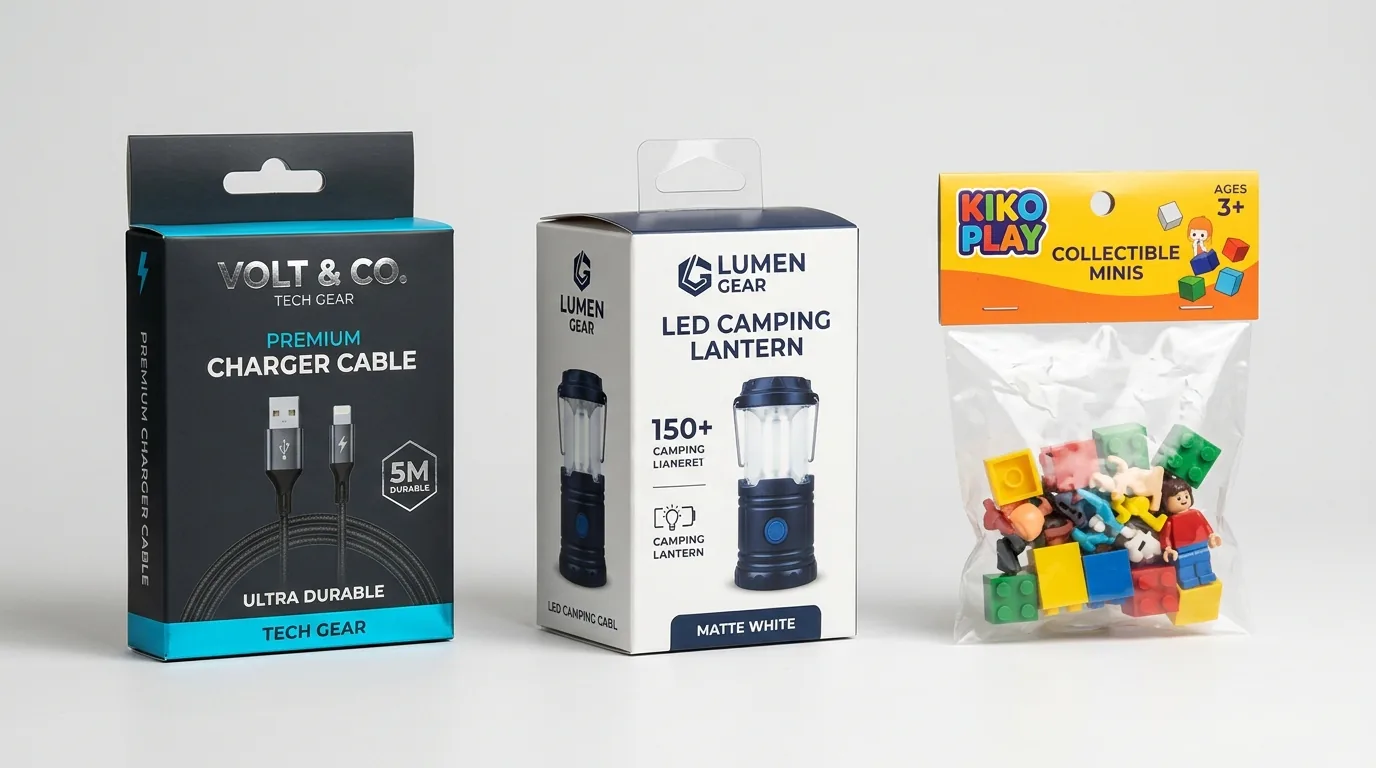
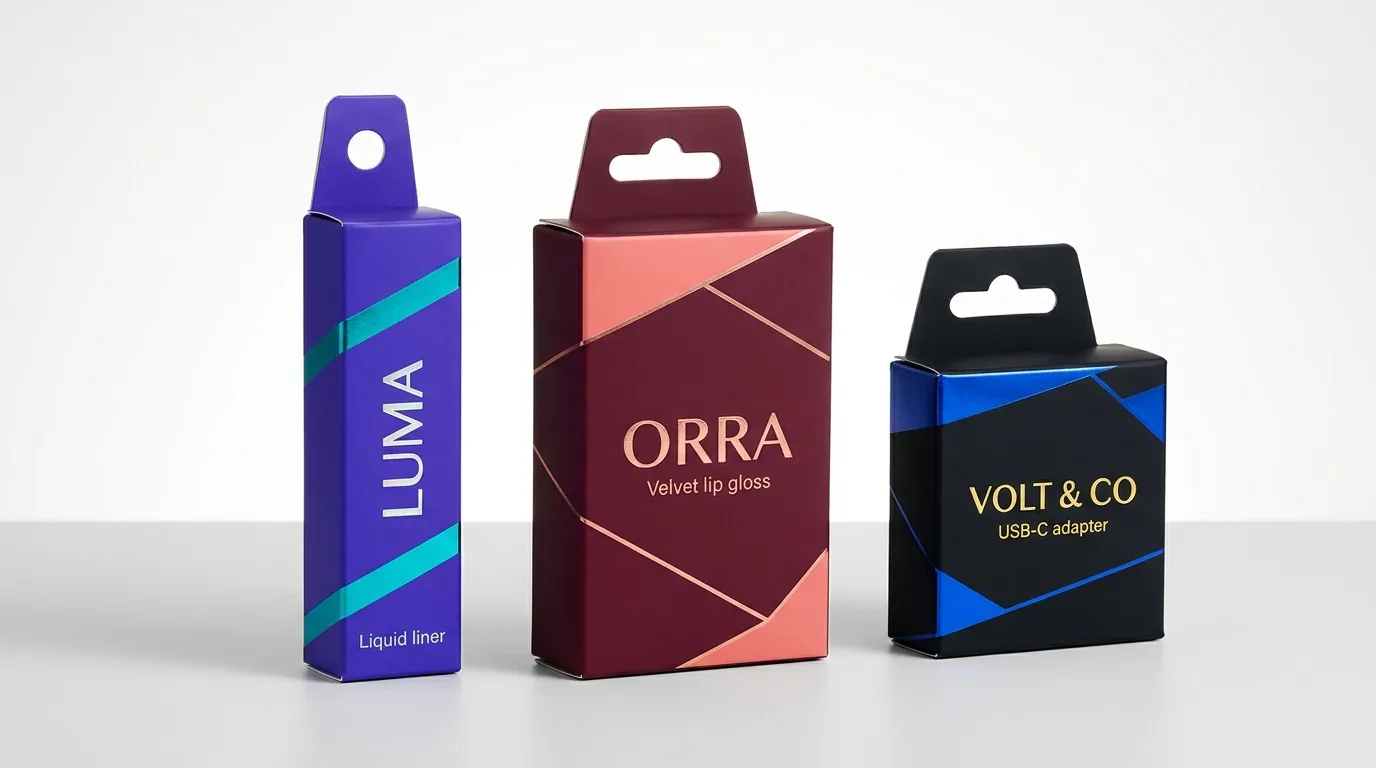
Retail brands merchandising on pegboards choose between four main hanging architectures: custom five-panel hanger boxes, custom hang tab boxes, custom header card boxes, and standard folding cartons fitted with peel-and-stick plastic tabs. A five-panel hanger box extends 100% of the rear wall upward into a fifth panel that folds 180 degrees and glues into a 36 to 48 pt double-ply billboard, supporting 16 to 24 ounces (455 to 680 g) with either top-tuck or horizontal side-tuck loading. An integral die-cut hang tab box raises a narrower centered pop-up tab (1.0 to 1.5 inches tall) that holds up to 8 to 12 ounces and folds 90 degrees flat for shelf display. Both one-piece paperboard designs eliminate the peeling failures and 6-second manual application labor of stick-on plastic hang tabs. For brands shipping across warm summer distribution hubs, switching to an integral paperboard hanger also guarantees 100% curbside recyclability and zero warehouse delamination.
How do five-panel hanger boxes, integral hang tab boxes, adhesive tabs, and header cards compare side by side?
Choosing the right pegboard structure depends on four engineering variables: packaged SKU weight, available vertical planogram spacing, top billboard branding area, and packing line assembly speed. Compare how five-panel hanger cartons, custom hang tab boxes, stick-on plastic tabs, and custom header card boxes perform across six retail metrics: Evaluating total landed packaging cost alongside fulfillment line speed shows why pre-glued one-piece paperboard hangers outperform multi-piece plastic tabs and stapled poly bags across high-volume retail rollouts. Every carton ships flat with pre-glued seams to minimize warehouse storage volume and speed up daily retail order fulfillment.
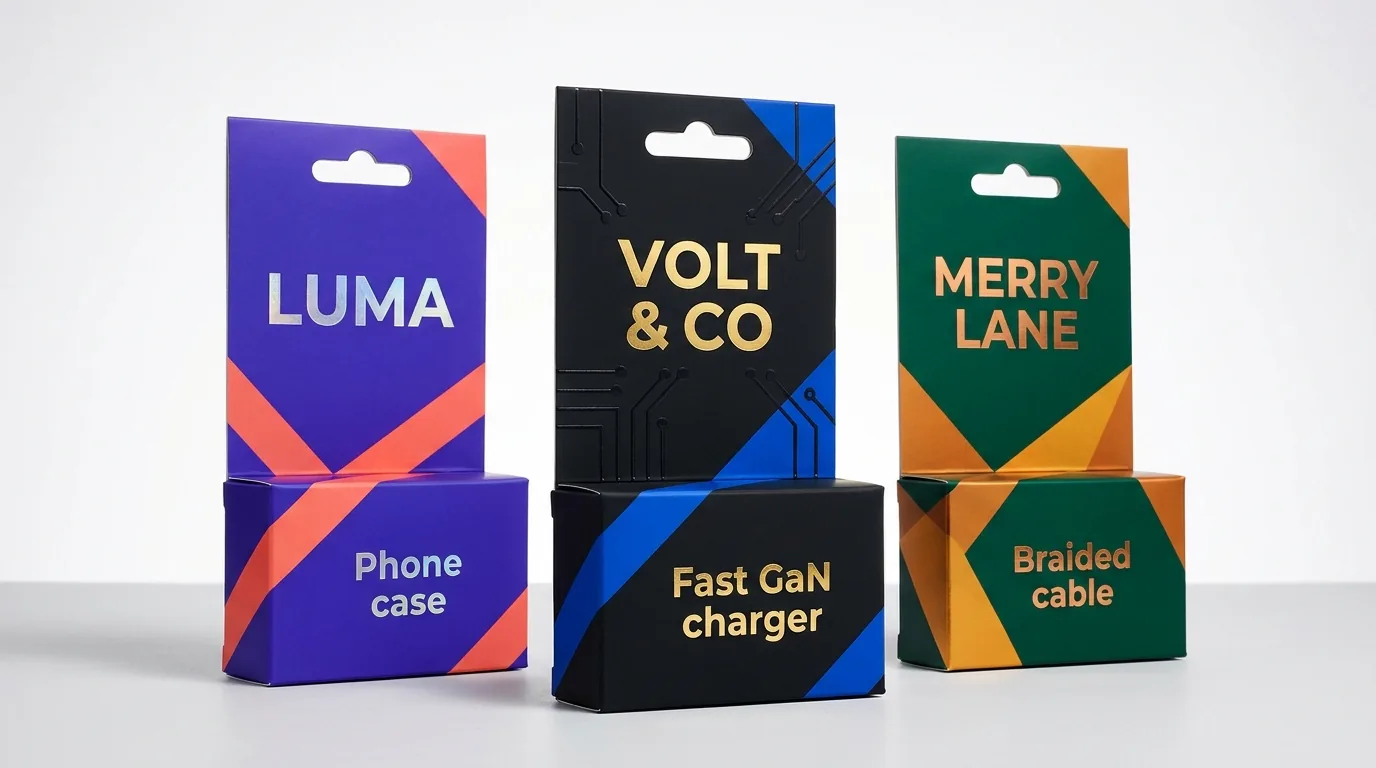
- Five-panel hanger boxes win on heavy tech and hardware walls: The unbroken full-width rear crease and 36–48 pt double-ply glued header prevent corner tearing on 12 to 24 oz SKUs like custom charger boxes and custom earbud boxes.
- Integral hang tab boxes win on tight beauty and checkout rows: A 1.0 to 1.25 inch pop-up tab adds minimal vertical height and folds flat when the same SKU sits on a shelf.
- Both one-piece cartons eliminate stick-on plastic tab failures: Pressure-sensitive adhesive tabs frequently delaminate from soft-touch matte or UV-coated boxes inside 120°F summer freight trailers.
| Feature | Five-panel hanger box | Integral die-cut hang tab box | Stick-on plastic hang tab | Bagged header card |
|---|---|---|---|---|
| Hanger structure | Full-width 2-ply glued 5th panel (36–48 pt) | Centered pop-up tab (50%–70% width) | Separate clear PET adhesive sticker | Folded card stapled/glued over poly bag |
| Max safe peg weight | 16–24 oz (455–680 g) | 6–12 oz (170–340 g) | 8–10 oz (peels in warm transit) | 6–12 oz (depends on bag seal) |
| Loading options | Top-load, side-tuck, or front book-flap | Top-load (front-hinged tuck lid) | Top-load or bottom-load tuck carton | Drop into bag + staple or heat-seal card |
| Top billboard area | 100% full width × 1.5–2.5 in (2-sided) | Compact neck around peg hole only | None (clear plastic tab over box) | 100% full width × 1.75–2.5 in |
| Packing labor per unit | 3–4 sec (1-piece pre-glued carton) | 3–4 sec (1-piece pre-glued carton) | 9–12 sec (erect box + peel & align tab) | 10–14 sec (fill bag + staple header) |
| Curbside recyclability | 100% mono-material paperboard | 100% mono-material paperboard | Mixed plastic + adhesive + paper | Mixed poly bag + metal staples + card |
Why does a 2-ply glued fifth panel hold 2x more weight than a stick-on plastic tab or single-ply neck?
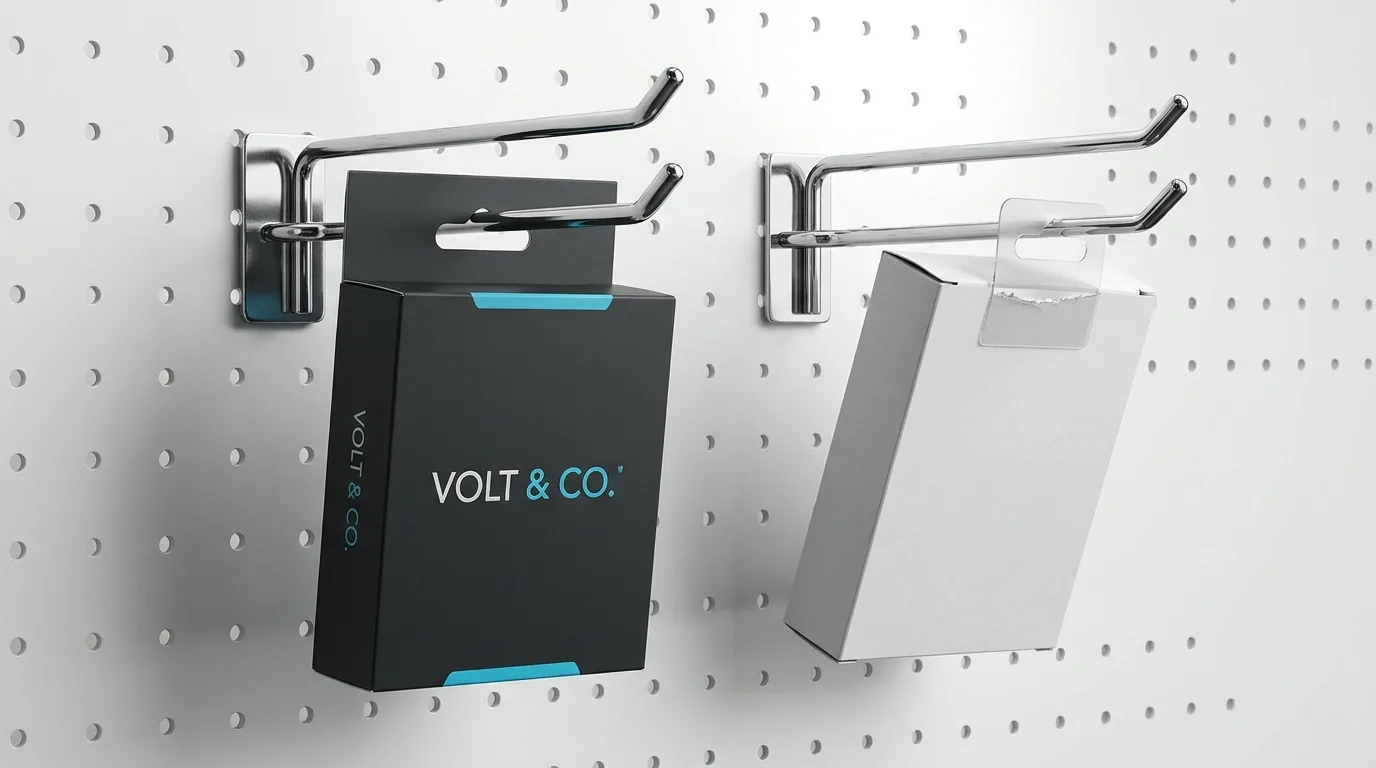
When a heavy product hangs on a metal peg rod, two failure modes threaten the package: slot crown tear-out (where the wire hook slices upward through the top of the hole) and neck delamination or crease buckling (where the tab peels off the back wall or folds forward). A five-panel hanger box solves both failure modes mechanically on the folder-gluer. Because the fifth panel is a continuous upward extension of the rear carton wall, there is zero adhesive shear interface between the box and the hanger. Folding the upper ply 180 degrees down and bonding it with cold-set PVA glue creates a laminated two-ply paperboard beam across the entire width of the box
- Zero peel-off shear risk on soft-touch matte boxes: Stick-on plastic hang tabs rely on a thin strip of acrylic adhesive that struggles to wet out low-surface-energy soft-touch BOPP film or aqueous coatings. An integral fifth panel is part of the paperboard sheet itself.
- Double-ply 36–48 pt slot rim: Die-cutting mirror Euro slots through both plies of a 20–24 pt sheet doubles the bearing thickness resting on the steel peg hook, preventing slot elongation during 90-day retail merchandising cycles.
- Optional side-tuck loading keeps the top crease 100% solid: On horizontal side-tuck five-panel hangers used for custom cable boxes and hardware kits, the top edge of the box never opens at all, making it impossible for a heavy item to pop the top lid open while hanging.
When should you choose a five-panel hanger box vs a header card carton or bagged header card?
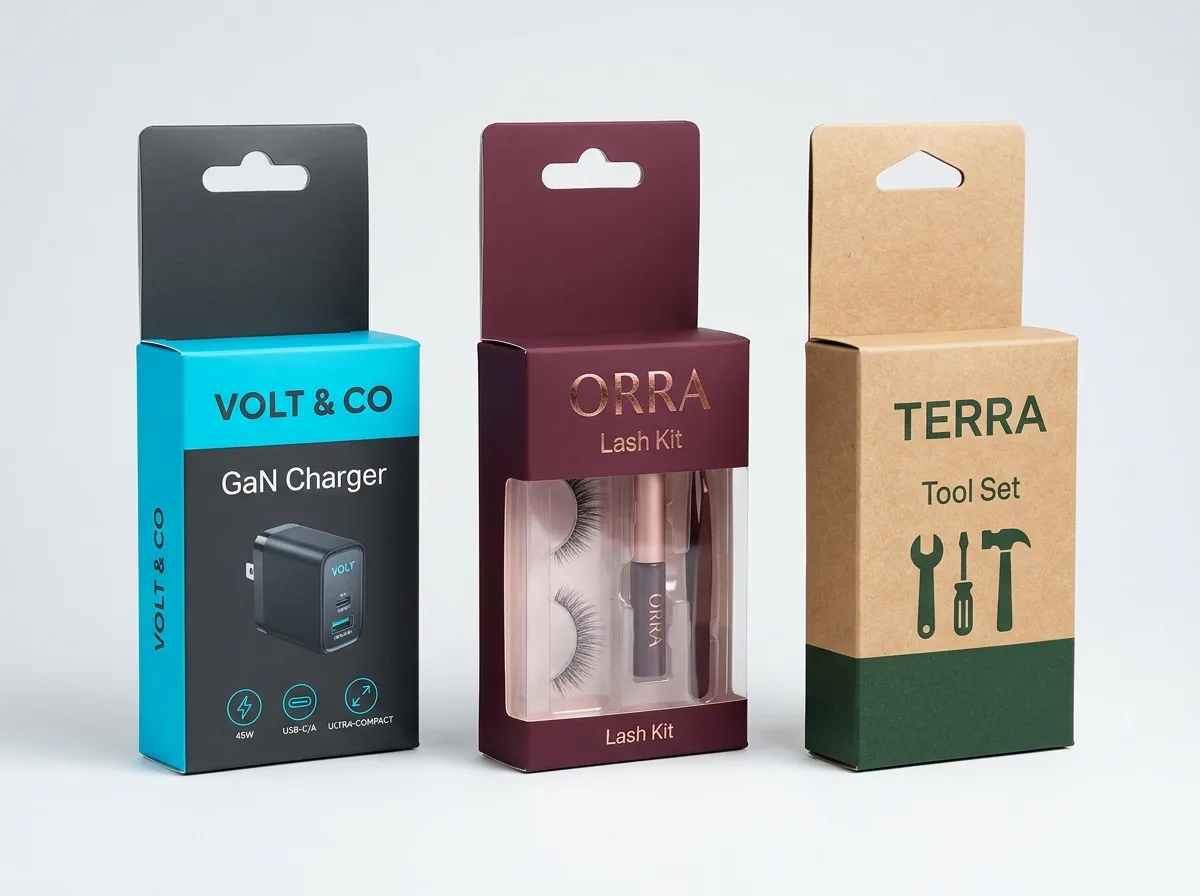
In packaging terminology, buyers sometimes use custom five-panel hanger boxes and custom header card boxes interchangeably because both feature a full-width top billboard with a peg hole. However, three structural distinctions help you pick the right specification for custom phone case boxes, custom toy boxes, and custom sock boxes: First, traditional header cards are folded 2-ply cardstock toppers stapled or heat-sealed over a flexible poly bag - an economical choice for soft textiles that need zero crush protection, whereas a five-panel hanger box provides four rigid paperboard walls that protect fragile electronics, glass bottles, or blister trays. Second, within one-piece folding cartons, a five-panel hanger architecture supports side-tuck end loading and fifth-panel front book-flap covers (where the fifth panel wraps over the front PET window with a velcro or magnetic catch), giving technical and beauty brands more structural versatility
- Choose a five-panel hanger box when you want side-tuck loading or 16–24 oz capacity: Loading from the left or right side walls keeps the top hanger fold completely uninterrupted.
- Choose an integral hang tab box when dual peg-and-shelf merchandising is required: Single-ply pop-up tabs fold 90 degrees flat over the lid when stores place the carton on a flat shelf.
- Replace poly-bagged header cards with windowed five-panel hanger cartons to pass plastic-free retail mandates: A kraft or SBS five-panel carton with an open feeler window holds socks or toys without poly bags or metal staples.
| Product & merchandising scenario | Recommended structure | Why this architecture fits |
|---|---|---|
| GaN charger, earbuds, or tool kit (8–24 oz) | Five-panel hanger box (2-ply header + side-tuck or ALB) | Maximum hook tear strength + 4-wall crush protection |
| Phone case or gaming mouse with flip-open cover | Five-panel hanger box with 5th-panel front book flap | Lets shoppers open the front cover to view the PET window |
| Lip gloss, mascara, eyeliner, or 510 cartridge (< 8 oz) | Custom hang tab box | Compact 1.0–1.5 in pop-up tab folds flat for shelf or shipper |
| Retail gift set or accessory carton needing a tall topper | Custom header card box | Dedicated 2.0–2.75 in top billboard above a top-tuck carton |
Know your size? Compare pricing across up to 3 quantities.
Request a Quote →How much fulfillment time do 1-piece five-panel hanger boxes save on your packing line?
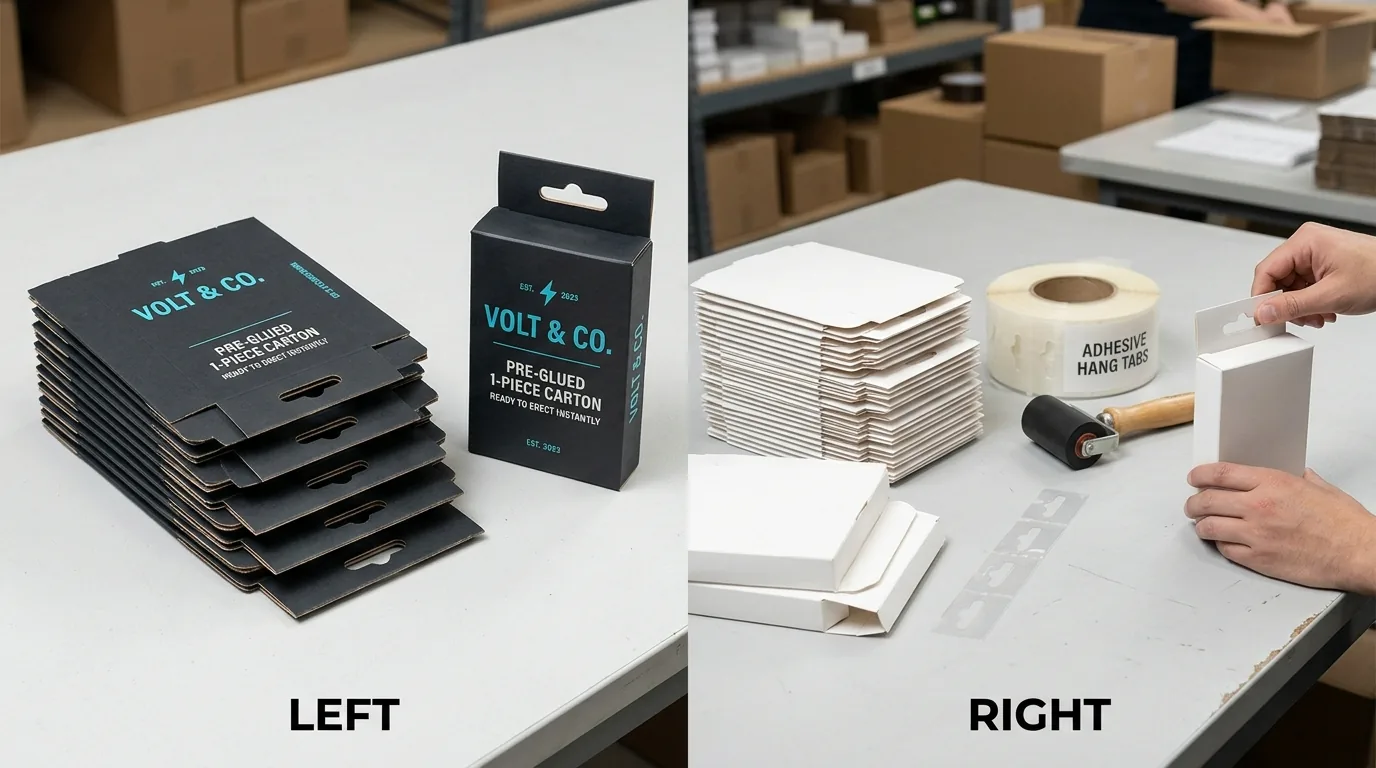
Review our companion guides on five-panel hanger box dimensions, fifth-panel height, and peg weight limits and five-panel hanger box dielines, fifth-panel folds, and side-tuck prepress setup, along with our comparison of integrated die-cut hang tab boxes vs adhesive hang tabs. Because CubitPack folds and glues both the side body seam and the 180-degree double-ply fifth panel inline on high-speed folder-gluers, your boxes arrive 100% flat and ready to erect in one motion
- 1-piece pre-glued arrival: No separate rolls of plastic hang tabs, no glue guns, and no saddle staplers are needed on your packing tables.
- 3-second pop-open erection: Packers squeeze the flat sleeve into a rectangular tube, load the product through the top, bottom, or side tuck, and close the flap.
- Perfectly centered Euro slots on every unit: Machine die-cutting guarantees the hang hole sits on the exact horizontal centerline (L / 2) within ±0.25 mm, eliminating crooked peg rows caused by hand-applied stickers.
- Request a free 2D CAD dieline and 3D proof from 1,000 units at CubitPack; our $50 physical sample kit credits in full toward your first order.
What mistakes happen when choosing between five-panel hanger boxes, hang tabs, and header cards?
Avoid peeling plastic tabs, ripped single-ply necks, and slow hand-packing lines by side-stepping these five selection mistakes
- Applying peel-and-stick plastic hang tabs onto soft-touch matte or UV-coated cartons, where low surface energy causes tabs to pop off inside warm delivery trucks.
- Using a narrow single-ply pop-up hang tab box for a 14 oz GaN charger or tool kit instead of specifying a full-width 2-ply five-panel hanger box.
- Packing fragile electronics or glass dropper bottles in poly bags with stapled header cards, which offer zero four-wall crush protection in transit.
- Ordering a top-opening five-panel hanger box for a heavy 20 oz hardware item when a horizontal side-tuck five-panel hanger would keep the top hanger crease 100% unbroken.
- Forgetting to check whether retail stores display your SKU only on peg hooks (ideal for fixed 2-ply five-panel hangers) or also stack it on flat shelves (where a fold-down hang tab may be preferred).
Packaging for this
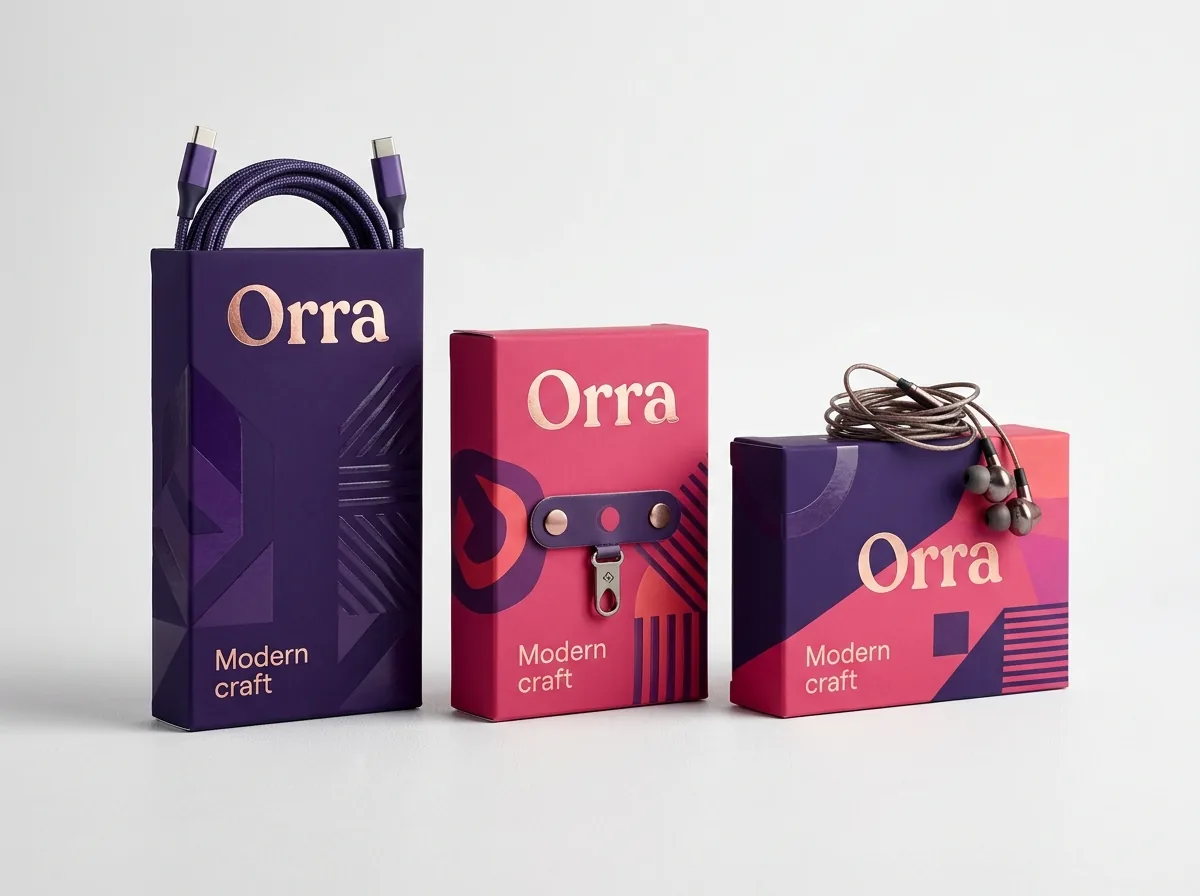
Ready to order five panel hanger boxes? Compare up to 3 quantities with a free 3D mockup.
Request a Quote →Questions about five panel hanger boxes
What is the main difference between a five-panel hanger box and a hang tab box?
A five-panel hanger box extends the entire width of the back wall upward (1.50 to 2.50 inches) and folds it 180 degrees into a glued 2-ply billboard header capable of holding 16 to 24 oz. A hang tab box raises a smaller, tapered tab (1.00 to 1.50 inches tall) in the center of the back wall for lighter items under 8 to 12 oz.
Why do stick-on plastic hang tabs fail on custom printed boxes?
Matte, soft-touch, and UV coatings reduce paperboard surface tension, and warehouse heat softens pressure-sensitive adhesive. Under constant downward gravity on a peg hook, stick-on plastic tabs slowly creep and peel off, whereas an integral paperboard fifth panel is die-cut from the carton wall itself.
Can a five-panel hanger box load from the side instead of the top?
Yes. In a side-tuck five-panel hanger carton, the top horizontal score line connecting the body to the fifth panel stays 100% unbroken, and the left and right walls open as tuck flaps so heavy cables, tools, or trays slide in horizontally.
Are five-panel hanger boxes pre-glued before shipping?
Yes. CubitPack pre-glues both the side body seam and the 180-degree fold-over fifth-panel header inline during production, shipping the cartons 100% flat so your team pops them open in seconds.
Is there an extra die charge for choosing a 2-ply five-panel hanger over a standard carton?
No. CubitPack includes custom 2D vector CAD dielines, interactive 3D digital proofs, steel-rule cutting dies, and printing plates at zero extra charge on all orders from 1,000 boxes, with free delivery across all 50 US states.
Still have a question? Ask a packaging specialist.
Request a Quote →Request your five panel hanger boxes quote
Tell us your size and quantities, and one dedicated account manager prepares pricing for each tier.
- Free design & AI-to-print studio + 3D mockup
- No die or plate charges · 4–5 day rush available
- Free shipping to all 50 states
- 10% off your first order
We compared structural load paths, peg-hook tear thresholds, billboard area, and packing-line motion times across five-panel hanger cartons, integral die-cut hang tab boxes, pressure-sensitive PET hang tabs, and stapled header cards using ECMA carton codes, PPC manuals, and TAPPI tear standards. Spot something wrong? Tell us and we fix it.
Sources
- Structural distinctions between full-width 2-ply fifth panels, tapered pop-up hang tabs, and side-tuck pegboard cartons.
- Comparative weight ratings, packing-line erection speeds, and mono-material paperboard recyclability vs plastic stick-on tabs.
- Adhesive shear failure mechanisms of pressure-sensitive plastic tabs on BOPP-laminated and coated cartons.
What changed
- November 10, 2026: First published with 4-way pegboard packaging comparison matrix, 2-ply vs stick-on tab stress analysis, and decision tree.
More guides
New packaging guides by email
Sizes, materials and design tips. Unsubscribe anytime.