
Header card boxes vs hang tab boxes and five-panel hanger cartons: which pegboard box fits your product?
Short answer: Choose custom header card boxes when you want a full-width 2.0 to 2.5 inch double-ply branding billboard above a top-loading carton for products up to 16 oz. Pick hang tab boxes for lightweight items under 10 oz where planogram height is tight, or side-loaded five-panel hanger cartons up to 24 oz.
On this page
- How do header card boxes, hang tab boxes, and five-panel hanger cartons compare across 7 retail metrics
- When should you upgrade from a die-cut or stick-on hang tab box to a full header card box
- When should you choose a top-loading header card box over a side-loading five-panel hanger
- How do you choose the right hanging carton structure in 3 steps
- Common mistakes
- FAQs
Request a custom quoteFree dieline & 3D mockup
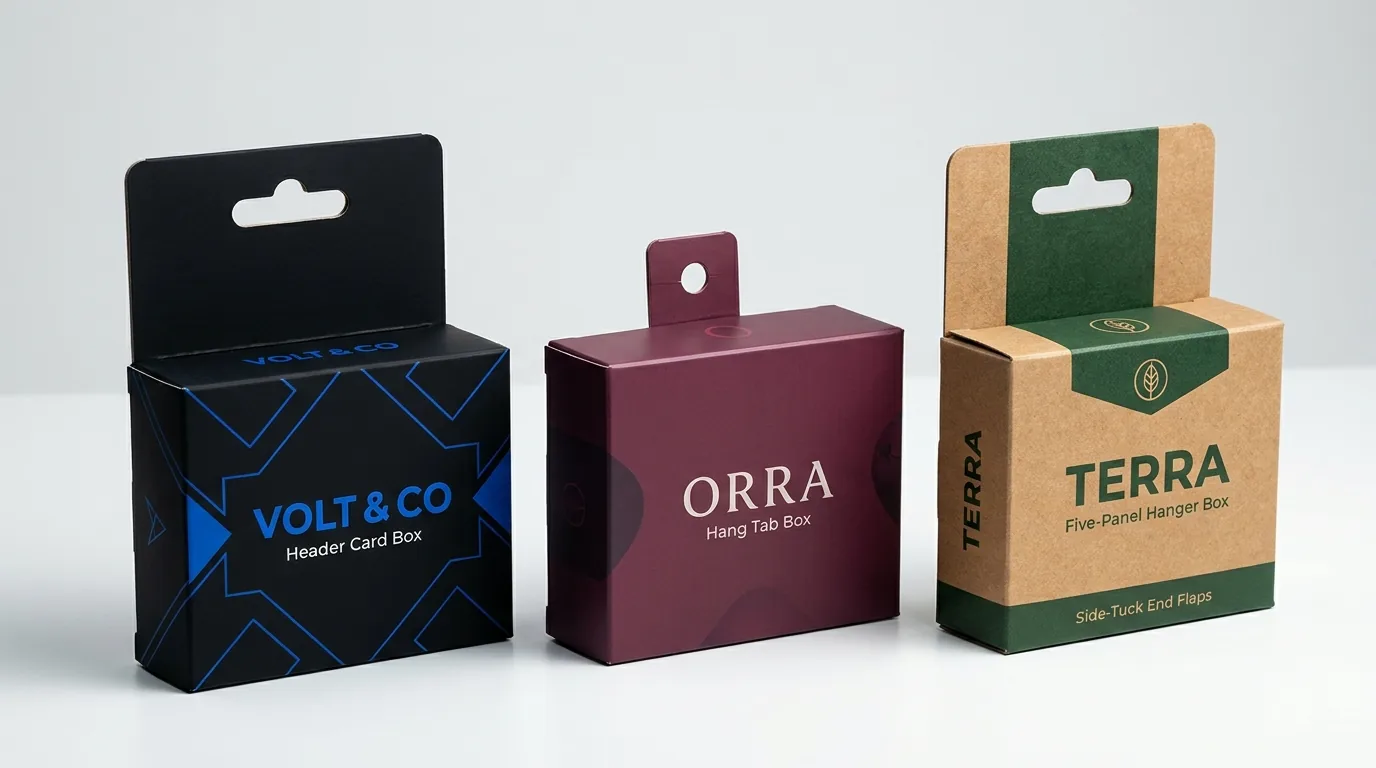
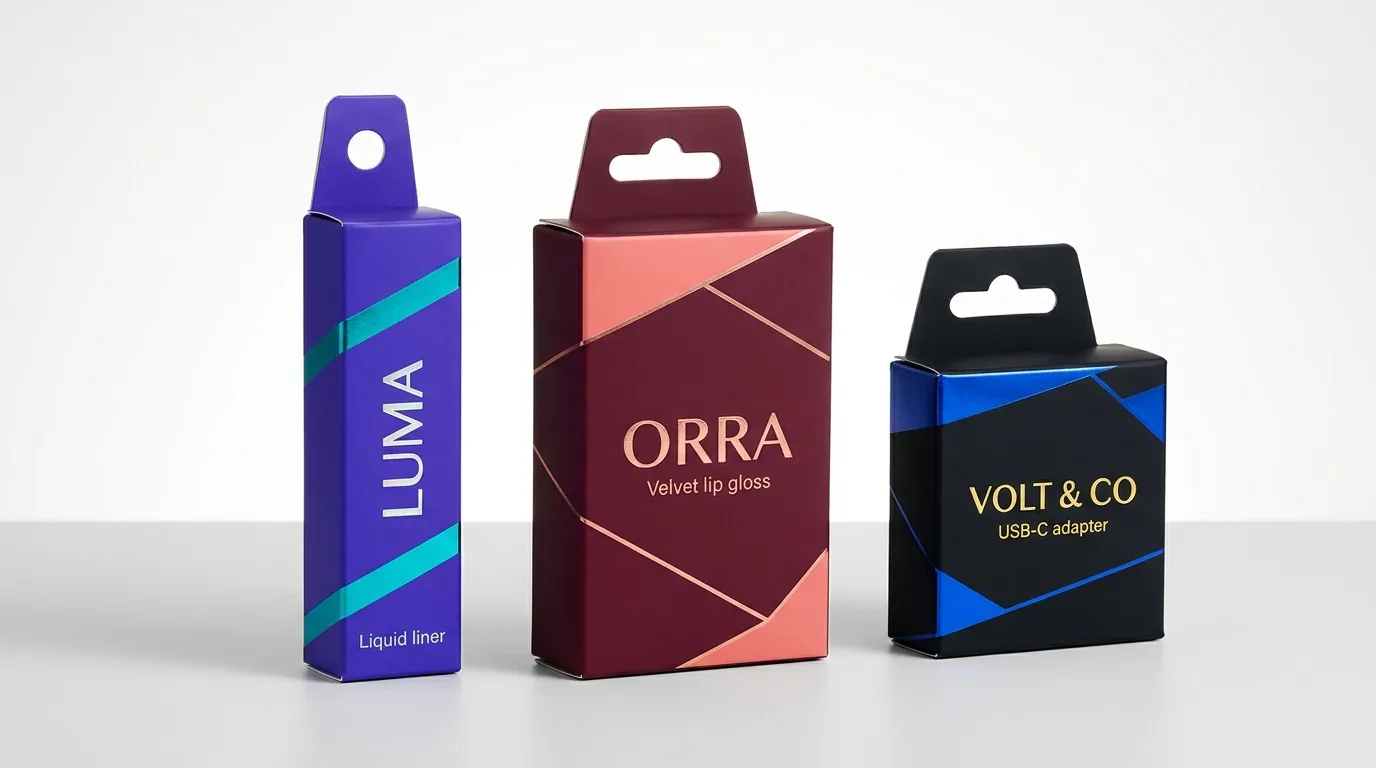
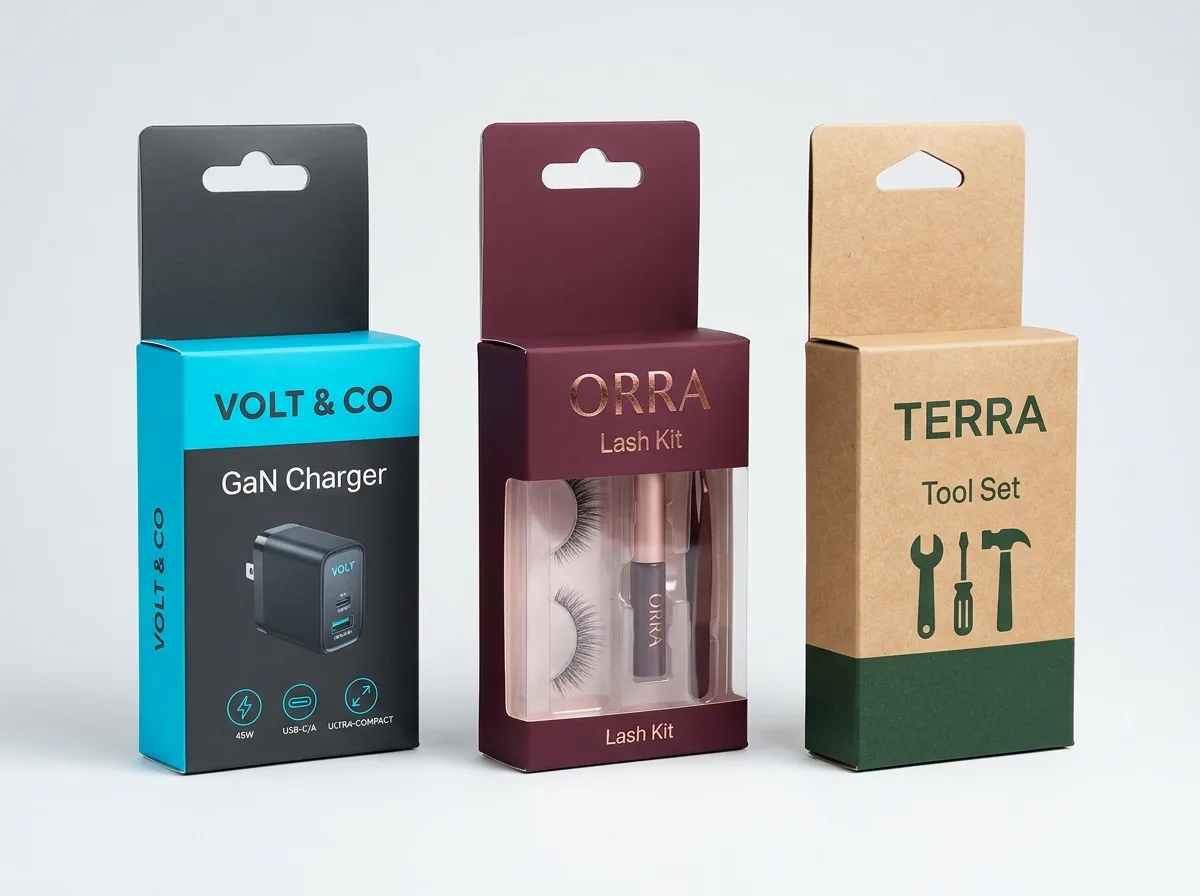
Retail brands merchandising on pegboard hooks or slatwall displays choose between three one-piece paperboard structures: custom header card boxes, custom hang tab boxes, and custom five-panel hanger boxes. Although all three eliminate clear plastic blister clamshells and hang from standard Euro sombrero or round peg holes, they differ sharply in top billboard area, tear-through strength, and how fulfillment teams load the box. A header card box folds the full width of the back panel 180 degrees over itself to form a 36 to 48 pt double-ply header billboard while preserving a fast top-loading front-hinged tuck lid. A hang tab box cuts only a narrow central tab out of a single-ply back extension, saving board area for light cosmetics under 8 to 10 oz. A five-panel hanger adds an entire fifth panel across the top seam and shifts product loading to the left and right side flaps, supporting heavy tools up to 24 oz (680 g).
How do header card boxes, hang tab boxes, and five-panel hanger cartons compare across 7 retail metrics?
At first glance on a retail pegboard, all three styles present a rectangular folding carton suspended below a hang slot. However, looking at the flat die-cut blank reveals three distinct structural approaches to how the hanging panel joins the carton body, how much branding real estate sits above the box lid, and how the package bears vertical hook stress during freight and store display. A header card carton folds the full width of the back wall 180 degrees over itself to create a rigid double-ply header while keeping a top-loading front-hinged tuck lid. A hang tab box trims away the upper corners so only a narrow central tab rises above the rear crease, minimizing sheet consumption for lightweight impulse items. A five-panel hanger rotates the carton grain and adds an entire fifth panel across the top seam, moving product loading to the left and right end flaps. Compare how pegboard header card cartons, custom hang tab boxes, and custom five-panel hanger boxes stack up across custom electronics boxes and custom cosmetic boxes
- Header card box (/custom-header-card-boxes): Best all-around choice for 2 to 16 oz consumer electronics, phone cases, cables, cosmetics, and toys needing a prominent upper brand header and top loading.
- Hang tab box (/custom-hang-tab-boxes): Best when vertical peg spacing is tightly restricted or when packing light 1 to 8 oz cosmetics and stationery at minimal board area.
- Five-panel hanger carton (/custom-five-panel-hanger-boxes): Best for heavy 16 to 24 oz hardware tools, automotive parts, or multi-piece kits that slide in horizontally through side flaps.
| Comparison factor | Header card box | Hang tab box | Five-panel hanger carton |
|---|---|---|---|
| Top billboard area | Full-width (6 to 12 sq in above lid) | None (narrow center tab only; 1.5–2.5 sq in) | Full-width (6 to 12 sq in) + optional book flap |
| Header / tab ply thickness | Double-ply glued (36 to 48 pt total) | Single-ply (18–24 pt) or stick-on PET tab | Double-ply glued (36 to 48 pt total) |
| Max safe peg hook weight | Up to 16 oz (450 g) | Up to 8–10 oz (225–285 g) | Up to 24 oz (680 g) |
| Product loading axis | Top-loading (front-hinged tuck lid) | Top-loading (front or rear tuck lid) | Side-loading (left and right end flaps) |
| Bottom floor construction | Friction tuck, 1-2-3 lock, or auto-bottom | Friction tuck, 1-2-3 lock, or auto-bottom | Continuous unbroken bottom wall |
| Manual packing speed | 9 to 12 seconds per box | 8 to 10 seconds (16s if sticking plastic tab) | 10 to 13 seconds per box |
| Curbside recyclability | 100% paperboard (when windowless) | 100% paperboard (unless PET stick-on tab) | 100% paperboard (when windowless) |
When should you upgrade from a die-cut or stick-on hang tab box to a full header card box?
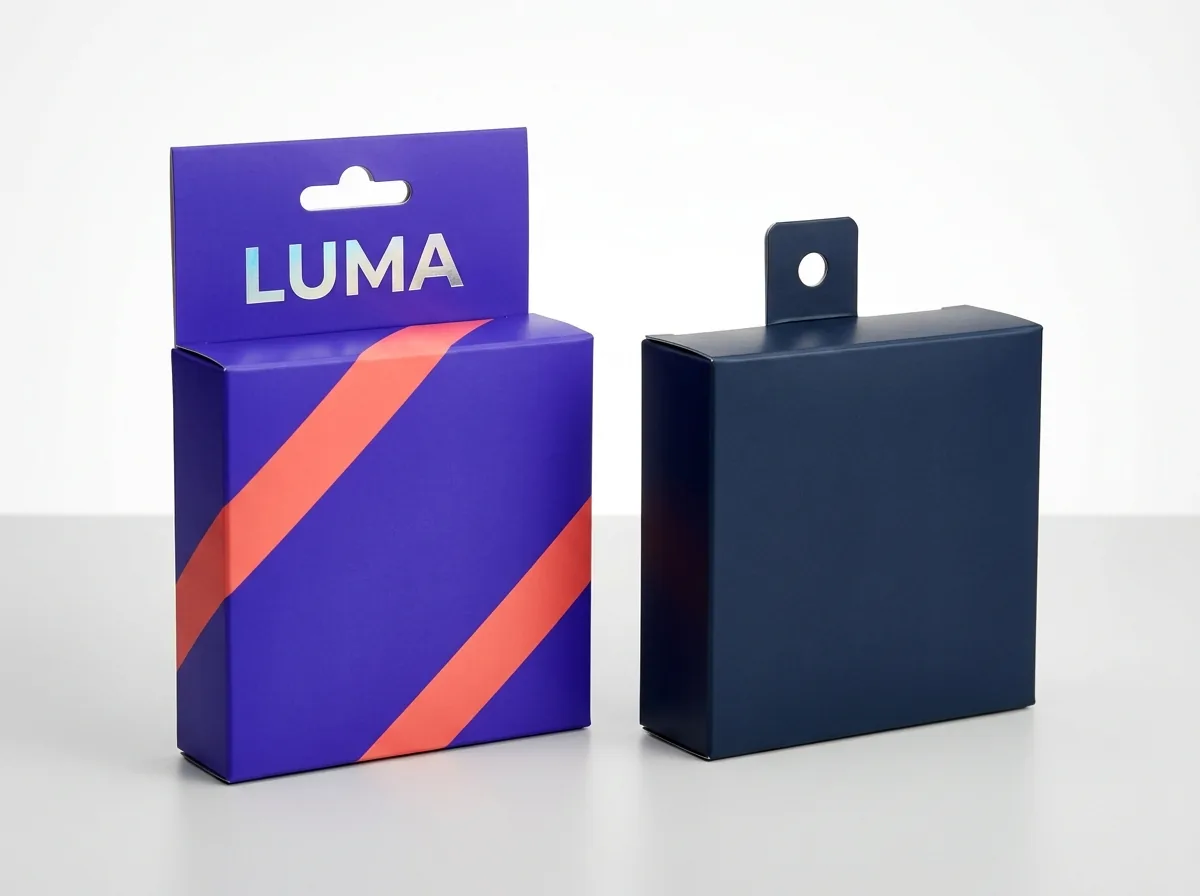
Many emerging brands launch with standard straight tuck end boxes and apply peel-and-stick clear plastic hang tabs by hand, or order a single-ply integrated hang tab carton to minimize paperboard square-inch usage on small runs. While a compact hang tab works cleanly for lightweight lip glosses, eyeliner pencils, and small stationery items under 8 oz where vertical planogram height is tightly capped, upgrading to a full-width double-ply header card box solves three frequent retail merchandising and fulfillment failures that cost brands reorders at national retail chains: When shoppers walk down a high-density pegboard aisle in a consumer electronics or pharmacy store, the upper header card acts as a miniature shelf talker that differentiates your SKU family at eye level while keeping the carton hanging straight on single-rod or double-wire hooks
- Eye-level brand billboard above the peg hook: On a crowded 6-hook pegboard row, shoppers scan the top 2 inches of each peg first. A 2.0 to 2.5 inch full-width header places your metallic foil logo, SKU color band, and wattage badge right around the peg rod.
- Zero peeling adhesive or single-ply curling: Stick-on plastic hang tabs frequently delaminate from soft-touch matte or UV-coated cartons inside warm shipping containers, dropping inventory onto the store floor. A factory-glued double-ply paperboard header bonds fiber-to-fiber and stays flat.
- Faster packing line throughput: Applying stick-on plastic hang tabs by hand adds 6 to 8 seconds of alignment labor per carton. Pre-glued double-ply header card boxes arrive already folded and bonded flat from the folder-gluer.
When should you choose a top-loading header card box over a side-loading five-panel hanger?
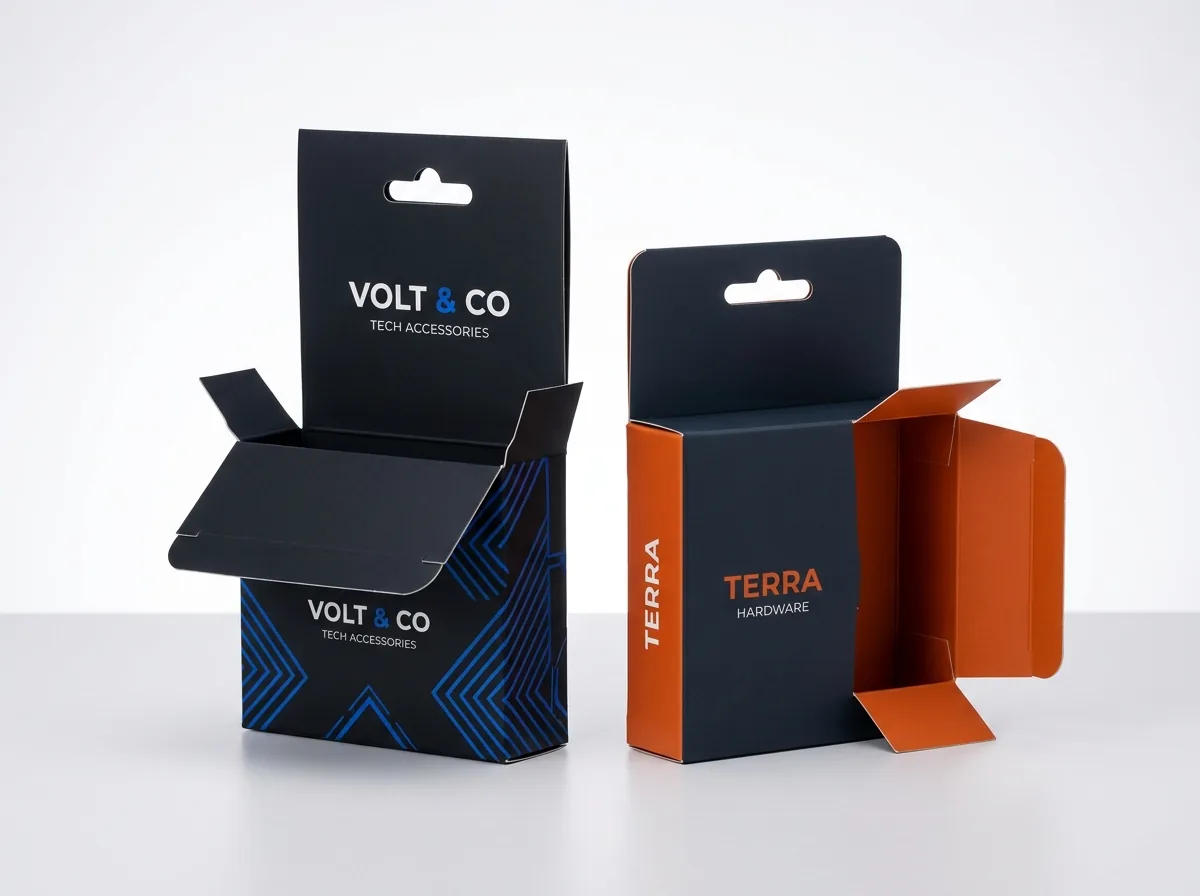
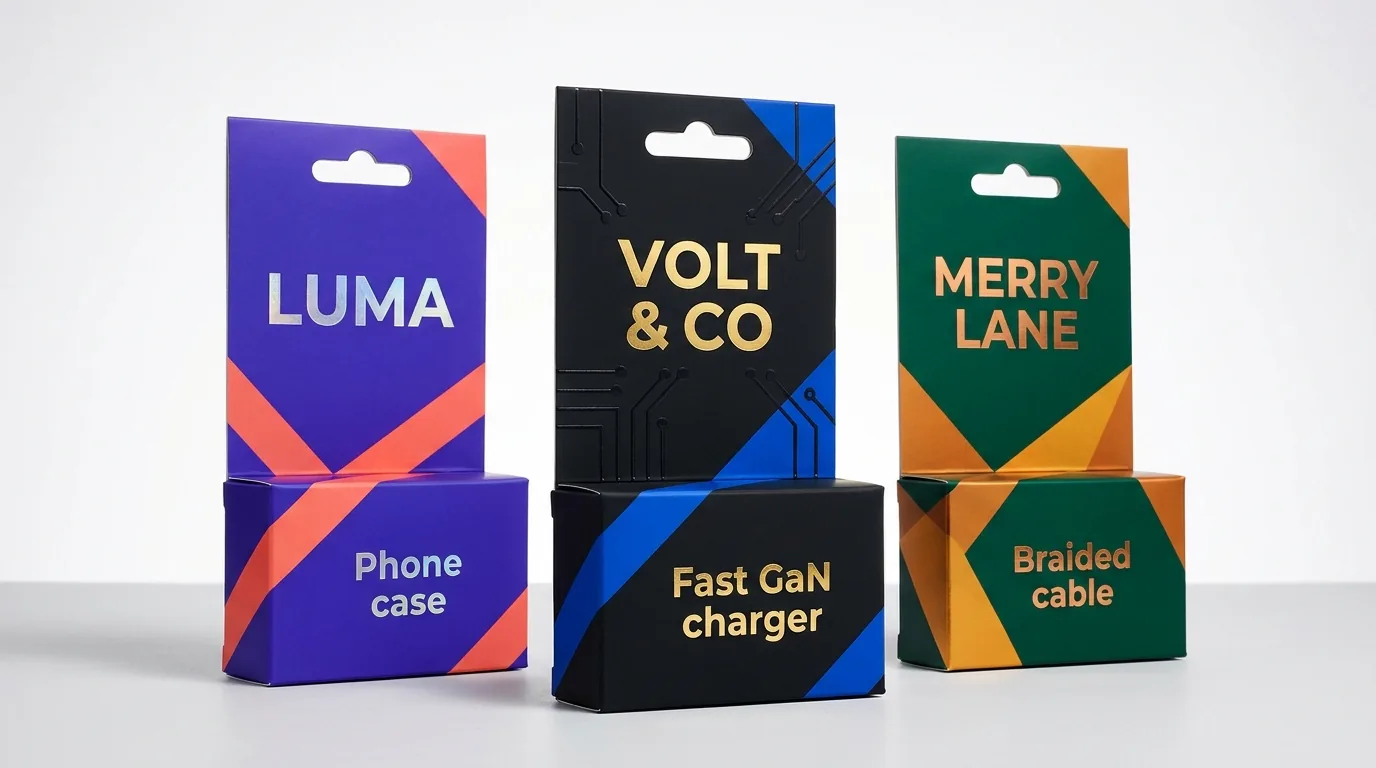
Both header card boxes and five-panel hanger cartons provide a full-width, double-ply top billboard with a die-cut Euro sombrero slot that fits single-rod and double-wire retail hooks. The structural choice between them comes down to how your product loads into the carton on your packing line and whether vertical gravity pushes directly against a bottom flap seam. Because a header card box loads vertically from the top (or bottom), operators can pop open a pre-glued crash-lock base and drop a tray-mounted charger or phone case straight down in seconds. By contrast, a five-panel hanger forms its floor from an unbroken horizontal wall and loads sideways through left and right end flaps, making it the preferred choice for dense 16 to 24 oz tools. Compare their mechanical trade-offs across custom phone case boxes and custom hardware boxes
- Choose a Header Card Box when your product or fitted tray drops vertically into the carton, or when you want a pre-glued auto-bottom for rapid hand-packing.
- Choose a Five-Panel Hanger when your product weighs 16 to 24 oz (450 to 680 g) or slides naturally sideways through a horizontal end opening.
- Both styles accept clear 0.15 mm PET window patching on the front panel to display product colors and textures.
| Structural feature | Header card box (top-loaded) | Five-panel hanger (side-loaded) | Engineering takeaway |
|---|---|---|---|
| Top closure junction | Front-hinged tuck lid locks below header | Unbroken crease from top wall into header | Header box opens from top; 5-panel stays sealed on top |
| Bottom floor support | Tuck, 1-2-3 snap-lock, or crash-lock base | Solid unscored bottom panel (end-tucked) | 5-panel floor cannot pop open under 20+ oz loads |
| Auto-bottom compatibility | Yes (pairs with pre-glued crash-lock base) | No (side flaps tuck manually or by machine) | Header box pops open faster for vertical hand-packing |
| Fifth book-flap option | Not standard (4 body panels + header) | Can extend 5th panel into hinged window cover | Use 5-panel when you need a flip-open front book cover |
Know your size? Compare pricing across up to 3 quantities.
Request a Quote →How do you choose the right hanging carton structure in 3 steps?
Combine this structural comparison with our sizing guide on header card box dimensions, billboard height, and peg weight limits and our prepress walkthrough on header card box dielines, double-ply back panels, and Euro slots, plus our retail shelf breakdown on folding cartons vs rigid boxes for retail shelves. Before locking your production tooling, run every pegboard SKU through this three-step engineering filter to verify weight capacity, billboard visibility, and hand-packing speed
- Step 1 (Filter by packaged weight): Under 8 oz works in all three styles; 8 to 16 oz requires a 20–24 pt double-ply Header Card Box with a locking bottom; 16 to 24 oz calls for a 24 pt Five-Panel Hanger.
- Step 2 (Filter by planogram billboard height): If you have 2.0 to 2.5 inches of vertical room above the box for a full-width logo block, choose a Header Card Box; if vertical clearance is under 1.5 inches, choose a Hang Tab Box.
- Step 3 (Request matched structural samples): Enter your dimensions in CubitPack's quote form (from 500 units) for a free 2D CAD dieline and 3D proof before payment.
What mistakes do brands make when choosing between header card, hang tab, and five-panel boxes?
Avoid fallen pegboard inventory and slow fulfillment lines by side-stepping these five selection errors
- Sticking adhesive plastic hang tabs onto soft-touch matte or UV-coated cartons, which peel off under warehouse heat and drop boxes off the pegboard.
- Using a single-ply paperboard hang tab box for a 12 oz electronics charger, causing the narrow tab neck to curl forward and tear on wire hooks.
- Ordering a side-loaded five-panel hanger for a fragile multi-piece kit that is much easier to drop vertically into a top-loading header card box.
- Mixing different header heights across a 4-SKU product line so the boxes hang at jagged, uneven elevations along the retail peg bar.
- Forgetting to upgrade a header card box from a friction tuck bottom to a 1-2-3 lock or auto-bottom when packaged weight exceeds 8 oz.
Packaging for this

Ready to order header card boxes? Compare up to 3 quantities with a free 3D mockup.
Request a Quote →Questions about header card boxes
What is the main difference between a header card box and a hang tab box?
A header card box extends the full width of the back panel 2.0 to 2.5 inches above the top lid and folds it 180 degrees over itself to create a thick double-ply branding billboard around the Euro slot. A hang tab box projects only a narrow single-ply center tab (or uses a stick-on plastic tab) with no upper billboard space.
When should I choose a five-panel hanger carton instead of a header card box?
Choose a five-panel hanger carton when your packaged SKU weighs between 16 oz and 24 oz (450 to 680 g) or when horizontal side-end loading is easier than top loading. Because a five-panel hanger closes on the left and right sides, its bottom panel is an unbroken wall that cannot pop open under heavy vertical loads.
Are double-ply paperboard header cards stronger than stick-on plastic hang tabs?
Yes. Adhesive plastic hang tabs frequently peel off soft-touch matte or UV-coated cartons during warm freight transit. A factory-glued double-ply paperboard header card forms a permanent 36 to 48 pt structural extension of the rear wall that holds up to 16 oz without peeling.
Can all three hanging box styles include a clear front display window?
Yes. Header card boxes, hang tab boxes, and five-panel hanger cartons can all include a die-cut front window (either open cut-out or patched with clear 0.15 mm PET film) as long as a 0.50 inch paperboard border remains around the window to preserve vertical crush strength.
Which hanging box style is fastest to assemble by hand?
A custom header card box paired with a pre-glued crash-lock auto-bottom is the fastest to pack (roughly 7 to 9 seconds per unit) because both the double-ply header card and the bottom floor pop into place automatically, leaving only the top tuck lid to close.
Still have a question? Ask a packaging specialist.
Request a Quote →Request your header card boxes quote
Tell us your size and quantities, and one dedicated account manager prepares pricing for each tier.
- Free design & AI-to-print studio + 3D mockup
- No die or plate charges · 4–5 day rush available
- Free shipping to all 50 states
- 10% off your first order
We compared billboard surface area (6–12 sq in vs 1.5–2.5 sq in), single-ply vs double-ply header tear thresholds (8–10 oz vs 16 oz vs 24 oz), and top-loading vs side-loading fulfillment speeds against Paperboard Packaging Council (PPC) structural manuals and ECMA carton classifications. Spot something wrong? Tell us and we fix it.
Sources
What changed
- November 9, 2026: First published with 7-metric comparison table covering header card boxes, hang tab boxes, and five-panel hanger cartons.
More guides
New packaging guides by email
Sizes, materials and design tips. Unsubscribe anytime.