
How do briefcase box handle slots, front flap locks, and CAD dielines work?
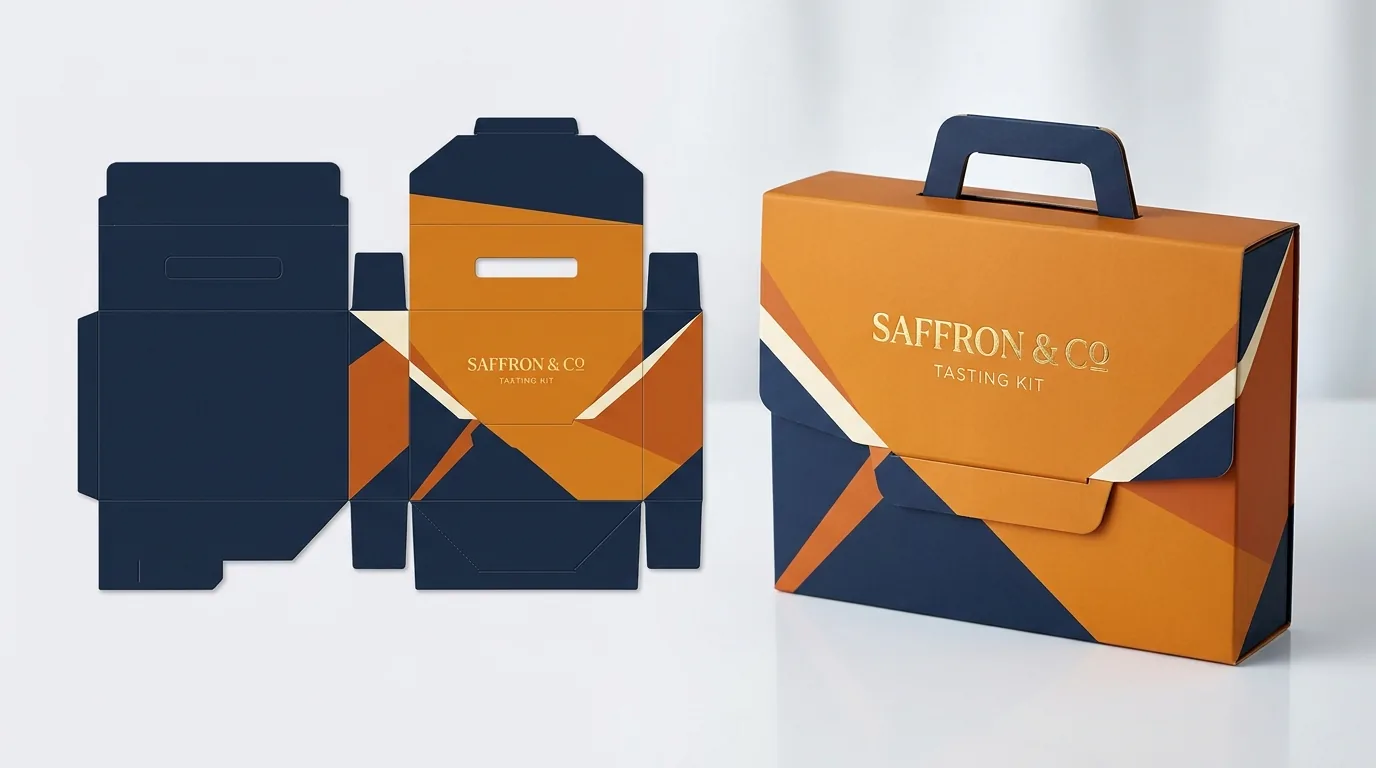
Short answer: Size the centered top-lid handle slot equal to 2x board thickness plus 1.8 mm width relief and +1.5 mm end relief so the lid drops smoothly over the standing handle. Rotate front-flap artwork 180 degrees on the flat sheet, and keep front headlines 0.375 in below the closed flap tip.
On this page
- What CAD tolerances keep the top-lid handle slot and front locking tongue smooth
- How do you orient front-flap artwork and avoid the hidden flap shadow zone
- Where do exterior lamination, foil stamping, and lower peek windows belong
- What 6 checks should you run on your free 2D CAD dieline and 3D digital proof
- Common mistakes
- FAQs
Request a custom quoteFree dieline & 3D mockup
Setting up print-ready artwork and structural steel-rule tooling for custom briefcase boxes involves two mechanical interactions you will not encounter on ordinary tuck-end cartons. First, an internal ceiling support deck folds inward off the front wall while its double-ply handle bridge stands upright, meaning the hinged outer top lid must drop cleanly over that handle through a precision pass-through aperture without scraping ink or bowing the ceiling. Second, the top lid continues across a second 90-degree crease into an attache front flap whose contoured friction-lock tongue tucks into the upper front panel, creating both an inverted artwork zone on the flat press sheet and a covered shadow band across the upper front face. Following exact CAD slot tolerances, lamination rules, and safe-zone buffers guarantees crisp five-second assembly. CubitPack supplies free custom briefcase CAD dielines and 3D proofs from 1,000 units.
What CAD tolerances keep the top-lid handle slot and front locking tongue smooth?
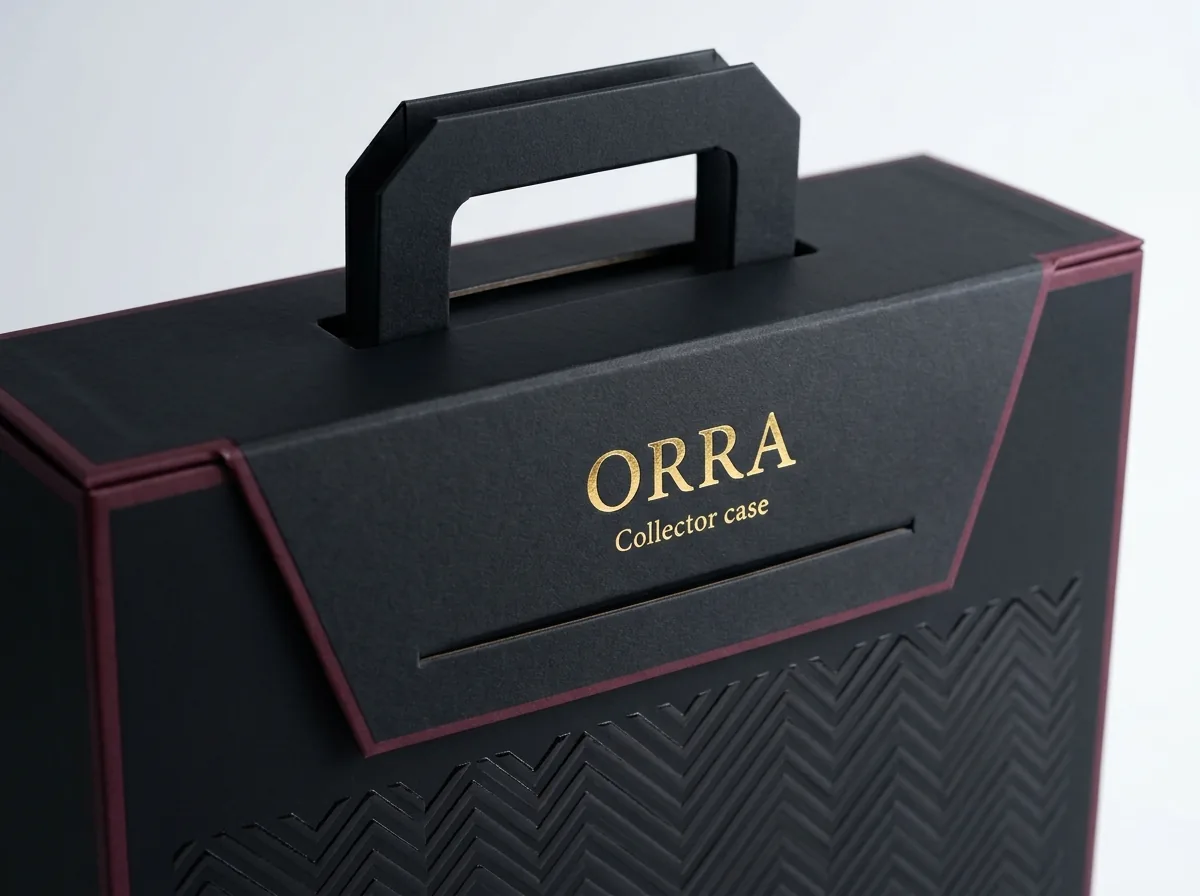
Every hardware-free custom briefcase box relies on friction and die-cut paperboard geometry rather than brass clasps, plastic handles, or hidden magnets. If the centered pass-through slot in the outer top lid is drawn line-on-line to the thickness of the folded handle bridge, packers have to pinch and wiggle every single lid shut, scuffing dark matte ink along the handle shoulders. Conversely, cutting the slot excessively wide exposes raw interior board gaps beside the handle. Use the tested steel-rule dieline clearances below across 18 pt, 24 pt laminated card, and 1.5 mm E-flute micro-corrugated
- Radius every slot corner: Specify at least a 1.5 mm corner radius at both ends of the top-lid handle aperture and curved wing-relief ticks at the ends of the front receiving cut so repeated opening never starts a tear.
- Double-score E-flute hinges: On 1.5 mm E-flute briefcases for custom meal kit boxes and custom corporate gift boxes, double parallel crease rules keep the 90-degree front flap folding crisp and square.
- Pre-glued crash-lock bottom clearance: Keep glue-free varnish masks on both the side glue lap and 45-degree auto-lock bottom tabs so factory cold-glue bonds fiber-to-fiber.
| Structural dieline element | 18 pt card (0.45 mm) | 24 pt laminated (0.61 mm) | 1.5 mm E-flute corrugated | Mechanical purpose |
|---|---|---|---|---|
| Folded double-ply handle bridge | 0.90 mm thick | 1.22 mm thick | 3.00 mm thick | Doubles tensile tear strength at finger grip |
| Top-lid slot width (front-to-back) | 2.6 to 2.8 mm | 3.0 to 3.2 mm | 4.8 to 5.2 mm | 2x caliper + 1.8 mm relief for zero-scuff drop |
| Top-lid slot length relief | +1.5 mm per end | +1.5 mm per end | +2.0 mm per end | Clears handle base radii as lid swings down |
| Front friction-lock tongue depth | 0.625 in (16 mm) | 0.750 in (19 mm) | 0.875 in (22 mm) | Winged shoulder ears hold flap shut without tape |
| Receiving slot to window bridge | Min 0.50 in (12.7 mm) | Min 0.50 in (12.7 mm) | Min 0.625 in (16 mm) | Prevents front wall tear above peek window |
How do you orient front-flap artwork and avoid the hidden flap shadow zone?
When your graphic designer opens an unfolded briefcase dieline in Adobe Illustrator, the four vertical body walls (Left, Front, Right, Back) sit side by side reading upright from bottom to top. Because the outer top lid hinges upward off the Back wall and the front fold-over briefcase flap extends even higher above that top lid, folding the lid 90 degrees over the ceiling and folding the flap another 90 degrees down the Front face flips the flap 180 degrees in space. Simultaneously, that closed flap covers the upper 2.5 to 3.5 inches of the Front body wall
- Rotate front-flap graphics 180 degrees on the flat sheet: Monograms, foil crests, and taglines placed on the front fold-over flap appear upside down on the flat 2D template so they land right-side up once folded shut.
- Respect the 0.375-inch shadow buffer: CubitPack marks a dashed cyan Flap Shadow Line across the Front body wall on your CAD dieline; keep main kit titles, subtitles, and icons at least 0.375 inches below that line.
- Turn the hidden upper front strip into a reveal moment: Print a welcome note, game prompt, or onboarding QR code inside the covered upper front band so recipients discover it the second they unlatch the tongue.
- Wrap background color continuously: Flood background colors and geometric patterns unbroken across the Back wall, Top lid, Front flap, and Front body wall plus 0.125 inches of outer bleed so zero white paper slivers peek out along folded score edges.
Where do exterior lamination, foil stamping, and lower peek windows belong?
Because a briefcase top lid and front flap bend across two full 90-degree score lines every time someone opens custom toy boxes, custom party favor boxes, or custom gift basket boxes, surface finishing directly protects structural longevity alongside visual shelf impact. Heavy dark CMYK or Pantone flood inks in midnight navy, obsidian black, burgundy, or forest emerald look dramatic on attache panels when paired with the prepress safeguards below
- Specify BOPP film lamination over dark double hinges: Matte, gloss, or velvety soft-touch film lamination bridges across the top-lid and front-flap score lines so paper fibers never crack white after repeated openings.
- Keep metallic foil 0.1875 in clear of fold creases: Stamp 24k gold, copper, rose-gold, or holographic foil emblems cleanly inside the flat face of the front fold-over flap rather than wrapping foil directly over the 90-degree hinge.
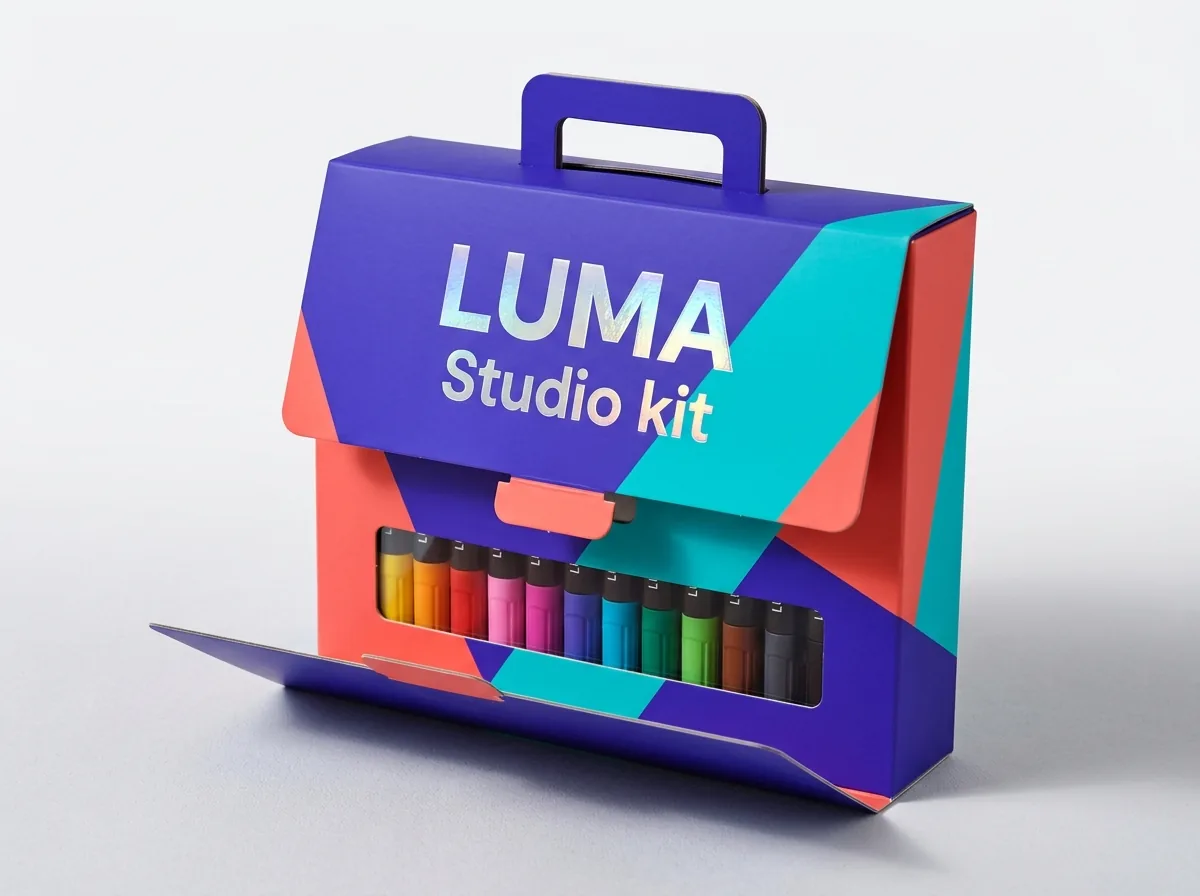
- Position lower front windows 0.50 in below the lock slot: Leaving a solid half-inch paperboard bridge between the horizontal tongue slot and the top edge of a clear film window keeps the front face taut when pushing the tongue home.
- Keep fine text 0.125 in away from the handle aperture: Allow standard die-cutting registration breathing room around the centered top-lid slot and oval finger grip.
Know your size? Compare pricing across up to 3 quantities.
Request a Quote →What 6 checks should you run on your free 2D CAD dieline and 3D digital proof?
Combine this prepress walkthrough with our dimension guide on briefcase box sizes, handle loads, and flat-top clearance and our style comparison on custom briefcase boxes vs gable boxes and two-piece cartons. Before we put 1,000 or more cartons on press for custom birthday boxes, custom food boxes, or custom christmas boxes, our prepress specialists inspect every vector path, glue-free mask, and crease-to-window bridge, and you can run through this quick six-point proof review with your design team
- 1. Separate vector dieline layer: Keep steel-rule cut, crease, and shadow-guide lines on a locked non-printing spot-color layer above your CMYK/Pantone artwork.
- 2. Verify front-flap orientation on the 3D proof: Spin CubitPack's interactive 3D digital proof to confirm the front flap logo reads upright when closed and aligns cleanly with the lower front panel.
- 3. Check lower front headline visibility: Confirm zero letters of your product title tuck underneath the beveled or straight tip of the closed front flap.
- 4. Confirm UPC barcode placement: Place retail barcodes on the flat outer bottom panel with black bars on a crisp white box clear of the 45-degree auto-lock fold seam.
- 5. Outline fonts and embed 300 DPI links: Convert all typography to vector outlines and supply metallic foil or Spot UV masks as 100% K vector layers.
- 6. Order a physical check when needed: Request your free 2D CAD dieline and 3D proof in our quote form, and use our $50 sample kit (credited to your first order) to feel board calipers and finishes in hand.
What dieline and artwork mistakes ruin briefcase box print runs?
Catch these five prepress traps on your 3D proof before releasing files to production
- Placing the front-flap brand logo upright on the flat template so it lands completely upside down when the flap folds down over the front wall.
- Centering the main product title vertically on the Front panel without checking the Flap Shadow Line, hiding the top half of the headline under the closed flap.
- Drawing a zero-clearance top-lid handle slot that binds against a 24 pt laminated double-ply handle bridge during packing.
- Placing a clear display window 0.125 inches below the front tongue receiving slot so the narrow paperboard strip buckles when tucking the flap.
- Flooding dark unlaminated ink across the double-hinged top lid and front flap without exterior matte, gloss, or soft-touch film protection.
Packaging for this

Ready to order briefcase boxes? Compare up to 3 quantities with a free 3D mockup.
Request a Quote →Questions about briefcase boxes
Where can I get an exact vector CAD dieline for a custom briefcase box?
Submit your desired interior Length × Width × Height and product weight in CubitPack's quote form (from 1,000 units). Our structural team generates a custom 2D vector PDF/AI dieline complete with handle slot tolerances and the front-flap shadow line free before payment.
Why does my front-flap logo look upside down on the flat briefcase dieline?
Because the top lid hinges upward off the Back panel and then folds 90 degrees over the top and another 90 degrees down the Front face, those two folds invert the panel 180 degrees. Rotating flap artwork 180 degrees on the flat sheet makes it stand upright when closed.
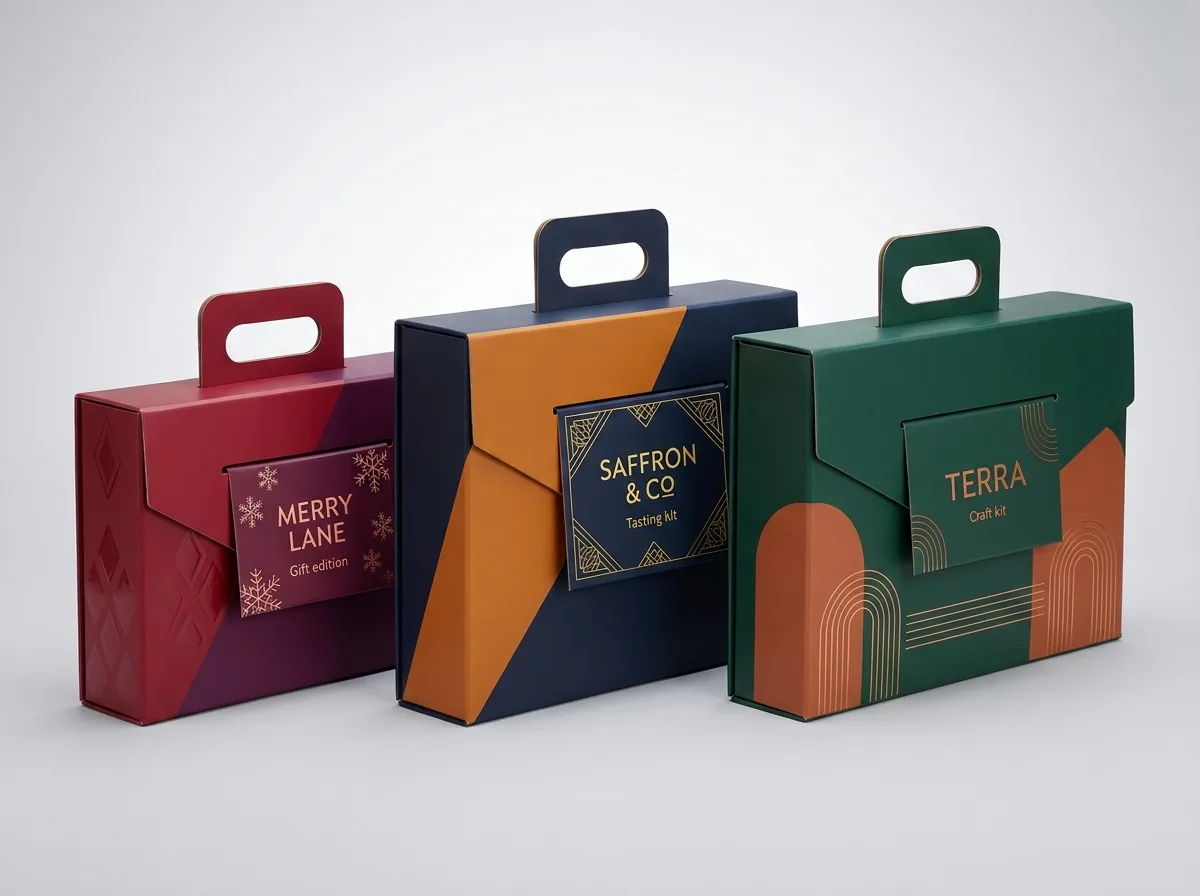
Can the front fold-over briefcase flap have a custom tapered, curved, or envelope shape?
Yes. Tapered trapezoid flaps, rounded attache corners, and stepped geometric flap silhouettes are cut by the same steel-rule die with zero extra tooling fees starting at 1,000 boxes.
Does the friction-lock paperboard tongue stay closed when carrying 3 to 4 pounds?
Yes. First, carry weight hangs primarily from the internal ceiling handle deck rather than pulling on the front flap; second, contoured winged shoulders on the locking tongue catch behind curved relief cuts on the front receiving slot for a snug hold.
Can I print inside a custom briefcase box so the interior shows color when lifted open?
Yes. Two-sided CMYK or Pantone printing floods the interior walls, inner ceiling handle deck, and underside of the front flap with color or patterns for an unmistakable tabletop reveal.
Still have a question? Ask a packaging specialist.
Request a Quote →Request your briefcase boxes quote
Tell us your size and quantities, and one dedicated account manager prepares pricing for each tier.
- Free design & AI-to-print studio + 3D mockup
- No die or plate charges · 4–5 day rush available
- Free shipping to all 50 states
- 10% off your first order
We verified top-lid handle pass-through slot clearances, winged friction-lock tongue depths, double-hinge score lamination rules, and front-flap shadow zone geometry against ECMA Folding Carton Design Codes, Paperboard Packaging Council (PPC) structural design manuals, and TAPPI score-line lamination standards. Spot something wrong? Tell us and we fix it.
Sources
- Slotted top-lid pass-through apertures, internal handle ceiling decks, and winged friction-lock front flap tongues.
- 2x caliper + 1.8 mm slot width clearances, 180-degree front-flap artwork rotation, and window-to-slot bridge minimums.
- Exterior BOPP film lamination across double-hinged 90-degree score lines to prevent ink cracking.
What changed
- November 6, 2026: First published with caliper-by-caliper handle slot tolerance table, 180-degree flap orientation map, and 6-point prepress checklist.
More guides
New packaging guides by email
Sizes, materials and design tips. Unsubscribe anytime.