
How do I design custom chocolate boxes that protect aroma and shine?
Short answer: Design custom chocolate boxes using neutral-odor virgin white card or kraft board, food-safe cocoa-butter grease barriers on request, and soft-touch lamination on dark exterior colors to prevent fingerprint smudges. Print your bonbon tasting guide inside the lid and group bar flavors on one dieline.
On this page
- Why do cocoa butter and single-origin aromatics need virgin board and barriers
- Which finishes prevent fingerprint smudges and elevate dark chocolate branding
- How do you lay out an inside-lid bonbon menu and FDA chocolate labeling
- What drives custom chocolate box cost and how do multi-SKU bar runs work
- How do you turn botanical cacao artwork or AI concepts into press-ready files
- Common mistakes
- FAQs
Request a custom quoteFree dieline & 3D mockup
Tempered chocolate is one of the most delicate foods you can package: its high cocoa butter content readily absorbs surrounding paper and ink odors, leaves translucent lipid stains on uncoated board above 70°F, and loses its glossy snap if exposed to light, humidity, or warm case lights. Designing high-performing chocolate packaging starts from the inside out: selecting neutral-odor virgin paperboard (and food-safe grease barriers plus low-migration inks on request when unwrapped confections touch the box), adding exterior soft-touch or matte lamination so dark espresso and navy boxes never show customer fingerprints, and laying out an illustrated flavor map inside the lid. At CubitPack, our prepress team sets up your custom dieline, foil layers, digital proof, and 3D mockup for free on orders starting at 1,000 folding cartons (or 50 rigid boxes), with zero die or plate charges and free shipping to all 50 states.
Why do cocoa butter and single-origin aromatics need virgin board and barriers?
Cocoa butter is a lipophilic (fat-loving) crystal network that acts like a sponge for volatile aromatic compounds in the air around it. If you pack unwrapped ganache truffles, chocolate bark, or lightly wrapped pralines inside a carton made from post-consumer recycled newspaper fibers or printed with high-solvent inks, the chocolate will pick up a flat, cardboardy off-note within days. To preserve delicate roasted cacao,floral, and fruit tasting notes, always specify virgin bleached white paperboard or virgin unbleached kraft board for custom printed chocolate boxes that hold unwrapped confections. When bonbons, clusters, or paper candy cups touch the inside of the box or cell dividers directly, request food-safe materials, cocoa-butter grease barriers, and low-migration inks on your quote. We produce direct-contact food orders in certified partner facilities so cocoa butter never wicks into the paperboard or leaves grease rings on the bottom of your gift box.
- Choose virgin white card or virgin kraft for unwrapped truffles so cacao aromatics stay clean and true.
- Reserve recycled paperboard for secondary outer bar cartons where the tablet is hermetically sealed inside foil.
- Request food-safe cocoa-butter barriers and low-migration inks when confections touch the board or dividers.
- Avoid large unshaded windows on bean-to-bar tablets, as direct UV store light accelerates cocoa butter oxidation.
Which finishes prevent fingerprint smudges and elevate dark chocolate branding?
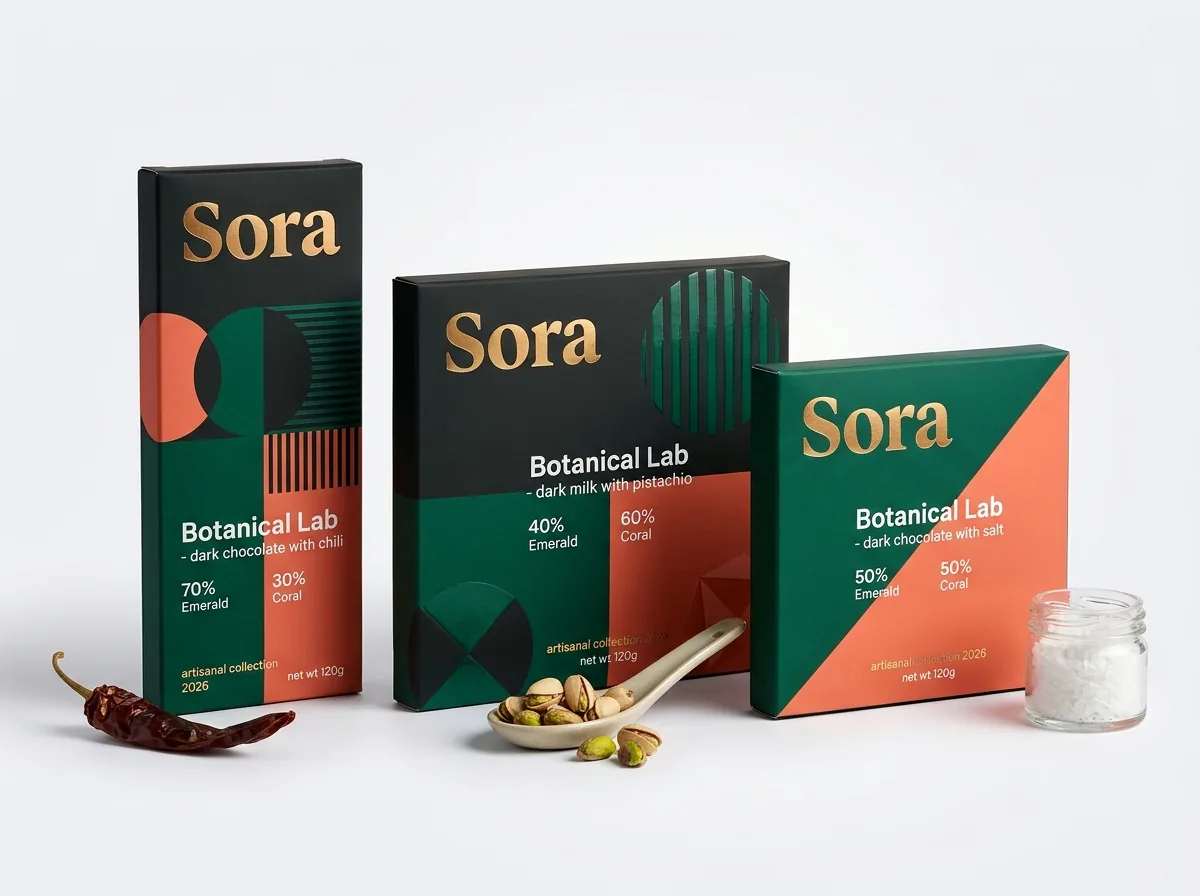
Chocolatiers love deep, saturated color palettes: dark roast espresso, midnight blue, burgundy wine, forest green, and matte black. However, heavy dark ink coverage on unlaminated paperboard is prone to two problems at the retail counter: white scuff marks along the fold scores and shiny fingerprint smudges from warm hands. Applying soft-touch lamination or matte lamination over the exterior of the carton solves both issues at once. Soft-touch film reinforces the paper fibers along 90-degree corner folds so dark ink never cracks, and its velvety matte texture resists skin oils when shoppers pick up a bar to read the tasting notes. Over that matte base, you can add foil stamping in gold, copper, or bronze for cacao percentages, or spot UV to trace a glossy cacao pod silhouette across the lid.
What drives custom chocolate box cost and how do multi-SKU bar runs work?
Craft chocolate makers rarely sell just one bar: a typical lineup includes 6 to 10 origins and inclusion flavors (such as 70% Madagascar, 80% Ecuador, Oat Milk Chai, and Dark Almond Sea Salt). If you designed a slightly different carton size for each bar, you would face separate setup runs for every flavor. By standardizing your entire bar collection on one universal envelope dieline (such as 3.125 × 0.45 × 6.25 inches), we can gang multiple flavor artworks together in one combined order. Use the cost comparison table below to see how structural, divider, and finishing choices influence your per-box price at CubitPack. Remember that every order includes free custom dielines, no die or plate charges, and free delivery across all 50 states.
| Packaging element | Cost-saving approach | Luxury boutique upgrade |
|---|---|---|
| Box construction | Flat-shipped folding two-piece carton or bar envelope | Pre-assembled wrapped rigid box with magnetic flap |
| Truffle insert | Standard 4-, 9-, or 16-cell interlocking card grid | Gold-foiled multi-tier partition or custom cavity tray |
| Flavor guide | Printed directly on the inside of the lid (1 piece) | Separate multi-page saddle-stitched tasting booklet |
| Multi-flavor bar runs | Share one universal bar dieline across all 6+ flavors | Different custom window cutouts on every flavor SKU |
| Foil & embossing | Single-pass gold or copper foil on the front logo | Multi-color foil + sculpted 3D embossing + ribbon bow |
How do you turn botanical cacao artwork or AI concepts into press-ready files?
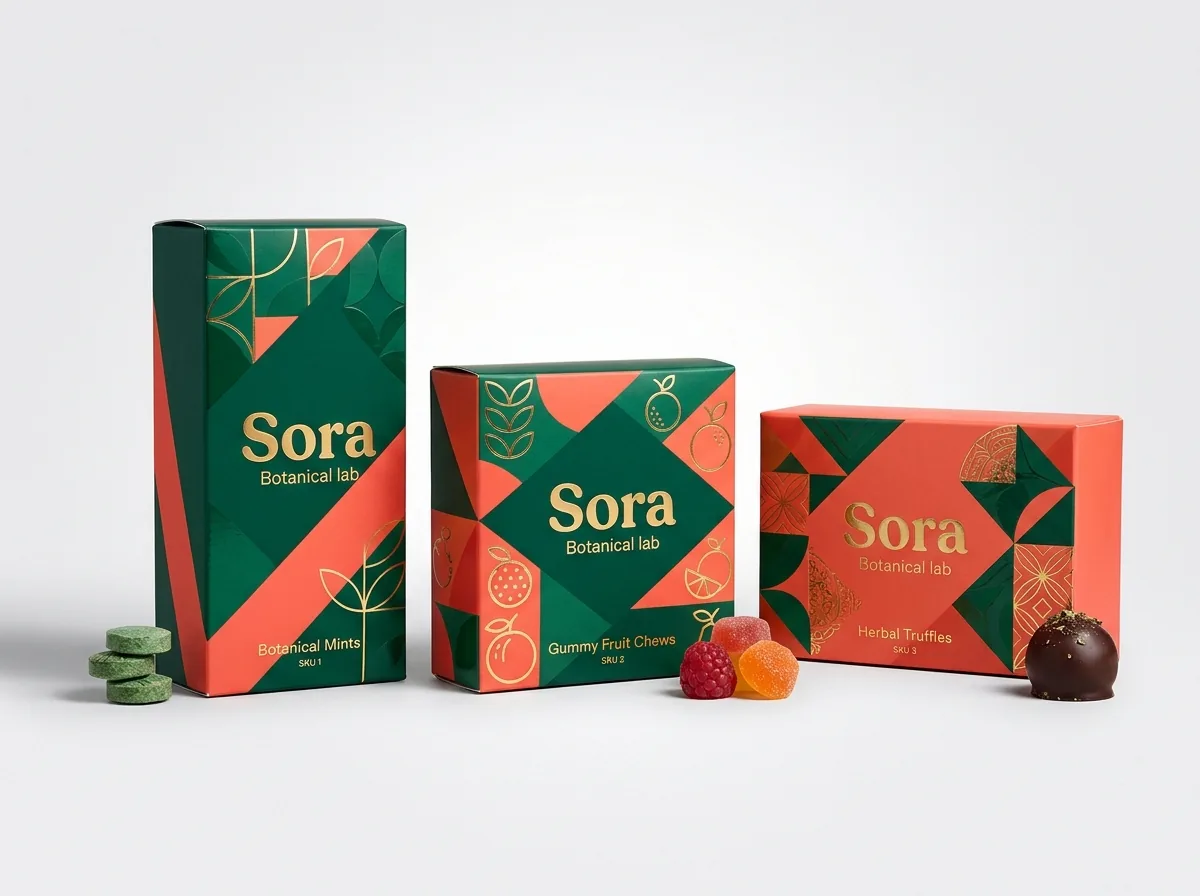
Bean-to-bar envelopes and luxury bonbon lids often feature intricate botanical cacao illustrations, vintage map engravings, or geometric Art Deco patterns. Whether you have a finished Adobe Illustrator file or a concept generated in an AI image tool, our print your AI design and free design help teams prepare your press-ready dieline at no cost. We convert low-resolution raster badges into crisp vector paths, set up dedicated spot-color layers for gold foil stamping and embossing dies, add 1/8 inch of full bleed past all cut lines, and leave an unvarnished glue zone on seal-end bar flaps so your boxes bond securely on the packing line. Before you pay a cent, you inspect a 2D digital proof and rotate an interactive 3D mockup of your box to check every panel, fold score, and inside-lid menu.
- Extend background colors and patterns 1/8 inch (0.125 in) outside all solid cut lines for full bleed.
- Keep cacao percentages, origin text, and barcodes at least 1/8 inch inside dashed fold score lines.
- Supply metallic foil stamping and embossing artwork as solid 100% vector spot layers.
- Keep glue flaps free of ink, varnish, and lamination so hot-melt or cold glue bonds cleanly.
What are the most common chocolate box design and prepress mistakes?
Protecting delicate cacao flavor and shelf appearance requires attention to board odor, ink coverage, and glue zones. Check these five mistakes before approving your proof
- Using pungent post-consumer recycled paperboard in direct contact with unwrapped truffles, which transfers paper odor to cocoa butter.
- Printing dark espresso or black chocolate boxes without matte or soft-touch lamination, leaving fold edges prone to white cracking and finger smudges.
- Placing a large clear window on a bean-to-bar chocolate carton where intense retail spotlights can cause fat bloom on the bar.
- Printing the inside-lid bonbon flavor map upside down relative to how the customer sets the lid down next to the base tray.
- Running gloss lamination or UV coating across the glue flap of a chocolate bar envelope, which prevents glue from bonding.
Find your size
Suggested inside size: 3.25 × 3.25 × 1.25 in
A starting point. Your account manager confirms the size with you before the proof.
Quote this size →Packaging for this
Ready to order chocolate boxes? Compare up to 3 quantities with a free 3D mockup.
Request a Quote →Questions about chocolate boxes
Can I print multiple chocolate bar flavors in a single 1,000-box order?
Yes. When all of your chocolate bar flavors use the exact same dieline dimensions, you can select 2 designs or 3+ designs on our quote form to split your order across multiple origins and flavor artworks while getting combined volume pricing.
How do I make sure my inside-lid bonbon flavor guide is oriented right?
Our prepress team orients the inside-lid artwork so that when a customer lifts the cover off the box, flips it over, and lays it flat beside the base tray, the top row of the printed diagram matches the top row of truffles.
Can I print on the inside of a bean-to-bar chocolate envelope?
Yes. Two-sided printing lets you print your brand story, cacao harvest metrics, and tasting notes across the entire interior of a straight tuck end bar envelope. Customers love unfolding the carton like a letter after unwrapping the foil.
Do you offer food-safe grease barriers for unwrapped chocolate bark and clusters?
Yes. When unwrapped chocolate bark, nut clusters, or truffles touch the paperboard directly, request food-safe materials on your quote. We produce direct-contact orders in certified partner facilities with grease-resistant liners.
What is the best finish for gold foil stamping on a chocolate box?
Soft-touch lamination or smooth matte lamination creates the highest visual contrast for metallic gold, copper, or rose-gold foil stamping. The non-reflective matte background makes the mirror-bright metallic foil stand out under boutique lighting.
Will I receive a digital proof and 3D mockup before paying?
Yes. Every order includes a free 2D digital dieline proof and an interactive 3D mockup showing outside graphics, inside-lid menus, and foil layers before you pay. You can also order our $50 sample kit (credited to your order).
Still have a question? Ask a packaging specialist.
Request a Quote →Request your chocolate boxes quote
Tell us your size and quantities, and one dedicated account manager prepares pricing for each tier.
- Free design & AI-to-print studio + 3D mockup
- No die or plate charges · 4–5 day rush available
- Free shipping to all 50 states
- 10% off your first order
This chocolate packaging design guide synthesizes virgin paperboard odor standards, cocoa-butter barrier guidelines, FDA 21 CFR 101 labeling rules, and CubitPack prepress workflows. A packaging specialist reviewed every section. Spot an error? Tell us and we will fix it.
Sources
What changed
- October 22, 2026: First published.
- October 22, 2026: Updated specifications, terminology, and verified source links.
More guides
New packaging guides by email
Sizes, materials and design tips. Unsubscribe anytime.