
How Do Straight Tuck, Reverse Tuck, and Auto-Lock Bottom Cartons Compare?
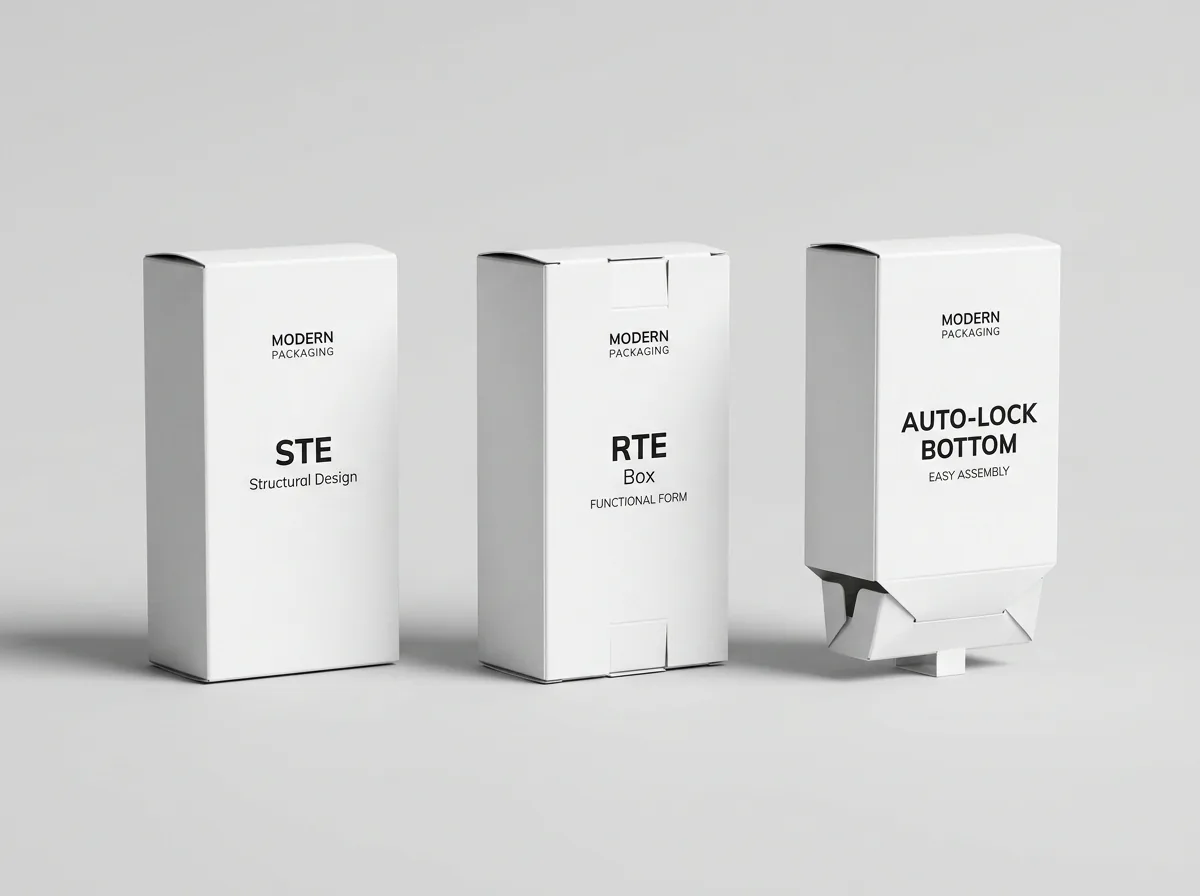
Short answer: Straight tuck end cartons fold both flaps toward the rear for an elegant retail front face; reverse tuck end cartons fold flaps in opposite directions to maximize sheet yield; auto-lock bottom cartons snap closed automatically to support heavy jars up to three pounds.
On this page
- How does straight tuck end (STE) carton construction work
- Why is reverse tuck end (RTE) preferred for sheet nesting efficiency
- When is a pre-glued auto-lock crash bottom essential
- How do dust flaps and friction locks prevent carton pop-open
- What automated cartoning machine tolerances apply to each closure
- How do you choose between manual hand filling and machine cartoning
- How do friction locks and slit locks maintain closure tension
- What are the secondary closure alternatives like seal end and sleeves
- Common mistakes
- FAQs
Request a custom quoteFree dieline & 3D mockup
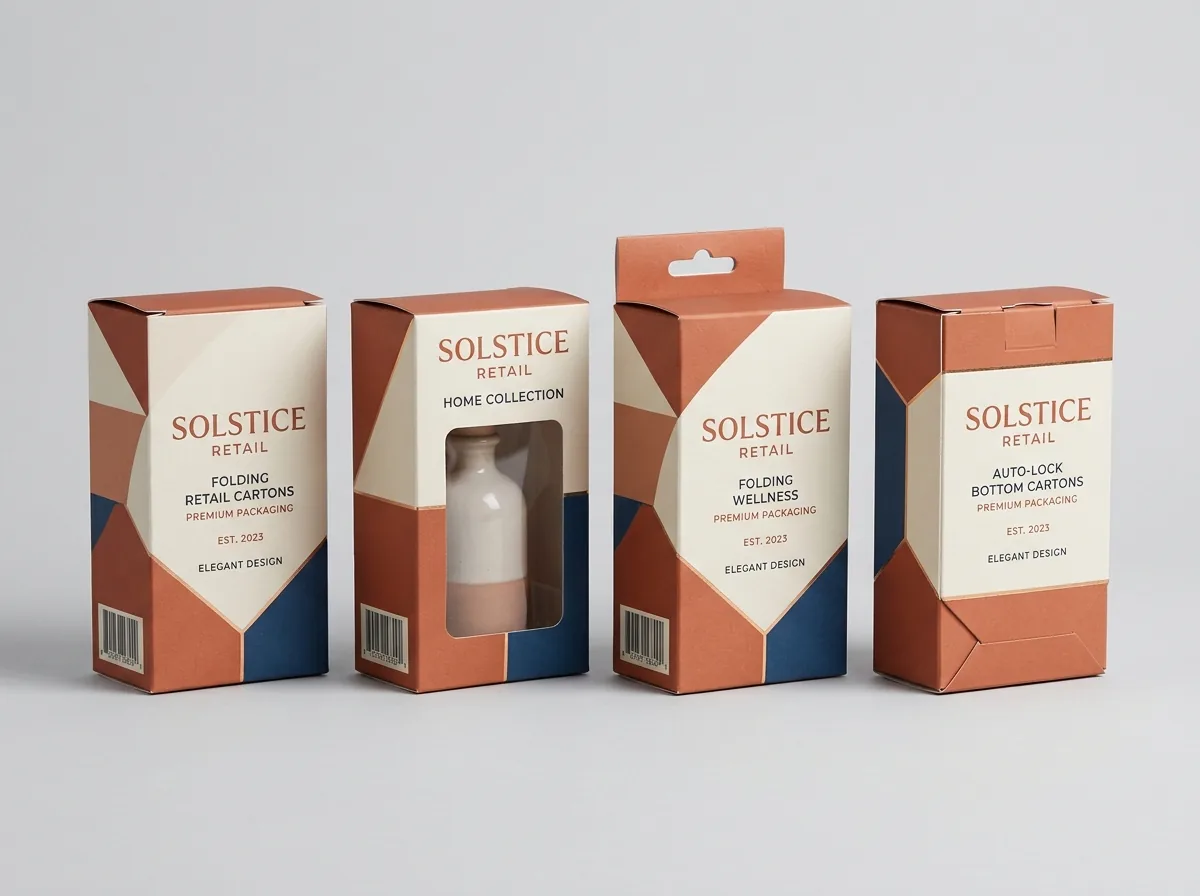
Choosing the correct paperboard closure geometry determines assembly labor, bottom load capacity, and retail shelf aesthetics for consumer brands. When ordering custom folding cartons, three primary ECMA closure designs dominate commercial manufacturing. Straight tuck end cartons feature top and bottom closure flaps hinged from the front panel that both fold backward, ensuring the front face presents zero raw die-cut edges to consumers. Reverse tuck end cartons feature flaps hinged from opposite panels, allowing carton blanks to interlock on flat sheets during die-cutting to maximize paperboard yield. Auto-lock crash bottom cartons feature pre-glued base flaps that spring into a locked floor when the carton is popped open. When configuring retail paperboard folding cartons, our packaging specialists verify closure mechanics against product unit weight on a complimentary 2D CAD dieline and interactive 3D digital proof before production commences.
How does straight tuck end (STE) carton construction work?
Straight tuck end (STE) cartons, categorized under ECMA code A20.20, are engineered for premium cosmetic, fragrance, and confectionery packaging. Both the top closure flap and the bottom closure flap hinge from the front display panel and tuck backward into the rear of the box. This deliberate structural geometry guarantees that the front face displays a continuous, clean folded edge with zero visible die-cut borders. During retail presentation, shoppers see an immaculate front billboard. STE cartons require manual folding of both top and bottom flaps during fulfillment, making them ideal for high-value goods where shelf beauty outweighs ultra-high packaging speed. In laboratory rub testing, front-facing folding scores show zero fiber disruption even under continuous transit scuffing.
Why is reverse tuck end (RTE) preferred for sheet nesting efficiency?
Reverse tuck end (RTE) cartons, classified under ECMA code A20.10, feature a top flap that folds backward and a bottom flap that folds forward, or vice versa. By hinging closure flaps on opposite body panels, individual carton blanks can be rotated 180 degrees and nested tightly against one another on large paperboard press sheets. This interlocking nesting configuration reduces scrap trim waste by 8% to 15% compared to straight tuck layouts, significantly lowering unit production costs on high-volume production runs exceeding 10,000 cartons. RTE cartons are widely adopted across pharmaceuticals, over-the-counter wellness products, and hardware components. Automated optical registration cameras on modern Bobst die-cutters track sheet gripper margins to hold tight +/- 0.5 mm cut-to-crease positioning across nested blanks.
When is a pre-glued auto-lock crash bottom essential?
Auto-lock bottom cartons (also known as crash-lock or snap-lock bottoms, ECMA A70.20) are engineered for products weighing between 12 ounces and 3 pounds, such as heavy glass cosmetic jars, scented candle tumblers, and gourmet food sauces. The bottom floor is composed of four interlocking geometric flaps that are pre-folded and glued along critical diagonal scorelines during the automated folder-gluer phase. When warehouse packers push the opposite corners of the flat-packed carton, the bottom flaps snap together instantly into a self-locking, load-bearing floor that cannot fall out under gravitational product weight. High-tack PVA cold emulsion adhesive along the glue tabs provides 45 psi shear bonding strength, preventing catastrophic base blowout during rough courier shipping.
Know your size? Compare pricing across up to 3 quantities.
Request a Quote →How do dust flaps and friction locks prevent carton pop-open?
Every tuck carton incorporates dual side dust flaps positioned beneath the main tuck closure. Dust flaps serve two critical engineering functions: they prevent airborne particulates from entering the carton interior, and they provide lateral friction resistance that keeps the main tuck flap securely seated. The tuck flap features subtle friction shoulders or slit locks that engage with small die-cut nicks in the dust flaps. This mechanical friction fit prevents accidental flap pop-open during retail handling while still allowing customers to open and reclose the carton easily without tearing paperboard fibers. Careful attention to scoreline creasing depth prevents unsightly paperboard surface cracking along 180-degree folds, preserving crisp high-resolution full-color exterior lithographic printing. Careful attention to scoreline creasing depth prevents unsightly paperboard surface cracking along 180-degree folds, preserving crisp high-resolution full-color exterior lithographic printing.
What automated cartoning machine tolerances apply to each closure?
High-speed automated cartoning lines require consistent paperboard score bend resistance to prevent machine jams. Rotary folding carton erectors pull flat blanks from vertical magazines, apply vacuum suction to square the body, and push mechanical tuck fingers to insert closure flaps at rates between 120 and 300 cartons per minute. Both straight tuck and reverse tuck cartons run smoothly on automated lines provided that paperboard grain runs parallel to the tuck hinge scoreline and score bending force remains under 120 milliNewtons. Auto-lock cartons can also run on automated lines equipped with bottom push-rod assemblies. Rigorous prepress file preparation ensures that vector dielines maintain exact 0.125-inch artwork bleeds and safe margins, preventing critical logos from getting trimmed off during rotary die-cutting. Rigorous prepress file preparation ensures that vector dielines maintain exact 0.125-inch artwork bleeds and safe margins, preventing critical logos from getting trimmed off during rotary die-cutting.
How do you choose between manual hand filling and machine cartoning?
When choosing between manual hand erection and automated cartoning machinery, order volume and fulfillment labor dictate the optimal closure choice. For boutique brands assembling 1,000 to 5,000 units by hand, auto-lock bottom cartons save significant labor time: a packer squares the box in one second, drops in the jar, and tucks the top lid. For operations packaging tens of thousands of units with mechanical cartoning equipment, reverse tuck end cartons deliver the lowest paperboard sheet cost and optimal high-speed mechanical feeding. Operating within standard converting guidelines guarantees consistent tuck flap friction tension, allowing end consumers to easily open and reclose cartons without tearing outer paperboard panels. Operating within standard converting guidelines guarantees consistent tuck flap friction tension, allowing end consumers to easily open and reclose cartons without tearing outer paperboard panels.
How do friction locks and slit locks maintain closure tension?
During retail display handling and customer inspection, friction tuck flaps must remain firmly seated without popping open unexpectedly. Packaging engineers incorporate precision friction locks or slit locks along the side edges of the closure flap. Small die-cut slits measuring 0.8 mm to 1.2 mm in length engage mechanically with corresponding friction shoulders on the dust flaps. As the tuck flap slides into the carton body, the slit locks snap past the dust flap edges, creating positive mechanical retention. This friction tension prevents accidental opening during rough retail handling while still enabling customers to pull the tab open smoothly without tearing outer paperboard fibers. Incorporating proper finger access thumb notches along dust flaps speeds up manual pack times while ensuring clean presentation on retail shelves. Incorporating proper finger access thumb notches along dust flaps speeds up manual pack times while ensuring clean presentation on retail shelves.
What are the secondary closure alternatives like seal end and sleeves?
Beyond standard tuck closures and crash bottoms, specialized consumer goods utilize seal end and sleeve configurations. Seal end cartons (ECMA A55.20) feature overlapping top and bottom flaps that are permanently bonded with hot-melt adhesive on automated packaging lines, creating a fully sift-proof, tamper-evident container ideal for granulated dry foods and baking mixes. Paperboard packaging sleeves (ECMA A10.20) consist of a four-panel tubular wrap open at both ends, engineered to slide securely over thermoformed food trays, soap bars, or apparel boxes. Sleeves provide premium branding billboard space while reducing paperboard material consumption by up to 40% compared to full cartons. Maintaining consistent humidity and temperature conditions in storage warehouses ensures paperboard retains proper moisture levels, preventing warp or brittle scorelines during automated filling. Maintaining consistent humidity and temperature conditions in storage warehouses ensures paperboard retains proper moisture levels, preventing warp or brittle scorelines during automated filling.
What mistakes happen with straight tuck vs reverse tuck vs auto lock folding cartons?
Our packaging specialists review every folding carton dieline to prevent these common packaging pitfalls
- Using a friction tuck bottom for heavy glass jars exceeding 1 lb, causing the bottom flap to pop open when lifted off store shelves.
- Specifying reverse tuck end for luxury cosmetics where raw die-cut edges visible on the front bottom panel detract from premium presentation.
- Failing to account for paperboard caliper displacement on tuck flaps, causing flaps to bow outward rather than sliding flush into the body.
- Running unlaminated dark ink across tuck flap crease scorelines, resulting in visible paper fiber micro-cracking.
- Placing live graphics across dust flap friction notches, leaving critical branding cut in half during die-cutting.
Packaging for this




Ready to order folding cartons? Compare up to 3 quantities with a free 3D mockup.
Request a Quote →Questions about folding cartons
What is the difference between STE and RTE folding cartons?
On straight tuck end (STE) cartons, both top and bottom flaps hinge from the front panel and fold backward. On reverse tuck end (RTE) cartons, the top flap hinges from the front while the bottom flap hinges from the rear, allowing tighter blank nesting on press sheets. Our structural specialists verify board calipers, score line depths, and folding tolerances during digital prepress review to ensure flawless operation.
How much weight can an auto-lock bottom carton hold?
When manufactured from 20 pt to 24 pt paperboard, an auto-lock crash bottom carton safely holds product weights up to 3 pounds without requiring tape or bottom adhesive.
Do auto-lock cartons ship flat?
Yes. Auto-lock bottom cartons ship 100% flat and pre-glued along both the side seam and bottom diagonal joints, packed in compact strapped bundles on pallets.
Can tuck flaps be opened and reclosed multiple times?
Yes. Friction tuck flaps are specifically engineered for repeated opening and closing cycles without tearing, making them ideal for cosmetics, daily vitamins, and personal care goods used over several months.
Are there extra tooling charges for auto-lock bottoms?
No. CubitPack provides transparent, all-inclusive pricing with zero custom die tooling charges and zero printing plate fees across all folding carton closure styles and custom dimensions.
What is a 1-2-3 snap lock bottom?
A 1-2-3 bottom (snap lock) is an unglued manual bottom closure where four flaps fold and interlock sequentially. It costs slightly less than an auto-lock bottom but requires extra hand assembly time.
Still have a question? Ask a packaging specialist.
Request a Quote →Request your folding cartons quote
Tell us your size and quantities, and one dedicated account manager prepares pricing for each tier.
- Free design & AI-to-print studio + 3D mockup
- No die or plate charges · 4–5 day rush available
- Free shipping to all 50 states
- 10% off your first order
Researched across Paperboard Packaging Council (PPC) manufacturing standards, European Carton Makers Association (ECMA) design codes, and TAPPI official test methods. Production facts verified with manufacturing specialists.
What changed
- November 11, 2026: Published technical engineering guide covering folding carton closures, paperboard calipers, and high-speed filling line optimization.
More guides
New packaging guides by email
Sizes, materials and design tips. Unsubscribe anytime.