
How do shipping box dielines, flute profiles, and ECT ratings work?
Short answer: A Regular Slotted Container (RSC / FEFCO 0201) dieline for custom shipping boxes lays out four alternating Length and Width body panels (L – W – L – W), a 1.25 to 1.5 inch side glue tab, and top and bottom flaps cut to half the box Width (W ÷ 2), with vertical B, C, or BC flutes rated 32 to 51+ ECT.
On this page
- What are the structural parts of a FEFCO 0201 RSC shipping box dieline
- How do E-flute, B-flute, C-flute, and BC double-wall profiles compare
- What is the difference between Edge Crush Test (ECT) and Mullen Burst (#) ratings
- How do I set up artwork, bleed, and tape keep-out zones on a shipping box dieline
- Should I choose flexo, digital CMYK, or litho print on brown kraft vs white corrugated
- Common mistakes
- FAQs
Request a custom quoteFree dieline & 3D mockup
Understanding a shipping box dieline, flute profile, and Edge Crush Test (ECT) rating ensures your artwork prints cleanly and your carton survives parcel sorting hubs without crushing. On a standard Regular Slotted Container (RSC, FEFCO code 0201), the flat blank consists of four alternating body panels (Length – Width – Length – Width) joined by vertical score lines, a 1.25 to 1.5 inch manufacturer's glue joint on one end, and four top and four bottom flaps separated by 1/4 to 3/8 inch slots. Because all eight flaps share the same height (0.5 × Width), the two wider outer major flaps meet edge-to-edge along the center seam when folded over the narrower inner minor flaps. Inside the board wall, vertical fluted arches, most commonly B-flute (1/8 in), C-flute (5/32 in), or BC double-wall (9/32 in), carry vertical stacking loads rated by Edge Crush Test (32 ECT to 51+ ECT) or internal burst pressure rated by Mullen Test (200# to 275#).
What are the structural parts of a FEFCO 0201 RSC shipping box dieline?
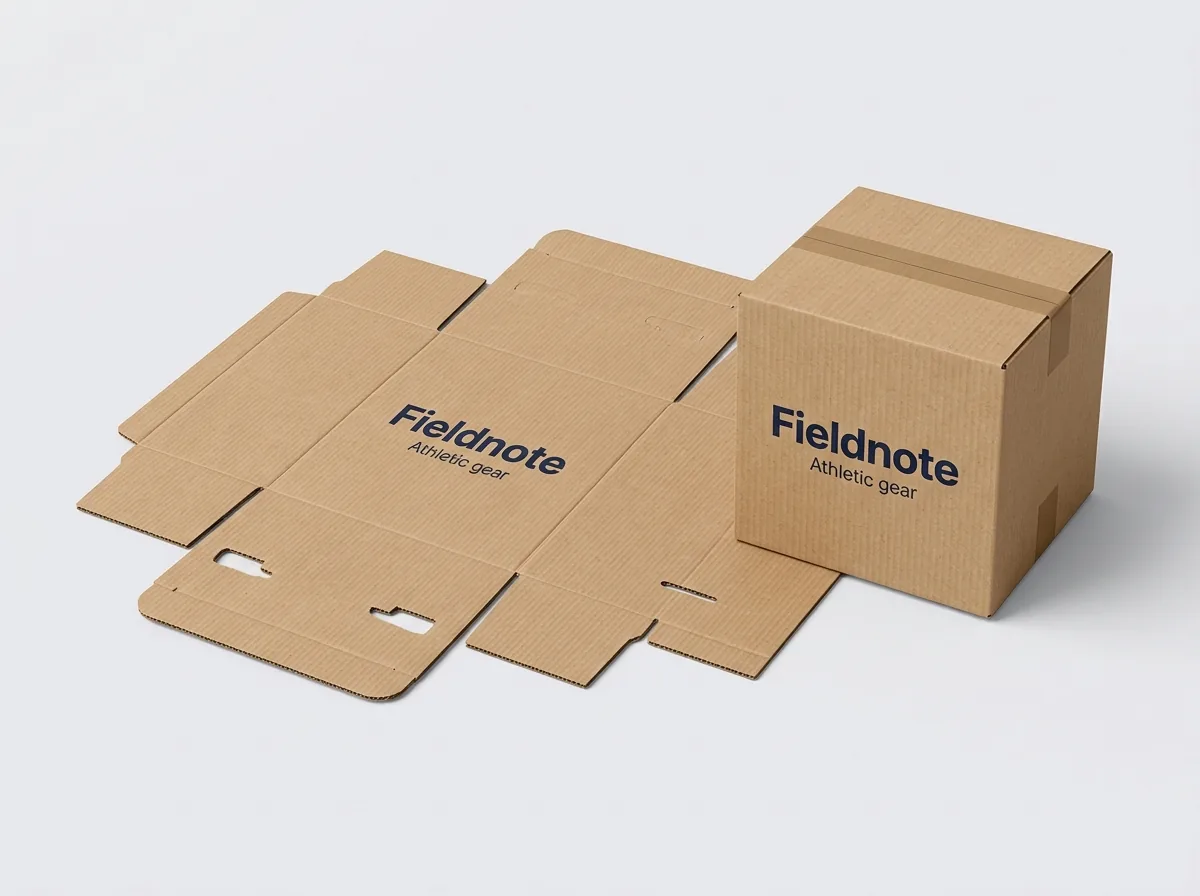
When our structural team prepares your free 2D vector dieline proof for RSC shipping boxes or custom corrugated boxes, the flat blank is viewed from the outside printing surface. Every FEFCO 0201 Regular Slotted Container dieline is built from these five geometric elements
- Four alternating vertical body panels (L – W – L – W): Joined by four vertical score lines, these panels form the four load-bearing perimeter walls of your box. For a 12 × 10 × 8 in interior RSC, the four panels measure 12 in, 10 in, 12 in, and 10 in across (plus minor score take-up allowances for board thickness).
- Equal-depth top and bottom flaps (Flap Height = 0.5 × Width): All four top flaps and all four bottom flaps are cut to half the box's Width (5.0 inches on a 12 × 10 × 8 in box). Because the two outer major flaps hinge off the longer Length walls and each span 0.5 × W across the Width opening, they meet squarely along the center seam. The two inner minor flaps hinge off the Width walls and leave a gap in the center underneath the major flaps.
- Flap clearance slots (1/4 in to 3/8 in wide): Vertical slots (6 to 9 mm wide depending on single-wall vs double-wall flute thickness) are punched between adjacent flaps so the minor and major flaps fold inward at 90 degrees without binding at the corners.
- Pre-glued manufacturer's joint tab (1.25 to 1.50 in wide): A tapered tab hinged off the first body panel that is glued to the fourth body panel during conversion so every shipping box arrives knocked-down flat (KDF) in strapped bundles.
- Vertical flute direction (parallel to Height H): The corrugated flutes always run vertically from the bottom score line to the top score line so the arches stand upright like columns when cartons are stacked on pallets and in delivery trucks.
How do E-flute, B-flute, C-flute, and BC double-wall profiles compare?
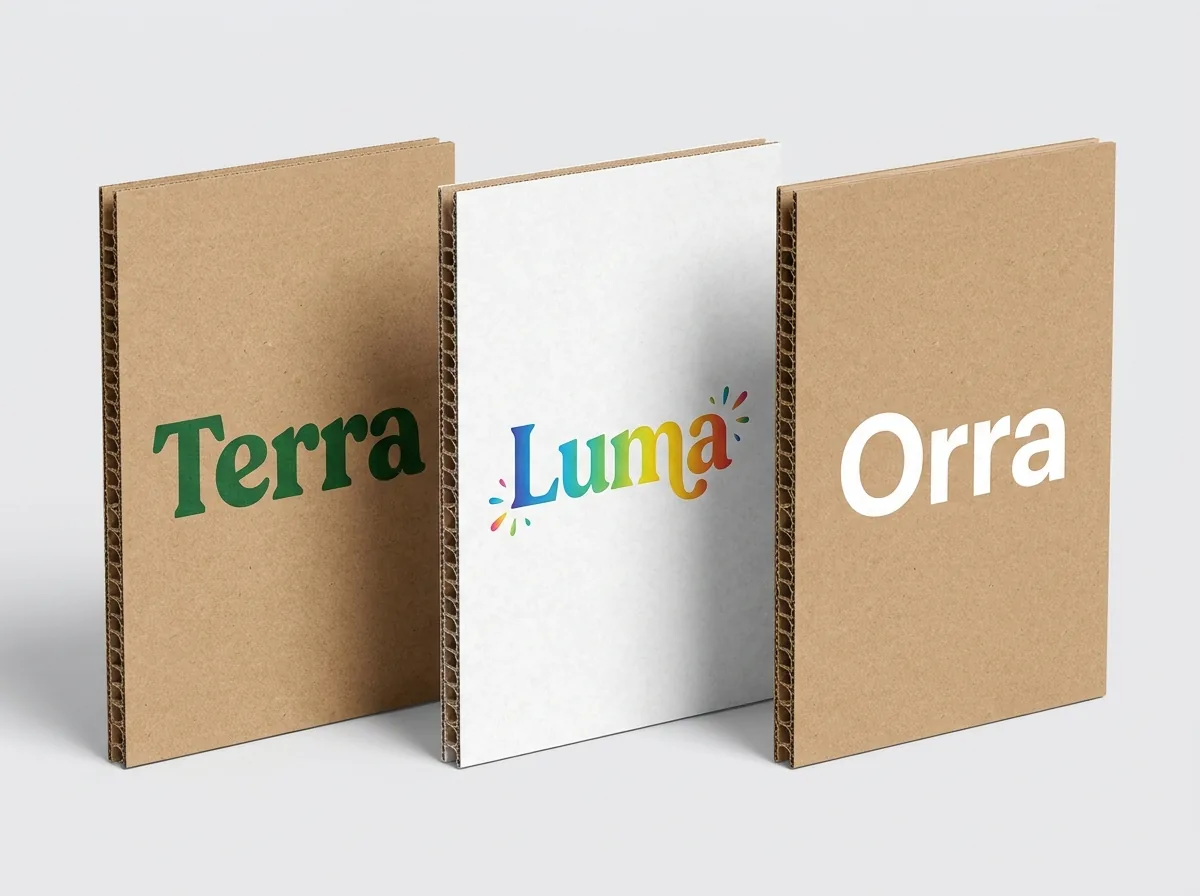
The wavy inner sheet of a corrugated wall, called the fluted medium, forms a continuous row of structural truss arches between the inner and outer linerboards. Tighter flutes with more arches per linear foot create a smoother printing surface and higher flat-crush resistance on custom mailer boxes, while taller flutes create a thicker beam for vertical stacking and drop cushioning on custom double-wall boxes
| Flute profile | Nominal wall caliper | Flutes per linear foot | Mechanical & print advantage | Primary box applications |
|---|---|---|---|---|
| E-flute (Single-wall) | 1/16 in (1.5–1.6 mm) | 90 ± 4 flutes/ft | Smooth print face; minimal washboarding; crisp folds | Die-cut DTC mailers, cosmetics kits, retail display boxes |
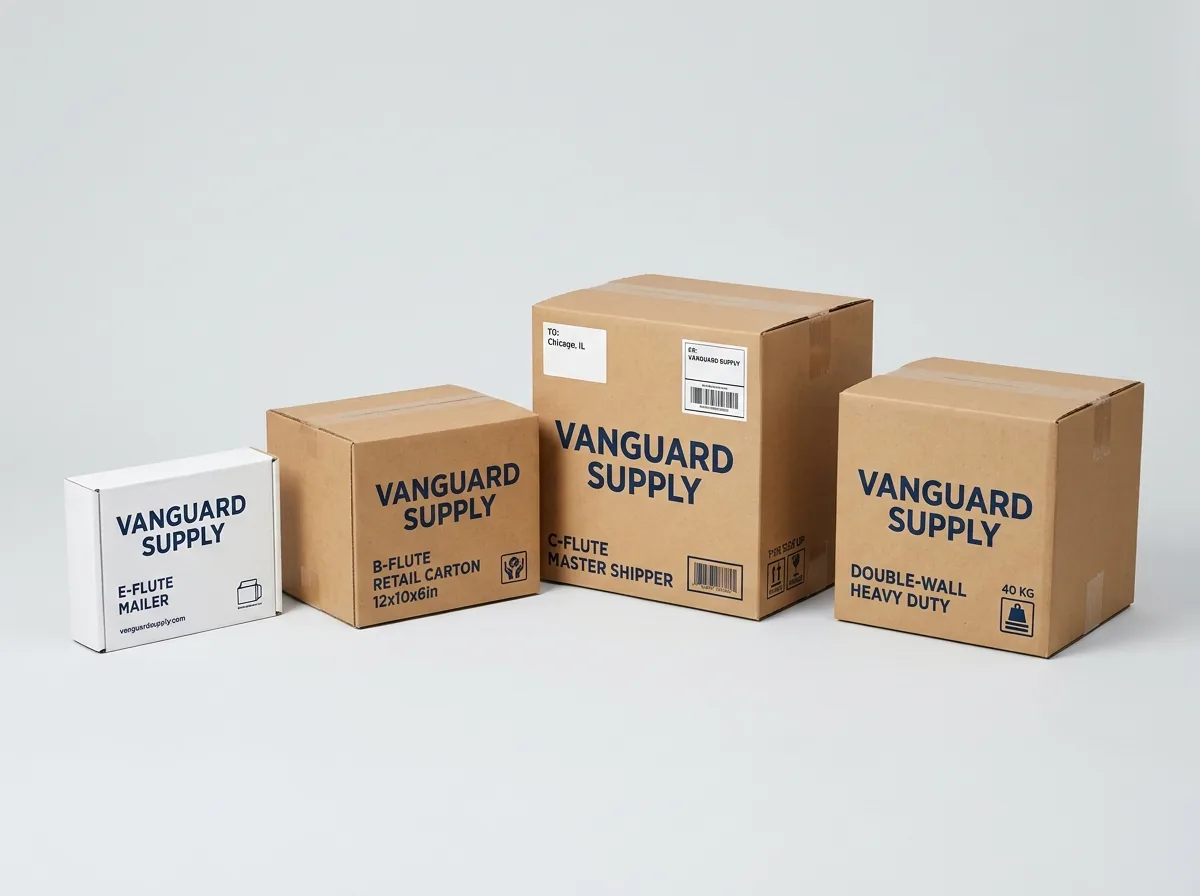
| B-flute (Single-wall) | 1/8 in (3.0–3.2 mm) | 47 ± 3 flutes/ft | High flat-crush & puncture resistance; sharp flexo/digital print | Branded e-commerce RSCs (<30 lb), canned goods, subscription boxes |
| C-flute (Single-wall) | 5/32 in (4.0 mm) | 39 ± 3 flutes/ft | Tall arches for transit shock absorption & column stacking | Standard shipping RSCs (up to 65 lb), apparel, pantry & dry food |
| BC-flute (Double-wall) | 9/32 in (7.0–7.1 mm) | 47 (B) + 39 (C) / ft | 5-ply wall combining B-flute print/puncture + C-flute cushioning | Cookware, 6–12 glass bottle shippers, auto parts, moving boxes |
What is the difference between Edge Crush Test (ECT) and Mullen Burst (#) ratings?
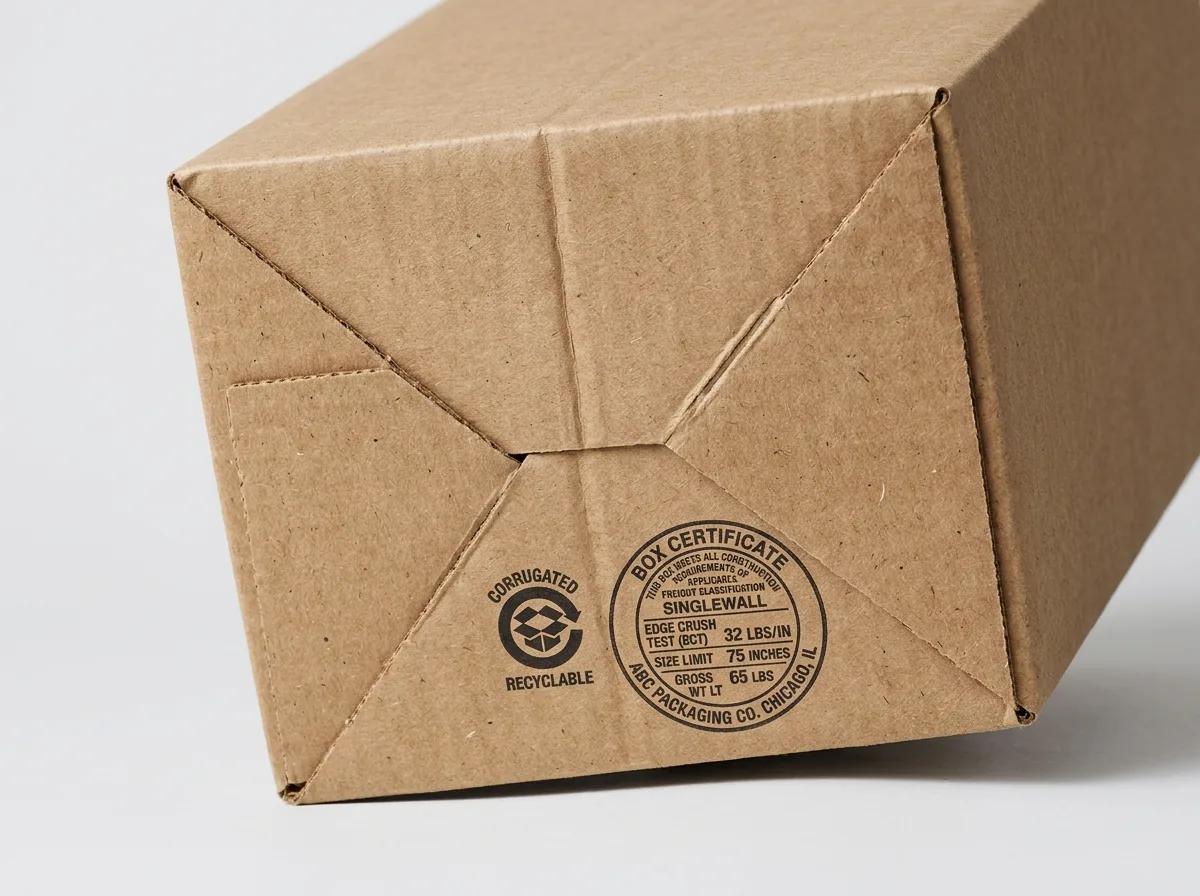
Flip any shipping carton upside down and you will see the circular Box Manufacturer's Certificate (BMC) printed on a bottom flap. That seal certifies the board's strength under one of two Fibre Box Association testing standards
| BMC board rating | Engineering test method | Max gross weight (FBA tariff) | Recommended real-world load | When to specify this grade |
|---|---|---|---|---|
| 32 ECT Single-Wall | 32 lb/in vertical edge compression | 65 lb · Max 75 united in | Up to 35–40 lb | Everyday e-commerce orders, cartoned goods, folded apparel |
| 200# Mullen Single-Wall | 200 psi hydraulic diaphragm burst | 65 lb · Max 75 united in | Up to 40 lb (sharp/loose items) | Unboxed hardware, metal tools, dense cylindrical cans |
| 44 ECT Single-Wall | 44 lb/in vertical edge compression | 95 lb · Max 95 united in | 35 to 65 lb | Wholesale master cases, tall 5-layer pallets, humid cold chain |
| 48 ECT Double-Wall (BC) | 48 lb/in vertical edge compression | 100 lb · Max 105 united in | 45 to 85 lb | 6–12 glass bottle cases, cast-iron cookware, fragile electronics |
| 51+ ECT Double-Wall (BC) | 51 lb/in vertical edge compression | 120 lb · Max 110+ united in | 65 to 100+ lb | Heavy automotive components, industrial gear, large moving boxes |
Know your size? Compare pricing across up to 3 quantities.
Request a Quote →How do I set up artwork, bleed, and tape keep-out zones on a shipping box dieline?
Setting up artwork for corrugated flexo, digital CMYK, or litho-lamination on custom ecommerce boxes, custom subscription boxes, or custom food boxes requires slightly wider mechanical tolerances than thin paperboard folding cartons
- 3-inch top tape seam keep-out zone (1.5 in each side): Standard fulfillment lines seal RSC boxes with 2-inch or 3-inch packing tape centered down the top major flap seam, with a 2-to-3-inch tape overhang folded down onto the left and right end panels. Keep all logos, headlines, and QR codes at least 1.5 inches (38 mm) away from the center flap meeting edge and 1.5 inches below the top horizontal fold line.
- 4 × 6 inch carrier shipping label zone: Reserve a clear 4.25 × 6.25 inch area on one top major flap or one upper side wall so UPS, FedEx, and USPS thermal barcode labels never cover your brand mark.
- Bleed (+0.25 in) and score safe margin (0.50 in): Extend full-bleed background fills 0.25 inches (6 mm) past outer cut lines, and keep critical text at least 0.50 inches (13 mm) inside all rotary score creases.
- Bottom flap BMC stamp area (3.5 × 3.5 in): Leave a clean 3.5 × 3.5 inch space on one outer bottom flap for the circular Box Manufacturer's Certificate, recycling symbol, and interior L × W × H dimension stamp.
Should I choose flexo, digital CMYK, or litho print on brown kraft vs white corrugated?
Match your artwork complexity and board color to the right corrugated printing method, then check our companion guides, how to measure and choose board for shipping boxes and RSC shipping boxes vs die-cut mailers and double-wall boxes
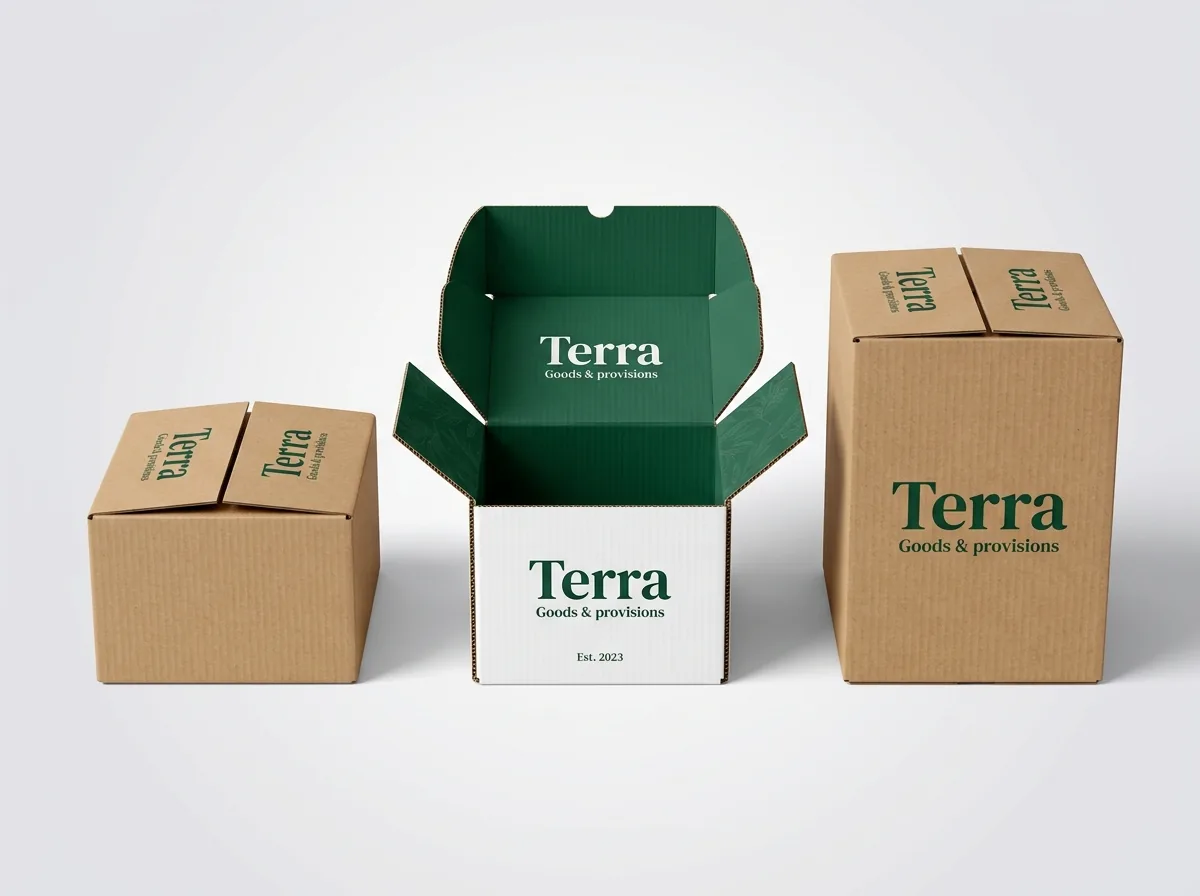
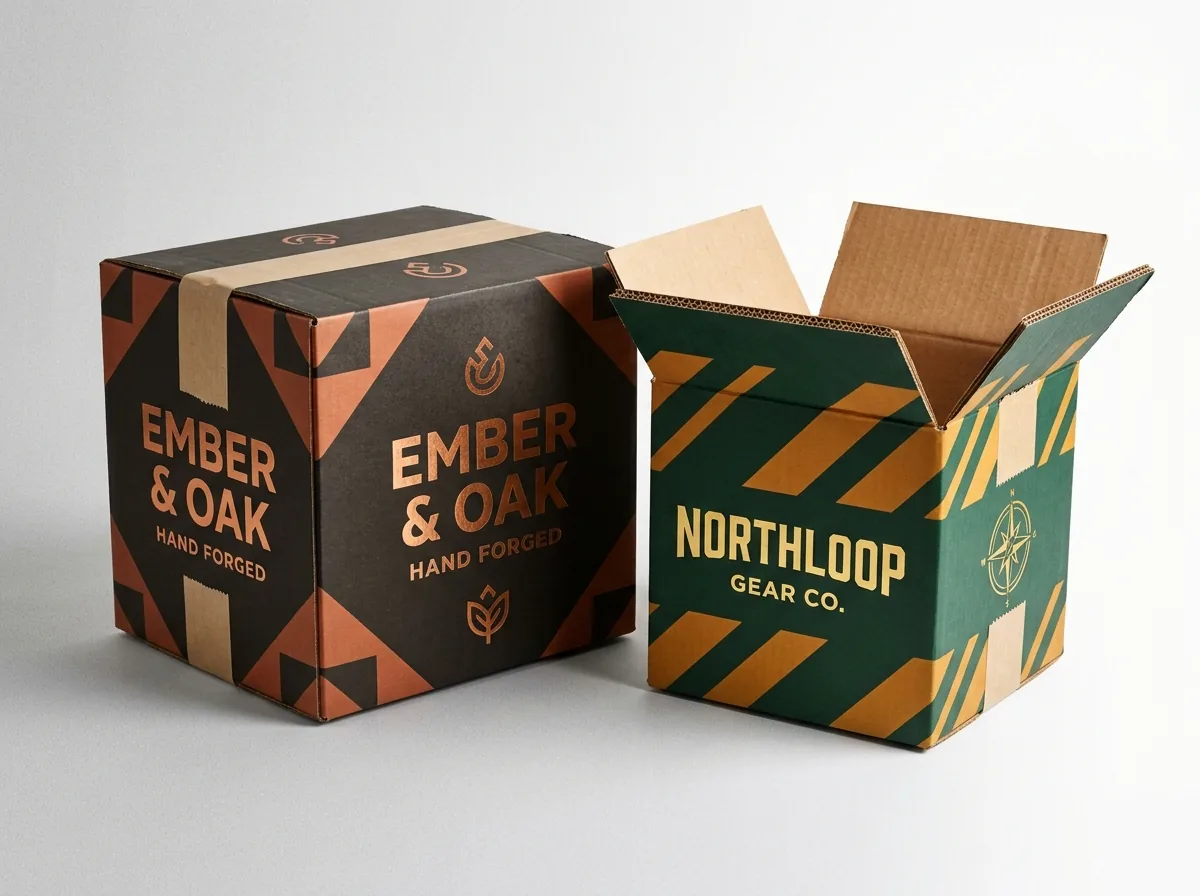
- 1–2 color direct flexo on natural brown kraft: The most economical choice for bold logos, handling icons, and typography on custom moving boxes, custom kitchenware boxes, and custom auto parts boxes. Keep minimum type size at 12 pt (14 pt for reversed knock-out text) and minimum line weight at 1.5 pt (0.5 mm). Dark saturated inks (forest green, deep navy, charcoal, burgundy, black) or opaque white ink look sharpest on unbleached kraft.
- Digital CMYK on mottled or coated white corrugated: Ideal for multi-color illustrations, pastel palettes, and inside-and-outside printed shipping cartons at 300 DPI CMYK with zero printing plate setup.
- Litho-laminated corrugated boxes: Offset-printed 300 DPI sheets laminated onto E-flute or B-flute board with optional matte, gloss, or soft-touch lamination and spot UV for retail-grade presentation.
What are the most common dieline and prepress mistakes on shipping boxes?
Check your artwork file against these five frequent corrugated prepress errors before sending your shipping box to production
- Centering a primary logo or headline across the top major flap seam, where 3-inch packing tape or a 4 × 6 inch thermal shipping label covers it as soon as the box is sealed.
- Placing a logo within 1 inch of the top horizontal fold on the left or right end panel, where the 2-to-3-inch packing tape overhang wraps down over the corner.
- Rotating the dieline layout 90 degrees so the corrugated flutes run horizontally instead of vertically along the Height (H) axis, cutting vertical stacking strength by more than 40%.
- Printing pale yellow, light pink, or sky blue CMYK inks directly onto unbleached brown kraft linerboard without a white ink underbase or white outer liner, causing colors to shift muddy brown.
- Using fine 6 pt serif text or 0.25 pt hairline strokes on a direct flexo corrugated print plate, which can fill in or bridge on textured kraft board.
Packaging for this
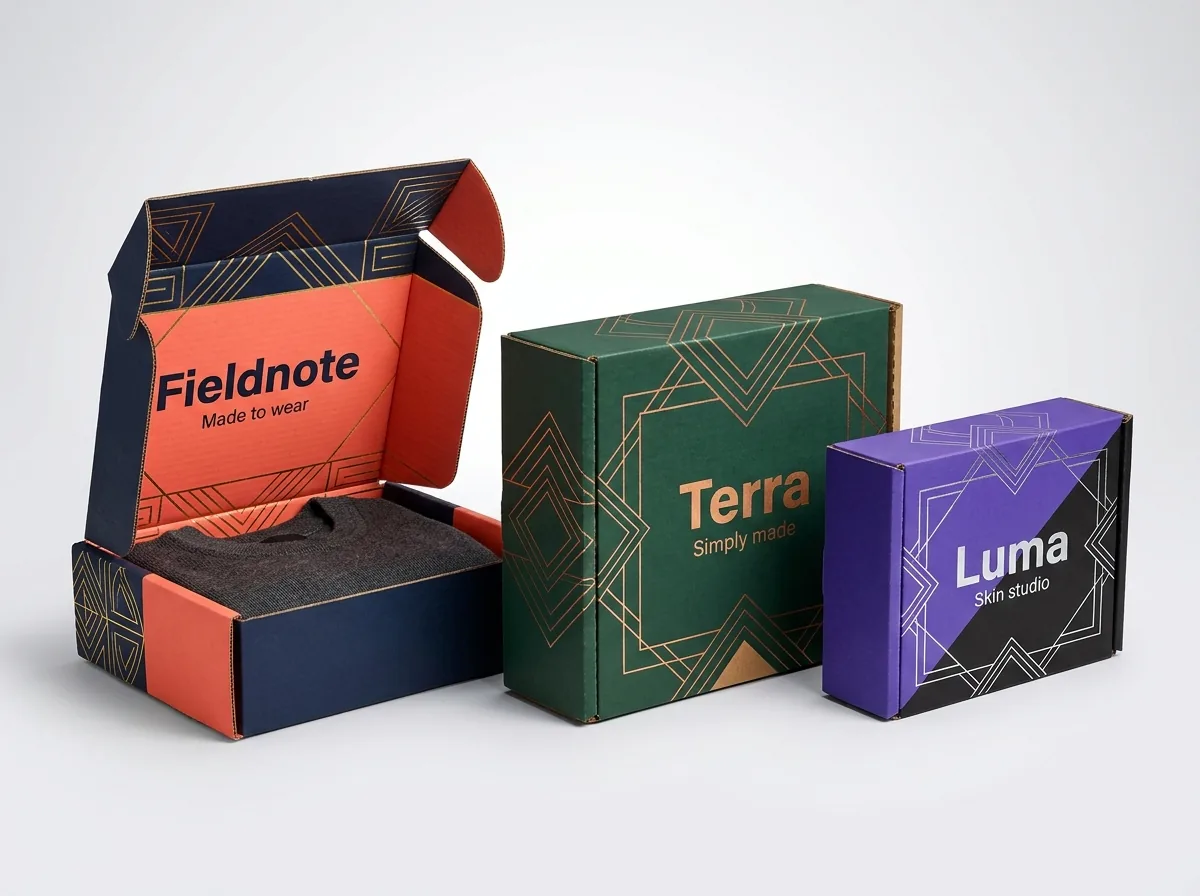
Ready to order shipping boxes? Compare up to 3 quantities with a free 3D mockup.
Request a Quote →Questions about shipping boxes
Why do the inner minor flaps on an RSC shipping box not meet in the middle?
On a standard FEFCO 0201 Regular Slotted Container, all four flaps are cut to the same depth (half the box Width, or W ÷ 2) so the blank can be slotted in a single straight rotary pass with zero board waste. Because the minor flaps fold across the longer Length (L) span, they only meet in the center if the box footprint is a square (L = W).
What is a Full Overlap (FOL / FEFCO 0203) shipping box dieline?
A Full Overlap Slotted Container (FOL, FEFCO 0203) cuts the outer major flaps to the full Width (W) of the box instead of half the Width, so the two major flaps overlap completely on top of each other. FOL boxes provide double-thick top and bottom protection for narrow heavy items.
Can you print opaque white ink on natural brown kraft shipping boxes?
Yes. We can print crisp opaque white ink, either as a standalone 1-color minimalist design on unbleached brown kraft or as an underbase layer beneath spot colors so your brand palette stays bright.
Is the Box Manufacturer's Certificate (BMC) required on every custom shipping box?
While parcel couriers accept un-stamped boxes for light parcels, printing the circular BMC stamp on the bottom flap is strongly recommended for all UPS, FedEx, and LTL freight cartons, especially if you ever need to document board strength for a carrier transit damage claim.
What file format should I upload for my custom shipping box dieline?
Upload a layered vector PDF, Adobe Illustrator (.ai), or EPS file with all fonts converted to outlines, images embedded at 300 DPI CMYK, and your artwork placed on a separate layer from the dieline cut and score lines. Need help? Our team provides free design assistance.
Still have a question? Ask a packaging specialist.
Request a Quote →Request your shipping boxes quote
Tell us your size and quantities, and one dedicated account manager prepares pricing for each tier.
- Free design & AI-to-print studio + 3D mockup
- No die or plate charges · 4–5 day rush available
- Free shipping to all 50 states
- 10% off your first order
We verified FEFCO 0201 and 0203 dieline flap formulas, E/B/C/BC flute arch counts and calipers, ECT vs Mullen burst tables, and BMC stamp rules against FEFCO technical manuals and Fibre Box Association handbooks. A packaging specialist checked every specification. Spot something wrong? Tell us and we fix it.
Sources
What changed
- October 25, 2026: First published with FEFCO 0201 dieline formulas, E/B/C/BC flute cross-sections, 32–51 ECT vs Mullen table, and tape/label prepress zone diagram.
More guides
New packaging guides by email
Sizes, materials and design tips. Unsubscribe anytime.