
Should I choose an RSC shipping box, a die-cut mailer, or a double-wall box?
Short answer: Choose a Regular Slotted Container (RSC / FEFCO 0201) on our custom shipping boxes page for the lowest unit cost on multi-item orders and wholesale cases from 5 to 65 lb. Choose a die-cut mailer (FEFCO 0427) for tape-free DTC unboxing under 20 lb, or a BC double-wall box for 40 to 100+ lb.
On this page
- What is the structural difference between an RSC shipping box, a die-cut mailer, and a double-wall box
- Why does an RSC shipping box cost less per cubic inch than a die-cut mailer
- Which corrugated box style packs faster on a fulfillment bench and how does unboxing compare
- When should I upgrade from a single-wall RSC to a double-wall shipping box
- How do I match RSC, mailer, and double-wall boxes across my product catalog
- Common mistakes
- FAQs
Request a custom quoteFree dieline & 3D mockup
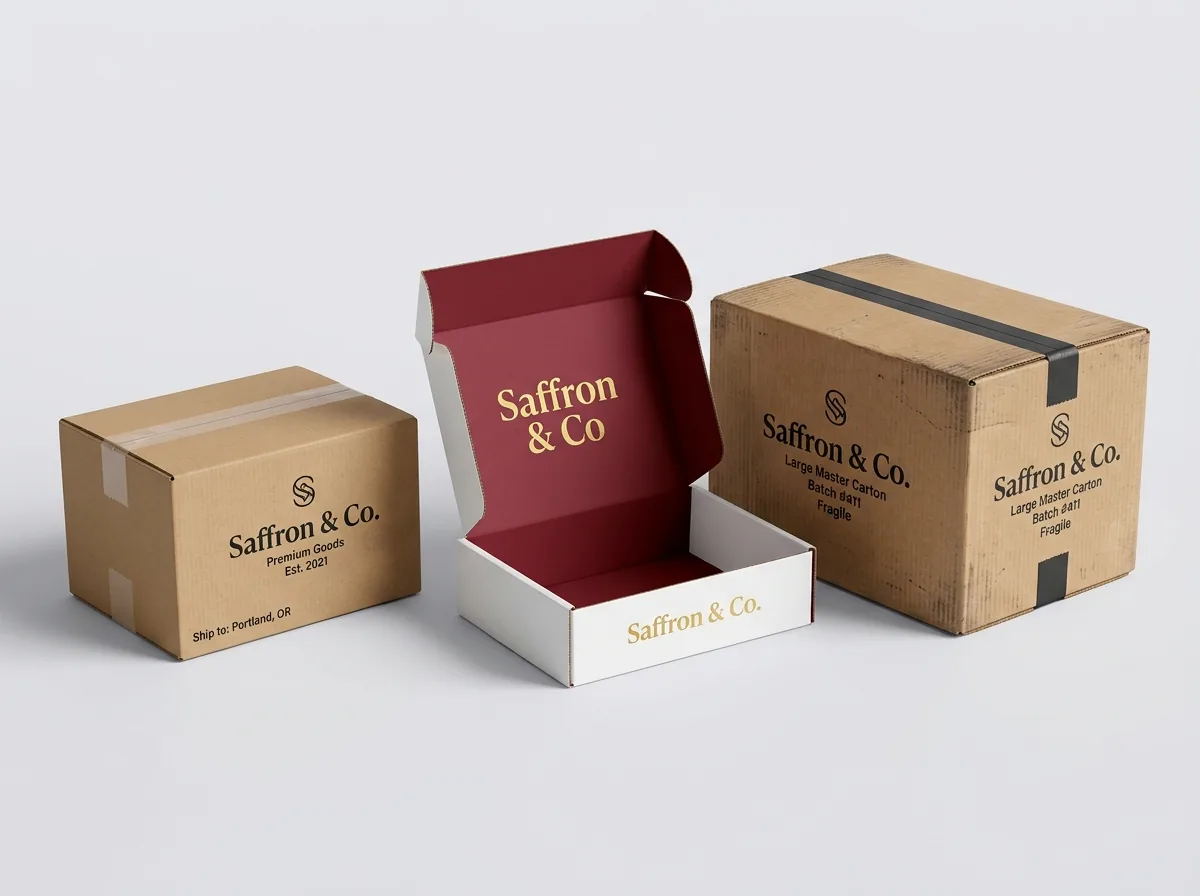
When comparing RSC shipping boxes vs die-cut mailers and double-wall boxes, the decision comes down to board efficiency, packing bench speed, customer unboxing presentation, and gross parcel weight. A Regular Slotted Container (RSC, FEFCO 0201) is cut from a straight rectangular corrugated blank with four top and four bottom flaps that seal with packing tape; because no board is wasted in corner trimouts, RSCs deliver the lowest unit cost per cubic inch for e-commerce orders and wholesale master cases weighing 5 to 65 lb. A die-cut corrugated mailer (Roll End Tuck Front, FEFCO 0427) uses a shaped blank that folds into double-thick side walls and a self-locking hinged lid, making it the go-to choice for curated subscription kits, cosmetics, and DTC gifts under 15 to 20 lb. A double-wall shipping box (BC flute, 48 to 51+ ECT) bonds two fluted mediums between three linerboards to protect 40 to 100+ lb loads.
What is the structural difference between an RSC shipping box, a die-cut mailer, and a double-wall box?
Although all three structures belong to our corrugated shipping family, spanning shipping boxes, custom mailer boxes, custom die-cut boxes, and custom double-wall boxes, each is engineered around a distinct mechanical load path, wall thickness, and closure mechanism
| Specification | Single-Wall RSC (FEFCO 0201) | Die-Cut Mailer (RETF / FEFCO 0427) | Double-Wall RSC (BC Flute 0201) |
|---|---|---|---|
| Wall construction | 3-ply single-wall (2 liners + 1 flute) | 3-ply single-wall rolled into double side walls | 5-ply double-wall (3 liners + B & C flutes) |
| Standard flute & caliper | B-flute (1/8 in) or C-flute (5/32 in) | E-flute (1/16 in) or B-flute (1/8 in) | BC double-wall (9/32 in / 7.1 mm) |
| Board strength rating | 32 ECT or 44 ECT single-wall | 32 ECT single-wall | 48 ECT to 51+ ECT double-wall |
| How the box closes | 4 top & 4 bottom flaps sealed with tape | Hinged lid w/ front tuck ears (no top tape) | Reinforced water-activated H-tape |
| Safe payload range | 5 lb to 65 lb | 1 lb to 20 lb | 40 lb to 100+ lb |
| How blanks arrive | Pre-glued flat tube (KDF) | Unfolded die-cut flat sheet | Pre-glued flat tube (KDF) |
Why does an RSC shipping box cost less per cubic inch than a die-cut mailer?
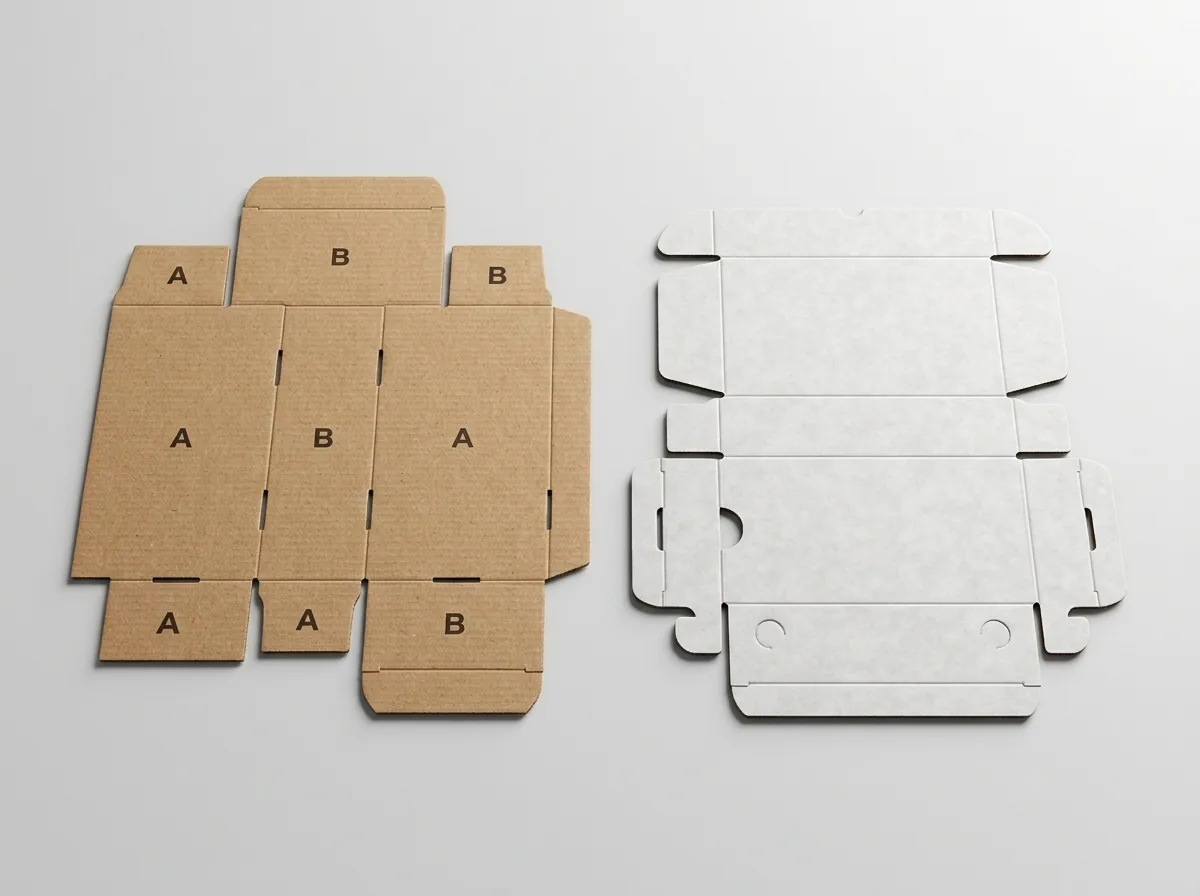
For the exact same usable interior volume, a single-wall Regular Slotted Container (RSC) uses 25% to 35% less corrugated board area than a Roll End Tuck Front (RETF) mailer box, which directly lowers your raw paperboard cost per parcel. Here is why flat blank geometry drives unit cost on custom corrugated boxes across medium and high-volume production runs
- 97%+ sheet utilization on an RSC (FEFCO 0201): An unfolded RSC blank is a pure rectangle whose length equals 2L + 2W + Glue Tab and whose width equals H + W. Every square inch of the rectangular corrugated sheet becomes part of your finished box except the narrow 1/4-inch vertical slots between the flaps.
- Extended roll-over wings on a die-cut mailer (FEFCO 0427): Because a mailer box locks together without glue or tape, its blank must include double-width side walls that roll over internal dust flaps, a full hinged lid, a front tuck panel, and curved locking ears. Those extra wings require 25% to 35% more corrugated square footage and leave corner trim cutouts on the press sheet.
- Straight rotary slotting vs flatbed die-cutting: Standard RSCs run on high-speed flexo folder-gluers that print, score, slot, and glue the manufacturer's side joint in one straight pass. Complex custom die-cut boxes run through rotary or flatbed cutting dies.
- When the mailer box pays for itself: On compact, high-margin direct-to-consumer kits under 12 to 15 lb, such as cosmetics, candles, or custom subscription boxes, the mailer's slightly higher board cost is offset by eliminating bottom tape, top tape, and loose void fill while elevating the unboxing ritual.
Which corrugated box style packs faster on a fulfillment bench and how does unboxing compare?
Whether you pack orders in-house or pay a third-party logistics (3PL) warehouse per pick-and-pack touch, assembly time directly impacts your fulfillment cost per parcel
| Fulfillment & unboxing metric | Single-Wall RSC (32–44 ECT) | Die-Cut Mailer (RETF) | Double-Wall RSC (48–51 ECT) |
|---|---|---|---|
| Manual bench assembly time | 8 to 12 seconds per box | 15 to 22 seconds per box | 14 to 18 seconds per box |
| Folding motions required | Pop tube open + fold 4 bottom & 4 top flaps | Pre-break 10 scores + roll 2 walls + tuck ears | Pop heavy tube + H-tape bottom & top seams |
| Case-erector automation | Compatible (10–15 boxes/min) | Usually hand-erected or specialty former | Compatible with heavy-duty case erectors |
| Customer opening experience | Slice center tape seam; 4 flaps open out | Peel front security tab; lift hinged chest lid | Slice reinforced H-tape; heavy-duty reveal |
| Inside printing impact | High (4 open flaps + 4 walls frame product) | Very High (full inside lid billboard) | Moderate (focus on structural instructions) |
Know your size? Compare pricing across up to 3 quantities.
Request a Quote →When should I upgrade from a single-wall RSC to a double-wall shipping box?
While single-wall 32 ECT and 44 ECT RSCs handle 85% of everyday e-commerce parcels, four transit conditions call for upgrading to 48–51 ECT BC custom double-wall boxes to prevent crushed corners and damage claims
- Heavy payloads over 40–45 lb and high point-loading: Products like cast-iron Dutch ovens in custom kitchenware boxes, metal rotors in custom auto parts boxes, or dumbbell sets in custom sports equipment boxes concentrate high force onto narrow edges. A 5-ply BC double-wall wall (9/32 in / 7.1 mm) combines a puncture-resistant outer B-flute layer (47 flutes per foot) with a shock-absorbing inner C-flute layer (39 flutes per foot).
- Multi-bottle glass cases (6-pack and 12-pack shippers): When shipping wine, olive oil, hot sauce, or cold-pressed juice in custom food boxes, pair a 48 ECT double-wall outer RSC with interlocking corrugated cell partitions and top/bottom corrugated pads so drop impacts from automated conveyor chutes never reach the glass.
- Bottom-row pallet stacking and long-span moving boxes: On tall LTL freight pallets stacked 4 to 6 layers high, or wide custom moving boxes (such as 24 × 18 × 18 in), double-wall construction prevents side-wall bowing and corner buckling during long-haul summer transit.
- High-humidity cold-chain and ocean container freight: Corrugated paper fibers absorb moisture in refrigerated coolers and ocean containers, which can cut single-wall compression strength by 35% to 50%. Upgrading to 48 or 51 ECT BC double-wall with virgin kraft liners preserves vertical stacking safety across multi-week supply chains.
How do I match RSC, mailer, and double-wall boxes across my product catalog?
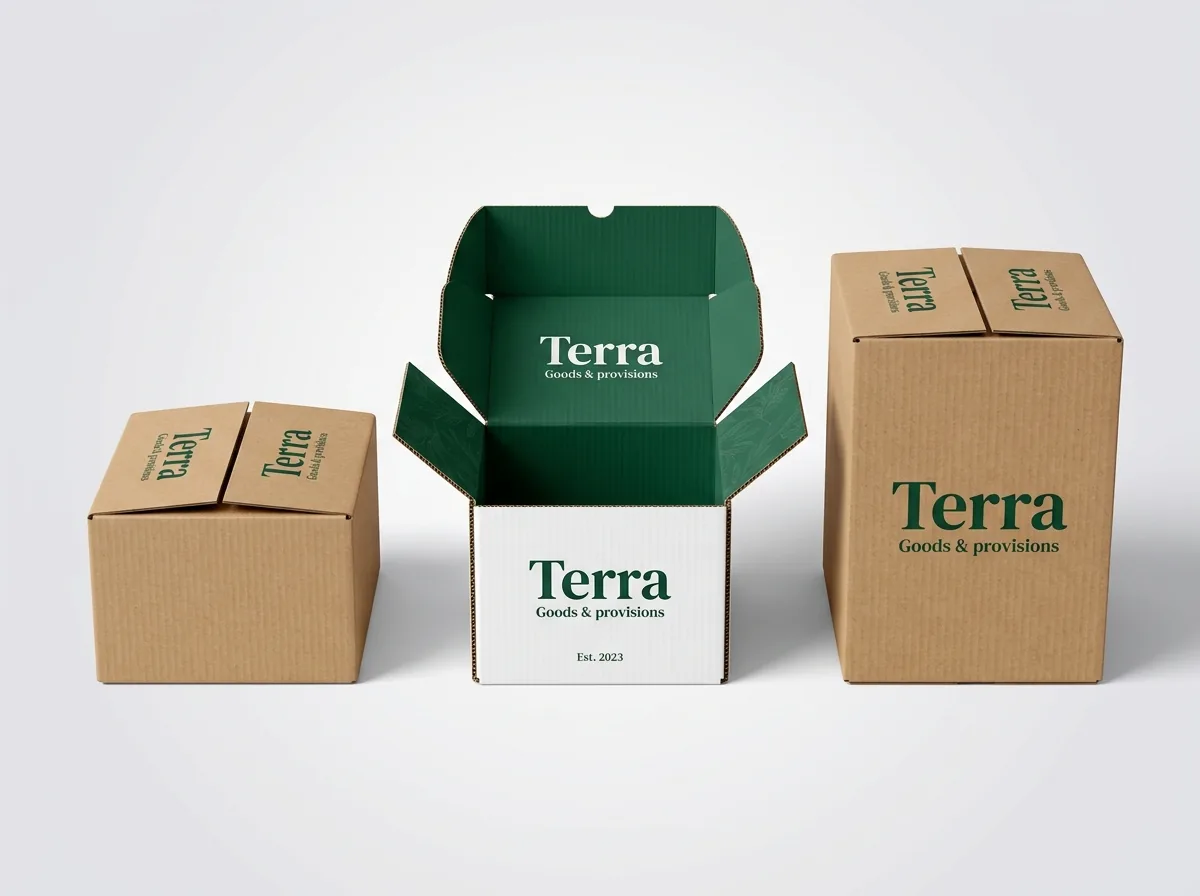
Most multi-SKU brands use two or three corrugated styles side by side, such as a die-cut mailer for single starter kits and an RSC or double-wall carton for multi-unit bundles and wholesale cases. Next, read our sizing guide, how to measure and choose board for shipping boxes, and our prepress guide, shipping box dieline, flutes, and ECT ratings explained.
- Step 1, Audit your SKU tiers by gross weight and dimensions: Assign compact single kits under 15 lb (and under 16 × 12 × 6 in) to E-flute or B-flute Die-Cut Mailer Boxes; assign 5 to 40 lb multi-item orders to 32 ECT Single-Wall RSCs; assign 40 to 65 lb wholesale master cases to 44 ECT Heavy Single-Wall RSCs; and assign 45 to 100+ lb heavy or fragile goods to 48–51 ECT BC Double-Wall RSCs.
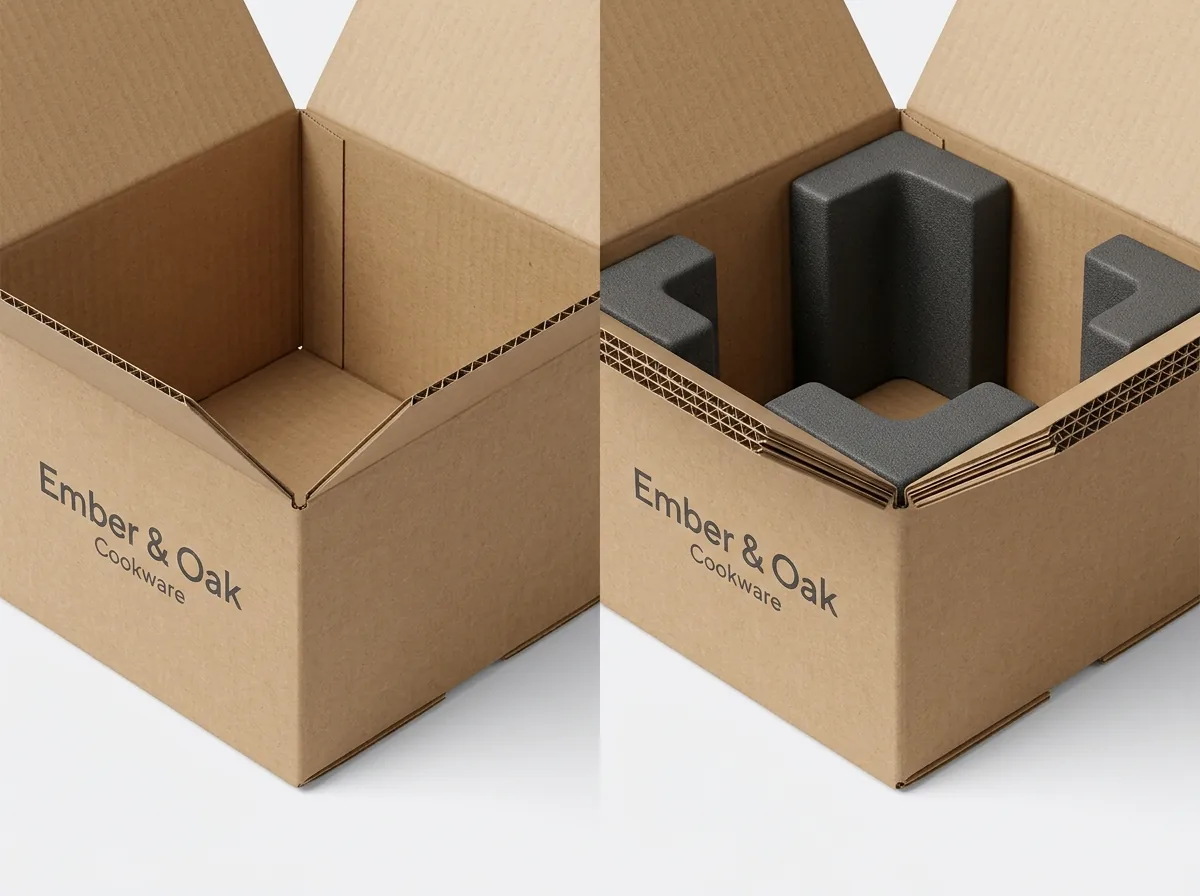
- Step 2, Match your interior protection in Step 2 of the quote form: Choose Card insert (interlocking corrugated cell dividers for bottles and jars), Honeycomb insert (recyclable kraft cushioning pads), or EPE foam insert (closed-cell polyethylene end-caps for heavy cookware, electronics, and auto parts).
- Step 3, Review your free 2D dieline and 3D digital proof before payment: Standard production takes 10–14 business days (4–5 business day rush available) with free delivery across all 50 US states, or start with our $50 sample kit (credited toward your production order).
What are the most common mistakes when choosing between RSC, mailer, and double-wall boxes?
Avoid these five structural mismatches when specifying corrugated packaging for your fulfillment line
- Packing 22+ lb of heavy glass jars into a self-locking die-cut mailer box, where conveyor drop shocks can pop the friction-fit front tuck ears open instead of using a taped RSC with corrugated dividers.
- Ordering a large 20 × 16 × 6 inch die-cut mailer for bulky apparel, where the wide unsupported hinged lid bows in transit and uses 35% more board than a low-profile RSC.
- Using a standard 32 ECT single-wall RSC for 55 lb cast-iron cookware or metal auto parts instead of upgrading to 48–51 ECT BC double-wall board with EPE foam or corner buffers.
- Over-specifying 48 ECT double-wall board for lightweight 4 lb e-commerce orders, which adds unnecessary empty box tare weight and increases folded KDF pallet storage space.
- Sealing heavy 45+ lb double-wall RSC boxes with a single strip of thin clear plastic tape instead of 3-inch water-activated fiberglass-reinforced paper tape applied in an H-pattern.
Packaging for this
Ready to order shipping boxes? Compare up to 3 quantities with a free 3D mockup.
Request a Quote →Questions about shipping boxes
Is an RSC shipping box cheaper than a die-cut mailer box of the same size?
Yes. Because a Regular Slotted Container (RSC) uses a straight rectangular blank with no corner trim waste and no double-folded side walls, it uses 25% to 35% less corrugated board area than a Roll End Tuck Front (RETF) mailer box of the same interior cavity.
Can I ship a die-cut corrugated mailer through UPS, FedEx, or USPS without an outer bag?
Yes. Corrugated E-flute (1/16 in) and B-flute (1/8 in) mailer boxes are built to travel directly through parcel carriers without an outer poly bag, simply apply a 4 × 6 inch shipping label and a front security tab or strip of tape.
What does BC flute mean on a double-wall shipping box?
BC flute means the wall is laminated from two distinct corrugated medium layers, one outer B-flute layer (1/8 in thick, 47 flutes/ft) for puncture resistance and print quality, and one inner C-flute layer (5/32 in thick, 39 flutes/ft) for cushioning and stacking strength, creating a 9/32 inch (7.1 mm) 5-ply wall.
Can you print inside and outside on both RSC shipping boxes and die-cut mailers?
Yes. Both RSC shipping cartons and die-cut corrugated mailers can be printed outside only, inside only, or outside + inside using flexo, digital CMYK, or litho-lamination on natural brown kraft or white corrugated board.
How should I seal a heavy double-wall RSC shipping box?
Use 3-inch water-activated reinforced paper tape (WAT) applied in an H-tape pattern across both the center major-flap seam and the two outer end seams so the starch adhesive bonds directly into the kraft liner fibers.
Still have a question? Ask a packaging specialist.
Request a Quote →Request your shipping boxes quote
Tell us your size and quantities, and one dedicated account manager prepares pricing for each tier.
- Free design & AI-to-print studio + 3D mockup
- No die or plate charges · 4–5 day rush available
- Free shipping to all 50 states
- 10% off your first order
We verified FEFCO 0201 and 0427 blank geometries, board area nesting ratios, packing bench assembly times, and 32–51 ECT load limits against FEFCO technical manuals, Fibre Box Association data, and ISTA 3A parcel guidelines. A packaging specialist checked every comparison row. Spot something wrong? Tell us and we fix it.
Sources
What changed
- October 25, 2026: First published with FEFCO 0201 vs 0427 vs BC double-wall structural matrix, blank nesting diagram, packing speed comparison, and SKU selection checklist.
More guides
New packaging guides by email
Sizes, materials and design tips. Unsubscribe anytime.