
How do corrugated die-cut box dielines, interlocking tabs, and steel-rule dies work?
Short answer: A corrugated die-cut CAD dieline maps sharp steel cutting blades, blunt creasing rules, and nicked tear-strip perforations onto a flat or curved laser-cut plywood die board. Calibrated slot widths, friction shoulder ears, and 6 mm print bleed let one sheet stamp and fold cleanly with zero tape.
On this page
- What do the four vector line types on a corrugated steel-rule CAD dieline control
- What is the difference between flatbed platen die-cutting and rotary cylindrical die-cutting
- How are self-locking tabs, friction slots, and built-in retention cradles engineered
- How do you prepare print-ready Illustrator files for outside and inside corrugated printing
- Common mistakes
- FAQs
Request a custom quoteFree dieline & 3D mockup
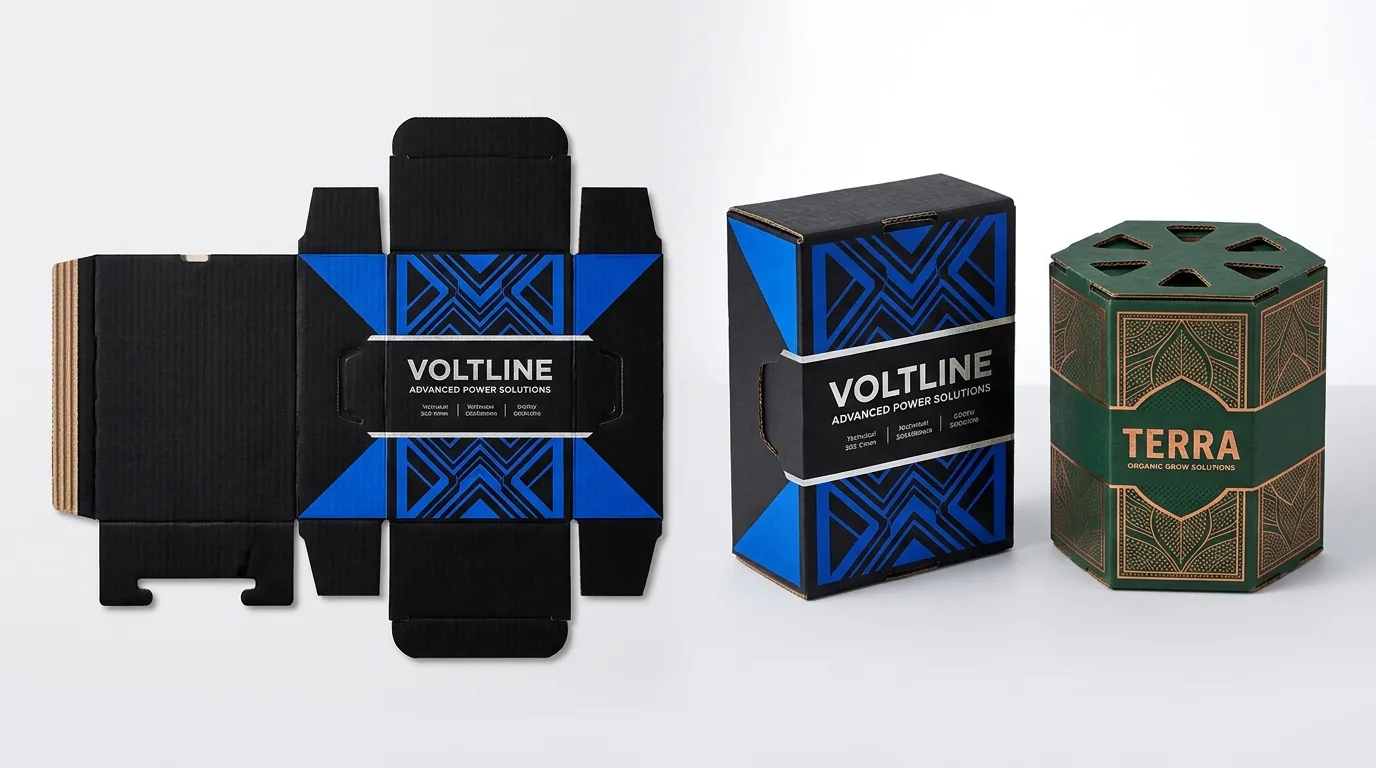
Designers opening their first vector CAD template for custom die-cut boxes notice far more line types than on a simple four-flap carton: through-cut outer contours, female floor slots, double-parallel rolled-wall scores, 45-degree corner miters, rounded finger notches, and nicked tear-strip zippers. In production, each vector stroke translates directly into specialized steel rules embedded in a laser-kerfed birch die board (for a flatbed platen press) or curved maple half-shell (for a rotary cylinder press), surrounded by compressible ejection rubber that pushes every scrap window cleanly out of the corrugated sheet in a single high-precision pass. Matching female slot width to exact flute caliper ensures locking tongues click home firmly without crushing arches, while CubitPack's zero die or plate setup policy, free structural CAD engineering, interactive 3D digital proof before payment, and free US shipping eliminate upfront tooling barriers.
What do the four vector line types on a corrugated steel-rule CAD dieline control?
When CubitPack prepress generates your free custom 2D vector dieline, every color-coded stroke corresponds to a distinct physical blade height and edge profile mounted inside the cutting die. Mixing up a cut path with a crease path or placing artwork inside a punch-out slot will slice right through your box on press. Review the four rule types below before placing graphics
- Sheet-holding nicks keep blanks intact on press: Microscopic 0.8 to 1.2 mm gaps ground into the cutting blade hold waste trim in place until the automatic stripping station knocks out every handle and locking slot cleanly.
- Parallel double creases for rolled walls: Wherever a side wall rolls 180 degrees over dust extensions into floor slots, prepress spaces two parallel creasing rules apart by 2x board thickness plus flute compression (approx. 3.5 mm on E-flute, 7.0 mm on B-flute) so walls stand plumb at 90 degrees.
- Creasing rule width scales with flute profile: Thin 2-point (0.7 mm) blunt rules score 1.6 mm E-flute cleanly, whereas thicker 4-point to 6-point (1.4 to 2.1 mm) rounded rules press wide fold channels into 3.2 mm B-flute and 4.0 mm C-flute without cracking outer kraft or mottled white liners.
- Grain and flute axis lock onto the dieline vertical: Prepress aligns corrugated flute arches perpendicular to the main horizontal load-bearing creases so vertical side walls act like miniature architectural columns on pallets and inside parcel trucks.
- Adhesive-free knock-out windows and vents: Every internal aperture on the CAD template carries continuous closed cut paths with rounded 3 to 12 mm corner radii so stripping pins punch out clean windows without leaving hanging paper chads.
| CAD vector rule | Physical steel-rule tooling | Where it sits on the blank | Prepress artwork rule |
|---|---|---|---|
| Through-Cut Line (Solid) | Razor-sharp 23.8 mm hardened steel blade + tiny sheet-holding nicks | Outer perimeter, locking tongues, female slots, vent & handle cutouts | Extend background ink 3–6 mm past outer cuts; keep text 6 mm inside |
| Crease / Score Rule (Dashed) | Rounded blunt steel rule set 1.5–3.5 mm lower than cutting blades | 90° wall hinges, 180° double-wall roll lines, internal cradle folds | Allow wraparound color-blocks; keep 6 pt micro-text off double scores |
| Cut-Crease / Zipper Perf | Alternating cut teeth and uncut bridges (e.g., 6 mm cut / 3 mm tie) | Tamper-evident e-commerce tear strips and retail display pop-offs | Print directional pull arrows beside strip; keep barcodes clear |
| Bleed & Glue/Tape Mask | Non-printing prepress margin + optional peel-and-seal applicator zone | Outer perimeter bleed + raw fiber strip for peel-and-seal tape | Leave adhesive applicator tracks ink-free and varnish-free |
What is the difference between flatbed platen die-cutting and rotary cylindrical die-cutting?
Corrugated converters stamp custom die-cut blanks on two primary press architectures. Understanding whether your structural design favors a flatbed platen die or a high-speed rotary cylinder helps explain registration tolerances, intricate cradle folds, and litho-laminated finish options
- Compressible ejection rubber keeps edges crisp: Dense closed-cell rubber strips bonded alongside every steel cutting rule compress at the bottom of the press stroke and spring back instantaneously to eject the sheet without tearing kraft or white fibers.
- Automatic scrap stripping removes handle and slot waste: Dedicated male-and-female stripping pins knock out internal handle holes, steam vents, and narrow 1.9 to 3.5 mm locking slots inline so flat KDF bundles arrive ready to fold immediately on your fulfillment line.
| Production factor | Flatbed Platen Die-Cutting | Rotary Cylindrical Die-Cutting |
|---|---|---|
| How the sheet is stamped | Flat laser-cut birch board presses vertically against a stationary steel platen | Curved maple half-shells spin continuously against a soft urethane anvil drum |
| Dimensional tolerance | Ultra-tight ±0.8 to ±1.2 mm cut-to-print registration | Standard ±1.5 to ±2.5 mm high-speed corrugated tolerance |
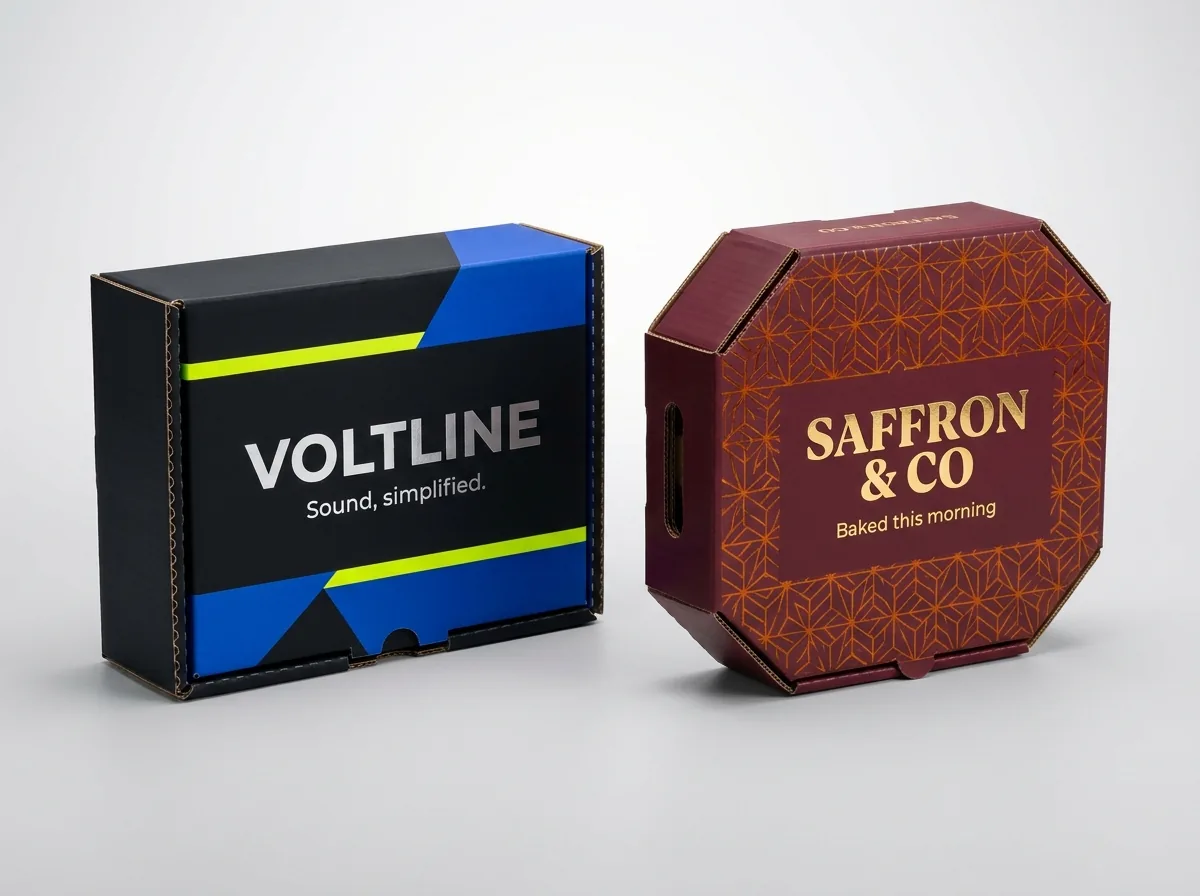
| Intricate tabs & cradles | Ideal for tight E-flute hardware cradles, small locking ears, and foil/Spot UV | Ideal for B/C-flute octagonal pizza boxes, vented food trays, and mail folders |
| Compatible print methods | Offset litho-lamination, digital CMYK, screen, and hot foil stamping | Inline 1–3 color flexo printing and high-speed digital corrugated |
| Die cost at CubitPack | Free (zero die or plate charges) | Free (zero die or plate charges) |
How are self-locking tabs, friction slots, and built-in retention cradles engineered?
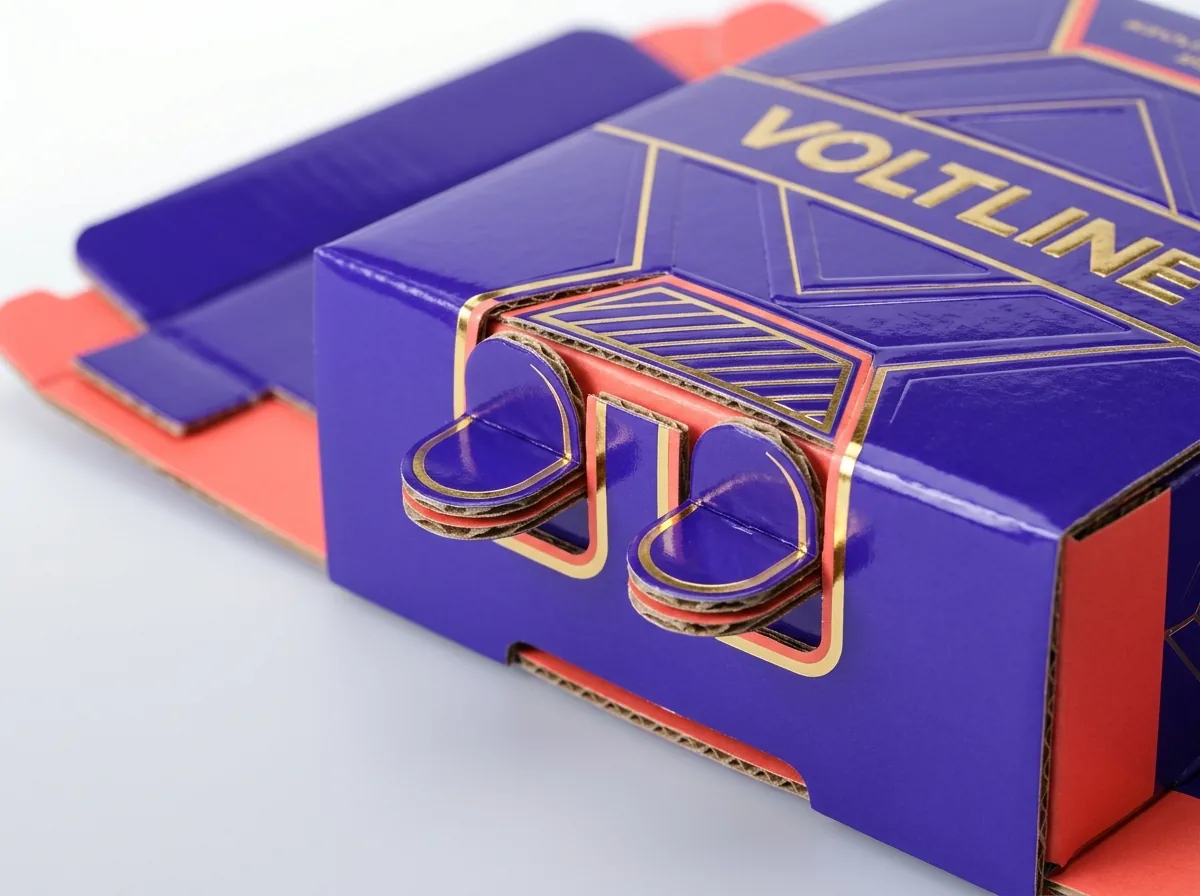
A tape-free corrugated box is only as reliable as the mechanical interference between its male locking tongues and female receiving slots. If slots are cut too narrow, warehouse packers crush the locking ears trying to force them shut; if slots are cut too wide, lids pop open on parcel sorting chutes. Whether we are engineering custom electronics boxes, custom subscription boxes, custom pizza boxes, or custom gift basket boxes, prepress calibrates five geometric details on every custom corrugated die-cut box
- Slot width matched to single board caliper: Female floor and front-wall slots are cut equal to nominal board thickness plus 0.3 mm (approx. 1.9 mm for E-flute, 3.5 mm for B-flute) so locking tongues slide in without crushing flutes yet resist popping back out.
- 1.5 mm retention shoulders (ear hooks): Extending subtle 1.5 mm rounded ears on both sides of a male locking tongue creates a positive mechanical click underneath the double-layered wall.
- Lead-in 15-degree corner chamfers on tongues: Angling the outer tips of every male locking tab by 15 degrees guides the tongue straight into the receiving slot during rapid bench assembly.
- Thumb-relief crescent cutouts: Adding a smooth 18 mm half-moon finger notch beside flush locking flaps lets customers lift the cover cleanly without tearing fingernails or prying walls apart.
- One-piece pop-up suspension cradles: Extending the inner roll walls or floor panels into scored star-burst or stepped air-cell flaps suspends routers, speakers, candle jars, or bottles 12 to 20 mm away from all six outer walls using zero plastic foam.
Know your size? Compare pricing across up to 3 quantities.
Request a Quote →How do you prepare print-ready Illustrator files for outside and inside corrugated printing?
Pair these six prepress rules with our companion guides on how to measure and choose flute for die-cut boxes and die-cut corrugated boxes vs RSC shipping and mailer boxes so your file sails through CubitPack's free artwork check on the first pass. Remember that corrugated sheets experience slight flute cushion compression during printing and die-cutting, making generous bleeds and clean layer separation essential
- Step 1: Place outside artwork and inside artwork on two separate templates (or clearly labeled Outside and Inside artboards) because turning a flat blank over flips left and right asymmetric cutouts.
- Step 2: Extend background flood coats and geometric patterns 4 to 6 mm past all outer cut lines and 3 mm into open window or handle cutouts so minor corrugated sheet shift never shows raw unprinted board.
- Step 3: Keep logos, 8 pt text, and QR codes at least 6 mm (0.25 in) clear of all creasing rules, locking slots, and tear-strip perforations so blunt score rules never distort scannable modules.
- Step 4: When printing bright brand colors or crisp white text onto natural brown kraft corrugated board, supply a 100% vector spot layer named WHITE_INK so unbleached kraft fibers do not mute your palette.
- Step 5: Place metallic hot foil stamping, raised Spot UV, and blind embossing on separate named 100% K spot vector layers set to overprint above your CMYK litho art.
- Step 6: Outline all fonts, embed 300 DPI CMYK linked rasters, call out Pantone solid coated or uncoated swatches where needed (backed by our Pantone match guarantee), and inspect your free 3D digital proof before payment.

What CAD dieline and artwork mistakes cause issues on corrugated die-cut boxes?
Check your Illustrator file against these five steel-rule prepress pitfalls before final sign-off
- Drawing a DIY dieline without double-parallel roll creases, which makes double side walls bow outward instead of locking flat at 90 degrees.
- Designing inside print artwork on the outside dieline without mirroring asymmetric handle or window cutouts, causing interior graphics to land backward.
- Printing flood varnish or heavy ink across a peel-and-seal adhesive strip track, which prevents hot-melt carrier tape from bonding to the board.
- Setting female locking slots too wide (6+ mm on E-flute), allowing friction tabs to pop loose whenever the parcel vibrates on a conveyor belt.
- Flattening cut and crease vector lines into the CMYK artwork layer so steel-rule lines accidentally print onto the finished box.
Packaging for this
Ready to order die cut boxes? Compare up to 3 quantities with a free 3D mockup.
Request a Quote →Questions about die cut boxes
Does CubitPack provide a custom 2D CAD dieline for my exact product shape for free?
Yes. Share your product dimensions (or ship your physical item to our team for structural fitting) and we engineer your custom 2D vector steel-rule dieline, inside-and-outside print templates, and 3D digital mockup free of charge, with zero die or plate setup fees.
Can CubitPack rebuild an AI-generated box concept onto a real steel-rule corrugated dieline?
Yes. Under our free AI-concept-to-print service, we rebuild every visual element of your AI packaging mockup cleanly onto a structurally accurate one-piece corrugated CAD dieline and show a 3D proof before you pay.
How much bleed do custom corrugated die-cut boxes require?
Provide 3 to 4 mm (0.125 in) of bleed on flatbed litho-laminated E-flute boxes and 5 to 6 mm (0.25 in) of bleed on rotary flexo or digital B/C-flute boxes so background colors wrap cleanly past every steel-rule cut.
Can I combine metallic foil stamping and Spot UV on a corrugated die-cut box?
Yes. By offset-printing your design onto a smooth top sheet, applying matte or soft-touch lamination, hot foil stamping, and raised Spot UV, and litho-laminating that sheet onto E-flute or B-flute corrugated board, you get luxury retail finishes with corrugated strength.
Can I test my locking tabs and built-in cradle with a physical prototype before ordering?
Yes. In addition to the free 3D digital mockup included with every quote, we offer custom CAD-cut physical prototypes (priced per product) and our $50 material & finish sample kit (credited toward your first production order).
Still have a question? Ask a packaging specialist.
Request a Quote →Request your die cut boxes quote
Tell us your size and quantities, and one dedicated account manager prepares pricing for each tier.
- Free design & AI-to-print studio + 3D mockup
- No die or plate charges · 4–5 day rush available
- Free shipping to all 50 states
- 10% off your first order
We verified steel-rule cutting, creasing, and zipper perforation standards, flatbed vs rotary die tolerances, locking-slot interference formulas, and corrugated bleed rules against FEFCO technical manuals, Fibre Box Association (FBA) die-cutting guides, and ISTA 3A parcel procedures. Spot something wrong? Tell us and we fix it.
Sources
What changed
- November 5, 2026: First published with 4-rule CAD dieline table, flatbed vs rotary steel-rule matrix, locking-slot tolerance specs, and 5-step prepress checklist.
More guides
New packaging guides by email
Sizes, materials and design tips. Unsubscribe anytime.