
How do you measure and choose the right flute for custom die-cut boxes?
Short answer: Always measure custom die-cut boxes by usable interior Length × Width × Height (L × W × H) inside the assembled cavity. Choose E-flute (1/16 in) for crisp retail-style tabs under 10 lb, B-flute (1/8 in, 32 ECT) for pizza, meal kits, and e-commerce parcels, or C-flute (5/32 in) for heavy cushioned shippers.
On this page
- Why must you measure usable inside L × W × H instead of flat sheet or outside dimensions
- Should you choose E-flute, B-flute, or C-flute corrugated board for custom die-cut boxes
- How do you size carry handles, steam vents, and tear-strip perforations without weakening the box
- What is the 4-step workflow to lock in your custom die-cut box dimensions
- Common mistakes
- FAQs
Request a custom quoteFree dieline & 3D mockup
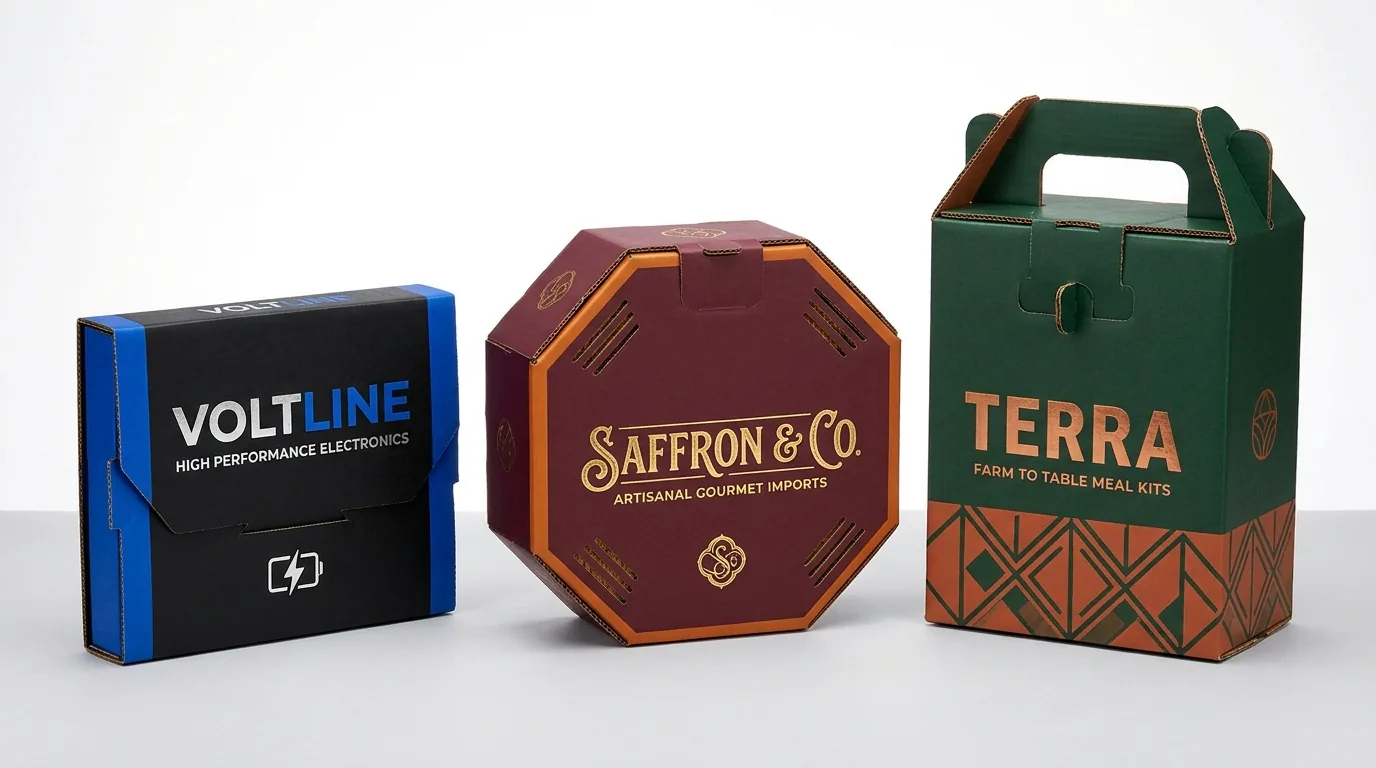
Ordering custom die-cut boxes requires tighter dimensional math than ordering a straight-slotted shipping carton because rolled double walls, angled corner miters, friction locking slots, and built-in retention wings fold inward from a single corrugated sheet. If you measure the outside of an old box instead of specifying usable interior Length × Width × Height, double-thick rolled B-flute side walls alone subtract 6 to 10 mm of interior width and pinch your product on the packing bench. Pairing accurate inside cavity measurements with the right flute profile ensures locking ears click home cleanly without cracking linerboard creases while trimming excess carrier dimensional (DIM) weight. CubitPack engineers your custom steel-rule CAD dieline free of charge, charges zero die or plate setup fees, shows a 3D digital proof before payment, and ships flat bundles free across all 50 US states in 10–14 business days.
Why must you measure usable inside L × W × H instead of flat sheet or outside dimensions?
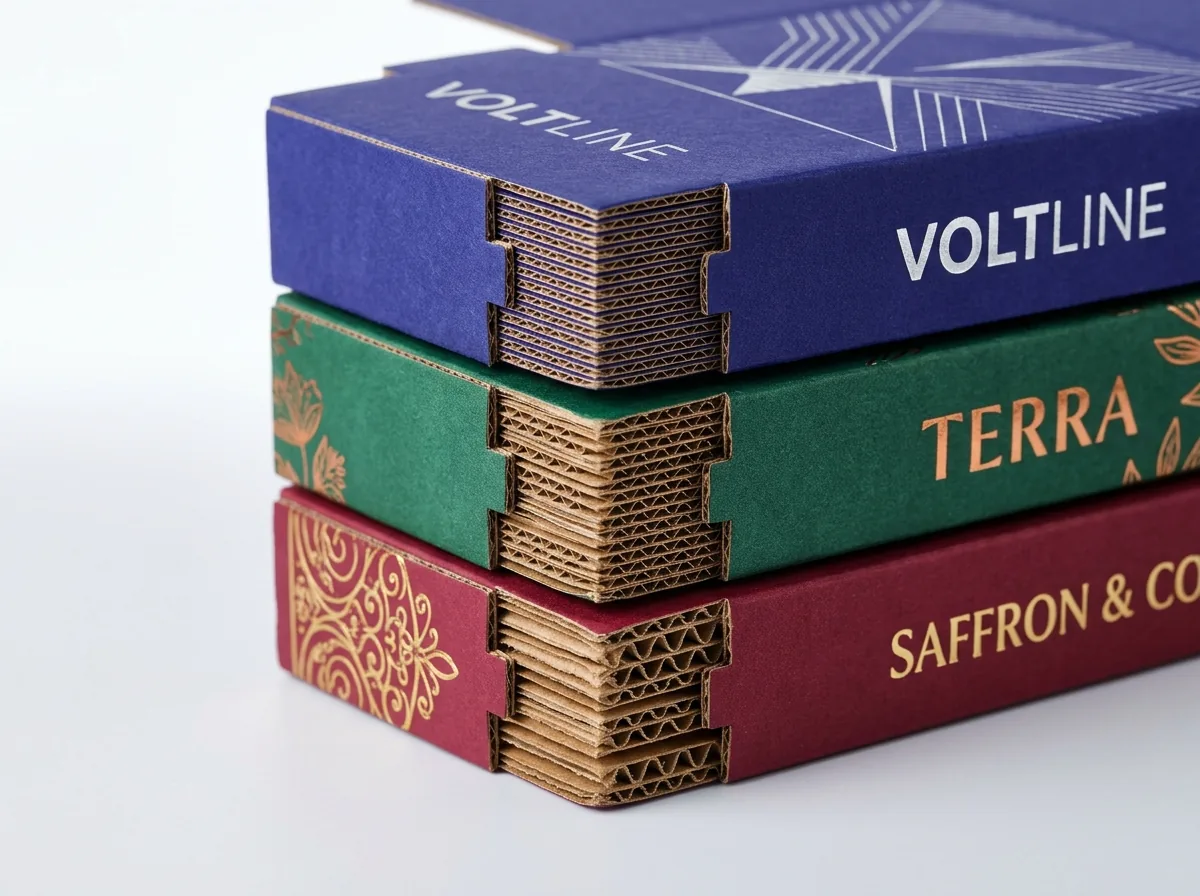
In corrugated structural design (FEFCO 04xx folder standards and Fibre Box Association conventions), dimensions are always quoted in usable Inside Length × Inside Width × Inside Height order from the perspective of a person standing in front of the open box. Length (L) is the left-to-right opening span across the hinged cover, Width (W) is the front-to-back depth from the locking wall to the rear hinge wall, and Height (H) is the clear vertical headspace between the floor and the closed cover ceiling. Every time a fluted corrugated panel bends 90 degrees or rolls 180 degrees over a double wall, the inner liner compresses and consumes interior clearance known as crease take-up. Compare how board caliper and wall construction shift outside parcel size relative to usable interior space
- Account for built-in corrugated cradles first: If your die-cut blank includes inward-folding air-cell buffers or suspension wings to hold a router or glass jar, measure the product itself and tell prepress how much perimeter air gap (typically 12 to 20 mm) you want around it.
- Check vertical headspace under dust wings: Side dust wings hinged off the cover rest directly atop the inner cavity rim, subtracting one board thickness (1.6 to 3.2 mm) from raw exterior height.
- Calculate UPS and FedEx DIM weight from Outer OD: Parcel carriers divide Exterior L × W × H (rounded to the nearest inch) by 139. Trimming just 0.4 in from an exterior wall so an 11.4 in box rounds to 11 in instead of 12 in can save an entire billable pound on every shipment.
| Flute & wall setup | Nominal board caliper | Double-rolled wall buildup (per side) | Outside OD over Usable ID (L & W) | Recommended clearance around product |
|---|---|---|---|---|
| E-Flute (90 flutes/ft) | ~1.6 mm (1/16 in) | 3.5 to 4.5 mm per rolled wall | +7 to +9 mm total | +2 to +3 mm slip clearance |
| B-Flute (47 flutes/ft) | ~3.2 mm (1/8 in) | 6.5 to 8.0 mm per rolled wall | +13 to +16 mm total | +3 to +5 mm slip clearance |
| C-Flute (39 flutes/ft) | ~4.0 mm (5/32 in) | 8.5 to 10.5 mm per rolled wall | +17 to +21 mm total | +4 to +6 mm slip clearance |
| Single-wall mitered folder | 1.6 to 3.2 mm (E or B) | 2.0 to 3.8 mm single wall | +4 to +8 mm total | +3 to +4 mm slip clearance |
Should you choose E-flute, B-flute, or C-flute corrugated board for custom die-cut boxes?
Flute profile controls three critical behaviors on a steel-rule die-cut blank: how sharply narrow locking tongues crease without splitting the outer kraft or white liner, how flat high-resolution graphics print across the washboard surface, and how much puncture or vertical stacking force the assembled walls resist during transit. Match your product category and payload weight to the right flute and Edge Crush Test (ECT) grade below
| Product & fulfillment scenario | Payload weight | Best flute & ECT spec | Why this board wins on a steel-rule die |
|---|---|---|---|
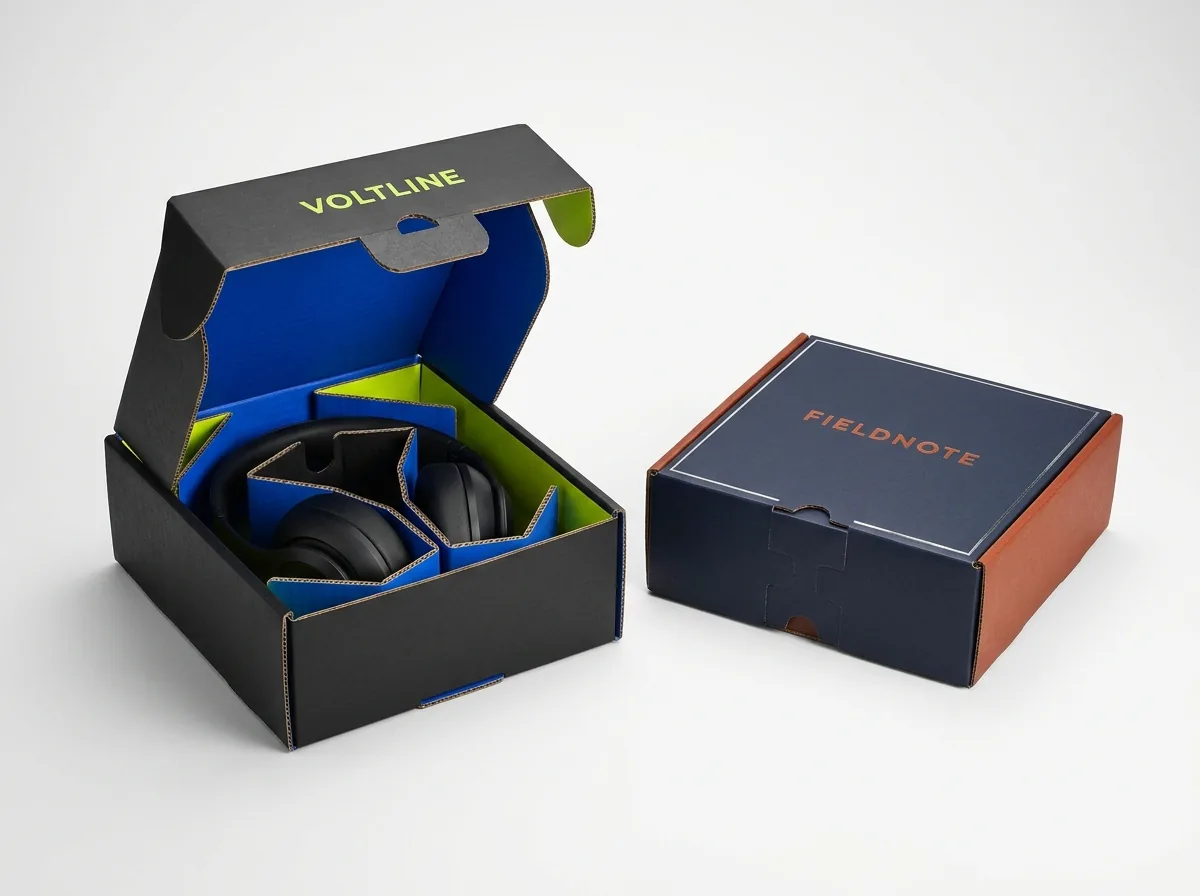
| Smart audio, routers & electronics | 0.5 to 6 lb | E-flute (1/16 in) litho-laminated | Folds tight internal cradles & prints offset-grade graphics |
| DTC apparel & subscription folders | 1 to 10 lb | E-flute or B-flute (32 ECT) | Slim mail profile + crisp twin locking ears with zero tape |
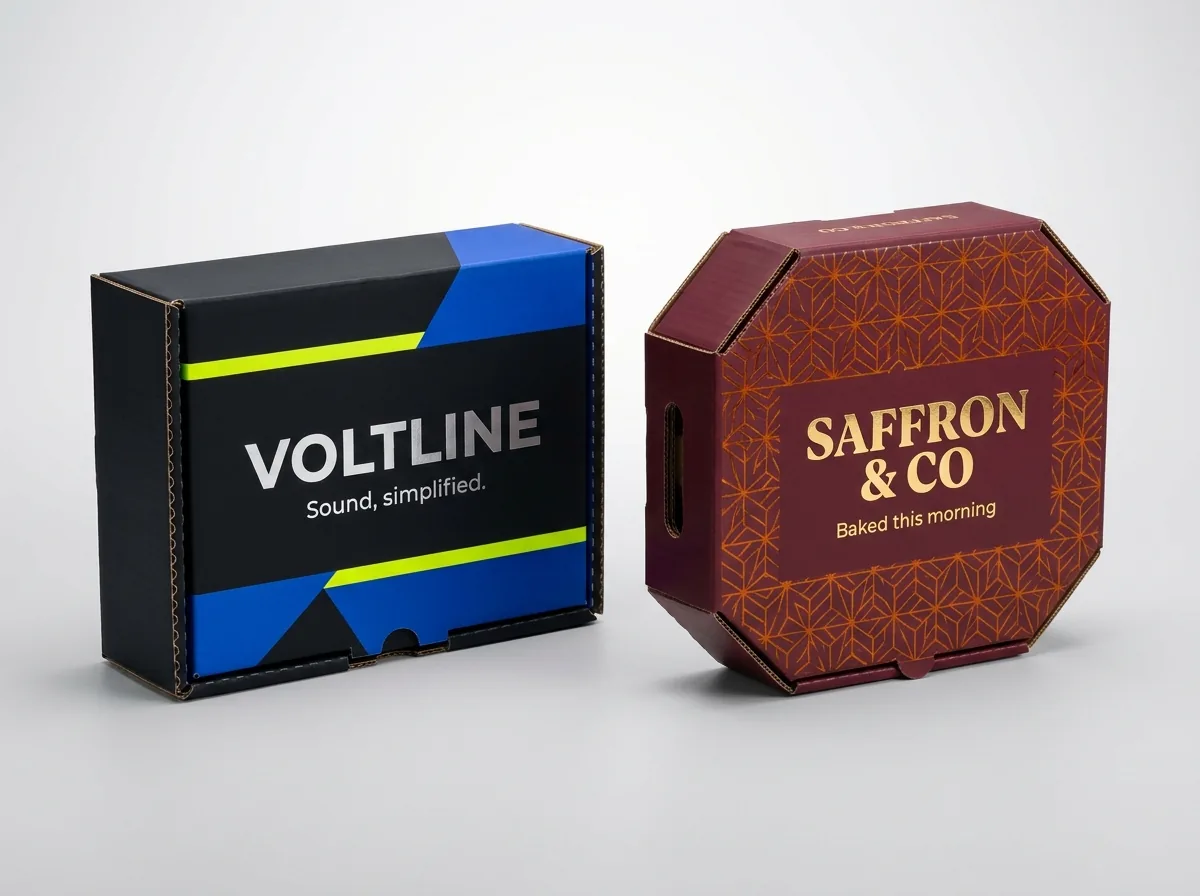
| Artisan 12–16 in octagonal pizza | 1.5 to 5 lb hot | B-flute (1/8 in) kraft corrugated | Insulates heat, vents steam, and resists soggy lid sag |
| Handled meal kits & pantry boxes | 8 to 22 lb | B-flute (1/8 in, 32–44 ECT) | High tear resistance around die-cut side carry hand-holes |
| Multi-jar gourmet gift baskets | 10 to 25 lb | B-flute 44 ECT or C-flute | Stiff floor and thick flute arches absorb parcel drop shock |
| Heavy hardware & industrial kits | 25 to 45+ lb | C-flute 44 ECT or EB double-wall | Maximum vertical stacking strength on warehouse pallets |
How do you size carry handles, steam vents, and tear-strip perforations without weakening the box?
One of the biggest advantages of custom printed die-cut boxes over straight-cut custom shipping boxes is stamping functional apertures in the exact same press pass as the outer perimeter. Whether you are building custom pizza boxes, custom meal kit boxes, custom electronics boxes, or custom ecommerce boxes, every cutout removes structural fiber from a load-bearing panel. Follow these four sizing rules to keep 32–44 ECT compression intact
- Hold a 15 mm (0.6 in) safety margin from all vertical corner creases: The four vertical corner columns carry up to 65% of a corrugated carton's top-to-bottom stacking load. Keep steam vents, window cutouts, and locking slots at least 15 mm away from vertical fold scores.
- Reinforce carry handles on 10+ lb boxes: Size ergonomic hand-holes around 85 × 25 mm with rounded 12 mm end radii so stress never concentrates at sharp corners, and position them through a double-folded flap layer so fingers lift two plies of corrugated board instead of one.
- Tune pizza and hot-food vent area: Two semicircular or capsule rear-wall vents measuring 30 × 14 mm let excess steam escape so crusts stay crisp without dumping cabin heat during delivery.
- Size tear-strip zippers 15 to 18 mm wide: Parallel nicked perforation blades spaced 15–18 mm apart across the cover let e-commerce shoppers pull a clean ribbon straight across the box without scissors.
- Frame clear PET window cutouts with a 15 to 20 mm corrugated border: Whenever a gift-basket or retail food die-cut box includes an inspection window on the top cover, preserve a continuous 15–20 mm corrugated border on all four sides so film adhesive bonds flat and the lid stays rigid.
Know your size? Compare pricing across up to 3 quantities.
Request a Quote →What is the 4-step workflow to lock in your custom die-cut box dimensions?
Pair these four measurement steps with our companion guides on die-cut corrugated boxes vs RSC shipping and mailer boxes and die-cut box dielines, interlocking tabs, and steel-rule dies before submitting your quote. Measuring your assembled product kit accurately on a flat fulfillment bench takes less than five minutes and guarantees that rolled corrugated side walls, corner miters, dust wings, and built-in retention flaps close squarely on the very first press run without pinching printed labels or rattling inside carrier trucks
- Step 1: Arrange your exact SKU or multi-item kit on a flat table in its desired unboxing layout, including any custom box inserts or custom tissue paper, and measure total length, width, and height with digital calipers or a rigid steel ruler rather than a flexible sewing tape.
- Step 2: Add +3 mm (1/8 in) on E-flute or +5 mm (3/16 in) on B-flute to Length, Width, and Height so warehouse packers can load items smoothly at peak fulfillment speed without scraping printed inner walls or catching paper pouches.
- Step 3: Select E-flute (1/16 in) for compact litho-printed tech hardware, cosmetics, and retail-ready folders under 10 lb; B-flute (1/8 in) 32 ECT for everyday artisan pizza, chilled meal kits, subscription sets, and e-commerce shippers; or 44 ECT B-flute and C-flute (5/32 in) when packing dense 20+ lb glass jars and multi-part assemblies.
- Step 4: Confirm grain and flute direction along the vertical Height axis if your boxes will stack on warehouse pallets or ride inside courier cages, keeping vertical compression columns continuous from floor to lid.
- Step 5: Enter those usable inside L × W × H numbers into CubitPack's shared quote form; prepress builds your exact steel-rule CAD dieline free of charge (with zero die or plate setup fees) and sends an interactive 3D digital mockup before payment, or you can order a $50 sample kit credited toward your first run.
What measurement and flute mistakes ruin custom corrugated die-cut boxes?
Double-check your spec sheet against these five dimensional and board-selection pitfalls before approving your proof
- Measuring an unfolded flat corrugated blank from cut edge to cut edge instead of giving usable assembled inside Length × Width × Height.
- Forgetting that switching an existing dieline from 1.6 mm E-flute to 3.2 mm B-flute shrinks interior width by 3 to 6 mm across rolled walls and tightens locking slots.
- Cutting sharp 90-degree rectangular corners on carry handle holes instead of rounded stadium ends, causing heavy meal-kit walls to rip when lifted.
- Orienting flutes horizontally across a tall narrow die-cut shipper instead of running flutes vertically along the Height axis for stacking compression.
- Adding 2 inches of unnecessary vertical air above a flat apparel or pizza SKU, inflating carrier DIM weight and letting stacked boxes dish inward.
Packaging for this


Ready to order die cut boxes? Compare up to 3 quantities with a free 3D mockup.
Request a Quote →Questions about die cut boxes
Do I enter inside or outside dimensions in the CubitPack quote form?
Always enter your usable interior Length × Width × Height (in inches) inside the assembled box cavity. Our structural specialists automatically add the exact flute thickness, rolled-wall crease take-up, and slot clearances onto your free CAD dieline.
What is the difference between 32 ECT and 44 ECT corrugated board on die-cut boxes?
Edge Crush Test (ECT) measures how many pounds per linear inch a corrugated wall supports vertically before buckling. Standard 32 ECT handles most single-parcel e-commerce, pizza, and subscription boxes up to 20–30 lb, while 44 ECT resists heavy pallet stacking and rough courier handling for dense kits.
Can CubitPack help me pick between E-flute and B-flute before production?
Yes. Request our $50 sample kit (credited toward your first order) to feel board thicknesses and finishes firsthand, or order a custom physical pre-production prototype cut to your exact product dimensions before approving your full run.
Does choosing a custom non-standard box size trigger extra die setup fees?
No. CubitPack charges zero die or plate setup fees on custom steel-rule corrugated die-cut boxes, so tailoring Length, Width, and Height to cut carrier DIM weight costs nothing extra in tooling.
What is the minimum order quantity for custom-sized corrugated die-cut boxes?
Our quote form offers preset quantities starting at 250, 500, 1,000, 2,500, and 5,000+ boxes, and trial orders are evaluated case by case with dedicated 24/7 account support and free shipping across all 50 US states.
Still have a question? Ask a packaging specialist.
Request a Quote →Request your die cut boxes quote
Tell us your size and quantities, and one dedicated account manager prepares pricing for each tier.
- Free design & AI-to-print studio + 3D mockup
- No die or plate charges · 4–5 day rush available
- Free shipping to all 50 states
- 10% off your first order
We verified usable interior Length × Width × Height conventions, E/B/C flute calipers and rolled-wall crease take-up allowances, 32–44 ECT stacking ratings, and handle/vent safety margins against FEFCO International Fibreboard Case Codes, Fibre Box Association (FBA) corrugated handbooks, and ISTA 3A parcel procedures. Spot something wrong? Tell us and we fix it.
Sources
What changed
- November 5, 2026: First published with E/B/C flute rolled-wall buildup table, 6-category flute & ECT selector matrix, and cutout safety margin rules.
More guides
New packaging guides by email
Sizes, materials and design tips. Unsubscribe anytime.