
Die-cut corrugated boxes vs RSC shipping vs mailer boxes: which structure fits best?
Short answer: Pick a custom steel-rule die-cut box for custom shapes, steam vents, carry handles, tear strips, or built-in product cradles with zero tape; pick a standard Roll End Tuck Front mailer for rectangular DTC gift kits; and pick an RSC shipping box for heavy, taped bulk master cases.
On this page
- How do custom die-cut boxes, RSC shipping boxes, and RETF mailers compare head to head
- When does a self-locking die-cut box beat a low-cost RSC shipping carton on total cost
- How does a custom die-cut box go beyond a standard Roll End Tuck Front mailer
- Which corrugated box style matches each food, tech, and e-commerce product
- How do you finalize your corrugated box choice before requesting a quote
- Common mistakes
- FAQs
Request a custom quoteFree dieline & 3D mockup
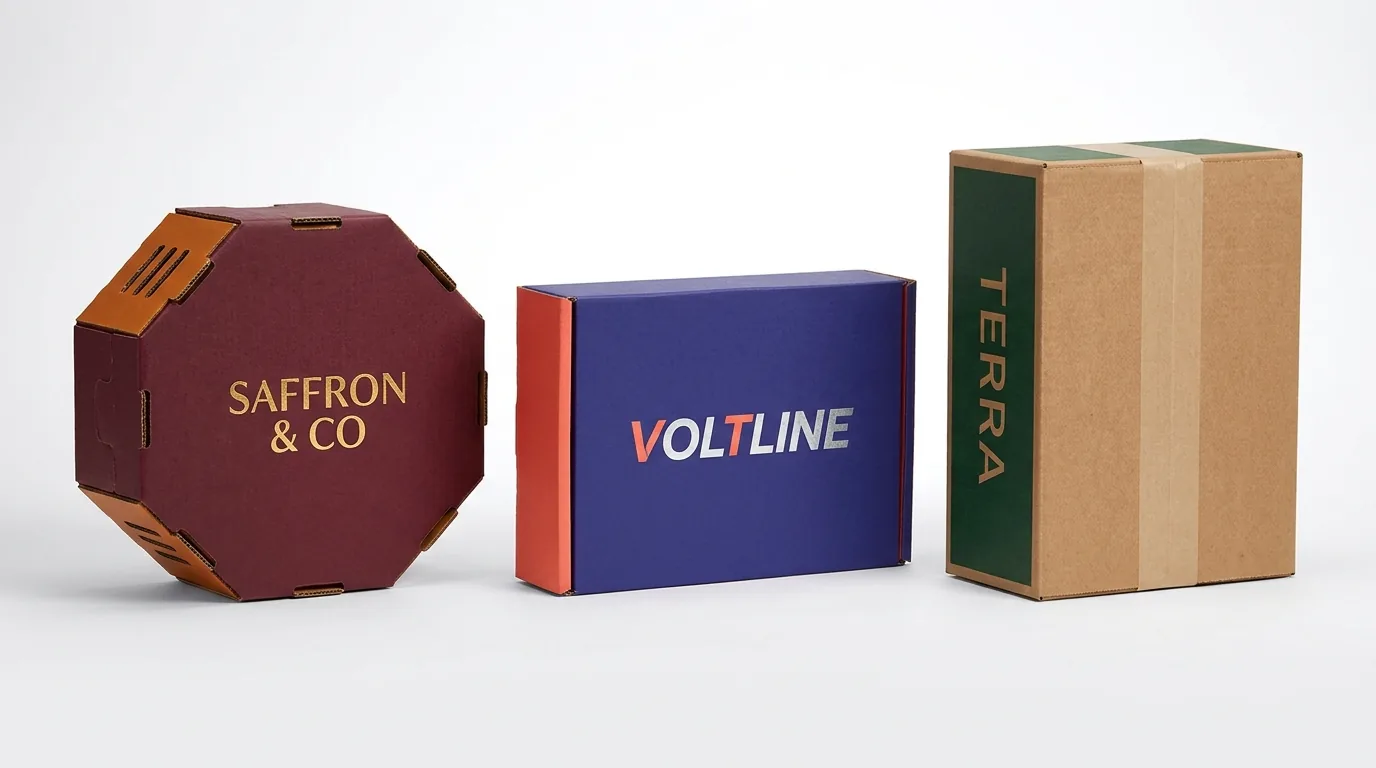
Operations leads comparing custom die-cut boxes against custom shipping boxes and custom mailer boxes are choosing among the three workhorse fluted corrugated architectures in modern US e-commerce, food delivery, and retail fulfillment. All three ship 100% knocked-down flat (KDF) in strapped bundles across all 50 states with free delivery, support vibrant outside and inside printing, and include CubitPack's zero die or plate setup policy with a free 3D digital proof before payment. Their structural DNA differs sharply: an RSC shipping box (FEFCO 0201) uses straight rotary slots and four meeting flaps sealed with packing tape for heavy bulk volume; a standard mailer box (FEFCO 0427) is one specific rectangular Roll End Tuck Front folder; and a custom steel-rule die-cut box unlocks complete geometric freedom with octagonal corners, ergonomic handles, hot-food vents, zippered tear strips, and integrated one-piece corrugated cradles.
How do custom die-cut boxes, RSC shipping boxes, and RETF mailers compare head to head?
Choosing the wrong corrugated structure creates hidden fulfillment drag: warehouse teams waste 25 seconds per order stuffing crumpled kraft paper and applying three strips of H-tape to an oversized RSC carton when a self-locking die-cut folder could click shut around the product in 6 seconds with zero void fill. Compare all three fluted formats across tooling, assembly labor, functional cutouts, and carrier billing below
| Engineering & fulfillment factor | Custom Die-Cut Box | RETF Mailer Box | RSC Shipping Box |
|---|---|---|---|
| FEFCO structural family | Bespoke 04xx / 07xx / 09xx steel-rule die | Standard 0427 rectangular roll-end mailer | Standard 0201 four-flap slotted container |
| Closure hardware required | None (interlocking tabs or peel-and-seal strip) | None (front tuck flap + cherry-lock ears) | 2-inch or 3-inch packing tape top & bottom |
| Custom silhouette & cutouts | Octagonal, tapered, handles, vents, windows | Rectangular tray with hinged top lid | Straight rectangular walls only |
| Internal product retention | Can fold built-in cradles from the 1-piece blank | Uses drop-in card, EVA, or EPE inserts | Uses separate corrugated dividers or pads |
| Bench assembly time | ~5–8 seconds (fold creases & click tabs) | ~6–9 seconds (roll side walls & tuck ears) | ~18–25 seconds (fold, tape bottom, pack, tape top) |
| Die & plate fees at CubitPack | Free (zero die or plate charges) | Free (zero die or plate charges) | Free (zero die or plate charges) |
When does a self-locking die-cut box beat a low-cost RSC shipping carton on total cost?
On raw corrugated board area alone, a Regular Slotted Container (FEFCO 0201) has the lowest blank cost per cubic inch because straight rotary slotting knives waste almost zero trim around rectangular sheets. Once operations managers calculate fulfillment bench labor, void-fill dunnage inventory, tape dispensers, steel-rule tooling, and UPS or FedEx dimensional weight across thousands of monthly shipments, however, a custom die-cut box frequently lowers total landed cost per delivered order while elevating customer unboxing satisfaction
- Zero steel-rule die barrier at CubitPack: Traditional corrugated converters bill steep upfront charges for a custom flatbed or rotary cutting die and printing plates, forcing growing brands into oversized stock RSC cartons. CubitPack waives all die and plate fees completely.
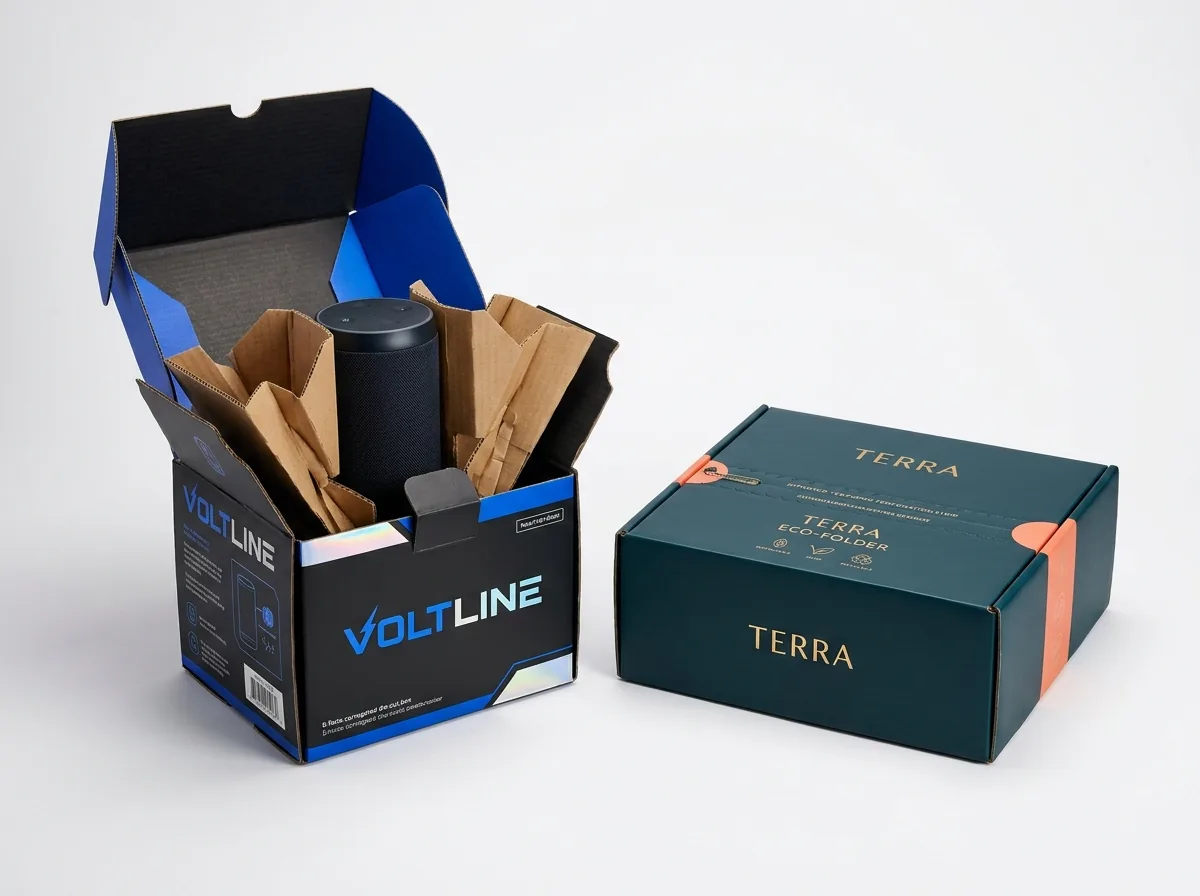
- Eliminating separate foam or plastic bubble wrap: A one-piece retention die-cut box folds internal corrugated suspension bridges directly out of its own side extensions, replacing two separate warehouse SKUs (an outer RSC box plus loose plastic air pillows or foam end-caps) with a single mono-material curbside-recyclable sheet.
- Zero packing tape across top branding: Eliminating two strips of water-activated paper or acrylic tape per carton cuts consumable spend, speeds peak-season fulfillment stations from 22 seconds down to 6 seconds per order, and keeps full-bleed CMYK or metallic foil lid graphics 100% unobstructed.
- Snug low-profile wrap-around geometry: For flat apparel, framed prints, laptops, books, and artisan pizza, a FEFCO 0422 wrap-around folder or octagonal die-cut box closes tightly at 1.5 to 3.5 inches tall, whereas standard RSC flaps gap or overlap unevenly on shallow depths.
- Lower carrier dimensional (DIM) weight brackets: Because major US parcel couriers divide Exterior Length × Width × Height by 139, replacing an oversized 6-inch-deep stock RSC box with a custom 3-inch-deep self-locking die-cut folder routinely trims 1 to 3 billable pounds off every shipping label.
How does a custom die-cut box go beyond a standard Roll End Tuck Front mailer?
Technically, a Roll End Tuck Front (RETF) mailer is one classic member of the die-cut corrugated family, which is why square cosmetic, supplement, and candle brands love custom mailer boxes starting at 250 units. Ordering bespoke custom corrugated die-cut boxes unlocks specialized mechanical features whenever a plain rectangular RETF chest falls short of your thermal, carrying, or return-logistics workflow
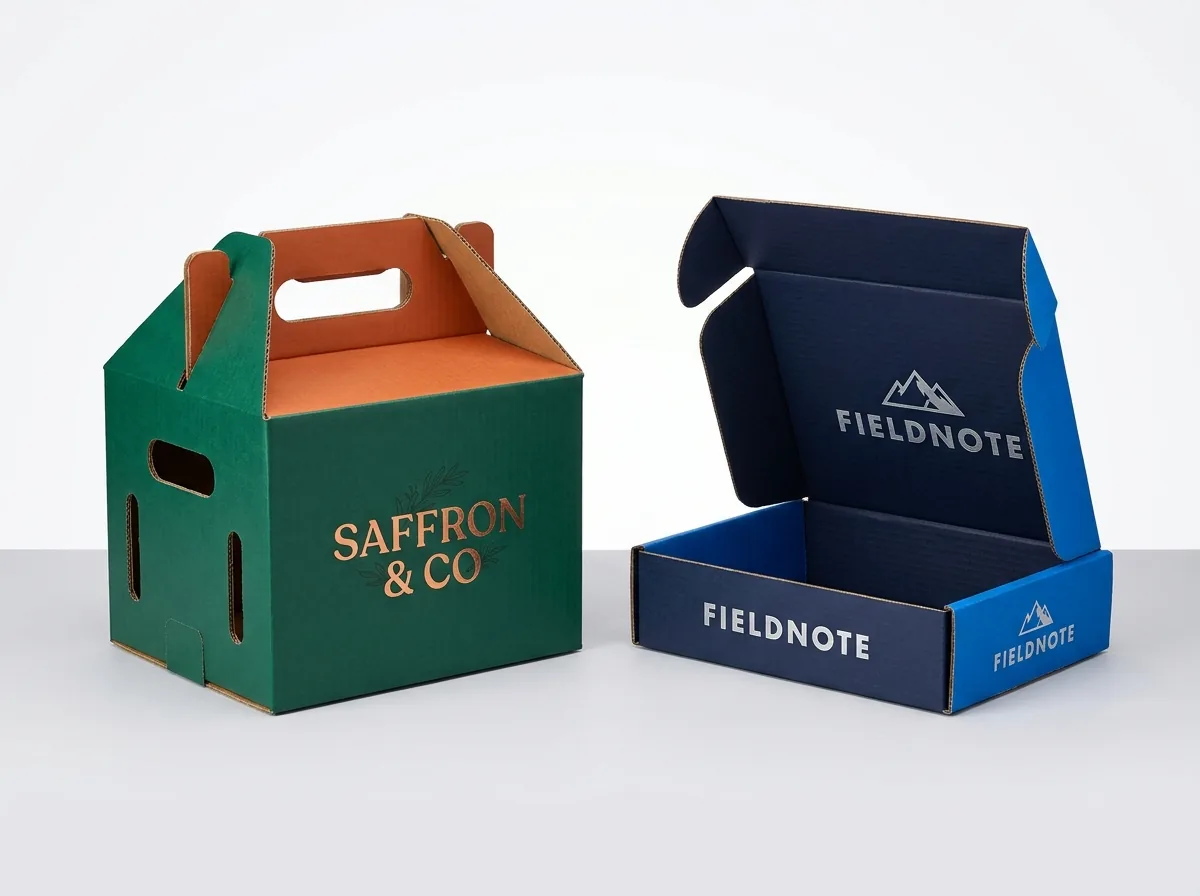
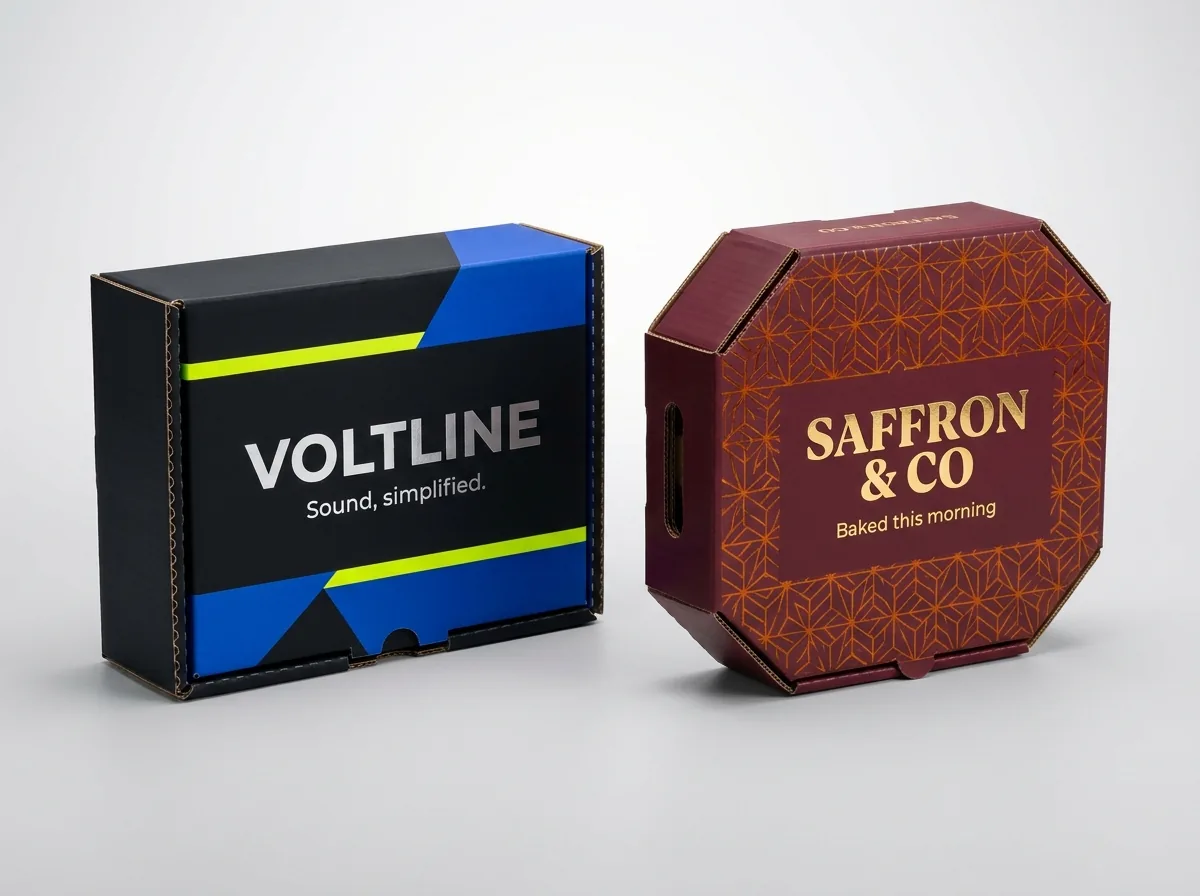
- Octagonal corner rigidity for hot food delivery: Beveling all four corners at 45 degrees adds eight vertical crease columns around a pizza or bakery pie, doubling top-lid sag resistance under insulated delivery bags while keeping round pies centered.
- Ergonomic two-ply carry lift for heavy meal kits: Punching stadium-shaped hand-holes through double-rolled corrugated side walls lets couriers and customers carry 15 to 22 lb chilled ingredient boxes comfortably from doorstep to kitchen counter.
- Dual-strip e-commerce return folders: Adding a primary peel-and-seal adhesive strip alongside a zippered tear-open strip and a secondary return adhesive track turns apparel folders into reusable two-way mailers without plastic polybags.
- Open-arch retail and gift-basket display: Custom die-cut trays can taper side walls downward toward the front or lock an integrated corrugated arch handle overhead so gourmet bottles and jars stay visible on farmstand and boutique tables.
| Product challenge | Why a Custom Die-Cut Box wins | When a Standard RETF Mailer wins |
|---|---|---|
| Hot wood-fired pizza & bakery trays | Octagonal beveled corners prevent pie sliding + rear vents release steam | Unvented rectangular mailer traps condensation on hot crust |
| Heavy 15 lb chilled meal kits | Die-cut double-ply side carry hand-holes + locking gable or tab top | Front cherry-lock ears are not meant to carry 15 lb by one lid |
| High-volume e-commerce apparel returns | Dual peel-and-seal adhesive strips + tear-strip zipper for instant courier return | Requires outer polybag or security sticker across front tuck flap |
| Fragile router or smart speaker | One-piece folded corrugated suspension wings molded into the blank | Clean rectangular presentation paired with a separate EVA foam tray |
Know your size? Compare pricing across up to 3 quantities.
Request a Quote →Which corrugated box style matches each food, tech, and e-commerce product?
Whether you are sourcing custom pizza boxes, custom meal kit boxes, custom electronics boxes, custom ecommerce boxes, or custom gift basket boxes, use this quick pairing table alongside our custom double-wall boxes to match every SKU in your catalog to its ideal corrugated workhorse. Matching flute thickness and closure mechanics directly to product fragility prevents transit damage claims while keeping warehouse kitting fast and intuitive
| Product SKU | Winning corrugated style | Flute & closure spec | Interior protection |
|---|---|---|---|
| 14-inch Artisan Pizza | Octagonal Vented Die-Cut Box | B-flute kraft + front friction tongue | Food-safe greaseproof liner |
| Wireless Headphones / Router | One-Piece Cradle Die-Cut Box | Litho E-flute + twin front lock tabs | Built-in folded corrugated wings |
| Weekly Chilled Meal Kit | Handled Self-Locking Die-Cut Box | B-flute 44 ECT + reinforced handles | Kraft honeycomb thermal liner |
| Skincare & Candle PR Kit | Standard RETF Mailer Box | White E-flute + cherry-lock ears | Die-cut card or EVA foam insert |
| 24-Unit Wholesale Case (42 lb) | RSC or Double-Wall Shipper | C-flute / BC double-wall + H-tape | 12-cell corrugated partition grid |
How do you finalize your corrugated box choice before requesting a quote?
Review these five decision checkpoints alongside our companion guides on how to measure and choose flute for die-cut boxes and die-cut box dielines, interlocking tabs, and steel-rule dies. Because CubitPack engineers custom 2D CAD templates and 3D digital mockups across all three corrugated styles under one roof with free shipping across all 50 US states, you can match each product line in your warehouse to the exact container it deserves without juggling multiple box vendors
- Choose a Custom Die-Cut Box when your product benefits from custom octagonal or tapered silhouettes, hot-food steam vents, reinforced double-ply carry handles, zippered tear-open strips, shallow wrap-around apparel folders, or built-in one-piece corrugated suspension cradles that eliminate separate foam inserts.
- Choose a Standard RETF Mailer Box (starting at 250 units) when you want a classic rectangular gift-chest unboxing with double-rolled side walls, full-bleed inside and outside printing, and front cherry-lock ears for skincare, supplements, candles, or influencer PR kits.
- Choose an RSC Shipping Box (or 48+ ECT BC Double-Wall Box) when you pack heavy 25 to 80+ lb wholesale master cases, moving boxes, or multi-SKU warehouse orders sealed rapidly on semi-automated H-tape machines.
- Audit carrier dimensional (DIM) weight across your top 3 shipping zones: eliminating 2 inches of empty headspace with a custom-fitted die-cut or RSC carton often pays back packaging upgrades through lower UPS, FedEx, and USPS parcel invoices.
- Ask CubitPack for a free 3D digital mockup and custom CAD dieline on your top two structural candidates (or order our $50 material & finish sample kit credited toward your first order) so your operations and brand teams can compare bench assembly speed and unboxing impact before payment.
What mistakes happen when choosing between die-cut, mailer, and RSC boxes?
Steer clear of these five structural mismatches before placing your corrugated production run
- Ordering a 4-flap RSC carton for a 2-inch-tall flat apparel or pizza item, resulting in awkward uneven flaps and wasted packing tape.
- Packing hot freshly baked food inside an unvented mailer box without die-cut rear steam slots, turning crisp crusts soggy in delivery bags.
- Paying another vendor steep steel-rule die setup charges when CubitPack includes custom die tooling with zero die or plate fees.
- Sending an unsealed friction-tab box through UPS or FedEx Ground without adding a peel-and-seal adhesive strip or tamper wafer seal.
- Using a thin single-wall folder for 50 lb industrial metal parts that belong in a taped 48 ECT BC double-wall RSC case.
Packaging for this


Ready to order die cut boxes? Compare up to 3 quantities with a free 3D mockup.
Request a Quote →Questions about die cut boxes
Are custom corrugated die-cut boxes much more expensive than RSC shipping boxes?
Because CubitPack charges zero steel-rule die or plate fees, custom die-cut boxes have zero upfront tooling penalty. While the flat corrugated blank uses slightly more board area for locking tabs or rolled walls, brands often save more per order by eliminating packing tape, loose void fill, and excess DIM weight.
Is a mailer box considered a die-cut box?
Yes. A standard Roll End Tuck Front mailer (FEFCO 0427) is one specific rectangular die-cut style. Ordering from our custom die-cut boxes page lets you go beyond standard RETF geometry into octagonal corners, carry handles, vents, tear-strip zippers, wrap-around folders, and built-in cradles.
Can custom die-cut boxes include peel-and-seal adhesive strips and return strips?
Yes. For e-commerce apparel and electronics shippers, we can apply a peel-and-seal adhesive tape strip paired with a die-cut tear-strip zipper, or dual adhesive strips so customers can reseal returns cleanly.
Do all three corrugated styles ship flat to save warehouse space?
Yes. Custom die-cut boxes, RETF mailer boxes, and RSC shipping cartons all arrive 100% knocked-down flat (KDF) in strapped bundles or palletized stacks with free shipping across all 50 US states.
How fast can CubitPack deliver custom printed die-cut or RSC boxes?
Standard production takes 10–14 business days after digital proof approval and payment, and 4–5 business day rush production is available when you have an urgent product launch, seasonal promotion, or warehouse restock, with 24/7 live customer support throughout production.
Still have a question? Ask a packaging specialist.
Request a Quote →Request your die cut boxes quote
Tell us your size and quantities, and one dedicated account manager prepares pricing for each tier.
- Free design & AI-to-print studio + 3D mockup
- No die or plate charges · 4–5 day rush available
- Free shipping to all 50 states
- 10% off your first order
We compared FEFCO 04xx one-piece die-cut folders, FEFCO 0427 RETF mailers, and FEFCO 0201 RSC slotted containers across tooling, bench assembly steps, flute profiles, and parcel drop practices using FEFCO codes, Fibre Box Association (FBA) manuals, and ISTA 3A standards. Spot something wrong? Tell us and we fix it.
Sources
What changed
- November 5, 2026: First published with 6-factor comparison matrix, landed-cost breakdown, RETF vs bespoke die-cut table, and 5-SKU corrugated pairing chart.
More guides
New packaging guides by email
Sizes, materials and design tips. Unsubscribe anytime.