
How do you measure and choose the right ECT rating for double wall boxes?
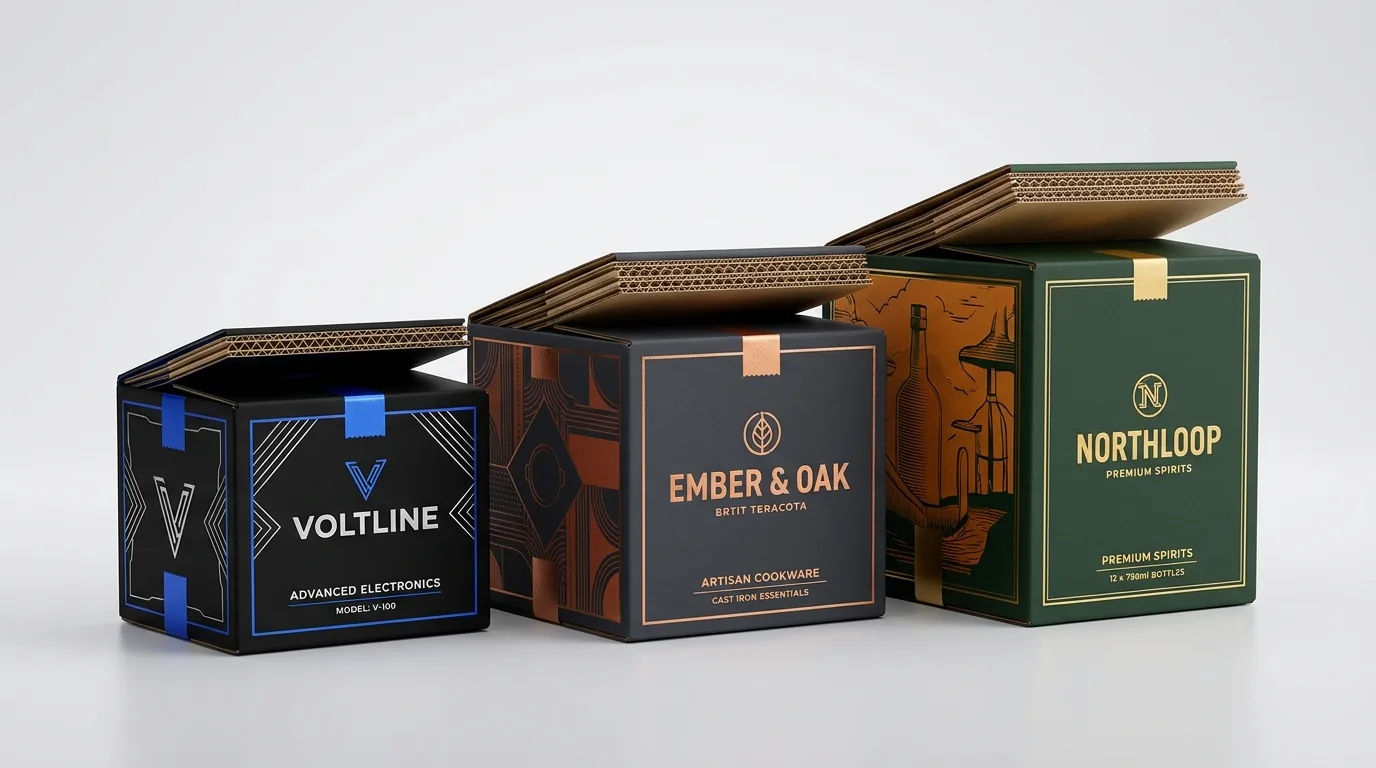
Short answer: Always measure custom double wall boxes by usable interior Length × Width × Height (L × W × H) inside the assembled cavity, including foam end-caps or bottle dividers. Choose 48 ECT EB-flute or BC-flute for 35 to 65 lb parcels, 51 to 61+ ECT for heavy pallet stacks, or 275–350# Mullen for sharp metal hardware.
On this page
- Why must you measure usable inside L × W × H instead of outside dimensions on 5-ply cartons
- Should you choose 48 ECT, 51+ ECT, or 275–350# Mullen burst double-wall board
- How do EPE foam end-caps, honeycomb pads, and bottle dividers change interior box dimensions
- What is the 5-step workflow to finalize your double-wall box size and ECT specification
- Common mistakes
- FAQs
Request a custom quoteFree dieline & 3D mockup
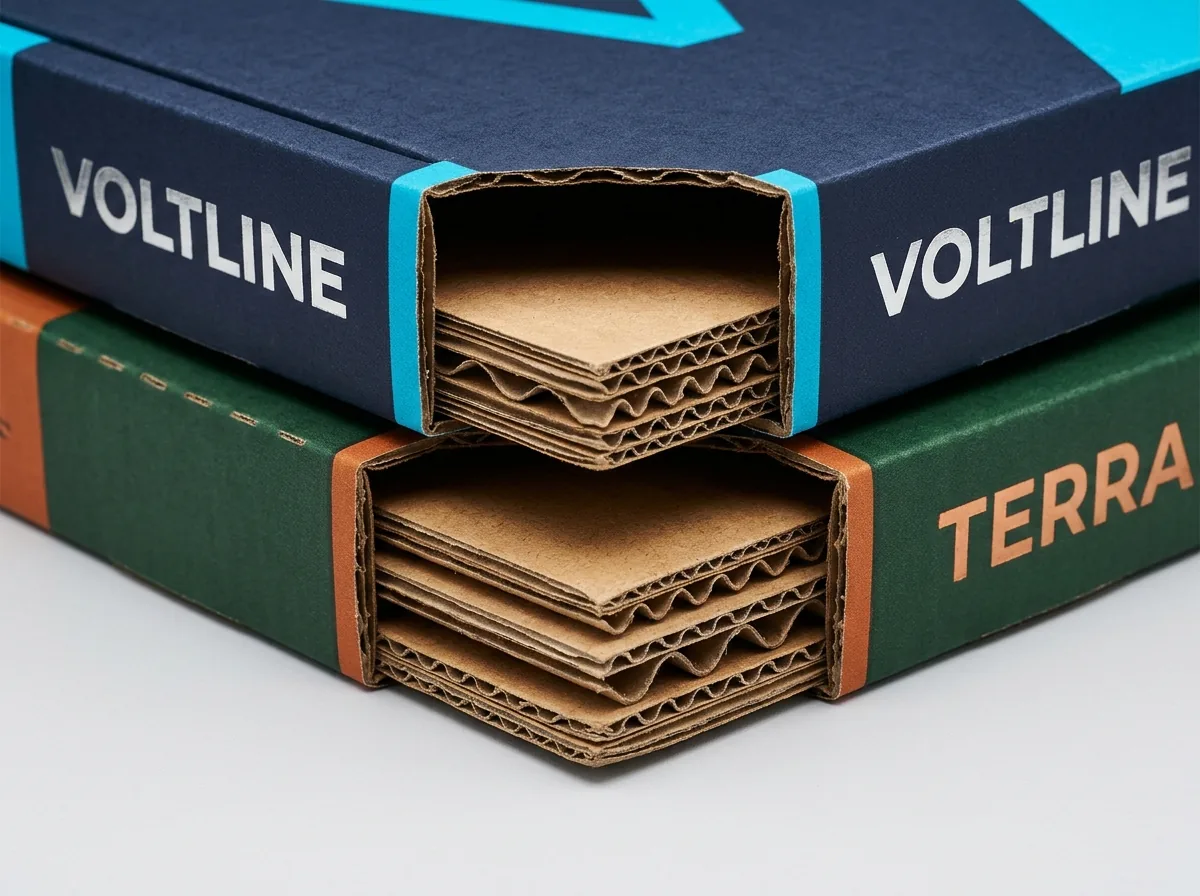
Sizing custom double wall boxes demands exact inside-to-outside allowance math because 5-ply combined board (two fluted mediums bonded between three flat linerboards) is nearly twice as thick as everyday single-wall corrugated stock. A single BC-flute wall measures roughly 7.0 mm (9/32 in) thick, meaning two opposing side walls add 14 to 16 mm to exterior width while four folded RSC flap layers add up to 28 mm to exterior height. If you hand a supplier outside parcel numbers by mistake, your cast-iron cookware, desktop electronics, or 12-bottle wine partitions will jam on the packing line. Pairing accurate usable inside L × W × H dimensions with the right Edge Crush Test (48 ECT, 51 ECT, or higher) keeps heavy pallet tiers upright and trims excess carrier dimensional weight. CubitPack prepares your custom 5-ply CAD dieline free of charge with zero die or plate setup fees and ships flat across all 50 US states in 10–14 business days.
Why must you measure usable inside L × W × H instead of outside dimensions on 5-ply cartons?
Across Fibre Box Association (FBA) and FEFCO 0201 Regular Slotted Container standards, corrugated box dimensions always denote usable Inside Length × Inside Width × Inside Height read from the open top of the assembled box. Length (L) is the longer opening span, Width (W) is the shorter front-to-back opening span, and Height (H) is the clear vertical distance between the closed bottom inner flaps and the closed top inner flaps. When 5-ply board bends 90 degrees at four vertical corners and 180 degrees across eight horizontal RSC flap scores, inner liners compress inward into the cavity. Compare how EB-flute and BC-flute 5-ply wall calipers expand exterior parcel dimensions beyond your usable interior cavity
- Include internal cushioning before measuring: Never measure a bare cast-iron Dutch oven, audio amplifier, or brake rotor alone. Assemble the item inside its closed-cell EPE foam end-caps, kraft honeycomb buffers, or 12-cell corrugated bottle partitions on a bench first, then measure the complete cushioned block.
- Watch carrier cubic-inch and oversize thresholds: Because four plies of BC-flute RSC flaps add over 1.1 inches to exterior height, an inside height of 15.0 inches yields a 16.1-inch outside height that UPS and FedEx round up to 17 inches for dimensional (DIM) weight billing.
- Verify pallet footprint overhang: On standard 48 × 40 inch GMA wooden pallets, accounting for the extra +5/8 inch of exterior BC-flute length and width prevents column-stacked cartons from overhanging the wooden deckboard edge, where overhanging corners lose up to 30% of their vertical stacking strength.
| 5-ply flute combination | Single wall caliper | Outside L & W buildup (2 walls) | Outside Height buildup (4 flap plies) | Recommended loading clearance |
|---|---|---|---|---|
| EB-Flute (E outer + B inner) | ~4.6 mm (3/16 in) | +9.5 to +11.0 mm (+3/8 in) | +18.5 to +20.0 mm (+3/4 in) | +4 to +5 mm slip margin |
| BC-Flute (B outer + C inner) | ~7.0 mm (9/32 in) | +14.0 to +16.0 mm (+5/8 in) | +27.0 to +30.0 mm (+1.1 in) | +5 to +6 mm slip margin |
| BC-Flute Full Overlap (FOL) | ~7.0 mm (9/32 in) | +14.0 to +16.0 mm (+5/8 in) | +42.0 mm (6 overlapping plies) | +6 mm slip margin |
| 3-ply C-Flute (for comparison) | ~4.0 mm (5/32 in) | +8.0 mm (+5/16 in) | +16.0 mm (+5/8 in) | +3 to +4 mm slip margin |
Should you choose 48 ECT, 51+ ECT, or 275–350# Mullen burst double-wall board?
Corrugated double-wall board is certified on its bottom Box Manufacturer's Certificate (BMC) stamp by one of two laboratory metrics: Edge Crush Test (ECT, measured in pounds per linear inch of vertical column compression) or Mullen Burst Test (measured in pounds per square inch of hydraulic diaphragm puncture pressure). High ECT grades excel when cartons sit stacked four to six tiers high on LTL freight trailers and humid warehouse racks, whereas high Mullen burst grades excel when dense, unpadded metal castings or hardware fasteners slam against the inner wall inside automated parcel chutes. Match your payload weight and shipping lane to the right 5-ply grade
| Product & transit profile | Packed box weight | Recommended 5-ply spec | Primary structural benefit |
|---|---|---|---|
| Desktop electronics & espresso gear | 20 to 45 lb | 48 ECT EB-flute double wall | Smooth E-flute outer print face + 5-ply corner drop armor |
| Enameled cast-iron cookware sets | 30 to 65 lb | 48 ECT or 51 ECT BC-flute | Deep 7 mm dual-flute shock cushion resists rim chipping |
| 6-bottle & 12-bottle spirits / wine | 22 to 48 lb | 48–51 ECT BC-flute + 2-ply cells | Prevents wet warehouse stack collapse & bottle-to-bottle clink |
| Brake rotors, alternators & power tools | 40 to 85 lb | 275# Mullen or 51 ECT BC-flute | Virgin kraft liners & center sheet stop sharp steel edges |
| Bulk fasteners & industrial hardware | 65 to 100+ lb | 61+ ECT or 350# Mullen BC-flute | Maximum burst & bottom-tier LTL pallet compression safety |
How do EPE foam end-caps, honeycomb pads, and bottle dividers change interior box dimensions?
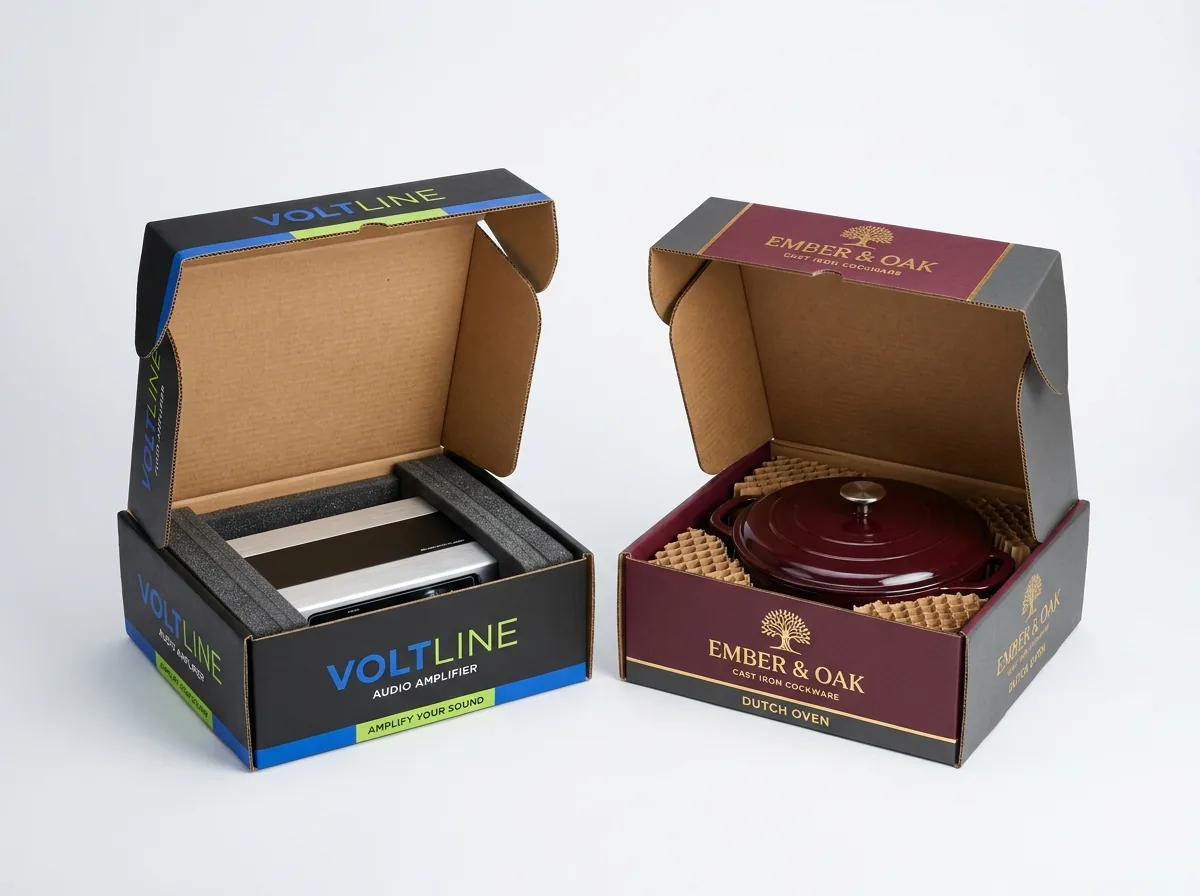
Even the toughest 51 ECT 5-ply custom double-wall cartons cannot stop internal damage if heavy items rattle freely against each other or strike the outer wall with zero deceleration distance. Pairing 5-ply outer walls with engineered internal cushioning turns cartons for custom kitchenware boxes, custom electronics boxes, custom auto parts boxes, custom wine boxes, and custom spirits boxes into ISTA 3A-ready transit systems. Add these proven buffer thicknesses to your bare product size when calculating usable inside L × W × H
- Closed-cell EPE polyethylene foam end-caps (25 to 50 mm per side): Unlike brittle white EPS bead foam that shatters on the first drop, resilient EPE foam rebounds across repeated parcel drops. Add 50 to 100 mm (2 to 4 in) to your bare product's L, W, and H to house perimeter foam ribs.
- Interlocking 5-ply or 3-ply bottle partitions: In a 12-bottle (4 × 3) wine or spirits case, three longitudinal divider strips plus two crosswise strips add five board thicknesses across Length and four across Width, plus top and bottom corrugated layer pads.
- Kraft honeycomb compression blocks (20 to 40 mm thick): All-paper hexagonal honeycomb pads placed under and above heavy cast-iron Dutch ovens or kettlebells absorb vertical drop shock without plastic foam while staying 100% curbside recyclable.
- Reinforced carry hand-hole clearance: If packers lift 40 to 65 lb cartons by side hand-holes, leave at least 15 mm of internal foam or corrugated backing clearance behind the cutout so fingers can curl inward comfortably without hitting sharp cargo.
- Zero loose void fill for dense metal parts: Never float a 35 lb brake rotor or electric motor in loose Kraft paper or air pillows; dense metal migrates straight to the bottom corner on the first conveyor drop unless locked inside die-cut corrugated or EPE foam cradles.
Know your size? Compare pricing across up to 3 quantities.
Request a Quote →What is the 5-step workflow to finalize your double-wall box size and ECT specification?
Combine this five-step bench workflow with our companion guides on double-wall boxes vs single-wall RSC and heavy-duty shippers and double-wall box dielines, BC vs EB flutes, and H-taping before requesting your quote. Locking in usable interior cavity dimensions alongside your pallet pattern and carrier weight rules guarantees your cartons erect squarely, fit 48 × 40 inch pallets without overhang, and protect high-value cargo from factory floor to customer doorstep
- Step 1: Assemble your product inside its final custom box inserts, EPE foam end-caps, honeycomb pads, or bottle dividers on a flat table and measure the full cushioned footprint (Length × Width × Height) with a rigid steel tape.
- Step 2: Add +5 mm (3/16 in) on EB-flute or +6 mm (1/4 in) on BC-flute to Length, Width, and Height so packers can slide heavy foam assemblies or divider sets smoothly into the vertical tube without binding against inner liner seams.
- Step 3: Check total gross weight against carrier heavy-package rules (UPS and FedEx apply special handling and team-lift label rules above 50 lb and 70 lb) and verify exterior L × W × H against 48 × 40 inch pallet stacking layouts.
- Step 4: Pick 48 ECT EB-flute when retail graphic sharpness and compact 4.6 mm walls matter most, 48–51 ECT BC-flute for 40 to 85 lb cookware, tools, and 12-bottle glass cases, or 275–350# Mullen when sharp metal edges create concentrated puncture hazards.
- Step 5: Enter your usable inside L × W × H into CubitPack's shared quote form; prepress builds your 5-ply CAD dieline free of charge (with zero die or plate setup fees), provides a 3D digital proof before payment, and offers physical drop-test prototypes or a $50 sample kit credited toward your first order.
What sizing and board-grade mistakes ruin heavy-duty double-wall cartons?
Check your engineering brief against these five costly 5-ply sizing and specification errors before approving production
- Submitting exterior measurements from an old single-wall box and losing 14 to 16 mm of usable interior width when upgrading to 7 mm BC double-wall walls.
- Sizing the carton to the bare product first and forgetting to leave 25 to 50 mm per side for EPE foam end-caps, honeycomb buffers, or 2-ply cell partitions.
- Letting 5-ply cartons overhang the edges of a 48 × 40 inch wooden pallet by even 1 inch, cutting bottom-tier vertical compression strength by nearly a third.
- Choosing standard 32 ECT single-wall board for 45+ lb cast-iron or multi-bottle cases that buckle on the bottom layer of humid LTL freight trailers.
- Orienting corrugated flutes horizontally along the box length instead of vertically along the Height axis, forfeiting top-to-bottom pallet stacking rigidity.
Packaging for this

Ready to order double wall boxes? Compare up to 3 quantities with a free 3D mockup.
Request a Quote →Questions about double wall boxes
Should I enter inside or outside dimensions when quoting custom double-wall boxes?
Always enter your usable interior Length × Width × Height (in inches) inside the assembled 5-ply box cavity, including any foam end-caps or dividers. CubitPack's structural prepress team automatically adds the exact 9.5 mm EB-flute or 14–16 mm BC-flute wall buildup and wide flap-slot clearances onto your free CAD dieline.
What is the difference between 48 ECT and 275# Mullen double-wall corrugated board?
A 48 ECT stamp certifies vertical stacking compression (48 pounds per linear inch of wall edge), making it ideal for palletized master cases and warehouse racking. A 275# Mullen stamp certifies burst and puncture resistance (275 pounds per square inch), using heavier virgin kraft liners to stop unpadded metal parts and sharp corners from punching through walls.
How much weight can a 48 ECT or 51 ECT double-wall shipping box hold?
Under Fibre Box Association Rule 41 / Item 222 guidelines, 48 ECT double-wall cartons routinely carry 65 to 80 lb payloads and 51 to 61+ ECT grades support 85 to 120+ lb when paired with proper interior cushioning and reinforced H-taping.
Can we order a custom physical prototype to run ISTA drop and crush tests first?
Yes. CubitPack produces custom 5-ply pre-production prototypes cut to your exact interior L × W × H and foam insert dimensions for bench fit checks and ISTA 3A/3B drop or compression testing, alongside our $50 material & finish sample kit (credited toward your first production order).
What is the minimum order quantity and turnaround for custom double-wall boxes?
Our shared quote form includes preset tiers starting at 250, 500, 1,000, 2,500, and 5,000+ boxes with zero die or plate setup fees. Standard production takes 10–14 business days (4–5 business days rush) with free shipping across all 50 US states.
Still have a question? Ask a packaging specialist.
Request a Quote →Request your double wall boxes quote
Tell us your size and quantities, and one dedicated account manager prepares pricing for each tier.
- Free design & AI-to-print studio + 3D mockup
- No die or plate charges · 4–5 day rush available
- Free shipping to all 50 states
- 10% off your first order
We verified usable interior Length × Width × Height conventions, EB-flute (4.6 mm) and BC-flute (7.0 mm) exterior wall buildup formulas, 48–71 ECT vs 275–350# Mullen burst standards, and pallet overhang rules against Fibre Box Association (FBA) corrugated handbooks, FEFCO 0201/0203 codes, and ISTA 3A/3B transit procedures. Spot something wrong? Tell us and we fix it.
Sources
What changed
- November 5, 2026: First published with EB/BC 5-ply wall buildup table, 48–61+ ECT vs Mullen selector matrix, and foam/partition clearance rules.
More guides
New packaging guides by email
Sizes, materials and design tips. Unsubscribe anytime.