
How do 5-ply double wall boxes compare to single-wall RSC and FOL heavy-duty shippers?
Short answer: Choose 3-ply single-wall RSC boxes (32–44 ECT) for everyday parcels under 35 lb. Upgrade to 5-ply double-wall RSC boxes (48–71 ECT) when payloads exceed 35–40 lb, hold dense metal or glass multi-packs, or stack on humid warehouse pallets. Pick Full Overlap (FOL) flaps for tall narrow frames and long shafts.
On this page
- How do 5-ply double-wall RSC, 3-ply single-wall RSC, and Full Overlap (FOL) shippers compare
- What 5 real-world payload triggers tell you single-wall board is no longer safe
- How does 5-ply double-wall board affect KDF bundle storage and carrier DIM weight
- Which corrugated shipper should your brand order for each SKU tier
- Common mistakes
- FAQs
Request a custom quoteFree dieline & 3D mockup
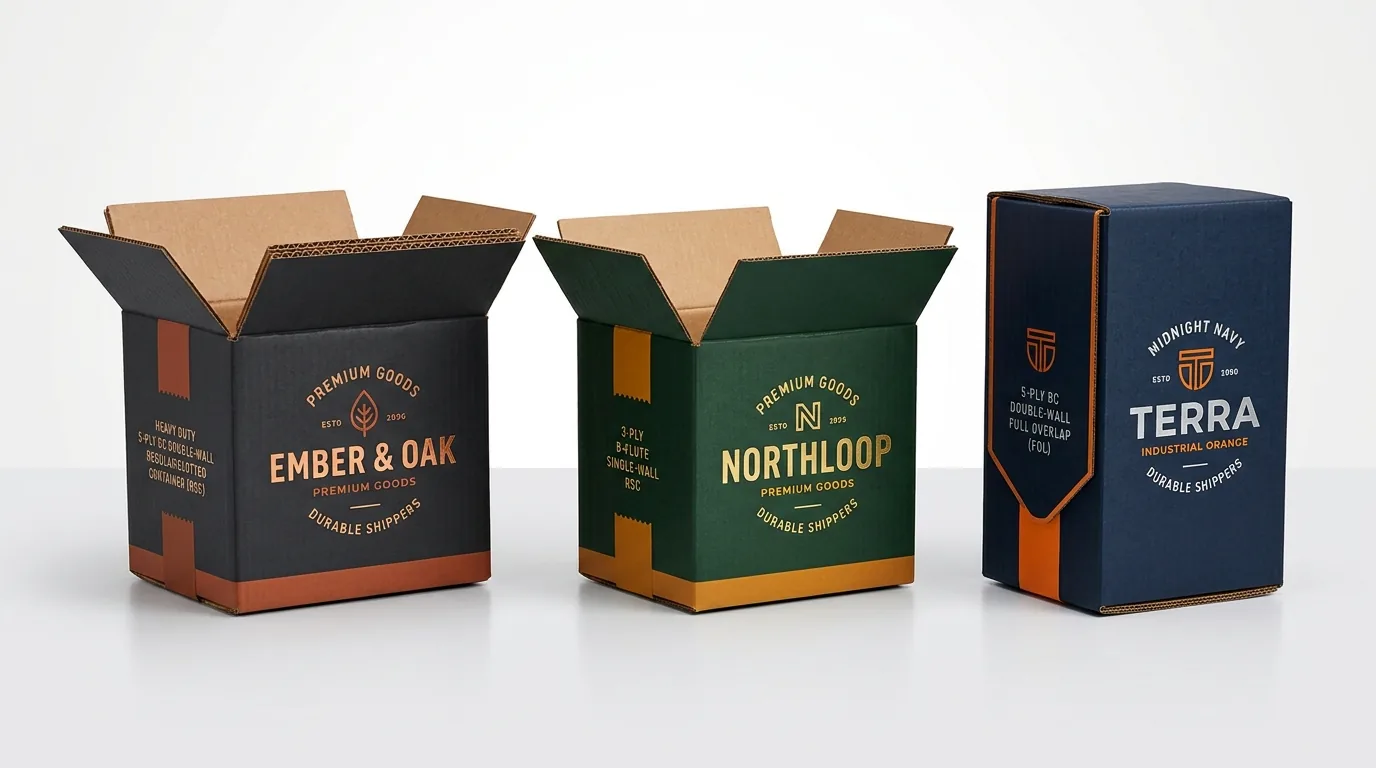
From ten feet away on a warehouse dock, custom double wall boxes and standard single-wall custom shipping boxes share the exact same FEFCO 0201 Regular Slotted Container silhouette: four vertical body walls and four meeting flaps on top and bottom. Look closely at any cut flap edge, however, and their structural physics diverge completely. Where a 3-ply single-wall carton relies on one fluted arch between two flat liners, a 5-ply double-wall carton sandwiches two distinct fluted arches (such as BC-flute or EB-flute) around a rigid center divider liner. That composite I-beam doubles side-impact puncture armor and elevates stacking compression from 32 ECT to 48–71+ ECT, preventing crushed bottom tiers on LTL pallets and shattered glass or chipped cast iron in parcel hubs. CubitPack builds all heavy corrugated formats with zero die or plate setup fees and free shipping across all 50 US states.
How do 5-ply double-wall RSC, 3-ply single-wall RSC, and Full Overlap (FOL) shippers compare?
Operations managers evaluating heavy transit packaging typically weigh three slotted corrugated configurations: standard 3-ply single-wall RSC (C-flute or B-flute), 5-ply double-wall RSC (BC-flute or EB-flute), and Full Overlap Slotted Containers (FEFCO 0203 FOL, available in either single-wall or 5-ply double-wall board). Review their mechanical differences across six warehouse and carrier benchmarks below
- Why the center liner changes puncture physics: When a conveyor diverter arm or adjacent steel corner strikes a 3-ply carton, tearing the outer liner collapses the lone flute directly into your product. On 5-ply board, the outer flute sacrifices itself to spread the impact across the tense middle linerboard while the inner flute stays intact.
- Humidity and 90-day warehouse creep: Corrugated paper fibers absorb moisture in humid coastal warehouses and ocean containers, losing 35% to 50% of dry lab ECT strength. Starting at 48 or 51 ECT double-wall keeps bottom pallet rows well above collapse thresholds.
- When Full Overlap (FEFCO 0203) wins: If your product is narrow and long (like framed art, golf clubs, or machined steel axles) where end-drop punctures happen through the top or bottom flaps rather than side walls, pairing 5-ply board with Full Overlap major flaps creates armor-plate ends.
| Engineering benchmark | 5-ply Double-Wall RSC (0201) | 3-ply Single-Wall RSC (0201) | Full Overlap Shipper (0203 FOL) |
|---|---|---|---|
| Combined board layers | 5 plies: 3 liners + 2 flutes (BC or EB) | 3 plies: 2 liners + 1 flute (B or C) | 3-ply or 5-ply with full-width outer flaps |
| Typical wall caliper | ~4.6 mm (EB) to ~7.0 mm (BC) | ~3.2 mm (B) to ~4.0 mm (C) | Same side walls; double-thick top & floor |
| Standard ECT & Mullen | 48 ECT to 71 ECT / 275–350# Mullen | 32 ECT to 44 ECT / 200# Mullen | 44 to 61+ ECT with reinforced end torque |
| Side-wall puncture stop | Center liner arrests sharp metal & forks | Single flute dents through on sharp hits | Matches chosen 3-ply or 5-ply side board |
| Top & bottom protection | 10 plies where minor + major flaps meet | 6 plies where minor + major flaps meet | Up to 15–20 plies across full overlapping span |
| Ideal cargo profile | 35–100+ lb cookware, rotors, wine, pallets | 5–35 lb everyday e-commerce & apparel | Mirrors, table tops, bikes, & heavy shafts |
What 5 real-world payload triggers tell you single-wall board is no longer safe?
Over-specifying 5-ply board on lightweight t-shirts wastes warehouse pallet space, whereas under-specifying 32 ECT single-wall board on cast-iron skillets triggers replacement shipments, broken-glass carrier penalties, and 1-star unboxing reviews. Even a 2% transit damage rate on high-ticket cookware, espresso machines, or reserve wine cases quickly wipes out any per-carton savings from thinner 3-ply paper. Audit your SKU line against these five concrete engineering triggers
| Damage or logistics trigger | Why 3-ply single-wall fails | How 5-ply double-wall solves it |
|---|---|---|
| Gross box weight exceeds 35–40 lb | Corner columns crease & bow during 30 in drops | Dual-flute beam resists corner crush & seam split |
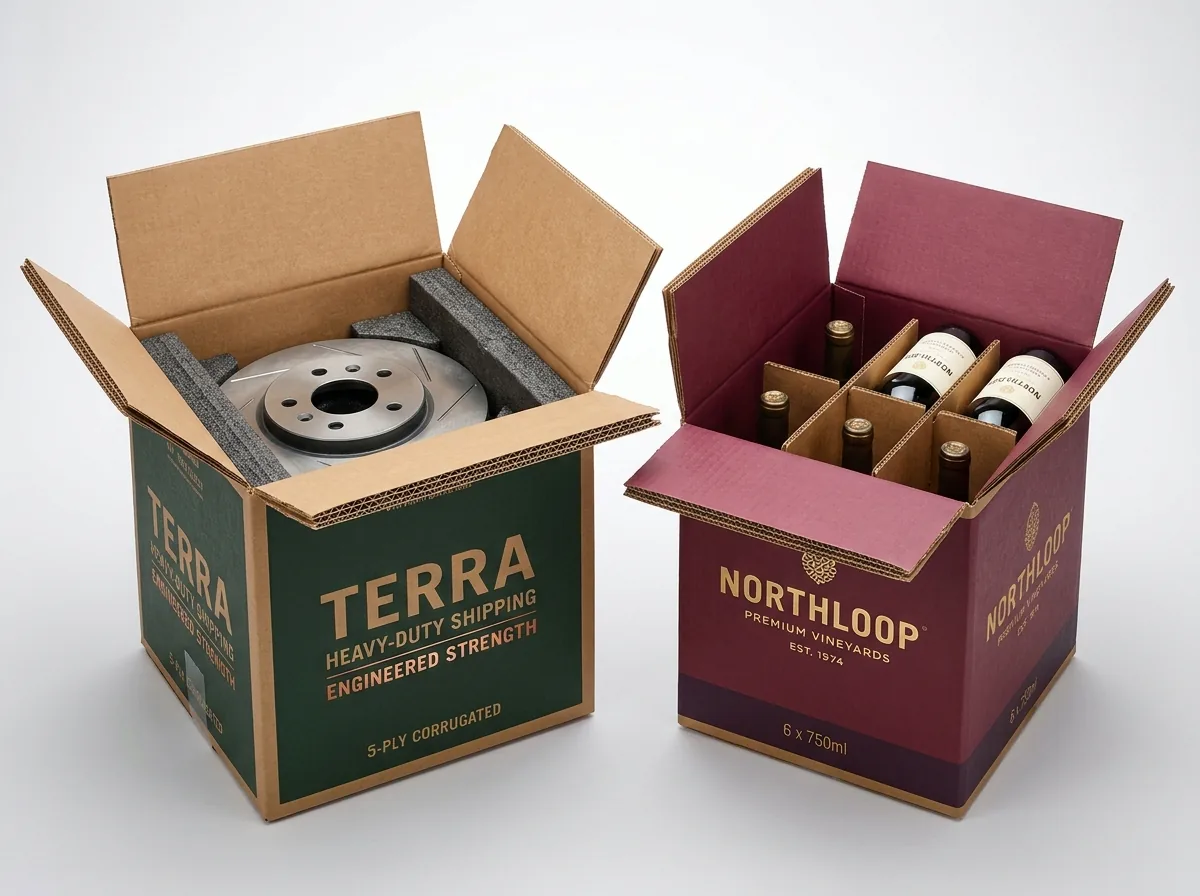
| Concentrated metal or cast-iron edges | Brake rotors & pot handles punch through 3 plies | 275# Mullen / 51 ECT + EPE foam stops point loads |
| 6-bottle & 12-bottle glass cases | Soggy cellar humidity & chute drops crack glass | 48–51 ECT walls + 2-ply cell partitions lock bottles |
| Stacked 4–6 tiers high on LTL pallets | Bottom-tier walls belly outward & topple pallet | 7 mm BC columns carry multi-hundred-pound static loads |
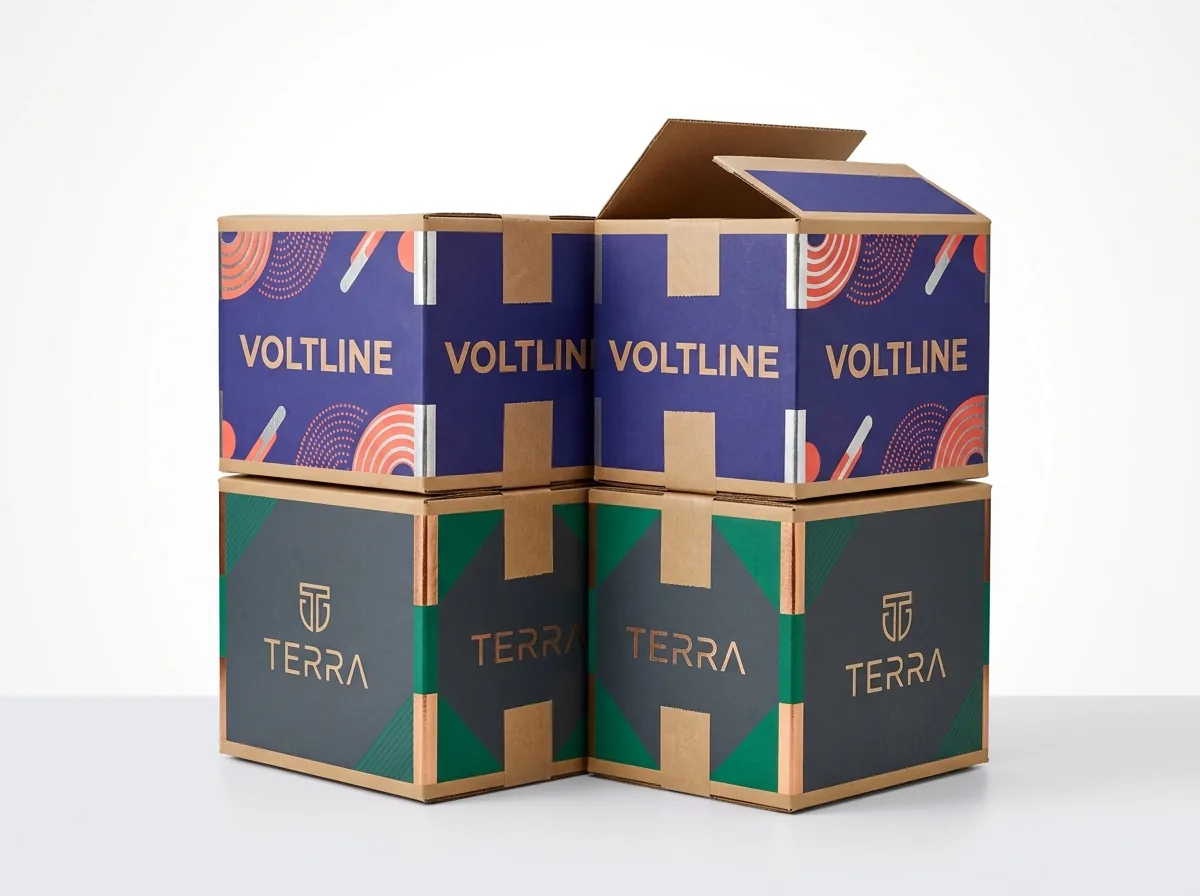
| Ships without an outer master overbox | Retail single-wall box arrives scuffed & dented | Litho-laminated EB double-wall ships SIOC cleanly |
How does 5-ply double-wall board affect KDF bundle storage and carrier DIM weight?
Switching from single-wall cartons to 5-ply double-wall shipping boxes changes two operational numbers on your fulfillment floor: how many flat blanks fit on an incoming storage pallet and how parcel carriers calculate dimensional weight. Many fulfillment directors hesitate to upgrade board caliper because they worry thicker walls will inflate UPS or FedEx zone rates, yet on dense payloads above 35 lb actual scale weight almost always governs the carrier invoice instead of cubic volume. Whether you ship custom auto parts boxes, custom tool boxes, custom hardware boxes, or custom sports equipment boxes, planning for 5-ply bundle height and cubic thresholds upfront keeps warehouse storage and freight budgets predictable
- Incoming KDF bundle thickness doubles: Because a folded flat Knocked-Down Flat (KDF) carton is two walls thick, one folded BC double-wall blank is roughly 14 mm (0.55 in) thick versus 8 mm (0.31 in) for C-flute single-wall. Expect 10 to 15 blanks per strapped bundle instead of 20 to 25, and plan pallet racking slots accordingly.
- Actual weight almost always beats DIM weight on heavy cargo: UPS and FedEx divide Exterior L × W × H by 139. A 16 × 12 × 12 inch inside double-wall carton (~17 × 13 × 13 inch outside) has a DIM weight of just 21 lb. If you pack 45 lb of cookware or wine inside, you pay the 45 lb actual scale weight regardless, so the extra 6 mm of wall thickness adds zero DIM surcharge.
- Zero wooden crating or double-boxing labor: Replacing two nested single-wall cartons with one right-sized 51 ECT double-wall RSC cuts corrugated fiber consumption, packing tape footage, void-fill waste, and packer touch time by 40 to 60 seconds per order.
- Compare self-locking styles for lighter kits: If your kit weighs under 25 lb and needs tape-free unboxing or custom carry handles rather than 5-ply pallet stacking, compare custom die-cut boxes and custom mailer boxes before over-specifying double-wall.
- Zero die or plate setup charges across every grade: Whether you run 3-ply single-wall for light accessories and 5-ply double-wall for heavy flagship hardware, CubitPack charges zero die or printing plate fees on both SKUs and ships flat bundles free across all 50 US states.
Know your size? Compare pricing across up to 3 quantities.
Request a Quote →Which corrugated shipper should your brand order for each SKU tier?
Use this four-tier fulfillment checklist alongside our guides on measuring and choosing ECT for double-wall boxes and double-wall box dielines, BC vs EB flutes, and H-taping to standardize your corrugated fleet without overspending on light items or risking transit breakage on heavy ones. Segmenting your catalog into distinct single-wall and double-wall weight brackets lets packers pull the exact board grade each SKU needs at the packing bench while keeping freight claims near zero across both ground parcel chutes and multi-tier LTL pallet lanes
- Tier 1 (Under 15 lb DTC & gift sets): Use E-flute or B-flute custom mailer boxes or self-locking custom die-cut boxes for fast tape-free assembly and clean interior branding.
- Tier 2 (15 to 35 lb non-fragile parcels): Use 32 ECT or 44 ECT C-flute single-wall custom shipping boxes for boxed apparel master packs, dry pantry goods, and soft home textiles.
- Tier 3 (35 to 85 lb dense, fragile, or retail-ready hardware): Step up to 48 ECT EB-flute (for high-graphic electronics and countertop appliances) or 48–51 ECT BC-flute custom double wall boxes paired with custom box inserts, EPE foam end-caps, or 12-cell bottle partitions.
- Tier 4 (65 to 120+ lb industrial freight & tall narrow frames): Specify 61+ ECT or 350# Mullen BC double-wall RSC or Full Overlap (FEFCO 0203 FOL) cartons sealed with 3-inch fiberglass-reinforced water-activated paper H-tape.
- Validate before scaling: Request CubitPack's $50 sample kit (credited toward your first order) or order a custom physical 5-ply prototype with engineered foam inserts to verify bench drop performance before full production.
What mistakes do brands make when choosing between single-wall and double-wall shippers?
Steer clear of these five packaging specification traps that drive freight damage claims and warehouse bottlenecks
- Relying on 32 ECT single-wall C-flute cartons for 45+ lb cast-iron, brake rotor, or 12-bottle wine shipments that burst corners on parcel chutes.
- Upgrading to 51 ECT double-wall walls while leaving heavy items loose inside the cavity without EPE foam end-caps, honeycomb blocks, or cell dividers.
- Assuming a thicker 5-ply wall triggers carrier DIM penalties on 40 to 80 lb shipments where actual scale weight already exceeds dimensional weight by 20+ lb.
- Forgetting to allocate extra pallet rack slots for incoming KDF double-wall bundles, which stack roughly twice as tall per 500 cartons as single-wall blanks.
- Using thin acrylic plastic tape instead of fiberglass-reinforced water-activated paper H-tape to hold stiff 5-ply major flaps shut in transit.
Packaging for this



Ready to order double wall boxes? Compare up to 3 quantities with a free 3D mockup.
Request a Quote →Questions about double wall boxes
Is 44 ECT single-wall corrugated board as strong as 48 ECT double-wall board?
While 44 ECT single-wall approaches 48 ECT double-wall in pure dry vertical edge compression, it still has only one fluted arch and no center divider linerboard. Double-wall 48 ECT delivers far superior side-impact puncture protection, deeper drop shock cushioning, and greater flexural stiffness against wall bowing.
When should I request a Full Overlap (FOL) double-wall carton instead of a standard RSC?
Choose Full Overlap (FEFCO 0203 FOL) when packing heavy, narrow-profile items such as framed mirrors, tabletop slabs, bicycles, or long metal shafts. Because both outer major flaps extend completely across the box width over one another, FOL creates double-thick 10-ply top and bottom armor.
Can custom double-wall boxes ship without an outer brown overbox (SIOC)?
Yes. Both direct-printed kraft BC-flute and litho-laminated white EB-flute double-wall boxes are widely engineered for Ships-In-Own-Container (SIOC) fulfillment, protecting heavy appliances, power tools, and cookware through parcel hubs while displaying bold retail graphics.
Are 5-ply double-wall corrugated boxes still 100% curbside recyclable?
Yes. All five paper plies (kraft or white liners and fluted mediums) plus cornstarch corrugating adhesive and reinforced paper H-tape repulp cleanly in standard municipal curbside bins and commercial warehouse cardboard balers.
Can we quote both single-wall and double-wall shipping boxes on the same order?
Yes. Many brands standardize on 32 ECT single-wall shipping boxes for light parcels and 48–51 ECT double-wall boxes for heavy master cases or flagship hardware. CubitPack charges zero die or plate setup fees on both and ships free across all 50 US states in 10–14 business days.
Still have a question? Ask a packaging specialist.
Request a Quote →Request your double wall boxes quote
Tell us your size and quantities, and one dedicated account manager prepares pricing for each tier.
- Free design & AI-to-print studio + 3D mockup
- No die or plate charges · 4–5 day rush available
- Free shipping to all 50 states
- 10% off your first order
We compared 5-ply double-wall RSC (FEFCO 0201), 3-ply single-wall RSC, and Full Overlap (FEFCO 0203 FOL) containers against Fibre Box Association (FBA) handbook specifications, humidity creep factors, carrier DIM weight formulas, and ISTA 3A/3B transit standards. Spot something wrong? Tell us and we fix it.
Sources
What changed
- November 5, 2026: First published with 6-point 5-ply vs 3-ply vs FOL matrix, 5 payload upgrade triggers, and KDF/DIM weight analysis.
More guides
New packaging guides by email
Sizes, materials and design tips. Unsubscribe anytime.