
How do you size custom subscription boxes for cubic shipping and fitted inserts?
Short answer: Always measure custom subscription boxes by usable interior Length × Width × Height (L × W × H) around your arranged assortment plus insert walls. Keep exterior volume (Outer L × W × H ÷ 1,728) just under a 0.10, 0.20, 0.30, or 0.40 cu ft USPS cubic bracket, and pick E-flute under 6 lb or B-flute above.
On this page
- How do usable inside L × W × H and rolled RETF walls affect USPS cubic tiers
- Should your monthly subscription box use E-flute (1/16 in) or B-flute (1/8 in) corrugated board
- How do you size inserts when your subscription assortment changes every month
- What is the 5-step bench test to finalize your subscription box dimensions
- Common mistakes
- FAQs
Request a custom quoteFree dieline & 3D mockup
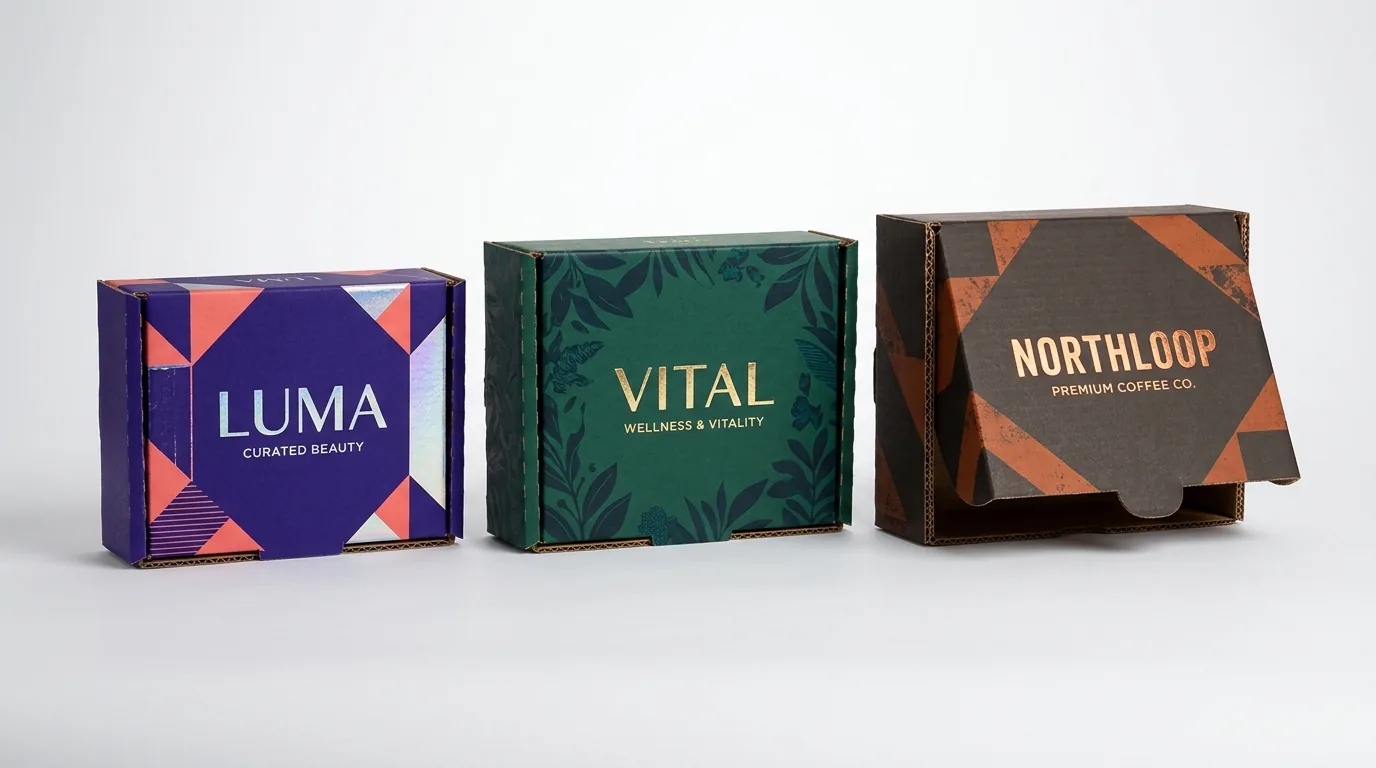
In a recurring membership business, trimming even half an inch off custom subscription boxes compounds across thousands of monthly renewals. Unlike one-off retail purchases where shipping is calculated once, subscription unit economics live or die by where your exterior box footprint lands on USPS Ground Advantage commercial cubic tiers and UPS or FedEx 139 dimensional (DIM) weight tables. At the same time, Roll End Tuck Front (FEFCO 0427) corrugated mailers fold double-thick side walls inward over floor locking slots, consuming 6 to 16 mm of exterior width. Quoting usable interior Length × Width × Height lets your products and inserts seat cleanly while keeping outside cubic volume tucked safely below the next carrier threshold. CubitPack engineers your exact subscription CAD dieline free of charge from 250 boxes, charges zero die or plate setup fees, and ships flat bundles free across all 50 US states.
How do usable inside L × W × H and rolled RETF walls affect USPS cubic tiers?
Carriers calculate cubic volume and dimensional weight strictly from Exterior Length × Exterior Width × Exterior Height measured at the widest bulge of the closed box. Under USPS Ground Advantage commercial cubic rules, parcels under 20 lb are billed in 0.10 cubic-foot increments calculated as (Outer L × Outer W × Outer H) ÷ 1,728. Because a Roll End Tuck Front subscription mailer folds two corrugated thicknesses on both side walls and along the front locking wall, exterior dimensions exceed usable interior cavity dimensions. Use the reference matrix below to match popular subscription footprints to their exterior cubic tier
- Watch the 0.01 cu ft cliff edge: A 10 × 8 × 4 inch inside B-flute box measures roughly 10.6 × 8.5 × 4.3 inches outside, or 0.224 cu ft, pushing it out of Tier 0.20 into Tier 0.30. Trimming inside height by just 3/8 inch to 3.625 inches drops exterior volume to 0.198 cu ft and locks in Tier 0.20 postage on every monthly renewal.
- Always quote Usable Inside L × W × H to prepress: Never subtract flute thickness yourself. Give CubitPack your required inside cavity dimensions and tell your specialist if you are targeting a strict exterior cubic ceiling.
- Keep longest exterior side under 18 inches: Exceeding 18 inches on any single edge disqualifies a parcel from standard cubic tiers and triggers zone-based dimensional rates.
| Subscription club archetype | Usable Inside L × W × H | Approx. Outer OD (E / B flute) | USPS Cubic Tier | UPS/FedEx 139 DIM |
|---|---|---|---|---|
| Beauty, serums & jewelry | 7.5 × 5.5 × 2.5 in | 7.9 × 5.8 × 2.7 in (E-flute) | Tier 0.10 (0.07 cu ft) | 1 lb DIM |
| Vitamins & wellness packs | 9.0 × 6.5 × 3.25 in | 9.4 × 6.8 × 3.5 in (E-flute) | Tier 0.20 (0.13 cu ft) | 2 lb DIM |
| 2–3 bag coffee & snack club | 10.0 × 8.0 × 4.0 in | 10.6 × 8.5 × 4.3 in (B-flute) | Tier 0.30 (0.22 cu ft) | 3 lb DIM |
| Pet treats, toys & book club | 11.5 × 9.0 × 4.25 in | 12.1 × 9.5 × 4.5 in (B-flute) | Tier 0.30 (0.30 cu ft) | 4 lb DIM |
| Apparel styling & VIP box | 13.5 × 10.5 × 4.5 in | 14.1 × 11.0 × 4.8 in (B-flute) | Tier 0.50 (0.43 cu ft) | 6 lb DIM |
Should your monthly subscription box use E-flute (1/16 in) or B-flute (1/8 in) corrugated board?
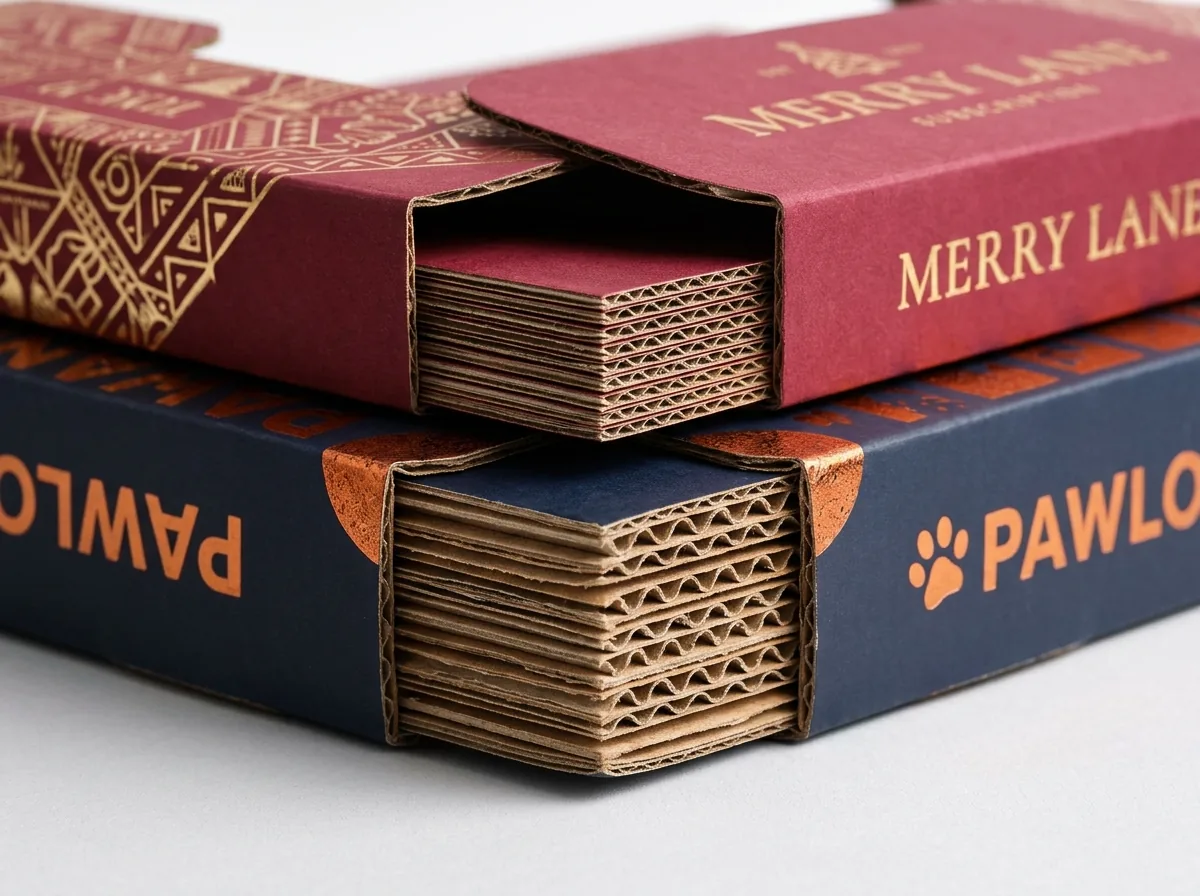
Flute height determines both how much exterior volume your rolled walls consume and how crisply fine typography, gradients, and metallic foils print across your lid. Virtually all DTC recurring clubs standardize on either slim 90-flute-per-foot E-flute or cushioned 47-flute-per-foot 32 ECT B-flute. When a box folds two side walls over themselves on a FEFCO 0427 template, thicker flutes double their wall buildup on both left and right edges, so choosing the slimmer flute that safely supports your payload directly protects your carrier cubic bracket. Compare both corrugated options across kit weight, wall buildup, warehouse pallet storage, and unboxing feel
| Selection factor | E-Flute (~1.6 mm / 1/16 in) | B-Flute (~3.2 mm / 1/8 in, 32 ECT) |
|---|---|---|
| Rolled-wall width buildup | +7 to +9 mm (+0.31 in) total outer L | +13 to +16 mm (+0.58 in) total outer L |
| Exterior & interior print look | Ultra-smooth, near-folding-carton sharpness | Classic sturdy corrugated texture, minimal washboard |
| Recommended kit weight | 0.5 to 6 lb curated assortments | 4 to 18 lb multi-item & glass-jar kits |
| Flat KDF storage density | ~3.2 mm flat blank (twice as many per rack) | ~6.4 mm flat blank (standard pallet stack) |
| Ideal subscription verticals | Cosmetics, serums, supplements, stationery | Coffee roasters, snacks, pet toys, apparel, meal kits |
How do you size inserts when your subscription assortment changes every month?
Membership programs fall into two operational models: replenishment subscriptions (which ship the exact same jar or pouch geometry every 30 days) and discovery curations (which ship 4 to 7 brand-new shapes every month). Designing the right interior staging system for printed corrugated subscription mailers keeps items from colliding across custom supplement boxes, custom cosmetic boxes, custom coffee boxes, custom pet treat boxes, and custom snack boxes without forcing a new box dieline every cycle
- Replenishment clubs: Engineer a precision die-cut card or EVA/EPE foam tray with +1.5 mm slip clearance on paperboard or -0.5 mm snug friction fit on foam around each bottle, tin, or refill pouch, leaving a 15 mm finger notch so subscribers lift bottles effortlessly.
- Rotating monthly discovery boxes: Size your master RETF cavity around your largest quarterly combination (for example, 10 × 8 × 3.75 in), then pair it with slotted movable card dividers or a 1-inch bed of crinkle paper topped by custom-printed tissue paper.
- Leave 4 to 6 mm of vertical headspace for welcome booklets: Monthly recipe cards, zines, and folded tissue layers sit between the product tops and the closed lid; zero vertical clearance makes the hinged lid bow upward and pop its cherry-lock ears.
- Anchor heavy glass items at the rear hinge wall: Place your heaviest candle jar, olive oil bottle, or serum nearest the back hinge spine and lighter pouches toward the front locking wall so box balance feels natural when lifted.
- Test drop survivability with worst-case mixes: Pair fragile glass months with custom box inserts or custom eva foam inserts that hold at least 12 mm of air-cell or foam buffer from every outer corrugated wall.
Know your size? Compare pricing across up to 3 quantities.
Request a Quote →What is the 5-step bench test to finalize your subscription box dimensions?
Follow this five-step bench workflow alongside our companion guides on custom subscription boxes vs standard mailers, poly mailers, and RSC shippers and subscription box inside printing, dielines, and unboxing retention. Spending ten minutes mocking up three months of real assortments before ordering your first 250-box run guarantees smooth fulfillment bench packing and predictable carrier invoices all year
- Step 1: Lay out three representative monthly curations (your lightest month, average month, and bulkiest holiday edition) flat on a table in a tight grid rather than a single tall stack, keeping total height under 4.5 inches wherever possible.
- Step 2: Add internal divider walls (12 to 15 mm buffer per foam or air-cell border) plus +4 mm horizontal slip margin and +5 mm vertical booklet/tissue headspace to lock in your usable Inside Length × Width × Height.
- Step 3: Estimate exterior dimensions (+0.35 in L, +0.25 in W, +0.25 in H for E-flute; +0.60 in L, +0.45 in W, +0.35 in H for B-flute) and multiply Outer L × W × H ÷ 1,728 to confirm you sit safely inside your target 0.10, 0.20, 0.30, or 0.40 USPS cubic tier.
- Step 4: Select E-flute (1/16 in) white or kraft corrugated for compact under-6-lb beauty and supplement clubs, or 32 ECT B-flute (1/8 in) for heavier multi-bag coffee, snack, meal-kit, pet, and apparel memberships.
- Step 5: Enter your usable inside L × W × H into CubitPack's shared quote form (minimum 250 boxes); prepress builds your exact FEFCO 0427 CAD dieline free of charge with zero die or plate setup fees, delivers a 3D mockup before payment, and offers a $50 sample kit credited toward your first order.

What sizing mistakes drain recurring subscription box margins?
Audit your draft dimensions against these five common subscription mailer sizing traps before locking in your dieline
- Ignoring exterior rolled-wall buildup so a box meant for USPS Cubic Tier 0.20 measures 0.21 cu ft outside and bills at Tier 0.30 on every single subscriber shipment.
- Ordering a tall 6-inch-deep cube for flat pouches and bottles that could lie side-by-side in a sleek 3.5-inch-tall stage layout with lower DIM weight.
- Quoting outside mailer measurements instead of usable inside L × W × H, pinching rigid supplement bottles or coffee bags between rolled double side walls.
- Forgetting vertical clearance for folded custom tissue paper and monthly story booklets, causing front cherry-lock ears to bulge open in postal sorting.
- Cutting fixed foam cavities for a discovery box whose product shapes change every 30 days instead of using modular card dividers.
Packaging for this

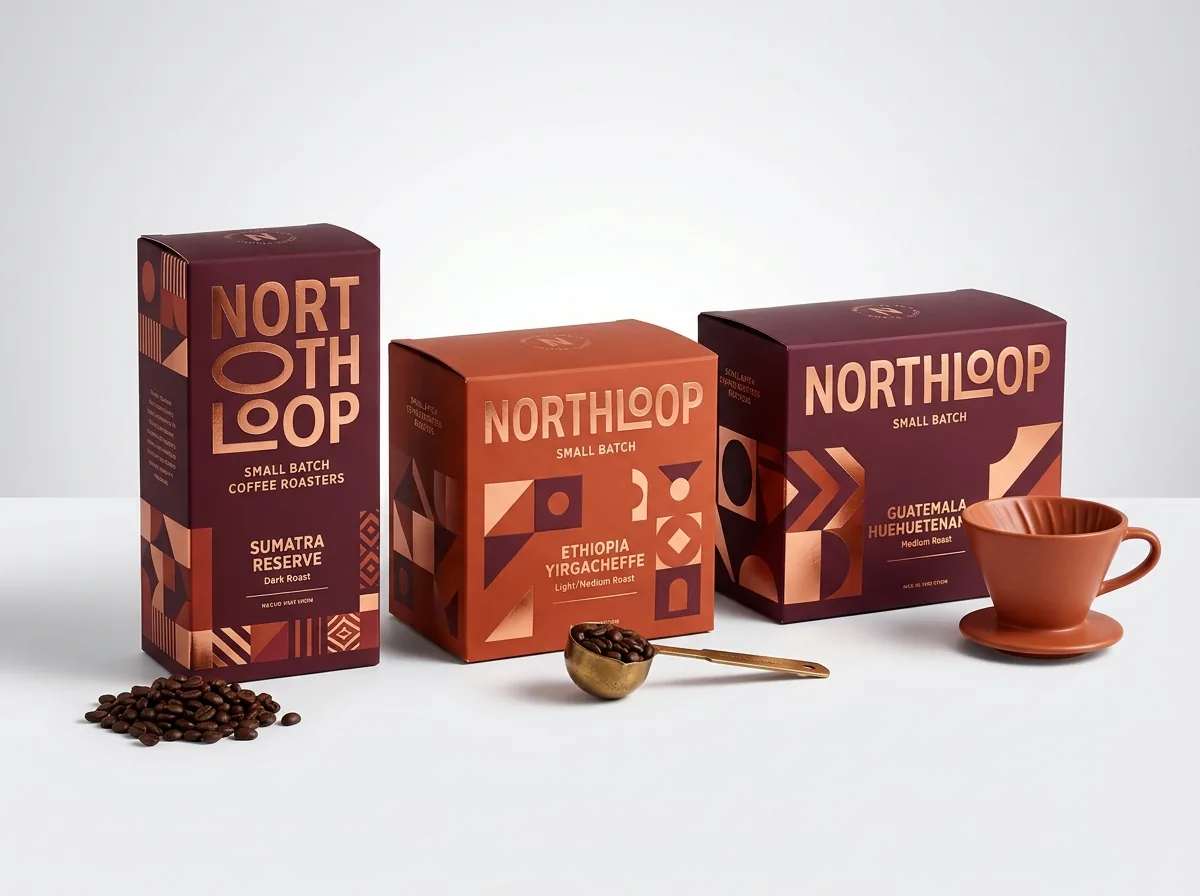
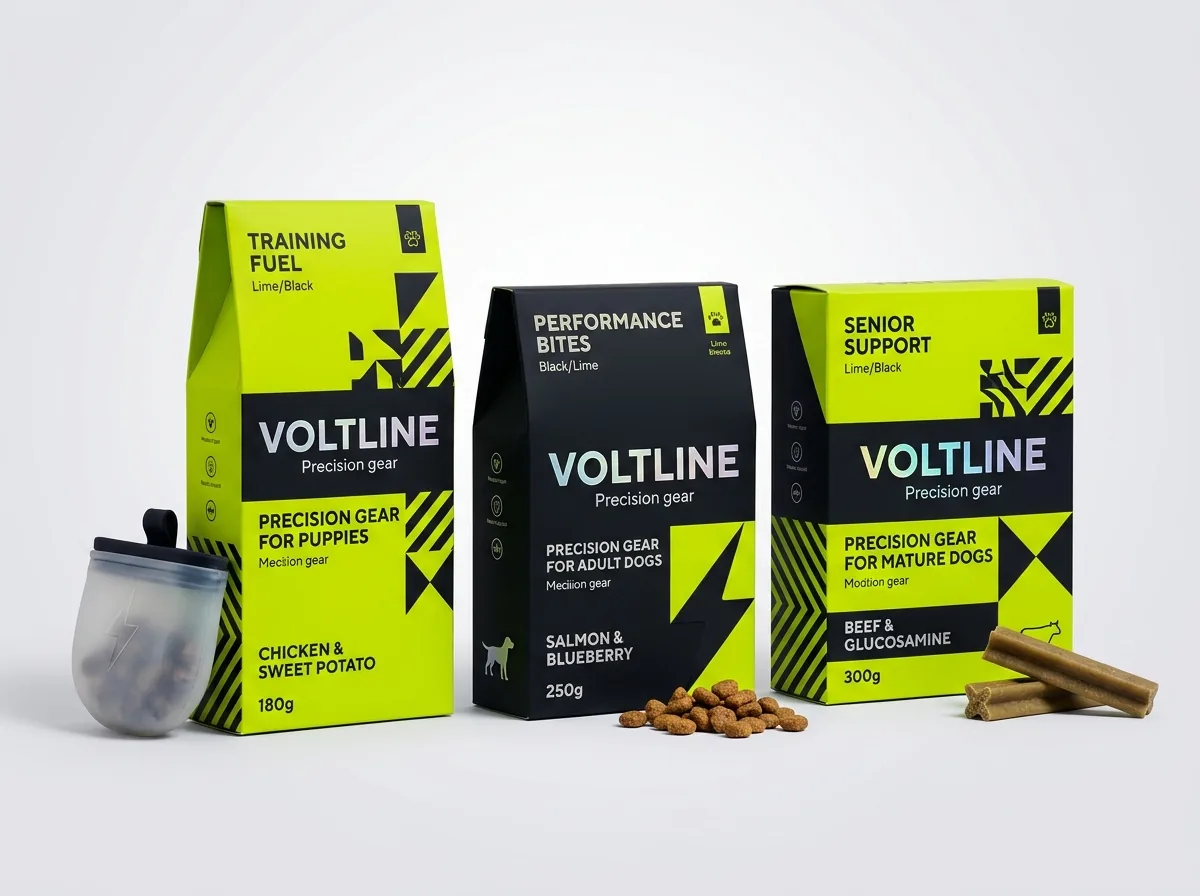
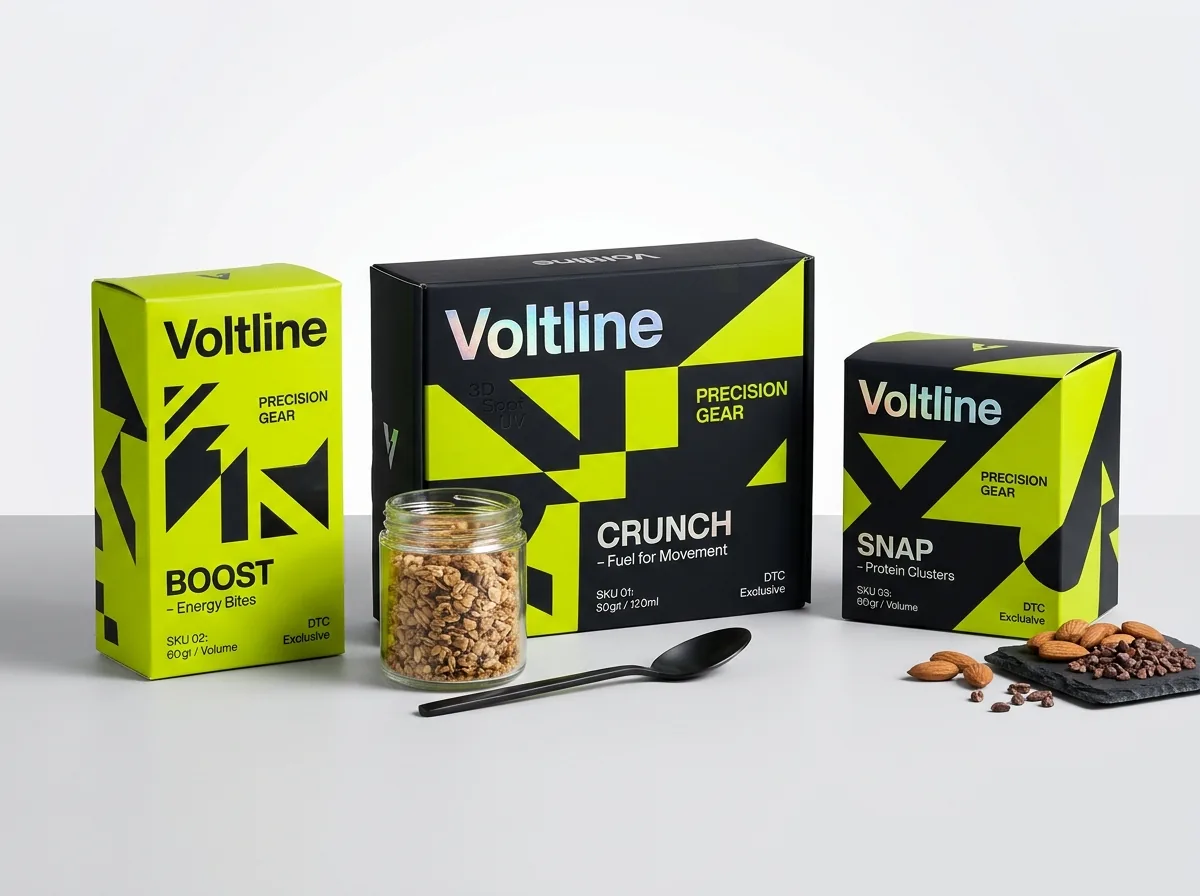
Ready to order subscription boxes? Compare up to 3 quantities with a free 3D mockup.
Request a Quote →Questions about subscription boxes
Do I enter inside or outside dimensions in the CubitPack subscription box quote form?
Always enter your usable interior Length × Width × Height (in inches) inside the assembled mailer tray. Our structural team automatically adds the exact E-flute or B-flute rolled-wall crease take-up, dust-flap clearances, and cherry-lock slot tolerances onto your free CAD dieline, and can confirm exact exterior cubic volume before you approve.
What is the most popular all-around custom subscription box size?
Across beauty, coffee, wellness, and lifestyle clubs, 9 × 6 × 3 in (compact Tier 0.20) and 10 × 8 × 3.75 in (versatile Tier 0.20/0.30 boundary) are two of the most widely ordered footprints because they frame 3 to 6 full-size items cleanly while fitting standard residential mailboxes and parcel lockers.
Can we order two box sizes (such as Starter and Deluxe tiers) starting at 250 units?
Yes. Each custom size starts at a 250-box minimum with zero die or printing plate setup charges, making it straightforward to run a compact monthly replenishment mailer alongside a larger quarterly VIP box.
How do I verify my products fit inside the mailer and insert before printing 250+ boxes?
CubitPack provides a free 2D vector CAD dieline and interactive 3D digital mockup before payment, offers our $50 material & finish sample kit (credited toward your first order), and can produce a custom physical pre-production prototype built to your exact dimensions.
How fast do custom-sized subscription boxes ship and how much warehouse space do they need?
Standard turnaround is 10–14 business days (with 4–5 business day rush available) and free shipping across all 50 US states. Because RETF subscription mailers arrive knocked-down flat (KDF), 250 E-flute blanks stack under 3 feet tall on a single shelf.
Still have a question? Ask a packaging specialist.
Request a Quote →Request your subscription boxes quote
Tell us your size and quantities, and one dedicated account manager prepares pricing for each tier.
- Free design & AI-to-print studio + 3D mockup
- No die or plate charges · 4–5 day rush available
- Free shipping to all 50 states
- 10% off your first order
We verified usable interior Length × Width × Height conventions, E-flute (1.6 mm) and B-flute (3.2 mm) rolled-wall buildup, USPS Ground Advantage cubic tier volume formulas (L × W × H ÷ 1,728), and UPS/FedEx 139 DIM divisors against FEFCO 0427 codes, Fibre Box Association (FBA) corrugated handbooks, and USPS Domestic Mail Manual standards. Spot something wrong? Tell us and we fix it.
Sources
What changed
- November 5, 2026: First published with 5-tier USPS cubic & 139 DIM subscription sizing matrix, E-flute vs B-flute comparison, and rotating insert clearance rules.
More guides
New packaging guides by email
Sizes, materials and design tips. Unsubscribe anytime.